How to Create an eCommerce Store?: Step-by-Step Guide

The foundation of the e-commerce business which we all are witnessing reaching new heights was laid back in 1969 by an American e-commerce company CompuServe. However, in 1995, when the launch of two major e-commerce companies Amazon and eBay took place it started to gain more global recognition and acceptance.

Since that day, the e-commerce sector has gone through many highs and lows. From initial weak response from the public to sky-scorching popularity it has seen it all. With around $6.3 trillion in retail sales, the e-commerce business has now, acquired approx. 20% of total retail sales worldwide.

This clearly indicates the growing desire or we can say the need of people to buy online. To take advantage of this growing public demand, building an e-commerce store is the wisest decision. But the question is how to build an e-commerce store that engages people and drives you to profit.

Well, as a leading e-commerce web development company, we have accumulated years of experience developing e-commerce stores to this guide. It will assist you with every piece of information you need to know to develop an excellent e-commerce store. Hence, let’s delve deep into the world of e-commerce and navigate a path to success.

A Step-by-Step Guide to Build e-Commerce Store

1. Determine Your e-commerce Business Model

It’s essential to establish your business concept before you start developing your online store. Your e-commerce business model specifies how you will operate, engage with customers, and ultimately sell your goods or services. When creating an e-commerce business strategy, keep the following things in mind:

Business-to-consumer (B2C): This is the most typical model, in which a company sells goods or services to customers.

Business-to-business (B2B): In this model, companies sell goods or services to other companies.

Customer-to-customer (C2C): This model is also referred to as online marketplaces that link consumers to traders and sell goods or services.

Customer-to-business (C2B): Here, individuals sell their products or services to various businesses.

Once you choose your desired business model, consider sales and marketing strategies for your products and services. Here are a few suggestions for it:

Direct-to-consumer (D2C): Sell your own products to customers directly, bypassing wholesalers and retailers. With this approach, you have more influence over how customers interact with your brand and how your brand is presented to them.

Drop shipping: Dropshipping involves partnering with suppliers who handle inventory and fulfilment. When a customer places an order on your e-commerce store, the supplier ships the product directly to the customer, eliminating the need for you to hold inventory. Additionally, Dropshipping also offers a multi-payment acceptance facility. Hence, it’s simple and affordable to launch a drop shipping business. Besides, Shopify dropshipping store development is much easier than developing a regular online store.

Print on demand products: The print-on-demand products business model is similar to dropshipping. It involves creating custom designs that are printed on various products such as t-shirts, mugs, or phone cases. When a customer places an order, the printing and fulfillment are outsourced to a supplier, who ships the finished product directly to the customer. This allows you to offer unique, personalized products without holding inventory.

Wholesaling: Purchase things in bulk from manufacturers and resell them in huge quantities at a discount to retailers or other businesses. Retailers then resell these products to end users.

White label: White-label products are manufactured by one company and marketed under a separate company’s name. In this case, your online store would buy products from a manufacturer and sell them under your brand name.

Private label: Employ a manufacturer to make a product that will only be available through you. In this case, you have more control over the product’s characteristics, packaging, and design.

Subscription: The subscription model provides products or services on an ongoing basis. Customers may receive ongoing services, access to premium content, or recurrent deliveries. For example, you may supply products like milk or fresh vegetable boxes on a weekly or monthly basis to regular clients who value convenience.

Bonus Tip: When you define your e-commerce business model, take time to analyze your target audience, industry trends, and competitive landscape. Understanding these factors will help you choose the most suitable model that aligns with your goals and ensures a successful e-commerce venture.

Remember, your e-commerce business model will influence various aspects of your store. (For ex. product sourcing, marketing strategies, pricing, and customer interactions.) Hence, careful consideration and research at this stage will set a strong foundation for your e-commerce journey.

2. Discover The Perfect Product To Sell

Once you’ve established your e-commerce business model, the next critical step is to find the ideal product to sell on your online store. Your e-commerce business’s success depends on picking the right product or market segment. Here are some key factors to consider while selecting the best products to sell on your online store:

Find Your Niche: Start by identifying a niche or a specific segment of the market that you are passionate about or have expertise in. A niche allows you to focus on a particular category of products or services. This makes it easier to target a specific audience and help you stand out from competitors.

Do Market Research: The next step is to conduct extensive market research to have a complete understanding of current trends, customer preferences, and demands. Then analyze all this information to know the desires and issues of your target market. Consider offering digital products, such as ebooks, music files, online courses, or images, which are well-suited for online sales and do not require physical shipping. And established products or services that can solve their issues or satisfy their needs.

Analyzing Your Competitors: Another most important thing to do is to research your rivals in both your niche and the whole e-commerce sector. Look for market gaps or places where you may provide a unique selling proposition (USP) to set your items apart from the competition.

Make Product Validation: The next important thing to consider before finalizing a particular product is to test selling that product on a small scale or by starting a pilot project to determine its likelihood of success. This will assist you in determining client interest and obtaining insightful feedback.

Consider Seasonality: Seasonality is one of the key things to consider before deciding on a particular product. Hence, depending on your product’s characteristics, think about how seasonal trends may affect your product. Because to ensure a regular flow of sales, you need to make sure that the demand for the product you have chosen is steady throughout the year.

Emphasizes Quality and Reliability: Now, pick products that are of excellent quality and obtained from dependable vendors. As building a loyal customer base depends on providing satisfying customer experiences and quality products.

Think About Scalability: When you are going to start selling particular products, you will find that process quite adventurous. However, during this product-selling process, you should always think about how your e-commerce store will grow by selling your products. So, consider how you might increase the range of your product offerings in the future to serve a larger clientele. Introducing and promoting new products regularly is important to meet market demand and keep your store aligned with the latest trends.

Keep Up with the Latest Trends: To make sure that your chosen product remains relevant over the long term, keep up with current market trends and project future demand.

Finally, it would help if you remember that selecting the ideal product to sell is a dynamic process that necessitates careful evaluation and deliberation. Thus, think about all of your alternatives carefully, and only make judgements after doing extensive research.

3. Determine The Prices Of Your Products

The third important step is to determine the prices of your product. Because the success of your e-commerce store depends on how well you price your products. Thus, calculate all costs associated with production or sourcing, including both direct costs (such as manufacturing and packing) and indirect costs (such as marketing and website upkeep).

Next, to understand market prices and position your items competitively, conduct a competitive study. Strike a balance between profitability and competitive pricing by taking into account the special value your items provide to clients.

Last, test several price points to find the best one. Then plan sporadic discounts and promotions on your product. However, before offering discounts and promotions make sure they don’t affect your profitability. To stay on top of market developments and uphold a successful pricing strategy, keep a close eye on performance and make necessary price adjustments.

Many new sellers ask, “How much does it cost to start selling products online?” When pricing your products, be sure to account for all associated costs, including setup, ongoing expenses, and any additional fees.

4. Research Your Shipping Costs And Options

Once you decide on your product pricing, the next important thing to consider is your product shipping options and their costs.

Because efficient shipping has a significant impact on consumer satisfaction and purchasing behaviour, it is essential in e-commerce. Thus, determine the cost of shipping considering the product’s weight, size, shipping distance, and carriers. To encourage customers, think about providing free shipping beyond a specific order threshold.

When evaluating shipping options, consider offering a flat rate shipping fee as a simple and predictable choice for customers.

Then investigate several shipping companies and services, evaluating aspects like responsiveness, dependability, and global reach. Use real-time shipping rate estimators to show customers accurate, live shipping prices during the checkout process by integrating real time shipping rates from carriers.

While doing all these, keep in mind customs laws and additional expenses when providing international shipping. Additionally, improves the packing for secure delivery and lowers shipping costs.

And last, for improved customer communication, provide shipping tracking information and order status updates. As well as Create a simple returns procedure to increase consumer loyalty and confidence. As a well-thought-out shipping strategy boosts the performance and consumer experience of your e-commerce store.

5. Decide a Brand Name, Choose a Hosting Provider & Purchase a Domain

Choosing the ideal brand name can completely transform your e-commerce business. However, it ought to be distinctive, memorable, and represent the products or services you offer.

Once you choose a brand name, your next task is to decide on a domain. Look for a hosting company that can supply your store with the dependability and speed it requires. Many hosting providers and website builders include a free domain or free domain name for the first year as part of their package, making it easier and more affordable to launch your online store. GoDaddy is a popular option for budding e-commerce business owners due to its reasonable plans and consistent support. They offer an all-in-one hosting solution and even make the process of purchasing a domain name simple. Additionally, some platforms allow you to sign up and get started with no credit card required, so you can explore their features risk-free before making a commitment.

However, keep in mind that your domain name should reflect your brand and be simple for clients to recall. If you get this trio perfect, your online store will start off strong.

6. Find Your Perfect E-commerce Website Builder

Selecting the ideal ecommerce platform is essential if you want to create your own online store. An ecommerce platform is a comprehensive solution that combines website building, sales channel integration, payment processing, and more. These platforms are built on a content management system (CMS), which serves as the foundational technology for building and managing your ecommerce website. Many ecommerce platforms also offer a free trial period, allowing you to test features before making any commitments. Here is a brief summary of some well-liked options for ecommerce platforms:

WooCommerce: WooCommerce is an open-source plugin for WordPress that allows for a great deal of customization. It allows you to establish a highly customised store, making it perfect for individuals with some technological know-how. Besides, considering the popularity of WordPress, you can easily find any Custom WordPress Development Company to help you build an e-commerce store to your liking.

Magento: If you want to scale, Magento is the best option. It’s ideal for growth because it has excellent features and flexibility. Despite requiring considerable technical know-how, it offers a wide range of customization options and third-party integrations.

Shopify & Square Online: Looking for a simple setup process? The solution is Shopify or Square Online. Both are all-in-one ecommerce platforms that serve both novices and specialists and are renowned for their user-friendly design, vast template library, and hosting options. To accommodate varying business needs, they provide multiple pricing tiers and often include a free trial so you can explore their features risk-free.

Customization, spending capacity, and technical proficiency are all important considerations when choosing a platform. To choose which is the greatest option for the success of your online store, compare their features, costs, and customer support.

7. Find a Skilled e-Commerce Developer

As your online business takes shape, think about hiring a qualified e-commerce developer.

A skilled developer can make final adjustments to your e-commerce website to make sure it runs smoothly and effectively.

Depending on the website builder you choose, Hire web developers with experience in e-commerce systems like WooCommerce, Shopify, or Magento. To evaluate their talents, look through their portfolio for prior e-commerce projects, client testimonials, and reviews.

Working with an experienced developer can help you save time, improve the performance of your online store, and handle technical difficulties successfully. Besides, it also enables you to concentrate on expanding your online store and improving the client experience.

8. Select an E-commerce Theme or Template

Now comes the exciting part: choosing the ideal e-commerce theme or template for the store design of your online shop. Store design is crucial, as the right theme not only complements your brand’s image but also improves the presentation of your products.

Many website builders have a large selection of pre-designed themes that you may modify to fit your preferences in terms of colours, fonts, and layouts. Paid or premium themes often come with more features, better design options, and easier customization, which can enhance your website’s functionality and appearance. To give clients a great browsing experience across devices, look for mobile responsiveness and user-friendly navigation.

Make sure the theme you choose is compatible with crucial e-commerce features like product galleries, shopping carts, and secure payment processors. With a well-selected theme, your e-commerce site will look polished and professional, paving the path for its success in the online market.

9. Customize Your E-commerce Site and Build Out Web Pages

Now that the structure is established, it’s time to customize your e-commerce site to give it a distinctive look.

You may begin personalizing your online store by making a customized design and selecting the proper color palette and layout that go with your brand identity.

These days, a lot of website builders provide simple customization options that enable you to tailor your store without any coding experience.

Therefore, when you begin customizing, don’t forget to develop and customize important web pages like the homepage, product pages, about us, contact us and FAQs. As part of this process, organize your product catalog to effectively showcase your products and improve your search engine ranking.

Following that, create captivating content that shows the benefits of your products and resonates with your target audience. After that, put in place easy-to-use navigation so that clients can find what they’re looking for.

Moreover, remember to make your website mobile-friendly to accommodate customers who are constantly on their mobile devices.

A well-customized website improves the purchasing experience and promotes return visits.

10. Add Necessary Plugins/Extensions/Apps

After customisation, your e-commerce store’s functionality should be improved. To do this, explore the world of plugins, extensions, and apps. There are a variety of add-ons available to improve the functionality of your site, depending on your website builder.

Integrate necessary plugins for analytics, social media integration, SEO optimization, and seo tools. Seo tools are essential for optimizing your website for search engines and tracking performance, helping you get discovered and analyze traffic and keywords directly from your dashboard. Additionally, to engage and delight your consumers, think about including facilities like live chat, client feedback, and a wishlist.

Also, don’t forget to include security plugins to secure client data from cyber threats.

However, before you install any plugins, make sure they are compatible with your website builder and will not slow down or degrade the user experience of your site.

Because a well-chosen selection of plugins can elevate your online store and provide clients with a seamless purchasing experience.

11. Secure Your E-commerce Store Using SSL And Install Backup Services

Security holds the greatest significance for any online store. Thus, to secure your online store, install an SSL (Secure Socket Layer) certificate. As it plays a pivotal role in protecting the confidential data of your customers.

SSL encrypts data while it is being transmitted, guaranteeing secure online transactions and fostering customer confidence. Most website builders make it simple to include SSL certificates for additional security.

Also, don’t underestimate the significance of regular backups. Install backup services to make sure that the data on your online store, including product details, customer information, and order history, is securely maintained.

Backups act as a lifeline in the event of a technical malfunction or data loss, allowing you to quickly recover your online store. Therefore, to safeguard the integrity of your e-commerce store, invest in reliable backup services or make use of built-in features provided by your website builder.

Knowing how well your store is performing is essential for its expansion since knowledge is power. Therefore, incorporate Google Analytics into your online store. It is a strong tool that offers insightful data on user behavior and website traffic.

By connecting your store to Google Analytics, you can track important data such as conversion rates, bounce rates, and popular product pages. Analyzing this data and user activity will assist you in optimizing your marketing strategy and improving the user experience.

Additionally, Google Analytics also offers e-commerce tracking. It allows you to keep track of sales, revenue, and other transaction-related statistics. With this knowledge, you can make data-driven decisions to improve the operation of your online store and boost its success in the cutthroat online market.

13. Configure an Inventory, Payment Gateway, and Tax Tools

Now at this point, your e-commerce store is almost ready to roll. But first, let’s make sure that inventory is managed effectively and transactions are seamless. Start by adding products to your store’s inventory, ensuring each item is accurately listed and categorized. And for smooth online transactions, install a trustworthy payment gateway and connect a payment processor that safely handles client payments, enabling efficient payment processing.

Popular choices like PayPal, Stripe, or Square improve customer confidence in your store by offering easy interfaces and supporting a variety of payment ways.

Following that, use inventory management software to keep track of product availability. They will handle product variations with ease and control your inventory while setting stock alerts. Make sure to maintain and sync customer data across all your sales channels for better inventory management and personalized marketing. A well-managed inventory guarantees prompt replenishment and eliminates overselling, which boosts customer satisfaction.

Lastly, remember to pay your taxes! Configure tax calculators to automatically determine and apply the proper tax rates on purchases based on your location and customer base. Stay compliant and save time by automating tax calculations, leaving you more room to focus on growing your business. Automating tax computations will help you stay compliant and save time, giving you more time to concentrate on expanding your e-commerce store.

14. Test and Launch Your E-Commerce Site

You’re almost there; now is the time to test your e-commerce site ahead of launching. Thoroughly test your website in all areas, including the contact forms, payment process, and product listings. Verify that all functions are working properly and that there are no broken links or formatting errors.

Make several test purchases to validate the payment procedure and ensure that customer orders are properly processed. To get feedback on the user experience and identify any potential problems, enlist the assistance of friends or relatives.

Once you’ve made the necessary changes and are confident in your store’s performance, you can proceed with officially launching your site. Use social media, email newsletters, and advertising efforts to spread the message.

And last, celebrate this achievement and look forward to the exciting road of running your e-commerce store. Success will come as a result if you continue to pay attention to customer feedback and look for ways to make your online store run more efficiently.

15. Begin Promoting Your E-commerce Website

Congratulations on opening your online store! It’s now time to spread the word and get customers to your online store. To do this and successfully sell online, put in place a comprehensive marketing strategy to increase visitors and sales.

Make use of social media networks to provide interesting content and promote your products or offer services. Social media platforms are an ideal platform to interact with your audience, address their inquiries, and develop a loyal following.

You can also use created email marketing campaigns to keep clients up to date on new items, discounts, and promotions. Because timely and customized emails often persuade customers to make repeat purchases.

Additionally, work with influencers or industry partners to reach a larger audience and attract new customers. Influencer collaborations and endorsements can generate buzz for your business.

Furthermore, invest in search engine optimization (SEO) to boost your website’s visibility on search engines and increase organic traffic. Use relevant keywords and optimize your product descriptions to appear higher in search results. Link building and outreach can further establish your site as an authoritative source.

Next, think about implementing loyalty programs, seasonal price reductions, or special offers to entice people to visit your online store again. Satisfied clients are more likely to recommend businesses to others and help them succeed in the long run.

To reach a larger audience and drive more sales, consider using paid ads on platforms like Google, Facebook, Instagram, or TikTok. Customize your adverts to appeal to certain demographics and interests. Created paid ads campaigns can help you target new customers and boost your store’s visibility.

And don’t forget to review website analytics on a regular basis in order to evaluate the success of your marketing initiatives and make fact-based judgments. Understanding your audience and their behavior can help you convert visitors into buyers, leading to more sales.

Because promoting your e-commerce website is an ongoing process. Therefore, to maintain your online store flourishing and expanding, always try out new marketing techniques, pay attention to client feedback, and adjust to industry trends. With dedication and persistence, your e-commerce venture is sure to flourish in the competitive digital landscape.

What are the Benefits of Selling Online and to Create Own Online Store?

Developing an E-commerce store is a fantastic method to expand your consumer base and diversify your customer channels.

Selling online is also a terrific strategy to enhance income because you may reach a broader audience than through traditional retail techniques.

statistics show that there are 268 million digital consumers in the United States, and this figure is anticipated to rise to 285 million soon. There is no question that you must be online if you want to reach a sizable customer base.

In addition to accessing a larger audience, online stores provide numerous other advantages, such as:

  • 24×7 accessibility: Customers may view products at any time, regardless of their time zone.
  • There are no restrictions based on location: Customers are able to buy from any part of the world.
  • Product selection: Compared to traditional retail establishments, e-commerce stores frequently have a far wider range of products available.
  • Customized shopping: Customers can shop based on their own requirements and individual tastes.
  • Direct-to-consumer sales channels: You may minimize costs for both you and your customers by doing business online and cutting out middlemen.
  • Faster reaction to market demands: Because e-commerce storefronts are digital, e-commerce proprietors can update their stores considerably more quickly in response to consumer demands and desires.

Ecommerce websites are highly versatile online platforms that can be tailored for various types of online stores, such as dropshipping, print-on-demand, or selling digital products. They often include features like free domain options, secure shopping carts, and support for multiple payment gateways, making them suitable for businesses of all sizes.

A quality e-commerce website offers more than just a platform to buy and sell products. It’s where a company can design an encounter that builds brand equity, attracts new clients, and turns occasional customers into ardent advocates.

Choosing the correct ecommerce platform is key to building a successful online store, as a feature-rich ecommerce platform supports multiple sales channels, social media integrations, and various payment options to help your business grow. Developing a marketing strategy to launch a successful online store can put you ahead of the competition.

If you require assistance in developing an e-commerce store, you can seek assistance from a professional e-commerce web development company.

As a reputable e-commerce web development company, Windzoon offers top-notch e-commerce website development services at the most economical rates and with the quickest turnaround times. Our expert developers can construct one-of-a-kind e-commerce web solutions tailored to your company’s needs.

Contact us to and more information about our e-commerce store creation services.

Know the Best Angular SEO Practices to Build Amazing Web Apps

Do you know? What is the common aspect in popular web apps like Netflix, PayPal, UpWorks and WikiWands? Yes, these web apps have been built using Angular. It is a popular JavaScript framework developed by Google and used by around 3,28,839 web apps.

However, is this the only reason why those web apps are popular in the digital landscape? Certainly not. To be successful on search engine result pages (SERPs), proper utilisation of SEO (Search Engine Optimization) (also known as search engine optimization seo) techniques is crucial. Because according to data, organic traffic is responsible for 53% of a website’s traffic.

But, much like any other JavaScript framework, Angular creates dynamic content on the client, not on the server side. As a result, search engine crawlers could require assistance to accurately analyse and index your web pages, which could result in lower rankings in search results. These are some of the seo challenges faced by Angular applications, especially due to client-side rendering and dynamic content.

You may avoid these drawbacks by implementing a few Angular SEO practices in your web app. As the best SEO company in India and the USA, we have listed some top Angular SEO tips in this blog to assist you. Using these techniques to optimize your Angular web app will significantly increase its position on SERPs. It is also important to ensure your Angular app is accessible and user-friendly for mobile devices, as a large portion of users access websites through smartphones and tablets.

Thus, let’s start our discussion with the very first question:

What does SEO mean in Angular?

SEO in Angular refers to Search Engine Optimisation approaches used within an Angular application. So that, it can boost its visibility and ranking in search engine results.

Angular is a client-side framework that renders web pages with JavaScript. However, search engines typically crawl and index HTML content.

To improve SEO, Angular developers can use server-side rendering (SSR), pre-rendering, meta tags, structured data, and friendly URLs. All of these increase search engine accessibility and discoverability of Angular applications.

Optimizing Angular apps involves a combination of these techniques, such as using Angular Universal for server-side rendering, implementing service workers to improve load times, and managing metadata, to achieve better search engine visibility.

Now, we will learn the importance of SEO for Angular web apps.

Why SEO is Crucial for Angular?

1. It Offers a Better User experience

It’s critical to optimise your website pages for both users and search engines. You can increase user engagement and conversion rates by providing high-quality content, improving page headers and descriptions, and shortening page load times. Optimizing page load speed is essential for both user experience and SEO.

2. It Increases Credibility and Authority

Search engine users usually place higher trust in websites and web applications that rank well in search results. Thus, optimising your Angular application for SEO may help you get more respect and authority in your industry. Moreover, make it more likely that users will see and engage with your content.

3. It Improves Visibility and Discoverability

Due to SEO, your web pages will rank higher on search engine results pages (SERPs). This makes them more visible to users searching for related phrases. Making your Angular application SEO-friendly may increase the possibility that users will locate your website pages. Providing search engines with relevant metadata and structured data is essential to enhance discoverability and ensure your content is properly indexed. It ultimately generates more noteworthy traffic for your website.

4. It Brings a Competitive Advantage

With so many websites and online applications vying for the same keywords and phrases, SEO is extremely competitive. However, you might outperform competing websites in your niche and boost traffic, engagement, and conversions by making your Angular application SEO-friendly.

Next, we will see the key SEO limitations in Angular.

What are the limitations of SEO in Angular?

1. Problem in JavaScript Rendering

The primary issue is how search engine crawlers understand JavaScript-rendered information. In conventional static websites, the server transmits fully-rendered HTML to the client, making it simple for search engines to crawl and index the material. But with Angular SPAs, a large portion of the page content is dynamically produced and shown on the client side using JavaScript, a process known as client side rendering.

Although Google’s capacity to crawl and index JavaScript material has dramatically improved over time, it is still more difficult than with static HTML. Google indexes JavaScript websites using a two-step procedure. The pre-rendering step involves crawling the raw HTML file, while the post-rendering phase involves rendering and indexing the JavaScript-generated content. This process normally takes a few seconds to a few minutes. Dynamic content rendering, where content is loaded dynamically after the initial page load, can further challenge search engines because the content is not present in the initial HTML source.

However, this two-step procedure has several built-in restrictions:

  • Delay in indexing: The pre-rendering and post-rendering steps require some time, so the material rendered in JavaScript may take longer to index. This delay may influence your website’s visibility in search engine results pages (SERPs).
  • Incomplete crawling: Not all search engines can efficiently crawl JavaScript-rendered content. As a result, even though your Angular website may rank highly on Google, other major search engines may not fully index it. Because many other search engines, such as Bing, Yahoo, and Baidu, have historically lagged in their ability to comprehend JavaScript.
  • Greater utilisation of resources: JavaScript rendering necessitates higher computational resources on the part of both search engines and user devices. This may slow down indexing and affect page load time, which is important for user experience and SEO rankings.

2. Lack of Semantic HTML

Semantic HTML elements such as <header>, <footer>, <article>, and <section> offer crucial context about your content to search engines, improving crawl ability and reducing crawl expenditure.

However, Angular web applications mostly employ generic <div> and <span> components for rendering, which lack the semantic context of conventional HTML elements.

3. Limited URL Structure

Different views in an Angular SPA are often loaded under the same URL, with JavaScript controlling view changes.

Although it improves user experience, this can have negative effects on SEO. Because these dynamically loaded views are published under the same URL, search engines have a difficult time distinguishing between them. This leads to a decrease in the number of pages that are indexed and the potential loss of organic traffic. Implementing proper internal links is crucial in this context, as they help improve crawlability and ensure that search engines can discover and index deeper pages within the site structure.

4. Loading Speed Limitations

The speed of Angular apps is a big drawback that reduces their SEO friendliness. Apps built using Angular are powerful, scalable, and user-friendly. What they aren’t usually is speed optimised. Most angular websites load as blank screens for a few strange seconds before generating the home page. Due to this, customers leave the website before they ever get there or use it. Speed improvements are crucial for SEO, as faster loading times help retain users and improve search rankings.

To diagnose and address performance issues in Angular apps, tools like Google PageSpeed Insights can be used to identify areas for further speed improvements and enhance overall SEO

5. Need for Additional Plugins and Configurations

While angular has many benefits for SEO, it also needs extra plugins and modifications to improve its functionality for search engines. For developers who are unfamiliar with Angular and SEO best practices, this can be time-consuming and difficult. Furthermore, these plugins and modifications may need to be updated regularly to stay up with changes in search engine algorithms and technology.

Is it possible to do SEO in Angular?

Yes, SEO can be done in Angular. Although Angular is a client-side JavaScript framework, there are ways to optimise Angular applications for search engines. To optimize Angular for better search engine visibility and performance, developers can implement various strategies such as server-side rendering, meta tag management, and performance optimization.

For example, server-side rendering (SSR) can be used to generate fully-rendered HTML content. This allows search engines to simply crawl and index it. SSR and pre-rendering techniques contribute to improved SEO by enhancing search engine indexing, improving initial load times, and boosting overall SEO performance. Pre-rendering and dynamic meta tags can also be utilised to optimise Angular apps for SEO.

Pre-render pages for specific routes generate static HTML, which can result in faster load times and better SEO performance.

Additionally, best practices like using clean URLs, enhancing page load time, and offering pertinent and structured information will further enhance the SEO effectiveness of Angular applications (which we will discuss in detail after this).

SEO Best Practices for Angular

1. Shift to Server-Side Rendering with Angular Universal

Angular Universal is a technology that enables Angular apps to be rendered on the server. By leveraging Angular Universal to enable server-side rendering (SSR), you can significantly improve SEO, as your application can build static HTML pages on the server that can be transmitted to the client instead of the raw JavaScript files. In this method, just like with a conventional website, search engine crawlers get a fully rendered page.

Steps to Employ Angular Universe:

Step 1: Establish a New Angular App

To build a new Angular application, use the following command:

ng new project-name –style=scss

Step 2: Download and install Angular Universal, then update your project files.

Make use of Angular Schematics to quickly incorporate Angular Universal into your project:

ng add @nguniversal/express-engine –clientProject project-name

When you execute the command in step 2, your Angular app generates and alters these files in your Angular web app.

CREATE   src/main.server.ts (298 bytes)

CREATE   src/app/app.server.module.ts (318 bytes)

CREATE   tsconfig.server.json (325 bytes)

CREATE   server.ts (2015 bytes)

UPDATE   package. json (2110 bytes)

UPDATE   angular.json (5247 bytes)

UPDATE   src/main.ts (432 bytes)

UPDATE   src/app/app.module.ts (359 bytes)

Step 3: Put your app to the test.

Testing your app is one of the most crucial steps in any app development project. Once you have correctly completed all of the previous stages, test your app with the following command:

npm run build: SSR && npm run server: SSR

When this code is deployed, your web application will be able to create and run with server-side rendering.

But keep in mind that while SSR considerably enhances SEO, it may increase server load, therefore consider using caching techniques to address this issue.

Bonus Tip: Use Pre-rendering

Pre-rendering is the process of assembling the page into a static file in advance to have a quicker initial load time on the client-side. This is also known as angular pre rendering.

You may accomplish this by utilising angular universal’s pre-rendering capability.

The difference between SSR and pre-rendering is that the latter renders the index.html page in advance so that it may be provided as a static asset. The former renders the index.html file on the spot when a request is made using a node.js server. If you have smaller applications or pages and their data is updated less frequently, prerendering is the way to go.

Additionally, static site generation is another approach that pre-generates HTML pages at build time, further improving performance and SEO in Angular apps.

2. Set Up Titles and Metadata

Text fragments called “meta tags” describe the contents of web pages. Meta tags are found in the page’s source code rather than on the page itself. Meta tags are merely tiny content descriptors that help describe to search engines what is the subject matter of a website’s content. Since almost all social media platforms utilise these tags to preview the link, they are very crucial when social sharing. In Angular applications, using meta and title services is essential for optimizing SEO, as they allow you to dynamically manage and update page titles and meta descriptions for better search engine visibility.

To simplify the rendering and management of meta tags on each page, utilise the Meta class from @angular/platform-browser. Meta services play a key role in managing and optimizing meta tags, including meta descriptions, to ensure each page is properly represented in search results.

With the help of the Title class imported from @angular/platform-browser, title tags can be rendered dynamically. Title services are important for managing page titles and ensuring each page has a relevant and optimized title for SEO.

See the codes here to utilize this technique:

import { Title, Meta } from ‘@angular/platform-browser’;

constructor(private titleService: Title, private metaService: Meta) {}

setSEOData(title: string, description: string) {

this.titleService.setTitle(title);

this.metaService.updateTag({ name: ‘description’, content: description }); // Set the meta description using the Meta service

}

It is important to optimize meta tags and meta descriptions for each page to improve search engine rankings. By dynamically updating page titles and meta descriptions for pages dynamically loaded in Angular apps, you enhance search engine crawlability and user experience. Optimizing meta tags for each page increases your site’s visibility in search results and supports better SEO performance.

3. Leverage Lazy Loading & Image Optimization

Your SEO score is significantly influenced by website load speed. To keep users on the page, it’s imperative to keep the first page load time as short as possible.

As we all are aware Angular applications are usually large. Therefore, it means that our Angular application’s initial loading time may be longer, which could negatively impact your SEO performance.

Here’s when lazy loading comes into action. Implementing lazy loading is a key technique for improving performance and SEO in Angular apps. By segmenting your application module into manageable bits, lazy loading enables on-demand, lazy downloads of modules.

The application’s performance can be greatly improved by lazy loading, which also speeds up initial load times.

4. Make Use of Structured Data (Schema) Markup

Structured data markup, is commonly referred to as schema markup. It is a method of providing extra metadata that describes the information on our pages. It makes your content more understandable to search engines, helping search engines understand the context and meaning of your pages for better indexing and rich results.

Additionally, it might enable rich snippets for your pages and increase your presence on search engine results pages. Moreover, this is the preferable method because Google highlights pages based on these criteria.

For even better SEO, you can manage private meta information such as meta descriptions, keywords, and titles using Angular’s Meta service. This allows you to dynamically update metadata, especially when using Angular Universal or SSR, ensuring search engines can properly index your pre-rendered content.

Here is a straightforward illustration of structured data for a recipe page:

< script type=”application/ld+json”>

    {

      “@context”: “https://schema.org”,

      “@type”: “ItemList”,

      “itemListElement”: [

        {

          “@type”: “ListItem”,

          “position”: 1,

          “url”: “https://example.com/apple-pie.html”

        },

        {

          “@type”: “ListItem”,

          “position”: 2,

          “url”: “https://example.com/blueberry-pie.html”

        },

        {

          “@type”: “ListItem”,

          “position”: 3,

          “url”: “https://example.com/cherry-pie.html”

        }]

    }

    </script>

To make this work seamlessly in your Angular application, utilise the ngx-json-ld package! This package is extremely lightweight and simple to use.

5. Skipping JS Hydration for Particular Components

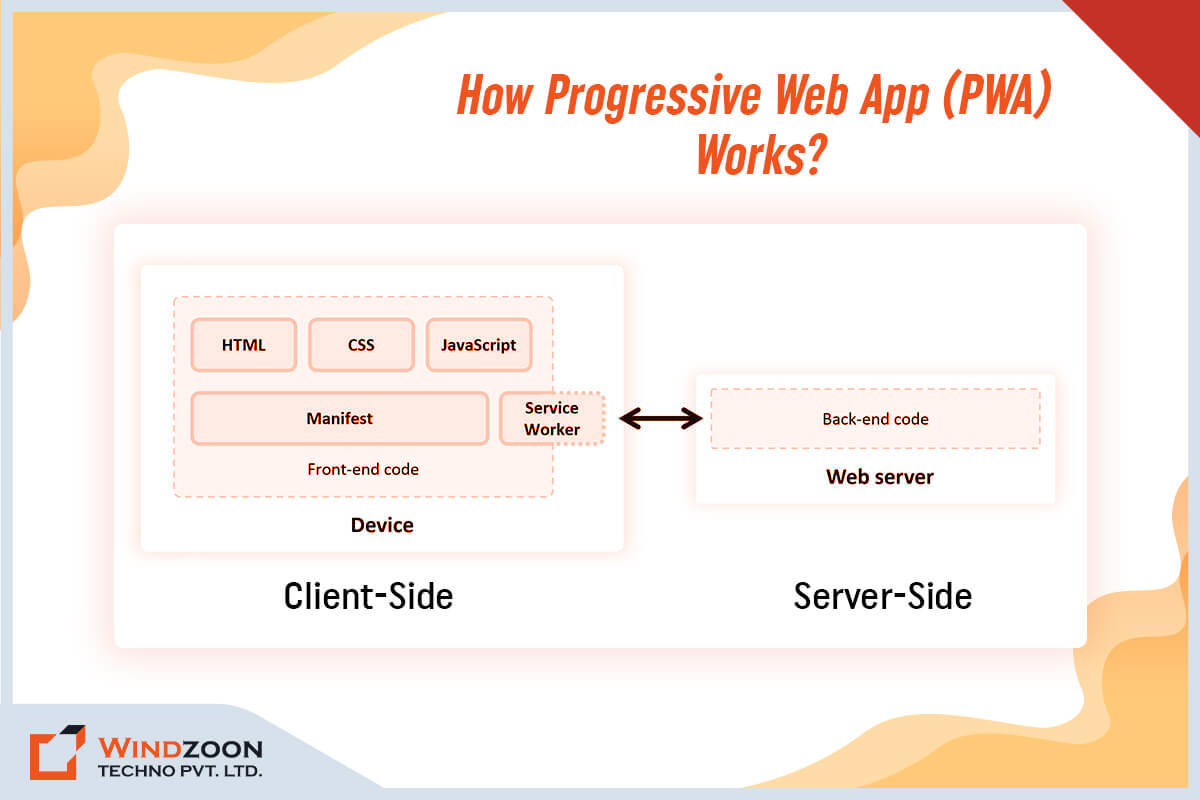
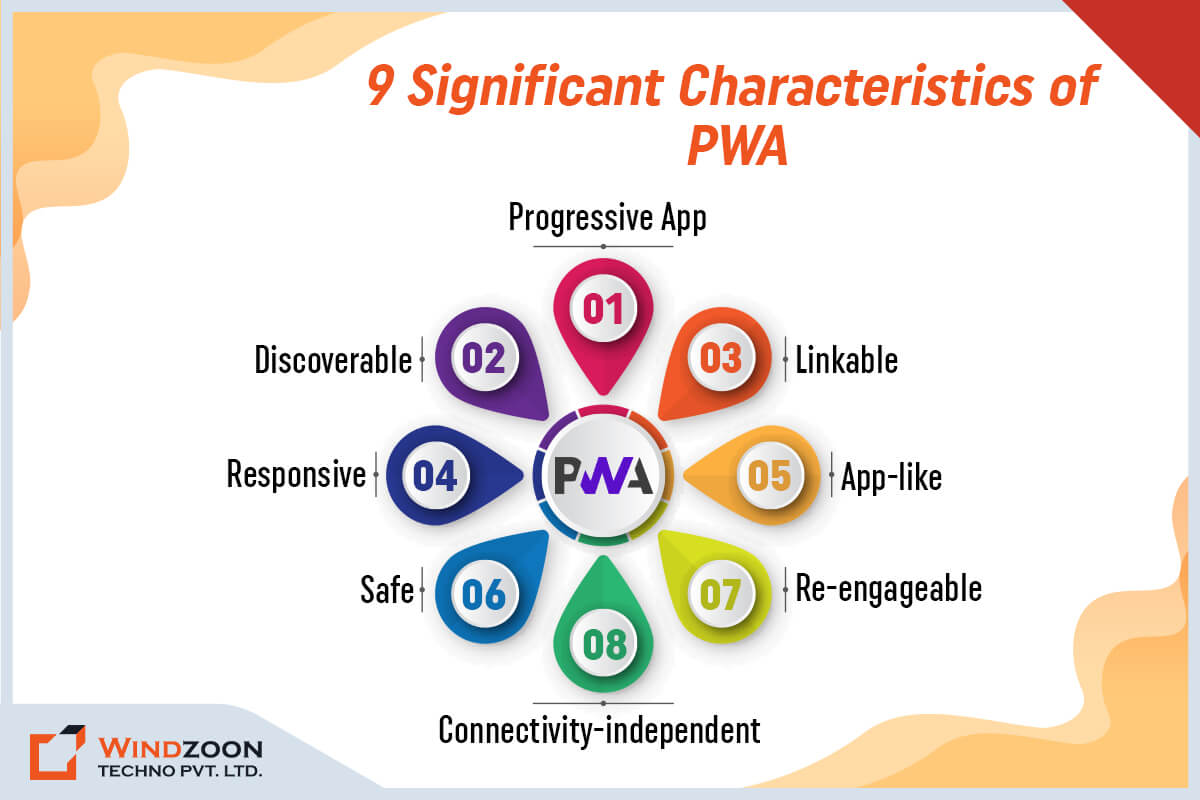
A progressive web app, often known as a PWA, is an online application that has several features (similar to those found in native apps). It gives users an app-like experience. PWA enables web applications to be added to a user’s mobile (or desktop) home screen as a native app without even going through the app deployment procedure.

Since Angular already comes with this capability, implementing PWA in it is a breeze. The SEO part of PWA is primarily focused on offline caching. It means, when a visitor views your page, the data is cached on the device. This enables the page to serve more quickly the next time, improving the user experience.

ng add @angular/pwa — project *project-name*

With this simple command, you may add customizable PWA capabilities to your Angular application. When a user views your application, an offline version of the app is made available.

6. Implement Proper Routing

Different views in an Angular SPA are loaded dynamically under the same URL, which might be problematic for SEO.

To increase the discoverability and indexability of your content by search engines, you can use Angular’s router module to link various views to distinctive URLs.

For instance:

const routes: Routes = [

{ path: ‘page1’, component: Page1Component },

{ path: ‘page2’, component: Page2Component }

];

@NgModule({

imports: [RouterModule.forRoot(routes)],

exports: [RouterModule]

})

export class AppRoutingModule { }

The above code generates two separate URLs (/page1 and /page2) for both the Page1Component and Page2Component.

7. Avoid Using Hash-based URLs

Routing is supported by Angular by default using hash-based URLs, such as www.example.com/#/page1. Hash-based URLs, however, are less SEO-friendly because search engines frequently overlook the portion of the URL that comes after the hash.

By setting the useHash configuration option to false in your routing module, you may convert to using URLs that follow the HTML5 pushState format:

@NgModule({

imports: [RouterModule.forRoot(routes, { useHash: false })],

exports: [RouterModule]

})

export class AppRoutingModule { }

8. By Enabling Canonical URLs

Duplicate content may jeopardise your SEO rankings, and it’s crucial for Angular apps because different URLs can show the same content.

Canonical URLs assist search engines in determining which version of a page to index and show in search results.

To successfully add a canonical URL to your page, utilise Angular’s Meta service. Angular’s Meta service allows you to dynamically set canonical URLs for each view, which helps improve SEO and avoid duplicate content issues:

import { Meta } from ‘@angular/platform-browser’;

constructor(private metaService: Meta) {}

setCanonicalURL(url: string) {

let link: HTMLLinkElement = this.metaService.getTag(‘rel=”canonical”‘);

if (!link) {

link = this.metaService.create(‘link’);

this.metaService.addTag({ rel: ‘canonical’, href: url });

} else {

this.metaService.updateTag({ rel: ‘canonical’, href: url });

}

}

Each time a new view is loaded, your component can use the setCanonicalURL method with the chosen canonical URL.

9. Take Advantage of Service Workers

Service workers are a great method to enhance the usability and performance of your Angular applications, which further enhances your SEO. These particular web workers provide features like caching, push notifications, and background syncs by operating independently of the main browser thread.

Here are some reasons why they could be a useful addition to your Angular app:

  • Offline abilities: Service workers have the ability to cache resources from your application, making it accessible when there is no network or poor network. This guarantees a seamless user experience, which is a crucial feature that search engines take into account.
  • Quick load times: Service providers can significantly shorten load times by delivering cached content. This improves page speed—a crucial element in SEO rankings.
  • Background information: To guarantee that customers always receive the most recent version of your application, service workers can refresh the cached resources in the background.

Angular has an excellent service worker library called @angular/service-worker. <

Here’s a straightforward application of the Service Worker Library:

The first step is to use the Angular CLI to add the service worker package to your project:

ng add @angular/pwa

Now, add the ServiceWorkerModule to your AppModule:

import { ServiceWorkerModule } from ‘@angular/service-worker’;

import { environment } from ‘../environments/environment’;

@NgModule({

declarations: [

AppComponent

],

imports: [

BrowserModule,

ServiceWorkerModule.register(‘ngsw-worker.js’, { enabled: environment.production })

],

providers: [],

bootstrap: [AppComponent]

})

export class AppModule { }

Create a service worker configuration in the ngsw-config.json file. From here, you can define the files and routes to the cache.

Keep in mind that service workers only operate over HTTPS for security reasons, with the exception of development on localhost.

Most Useful Tools for Angular SEO

1. Angular Universal for Server-Side Rendering

As we’ve already covered, Angular Universal is an essential tool for improving SEO in Angular applications. It enables the pre-rendering of Angular apps on the server, producing static HTML pages that are simple for search engine bots to crawl.

Angular Universal not only improves search engine indexing but also contributes to speedier performance and first-contentful-paint times. Hence, it’s a crucial remedy for the SEO problems that client-side rendered JavaScript apps have.

2. Ngx-seo

Ngx-seo is a wonderful package that will assist you in managing metadata in your Angular web application. It offers a simple API for dynamically updating the metadata of your pages, which is very helpful for single-page applications.

The library is capable of managing conventional metadata, Open Graph metadata, and Twitter Card metadata—all crucial for successful SEO.

You must first install Ngx-seo using npm, import the module, and then use its services to modify your page’s information as necessary.

3. Scully

Scully is an Angular static site generator, sometimes known as the “Jamstack solution for Angular.”

It takes your application and turns it into a static site that can be simply delivered, giving you the SEO advantages of server-rendered apps while keeping the benefits of SPAs for development.

Scully’s pre-rendered pages are simple for search engine crawlers to index, resulting in high visibility on search engine result pages. Additionally, Scully includes plugins for lazy-loading images, making an XML sitemap, and more that all support your SEO efforts.

4. NgOptimizedImage

Angular has a special directive for optimising images called NgOptimizedImage.

This directive enables you to use several image optimisation strategies that can significantly enhance the performance of your application, including lazy loading, responsive images, and present picture formats like WebP.

Optimising your pictures with NgOptimizedImage will dramatically improve the SEO of your Angular app because page speed is a key ranking element for SEO.

5. Yoast SEO

Yoast SEO is a well-liked and useful tool for enhancing Angular SEO. While Yoast SEO is most known for its WordPress integration, it also includes an Angular plugin that aids in the optimisation of Angular applications.

It offers functions including generating XML sitemaps, managing meta tags, readability analysis, and content analysis. With Yoast SEO, developers can easily optimize their Angular apps for search engines. Additionally, using Google Search Console is essential for submitting sitemaps and monitoring website performance, which helps further optimize Angular applications for better search engine indexing.

They accomplish it by ensuring correct metadata, keyword usage, readability, and overall SEO best practices, ultimately improving the exposure and ranking of their Angular websites in search engine results. It’s also important to regularly identify and fix broken links, as these can negatively impact SEO by causing 404 errors and affecting search engine rankings.

While Angular is an effective framework for creating dynamic websites, there are several SEO-related issues that need to be resolved. These restrictions can be removed by adhering to established practices for optimising Angular web pages for search engines.

If you continue to think that integrating SEO best practices into your Angular web app will be difficult for you, you can always get assistance from a local SEO agency.

Windzoon is a prominent web app development and digital marketing company. We have more than 8 years of experience creating Angular web app solutions that are SEO-optimized.

Hence, leverage our Angular web development services and professional SEO services to develop complete SEO-optimized Angular solutions. Contact us to get a quote and to know more about us.

How Has AI Been Affecting UX Design? Know its 7 Benefits & Drawbacks

The emergence of new technology and innovations has become a part of our daily lives. We all have accepted that “technological changes are constant”. And we all are very open-minded about that.

However, that open-mindedness and acceptance only last till it doesn’t start to replace our jobs. Because once technology started to become a replacement for our job we all get weary and fearful about its impending arrival.

And nowadays, Artificial Intelligence has evolved as the biggest job replacer in so many sectors. As per the report, it will replace the equivalent of 300 million jobs across various industries. And UI & UX design is considered one of such industries. The use of AI in UI/UX design has created a significant threat to the employment of UI/UX designers. As AI becomes more integrated, the ux designer’s job is evolving, requiring adaptation to new tools, critical thinking, and a focus on human-centered problem solving. Mastering AI tools and developing skills like empathy and storytelling are becoming essential for today’s UX professionals.

But is that true?  Does AI actually help or hurt UI/UX designers? The ongoing debate also raises the question: will AI replace UX designers? While AI can automate certain tasks and enhance decision-making, unique human skills such as empathy, creativity, and emotional intelligence remain irreplaceable in UX design. And is its implementation into UI & UX design truly advantageous, or does it have any drawbacks? What kinds of AI tools are on the market for UI/UX design?

As a leading Web Design Company in India and the USA, we will give you answers to all of these questions with many more. AI is transforming the roles of ux professionals, increasing productivity, and requiring ongoing skill development to stay relevant. We will also explore how the future of ux is being shaped by AI, influencing industry trends and the work environment for UX professionals. And provides you with detailed information about AI involvement in UI/UX design and will satisfy all your curiosity.

What is Artificial intelligence?

Artificial intelligence (AI), often known as machine intelligence, is a subfield of computer science. It focuses on creating and controlling technology that can decide for itself what to do and how to do it without human intervention.

AI is not a singular technology. Instead, it is an umbrella word for any form of software or hardware component that enables machine learning, computer vision, natural language understanding, natural language production, natural language processing, and robotics. Many AI applications in design are powered by AI and machine learning, which enable automation and provide data-driven insights. AI works by analyzing large datasets, recognizing patterns, and automating tasks such as customer service chatbots or recommendation systems.

Additionally, AI is used in a variety of industries, including finance, healthcare, and autonomous cars as well as virtual assistants. Although AI has advanced significantly, the goal of developing real human-like intelligence remains unmet, spurring innovation and influencing the direction of technology.

Step-by-Step Evolution of AI

The evolution of AI may be understood by classifying it into three divisions depending on the human features it seeks to mimic:

Weak or Narrow AI: These are AI systems created to carry out a certain activity without the aid of humans. These systems concentrate on one job at a time and do not immediately transfer their expertise to other jobs. Currently, this describes the majority of AI.

Strong or general AI: This refers to machines with the capacity to learn a variety of tasks and have an understanding of the world comparable to that of humans. However, this kind of AI is still in its early stages of research.

Super AI: This category refers to fictitious AI systems that are capable of performing any task better than a human. Super AI systems are not only able to comprehend human emotions and experiences, but they can also express their own emotions, opinions, and desires.

After examining the many stages of AI development, we can conclude that the technology is currently halfway between the narrow AI and general AI levels. Many organizations have adopted AI across various business functions, leading to widespread transformation in how industries operate. And it will take some time for it to fully advance to the general AI level.

Let’s now describe the next issue and determine whether AI is helpful or detrimental.

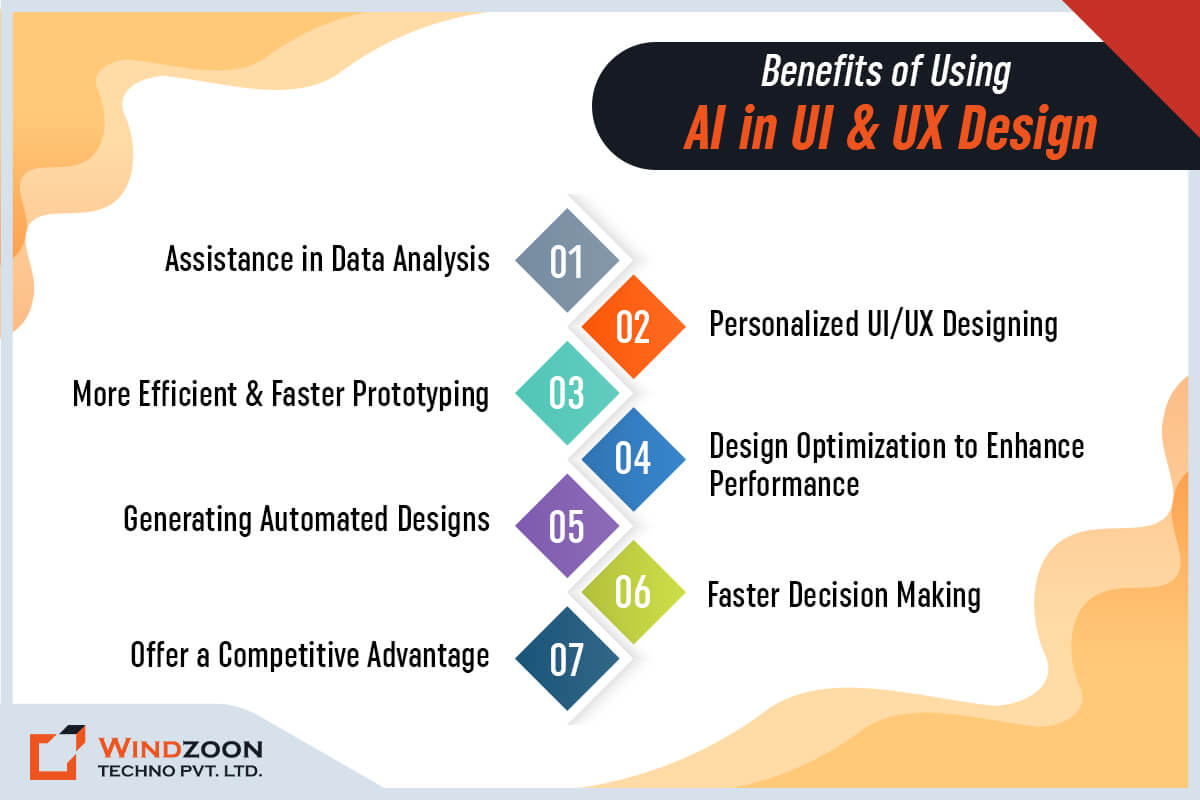
7 Benefits of Using AI in UI & UX Design

benefits-of-ai-in-ui-ux

1. Assistance in Data Analysis

Incorporating AI into UI and UX design has many advantages, one of which is its capacity to significantly aid in data analysis. AI algorithms can effectively handle and analyze the massive amounts of user data that are currently available to derive valuable insights. AI can also analyze data from multiple sources to generate actionable insights, and analyze user data to personalize experiences for each user.

Additionally, through comprehending consumers’ behavior, preferences, and interactions, designers can gain important insights into their wants and expectations. AI helps identify patterns in user behavior and preferences, enabling design professionals to uncover trends and insights that inform better design decisions. Design professionals may make informed judgments and produce user experiences that cater to particular user groups or personas using this data-driven approach.

Designers can create a seamless and customized user experience by ensuring that their designs are in line with customer expectations thanks to AI’s data analysis skills. AI tools can also collect data efficiently, supporting ongoing optimization and continuous improvement of the user experience.

2. Personalized UI/UX Designing

In today’s UI and UX designs, personalization has emerged as a crucial component. To enable individualized design experiences, AI technology is essential. AI can utilize machine learning algorithms to assess user data and produce user personas or profiles. AI also enables the creation of personalized interfaces that adapt to each individual user, tailoring content and interface elements based on their unique behavior and preferences.

This analysis considers a number of variables, including user preferences, previous behavior, demographic data, contextual data, and even the user’s search history. Designers may produce interfaces that adapt to and serve the needs of different users based on these ideas.

Individualized UI/UX design improves customer satisfaction, engagement, and overall experience. Users feel appreciated and understood because it fosters a sense of exclusivity and customisation. Designers can create highly relevant and targeted experiences with the help of AI-powered personalisation, which improves user retention. It is essential to apply user centered design principles to ensure that AI-driven personalization remains focused on real human needs and experiences.

3. More Efficient & Faster Prototyping

The UI/UX design process includes prototyping, and AI can greatly increase its effectiveness and speed. AI-powered prototyping tools use algorithms to produce interactive prototypes based on design inputs. These tools can quickly generate multiple variations of a design, allowing teams to test and optimize different options efficiently.

Designers can save time and effort by using these tools to automatically convert wireframes or design concepts into working prototypes. With AI, designers can rapidly test various interactions, iterate and improve their concepts, and get feedback more quickly.

Additionally, by using a streamlined prototyping procedure, designers can find potential design issues or advancements early on, resulting in more effective design cycles and eventually better final products.

4. Design Optimization to Enhance Performance

AI algorithms can optimize designs to improve usability and performance. AI can spot patterns and trends that have an impact on user experience by analyzing user interactions. Additionally, AI can analyze user patterns—historical behaviors and preferences—to inform ongoing design optimization and ensure that design decisions are data-driven.

It can identify usability problems like unclear navigation or items that take a long time to load and offer suggestions for fixing them. AI-driven design optimization aids designers in locating opportunities to improve the user experience. And that results in enhanced customer satisfaction and improved performance.

Designers may make sure that their interfaces continue to be pertinent and successful in fulfilling user expectations by regularly evaluating and optimizing designs based on user input and real-time data.

5. Generating Automated Designs

Artificial intelligence (AI) has the capacity to produce automated designs based on established rules and criteria. Designers can input user needs, branding standards, and design limits into AI-powered tools to automatically generate a variety of design possibilities. Generative AI is transforming the way designers approach automated design creation by enabling the rapid generation of prototypes and layouts.

In addition to saving time, this automated design creation approach encourages creativity by offering designers a variety of potential design options. AI tools can brainstorm and enhance design ideas, supporting designers in the creative process. Furthermore, AI can create or extract various design elements, streamlining the design process and allowing for more efficient iteration. AI-generated designs act as a springboard for additional amplification and personalization. Additionally, it makes it possible for designers to swiftly and effectively examine many options.

This mix of AI automation and human creativity leads to unique and visually appealing designs that connect with the brand and meet consumer needs.

6. Faster Decision Making

Making swift, well-informed decisions is essential in the fast-paced world of UI and UX design. AI can help designers make judgments more quickly and based on data. AI systems can offer insights and predictions about user preferences and behavior by studying user data. Additionally, AI can anticipate user needs and behaviors, enabling designers to proactively address potential issues and create more personalized, streamlined experiences that support faster, more informed decision making.

This knowledge enables designers to assess design options and make decisions based on facts rather than conjecture. By examining user input or carrying out automated usability testing, AI can also assist designers in identifying potential problems or places for improvement in the design.

Design iterations may be made more quickly and designs can be improved thanks to the application of AI. AI shortens the time needed for decision-making and offers insightful information.

7. Offer a Competitive Advantage

Companies can significantly increase their competitive edge by using AI in the UI and UX design processes.

Businesses that prioritize AI-powered design may provide extraordinary user experiences that set them apart from their rivals in today’s digital market, where user experience is a crucial differentiator. By leveraging powerful tools and AI powered systems, companies can streamline the entire process of UX design—from research and ideation to implementation—making tasks more efficient, data-driven, and less prone to error. Companies can gain a competitive advantage by attracting and retaining consumers, fostering brand loyalty, and expediting design workflows through personalizing interfaces, enhancing performance, and optimizing workflows.

Businesses may utilize AI to keep ahead of shifting customer expectations, adjust to emerging trends, and continuously improve their goods and services based on data and insights that are available right away.

Is AI in UI/UX design truly as accurate and impactful as it seems?

AI is entirely dependent on the algorithms that people have developed, and since people are prone to error by nature, so is AI. As previously stated, AI is still in its early stages, therefore you can easily guess its accuracy. Isn’t that questionable?

Since more and more content and design decisions are being made based on AI-driven insights, it is crucial to thoroughly verify any advice and data that the technology offers before implementing it into your brand’s unique digital offerings. Collecting user feedback and using AI to analyze user feedback is essential for uncovering actionable insights and ensuring that AI-driven recommendations truly enhance the user experience. Do not be concerned. Because Google Search, our trusted online companion, is still available to us for fact-checking AI-generated design and content insights.

Do not fret! Because Google Search, our trusted online buddy, is still available to us for fact-checking AI-generated design and content insights.

Besides, AI-powered tools can streamline UX research by automating data gathering and analysis, making it easier for UX researchers and designers to gather information quickly and perform work at scale. However, for high-quality research, it’s still preferred to stick with conventional online UX design techniques.

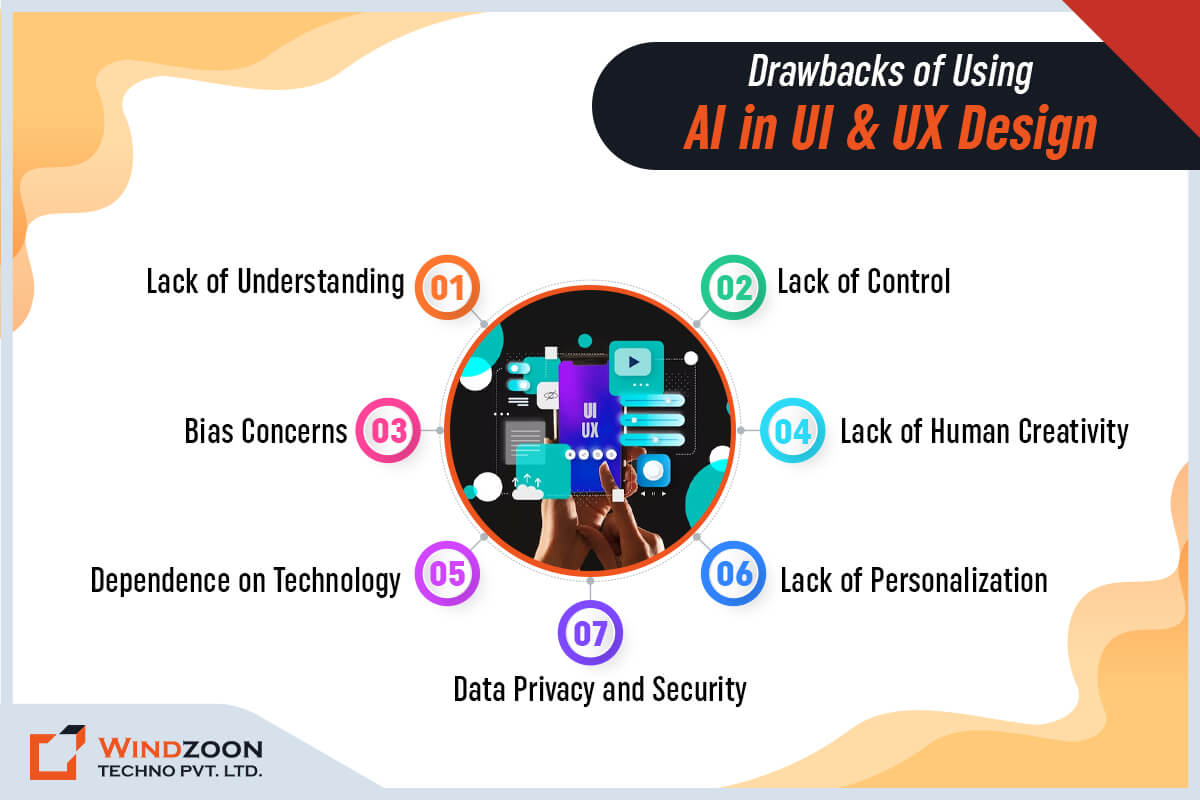
7 Drawbacks of Using AI in UX & UI Design

drawbacks-of-ai-in-ui-ux

1. Lack of Understanding

AI’s intrinsic lack of comprehension is one of the main disadvantages of employing it in UX and UI design. Although AI systems are capable of analyzing enormous amounts of data and spotting patterns, they find it difficult to fully understand human emotions, motives, and cultural quirks. AI’s ability to analyze user data and predict behaviors enables tailored user experiences, but it still has limitations in interpreting complex human motivations.

Design choices frequently call for a thorough understanding of user psychology and behavior, which AI may lack. Because of this restriction, designs may not emotionally connect with users or adequately meet their fundamental requirements.

2. Lack of Control

It may be difficult for designers to maintain control over AI-driven design processes. AI algorithms can generate design recommendations or even automate specific design activities, lowering the amount of manual input necessary from designers. While AI can streamline repetitive tasks and automate many repetitive tasks such as data analysis or image editing, this efficiency may also reduce opportunities for creative exploration.

However, this can result in a loss of creative autonomy and the possibility of impersonal designs. Designers might be forced to rely significantly on AI-generated proposals, which would limit their capacity to experiment with alternate design solutions or push the envelope.

3. Bias Concerns

Since AI systems learn from data, biases or constrained viewpoints in the training data may be perpetuated in the design process. This raises serious questions regarding equity, inclusivity, and diversity in UX and UI design.

Ethical data collection is crucial to minimize bias in AI-driven design, as improper or unrepresentative data can reinforce existing prejudices and limit the effectiveness of AI tools.

AI-generated biased design recommendations may lead to accidental exclusion or discrimination against particular user groups. To promote inclusive and equitable user experiences, designers must be careful in identifying and correcting any biases in AI-generated design recommendations.

4. Lack of Human Creativity

While AI excels in pattern detection and efficiency, it struggles to match the breadth of human creativity. Design is a highly creative field that necessitates unconventional thinking, trying out novel concepts, and taking intuitive risks.

While AI can help with creating design possibilities based on current patterns, it might not be able to come up with really ground-breaking and original solutions, which only human designers are capable of conceiving. AI may struggle to reach the originality and distinctiveness that human creativity brings to designs. Strong ux skills, such as empathy and creative problem-solving, remain vital despite advancements in AI, ensuring that design continues to be human-centric and innovative.

5. Dependence on Technology

Designing UX and UI with a lot of AI can lead to a dependency on the technology. AI algorithms for decision-making, prototyping, and even producing design concepts may cause designers to become unduly dependent on them.

This dependence may make it more difficult for the designer to use critical judgment, believe in their gut, and make the most of their particular talents and experience. To retain a comprehensive and person-centred approach to design, it is crucial to achieve a balance between AI support and human design intuition. Utilizing AI thoughtfully is important to ensure it supports, rather than replaces, human judgment in the design process.

6. Lack of Personalization

Modern UX and UI design place a strong emphasis on personalization because people want experiences that are suited to their specific wants and needs. While AI algorithms are excellent at evaluating vast datasets and seeing trends, they can find it difficult to fully understand the unique quirks of each person.

AI-driven personalisation may fall short of genuinely comprehending and satisfying each user’s specific needs, resulting in impersonal or generic experiences. Even the most advanced ai tool may struggle to fully capture individual user nuances. In order to create individualized experiences, designers must take into account the limitations of AI and work to complement it with human-centred design methodologies.

7. Data Privacy and Security

AI generates insights and suggestions using enormous amounts of consumer data. However, this reliance poses issues with data security and privacy. Designers are responsible for ensuring that user data is handled sensibly, following data protection laws, and putting in place strong security measures. Certain AI tools are designed with enhanced privacy and security features to protect user data, making them a better choice for sensitive projects.

The integrity of the design process may be jeopardized if these issues are not addressed. Users’ privacy should be respected, and data security should be given top importance in AI-driven design procedures.

AI in UI/UX: Is it a Companion or Competitor of Designers?

AI as a Companion of Designers

AI may become excellent friends with UI/UX designers in the following ways:

  • By provisioning automation, AI frees designers from doing mundane tasks such as resizing images, organizing files, or creating templates.
  • AI-powered tools give designers a leg up in the design process by making design recommendations and assisting in the development of their creativity.
  • In order to help designers iterate designs more quickly and effectively, it also gives them real-time feedback regarding the design combinations and decisions they make.
  • Designers may create better interfaces with the support of AI-powered analytics tools that provide them with insights into user behavior and preferences.

In accordance with recent data, in the previous quarter, approximately 93% of web designers used AI technologies for design-related tasks. the source of From which:

  • 58% of designers used it to create images or other asset designs;
  • Following that, 50% of designers utilized it to create full websites;
  • Another 49% of designers experimented with the design using AI;
  • While 43% of designers employed AI to improve their designs;
  • Following that, 40% of designers utilized it to judge the quality of their work;

So it speaks a lot about AI being a companion of UI/UX designers.

AI as a Competitor of Designers

There are several ways in which AI could be viewed as a threat to UI/UX designers:

  • Since AI commonly automates many UI/UX design processes, it might ultimately replace UI/UX designers who just have rudimentary expertise (although that day is yet in the future).
  • It’s also not a good idea to rely too heavily on AI because it could lack human emotions and critical thinking when it comes to meeting user demands.
  • Since AI is overly reliant on data, it may ignore the subjective and qualitative parts of the design.
  • It might be constrained by biases because of the reliance on algorithms and particular datasets.

In other words, over-dependence on AI may be detrimental to UI/UX designers and even businesses due to its poor conversion potential. However, no matter how intelligent AI gets, you can become a better designer by developing some regular routines that will help you with your UI/UX design.

Here, therefore, is a glimmer of hope for UI/UX designers. Since we understand the solution, which is to combine human and artificial intelligence to improve the effectiveness and results of UI/UX design, we can move forward with it.

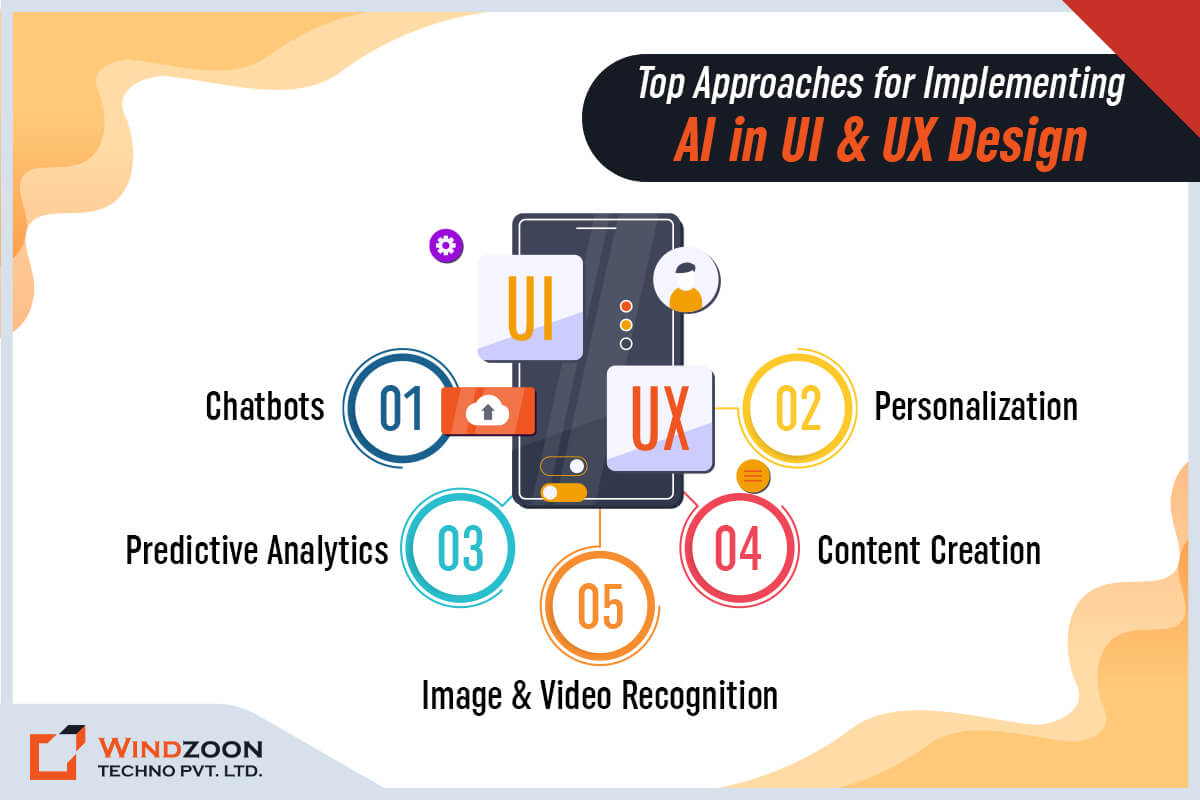
5 Top Approaches for Implementing AI in UI/UX Design

top-way-to-use-ai-in-ui-ux

1. Chatbots

Chatbots are one of the most significant areas where AI can be applied in UI/UX design. Chatbots are conversational agents powered by AI that can communicate with and support users. Increasingly, chatbots are being enhanced with voice commands and integrated with platforms like Google Assistant, allowing users to interact through natural language and voice interfaces. Chatbots can help customers navigate a website, offer customer service, and respond to frequently asked inquiries. Chatbots can increase user interaction and lighten the pressure on customer service departments.

2. Personalization

AI may assist designers by evaluating user data and behavior to generate customised user experiences. AI algorithms can evaluate user data like as browser history, search queries, and social media activity to learn about the user’s preferences and personalize the user experience accordingly. By leveraging AI to analyze user data, designers can deliver more relevant and engaging experiences tailored to individual users. And personalization can boost customer happiness and user engagement.

3. Image and Video Recognition

Pictures and videos can be analyzed using AI algorithms to determine their content. To enhance user experience, image and video recognition can be employed in UI/UX design. For instance, an online store may employ picture recognition to enable users to conduct product searches using photographs. Image and video recognition can also be used to evaluate user-generated content in order to better understand user behavior and preferences.

4. Predictive Analytics

Another area in UI/UX design where AI can be applied is predictive analytics. Data analysis is used in predictive analytics to forecast future events. AI systems can examine user data to forecast user behavior and offer tailored advice. Predictive analytics, for instance, can be used by an e-commerce site to make product recommendations based on a user’s browsing and buying patterns.

5. Content Creation

Blog posts, social media posts, and product descriptions can all be produced using AI algorithms. AI algorithms can assist designers in reducing the amount of time spent on content production while also enhancing the quality of the output. Based on user information and behavior, AI-generated content can also be tailored.

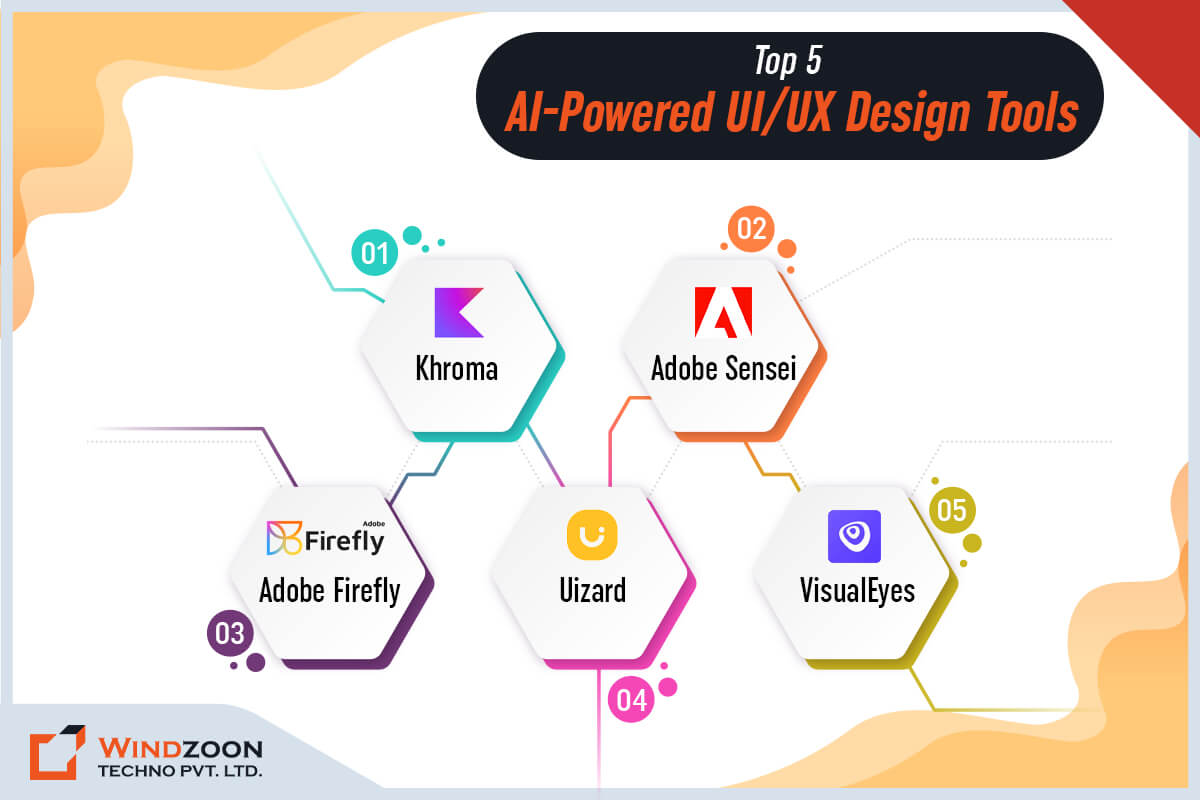
A Look at the Most Popular 5 AI-Powered UI/UX Design Tools

ai-ui-ux-design-tools

1. Khroma

Khroma is an AI color application for designers that helps them identify and save color schemes they use regularly.

The application generates an automated palette for native designs by applying AI to identify a color scheme that the developer prefers or frequently uses. Color is a crucial component for graphic designers and has an impact on the quality of their work.

The software is simple to use. Simply click the “Create Palette” button to generate a palette using the colors you’ve selected. Additionally, you can choose colors from images that you snap or upload.

2. Adobe Sensei

It can act as your helper while you work on creative projects, assisting you in achieving photorealistic effects, discovering relevant content with an intuitive search, and carrying out other tasks.

It offers very realistic visuals and enables you to make the necessary modifications quickly and precisely. Also, the direct search makes it even easier to find the needed material. Given all of these attributes, Adobe Sense is a very crucial tool for tech-savvy designers.

3. Adobe Firefly

With its generative fill function, Adobe Firefly, an AI/ML-powered image editing tool, elevates Photoshop to a new level by enabling you to replace background images and image parts with an exact and realistic image feel.

To insert the new element into the design, simply choose the specific region in the image, then select the generative fill option, type the type of element you want to fill into the search box, and eureka, your photorealistic masterpiece is complete.

It enables you to produce graphics for UI/UX designs, social media campaigns, and much more.

4. Uizard

Uizard is an AI-powered UI/UX design and prototyping tool that enables designers to quickly generate app UI/UX designs. The best part is that any designer, even those with only a little experience, may use this tool to create visually appealing designs.

All they have to do is choose the device they are designing for, explain the project in simple terms, and then specify the design aesthetic they require. Then, with only one click, it will produce amazing design mockups.

The Uizard software can even produce a realistic graphic representation of that screen from your preliminary app wireframe design.

5. VisualEyes

An AI-powered design feedback product called VisualEyes is more comparable to Grammarly for content. By emulating eye-tracking research and preference testing, it assesses your UI design and promises to provide predictions with an accuracy of 93%.

It puts your design through three rounds of testing: Attention Map, Clarity Score, and Areas of Interest.

Using this tool, you can develop aesthetically amazing UI/UX design by conducting A/B testing of your design options, quick preference tests, accurate design assumptions, understanding areas where people can spend more time looking at a design, and reducing clutter in a design.

AI has the ability to transform UI/UX design by offering insights, automating activities, and delivering personalized experiences. It can boost productivity, enhance user experience, and provide businesses with a competitive edge.

However, designers must be cognizant of the drawbacks of adopting AI, such as a lack of understanding, data privacy and security, bias, dependence on technology, and expense.

Nevertheless, it is unlikely that AI will ever surpass human ingenuity. As it can be used as a designer’s assistant to quickly create beautiful user interfaces and save a lot of time for user research to provide a fantastic user experience.

At Windzoon, we have a team of imaginative UI/UX designers who constantly push AI with their ingenuity and comprehend the needs of our clients.

Contact us to avail of our best-in-class web design services and .

Front End Development Outsourcing: A Guide with 6 Tips to Pick an Expert

Staying ahead of the competition in today’s fast-paced digital landscape necessitates a strong online presence. For that, businesses need to develop websites or applications as per their requirements. This is especially important for businesses seeking to improve their digital presence and reach a wider audience. Because every successful website or application must have flawless front-end development at its foundation.

However, not many businesses have the resources or skills in-house to handle this critical component of their digital ventures. This is when outsourcing front-end development becomes an appealing alternative. Working with an outsourced team can provide cost effective solutions and comprehensive services, allowing you to access a full range of web development expertise without the overhead of building an in-house team.

According to Statista, the outsourcing business generated $92.5 billion in revenue in 2019, and the demand is constantly rising. This growth is driven by the expertise of outsourcing companies in web development, offering industry-specific solutions and award-winning services. Outsourcing allows companies to access global talent and gain immediate access to skilled professionals, streamlining the process of building high-quality digital products. Because there are many benefits to outsourcing front-end development to a reputable Web app development company. However, in order to assess whether outsourcing coincides with your business goals, you must first comprehend both the pros and cons.

In this blog post, we will discuss the pros and cons of outsourcing front-end development. And will provide you with in-depth information on this subject that will help you make an informed decision for your business.

What is front-end development?

The portion of a website or application that users directly access and interact with is referred to as the front end, also known as front end web development or frontend development. It serves as the “face” of the digital experience.

Front-end development, or frontend development, entails bringing that face to life by turning designs into a user interface on the client side of the application, making it useful and user-friendly.

To create the structure, layout, and interactivity of a website, front-end developers use programming languages like HTML, CSS, and JavaScript. These programming languages are used to create and position static and interactive elements on web pages. Developers meticulously develop the visual and interactive elements, like fonts, colors, images, carousels, and animations, using CSS to position static content for consistency and to enhance user experience.

Besides, they also make sure that the website operates without a hitch across all platforms and browsers, changing its design and functionality to deliver a consistent user experience.

In a nutshell, front-end development involves creating the magic that users encounter and engage with whenever they visit a website or application.

Popular Front-end Frameworks Available in the Market

1. ReactJS

Despite being primarily a JavaScript toolkit for creating user interfaces, React is frequently referred to be a front-end framework. React was created in 2011 by Facebook developer Jordan Walke. After becoming an open-source framework in 2013, React began to gain popularity.

React is widely used for custom JavaScript development, enabling developers to build interactive and dynamic user interfaces. It is commonly chosen to create single web page applications that leverage client side routing, allowing seamless navigation without full page reloads.

Developers who work with React use JavaScript and declarative code. A distinct JSX feature allows them to use HTML to update the DOM (Document Object Model) and build a Virtual DOM, resulting in increased efficiency.

Another feature of React is the usage of reusable components organized in a tree-like structure, as well as one-way data binding, which limits data flow between components and views to only one direction.

2. Angular

A complex front-end framework, Angular was created by Google. It is an open-source framework for developing TypeScript-based web applications.

Angular is ideal for building large-scale web apps and supports client side routing, enabling seamless navigation without full page reloads. Angular developers write robust front end code to manage complex interfaces and ensure smooth user experiences.

Three essential components of Angular are two-way data binding, dependency injection, and a modular architecture that lets you divide your application up into reusable parts.

Building complex enterprise-level applications like large-scale e-commerce platforms, banking, and healthcare systems is a good fit for Angular.

3. VueJS

Developed by Evan You, Vue.js is a progressive front-end framework. It is a simple and lightweight JavaScript library that may be used to create user interfaces.

Vue’s fundamental characteristics are reactive and composable data bindings, a virtual DOM, and a component-based architecture. Vue makes it easy to add interactive elements to user interfaces, enhancing user engagement and experience.

Vue’s fundamental characteristics are reactive and composable data bindings, a virtual DOM, and a component-based architecture.

Vue can be used to create small to medium-sized applications, such as blogs, forums, and personal web pages. It is also well-suited for developing web apps with custom JavaScript development, allowing for tailored solutions that leverage Vue’s flexibility and efficiency.

4. jQuery

“jQuery” is a renowned front-end library created by John Resig. It is a lightweight and fast JavaScript package for streamlining HTML document traversal and manipulation, event handling, and animation. jQuery helps developers create interactive elements and efficiently manage both static and interactive elements on web pages.

jQuery is appropriate for enhancing existing websites with interactivity and animation as well as developing small-scale applications.

5. EmberJS

Yehuda Katz created the frontend framework known as EmberJS. It is a strong and independent JavaScript framework for creating large-scale online applications.

Two-way data binding, a component-based architecture, and a potent CLI for generating code and managing dependencies are some of Ember’s standout features.

Ember is suitable for creating complicated applications that need great scalability, such as corporate apps and enterprise-level systems. It is often chosen for scalable solutions and high quality projects that require close collaboration between front-end and back end developers, ensuring seamless integration and robust performance.

Benefits of outsourcing front-end development

1. Help you save cost

Outsourcing front-end development offers cost effective solutions compared to relying solely on in house resources. Instead of hiring and training a front-end development staff internally, you can save money by cooperating with a group or organization outside your company.

This eliminates the need for ongoing training expenditures, infrastructure costs, and salary and benefit costs associated with maintaining in house resources. It is especially helpful for small and medium-sized businesses with limited resources since you may save money and make better use of what you already have.

2. Enables you to cut down on time

It can take a while to recruit and hire individual front-end engineers or to assemble a competent front-end development team from scratch.

You can avoid this time-consuming recruitment procedure by outsourcing. This approach provides immediate access to a group of professionals who are already adept at front-end development.

Outsourced teams can quickly adapt to changing project needs and accelerate delivery, helping you meet tight deadlines and speed up time-to-market.

It saves you the time and effort needed for recruiting, screening, interviews, and onboarding of new employees. You can get started on projects quickly and efficiently to fulfil deadlines.

3. Allows you to focus on your core business objectives

Outsourcing front-end development frees up internal resources, allowing your in house team to focus on core business functions and core business activities instead of technical tasks.

You can focus on strategic planning, marketing, customer relations, and other areas crucial to the success of your company rather than dividing your attention and efforts among numerous duties.

Outsourcing allows you to harness the experience of front-end development professionals while redirecting your focus to activities that have a direct influence on your business’s success.

Outsourcing can be a simple solution if you need to rebuild or rework an existing front end. Renovating your current front end is a task best left to seasoned front-end development teams or agencies.

They are able to assess your needs, make suggestions for improvement, and carry out the redevelopment process without incident. Experienced teams consistently deliver high quality projects that deliver exceptional user experiences and boost user engagement. By contracting out this work, you can make sure that your front end is efficiently updated and adheres to the most recent standards for both user experience and design.

5. Provide you with extreme adaptability

You have more project scalability options when you outsource front-end development. Outsourcing provides scalable solutions that can easily complement your existing team and integrate with other team members as needed. This allows you to modify your resources accordingly, whether you need to expand your front-end staff for a short-term project or scale it down during quieter seasons.

The external personnel can quickly adjust to your project requirements, allowing you to scale up or down as required. With this scalability, you can maximize efficiency and productivity by having the appropriate knowledge and resources available at any step of your project.

Things to consider before outsourcing front-end development services

1. Back-end integration

Before outsourcing your front-end development, make certain that the external team or agency is capable of interacting with your existing back-end systems.

They ought to be well-versed in the back-end technologies, APIs, databases, and any other elements that communicate with the front end.

To achieve seamless integration and compatibility between the front-end and back-end systems, your internal team and the external developers must work together effectively. This collaboration should include close coordination with your back end development team, integration of third party services to enhance website functionality, and ensuring compatibility with your chosen content management system.

2. Synchronize and organize

To successfully outsource front-end web app development services, it’s crucial to establish efficient project management and communication procedures. Make sure you have a clear mechanism in place for exchanging comments, design assets, and project needs.

Incorporating user research and leveraging deep knowledge of workflows help teams gain access to best practices for coordination, ensuring that both user needs and project goals are met effectively.

Set up recurring conferences or check-ins to keep everyone in the loop and informed of the project’s advancement. To avoid confusion or overlapping duties, be sure to define roles and responsibilities.

Clarity, transparency, and efficiency will be preserved throughout the development process with the aid of workflow organization and coordination between your internal team and the external developers.

3. Time zone differences

When outsourcing front-end development, time zone differences may be a concern. Especially if you’re working with a team based in another part of the world. It’s crucial to assess how time zones affect project communication and development.

Adjust meeting schedules or use asynchronous communication techniques to strike a balance that enables productive collaboration. Consider the availability of important stakeholders and the probable requirement for overlap in working hours.

Timezone variations can be overcome and good coordination is ensured with the use of clear communication channels and project management technologies, which is essential for delivering a seamless user experience.

Cooperation Models For Outsourcing Front-end Development

1. Staff Augmentation Model

In this collaborative approach, you add external front-end developers to your current internal staff. These outsourced developers work alongside your existing team and collaborate with other team members to ensure seamless integration and efficient project execution. You can use the outsourced developers’ skills while maintaining complete control over your project and tasks.

This strategy is appropriate when you have specific short-term needs or require more expertise for a particular project. It gives you the freedom to scale your team up or down in accordance with your needs.

The outsourced developers blend easily into your current team and work closely with them to complete the tasks given to them.

2. Project-Based Model

In the project-based model, the whole front-end development project is contracted out to a third-party group or organization. The contracted team manages the entire development process from beginning to end as you specify the project’s scope, needs, and deadlines.

This approach is best suited for well-defined projects with precise objectives and set deliverables. It is convenient because the outsourced staff handles project management and execution, freeing you up to concentrate on other areas of your organization. By leveraging this model, you can better ensure desired outcomes and project success, as the team is focused on meeting your specific goals and delivering quality results.

3. Dedicated Team Model

In the dedicated team approach, you establish a sustained collaboration with an outside front-end development team. This group functions as an extension of your organization and only handles your projects.

You have complete control over team management, project prioritization, and work assignments. In addition, this model allows adaptability, scalability, and ongoing collaboration. Outsourced teams can help you reach a broader audience by providing the flexibility to scale resources and expertise as needed, ensuring your product is accessible across multiple platforms and user segments.

Hence, it is ideal for companies with complex, lengthy projects that call for devoted personnel and close collaboration. It also works well for companies that need continuing front-end development support.

Which Model is Best for You?

The partnership model you choose is determined by your specific demands, project requirements, and company objectives.

The staff augmentation strategy could be a good choice if you need specialized knowledge or have a short-term project.

The project-based approach can offer simplicity and targeted execution for projects that are well-defined and have defined deliverables.

The dedicated team model can be the ideal option if you need ongoing cooperation, committed resources, and total control over project management.

When choosing the cooperation model, take into account elements like project complexity, budget, timeframe, and the degree of control and involvement you want.

Additionally, make certain that the outsourcing partner you choose has a proven track record in delivering a unique online presence, along with the necessary knowledge and efficient communication routes to support your preferred strategy.

How to ensure successful outsourcing of front-end development

1. Choose the best front-end development firms

Take your time researching and locating the best front-end development businesses or agencies. Seek out businesses with a good standing, a proven track record of success, deep knowledge in front-end development, and relevant front-end development knowledge.

Ask for references and look through their portfolios and customer testimonials. It’s crucial to pick a business that complies with your project’s specifications and has the essential expertise to produce high-quality solutions.

So, while choosing a candidate, take into account qualities like communication prowess, responsiveness, and cultural fit.

2. Tell them about your development strategy

Clearly convey your development strategy to the front-end development firm you’ve chosen. Give specific details about the aims, goals, features, and design specifications of your project.

If you have any wireframes, mockups, or prototypes, share them with the development team so they can better grasp your vision. Providing user research, such as insights from Hotjar, Google Analytics, or user interviews, allows the team to gain access to valuable data that can inform development decisions and improve the final product. The more details you give the developers, the simpler it will be for them to tailor their work to meet your requirements.

3. Get them to give you a thorough estimate

Request a detailed quotation from the front-end development company. This estimate should detail the scope of work, deadlines, milestones, pricing structure, and clearly define the project scope. Additionally, request regular progress reports during development to monitor project advancement and maintain quality control. As it’s critical to have a thorough awareness of the project’s budget and schedule.

Go over the estimate in detail and talk through any queries or worries you may have. A thorough estimate makes sure that everyone is on the same page about the project’s goals and financial constraints.

4. Sign the contract with your preferred company

When you are completely content with the estimate and terms, it is time to sign a formal contract with the front-end development company.

The contract should include key details such as project deliverables, timeframes, payment conditions, intellectual property rights, confidentiality, and dispute resolution processes. It is also important to include clauses for intellectual property protection and specify the use of third party services, especially if integrating external solutions or tools is anticipated during development.

Make sure the conditions and obligations specified in the contract are understood by both parties. This action establishes a legal framework and safeguards the interests of both parties.

5. Maintain consistent communication with your outsourcing partner

For an outsourcing relationship to be successful, effective communication is essential. Create a method for ongoing communication with the front-end development team. Plan frequent check-ins, meetings, or video conferences to update project status, answer questions, and collect feedback.

To ensure seamless communication, make use of collaborative tools such as Slack or Zoom, along with project management platforms. These tools help bridge communication gaps, improve team coordination, and support transparency by making it easy to track work and share files. Maintaining open lines of communication will allow you to make sure that everyone is on the same page and deal with any problems as soon as they arise.

6. Rework the back-end integration with your outsourcing team

Work closely with the front-end development company to ensure that the front-end and back-end systems integrate well. Collaborate with back end developers to facilitate the integration of third party services and ensure compatibility with your content management system. Share any pertinent details or materials concerning your back-end system’s APIs, databases, and third-party integrations.

To make sure the integrated systems are flawlessly functional and satisfy your needs, evaluate and test them frequently. Resolve any issues or concerns that arise during the integration process as soon as possible, and work with the development team to identify effective solutions.

Cost of Outsourcing Front-end Development

Of course, the main goal of outsourcing front-end development is not to reduce costs or raise prices. Nevertheless, as your development partner’s location changes, so do the project development costs. For instance, it might fluctuate widely, from $15 per hour to $175 per hour.

Outsourcing, especially to nearshore providers, offers cost effective solutions and scalable solutions that can be tailored to fit different budgets and project sizes. This flexibility allows you to access high-quality development services without overspending, whether you have a small or large project.

The kind and duration of your project are two more key factors that affect pricing. In comparison to a straightforward, uncomplicated undertaking, a complex project will cost more. As a result, you are unable to determine the upfront costs of outsourcing front-end development for your project.

However, we have divided the top outsourcing nations into six categories based on their varying development costs.

8. Conclusion

Outsourcing front-end development offers numerous advantages, especially for enhancing your digital presence and increasing user engagement. While outsourcing front-end development has many advantages, there are drawbacks as well. On the plus side, it allows you to concentrate on your primary company objectives while saving money and time. It offers tremendous versatility and enables the seamless reconstruction of existing front ends.

However, it’s crucial to carefully choose the best outsourcing partner, maintain excellent communication, and take into account aspects like back-end integration and time zone differences.

As striking the correct balance and building solid teamwork will contribute to a positive outsourcing experience. And if you’re looking for a reliable outsourcing partner, Windzoon is the ideal option.

Our team of skilled front-end developers can create the front end of your app or website based on your needs. So, get in touch with us to request a quote to hire web app developers from us.

Single-Page Apps: A Useful Guide to Know it Better

Do you get frustrated with the constant back-and-forth between multiple web pages? In addition to waiting for them to load and losing your train of thought in the process?

Do you really wish there was a way to develop a seamless and immersive web experience that keeps your users engaged with your web app?

Look no further! Because, in this comprehensive guide, we’ll get deeper into the world of Single Page Applications (SPAs). And will learn about how they offer a revolutionary solution to this very problem.

Because gone are the days of constant page refreshes and disjointed user journeys. SPAs offer a result-driven solution, allowing you to build dynamic, interactive, and lightning-fast web applications. So that you can engage your users from the moment they land on your web app.

Hence, brace yourself for an exciting journey where we’ll dive deep into the world of SPAs, exploring their benefits, challenges, and best practices. Get ready to reimagine web development and embark on a path of single-page app development services. And deliver extraordinary user experiences like never before!


So before we delve deeper into the world of SPAs, let’s first learn some basic details about SPAs.

What is a Single Page Application?

I know that every reader of this article is not a technical person. Hence, I will explain this core information in a very simple way with real-world examples.

Thus, imagine going through a virtual garden where each step reveals a new flower. Now, this my dear reader, is the core concept of a Single Page Application (SPA). It’s a digital masterpiece precisely constructed by skilled web developers to provide an engaging and smooth experience.

Unlike traditional websites, which take you to different pages with each click, SPAs advertise themselves as a quiet haven where everything unfolds on a single page, similar to chapters within a book. It’s almost as if the web transforms into a skilled narrator, unfolding a story that evolves as you go deeper.

Besides, SPAs have the capacity to remove loading displays as content appears and disappears seamlessly, as if by magic. You may browse, interact, and enjoy the wonders of a website without ever leaving the comfort of one single, mesmerizing page.

So, if you ever come across a web experience that enchants you with its smooth transitions and fluidity, be aware that you have entered the world of a single-page application.

The Architecture of Single Page Application

architecture-of-spa

A single-page application (SPA) is like a cool web app that loads up a single page when you first open it, and then it does some magical tricks to update the stuff on that page without having to refresh the whole thing.

Now, The architecture of a Single-Page-Application typically consists of three main components: the client-side, the server-side, and the API (Application Programming Interface).

First up, we have the client-side. This is the part that is displayed in your web browser. It is in charge of the sophisticated user interface and the entire application’s logic. It was created utilizing HTML, CSS, and JavaScript, and it functions as the operation’s brain. Additionally, you may arrange your code with the aid of frameworks like React, Angular, and Vue.js. Therefore, see the client-side as the designer who creates a beautiful page and keeps everything going well.

The second one is the server-side, backend stuff. It manages tasks like data retrieval and storage. Through an API, which functions as a sort of private language, it communicates with the client-side. The server-side, which is written in languages like Node.js, Python, or Java, connects to external services and databases to obtain the data you require.

Finally, there is an API. For the client-side and the server-side, it serves as a middleman and liaison. It establishes the guidelines and standards for how the client-side can send requests for data to the server-side and get responses. Imagine it as the hip translator who makes sure that everyone can understand one another. The API is typically developed using REST (Representational State Transfer) or GraphQL technologies.

Each time you use a SPA and hit a button or submit a form, the app utilizes AJAX to send a request to the server in the background. AJAX works like a messenger that communicates with the server invisibly while obstructing what you see on the web page.

After receiving and handling the request, the server gets the requested data. The information is then sent back to the app in a lite weight format called JSON. JSON is equivalent to a unique envelope that holds the data, making it straightforward for the application to understand.

Instead of reloading the website after getting the data, the app uses it to dynamically update the page. It’s like adding information or changing it without having to start from scratch. This offers an engaging and fluid experience that is comparable to using a magic painting that changes without forcing you to restart.

In addition, it makes it easier for mobile app development services providers to work on different app components separately without worrying about every aspect at once.

Now, let’s learn about the key difference between SPAs & MPAs.

What is the Difference between SPA & MPA

difference-spa-vs-mpa

Here’s a detailed comparison table that highlights the fundamental distinctions between Single Page Applications (SPAs) and Multi-Page Applications (MPAs).

[wpdatatable id=17 table_view=regular]

After this, we will learn about the benefits of using single-page applications.

Advantages of Single Page Application

advantages-of-spa

1. Improving the User Experience

By offering a fluid and engaging interface, single-page applications (SPAs) improve the user experience.

Users of SPAs can move throughout the application without being interrupted by the abrupt page reloads that are typical of conventional web pages.

Here, a seamless and uninterrupted user experience is produced by the content’s dynamic updating on a single page. It resembles strolling through a lovely garden where each turn unveils something fresh and enthralling.

2. Quick and Adaptable

SPAs are recognized for their quickness and adaptability. Client-side rendering, which is used by SPAs, enables quicker page loading and content updates.

SPAs lessen the server’s strain, resulting in quicker response times, by shifting the rendering and processing responsibilities to the client’s device.

Additionally, SPAs offer flexibility in terms of handling data by making asynchronous requests using AJAX (Asynchronous JavaScript and XML).

3. Caching Prowess

SPAs already have built-in caching, which improves their performance even more. Once the required assets have been loaded, they can be cached on the client side to prevent having to request them from the server again.

This caching approach enables SPAs to provide a speedier experience for returning users because the browser may get items locally without making further queries. Additionally, caching lowers bandwidth usage and server load.

4. More Appropriate for Mobile Devices

SPAs are suitable for mobile devices since they have the ability to give an experience that is comparable to that of a native app.

Mobile users commonly encounter connectivity issues and slower network speeds, however, SPAs assist in resolving these issues by restricting data flow and improving performance.

SPAs are a dependable solution for mobile situations because they allow users to view and interact with the application even when there is no or restricted connectivity.

5. Compatibility with Multiple Platforms

SPAs are designed to be platform-agnostic, enabling them to function on an array of operating systems and devices without requiring substantial modifications.

As a result of its cross-platform capabilities, the app provides a consistent user experience across all browsers and platforms.

Whether you’re working with a desktop computer, a smartphone, or a tablet, the SPA will adjust to your device’s capabilities and give a seamless experience.

6. Developmental Ease

In comparison to developing multi-page apps, building SPAs might be simpler. Because the client-side logic is written in technologies such as HTML, CSS, and JavaScript.

Frameworks such as React, Angular, and Vue.js make development even easier by offering reusable components and optimized workflows.

The separation of responsibilities between the client-side and server-side also enables parallel development, in which front-end and back-end teams can work independently, resulting in a more efficient development process.

7. Less Work to Maintain

Due to its component-based structure and modular design, SPAs are simpler to maintain. Usually, the codebase is divided into reusable components, which makes it simpler to comprehend, test, and update.

With SPAs, changes can be made to specific components without affecting the entire application, reducing the risk of introducing bugs. Automated testing tools and continuous integration techniques also help SPAs, assuring higher-quality and more maintainable code.

8. iOS and Android App Conversion

Using frameworks like React Native or Apache Cordova, SPAs can be transformed into mobile applications for the iOS and Android operating systems.

With this method, developers may reuse a substantial percentage of the SPA software to quickly and easily produce mobile apps that replicate native functionality.

By leveraging the existing web development skills and codebase, businesses can reach a broader audience by deploying their applications on both web and mobile platforms.

9. Debugging in Chrome

The Chrome browser provides excellent debugging tools specifically designed for SPAs.

With Chrome DevTools, developers can inspect and debug their applications, analyze network requests, monitor performance, and track JavaScript errors.

These debugging capabilities help in identifying and resolving issues during the development process, ensuring a smooth and error-free user experience.

Next, we will get to know about some of the drawbacks of single-page applications.

Disadvantages of Single-Page Application

1. JavaScript Dependency

SPAs heavily rely on JavaScript for rendering and interactivity. This means that if a user has JavaScript disabled in their browser, the SPA may not function properly or may not load at all. While JavaScript support is widely available, this dependency can be a limitation for users who prefer or need to disable JavaScript for security or accessibility reasons.

2. Resilience and Scalability

Scalability and resilience issues might present difficulties for SPAs. As the application’s complexity rises, SPAs may struggle to handle vast amounts of data and complicated interactions. Additionally, performance problems like longer response times or an increase in server load during peak traffic times may result from improperly planned and optimized server-side infrastructure.

3. Ineffective SEO Optimization

SPAs may face difficulties with search engine optimization (SEO) compared to traditional Multi-Page Applications (MPAs). Since the content of an SPA is dynamically loaded and often manipulated by JavaScript, search engines may have difficulty indexing and understanding the content. Extra effort and implementation of techniques like server-side rendering or pre-rendering are necessary to ensure proper indexing and visibility in search engine results.

SPAs may present challenges when it comes to link sharing. In SPAs, the URL typically remains constant, and only the content on the page changes dynamically. This can make it difficult to share specific pages or sections of an application with others. Additionally, when sharing a link to a specific state within a SPA, the recipient may not see the same content if the application state has changed since the link was generated.

5. Difficult Analytics Tracking

Tracking user behavior and gathering analytics data in SPAs can be more complex compared to MPAs. Traditional analytics tools rely on page loads and navigation events to collect data. In SPAs, where page transitions happen dynamically, extra effort is required to track and capture relevant user interactions, such as button clicks or form submissions, and send them to analytics platforms.

6. An Issue with Security

SPAs introduce additional security considerations. Since much of the application logic and data handling occurs on the client-side, there is an increased risk of exposing sensitive information or vulnerable code if proper security measures are not implemented. Careful attention must be given to client-side security practices, including input validation, authentication, and protection against cross-site scripting (XSS) and cross-site request forgery (CSRF) attacks.

7. Challenges in Future Upgradation

SPAs may face challenges when it comes to future upgrades or adopting new technologies. As SPAs often rely on specific JavaScript frameworks or libraries, upgrading to newer versions or switching to different technologies can be a complex and time-consuming process. This can lead to issues with compatibility, backward compatibility, and the need for extensive code refactoring.

8. Uses a Lot of Browser Resources

SPAs can be resource-intensive on the client-side. As the application grows in complexity and data volume, the browser needs to allocate more memory and processing power to handle the rendering and execution of JavaScript code. This can lead to slower performance on devices with limited resources or older browsers.

Now, we will discuss some of the prominent examples of single-page applications.

Striking Examples of Single-Page Applications

key-example-of-spa

In an age where convenience and speed rule, single-page applications (SPAs) have taken the digital world by storm. As a result of its speed and responsiveness, many enterprises have invested in single-page applications.

Many of you frequently use SPAs without even knowing it. Let’s examine some of the prominent examples of single-page applications.

1. Gmail

A great example of a single-page application that practically everyone uses every day is Gmail. When you first open Gmail, a progress bar indicates that the app’s page is downloading from the server. After the loading is complete, the right and left sidebars, as well as the header, remain static as you write and read emails.

2. Facebook

Facebook’s classification as a single-page application is a subject of much debate. The news feed page, however, is an example of a SPA function. Users may navigate, check friends’ postings, and remark without having to reload the page because the data is dynamically loaded. Also, downloaded components such as subtitles and photographs will continue to appear if your internet connection is down due to browser caching.

3. Trello

Trello is a project management solution that uses the SPA technique to organize and manage projects. The application makes the website more interactive and dynamic by allowing users to add, edit, and move cards without refreshing the page.

4. Spotify

In order to offer a smooth user experience, Spotify uses a SPA strategy. Spotify is an online music streaming service. As the user interacts with the app, the content is continually updated, creating a seamless and never-ending music streaming experience.

5. Airbnb

Airbnb is another well-known instance of a daily-used single-page application. Whenever you search for apartments, view results, and open a stay profile, you’ll notice that the logo and header remain consistent every time you engage with content.

After this, we will get to know about the process of developing a single-page application.

How to Develop a Single-Page Application

Below is a list of steps to develop a single-page application.

  1. Choose a JavaScript framework: Pick a popular framework like React, Angular, or Vue.js to build your SPA. They provide handy tools and libraries for easier development.
  2. Plan your app structure: Sketch out the different sections and features of your SPA. This helps you organize your code and create a smooth user experience.
  3. Design the interface: Create a visually appealing and user-friendly interface using HTML, CSS, and your chosen framework. Break it down into reusable components.
  4. Implement routing: Use a routing library like React Router or Vue Router to handle navigation within your SPA. Define routes for different pages or sections of your app.
  5. Manage state: Utilize a state management library like Redux or Vuex to handle your app’s state. This enables data sharing between components easier.
  6. Fetch data asynchronously: Use AJAX requests or APIs to fetch data from a server or external sources. With the data retrieved, update the user interface.
  7. Optimize performance: Employ techniques like code splitting, lazy loading, and caching to make your SPA faster. Minimize the initial bundle size and cache assets.
  8. Handle user interactions: Implement event handlers and user input validations to manage user actions. After that, alter the UI in response to user interactions.
  9. Test your app: Perform thorough testing using unit and integration tests to ensure your SPA works as intended.
  10. Deploy your app: Choose a hosting provider and deploy your SPA to a server or cloud platform. Optimize your app for production and consider using CDNs for better performance.

Conclusion

Single-page applications offer a modern technique for building web applications that could greatly enhance user engagement and experience. You may create a responsive, dynamic, and seamless SPA that smoothly provides information to your users with the aid of modern web technologies like JavaScript frameworks and APIs.

Additionally, developing SPAs could be challenging, particularly if you’re not experienced in web development or lack the necessary tools and skills. Therefore, it’s essential to collaborate with an experienced single-page app development company who can help you with the design, development, and deployment of your SPA.

Windzoon is a well-known Web app development company with extensive experience and expertise in producing SPAs. Contact us and request a quote to take advantage of our services.

Know All About PWA & 9 Benefits to Use in Web App Development

Have you ever had trouble accessing a website on your phone or tablet? Maybe the website was slow to load, didn’t work properly, or required an internet connection to function. Well, businesses are facing the same issues with their web apps.

Native apps are expensive to develop and maintain, while responsive web apps often lack the functionality and features of their native counterparts.

However, don’t freak out, because there’s a solution on the horizon – Progressive Web Apps (PWAs). PWAs offer the best of both worlds, with the functionality of a native app and the accessibility of a web app.

Because of this, the market for progressive web applications reached USD 1.13 billion in 2019 and is anticipated to reach USD 10.44 billion by 2027, achieving a CAGR of 31.9% over the projected time frame.

And as a leading web app development company, in this blog, we’ll thoroughly explain to you why PWAs are becoming the future of web development and discuss some real-world examples of successful PWAs. So, without further ado, let us get started with our discussion!


Our first topic of discussion is to get basic information about Progressive web applications.

What are Progressive Web Apps?

Progressive Web Applications (PWAs) are lightweight applications developed utilizing tried-and-trusted web technologies such as HTML, CSS, and JavaScript. But what sets them apart is that they look and function just like a native app! Hold on, what exactly is a native app?

Well, a native app is a software application that’s designed specifically for a particular device platform like iOS or Android. And It’s also built using a specific programming language, which can be quite a hassle.

However, working with PWAs is a breeze. They are jam-packed with features including offline functionality and push notifications. The best thing is? They were created utilizing modern APIs, making them extremely reliable and installable on any device.

The real kicker is that PWAs make use of the vast web ecosystem. This encompasses plugins, community support, and simple deployment. PWAs, unlike native apps, can be created quickly and with little effort.

Next, we will learn about the architecture of PWAs.

How Progressive Web App (PWA) Works?

how-pwa-works

The architecture of a Progressive Web Application (PWA) is basically like a two-sided coin. On one side, you have the client which is where the user interacts with the app. And on the other side, you have the server which is where the app is hosted and managed.

The client-side of a PWA is built using web technologies that we all know and trust, like HTML, CSS, and JavaScript. This is where the magic happens, and where all the fun stuff takes place as here user interacts with the app.

The significant thing is that these web technologies let the PWA function like an actual native app. That means it can work on any device, from your desktop to your phone or tablet, without needing to be downloaded from an app store.

Now, let’s flip the coin over to the server-side. This is where things get more technical, but don’t worry, we’ll keep it simple. The server side of a PWA uses a combination of traditional web server technologies and modern APIs to deliver an app-like experience.

These APIs include Service Workers which allow the app to work offline by caching its content. It means that even if you’re in the middle of nowhere with no Wi-Fi or data, you can still use the app without any issues. Sounds great, right?

There is more, though. PWAs also make use of Web App Manifests, which describe the app’s metadata. It encompasses elements like the app icon, name, and theme color. This metadata is used to add the PWA to the user’s home screen, making it quickly accessible and identifiable.

Another feature worth noticing is the PWA architecture’s use of a secure HTTPS connection. This guarantees that all data sent between the client and server is encrypted and secure from malicious intrusions. It’s akin to having a bodyguard for your data.

Moreover, the PWA architecture is designed to provide users with a seamless, app-like experience while utilizing the power and flexibility of the web. However, to avail of its full potential it’s recommended to hire mobile app developer from a reputed web development agency.

Now, we will get to know about the fundamental pillars of progressive web apps.

The Three Pillars of Progressive Web Applications

Progressive Web Apps (PWAs) are web-based applications that are capable, reliable, and installable. With the help of these three pillars, they become an experience that resembles a platform-specific application.

3-pillars-of-pwa

1. Capable

The first pillar of PWA applications is capability. It means that PWAs are capable of providing a range of functionalities that can compete with native applications.

They can access device hardware and leverage features like cameras, microphones, geolocation and sensors, just like a native app can.

Besides, PWAs provide the ability to receive push notifications, which is essential for keeping users engaged with the app.

2. Reliable

The second pillar of PWA apps is reliability. Basically, these apps are built to work smoothly no matter what kind of network you’re on, even if it’s weak or unstable. Plus, they can give you a seamless experience even if you don’t have internet, and they load super fast.

The question is, how do they accomplish it?

With the help of service workers, which are scripts that run in the background to cache the app’s content.

And caching frequently used resources also aids in accelerating the performance of the application.

3. Installable

The third and final pillar of PWA applications is all about being “installable”. Basically, this means that PWAs can be installed on a user’s home screen, just like a native app.

However, to achieve this, PWAs use something called a Web App Manifest which defines important things like the app’s icon, name, and even its theme color. All of this helps create an app-like experience that users can easily access and enjoy.

Plus, when you install a PWA, you don’t have to go through the hassle of downloading it from an app store. And that makes the installation process easy and hassle-free.

After this, let’s learn about some of the wonderful features of PWA.

9 Significant Characteristics of PWA

characteristics-of-pwa

1. Progressive App

A progressive web app, by definition, must function on any device and improve progressively, taking benefit of any features available on the user’s device and browser.

2. Discoverable

A progressive web app should be findable in search engines since it is a website. This is a significant benefit over native apps, which are still not as searchable as websites.

3. Linkable

Another trait that has been carried over from websites is that a well-designed website should use the URI to denote the application’s present state. By doing this, the web app will be able to retain or refresh its current state when a user bookmarks or shares the app’s URL.

4. Responsive

A progressive web app’s UI has to adapt to the device’s form factor and screen size.

5. App-like

The application shell model should be used to create progressive web apps, which should have a native-app-like design and require a few page refreshes.

6. Connectivity-independent

It ought to function offline or in places with poor connectivity.

7. Re-engageable

Since users of mobile apps are more likely to re-use them, progressive web apps are made with the same objectives in mind and incorporate push notifications among other features.

8. Safe

A progressive web app must be hosted over HTTPS to prevent man-in-the-middle attacks because it offers a more personalized user experience and can intercept all network requests through service workers.

Next, we will understand the things to keep in mind before designing & developing progressive Web apps.

Things to Consider While Designing Progressive Web Apps

  • It’s crucial to put the user experience front and center while creating PWAs.
  • PWAs should be responsive, meaning they should adjust to multiple screen sizes and orientations.
  • Additionally, they ought to be created with accessibility in mind, with simple navigation, readable fonts, and high contrast.
  • Furthermore, PWAs ought to be created with offline usage in mind, offering users offline content and utilizing caching to boost performance.
  • Finally, PWAs should be made installable, with a clear call to action encouraging users to add the app to their home screen.

Things to Consider While Developing Progressive Web Apps

  • Developing PWAs necessitates an understanding of modern web development technologies as well as best practices.
  • PWAs can be created with a number of different frameworks and tools, such as React, Angular, Vue, and Ionic.
  • To deliver a smooth user experience, developers must make sure the app is quick, reliable, and engaging by leveraging service workers, caching, and push notifications.
  • Furthermore, developers must optimize the app for search engines and make it accessible to users with disabilities.

After this, our next topic of discussion is to know about the key difference between the three primary web app development techniques.

Comparison: Progressive Web Apps vs. Native Web Apps vs. Responsive Web Apps

1. Native Applications

Native Applications have been in existence for a while. They were the main forces behind the development of novel technologies and altered peoples’ perspectives on mobile phone usage. However, there are some drawbacks to a Native App, making Progressive Web Apps a preferable option.

For instance, developers must create native applications for particular operating systems using specific coding languages. To be transmitted to users, these applications must be released on an app distribution platform like the Play Store or the App Store, which might pave the way for monopolization over application distribution.

2. Progressive Web Applications

Progressive Web Applications (PWA) are websites that attempt to emulate the features of native mobile applications. Besides, they aren’t made accessible via platforms used for app release.

3. Responsive Web Applications

The motive behind the development of responsive web applications was to enhance user experience on an array of devices. Its other major purpose was to accommodate the variations in screen sizes among digital devices. However, it lacks features that are typical of native and progressive web applications, such as push notifications, offline support, etc.

Below is a comparison of Progressive Web Apps, Native Apps, and Responsive Web Apps:

comparison-pwa-nativeapps-responsiveapps

[wpdatatable id=16 table_view=regular]

Read Also: Know Which one is better for your business; Flutter or PWA?

And here comes our main topic of discussion and that is:

9 Reasons Why PWAs are the Future of Web Development

reasons-why-pwa-is-future-of-web-development

The popularity of Progressive Web Apps (PWAs) as a substitute for native apps has grown in recent years. They offer a lot of advantages that traditional web apps and native apps can’t provide. Here, we will discuss the nine reasons why PWAs are the future of web development.

1. Effective SEO and Discoverability

One of the most significant advantages of PWAs is that they are easily discoverable and search engine optimized. Due to the fact that they have extensive internet functionality, database access, and automatic data.

As a result, search engines like Google, Bing, and others can easily find and index them just like regular web pages. Thus, they can be found through search engine inquiries, increasing the visibility and traffic to your app.

Additionally, they can be shared via URLs, making promoting and sharing your app simpler.

2. No Need for Downloads and Installations

In contrast to native apps, PWAs don’t need to be downloaded or installed.

Instead, they can be accessed via a web browser, saving users the trouble of visiting an app store.

This drastically reduces the risk of customers abandoning an app during the installation process.

3. Ability to Work on a Slow Network

PWAs are made to work well in all kinds of network conditions, even sluggish or unstable ones.

This is made possible by using PWAs’ built-in service workers, which save and cache the content for subsequent display when your clients’ network connections fail.

Additionally, it makes the PWA accessible without having to download it, which is particularly helpful when connectivity is weak.

4. Benefit of Push Notifications

PWAs can notify users via push notifications exactly like native apps.

This implies that users can get updates and alerts even while they aren’t actively using the app. With the help of this PWA functionality, eCommerce businesses have great chances to retain clients.

Because it serves as a reminder to customers of things like forgotten deals and offers and abandoned shopping carts. Brands can interact with their customers more frequently and efficiently by using highly visible push notifications.

5. Capable of Doing Real-time Background Sync

PWA’s service workers can synchronize data in real-time in the background without the user having to interact with the app in any way.

Therefore, the user won’t have to wait for the app to refresh when they open it again because the data will already be up-to-date.

This functionality can be beneficial for apps that require real-time data synchronization, such as chat apps or collaborative software.

6. Required Less Development Time and Costs

Since PWAs only need a single codebase to deliver a consistent experience across all platforms and devices, they are less expensive to design, develop, launch, and maintain.

PWAs provide quick distribution of updates, new features, bug corrections, and other things, which saves money for organizations. In comparison to mobile apps, maintaining progressive web apps is 33% cheaper.

When compared to websites and mobile apps, PWAs allow businesses to deliver the same content across all touchpoints, saving time and money. The PWAs are a financially appealing choice because you don’t have to bother about routine upgrades if they’re functioning properly.

7. Offers Fast and Reliable Performance

Progressive web apps allow for content caching every time a user visits, resulting in a smoother and dramatically better user experience.

Additionally, content caching speeds up page loading. PWAs are fast and constant in their performance, which benefits conversion rates. Compared to native apps, conversion rates from progressive web apps are 52% higher.

Furthermore, a positive user experience aids businesses in customer retention and loyalty.

8. Improved User Experience and Security

When compared to regular web apps, PWAs can provide a better user experience. As they are developed to offer app-like features such as full-screen mode, offline mode, and a home screen icon.

Since PWAs use HTTPS encryption, they are also more secure than regular web apps. It blocks content manipulation, eavesdropping, and other harmful and unlawful activities.

On top of that, PWA takes advantage of web Bluetooth technology, and it comes with some additional security features.

9. Required Minimal Storage Space

PWAs are more compact than mobile apps in terms of size. As a result, PWAs load faster, take less memory to execute and place less strain on the user’s hard disk.

It is due to the manner in which PWAs have developed, which permits data caching in the background while a user interacts with a website.

Also, they do not require downloading or installation on the device. This feature is highly valuable for organizations with a target audience that is sensitive to device storage restrictions.

Next, we will learn about some of the promising examples of progressive web apps around the world.

Some Striking PWA Examples to Know

examples-of-pwas

1. Zee5

ZEE5 built a PWA to streamline its platform and broaden its reach. It has increased app performance by three times and decreased buffering time by fifty percent.

2. Starbucks

Starbucks developed a PWA of their ordering platform that offers a comparable user experience to their current native app. Customers may quickly browse the menu, customize orders, add things to their basket, and do other tasks, whether they are doing so online or offline. It has raised the number of daily active users by twofold. And improve orders on desktop at almost the same rate as on mobile.

3. Pinterest

Pinterest revamped its mobile site as a PWA, which increased its core engagements by 60%. Furthermore, they saw a 44% increase in user-generated ad revenue, as well as a 40% increase in time spent on the site.

4. Forbes

Forbes is one of the prominent players in the news and media world. It has converted its website to a PWA. And now it loads in 2.5 seconds on mobile, compared to 6.5 seconds for its previous website. Additionally, there has been a 10% increase in impressions per visit.

5. Twitter Lite

Twitter has also employed PWA for its lite version, which is small, blazingly fast, and still retains the majority of the original app’s features. Twitter Lite reported a 65% increase in pages per session, a 75% rise in Tweets, and a 20% drop in bounce rate. Even on slow networks, Twitter Lite loads in under 3 seconds for repeat visits.

Conclusion

Progressive Web Apps is an innovative solution that combines the best of web and native app technologies. They provide a fast, reliable, and engaging experience for users while enabling developers to create apps that are cost-effective and easy to maintain.

With the rise of mobile usage and the growing demand for mobile-friendly solutions, PWAs are proving to be the future of web development.

Companies such as Starbucks, Pinterest, and Twitter have already leveraged PWAs to improve their user experience and boost their revenue. You can also become like them by joining hands with a skilled web development company to build PWA for your organization.

Windzoon is a prominent mobile app development services provider with exceptional experience and expertise in developing PWAs. To leverage our services, reach out to us and get a quote.

Know 8 Benefits & Drawbacks of OpenAI in Web App Development

Artificial intelligence, deep learning, and neural networks – these once seemed like the exclusive domain of tech giants like Google, Facebook, and Amazon. But with the emergence of OpenAI, these cutting-edge technologies are now within reach for developers of all levels.

However, as Spider-Man’s Uncle Ben once famously said, ‘With great power comes great responsibility.’ OpenAI integration in web development can bring a wealth of benefits, but also comes with its own set of challenges and ethical considerations.

As a leading web app development company in India & the USA, in this blog, we’ll take you for a deep dive into the benefits and drawbacks of integrating OpenAI into web app development. So grab a cup of coffee, sit back, and let’s explore the fascinating world of OpenAI together!

So first, we will learn about some significant advantages of integrating OpenAI into web app development.


Benefits of OpenAI’s Integration in Web App Development

benefits-of-openai-integration-in-webapps

Here, are the major benefits you will avail of by integrating OpenAI into web development projects.

1. Makes Customer Support a Breeze

Incorporating OpenAI in customer support can make things a whole lot easier for businesses. By automating responses to frequently asked questions, OpenAI can lighten the load of customer support staff, freeing them up to handle more complicated issues.

Plus, chatbots powered by OpenAI can deal with multiple customer queries at once, which means faster response times and happier customers. As who doesn’t love a quick and helpful response when they’re in need?

2. Personalized User Experience

With OpenAI, businesses can create a personalized user experience by analyzing user behavior and preferences. This can help businesses provide tailored recommendations and suggestions to users.

For example, if you like a certain type of shoes, an online shop can use OpenAI to recommend similar shoes that you might love. That way, you can discover new things that fit your style perfectly.

Hence, by providing a personalized user experience, businesses can keep customers engaged and happy, which can lead to more sales.

3. Aids You in Improving Your Services and Products

You can gain a significant edge by integrating OpenAI in web development because it offers insightful data on user behavior and preferences.

Utilizing OpenAI, you can examine user data to identify patterns and trends that can guide your decision-making regarding product development and marketing tactics.

For instance, if you run a food delivery service, OpenAI can assist you in analyzing client feedback and pinpoint areas where your service can be improved. By upgrading your product or service, you can attract more clients and expand your business.

4. Eliminates Boring, Repetitive Work

Consider working on a project where you are required to repeatedly write the same code. Not only is it monotonous, but it takes a lot of time. In this situation, OpenAI can help. With its sophisticated natural language processing and machine learning capabilities.

OpenAI is trained to produce code snippets based on the project’s requirements. As a result, developers won’t have to spend excessive hours on boring and repetitive activities.

For instance, OpenAI may be used to automatically produce HTML & CSS code for web page layouts, saving developers considerable time and boosting productivity.

With OpenAI, you can focus on more fascinating tasks that need human ingenuity and problem-solving abilities while leaving the tedious job to the computers.

5. Takes Business to the Next Level

OpenAI can help take your biz to the next level. But how? Well, this tech wizard can automate tasks that bog you down and help you focus on what really matters: growing your company!

Plus, it’s like having a crystal ball that shows you what your customers want and where your business can expand.

For example, if you run an online store, OpenAI can go through your customer data and tell you which markets to target next. With OpenAI on your side, you’ll be able to scale your operations and rake in more money than ever before!

6. Catches Scammers Red-handed

OpenAI can be a great tool for businesses to catch those sneaky scammers by analyzing their sketchy behavior patterns. This helps businesses to avoid fraud and keep their customers’ personal data safe and sound.

For instance, a bank can use OpenAI to go through transaction data and immediately spot any suspicious activities. By catching fraudsters in the act, businesses can prevent losses and maintain their customers’ trust.

7. Facilitates HR Management and Talent Acquisition

Do you know what’s a real pain in the neck for any HR executive? Going through heaps of resumes in search of the perfect individual.

Fortunately, OpenAI can make things simpler by assisting businesses in streamlining talent acquisition and human resource management. Businesses can save time and money while ensuring the best applicants are hired by automating the recruitment and screening procedures.

So, rather than sifting through resumes for hours, an HR department can use OpenAI to automate the process and identify the most qualified candidates for a job. With this kind of assistance, businesses can cut costs while increasing overall efficiency.

8. Provides Multilingual Capabilities

OpenAI is like a super-powered translator that can help businesses talk to customers and employees in different languages.

So if you’re trying to expand your biz overseas or just want to give your customers some love in their native tongue, OpenAI can help.

For example, if you’ve got a customer service team, they can use OpenAI to chat with customers in their own language, which is gonna make those peeps feel super appreciated.

Bottom line – OpenAI’s multilingual skills can help your biz connect with more people and provide better service.

Now, we will get to know about some key downsides of integrating OpenAI into web app development.

Drawbacks of OpenAI’s Integration in Web App Development

drawbacks-of-openai-integration-in-webapps

Here, are several drawbacks that must be considered when integrating OpenAI into web development projects.

1. Complexity in Integration

So let’s talk about the first thing you should be aware of before diving into OpenAI integration for your web app – it can get pretty complex! You need to have a decent amount of technical knowledge to properly integrate OpenAI tools into your app.

If you’re not familiar with machine learning or AI technologies, it can be a bit intimidating. As integration requires an understanding of the tool’s API, configuration and customization. Hence, it’s not exactly a walk in the park, especially for beginners.

2. Limited Availability

Another bummer about using OpenAI in web development is its limited availability. Since it’s still a relatively new technology, not all of its features are widely available to everyone.

For instance, the GPT-3 and 4 language model is currently only accessible to a select group of beta testers, and even then, there’s a long waitlist to get in.

This can be frustrating and slow down the development process for AI-powered web apps. It’s like trying to bake a cake without all the necessary ingredients – you’re bound to run into some issues.

3. Error in Predictions

Now, let’s talk about one of the potential pitfalls of using OpenAI in web development – errors in predictions.

Look, we all know that AI isn’t perfect, and neither is OpenAI. Sometimes, it can be wrong in its predictions, which can cause issues for web apps that rely on accurate results.

For example, OpenAI’s image recognition algorithms may not always correctly identify objects in images or videos which could be problematic for apps that need precise object identification.

While OpenAI is constantly improving, it’s important to be aware of its limitations and the potential for errors.

4. Data-Privacy-Related Concerns

Next, we’ll talk about something that’s always important: data privacy. When it comes to integrating OpenAI into web development, privacy concerns can be a real issue.

Using AI technology in web development can create potential privacy issues, particularly when handling sensitive information. Developers must take appropriate measures to prevent data breaches and ensure that their apps comply with relevant data privacy regulations.

As it’s crucial to keep your user’s information safe and secure while still utilizing AI technology to its full potential.

5. Limited Interpretability

When it comes to using OpenAI in web development, one thing to keep in mind is that it has limited interpretability.

In other words, it may be challenging to understand how an AI model generates its predictions. This might produce trust issues between users and developers since, after all, how can you trust something you don’t understand?

Additionally, developers must be able to explain to users how their AI-powered web apps function. But given the mystery surrounding the models that support these apps, that can be a real challenge.

6. Ethical Concerns

Another letdown of integrating OpenAI in web development is the ethical concerns that come with it. As AI becomes more widespread, there’s a risk that it could be misused or abused.

We need to make sure that it is not used for nefarious purposes, like discrimination or reinforcing harmful biases.

Thus, developers need to be aware of these risks and take action to ensure that their apps are ethically sound. So, use AI for good, not evil!

7. High Cost

Another crucial thing to consider when integrating OpenAI in web development is that it can be pretty pricey.

Since the technology is still fresh and not yet widely accessible, developers may need to shell out some cash for expensive hardware or cloud computing services to access OpenAI’s tools and tech.

And that can definitely be a major roadblock for smaller businesses trying to break into the AI game.

8. Dependency

Finally, one potential drawback of OpenAI integration in web development is dependency.

When developers rely heavily on OpenAI tools and technologies, they may become too reliant on them, which can create a dependency that is difficult to break.

If OpenAI were to go out of business or discontinue a particular tool or service, it could leave developers scrambling to find alternative solutions.

Conclusion

OpenAI has the potential to revolutionize web app development and bring about a new era of innovation and efficiency. It has both advantages and disadvantages when it comes to web app development.

As with any new technology, it is up to developers and users alike to approach OpenAI with caution and awareness, while also embracing its incredible potential. As the famous quote by William Gibson goes, “The future is already here – it’s just not evenly distributed.” Let’s make sure that OpenAI is distributed in a way that benefits everyone.

If you need any help incorporating OpenAi into your web app development, then you can always count on us.

Windzoon is a prominent web development services provider in India & the USA with more than a decade of experience developing web apps for varied business models. To leverage our best-in-class services, reach out to us and get a quote.

OpenAI in Web Development: 8 Useful Features for Your Web Apps

Greetings, fellow web wizards! Do you ever wish for your websites to get a little bit of fairy dust and turn into truly magical? Well, hold onto your broomsticks, because I’ve got something that might just do the trick, and its name is Open AI!

Open AI is like having a team of genies at your fingertips, ready to grant your every web development wish. It is an artificial intelligence platform with numerous advantages for web app development. Given that it has received over $1 billion in funding, it is also one of the most financially secure machine-learning startups worldwide.

With its ability to analyze vast amounts of data and learn from user behavior, Open AI can help you create websites that are smarter, more intuitive, and more engaging than ever before.

But that’s not all – Open AI has a ton of other use cases and benefits for web development services in India that you won’t want to miss. So, come with me on a journey into the enchanted world of Open AI, and let’s see what kind of magic we can create together!


What is OpenAI?

OpenAI is like having a super-smart buddy who’s always ready to help you out. However, instead of being human, it’s an artificial intelligence platform that’s constantly learning and growing.

Think of OpenAI as a brain on steroids – it has the ability to process and analyze huge amounts of data in lightning-fast time. This means that it can help people in a wide range of industries, from healthcare to finance to education.

The team at OpenAI is made up of some of the most brilliant minds in the AI world, and they’re always pushing the boundaries of what’s possible. They’re working on some seriously cool projects, like developing robots that can learn from humans and play games like chess and Go.

But even more than that, they’re dedicated to making AI accessible to everyone. They believe that this technology has the power to change the world for the better, and they want to make sure that everyone has the chance to be a part of that change.

Now, let’s learn about some striking data & statistics regarding Open AI.

  • According to the most recent ChatGPT-4 data, OpenAI is working on a mobile app powered by GPT-4.
  • According to industry insiders, ChatGPT-4 will be available on Bing Chat as well.
  • ChatGPT was built on top of GPT-3.5, and Microsoft’s Bing Search uses GPT-3 and GPT-3.5, as well as a patented technology called Prometheus, to give answers faster while making proper use of real-time data.
  • According to the most recent ChatGPT-4 data, if GPT-4 is trained on 100 trillion parameters, it will have the same parameter set as the human brain.
  • By the end of 2023, OpenAI’s sales will be around $200 million.
  • ChatGPT crossed the 100 million user threshold in January 2023.
  • Within a week after its launch, ChatGPT had surpassed 1 million members.
  • Microsoft has invested over $10 billion in OpenAI, acquiring a 46 percent share in the company.
  • According to the most recent ChatGPT figures, the parent company of ChatGPT is worth over $29 billion in 2023.
  • ChatGPT can only collect data prior to 2021 because the creators ceased training that year.
  • ChatGPT has over 57 million monthly users within the first month of its inception.
  • ChatGPT’s owner, OpenAI, expects the company to produce roughly $1 billion in revenue over the next two years.
  • By January 2023, ChatGPT had almost 13 million unique active users every day.
  • Experts estimate that the enormous volumes of data in ChatGPT-4 might be nearly 571 times larger than the 175 billion parameter training data size of GPT-3.

After this, let’s understand the importance of OpenAI in the web development industry.

Significance of OpenAI in the Web Development Industry

First off, OpenAI is a game-changer when it comes to creating web applications. With its natural language processing capabilities, OpenAI can help web developers create websites and apps that can communicate with users like humans. This means that web development can be taken to a whole new level, making it possible to create websites that are more intuitive, responsive, and user-friendly.

Secondly, OpenAI can save web developers a ton of time and effort. Its machine learning algorithms can be used to automate a variety of tasks, from content creation to website design. This can free up developers to focus on more creative aspects of web development, such as user experience and branding.

Thirdly, OpenAI can help businesses improve their online presence. By providing personalized recommendations and search results, OpenAI can help businesses connect with customers and create a more engaging online experience. This can lead to increased traffic, higher conversion rates, and better customer retention.

Overall, OpenAI is a powerful tool for web developers and businesses alike. It can help create more intelligent and intuitive web applications, save time and effort in development, and improve online engagement and customer experiences.

So, if you’re a business looking to improve your online presence, you should definitely consider web development services in India & the USA for incorporating OpenAI into your web development toolkit.

Now, let’s get to know about some interesting use cases of OpenAI in web development.

8 Features of OpenAI You Can Use in Web Development

features-of-opanai-use-in-webapps

1. Coding Assistant: Your AI-powered coding buddy!

If you’re a developer, you know that coding can be challenging and time-consuming. That’s where a coding assistant comes in – it’s an AI-powered tool that helps you write code more quickly and accurately. OpenAI’s coding assistant is here to help you write better code in less time!

Example Application of Coding Assistant:

  • Autocomplete code as you type: Say goodbye to typos and syntax errors!
  • Suggest fixes for errors and bugs: Your coding assistant can catch mistakes before they become big problems.
  • Offer suggestions for optimizing code: Let your assistant help you write code that’s faster, more efficient, and easier to maintain.
  • Help with refactoring and code review: Your assistant can make suggestions for cleaning up and improving existing code.

How OpenAI can improve coding in web development?

By using OpenAI’s coding assistant, developers can be more productive and save time and money. You’ll be able to write better code, catch errors before they cause problems, and optimize your code for maximum efficiency. Your assistant will be your new best friend in web development!

What OpenAI tool is used as a coding assistant?

OpenAI Codex is the perfect tool to use as your coding assistant. It uses machine learning to understand natural language and generate code based on your input. With Codex, you’ll be able to write code faster and more accurately than ever before!

2. Natural Language Processing: A Human-like Virtual Assistance

Have you heard about natural language processing (NLP)? It’s an AI-powered tool that can help web applications understand and process natural language queries from users. OpenAI’s NLP tools are like magic wands that can make web applications more intelligent and interactive.

Example Application of Natural Language Processing:

  • Chatbots and Virtual Assistants: Have you ever chatted with a bot on a website? That’s NLP in action. OpenAI’s NLP tools can help create chatbots and virtual assistants that can talk to users like humans do.
  • Sentiment Analysis: NLP can also be used to determine the tone and emotion of the text. This can be useful for analyzing customer feedback, social media posts, and reviews.
  • Language Translation: Want to create a multilingual website? NLP can help translate text from one language to another.
  • Text Classification and Summarization: NLP can analyze and categorize large amounts of text. This can be useful for summarizing articles, categorizing emails, and more.

How can OpenAI improve NLP in web development?

OpenAI’s NLP tools are some of the most advanced in the industry. With OpenAI’s NLP tools, web developers can build more intelligent and interactive web applications that can understand and respond to user input in more sophisticated ways. This means that websites can provide a more personalized experience for users, making them feel heard and understood.

What OpenAI tool is used for NLP?

OpenAI GPT-3 is a powerful tool that can be used for natural language processing. It’s like a language wizard that can generate natural-sounding responses to user queries. With GPT-3, web developers can build chatbots, virtual assistants, and other conversational interfaces that can understand and respond to users in a more human-like way.

3. Image and Video Analysis: Let AI Make Sense of What You See!

The Image & Video Analysis feature is an AI-powered tool that can be integrated into web applications using OpenAI tools. This feature allows web applications to analyze and interpret visual data in a more sophisticated way, making them more intelligent and responsive to visual input.

Example Application of Image & Video Analysis

  • Object recognition and detection: Identify and locate objects in images and videos.
  • Facial recognition and analysis: Recognize and analyze faces in images and videos.
  • Image and video captioning: Generate descriptions for images and videos.
  • Scene understanding and segmentation: Analyze and interpret the content of an image or video.

How OpenAI can help improve image and video analysis in web development?

OpenAI’s image and video analysis tools are seriously advanced. By leveraging these tools, web developers can create applications that can better understand and interpret visual input. This means your website or app can become smarter and more intuitive!

What OpenAI tool can you use for image and video analysis?

The answer is OpenAI CLIP! This powerful tool can classify and recognize objects in images and videos. With CLIP, you can build applications that can analyze and interpret visual data with ease.

So, let AI help you make sense of what you see with image and video analysis from OpenAI!

4. Speech Recognition: Your AI-powered transcriber!

If you’re creating a web application that involves spoken input, you know how important accurate speech recognition can be. That’s where OpenAI’s speech recognition tools come in – they’re AI-powered tools that can transcribe spoken words into text with high accuracy.

Example Application of Speech Recognition:

  • Voice assistants and chatbots: Your application can listen and respond to user input through spoken words.
  • Closed captioning for videos: Make your videos accessible to a wider audience by providing accurate captions.
  • Transcription of audio recordings: Quickly and easily transcribe interviews, podcasts, and other spoken content.
  • Dictation for text input: Allow users to input text through voice commands, making it easier and more convenient for them.

How OpenAI can improve speech recognition in web development?

OpenAI’s speech recognition tools are some of the most accurate in the industry. By using OpenAI’s tools, web developers can make their applications more accessible and user-friendly. Users can feel confident that their spoken words will be accurately transcribed into text, making the application easier to use.

What OpenAI tools are used for speech recognition?

OpenAI’s GPT-3 and Wav2vec 2.0 are two powerful tools that can be used for speech recognition. They use advanced machine learning techniques to accurately transcribe spoken words into text, making it easy to build voice-enabled applications like chatbots and voice assistants.

5. Predictive Analytics: Your crystal ball for the web!

As a business owner or analyst, you know that data can be overwhelming and making accurate predictions can be tricky. However, with an AI-powered tool, predictive analytics, you can analyze data and predict future events. OpenAI’s predictive analytics tools are the top dogs in the industry, helping you build smarter and more data-driven web applications.

Example applications of predictive analytics:

  • Understand customer behavior: Predict what customers will buy next and what they’re most likely to be interested in.
  • Forecast sales: Know how much inventory you’ll need and when to restock to avoid stockouts.
  • Detect fraud: Identify potential fraudulent transactions and prevent loss.
  • Manage risks: Evaluate potential risks and make decisions based on data-driven insights.

How OpenAI can improve predictive analytics in web development?

OpenAI’s predictive analytics tools are like having a crystal ball for the web. You can make smarter business decisions and take proactive actions based on insights and predictions about customer behavior, sales, fraud, and other critical metrics. It’s akin to possessing a hidden weapon in your armory!

What OpenAI tools are used for predictive analytics?

OpenAI’s GPT-3 and DALL-E are the heavy hitters in predictive analytics. They can analyze massive amounts of data and make accurate predictions about future events. You won’t find better tools anywhere else! So, let OpenAI’s predictive analytics tools be your crystal ball for the web!

6. Fraud Buster: The Ultimate Guardian Angel for Your Web Application!

If you’re running a web application, the last thing you want is to fall victim to fraudsters who can steal your valuable data and resources. But fret not, because OpenAI’s fraud detection tools are here to save the day! It’s an AI-powered tool that helps you detect and prevent fraud in real-time.

Example Application of Fraud Buster:

  • Credit card fraud detection: Detect unauthorized transactions and protect your users’ financial information.
  • Account takeover detection: Stop hackers from taking control of your users’ accounts and stealing their personal data.
  • Identity verification: Verify the identity of your users and prevent fake accounts from being created.
  • Anti-money laundering: Identify suspicious transactions and prevent money laundering activities.

How OpenAI can improve fraud detection in web development?

OpenAI’s Fraud Buster tools are some of the most advanced in the industry. By using OpenAI’s tools, web developers can build more secure and trustworthy web applications that can detect and prevent fraud in real-time. Thus, say goodbye to sleepless nights worrying about fraudsters trying to exploit your web app!

What OpenAI tools are used for fraud detection?

OpenAI’s GPT-3 and Anomaly Detection are some of the most powerful tools in the industry that can be used for fraud detection. They analyze large datasets and identify patterns and anomalies that could indicate fraudulent activity. With OpenAI’s fraud detection tools, you’ll have the ultimate guardian angel for your web application!

7. Virtual Customer Service: Your AI-Powered Support Team!

Are you worn out of responding to never-ending support and customer inquiries? Virtual customer service is here to save the day! Powered by OpenAI, this cutting-edge tool can provide automated customer support for your web applications, making your customers’ experience more responsive and user-friendly than ever before.

Example Application of Virtual Customer Service:

  • Chatbots and virtual assistants: Let your AI-powered support team handle customer inquiries and requests.
  • Automated email responses: Your virtual customer service can help you manage incoming emails and respond to common queries automatically.
  • Self-service portals: Provide your customers with self-service options that allow them to quickly find the information they need.
  • Voice-enabled customer support: Give your customers the option to interact with your support team through voice commands.

How OpenAI can improve virtual customer service in web development?

OpenAI’s virtual customer service tools are some of the most advanced in the industry. By integrating OpenAI’s technology into your web applications, you can provide your customers with fast, efficient, and personalized support through chatbots, virtual assistants, and other automated channels.

What OpenAI tools are used for virtual customer service?

OpenAI’s GPT-3.5 is the perfect tool to power your virtual customer service. With their ability to generate natural-sounding responses to customer inquiries, this tool can help you build chatbots and other conversational interfaces that feel like real human interaction. So why not give your customers the best support experience possible with Virtual Customer Service?

8. Intent Recognition: Understand What Your Users Want!

Every businessman has this hidden desire to understand their customer or users better. Well, it is now possible with intent recognition. This AI-powered tool can help you interpret what your users really mean when they interact with your web applications. OpenAI’s intent recognition tools are top-notch and can help you build more intelligent and user-friendly web applications.

Example Application of Intent Recognition:

  • Chatbots and virtual assistants: Improve your chatbots and virtual assistants by accurately understanding what your users are saying.
  • Search engine optimization: Optimize your search results by understanding the intent behind user queries.
  • Personalization of content and recommendations: Deliver personalized content and recommendations based on user intent.
  • Voice-enabled interfaces: Make your voice-enabled interfaces more intuitive and user-friendly by accurately interpreting user intent.

How OpenAI can improve intent recognition in web development?

OpenAI has some of the coolest intent recognition tools out there! With these tools, you can create web applications that really get your users. They can analyze what people say in natural language and give you the right interpretation of what they mean. This means that you can give your users personalized and accurate responses that match their needs.

What OpenAI tools are used for intent recognition?

OpenAI’s GPT-3 and Dialogue Systems are incredibly powerful tools that can help you with intent recognition. They can analyze natural language inputs and accurately interpret user intent. With these tools, you can build more intelligent and user-friendly web applications that truly understand your users.

Conclusion

OpenAI’s integration in web development has unlocked a new realm of possibilities for businesses to enhance their operations and provide exceptional customer experiences. With its vast array of features, OpenAI has transformed the way businesses interact with their customers.

As the technology continues to evolve, the potential for OpenAI in web development is limitless. Businesses that leverage OpenAI will undoubtedly gain a competitive advantage and position themselves for success in the ever-evolving digital landscape.

So don’t contemplate anymore. Connect with any reliable web development company in India & the USA to avail the full potential of OpenAI.

Windzoon has been a prominent web development services provider for a decade. We have an amazing team of skilled and experienced developers who can help you leverage OpenAI in the best possible way.

Hence, contact us today and get a quote to reap the benefits of our world-class services.

8 Best PHP Web Development Tools To Develop Top Websites in 2023

Have you ever spent hours working on a website, only to be left with a mediocre result? As a developer or IT company owner, you know that building exceptional websites requires the right tools. Read more about the importance of websites for your small business growth.

PHP, which stands for “hypertext preprocessor,” is a popular server-side scripting language designed for web development. It enables dynamic content generation and robust backend functionality. And currently, in the web development market, PHP has the best web development tools. It is used by 77.5% of websites around the world. This widespread adoption is supported by a large community and an active developer community, making it easier to find support, resources, and learning opportunities.

With the help of a PHP development company and the right php development tools, you can create a website that not only looks beautiful but also performs flawlessly. Developers often use a php framework to build complex and scalable applications efficiently. In this article, we’ll take you on a journey through the 10 best PHP development tools that will help you develop top-notch websites in 2023.

So sit back, grab a cup of coffee, and get ready to have an answer to the very first question, that is:

What Type of Technology is PHP?

PHP is a super useful programming language that’s perfect for web development. It’s been around since the mid-90s (yep, that’s right – it’s been around longer than some of us have been alive!) and it’s still going strong today. So what makes PHP so great?

Well, for starters, it’s super easy to learn. Even if you’re a total coding newbie, you can pick up the basics of PHP pretty quickly. And once you’ve got the hang of it, you can use it to build all sorts of cool stuff – from simple websites to complex web applications.

Currently, there are around 86,868,821 PHP-powered websites all over the world.

php-usage-statistics

One of the things that sets PHP apart from other programming languages is its ability to work with databases. If you’re building a website that needs to store and retrieve data (like user profiles, blog posts, or product information), PHP can help you do that.

It’s also great for creating dynamic content that changes based on user input or other factors.

Another awesome thing about PHP is that it’s open-source, which means that anyone can use it and contribute to its development.

This has helped to create a huge community of developers who are constantly improving and expanding the language.

To make the most of PHP’s features and streamline your workflow, developers often rely on various PHP tools that assist with database management, security, code quality, and productivity.

However, to build a website using PHP, you would need the appropriate PHP development tool, and that becomes our very next question.

Read More: PHP vs WordPress: Which is Better for Your Business?

What is the PHP Development Tool

PHP development tools are like superheroes for developers, swooping in to save the day and make their lives so much easier. They come in all shapes and sizes, from simple text editors to fancy IDEs with all the bells and whistles, like code highlighting, autocomplete, and debugging. Many PHP development tools come with robust features that enhance productivity and code quality, making them essential for modern web development.

You’ve probably heard of some of the most popular PHP development tools out there, like Visual Studio Code, PhpStorm, and Sublime Text.

So what’s the point of these tools?

Well, they’re designed to make the process of developing PHP applications faster, easier, and more efficient by simplifying tasks for developers at every stage of the workflow.

With the help of these shining stars, you can spot errors in a flash, write code like a boss, and manage big, complex projects without breaking a sweat.

Whether you’re a newbie or a seasoned pro, using a PHP development tool is an absolute game-changer. If you’re working with PHP and not taking advantage of one of these tools, you’re seriously missing out.

So check out the next question to find out the best way to choose the right PHP development tools.

Setting up a PHP Development Environment

Before you can dive into building powerful PHP web applications, it’s essential to set up a robust PHP development environment. A well-configured environment not only helps PHP developers write and test PHP code efficiently but also streamlines the entire development process, from initial coding to final deployment.

The foundation of any PHP development environment includes a few essential tools:

  • Code Editor or IDE: Choosing the right code editor or Integrated Development Environment (IDE) is the first step. Tools like Visual Studio Code, PHPStorm, and Sublime Text are popular among PHP developers for their advanced features such as syntax highlighting, code completion, and integrated debugging. These tools make it easier to write clean, efficient PHP code and manage your web projects effectively.
  • Web Server: To run and test your PHP web applications locally, you’ll need a web server. Apache and Nginx are the most commonly used web servers in PHP development. Many developers opt for all-in-one packages like XAMPP, WAMP, or MAMP, which bundle a web server, PHP, and a database management system into a single, easy-to-install package. This setup allows you to simulate a live server environment on your local machine, making it simple to test and debug your PHP web projects before going live.
  • Database Management System: Most dynamic web applications require a database to store and retrieve data. MySQL and MariaDB are widely used with PHP, but you can also use PostgreSQL or SQLite depending on your project needs. Effective database management is crucial for handling user data, content, and other information within your PHP web applications.

By combining these essential tools, PHP developers can create a seamless development environment that supports the entire lifecycle of a PHP application. Whether you’re building a simple website or a complex web application, having the right setup ensures you can write, test, and deploy your PHP code with confidence. Plus, a well-organized development environment helps reduce errors, improve code quality, and makes collaboration with other developers much smoother.

Setting up your PHP development environment might seem daunting at first, but with the right tools and a bit of practice, you’ll be ready to tackle any PHP project that comes your way!

Setting up a PHP Development Environment

Before you can dive into building powerful PHP web applications, it’s essential to set up a robust PHP development environment. A well-configured environment not only helps PHP developers write and test PHP code efficiently but also streamlines the entire development process, from initial coding to final deployment.

The foundation of any PHP development environment includes a few essential tools:

  • Code Editor or IDE: Choosing the right code editor or Integrated Development Environment (IDE) is the first step. Tools like Visual Studio Code, PHPStorm, and Sublime Text are popular among PHP developers for their advanced features such as syntax highlighting, code completion, and integrated debugging. These tools make it easier to write clean, efficient PHP code and manage your web projects effectively.
  • Web Server: To run and test your PHP web applications locally, you’ll need a web server. Apache and Nginx are the most commonly used web servers in PHP development. Many developers opt for all-in-one packages like XAMPP, WAMP, or MAMP, which bundle a web server, PHP, and a database management system into a single, easy-to-install package. This setup allows you to simulate a live server environment on your local machine, making it simple to test and debug your PHP web projects before going live.
  • Database Management System: Most dynamic web applications require a database to store and retrieve data. MySQL and MariaDB are widely used with PHP, but you can also use PostgreSQL or SQLite depending on your project needs. Effective database management is crucial for handling user data, content, and other information within your PHP web applications.

By combining these essential tools, PHP developers can create a seamless development environment that supports the entire lifecycle of a PHP application. Whether you’re building a simple website or a complex web application, having the right setup ensures you can write, test, and deploy your PHP code with confidence. Plus, a well-organized development environment helps reduce errors, improve code quality, and makes collaboration with other developers much smoother.

Setting up your PHP development environment might seem daunting at first, but with the right tools and a bit of practice, you’ll be ready to tackle any PHP project that comes your way!

How to Choose the Right Tools for PHP Development?

Sometimes choosing the right tools for PHP development can be a bit of a challenge, but fear not – I’ve got some tips to help you out. First things first, think about your own skill level and what you’re trying to accomplish. Before selecting a tool, carefully evaluate your project requirements to ensure the tool aligns with the needs and scope of your development project. If you’re a beginner, you might want to stick with a simpler text editor with basic features. On the other hand, if you’re a pro with a big, complex project to tackle, you’ll probably want an IDE with all the bells and whistles.

Next up, consider what features are most important to you. Are you looking for something with great code highlighting and autocomplete, or do you need more advanced debugging capabilities? The right tools can also help streamline your development workflow, making it easier to write, test, and deploy your PHP applications. Create a list of the features you must have, then use it to direct your search.

Another essential factor you should think about is your budget. Some PHP development tools are free, while others require a paid license. Determine the amount you’re willing to spend, then go forward from there.

When choosing PHP development tools, pay attention to whether they support coding standards and offer comprehensive documentation. Adhering to coding standards ensures code quality and security, while comprehensive documentation simplifies the development process and provides valuable resources.

Lastly, don’t be afraid to try out different tools until you find the one that works best for you. Many PHP development tools offer free trials or have a free, basic version, so take advantage of those opportunities to test the waters. Remember, the choice of tool can significantly impact the success of your development project.

Choosing the right tools for PHP development might take a bit of trial and error, but with a little research and experimentation, you’ll be well on your way to finding the perfect fit. If you still need help then you can consult any experienced PHP web development company

Read More: Top 11 Reasons to Choose PHP for Your Web App Development Needs

With this, we have reached the most interesting part of this article, which is:

The Top Development Tools for PHP to Avail of in 2023

top-php-development-tools

In this section, we will learn about what tools are used in PHP and how they compare to other PHP development tools available in the market. These tools are designed with a focus on enhancing productivity for PHP developers by streamlining workflows and accelerating development. This in-depth information will help you pick the best PHP development tool that best suits your requirements.

1. PHPStorm

PhpStorm is a popular IDE (Integrated Development Environment) designed specifically for PHP development. It’s developed by JetBrains, a company known for creating high-quality software tools for developers. The php storm IDE is recognized for its comprehensive feature set, supporting PHP frameworks, front-end technologies, database integration, remote deployment, version control, debugging, and other essential development tools.

PHPStorm is jam-packed with features that make it a great choice for developers of all skill levels. Here are some of its significant and exclusive features:

  • Powerful code editing features like code completion, code analysis, and quick fixes, make it easier to write clean and error-free code.
  • You can debug your code with Xdebug, Zend Debugger, and other popular debuggers, including inline debugging.
  • PHPStorm has built-in support for Git, SVN, Mercurial, and other version control systems.
  • Built-in support for various databases, including MySQL, PostgreSQL, and Oracle. This means you can work with your databases directly from the IDE without needing a separate tool.
  • It makes it easy to manage your PHP projects with features like project-wide search & replace, code templates, and live templates.
  • Offers automated refactorings that help you quickly and safely clean up and optimize your code.
  • Support for a wide range of web technologies, including HTML, CSS, JavaScript, and more.
  • Includes project management features to help organize and manage your coding projects efficiently within the IDE.

PHPStorm is highly extensible, allowing developers to enhance its capabilities with various plugins that tailor the IDE to specific project needs.

Now, let’s compare the advantages and disadvantages of PHPStorm:

One notable advantage is that PHPStorm offers a smooth transition for developers moving from other IDEs, with support resources and features that minimize disruptions during migration.

Advantages of PHPStorm

  • Powerful and feature-rich
  • Smart code completion and analysis
  • Debugging capabilities
  • Version control integration
  • Wide range of web technology support

Disadvantages of PHPStorm

  • Paid license required
  • The steep learning curve for beginners
  • Can be resource-intensive
  • Can be overwhelming with too many features
  • Limited customization options

Overall, PHPStorm is an excellent choice for experienced PHP developers who need a robust and powerful tool for their projects.

However, beginners may find it challenging to learn and navigate, and the paid license may not be feasible for those on a tight budget. But if you’re looking for a top-of-the-line PHP development tool, PHPStorm is definitely worth considering.

Some Additional Information:

Platforms supported: Linux, Mac OS X, and Microsoft Windows

Language supported: JavaScript, HTML, and PHP 5.3, 5.4, 5.5, 5.6, and 7.0

Price: USD $249 for the initial year; subsequent use is less expensive.

2. Zend Studio

Zend Studio is a professional Integrated Development Environment (IDE) designed specifically for PHP development. It provides developers with the necessary tools to create, test, and deploy high-quality PHP applications quickly and efficiently.

Zend Studio has a plethora of features that make it an excellent choice for developers of all skill levels. Here are some of its notable and unique features:

  • Code assist and syntax highlighting for PHP, HTML, CSS, and JavaScript
  • Advanced debugging capabilities, including remote debugging and profiling
  • Ability to set breakpoints during debugging to pause code execution and inspect variables
  • Provides detailed stack traces to help diagnose issues by showing the code path leading to errors and exceptions
  • Integration with Git, SVN, and GitHub for version control
  • Support for popular PHP frameworks like Symfony, Laravel, and Zend Framework
  • Code generation and scaffolding to speed up development time
  • Cloud deployment options for easy hosting and management of applications
  • Debugging and profiling tools to identify and resolve bugs quickly
  • Code completion and code formatting features to improve code quality and consistency
  • Integration with Zend Server for efficient deployment and management of PHP applications
  • Ability to work with a variety of databases including MySQL, Oracle, and PostgreSQL
  • Support for testing frameworks such as PHPUnit, Codeception, and Pest, enabling unit testing directly within the IDE

Zend Studio also allows developers to write tests for their PHP applications and measure code coverage, ensuring that unit testing is thorough and effective.

Let’s now evaluate Zend Studio’s advantages and disadvantages:

Advantages of Zend Studio

  • Robust debugging features for finding and fixing errors
  • Seamless integration with popular version control systems
  • Support for popular PHP frameworks and libraries
  • High level of customization and flexibility
  • Cloud deployment options for easy application management

Disadvantages of Zend Studio

  • Expensive licensing costs for a professional version
  • The steep learning curve for beginners
  • Resource-intensive and may require powerful hardware
  • Limited community support compared to other IDEs
  • Not as feature-rich as some other IDEs on the market

Overall, Zend Studio is a powerful and versatile IDE that offers a wide range of features for PHP developers. However, it’s high cost and steep learning curve may make it less accessible for beginners or those on a tight budget.

Nonetheless, it remains a popular choice for professional developers who require advanced debugging and integration capabilities.

Some Additional Information:

Platforms supported: Mac OS, Linux, Windows, and IBM i
Languages supported: JavaScript, PHP, LESS, Sass, CSS, and Markdown.

Price: $89 for personal use and $189 for business use (both are perpetual licenses with a year of free updates). A 30-day free trial is included.

License: PDF of the Zend Studio License.

3. Visual Studio Code

Visual Studio Code is considered to be one of the most prominent code editors on the market. It is a lightweight yet powerful code editor developed by Microsoft for Windows, macOS, and Linux. It comes with a wide range of features and extensions, making it a versatile tool for all kinds of programming projects. Visual Studio Code can also help optimize your development workflow by streamlining tasks such as writing, testing, and deploying code.

The following are some of the main attributes and advantages of Visual Studio Code:

  • Intuitive and customizable user interface
  • Robust debugging capabilities
  • Integration with other version control systems and support for Git
  • A vast marketplace of extensions and add-ons, with options for every language and framework
  • Availability of various plugins to extend functionality and tailor the editor to specific project needs
  • Multi-platform support
  • Live sharing and collaboration capabilities
  • Built-in terminal

Now, let’s compare some of the advantages and disadvantages of Visual Studio Code:

Advantages of Visual Studio Code

  • Free and open-source
  • Lightweight and customizable
  • Large and active community
  • Robust debugging capabilities
  • The extensive marketplace of extensions
  • Cross-platform support
  • Built-in Git integration

Disadvantages of Visual Studio Code

  • Can be slower when working with larger codebases
  • ome users may prefer a more traditional, integrated development environment
  • Some advanced features may require installing extensions
  • Some users may find the user interface overwhelming or confusing
  • Can be resource-intensive
  • Limited support for enterprise-level projects
  • Limited debugging capabilities compared to some other IDEs

All in all, Visual Studio Code is a powerful and versatile tool that can be customized to fit the needs of any developer.

Its active community and vast marketplace of extensions make it a go-to choice for many developers, and its intuitive interface and robust debugging capabilities make it a great option for both beginners and advanced users alike.

Some Additional Information:

Platforms supported: Linux, Microsoft Windows, and Mac OS X.

Languages supported: Java, HandleBars, Ini, Lua, Makefile, Objective-C, Perl, PowerShell, Python, R, Razor, Ruby, Rust, SQL, Visual Basic, Batch, C++, Clojure, CoffeeScript, DockerFile, Elixir, F#, Go, Pug template language and XML.

Price: FREE (MIT License)

4. Netbeans

Netbeans is basically an awesome open-source integrated development environment (IDE) that allows developers to create software using various programming languages such as Java, JavaScript, HTML5, and more. It’s been around since 1997 and has undergone many upgrades since then. NetBeans supports an efficient development workflow by providing tools that streamline writing, testing, and maintaining PHP applications.

Let’s dive into some of the cool things that NetBeans has to offer:

  • It’s cross-platform, meaning you can use it on your Windows, Mac OS, or Linux computer.
  • It has a code refactoring feature that helps you improve your code without changing its behavior.
  • The GUI builder lets you easily create graphical user interfaces for your applications.
  • The built-in debugger helps you find and fix errors in your code.
  • You can integrate NetBeans with popular version control systems like Git, SVN, and Mercurial.
  • NetBeans offers robust project management features, making it easier to organize and manage your coding projects.
  • In addition to Java and PHP, NetBeans supports other languages such as C, C++, HTML, and JavaScript.

Now, let’s talk about the good and the not-so-good things about using NetBeans:

Advantages of Netbeans

  • Works on different operating systems
  • Code refactoring feature
  • GUI builder
  • Built-in debugger
  • Integrates with version control systems

Disadvantages of Netbeans

  • Can take up a lot of memory
  • Might be slow on older computers
  • Not as customizable as some other IDEs
  • Limited support for some languages
  • The steep learning curve for beginners

Moreover, NetBeans is a robust and versatile IDE that provides a range of features to help developers build high-quality software.

While it may not be the best choice for beginners or those working on mobile app development, it is a solid option for developers looking for a free, open-source IDE that supports multiple languages and platforms.

Some Additional Information:

Platforms supported: Linux, Mac OS X, Microsoft Windows, and Solaris

Languages Supported: Java ME & SE, XML, Groovy, JavaScript, HTML5, PHP, C/C++, Javadoc, and JSP

Price: FREE (GPLv2 or CDDL)

5. Aptana Studio

Aptana Studio is a renowned open-source Integrated Development Environment (IDE) for web development. It was first released in 2006 and has since been a popular choice among web developers. Aptana Studio supports various web development languages like HTML, CSS, JavaScript, PHP, and more. It can also assist with database operations for web applications, making it easier to manage and interact with databases during development.

Let’s take a closer look at some of the significant and exclusive features of Aptana Studio:

  • Built-in support for popular web technologies like HTML, CSS, JavaScript, PHP, and Ruby on Rails
  • Integrated Git and SVN version control
  • Open source and has a deployment wizard for RoR
  • Code assist and syntax highlighting for various languages
  • Integrated debugger for JavaScript and Ruby on Rails
  • Built-in terminal and command line support
  • Support for FTP, SFTP, and FTPS file transfer protocols
  • Customizable user interface with multiple themes and plugins
  • Support for integrating web services, enabling seamless communication with APIs and external platforms

Now, let’s compare the advantages and disadvantages of using Aptana Studio:

Advantages of Aptana Studio

  • Supports multiple languages and frameworks
  • Built-in version control and terminal support
  • Customizable interface with multiple themes
  • Integrated debugger for JavaScript and Ruby
  • Open-source and free-to-use
  • Git integration
  • FTP/SFTP support

Disadvantages of Aptana Studio

  • Can be slow on older computers
  • Limited support for some latest web technologies
  • Might not be as beginner-friendly
  • Not as customizable as some other IDEs
  • Some users report stability issues
  • Lack of customer support and documentation
  • Not as widely used or popular as some other IDEs

Basically, Aptana Studio is a solid IDE that is great for web developers who work with multiple languages. Its code assist feature, Git integration, built-in debugger, FTP/SFTP support, and pre-built code templates make it a versatile tool.

However, it might not be the best choice if you have an older computer, or if you’re a beginner looking for a more user-friendly IDE.

Some Additional Information:

Platform supported: Mac OS X, Linux, and Microsoft Windows.

Languages Supported: Ruby on Rails, PHP, Python, Perl, HTML5, CSS3, DOM, JavaScript.

Price: FREE (GPL)

6. CodeLobster

CodeLobster is a free, cross-platform integrated development environment (IDE) that’s designed for web development. It supports a variety of programming languages, including PHP, HTML, CSS, JavaScript, and more. CodeLobster has a simple, intuitive interface that makes it easy for developers to use. It also supports PHP environments, allowing seamless development and testing with any web server that supports PHP.

Here are some of the significant and exclusive features of CodeLobster:

  • CodeLobster automatically highlights and formats code to make it more readable.
  • It includes a library of code snippets that developers can use to speed up their workflow.
  • Built-in PHP debugger for easy debugging of PHP code.
  • Version control integration with Git, SVN, and Mercurial.
  • Built-in FTP client for easy file management.
  • Supports multiple frameworks like CakePHP, CodeIgniter, Laravel, Symfony, and Yii.
  • Intuitive interface with customizable panels and a dark mode option.
  • Tools for managing databases, including integration with popular database management systems.

Now, let’s compare the advantages and disadvantages of using CodeLobster:

Advantages of CodeLobster

  • Supports various programming languages
  • Code highlighting, formatting, and completion
  • Built-in PHP debugger for easy debugging
  • Version control integration with Git, SVN, and Mercurial
  • Built-in FTP client for easy file management
  • Supports multiple frameworks

Disadvantages of CodeLobster

  • Not suitable for large-scale projects
  • Limited plugin support
  • Limited code refactoring options
  • Some features require a paid license
  • Occasional stability issues
  • Limited customer support

In general, CodeLobster is a lightweight and intuitive IDE that is great for small to medium-sized projects. Its built-in features and plugins make it efficient for developers to create quality code.

However, it may not be suitable for large-scale projects due to limited capabilities and plugin support.

Some Additional Information:

Platform Supported: Windows, Linux, and macOS.

Languages Supported: JavaScript, TypeScript, HTML, XML, CSS, Sass, LESS, Node.js, PHP, and SQL

Price: $59.95 for the first year (for a maximum of three devices), $19.95 after that, with a free 30-day trial.

7. Sublime Text

Sublime Text is a popular cross-platform text editor that’s designed for code editing. It was first released in 2008 and has gained a loyal following among developers because of its speed, ease of use, and powerful set of features. Sublime Text is known for its minimalist design and customizable interface.

Here are some of the significant and exclusive features of Sublime Text:

  • Sublime Text allows developers to work with multiple cursors simultaneously, which can save a lot of time when editing code.
  • Its Goto Anything feature allows developers to quickly navigate to files, symbols, or lines of code using keyboard shortcuts.
  • It has the Command Palette that allows developers to access any feature in Sublime Text with just a few keystrokes.
  • Sublime Text has a distraction-free mode that allows developers to focus on their code without any distractions.
  • It has a built-in package manager that makes it easy for developers to install and manage plugins.
  • Sublime Text has a powerful plugin API that allows you to customize and extend its functionality to suit your needs.

Now, let’s compare the advantages and disadvantages of using Sublime Text:

Advantages of Sublime Text

  • Sleek and responsive interface
  • Quick and efficient editing capabilities
  • Wide range of customization options
  • Cross-platform compatibility
  • Multiple cursors
  • Package control for plugins
  • Multiple selection and command palette
  • Powerful plugin API

Disadvantages of Sublime Text

  • Only offers a limited free trial after that paid license required
  • Some users may prefer a more feature-packed IDE
  • No built-in debugger
  • Can be more expensive compared to other text editors
  • Limited user interface customization
  • The steep learning curve for new users
  • Limited support for certain programming languages
  • No integrated terminal

Moreover, Sublime Text is a great choice for developers who value speed, efficiency, and powerful features over a more customizable user interface.

While it may take some time to learn its unique workflow, Sublime Text’s flexibility and extensibility make it a popular choice among experienced developers

Some Additional Information:

Platform Supported: Mac OS X, Linux and MS Windows

Languages Supported: All widely used languages

Price: Sublime costs $80 one time, with a free trial available.

8. Eclipse

Eclipse is an IDE (integrated development environment) that developers use to build software applications. It has existed since 2001 and is still active today. Since it is open-source, anyone can use and modify it for no charge. Eclipse is known for its extensibility, which means it’s easy to add plugins and features to the IDE.

Let’s take a look at some of Eclipse’s significant and exclusive features:

  • Multi-language support, including Java, C++, Python, and more
  • Highly customizable interface with drag-and-drop functionality
  • Advanced code editing, debugging and testing tools, including real-time error reporting and code profiling
  • Integrated development environment for web applications with support for HTML, CSS, and JavaScript
  • Supports PHP development environments, allowing seamless integration with any web server that supports PHP for both GUI and non-GUI web applications
  • Code completion and code refactoring features to streamline coding processes
  • Rich Client Platform as well as supports Tomcat, GlassFish, and other servers & Web Tools Platform.
  • Large and active community support with regular updates and plugins available
  • Integration with popular build systems and version control tools like Maven and Git
  • A modular architecture that allows developers to customize and extend the functionality of the IDE
  • An extensive plugin ecosystem that provides additional features and tools
  • Availability of various plugins to extend Eclipse’s functionality and tailor the IDE to specific project needs

Eclipse’s collaboration features can also facilitate communication and collaboration with non technical stakeholders, making it easier for teams to work together throughout the development process.

Now let’s compare the advantages and disadvantages of using Eclipse:

Advantages of Eclipse

  • Open-source and free-to-use
  • Wide range of programming language support
  • Advanced code editing and debugging tools
  • Modular architecture for customization
  • Integrated debugger
  • Customizable interface
  • Built-in code analysis tools

Disadvantages of Eclipse

  • Can be slow and resource-intensive on older systems
  • Can be overwhelming due to the abundance of features
  • Heavy reliance on plugins for additional functionality
  • Large download size
  • Some plugins may not work with all versions of Eclipse
  • Requires Java to run
  • Limited support for certain programming languages
  • Limited visual design tools for UI development

Overall, Eclipse is a powerful and versatile IDE with a lot of features for developers to use.

However, it can be overwhelming for beginners and may require a bit of a learning curve to become proficient. Additionally, it may be slow on older systems due to its resource-intensive nature.

Nevertheless, its extensive plugin ecosystem and customization options make it a popular choice among developers.

Some Additional Information:

Platform supported: Linux, Mac OS X, Microsoft Windows, and Solaris

Languages supported: PHP, Prolog, Python, R, Ruby, Ruby on Rails, Rust, Scala, Clojure, Groovy, Scheme, Ada, ABAP, C, C++, COBOL, D, Fortran, Haskell, Java, JavaScript, Julia, Lasso, Lua, NATURAL, Perl, and Erlang, LaTeX, Mathematica.

Price: FREE (Eclipse Public License).

And that’s a wrap, folks! We’ve covered eight of the best PHP development tools out there for building top-notch websites. Each of these tools has its strengths and weaknesses, and it’s up to you to decide which one works best for your particular project.

Whether you’re a seasoned developer or just starting out, there’s a PHP development tool on this list that can help you streamline your workflow, catch errors in your code, and build better websites. From NetBeans to Sublime Text, CodeLobster to Eclipse, and Aptana Studio to PhpStorm, these tools offer a range of features and functionality to suit a variety of needs.

If you feel like you need help choosing the best one for your purpose then you can collaborate with any reliable PHP development company.

With 8+ years of experience, Windzoon is a seasoned web app development services provider. Hire PHP developers from us to build avant-garde PHP web solutions tailored to your needs.

To reap the benefits of our services or learn more about them, please reach out to us and get a quote.