How Digital Marketing Services Can Turn Your Business into a Recognized Brand

Every strong brand begins with a clear purpose. This transformation and wellness brand had built a solid track record and helped many people regain confidence, yet they still weren’t attracting enough clients. Their digital presence lacked clarity, their communication wasn’t consistent, and their story wasn’t reaching the right audience. Their true value remained largely unseen.

To unlock meaningful growth, they needed more than occasional online activity; they needed a strategic digital partner who could strengthen their identity, highlight their purpose, and convert interest into action.

That’s when they partnered with Windzoon Techno Pvt.Ltd., a digital transformation company that helps businesses build stronger visibility and long-term credibility. Through customized marketing strategies, website development, and a tailored CRM system, Windzoon provided a strong foundation for structured and sustainable digital growth. The goal was clear: turn genuine results into impactful storytelling that builds trust, enhances visibility, and positions a growing wellness brand as a recognized name in its category.

Identifying Core Marketing Challenges

The first step was understanding why a brand with real-world credibility was struggling to gain traction online. A deep digital audit revealed several core challenges:

  • Inconsistent Branding: The messaging and visual identity were not aligned across platforms, making the brand difficult to recognize.
  • Low Engagement: The content lacked emotional connection, resulting in minimal interaction from the audience.
  • Weak Brand Recall: Despite having a decent offline presence, people did not clearly remember or relate to the brand online.
  • Limited Awareness: Many potential clients were unfamiliar with the benefits and impact of the transformation and wellness services offered.

To grow digitally, the brand needed a clearer identity, stronger positioning, and communication that resonated on a human level.

Windzoon’s Strategic Pillars That Drove the Brand’s Growth

We designed a structured, creative, and data-driven framework that strengthened the brand’s presence across digital channels. Each pillar contributed to strong, measurable improvements.

1. Customized Social Media Marketing Strategy

Through a customized social media approach, engagement doubled, followers grew by 1.3x, and inquiries increased by 35%.

Windzoon created a consistent and relatable brand voice by defining audience segments, emotional content themes, and a clear storytelling structure. The content focused on transformation stories, founder insights, customer experiences, and interactive formats. This helped the brand move from simply being visible online to building a loyal and engaged community that connected deeply with its purpose.

2. SEO Services – Improving Search Visibility

SEO played a key role in long-term visibility. Organic traffic increased by 85%, over 20 high-value keywords reached page one, and branded searches grew by 1.6x.

Windzoon strengthened the brand’s search presence through strategic keyword mapping, on-page optimization, and technical improvements. This attracted high-intent users and individuals actively seeking transformation and wellness solutions and led to steady improvements in visibility and conversions.

3. Public-Figure Storytelling

Sharing transformation journeys of well known personalities, creators, and public figures amplified trust and credibility. These relatable stories improved brand recall by 2.3x and increased inquiries by 45%.

Windzoon highlighted their experiences in a respectful, authentic way. Since these individuals already had strong audiences, their stories naturally expanded the brand’s reach and encouraged new users to explore the brand with confidence.

4. Paid Marketing Services

Through targeted ad campaigns, ROI improved by 1.7x, qualified leads increased by 95%, and cost per acquisition decreased by 32%.

Windzoon focused on high-intent targeting, A/B-tested creatives, and strategic retargeting. Each campaign was designed for maximum impact, helping the brand generate consistent, cost-effective leads every month.

5. Podcast Collaborations

Windzoon arranged podcast collaborations with established podcasters whose audiences aligned with the brand’s messaging. These episodes significantly boosted engagement and contributed to higher brand credibility.

To support the momentum, Windzoon ran paid promotions around the podcast content, increasing monthly leads from 1,000 to 2,500. This combination of influential conversations and digital amplification became a major driver of awareness and inquiries.

6. Website Design & Development

Windzoon rebuilt the website into a clean, intuitive, and user-friendly platform designed to improve both performance and user experience. The new website increased page load speed by 45 percent, boosted inquiries by 150 percent, and nearly doubled session duration.

The upgraded structure helped the brand present its purpose more clearly, with a visually appealing layout that made users feel informed, confident, and comfortable throughout their journey. This enhanced clarity and experience directly contributed to higher conversions.

7. Custom CRM Software

To support the growing volume of inquiries and internal operations, Windzoon built a fully customized CRM system tailored to the brand’s end-to-end workflow. The platform streamlined key processes by integrating modules such as accounting, lead management, task tracking, and an internal LMS for team coordination and training.

This system enabled faster response times, structured follow-ups, smoother communication across departments, and accurate performance tracking. With every lead now monitored through a unified platform, the brand experienced stronger operational efficiency and a noticeable improvement in conversion management.

Strengthening Brand Trust Through Data-Driven Insights

Windzoon’s decisions were guided by data at every step. By analyzing audience behavior, campaign performance, and website interaction patterns, the team optimized strategies to deliver the best possible results.

Key focus areas included:

  • Audience Behavior Analysis – Understanding which content triggered emotional engagement.
  • Performance Optimization – Adjusting social, search, and paid campaigns for maximum results.
  • User Experience Enhancement – Improving website navigation and flow for smoother journeys.

This data-driven method ensured intentional actions and measurable improvements. Over time, engagement grew, conversions increased, and the brand became a trusted name in the transformation and wellness space.

Measuring Growth – The Results That Defined Success

Instead of highlighting isolated numbers, success was evaluated through the brand’s overall digital progression. Within a few months, the brand saw:

  • Stronger digital visibility
  • Higher engagement across channels
  • A steady rise in qualified inquiries
  • Consistent organic growth
  • More predictable, cost-efficient results from paid campaigns
  • A website that became a major conversion driver
  • Improved internal efficiency through CRM automation

These combined outcomes marked a shift from scattered digital efforts to a structured, growth-driven ecosystem delivering consistent, measurable improvements.

Conclusion

This project demonstrates how a clear brand purpose, when supported by strategic digital initiatives, leads to measurable and sustainable growth. Windzoon helped the wellness brand align its messaging, enhance its visibility, and streamline its digital journey from first interaction to conversion. The collective improvements across social media, search, content, paid campaigns, and CRM created a cohesive ecosystem that strengthened brand reputation and accelerated user acquisition. Effective digital marketing is ultimately defined by its ability to turn real value into recognized presence, and this case reflects that principle in action.

Effective Digital Marketing for Accounting Firms: Top Strategies to Win Clients

Want to grow your accounting business? Digital marketing for accounting firms offers powerful tools to attract clients and build your brand online. This article will show you effective strategies your firm can use to thrive in the digital space.

Key Takeaways

  • Digital marketing is essential for accounting firms to remain competitive, cost-effective, and to foster client relationships through targeted campaigns.
  • A comprehensive digital marketing strategy involves SEO, content marketing, social media, and PPC, tailored to firm goals and target audiences.
  • Measuring the success of digital marketing through KPIs and analytics is crucial for optimizing efforts and achieving desired outcomes.

Importance of Digital Marketing for Accounting Firms

Importance of Digital Marketing for Accounting Firms

In today’s digital landscape, digital marketing keeps accounting firms competitive and relevant. Its cost-effectiveness compared to traditional methods makes it accessible to firms of all sizes. Whether you’re a large accountancy firm or a small business, digital marketing offers a level playing field.

Accountants can utilise digital marketing to target specific demographics likely to require their services, thereby enhancing the relevance and effectiveness of their campaigns. Furthermore, engaging clients through digital channels fosters stronger relationships and keeps them informed about relevant changes and services.

Data analytics from digital marketing activities enable continuous improvement in strategies. With 68% of individuals starting their purchasing decisions online, PPC campaigns become crucial. Google Ads, in particular, stands out as the primary advertising network for accountants due to its extensive reach and ability to target users actively searching for accounting services. Now we are discussing various digital marketing strategies for an accounting firm to grow its user.

How Accounting Firms Can Win Clients with Digital Marketing?

1. Developing a Digital Marketing Strategy

Accountants need clear goals to guide their digital marketing campaigns that deliver measurable results. Knowing whether the aim is to increase brand awareness, generate leads, or retain clients prevents efforts from becoming disjointed.

There is no one-size-fits-all approach to digital marketing; multiple strategies can be employed depending on the firm’s unique needs. Flexibility and adaptability are crucial. For businesses seeking expert assistance, working with a digital marketing agency can be a key step—learn how to find the ideal one for your company. Leveraging digital marketing tools:

  • Content marketing
  • Email marketing
  • Social media management helps accountants build comprehensive strategies that cover all stages of the client buying process and enhance their digital marketing efforts.

2. Search Engine Optimization (SEO) for Accountants

SEO optimization is vital for enhancing the organic visibility of accounting firms across various sectors, including large enterprises that can benefit from dedicated enterprise SEO strategies, driving sustained traffic, and building credibility. Thorough keyword research identifies terms that accurately represent services and resonate with the target audience. Optimizing content to align with these keywords can significantly improve organic reach.

On-page optimisation involves creating high-quality content that offers valuable information and enhances user experience. This includes incorporating meta tags, relevant keywords, and descriptions to improve search engine rankings. Off-page optimisation, such as building high-quality backlinks, can further boost search engine rankings and increase website traffic.

With over 60% of users accessing websites from mobile devices, mobile optimization is crucial. Tracking website performance through analytics tools offers insights into visitor behavior and SEO effectiveness, enabling continuous strategy refinement.

3. Local SEO Techniques

Local SEO is vital for accounting firms aiming to attract clients from their geographic area. Key points include:

  • Optimizing for local searches enhances online visibility and drives organic traffic.
  • 80% of users visit a business within a day of searching for local services.
  • Setting up and optimizing a Google My Business profile is a fundamental step.
  • Nearly half of all Google searches seek local information.

Schema markup improves local search performance by providing search engines with better content context. Collecting Google reviews from satisfied clients further enhances local SEO and attracts new business.

Participating in local events, charitable initiatives, and sponsorships enhances local visibility, showcasing a firm’s community commitment and attracting potential clients. Collaborative events effectively reach a wider local audience. Cross-promotions are another valuable approach for introducing your firm to new potential clients.

4. Content Marketing for Accounting Firms

Content Marketing for Accounting Firms

Creating valuable content establishes an accounting firm as an authority. Content marketing connects accountants with clients through relevant and consistent materials. Defining the target audience helps create focused, appealing content that resonates with potential clients.

Content marketing guides potential clients through their decision-making process with timely and relevant information. Articles, guides, and web content meet audience needs and enhance visibility, while clear marketing channels keep content strategies aligned with business objectives.

Quality content tailored to audience needs:

  • Enhances trust and establishes lasting client relationships.
  • Boosts visibility in local search results by meeting search intent.
  • Makes content relevant and engaging by addressing client-specific challenges directly.

5. Social Media Management

Social media advertising expands content reach and allows for greater engagement with a broader audience. It is vital for establishing professional relationships and expanding reach with minimal marketing costs. Over 90% of millennials and nearly 50% of baby boomers use social media to look for services, making it crucial for accountants to engage with these demographics.

Building an online community through social media enhances brand loyalty and client engagement. Active social media use offers several benefits:

  • Improves visibility
  • Keeps the brand top-of-mind for potential clients
  • Increases brand exposure through engaging content, shared insights, and audience interaction.

Social media platforms allow accountants to showcase their expertise and personality, making firms more relatable. Content types that help firms position themselves as thought leaders include:

  • Blog posts
  • Videos
  • Updates
  • Infographics
  • Email newsletters

6. Pay-Per-Click (PPC) Campaigns

PPC advertising provides immediate visibility, attracts leads quickly, and precisely targets audiences. Paid ads enhance organic content outreach, with an average ROI of 800% on Google Ads. Understanding the target audience is crucial to avoid wasted spending.

High-intent keywords are specifically targeted for Google Ads in accounting services. SEO offers long-term growth, while PPC captures immediate opportunities, creating a complementary effect. Clients using Google Ads typically see a 2–3x return within the first 60 days.

7. Email Marketing Strategies

Encouraging website visitors to subscribe with incentives effectively builds an email subscriber list. Targeted email marketing maximizes engagement with potential clients, especially around critical reporting dates. Newsletters should include:

  • Valuable content
  • Industry news
  • Firm updates
  • Accounting tips

Automating email communications through CRM saves time for accounting firms. Email marketing remains one of the most effective ways because:

  • Nearly all users check their emails daily, providing a prime opportunity for nurturing leads.
  • Re-engagement emails can revive interest among cold leads.
  • Re-engagement emails can reconnect with inactive clients.

Email marketing is a cost-effective way for accounting firms to acquire clients, generating significant returns on investment. Consistent email communication, even at a lower frequency, reinforces trust and keeps the firm top-of-mind. Simple language and straightforward messaging enhance reader engagement and comprehension.

8. Utilizing CRM Systems

A CRM system helps accounting practices manage client interactions effectively, track communication, and automate follow-ups. Centralizing all client data in a CRM system simplifies managing interactions and communications.

Integrating a CRM with accounting software streamlines data management and reduces manual work. Effective CRM implementation improves team collaboration, ensuring all employees have access to up-to-date client information for financial reporting.

A CRM system holds various data, including buying information, contact details, and brand interactions.

9. Web Design and User Experience

Web Design and User Experience for Accounting Firms

A professional website is crucial for attracting potential clients, as half of users form their impressions based on cutting edge web design. Modern, sleek designs enhance aesthetics and usability, which play a crucial role in converting visitors.

Effective website design should include:

10. Lead Generation Tactics

Lead generation is crucial for attracting new customers and retaining existing ones. The leading lead generation process involves using lead magnets like free resources or consultations to effectively grow an email list by providing value and generating more leads. Offering free consultations increases the chances of converting leads into clients by allowing them to experience services firsthand.

Special promotions like discounted rates, bundled packages, or additional services at no extra cost attract new clients. Attending industry events facilitates networking and creates valuable time referrals through personal interactions for businesses, including insights from industry influencers, contributing to staying ahead in business growth opportunities.

Leveraging existing customers’ client relationships for referrals is a key strategy to boost lead generation for accountants and expand the potential client base while fostering relationships.

11. Measuring Digital Marketing Success

Key performance indicators (KPIs) assess the effectiveness of digital marketing strategies, enabling measurement against objectives. Return on investment (ROI) compares marketing costs to generated revenue, highlighting overall campaign performance. Effective PPC campaigns can yield a remarkable ROI, with some firms experiencing over 1,000%. Customer acquisition cost (CAC) evaluates the total expense of gaining a new customer, guiding budget allocation.

Tracking metrics during the customer journey stages—awareness, consideration, and decision—identifies successful marketing tactics. The click-through rate (CTR) evaluates ad effectiveness, calculated as clicks divided by impressions.

Key metrics to understand include:

  • Conversion rate: indicates the percentage of visitors who perform desired actions, reflecting engagement success.
  • Impressions: measure how often content is displayed, contributing to brand visibility.
  • Reach: counts unique users.
  • Loading speed: is critical; slow websites can deter potential clients from engaging with the content and achieving measurable results.

Summary

Digital marketing offers accounting firms a plethora of tools to stay competitive, from SEO and local SEO techniques to content marketing and social media management. Developing a clear digital marketing strategy, leveraging PPC campaigns, and utilizing email marketing can lead to measurable success and growth. Implementing CRM systems and focusing on web design further enhances client engagement and retention.

By applying these strategies, accounting firms can attract new clients, retain existing ones, and ultimately drive business growth. The digital marketing landscape is ever-evolving, but with the right approach and continuous adaptation, accountants can ensure their marketing efforts deliver impressive results.

Frequently Asked Questions

Why is digital marketing important for accounting firms?

Digital marketing is essential for accounting firms as it keeps them competitive and relevant, enabling cost-effective, targeted strategies that improve client engagement and outreach. Embracing digital marketing ensures firms can effectively connect with their audience in today’s digital landscape.

What are the key components of a successful digital marketing strategy for accountants?

A successful digital marketing strategy for accountants requires clear goals and adaptability, with essential components including SEO, content marketing, social media management, PPC campaigns, and email marketing. Focusing on these elements will enhance your online presence and client engagement.

How does SEO benefit accounting firms?

SEO significantly benefits accounting firms by increasing their organic visibility and driving sustained traffic, which builds credibility and attracts potential clients. Effective SEO practices such as keyword research and content optimization are essential for achieving these results.

What role does social media play in digital marketing for accountants?

Social media is vital in digital marketing for accountants as it broadens content reach, fosters engagement with various demographics, and showcases expertise, ultimately enhancing community and brand loyalty. Leveraging social platforms can significantly attract and connect with clients, especially millennials and baby boomers.

How can accounting firms measure the success of their digital marketing efforts?

To effectively measure the success of digital marketing efforts, accounting firms should focus on key performance indicators (KPIs) like ROI, customer acquisition cost, and conversion rates. By analyzing these metrics, firms can gain valuable insights into their marketing effectiveness and make informed decisions.

The Future of Artificial Intelligence in Digital Marketing Services

The grand entry of ChatGPT has successfully made AI (artificial intelligence) the talk of the town. Before, it was just a topic for deep discussion among technocrats, scientists and thinkers. But now, it has become a subject of intrigue and concern for even the ordinary people.

The reason is; that the advancement of technology has led to AI saturating every industry and working field. One such industry is digital marketing. The incorporation of artificial intelligence (AI) in digital marketing has transformed the way businesses communicate with their consumers, personalize experiences, and optimize campaigns for optimal efficiency.

As per Statista, the market for artificial intelligence (AI) in marketing was projected around 15.84 billion dollars in 2021. The same source reveals that, by 2028, the value will be increased to above 107.5 billion dollars.

In this blog post, we’ll look at the incredible influence of AI in digital marketing. In addition, learn how collaborating with a digital marketing agency in India or the USA may help you redefine strategy, improve customer interaction, and pave the road for a more effective and data-driven future with AI.


What is Artificial Intelligence?

Artificial Intelligence, commonly known as AI, is akin to a highly intelligent computer brain. This advanced technology enables computers and machines to think, learn, and tackle problems much like humans do. It does so by processing data – both historical and current – to make informed decisions without human intervention.

Remember when you’re playing a video game and the characters you play against seem to think and make decisions on their own? That’s AI in action. Or when you talk to Siri or Alexa, and they understand you and respond, that’s also AI.

AI’s applications are vast and varied. It powers self-driving cars, allows smartphones to recognize faces, and even enables chatbots to assist customers efficiently. In essence, AI is like having a really clever helper that can process lots of information quickly and help us in our daily lives.

Now, let’s learn about the role of artificial intelligence in digital marketing.

Role of AI in Digital Marketing Services

When we talk about the role of Artificial Intelligence (AI) in digital marketing, it is like a highly intelligent partner that assists businesses in efficiently reaching and engaging with a larger online audience.

To know it better, here is an example, when you’re shopping online, AI analyzes your previous purchases and browsing habits. It’s as if the website ‘remembers’ what you like, suggesting new products that align with your interests.

Additionally, AI excels in crafting compelling advertisements designed to grab the attention of the right audience. Its ability to process vast amounts of data enables businesses to understand their customers better. AI can identify the likelihood of a product appealing to different demographic groups, such as a 20-year-old woman or a 50-year-old man. This helps businesses to do more targeted and effective advertising.

Furthermore, AI-powered chatbots on websites offer instant assistance to customers. They answer their queries in no time, thereby enhancing customer service and experience.

Moreover, AI in digital marketing is about leveraging advanced technology to accurately showcase products to the appropriate audience, create more engaging ads, and deliver prompt and efficient customer service.

Examples of AI’s Role in Digital Marketing Services

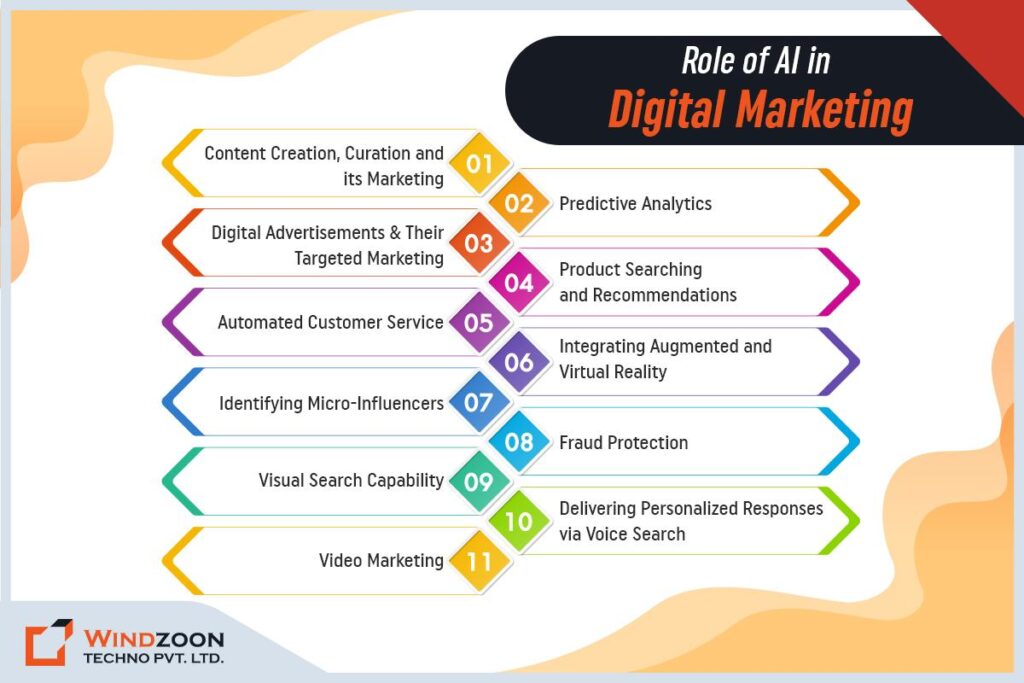
role-of-ai-in-digital-marketing


Following are some routine AI in digital marketing examples:

1. Content Creation, Curation and its Marketing

Artificial Intelligence (AI) is revolutionizing the field of content creation by automating routine tasks and enabling the generation of personalized content on a large scale. Natural Language Generation (NLG) algorithms, such as ChatGPT and BARD, are at the forefront of this change. They can produce various forms of content including blog posts, product descriptions, and social media updates, all while adhering to specific brand guidelines and catering to audience preferences.

In addition to content creation, AI plays a crucial role in content curation. AI-powered tools are adept at navigating the vast sea of online content to pinpoint relevant and trending topics. These tools are not just limited to content discovery; they also aid in determining the most suitable type of content for different platforms and the optimal timing for distribution. This ensures that the content reaches the intended audience effectively and efficiently.

Furthermore, in the realm of AI-driven content marketing, these technological advancements extend to providing data-driven insights and feedback to content creators. By establishing a continuous feedback loop, these tools empower marketers to refine their content creation strategies continuously. They can track and analyze their performance relative to competitors, paving the way for enhanced content quality and more successful marketing outcomes.

2. Predictive Analytics

The use of AI-driven predictive analytics has revolutionized the process of generating and nurturing leads. AI excels in sifting through millions of social media trends and posts, identifying patterns in text, images, and hashtags. Through this analysis of historical data, AI algorithms are capable of pinpointing potential customers with a higher likelihood of conversion. This enables marketers to concentrate their resources on more promising leads.

Additionally, AI is adept at anticipating customer behaviors, such as the likelihood of them discontinuing service, known as churn. This predictive capability allows for preemptive actions to maintain customer loyalty. This adaptability is crucial for marketers to respond to changing market dynamics, ultimately boosting the brand’s performance as new data unfolds.

3. Digital Advertisements & Their Targeted Marketing

Aside from assisting marketers in reaching the correct audience, AI in digital marketing brings up a plethora of chances for businesses to construct new ad campaigns across platforms such as Google, Facebook, and Instagram. These platforms examine user data, including gender, age, interests, demographics, and other personal characteristics, to deliver the optimal experience.

AI ensures, for instance, that people who have been searching for bicycles online get more advertisements for bicycles or riding gear rather than irrelevant items like lawnmowers in their search results.

Targeted Marketing allows AI algorithms to ensure that the user receives the most relevant adverts, therefore boosting the performance of the digital ads provided.

Here, since you are paying for each ad that is shown to a user, you have the choice of who sees your adverts. To provide personalized client experiences, you must first anticipate different consumer categories and include smart designs in digital marketing campaigns.

4. Product Searching and Recommendations

Artificial intelligence improves the accuracy of finding things that customers wish to purchase and presents recommendations for those products. AI-powered product recommendations help consumers locate the products they want to buy.

This is like a friendly store associate who can recall everything you’ve ever liked or purchased. When you look for products online, AI leverages your previous searches and purchases to suggest other items you might be interested in.

On the other side, the right AI tools allow digital marketers to make more accurate and timely forecasts about which things people will purchase. This boosts sales and allows firms to showcase products to potential buyers who have previously decided that they are worthwhile and efficient.

5. Automated Customer Service

Artificial intelligence facilitates automated customer service. It encompasses tasks like sending out messages, providing automated responses through chatbots, delivering results from surveys, and responding to inputs on various online platforms.

Chatbots, powered by AI, are a prominent example of this technology in action. They have revolutionized customer support by offering immediate assistance to users around the clock.

These AI-driven virtual assistants are capable of handling standard inquiries, supplying information about products, and assisting customers throughout their purchasing journey.

Equipped with Natural Language Processing (NLP), chatbots can comprehend and interact with human language, creating a smooth and individualized conversation experience. This level of automation not only conserves time and company resources but also ensures uniformity in customer service across multiple channels.

6. Integrating Augmented and Virtual Reality

Artificial Intelligence (AI) is set to significantly boost the development of Virtual Reality (VR) and Augmented Reality (AR) in the coming years. This emerging marketing approach is outshining traditional methods like billboards and print advertisements.

By blending the virtual world with real-world settings, it offers customers an entirely new and engaging experience. AR, in particular, opens the door to limitless immersive experiences.

Imagine offering interactive product demonstrations or transporting customers directly into your store through virtual showrooms. AR is the key element in transforming standard marketing efforts into extraordinary, memorable journeys.

Hence, prepare to amaze your customers as they interact with your brand in unprecedented ways. Remember, the future of marketing transcends mere product selling; it’s about crafting unforgettable experiences.

7. Identifying Micro-Influencers

This is about finding the right people online to promote products. Micro-influencers are like mini-celebrities on social media; they have fewer followers than big stars but are often more connected to their audience.

AI helps businesses find these micro-influencers. It looks at data like who’s talking about certain topics or products and how people respond to them. This way, businesses can partner with the right micro-influencers who fit with their brand and will appeal to their target customers.

8. Fraud Protection

AI in digital marketing services is like a digital security guard. It helps protect online transactions from fraud. AI systems can learn to spot unusual patterns, like if someone tries to buy a lot of things in a very short time or from a different country than usual.

This can signal a fraudulent transaction. By identifying these patterns, AI can alert the business and help prevent fraud, making online shopping safer for both the business and the customers.

9. Visual Search Capability

Visual search technology, driven by AI algorithms, enables consumers to search using images instead of text or keywords. This advanced search method allows users to find items online by simply using pictures. Google Lens stands as a prime example of this AI-powered Visual Search Capability in the digital marketplace.

This technology is particularly beneficial for those who may not know how to accurately describe what they are looking for, or for those who are not familiar with the specific vocabulary of an item. Consequently, visual search offers a practical solution, bypassing the challenges people encounter when they input incorrect terms in a search bar.

Voice recognition technology, like Alexa playing music or Siri setting alarms, is gaining global popularity. Marketers must recognize the importance of optimizing websites for voice search, as this shift underscores its growing significance.

Artificial Intelligence enables devices to understand and respond to voice commands using natural language. Have you come across Machine Translation Post-Editing? This advanced technology combines native translators’ expertise to create accurate multilingual content that effectively communicates marketing messages, all while minimizing errors. In digital marketing, AI is paving the way for swift conversion of content into multiple languages, catering to diverse customers.

Furthermore, companies can now obtain immediate insights into customer interactions across various communication channels. Backend teams can use this information to automatically route issues to the right support group and employ statistical models to identify the most effective next steps.

11. Video Marketing

Videos have emerged as a potent tool for disseminating knowledge and information. In the past year, there has been a significant surge in video consumption, particularly in live-streaming content.

In response to this trend, businesses are increasingly leveraging artificial intelligence to enhance the effectiveness of their video marketing strategies. AI aids companies in gaining deeper insights into their consumers’ viewing patterns, helping them understand customer behavior, provide tailored content, and ultimately, increase the Return On Investment (ROI) of their video content.

All the digital marketing applications discussed are integral to the Real-Time Optimization approach in ongoing marketing strategies, setting a foundation for automated sales predictions. Future advancements in AI will further enable businesses to operate at optimal profitability, elevate sales, and make adjustments based on concrete data.

Benefits of AI in Digital Marketing Services

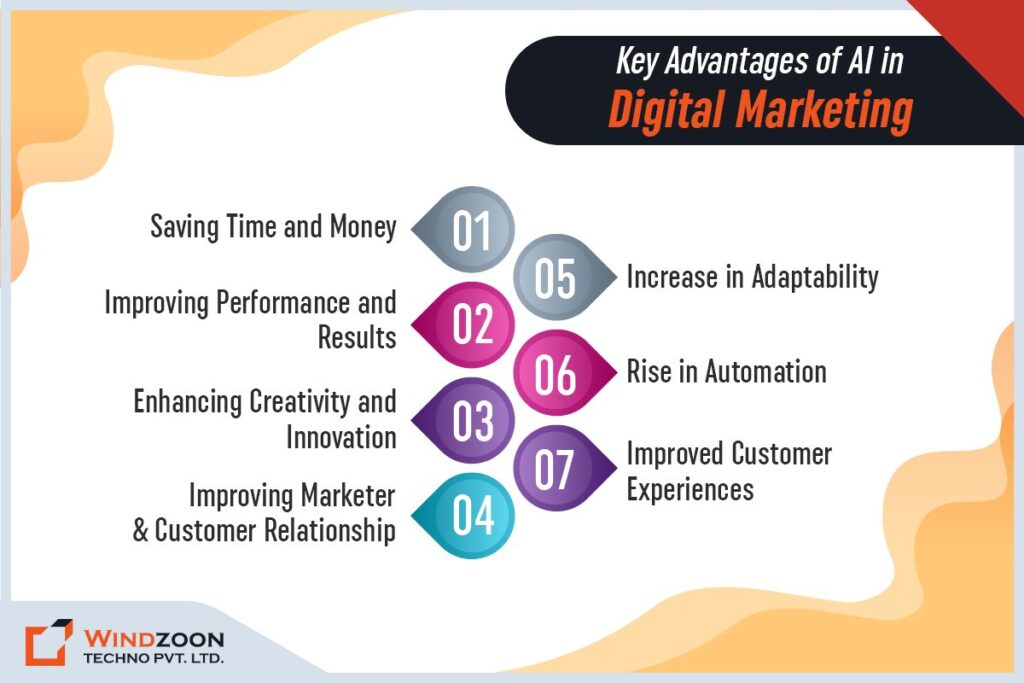
advantages-of-ai-in-digital-marketing

Here are some of the significant advantages of Artificial Intelligence in Digital Marketing.

  1. Saving Time and Money: AI streamlines marketing processes, automating tasks that humans usually perform. This automation saves considerable time and reduces costs, as AI can handle tasks like data analysis and customer service inquiries quickly and efficiently.
  2. Improving Performance and Results: AI’s ability to analyze vast amounts of data helps businesses make more informed decisions. It can predict customer trends and preferences, leading to more effective marketing strategies and better results in terms of sales and customer engagement.
  3. Enhancing Creativity and Innovation: AI provides marketers with new tools and insights, sparking creativity. It can suggest content ideas, design layouts, and even help in creating personalized marketing messages, pushing the boundaries of traditional marketing.
  4. Improving Marketer and Customer Relationship: AI helps in personalizing customer interactions, making them more meaningful. By understanding customer behavior and preferences, AI enables marketers to communicate with customers more effectively, building stronger relationships.
  5. Increase in Adaptability: With AI, marketers can quickly adapt to changes in the market or consumer behavior. AI’s real-time data analysis helps businesses stay agile and responsive to new trends or customer needs.
  6. Rise in Automation: Automation in digital marketing, powered by AI, includes everything from automated email campaigns to chatbots handling customer service inquiries. Due to this efficiency, businesses can concentrate on more strategic responsibilities.
  7. Improved Customer Experiences: AI enhances the customer experience by providing personalized recommendations, quick responses to inquiries, and more engaging content. This tailored approach makes customers feel understood and valued, increasing their loyalty to a brand.

Significant AI Tools for Digital Marketing Services

The following are 19 AI marketing tools you need to try in 2024:

  1. Jasper AI: For copywriting
  2. Surfer SEO: For SEO content writing
  3. Content at Scale: For generating SEO blog posts
  4. Originality AI: For detecting AI-generated content
  5. Writer.com: Content writing tool for teams
  6. FullStory: For analyzing digital experiences
  7. Zapier: For automating various tasks
  8. Hemingway App: For editing and improving content
  9. Chatfuel: For creating chatbots
  10. Grammarly: For content editing and grammar checking
  11. Albert.ai: For digital advertising
  12. Headlime: For designing landing pages
  13. Userbot.ai: For managing conversations
  14. Browse AI: For web page scraping
  15. Algolia: For search and recommendation APIs
  16. PhotoRoom: For removing backgrounds from images
  17. Reply.io’s AI Sales Email Assistant: For managing email replies
  18. Brand24: For media monitoring
  19. Influencity: For influencer marketing

Wants to Leverage AI-Enabled Digital Marketing Services?

The incorporation of AI in digital marketing is poised to alter the industry, increasing the effectiveness and efficiency of marketing efforts while providing improved customer experiences. With fresh and fascinating advancements anticipated in the upcoming years, artificial intelligence in digital marketing has a bright future.

To take advantage of this bright future, you will need the help of a next-gen AI-enabled digital marketing company that helps businesses grow and thrive in the digital world.

We at Windzoon offer innovative AI-enabled digital marketing services to scale up our clients’ businesses. Our team of professional digital marketers love going above and beyond to achieve our clients’ goals.

Hence, don’t wait any longer; contact us now to get a quote and leverage our services.

Know the Best Angular SEO Practices to Build Amazing Web Apps

Do you know? What is the common aspect in popular web apps like Netflix, PayPal, UpWorks and WikiWands? Yes, these web apps have been built using Angular. It is a popular JavaScript framework developed by Google and used by around 3,28,839 web apps.

However, is this the only reason why those web apps are popular in the digital landscape? Certainly not. To be successful on search engine result pages (SERPs), proper utilisation of SEO (Search Engine Optimization) (also known as search engine optimization seo) techniques is crucial. Because according to data, organic traffic is responsible for 53% of a website’s traffic.

But, much like any other JavaScript framework, Angular creates dynamic content on the client, not on the server side. As a result, search engine crawlers could require assistance to accurately analyse and index your web pages, which could result in lower rankings in search results. These are some of the seo challenges faced by Angular applications, especially due to client-side rendering and dynamic content.

You may avoid these drawbacks by implementing a few Angular SEO practices in your web app. As the best SEO company in India and the USA, we have listed some top Angular SEO tips in this blog to assist you. Using these techniques to optimize your Angular web app will significantly increase its position on SERPs. It is also important to ensure your Angular app is accessible and user-friendly for mobile devices, as a large portion of users access websites through smartphones and tablets.

Thus, let’s start our discussion with the very first question:

What does SEO mean in Angular?

SEO in Angular refers to Search Engine Optimisation approaches used within an Angular application. So that, it can boost its visibility and ranking in search engine results.

Angular is a client-side framework that renders web pages with JavaScript. However, search engines typically crawl and index HTML content.

To improve SEO, Angular developers can use server-side rendering (SSR), pre-rendering, meta tags, structured data, and friendly URLs. All of these increase search engine accessibility and discoverability of Angular applications.

Optimizing Angular apps involves a combination of these techniques, such as using Angular Universal for server-side rendering, implementing service workers to improve load times, and managing metadata, to achieve better search engine visibility.

Now, we will learn the importance of SEO for Angular web apps.

Why SEO is Crucial for Angular?

1. It Offers a Better User experience

It’s critical to optimise your website pages for both users and search engines. You can increase user engagement and conversion rates by providing high-quality content, improving page headers and descriptions, and shortening page load times. Optimizing page load speed is essential for both user experience and SEO.

2. It Increases Credibility and Authority

Search engine users usually place higher trust in websites and web applications that rank well in search results. Thus, optimising your Angular application for SEO may help you get more respect and authority in your industry. Moreover, make it more likely that users will see and engage with your content.

3. It Improves Visibility and Discoverability

Due to SEO, your web pages will rank higher on search engine results pages (SERPs). This makes them more visible to users searching for related phrases. Making your Angular application SEO-friendly may increase the possibility that users will locate your website pages. Providing search engines with relevant metadata and structured data is essential to enhance discoverability and ensure your content is properly indexed. It ultimately generates more noteworthy traffic for your website.

4. It Brings a Competitive Advantage

With so many websites and online applications vying for the same keywords and phrases, SEO is extremely competitive. However, you might outperform competing websites in your niche and boost traffic, engagement, and conversions by making your Angular application SEO-friendly.

Next, we will see the key SEO limitations in Angular.

What are the limitations of SEO in Angular?

1. Problem in JavaScript Rendering

The primary issue is how search engine crawlers understand JavaScript-rendered information. In conventional static websites, the server transmits fully-rendered HTML to the client, making it simple for search engines to crawl and index the material. But with Angular SPAs, a large portion of the page content is dynamically produced and shown on the client side using JavaScript, a process known as client side rendering.

Although Google’s capacity to crawl and index JavaScript material has dramatically improved over time, it is still more difficult than with static HTML. Google indexes JavaScript websites using a two-step procedure. The pre-rendering step involves crawling the raw HTML file, while the post-rendering phase involves rendering and indexing the JavaScript-generated content. This process normally takes a few seconds to a few minutes. Dynamic content rendering, where content is loaded dynamically after the initial page load, can further challenge search engines because the content is not present in the initial HTML source.

However, this two-step procedure has several built-in restrictions:

  • Delay in indexing: The pre-rendering and post-rendering steps require some time, so the material rendered in JavaScript may take longer to index. This delay may influence your website’s visibility in search engine results pages (SERPs).
  • Incomplete crawling: Not all search engines can efficiently crawl JavaScript-rendered content. As a result, even though your Angular website may rank highly on Google, other major search engines may not fully index it. Because many other search engines, such as Bing, Yahoo, and Baidu, have historically lagged in their ability to comprehend JavaScript.
  • Greater utilisation of resources: JavaScript rendering necessitates higher computational resources on the part of both search engines and user devices. This may slow down indexing and affect page load time, which is important for user experience and SEO rankings.

2. Lack of Semantic HTML

Semantic HTML elements such as <header>, <footer>, <article>, and <section> offer crucial context about your content to search engines, improving crawl ability and reducing crawl expenditure.

However, Angular web applications mostly employ generic <div> and <span> components for rendering, which lack the semantic context of conventional HTML elements.

3. Limited URL Structure

Different views in an Angular SPA are often loaded under the same URL, with JavaScript controlling view changes.

Although it improves user experience, this can have negative effects on SEO. Because these dynamically loaded views are published under the same URL, search engines have a difficult time distinguishing between them. This leads to a decrease in the number of pages that are indexed and the potential loss of organic traffic. Implementing proper internal links is crucial in this context, as they help improve crawlability and ensure that search engines can discover and index deeper pages within the site structure.

4. Loading Speed Limitations

The speed of Angular apps is a big drawback that reduces their SEO friendliness. Apps built using Angular are powerful, scalable, and user-friendly. What they aren’t usually is speed optimised. Most angular websites load as blank screens for a few strange seconds before generating the home page. Due to this, customers leave the website before they ever get there or use it. Speed improvements are crucial for SEO, as faster loading times help retain users and improve search rankings.

To diagnose and address performance issues in Angular apps, tools like Google PageSpeed Insights can be used to identify areas for further speed improvements and enhance overall SEO

5. Need for Additional Plugins and Configurations

While angular has many benefits for SEO, it also needs extra plugins and modifications to improve its functionality for search engines. For developers who are unfamiliar with Angular and SEO best practices, this can be time-consuming and difficult. Furthermore, these plugins and modifications may need to be updated regularly to stay up with changes in search engine algorithms and technology.

Is it possible to do SEO in Angular?

Yes, SEO can be done in Angular. Although Angular is a client-side JavaScript framework, there are ways to optimise Angular applications for search engines. To optimize Angular for better search engine visibility and performance, developers can implement various strategies such as server-side rendering, meta tag management, and performance optimization.

For example, server-side rendering (SSR) can be used to generate fully-rendered HTML content. This allows search engines to simply crawl and index it. SSR and pre-rendering techniques contribute to improved SEO by enhancing search engine indexing, improving initial load times, and boosting overall SEO performance. Pre-rendering and dynamic meta tags can also be utilised to optimise Angular apps for SEO.

Pre-render pages for specific routes generate static HTML, which can result in faster load times and better SEO performance.

Additionally, best practices like using clean URLs, enhancing page load time, and offering pertinent and structured information will further enhance the SEO effectiveness of Angular applications (which we will discuss in detail after this).

SEO Best Practices for Angular

1. Shift to Server-Side Rendering with Angular Universal

Angular Universal is a technology that enables Angular apps to be rendered on the server. By leveraging Angular Universal to enable server-side rendering (SSR), you can significantly improve SEO, as your application can build static HTML pages on the server that can be transmitted to the client instead of the raw JavaScript files. In this method, just like with a conventional website, search engine crawlers get a fully rendered page.

Steps to Employ Angular Universe:

Step 1: Establish a New Angular App

To build a new Angular application, use the following command:

ng new project-name –style=scss

Step 2: Download and install Angular Universal, then update your project files.

Make use of Angular Schematics to quickly incorporate Angular Universal into your project:

ng add @nguniversal/express-engine –clientProject project-name

When you execute the command in step 2, your Angular app generates and alters these files in your Angular web app.

CREATE   src/main.server.ts (298 bytes)

CREATE   src/app/app.server.module.ts (318 bytes)

CREATE   tsconfig.server.json (325 bytes)

CREATE   server.ts (2015 bytes)

UPDATE   package. json (2110 bytes)

UPDATE   angular.json (5247 bytes)

UPDATE   src/main.ts (432 bytes)

UPDATE   src/app/app.module.ts (359 bytes)

Step 3: Put your app to the test.

Testing your app is one of the most crucial steps in any app development project. Once you have correctly completed all of the previous stages, test your app with the following command:

npm run build: SSR && npm run server: SSR

When this code is deployed, your web application will be able to create and run with server-side rendering.

But keep in mind that while SSR considerably enhances SEO, it may increase server load, therefore consider using caching techniques to address this issue.

Bonus Tip: Use Pre-rendering

Pre-rendering is the process of assembling the page into a static file in advance to have a quicker initial load time on the client-side. This is also known as angular pre rendering.

You may accomplish this by utilising angular universal’s pre-rendering capability.

The difference between SSR and pre-rendering is that the latter renders the index.html page in advance so that it may be provided as a static asset. The former renders the index.html file on the spot when a request is made using a node.js server. If you have smaller applications or pages and their data is updated less frequently, prerendering is the way to go.

Additionally, static site generation is another approach that pre-generates HTML pages at build time, further improving performance and SEO in Angular apps.

2. Set Up Titles and Metadata

Text fragments called “meta tags” describe the contents of web pages. Meta tags are found in the page’s source code rather than on the page itself. Meta tags are merely tiny content descriptors that help describe to search engines what is the subject matter of a website’s content. Since almost all social media platforms utilise these tags to preview the link, they are very crucial when social sharing. In Angular applications, using meta and title services is essential for optimizing SEO, as they allow you to dynamically manage and update page titles and meta descriptions for better search engine visibility.

To simplify the rendering and management of meta tags on each page, utilise the Meta class from @angular/platform-browser. Meta services play a key role in managing and optimizing meta tags, including meta descriptions, to ensure each page is properly represented in search results.

With the help of the Title class imported from @angular/platform-browser, title tags can be rendered dynamically. Title services are important for managing page titles and ensuring each page has a relevant and optimized title for SEO.

See the codes here to utilize this technique:

import { Title, Meta } from ‘@angular/platform-browser’;

constructor(private titleService: Title, private metaService: Meta) {}

setSEOData(title: string, description: string) {

this.titleService.setTitle(title);

this.metaService.updateTag({ name: ‘description’, content: description }); // Set the meta description using the Meta service

}

It is important to optimize meta tags and meta descriptions for each page to improve search engine rankings. By dynamically updating page titles and meta descriptions for pages dynamically loaded in Angular apps, you enhance search engine crawlability and user experience. Optimizing meta tags for each page increases your site’s visibility in search results and supports better SEO performance.

3. Leverage Lazy Loading & Image Optimization

Your SEO score is significantly influenced by website load speed. To keep users on the page, it’s imperative to keep the first page load time as short as possible.

As we all are aware Angular applications are usually large. Therefore, it means that our Angular application’s initial loading time may be longer, which could negatively impact your SEO performance.

Here’s when lazy loading comes into action. Implementing lazy loading is a key technique for improving performance and SEO in Angular apps. By segmenting your application module into manageable bits, lazy loading enables on-demand, lazy downloads of modules.

The application’s performance can be greatly improved by lazy loading, which also speeds up initial load times.

4. Make Use of Structured Data (Schema) Markup

Structured data markup, is commonly referred to as schema markup. It is a method of providing extra metadata that describes the information on our pages. It makes your content more understandable to search engines, helping search engines understand the context and meaning of your pages for better indexing and rich results.

Additionally, it might enable rich snippets for your pages and increase your presence on search engine results pages. Moreover, this is the preferable method because Google highlights pages based on these criteria.

For even better SEO, you can manage private meta information such as meta descriptions, keywords, and titles using Angular’s Meta service. This allows you to dynamically update metadata, especially when using Angular Universal or SSR, ensuring search engines can properly index your pre-rendered content.

Here is a straightforward illustration of structured data for a recipe page:

< script type=”application/ld+json”>

    {

      “@context”: “https://schema.org”,

      “@type”: “ItemList”,

      “itemListElement”: [

        {

          “@type”: “ListItem”,

          “position”: 1,

          “url”: “https://example.com/apple-pie.html”

        },

        {

          “@type”: “ListItem”,

          “position”: 2,

          “url”: “https://example.com/blueberry-pie.html”

        },

        {

          “@type”: “ListItem”,

          “position”: 3,

          “url”: “https://example.com/cherry-pie.html”

        }]

    }

    </script>

To make this work seamlessly in your Angular application, utilise the ngx-json-ld package! This package is extremely lightweight and simple to use.

5. Skipping JS Hydration for Particular Components

A progressive web app, often known as a PWA, is an online application that has several features (similar to those found in native apps). It gives users an app-like experience. PWA enables web applications to be added to a user’s mobile (or desktop) home screen as a native app without even going through the app deployment procedure.

Since Angular already comes with this capability, implementing PWA in it is a breeze. The SEO part of PWA is primarily focused on offline caching. It means, when a visitor views your page, the data is cached on the device. This enables the page to serve more quickly the next time, improving the user experience.

ng add @angular/pwa — project *project-name*

With this simple command, you may add customizable PWA capabilities to your Angular application. When a user views your application, an offline version of the app is made available.

6. Implement Proper Routing

Different views in an Angular SPA are loaded dynamically under the same URL, which might be problematic for SEO.

To increase the discoverability and indexability of your content by search engines, you can use Angular’s router module to link various views to distinctive URLs.

For instance:

const routes: Routes = [

{ path: ‘page1’, component: Page1Component },

{ path: ‘page2’, component: Page2Component }

];

@NgModule({

imports: [RouterModule.forRoot(routes)],

exports: [RouterModule]

})

export class AppRoutingModule { }

The above code generates two separate URLs (/page1 and /page2) for both the Page1Component and Page2Component.

7. Avoid Using Hash-based URLs

Routing is supported by Angular by default using hash-based URLs, such as www.example.com/#/page1. Hash-based URLs, however, are less SEO-friendly because search engines frequently overlook the portion of the URL that comes after the hash.

By setting the useHash configuration option to false in your routing module, you may convert to using URLs that follow the HTML5 pushState format:

@NgModule({

imports: [RouterModule.forRoot(routes, { useHash: false })],

exports: [RouterModule]

})

export class AppRoutingModule { }

8. By Enabling Canonical URLs

Duplicate content may jeopardise your SEO rankings, and it’s crucial for Angular apps because different URLs can show the same content.

Canonical URLs assist search engines in determining which version of a page to index and show in search results.

To successfully add a canonical URL to your page, utilise Angular’s Meta service. Angular’s Meta service allows you to dynamically set canonical URLs for each view, which helps improve SEO and avoid duplicate content issues:

import { Meta } from ‘@angular/platform-browser’;

constructor(private metaService: Meta) {}

setCanonicalURL(url: string) {

let link: HTMLLinkElement = this.metaService.getTag(‘rel=”canonical”‘);

if (!link) {

link = this.metaService.create(‘link’);

this.metaService.addTag({ rel: ‘canonical’, href: url });

} else {

this.metaService.updateTag({ rel: ‘canonical’, href: url });

}

}

Each time a new view is loaded, your component can use the setCanonicalURL method with the chosen canonical URL.

9. Take Advantage of Service Workers

Service workers are a great method to enhance the usability and performance of your Angular applications, which further enhances your SEO. These particular web workers provide features like caching, push notifications, and background syncs by operating independently of the main browser thread.

Here are some reasons why they could be a useful addition to your Angular app:

  • Offline abilities: Service workers have the ability to cache resources from your application, making it accessible when there is no network or poor network. This guarantees a seamless user experience, which is a crucial feature that search engines take into account.
  • Quick load times: Service providers can significantly shorten load times by delivering cached content. This improves page speed—a crucial element in SEO rankings.
  • Background information: To guarantee that customers always receive the most recent version of your application, service workers can refresh the cached resources in the background.

Angular has an excellent service worker library called @angular/service-worker. <

Here’s a straightforward application of the Service Worker Library:

The first step is to use the Angular CLI to add the service worker package to your project:

ng add @angular/pwa

Now, add the ServiceWorkerModule to your AppModule:

import { ServiceWorkerModule } from ‘@angular/service-worker’;

import { environment } from ‘../environments/environment’;

@NgModule({

declarations: [

AppComponent

],

imports: [

BrowserModule,

ServiceWorkerModule.register(‘ngsw-worker.js’, { enabled: environment.production })

],

providers: [],

bootstrap: [AppComponent]

})

export class AppModule { }

Create a service worker configuration in the ngsw-config.json file. From here, you can define the files and routes to the cache.

Keep in mind that service workers only operate over HTTPS for security reasons, with the exception of development on localhost.

Most Useful Tools for Angular SEO

1. Angular Universal for Server-Side Rendering

As we’ve already covered, Angular Universal is an essential tool for improving SEO in Angular applications. It enables the pre-rendering of Angular apps on the server, producing static HTML pages that are simple for search engine bots to crawl.

Angular Universal not only improves search engine indexing but also contributes to speedier performance and first-contentful-paint times. Hence, it’s a crucial remedy for the SEO problems that client-side rendered JavaScript apps have.

2. Ngx-seo

Ngx-seo is a wonderful package that will assist you in managing metadata in your Angular web application. It offers a simple API for dynamically updating the metadata of your pages, which is very helpful for single-page applications.

The library is capable of managing conventional metadata, Open Graph metadata, and Twitter Card metadata—all crucial for successful SEO.

You must first install Ngx-seo using npm, import the module, and then use its services to modify your page’s information as necessary.

3. Scully

Scully is an Angular static site generator, sometimes known as the “Jamstack solution for Angular.”

It takes your application and turns it into a static site that can be simply delivered, giving you the SEO advantages of server-rendered apps while keeping the benefits of SPAs for development.

Scully’s pre-rendered pages are simple for search engine crawlers to index, resulting in high visibility on search engine result pages. Additionally, Scully includes plugins for lazy-loading images, making an XML sitemap, and more that all support your SEO efforts.

4. NgOptimizedImage

Angular has a special directive for optimising images called NgOptimizedImage.

This directive enables you to use several image optimisation strategies that can significantly enhance the performance of your application, including lazy loading, responsive images, and present picture formats like WebP.

Optimising your pictures with NgOptimizedImage will dramatically improve the SEO of your Angular app because page speed is a key ranking element for SEO.

5. Yoast SEO

Yoast SEO is a well-liked and useful tool for enhancing Angular SEO. While Yoast SEO is most known for its WordPress integration, it also includes an Angular plugin that aids in the optimisation of Angular applications.

It offers functions including generating XML sitemaps, managing meta tags, readability analysis, and content analysis. With Yoast SEO, developers can easily optimize their Angular apps for search engines. Additionally, using Google Search Console is essential for submitting sitemaps and monitoring website performance, which helps further optimize Angular applications for better search engine indexing.

They accomplish it by ensuring correct metadata, keyword usage, readability, and overall SEO best practices, ultimately improving the exposure and ranking of their Angular websites in search engine results. It’s also important to regularly identify and fix broken links, as these can negatively impact SEO by causing 404 errors and affecting search engine rankings.

While Angular is an effective framework for creating dynamic websites, there are several SEO-related issues that need to be resolved. These restrictions can be removed by adhering to established practices for optimising Angular web pages for search engines.

If you continue to think that integrating SEO best practices into your Angular web app will be difficult for you, you can always get assistance from a local SEO agency.

Windzoon is a prominent web app development and digital marketing company. We have more than 8 years of experience creating Angular web app solutions that are SEO-optimized.

Hence, leverage our Angular web development services and professional SEO services to develop complete SEO-optimized Angular solutions. Contact us to get a quote and to know more about us.


7 Enterprise SEO Strategies That Boost Your Online Authority

Picture yourself driving your trusty old truck down a dusty road. Suddenly, disaster strikes – one of your tires blows out, leaving you stranded. You must change the tire, but do you use a regular car jack or a specialized one made for trucks like yours?

Off course you would choose a truck jack, as a car jack doesn’t have the capacity to lift your truck. Just like that when your enterprise website is falling down in SERPs ( Search Engine Result Pages), you would need the help of enterprise SEO to uplift its ranking rather than regular SEO.

Since 93 percent of all online encounters start with a search engine and more than 50 percent of all website traffic comes from organic search, your choice of SEO methods may be the secret to your success in the online sphere.

As a prominent digital marketing agency, we will help you navigate through the world of enterprise SEO. Where we’ll explore the most effective tactics and strategies that can help your business navigate the ever-changing terrain of the online landscape. So, buckle your seatbelt and get ready for the journey.

What is Enterprise SEO?

It is a major league online marketing technique for big-shot businesses. And when I say “big-shot,” I’m not referring to their revenue. Instead, I’m talking about their website’s complexity and the number of pages it’s got.

Enterprise SEO involves optimizing a jumbo-sized website with intricate architecture and multiple pages to improve its visibility and ranking on search engines. That’s why it’s called “Enterprise” SEO, typically applied to large organizations with significant online presence and resources.

For instance, a software behemoth like Microsoft needs a strong Enterprise SEO strategy to maintain its online presence. Given that Google has indexed an incredible 100 million pages from its websites, Microsoft must manage them all, right?

That’s where their Enterprise SEO plan, which entails optimizing product pages, creating top-notch content, and constructing excellent backlinks, comes in. They also make sure that their branding and messaging are consistent across all areas and languages.

With a solid Enterprise SEO strategy, Microsoft can streamline their online operations and offer a seamless experience to its clients, solidifying its position as a leader in the tech industry. And eventually, accomplishing their objectives of raising organic traffic, boosting brand recognition, and driving revenue growth.

But here comes the million-dollar question and that is:

What is the Difference Between SEO & Enterprise SEO?

As I explained above, your business SEO plan must differ from ordinary SEO because the methods you employ for small-scale SEO won’t always be effective for websites with hundreds or thousands of pages.

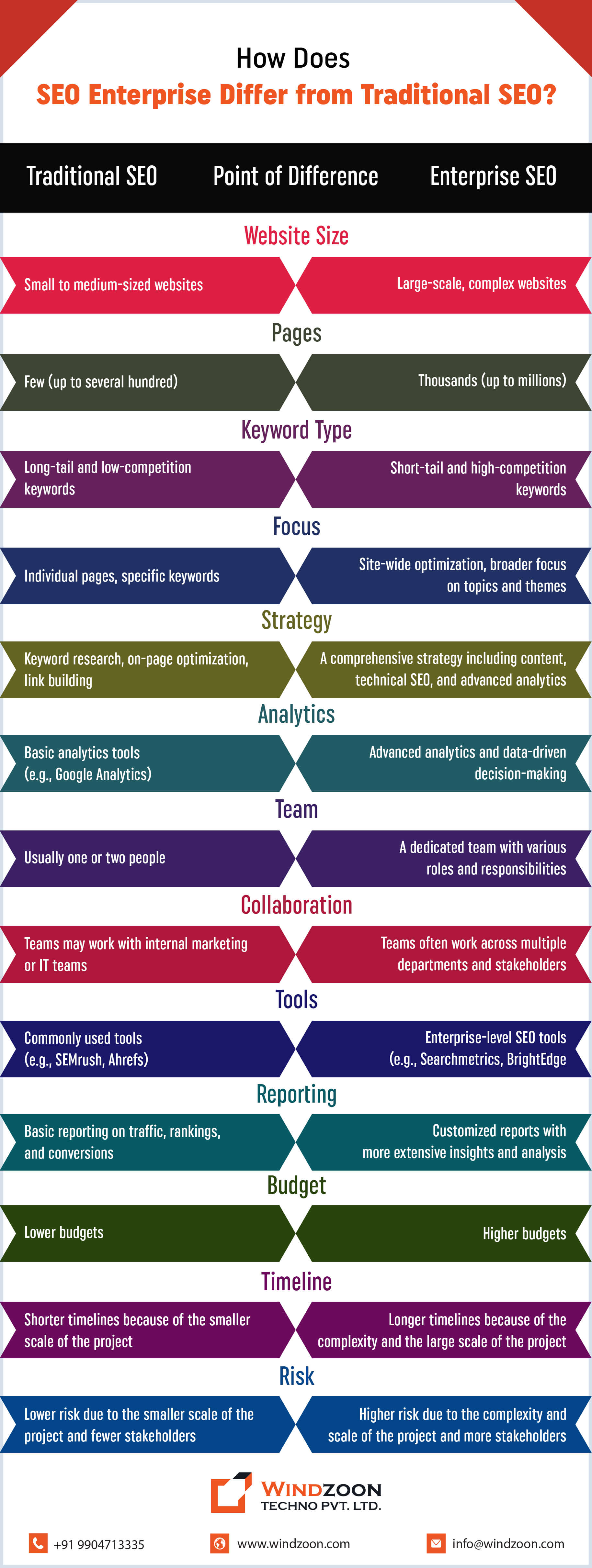
To give you some more understanding, I have prepared a comparison table of traditional & enterprise SEO. It will help you clear your confusion regarding the key difference between both SEO strategies.

difference-traditional-seo-and-enterprise-seo

[wpdatatable id=15]

Read More: SEO vs SMO – Key Difference Between SEO and SMO

Now, comes another significant question and that is:

What is Enterprise SEO Strategy?

Before we get into an enterprise SEO strategy, let’s clear something up: just because you’re a big-shot organization doesn’t imply there aren’t SEO methods tailored to you.

In reality, optimizing a massive website takes more work, time, and a different approach. Hence requires a unique strategy – and that’s where Enterprise SEO comes into play.

The game plan for making large and complex websites more visible to users on search engines is called the Enterprise SEO strategy. It involves SEO experts using various tactics like content optimization, technical SEO, and analytics to increase a website’s ranking, traffic, and sales.

To create an effective enterprise SEO strategy, you need to know your target audience, industry, and the latest SEO best practices.

But don’t worry, you don’t have to do it all on your own – working with an experienced local SEO agency can help you create a personalized plan that addresses your website’s specific needs while also helping you achieve your business objectives.

Now, we will move forward with our next topic of discussion and that is:

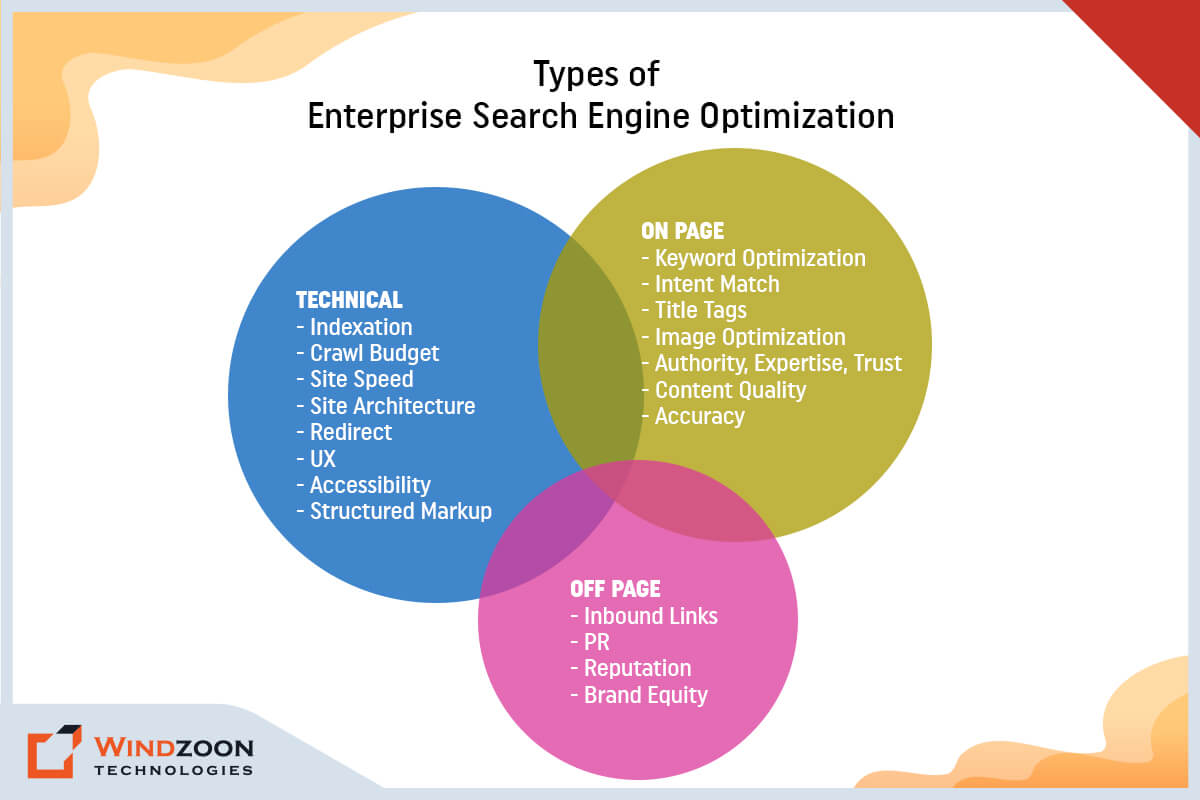
Types of Enterprise Search Engine Optimization

types-of-enterprise-seo

In this section, we will talk about the different types of Enterprise Search Engine Optimization (SEO). And how they can help your website rank higher on search engine result pages (SERPs).

So, First up is Technical SEO. This type of SEO technique involves optimizing your enterprise website’s technical elements such as the site structure, speed, security, and mobile-friendliness. By ensuring your website is easily accessible and user-friendly, you can improve its visibility and search engine ranking.

After this, the next one is on-page SEO. This SEO technique focuses on optimizing certain web pages on your website by utilizing pertinent keywords, improving the content, and enhancing the user experience. By offering valuable and informative content, you can draw more visitors to your web page and keep them engaged.

And Finally, there’s Off-Page SEO. This SEO technique consists of promoting your website through external channels like social media, guest blogging, and link building. By building quality links and establishing a strong online presence, you can improve your website’s authority and reputation.

By incorporating all three types of SEO techniques, you can create a comprehensive and effective enterprise SEO strategy that helps your website rank higher on SERPs, attract more traffic, and ultimately, generate more leads and sales.

Our next topic of discussion is one of the important topics of the article, a question that you might be tempted to ask and that is:

What is the Importance of Enterprise SEO?

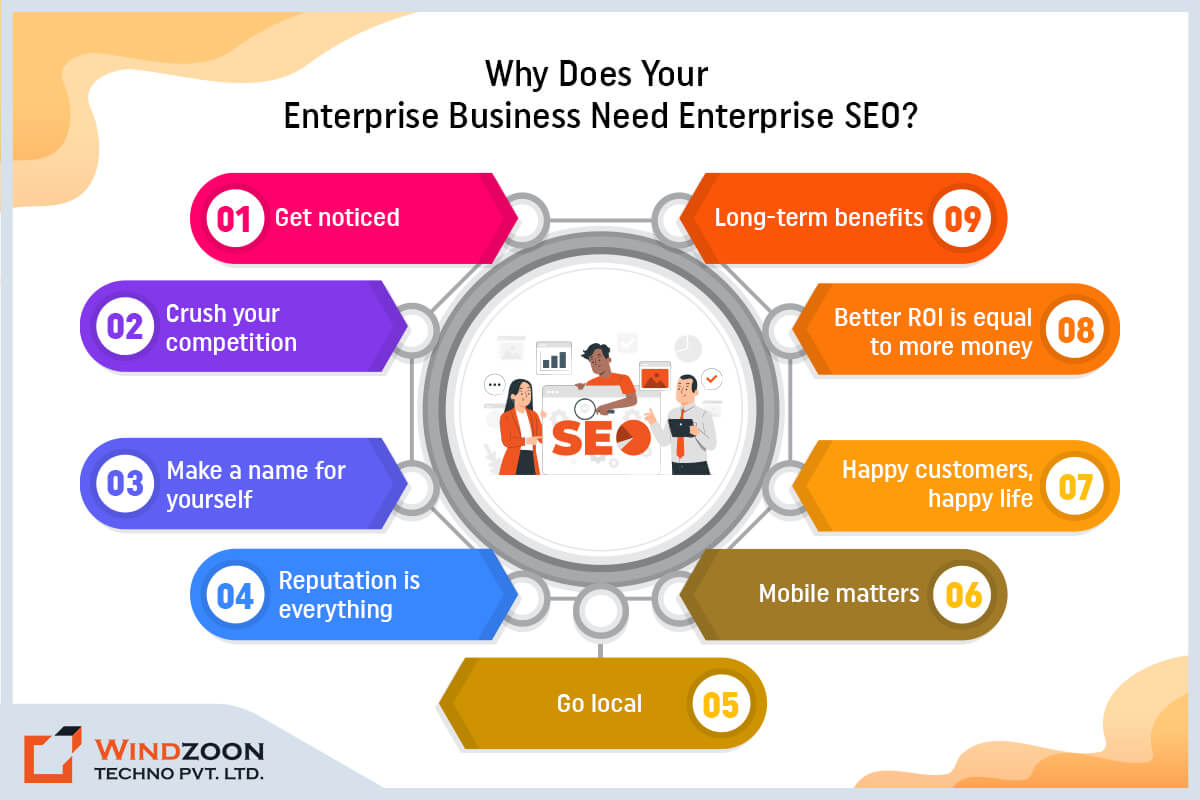
why-business-need-enterprise-seo

Now, let me tell you some awesome reasons why your company needs a digital marketing strategy that is tailored to your enterprise:

1. Get Noticed:

With an enterprise SEO strategy, you can boost your website’s search engine ranking and get it in front of more eyeballs. This means more traffic, which can lead to more sales and growth for your biz!

2. Crush Your Competition:

In today’s digital world, a killer SEO strategy can give you a leg up on the competition. By investing in enterprise SEO, you can stand out from the crowd and attract more customers to your business.

3. Make a Name for Yourself:

An effective enterprise SEO strategy can help increase brand awareness, making your company more recognizable to potential customers. This is huge for building a loyal customer base and growing your business over time.

4. Reputation is Everything:

An enterprise SEO strategy can help you monitor and manage your online reputation. By proactively addressing negative comments or reviews, you can show potential customers that you care and improve your overall reputation.

5. Go Local:

If your biz operates in multiple locations, enterprise SEO can help you optimize your website for local search. This can lead to more foot traffic and sales, and make it easier for customers in each location to find you.

6. Mobile Matters:

An enterprise SEO strategy can also help you optimize your website for mobile devices, which is critical if you have an e-commerce business. By ensuring your site is mobile-friendly, you can attract and retain more customers who are browsing on their phones.

7. Happy Customers, Happy Life:

By optimizing your website for search engines, you can also improve its overall usability, which means happier customers. When customers can find what they need and engage with your brand easily, they’re more likely to stick around and keep coming back for more.

8. Better ROI is Equal to More Money:

Investing in an enterprise SEO strategy can provide a great bang for your buck. By attracting more traffic and generating more sales, you can increase your revenue and profits, which is music to any business owner’s ears.

9. Long-term Benefits:

Enterprise SEO is a long-term strategy that can keep giving back to your organization for years to come. By staying up-to-date with the latest SEO trends and continuously optimizing your website, you can stay ahead of the competition and keep growing your business.

Read More: ECommerce SEO: 12 Useful Tips to Rank Higher and Grow Sales

With this here comes our show-stopper question and that is:

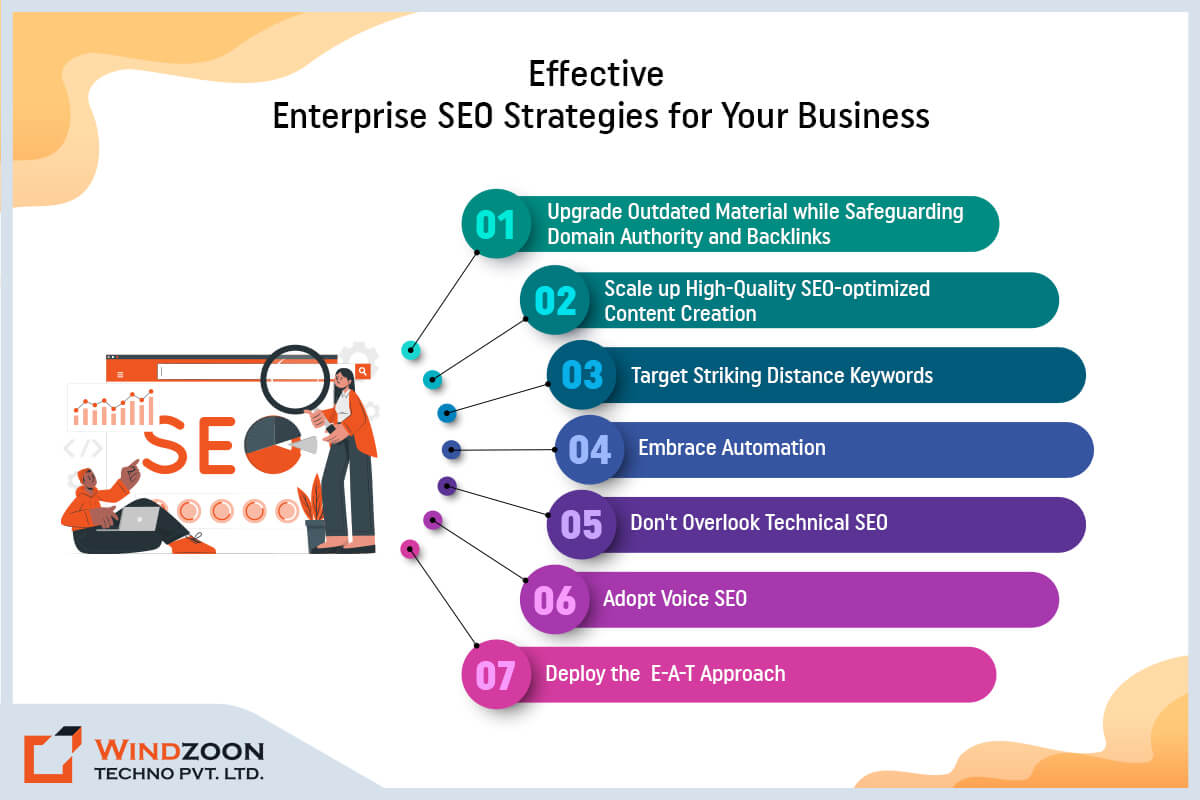
Effective Enterprise SEO Strategies for Your Business

enterprise-seo-strategies

After learning about the amazing reasons to use enterprise SEO, now, it’s time to learn about some of the best strategies for enterprise SEO.

1. Upgrade Outdated Material while Safeguarding Domain Authority and Backlinks

The first useful strategy, which is also one of the obstacles for enterprise SEO teams, is keeping material up-to-date, accurate, and refreshed for current industry standards.

But here’s the catch, when you’re refreshing your content, you need to be careful not to toss out old content with high page authority and backlinks.

Instead, you should refresh your content while straddling the line of adding fresh information without removing secondary keywords that your content is ranking for.

Updating content at an enterprise organization is no walk in the park, let me tell you. It’s a complex process that requires a scalable approach so your SEO team can figure out which pages need to be updated and how to make them more competitive.

Because the ultimate goal of enterprise SEO is to create a method that can be scaled up as your business grows.

2. Scale up High-Quality SEO-optimized Content Creation

Creating high-quality content is clutch when it comes to enterprise SEO.

So, if you’re trying to get your website to the top of search engine results, your content has gotta be SEO-friendly and packed with useful info for your visitors and search engines alike.

But, creating top-notch articles for an enterprise business is no easy feat, and trying to scale up your content production while keeping your quality high can be a real head-scratcher.

So, how do you maintain quality and quantity all at once?

One solution is to get more writers on your team with a solid content brief to make sure all the important elements are covered.

You gotta target the right keywords, include relevant internal links, write compelling meta descriptions, and make sure your meta tags are on point. Plus, improving your readability score and increasing your keyword relevancy score is key.

You can easily manage and optimize your content with content optimization software. Without content optimization software, you’ll be stuck optimizing articles manually, and that’s not gonna help you speed up your content creation process.

There are many content optimization software out there. Or you can even take help from a professional digital marketing agency for optimizing & scaling up your content.

3. Target Striking Distance Keywords

Now, let’s talk about the third bomb strategy for enterprise SEO – Targeting striking distance keywords.

Basically, these are the keywords that are so close (positions 11 to 20) to hitting the top of page one on Google, they’re just a little nudge away. It’s like that runner who’s almost at the finish line, but just needs that extra burst of energy to cross it.

So, why should you focus on these keywords?

Well, because by targeting these keywords, you can make your website more visible and attract more traffic and conversions. It’s a great way to get quick wins for your SEO efforts.

Refreshing your existing content with striking distance keywords is a super quick way to get those keyword wins.

Plus, it gives you a chance to revisit and spruce up your old content. You can update the meta tags, add some fresh internal and external links, and bam – you’re good to go!

Here’s the kicker- It won’t take up too much of your time, but the results will blow your mind.

4. Embrace Automation

Next, we will talk about- automation, and how it can save the day for your enterprise SEO team.

Managing thousands or even millions of web pages can be a real challenge, especially if you’re trying to keep them all up-to-date and optimized for search engines.

But don’t fret! You may save a ton of time and money by streamlining your SEO procedures with the use of automation. Here are a few illustrations of how automation might aid in enterprise SEO:

Automated Site Crawlers: These incredible tools can scan your website and discover any errors, such as missing meta tags, broken links, and duplicate content. This will enable you to swiftly address any issues and keep your website operating flawlessly.

Automated Reporting: No more manually collecting data from various sources! Use automatic reporting systems to collect and evaluate data about the performance of your website. This can assist you in identifying trends, monitoring your progress, and forming wise decisions about your SEO approach.

Automated Content Creation: Who says you need human writers for every little thing? Use automation tools to generate less important content like product descriptions or social media posts. That way, your team can focus on the big stuff.

Automated Link Building: Building backlinks is super important for SEO, but it can be a real-time suck. Use automated link-building tools to find relevant websites and automate the outreach process. That way, you save time and increase your chances of success.

Now now, let’s not get carried away. Automation isn’t a cure-all for SEO success. You still need a solid strategy and skilled team members to make it work. But trust me, automation can make your life way easier!

5. Don’t Overlook Technical SEO

Now comes one of the most important strategies for enterprise SEO and that is technical SEO

Basically, technical SEO means making sure that your website’s technical stuff is in tip-top shape so that search engines can crawl and index your site like a pro.

This includes things like making your site speedy Gonzales, mobile-friendly, secure like Fort Knox, and using structured data markup (sounds fancy, right?).

Now, why is technical SEO so important? Well, think about it. If Google can’t crawl and index your website, then all of your other SEO efforts are basically pointless. So, you gotta get your technical game on fleek.

Here are some things you should focus on for technical SEO:

Site Speed: Nobody likes a slowpoke, especially not Google. So, you gotta optimize your site’s performance. This can include things like squishing those big images down to size, making your code teeny tiny, and caching like a boss.

Mobile-friendliness: Let’s face it, we’re all on our phones 24/7. Hence, having a mobile-friendly website is extremely important. Make sure your site looks good and is easy to use on all devices, big or small.

Security: You wouldn’t want someone snooping around your stuff, right? The same goes for your users. Make sure your site is using HTTPS encryption to protect your users’ info. Plus, Google likes secure sites so that it can boost your SEO game.

Structured Data Markup: This particular approach may sound exotic, but it’s simply a method for Google to comprehend what your site is about. In a nutshell, you may enrich your content with additional information, such as product descriptions or reviews, to help Google deliver more relevant search results to users.

So keep in mind that technical SEO is only a small part of the puzzle. You need to have a well-rounded plan that covers both producing fantastic content and constructing those sweet, sweet backlinks.

6. Adopt Voice SEO

Our next strategy is one of the hottest topics in the world of enterprise SEO and that is Voice SEO!

With the rise of voice-activated technology like Siri, Alexa, and Google Assistant, voice search has become a game-changer in the SEO landscape. Enterprises need to adapt to this new trend and revolutionize their SEO strategies to stay ahead of the game.

Besides, did you know that 27% of the online global population is using voice search on mobile?

That’s quite a huge number! And with voice searches, users are provided with the top result rather than a full search engine result page. So if your enterprise wants to attract the highest inbound traffic, you need to optimize your content for voice search.

The good news is that more and more enterprises are jumping on the voice SEO bandwagon. Take Nestle, for example – they’ve created a custom skill for Alexa that supports voice cooking instructions while the user cooks. How cool is that?

So, how can your enterprise optimize for voice search? Well, for starters, you need to focus on long-tail keywords and natural language. Think about how people speak in everyday life, and use those phrases in your content. Also, make sure your content is mobile-friendly and easily digestible.

7. Deploy the  E-A-T Approach

If you’re tryna be the big kahuna of online searches, you gotta work on your E-A-T game. That’s short for expertise, authority, and trustworthiness, according to Google’s Search Quality Evaluator Guidelines. They use EAT to evaluate content creators, web pages, and websites.

So here comes the question; Why’s Google so hung up on E-A-T?

It’s because they wanna make sure the info they recommend is legit and comes from the real deal experts in that field.

So, the next question is, how can you increase the authority and credibility of your content and website? Simple; get some links, mentions, shares, and reviews to show that people are vouching for you and your stuff.

Besides, Google holds Your Money, Your Life (YMYL) sites to the highest standards as they have a big impact on your safety, security, and overall well-being.

Hence, you can’t fake expertise, authority, and trustworthiness. But with the right E-A-T strategies, your biz can have a killer online presence and snag the top spot on Google search.

Read More: 12 Effective Hotel SEO Tips to Rank #1 on Google

Conclusion

So, as my parting remark, let me repeat the thing which I have been trying to explain from the start of the article. And that is; If you’re looking to rank higher on search engines and want to get more organic traffic, then an enterprise SEO strategy is the only way to go!

However, let’s be real, getting those results takes time, effort, and expert guidance. So, if you’re thinking of adopting an enterprise SEO strategy, it’s probably a good idea to work with a professional SEO services provider to make sure you do it right.

By knowing what search engines are looking for and how users interact with search results, you can create a top-notch SEO strategy that really hits the spot! Plus, by keeping an eye on your progress with regular tracking, reporting, and analysis, you can stay on top of your game.

And guess what? Windzoon is the Best SEO Company around, with tons of experience working with different business models. Our team of seasoned digital marketers and SEO artisans can whip up a customized SEO strategy that’s tailor-made for your business.

Thus, if you’re ready to take your SEO to the next level, give us a holler and get a quote. We promise you won’t regret it!

SEO for Hotels – Improve Your Hotels Online Visibility by 12 Tips

Picture this: you’re a weary traveler, trudging through a new city, looking for a place to rest your head. You whip out your trusty smartphone and type in “hotels near me.” The search results pop up, and you scroll through the options. Which hotel catches your eye? Is it the one with the poorly lit photos and sparse reviews, or is it the one with glowing reviews and stunning visuals?

For hotels and tourism businesses, standing out in the vast sea of online searches is crucial. The size of the worldwide online industry was estimated to be 475 billion dollars in 2022. According to projections, this amount will exceed 521 billion US dollars in 2023 and reach over a trillion US dollars by 2030. And with the pandemic driving more people to domestic travel, it’s more important than ever to have a strong online presence.

So, how can hotels and tourism businesses optimize their online presence for maximum visibility and bookings? As a leading digital marketing agency with years of experience in offering services to the tourism industry, we have prepared some SEO tips for hotel & travel websites. The application of these tips will help you increase your brand visibility and bookings.

So, let’s dive into some SEO tips and tricks that will make your business stand out from the competition.

What is SEO for Hotel & Travel Websites?

We’ll provide a very basic explanation for this question. As an illustration, visualize your hotel or travel website as a magical castle that you want to invite as many guests to explore. From the warm rooms to the stunning vistas, you’ve worked so hard to create a magical experience. But how are people supposed to locate your castle in the big, crowded, internet kingdom?

That’s where SEO enters into play. Search engine optimization, or SEO, is a kind of mystical wand that can raise the ranking of your website in search engine results. By using strategic keywords, optimizing your website structure, and crafting captivating content, you can attract more visitors to your castle and ensure that they have an unforgettable experience. So, cast your SEO spell and watch as the kingdom flocks to your magical castle.

Benefits of SEO for Hotel & Travel Websites

Benefits of SEO for Hotel & Travel Websites

  1. Increased Visibility: SEO helps your website appear higher in search engine results pages (SERPs), which means more people are likely to find and visit your website.
  2. More Traffic: With increased visibility comes more traffic to your website, as people are more likely to click on links that appear higher in search results.
  3. Higher Booking Rates: By optimizing your website for search engines, you can attract more qualified leads who are more likely to book directly on your website.
  4. Improved User Experience: SEO involves optimizing the structure and content of your website, making it more user-friendly and easier to navigate.
  5. Competitive Edge: SEO helps you stand out from the competition by showcasing your unique offerings and value proposition.
  6. Brand Credibility: By appearing higher in search results, you can boost brand awareness and credibility, as people are more likely to trust websites that appear at the top of search results.
  7. Long-term Benefits: SEO is a long-term strategy that can continue to drive traffic and bookings to your website for months or even years to come.
  8. Cost-effective: Compared to other forms of digital marketing, such as paid advertising, SEO can be a more cost-effective way to drive traffic and bookings to your website.
  9. Analytics and Tracking: With SEO, you can track and analyze the performance of your website and adjust your strategy accordingly.
  10. Reach Global Audiences: With SEO, you can target specific keywords and phrases that are relevant to your target audience, including global travelers.

Read More: Hire Digital Marketing Agency For Small Businesses: 8 Useful Tips

12 Effective Hotel SEO Tips to Rank #1 on Google

Hotel SEO Tips to Rank #1 on Google

1. Research and Identify Your Keywords

Any SEO strategy should start with a study and keyword identification phase. These are the keywords or sentences that people type into search engines to find your products or services.

Additionally, by focusing on the right keywords, you can draw pertinent traffic to your website and raise the likelihood that users will become paying customers.

To discover the most pertinent and lucrative keywords for your business, you can use a variety of keyword research tools, such as Google Keyword Planner, Ahrefs, or SEMrush. Once you’ve chosen your keywords, incorporate them into the text, meta descriptions, headings, and URLs of your website.

2. Get Into Content Marketing

The next piece of advice is to do content marketing well. It is an effective SEO strategy that entails creating high-quality, informative content. So that, it can attract, engage, and convert your target audience.

However, to do that you need to publish the more recent and pertinent material on your website. It will help your website to gain more authority on SERPs. In addition to increasing your brand reputation and helping you receive backlinks from other websites.

Apart from that, you can demonstrate your expertise and value proposition using a variety of content forms like blog posts, infographics, videos, or guides. However, it’s crucial to produce content that is in line with the interests and requirements of your target audience as well as your company’s objectives.

3. Create Click-worthy Meta Descriptions & Taglines

Meta descriptions and taglines are the short and concise texts that appear below your website’s title in search engine results. They provide a brief summary of your website’s content and value proposition and encourage users to click on your link.

Therefore, it’s crucial to craft compelling and relevant meta descriptions and taglines that entice users to visit your website. You can use action-oriented language, include your target keywords, and highlight your unique selling points to create click-worthy meta descriptions and taglines.

4. Keep Your URLs Clean

Your website’s URLs or web addresses are also critical for SEO. They should be short, descriptive, and easy to read and remember. Avoid using long and complicated URLs that contain random letters or numbers, as they can confuse both users and search engines.

Instead, use hyphens to separate your words and include your target keywords in your URLs. For example, a clean URL for a blog post about the best hotels in Paris could be www.yourwebsite.com/best-hotels-in-paris.

5. Emphasize Using Local SEO

As a hotel or travel website, one of your top priorities should be to rank for local search terms. When people search for hotels or travel destinations, they usually look for options that are nearby. That’s why it’s crucial to optimize your website for local SEO.

Local SEO involves optimizing your website for location-based keywords, such as “hotels in London” or “best restaurants in New York.” You can do this by including your location in your website’s content, titles, and meta descriptions.

Moreover, it’s essential to have a Google My Business listing. It’s free, and it can help you rank higher in local search results. Make sure to provide accurate information about your hotel or travel business, including your address, phone number, and hours of operation.

6. List Your Website on Popular Travel Booking Sites

Getting your hotel or travel website listed on popular travel booking sites can effectively drive traffic and increase bookings. These sites, such as Booking.com or Expedia, are visited by millions of people every day, and they can help you reach a wider audience.

However, keep in mind that these booking sites usually charge a commission for every booking made through their platform. That’s why it’s crucial to find a balance between the commission you pay and the benefits you get from the listing.

7. Collaborate with High-Quality Blogs or News Sources

Collaborating with high-quality blogs or news sources can be an effective way to get backlinks and increase your website’s authority. When you get a backlink from a reputable website, it tells search engines that your website is also trustworthy and relevant.

To find blogs or news sources to collaborate with, you can use tools like BuzzSumo or Ahrefs. These tools allow you to search for websites that are relevant to your niche and have high domain authority.

When reaching out to these websites, make sure to offer them something valuable in return, such as a guest post or a discount for their readers.

8. Develop a Linking Strategy

Internal linking is an essential aspect of on-page SEO. It helps search engines understand the structure of your website and the relevance of each page.

When creating content for your hotel or travel website, make sure to link to other relevant pages on your site. For example, if you’re writing about the top attractions in Paris, you can connect to your page about hotels in Paris or your page about Paris tours.

Moreover, it’s essential to get external links to your website. As mentioned earlier, getting backlinks from reputable websites can help increase your website’s authority and improve your search engine rankings.

You can develop a linking strategy by creating shareable content, such as infographics or guides, and reaching out to relevant websites to ask for backlinks.

9. Use Free Products From Google

Google offers several free products that can help improve your hotel or travel website’s SEO. These products include Google Analytics, Google Search Console, and Google My Business.

Google Analytics allows you to track your website’s traffic, user behavior, and conversions. It can assist you in determining which sites are effective and which ones require improvement.

Google Search Console can assist you in monitoring the success of your website in search results. It allows you to see which keywords your website is ranking for, how many clicks you’re getting, and how many impressions your website is receiving.

Google My Business can help you manage your online presence on Google. It allows you to create a business profile, respond to reviews, and manage your location on Google Maps.

10. Be Sure to Format and Label Pictures Correctly

Images play an essential role in any hotel or travel website. They can capture a visitor’s attention and provide a visual representation of your property, destination, or services. However, search engines cannot “see” images as humans do, so it’s essential to properly format and label them to improve your website’s SEO.

Firstly, make sure that the images you use on your website are high-quality, optimized for the web, and relevant to your content. Secondly, add descriptive and keyword-rich alt tags to your images to help search engines understand what they are about. Alt tags also help visually-impaired visitors understand what the image is about when using a screen reader.

11. Make Your Hotel & Travel Website Visually Appealing

A visually appealing website can significantly improve your visitors’ experience and keep them on your website longer. A visually-pleasing website can also improve your website’s bounce rate, which is an important factor in search engine rankings.

Ensure that your website’s design is attractive, easy to navigate, and user-friendly. Use high-quality images and videos to showcase your hotel or travel destination and use engaging content to tell your story. Additionally, make sure that your website’s layout is consistent, and that the content is organized and easy to read.

12. Prioritize Site/Page Speed

In today’s digital age, website speed is crucial. A slow website can negatively impact user experience, increase bounce rates, and ultimately affect your website’s SEO. As a result, optimizing your website’s performance is critical.

Start by compressing your images and videos, which can significantly reduce your website’s loading time. Additionally, choose a reliable web host, minimize HTTP requests, and leverage browser caching to improve your website’s performance. You can use Google’s PageSpeed Insights tool to evaluate your website’s speed and identify areas of improvement.

Read More: Reasons Why Businesses Need a Digital Marketing Strategies

Conclusion

In conclusion, SEO is critical for any hotel or travel website to gain visibility, attract more visitors, and increase bookings or sales. The above 12 tips can help you optimize your website for search engines and improve your online presence.

By implementing these tips, you can significantly improve your website’s SEO, attract more visitors, and ultimately increase your hotel or travel website’s revenue. However, bear in mind that SEO is a continuous process that requires continuous monitoring and optimization.

Therefore, to get the most out of SEO for your hotel and travel site, you should collaborate with the best SEO service provider company.

Windzoon is a reputable provider of digital marketing services that help companies develop effective digital marketing strategies. Please get in touch with us and request a quote to learn more about our services that are focused on outcomes.

ECommerce SEO: 12 Useful Tips to Rank Higher and Grow Sales

In the current digital era, having a strong online presence is essential for any company, especially for eCommerce websites. With millions of online shoppers looking for products and services every day, a well-optimized website can mean the success or failure of a business.

You might be surprised to discover that 93% of online activities begin with a search engine. And this data indicates that if your eCommerce website is not listed highly in search engine results pages (SERPs), you are losing out on a sizable chunk of potential consumers.

In this scenario, a digital marketing company could help. Working with experts in the field, you can create a comprehensive SEO strategy that will improve your website’s search engine rankings, boost traffic, and ultimately grow your eCommerce company.

In this blog, we’ll explore the top 12 SEO tips for optimizing your eCommerce websites.

So, let’s delve into the realm of SEO and see how you can optimize your eCommerce website for success!

First of all, we’ll learn about what exactly SEO means for any eCommerce website.

Read More: eCommerce Web Design Trends

What is SEO for ECommerce?

SEO for eCommerce is a tactic that aids online stores in rising in search engine results. High-quality content on a well-designed, search-engine-optimized website will help it rank higher in Google and other search engines, boosting its visibility and generating traffic for your online store.

In other words, SEO for eCommerce focuses on optimizing your site so that leads and conversions are simpler to generate.

But unlike SEO for content-focused websites, SEO for eCommerce involves more than just incorporating keywords, creating blog entries, and acquiring links. Here, you must comprehend how search engines function and what they reward.

That entails understanding the fundamentals of SEO for eCommerce, taking into account Google’s recommendations, figuring out what the target audience wants, and carefully putting it to use.

Now, we will get to know about the benefits of availing SEO for an eCommerce website.

Benefits of SEO for ECommerce

Benefits of SEO for ECommerce

Search Engine Optimization (SEO) is one of the essential parts of any successful eCommerce business. It’s a powerful tool that helps significantly raise your online store’s sales by boosting traffic and conversions. Here are a few of the major benefits of SEO for eCommerce:

1. Enhanced Online Exposure

Your website’s search engine ranking can be improved with the aid of SEO, making it more likely that users who are looking for relevant keywords will find it.

2. Higher Quality Traffic

SEO helps you draw in customers who are truly interested in your offerings, which increases the likelihood that they will make a purchase.

3. Better User Experience

SEO involves making your website more user-friendly, not just for search algorithms but also for human visitors. By enhancing the speed, usability, and general design of your website, SEO aids in the formation of a better user experience.

4. Brand Recognition

A better search engine ranking can increase your brand’s authority and credibility in your sector, boosting the probability that customers will believe in you and use your services.

5. Cost-Effective Marketing

SEO is a low-cost marketing strategy that can help you save your hard earned money and benefits your eCommerce company in the long run.

6. Competitive Advantage

You can outperform other eCommerce companies who don’t optimize their websites for search engines by adopting SEO.

7. Better Return

As it can produce long-term results without requiring continuous investment, SEO can offer a higher return on investment (ROI) than most other marketing strategies.

8. Faster Page Performance

For any website, its page loading speed holds so much importance in its success and failure. By optimizing your website for SEO, you can increase its loading speed, make it more user-friendly, and reduce bounce rates.

9. A Higher Conversion Rate

SEO can improve conversion rates and sales by driving higher-quality traffic and generating more leads.

10. Effective Consumer Targeting

You can more effectively target your ideal customer base by optimizing your website for particular keywords and phrases.

11. A Better Monitoring and Analysis Mechanism

With SEO, you can monitor and assess your website’s performance and take data-driven actions to enhance your eCommerce company.

12. Long-term Advantages

By gradually raising your website’s ranking and exposure, SEO can benefit your eCommerce company in the long run in contrast to other marketing strategies that might only have short-term benefits.

Read More: Why WordPress is the Best for Online Store Development?

After this, we have finally come to the main topic of our discussion and that is effective SEO eCommerce tips.

12 Effective Tips of SEO for ECommerce to Boost Search Traffic & Sales

Tips of SEO for ECommerce to Boost Traffic and Sales

1. Carry Out In-depth Keyword Research

You must use the appropriate keywords on your website in order to draw prospective customers there. You can grasp the words and phrases your prospective customers use to search for goods and services online by conducting in-depth keyword research. To discover the ideal keywords for your company, use tools for keyword research like Google AdWords or SEMrush.

How to Perform a Phrase Analysis:

  • Make a list of possible keywords by brainstorming.
  • Utilize keyword research tools to evaluate the competition and search traffic.
  • Think about using long-tail keywords (phrases containing more than two words).
  • Make sure your keywords accurately describe your products or services.
  • Look for keywords with a lot of search activity but a little rivalry.

2. Optimize Your Product Pages

Your product pages are essential to the success of your website. They ought to be tailored to the keywords you’ve selected. However, make sure the details on your product pages about the products and services you provide are correct.

How to Improve Your Product Pages:

  • The title, URL, and meta description of the page should all contain the target keywords.
  • Utilize relevant and high-quality images of your products & services.
  • Create original and thorough product descriptions.
  • Utilize client testimonials to boost credibility and social evidence.
  • Ensure the page is user-friendly and simple to navigate.

3. Draft Distinctive Product Descriptions

Your product descriptions ought to be interesting and distinctive. Thus, refrain from using descriptions that are generic and easily available on other websites. Because search engines are better able to comprehend the substance of your pages when you use unique product descriptions. And will improve your website’s position in search results.

How to Create Creative Product Descriptions:

  • Use language that is precise and illustrative.
  • Emphasize the qualities and advantages of your products and services.
  • Avoid keyword stuffing and organically incorporate keywords.
  • Write for your intended audience instead of search algorithms.
  • Make the description easy to comprehend by using formatting (like bullet points).

4. Optimize Your ECommerce Website Images

Product images are essential when it comes to online shopping. They can assist prospective customers in visualizing the product and deciding whether or not to purchase it. And SEO optimizing your product images can significantly enhance your website’s page loading speed and user experience.

How to Optimize Your Product Images:

  • Make use of pertinent, high-quality images for your products.
  • Reduce the file size of your images by compressing them.
  • Make use of alt tags and descriptive file titles.
  • Ensure your images can be viewed on any platform and are responsive.
  • Utilize image sitemaps to assist search engines in indexing your images.

5. Improve Your Website Speed

Website speed is essential for a seamless user experience. A sluggish eCommerce website can turn away potential customers and damage your search engine ranking.

How to Boost Your eCommerce Website Speed:

  • To pinpoint places where your eCommerce site needs work, use tools like GTmetrix or Google PageSpeed Insights.
  • Cut down on the number of page elements to minimize HTTP requests.
  • To lessen server burden and accelerate page load times, use browser caching.
  • Optimize images and decrease file size.
  • Utilize a content delivery network (CDN) to send information to users more quickly.
  • Make use of a dependable web hosting provider.

6. Use Schema Markup

A code called schema markup makes it easier for search engines to comprehend the content of your website. Using schema markup, you can enhance your eCommerce website’s visibility on SERPs as well as attract more customers.

How to Use Schema Markup:

  • To describe your goods, testimonials, and ratings, avail of schema markup.
  • Use structured data markup to provide context for your content.
  • Utilize Google’s Structured Data Testing Tool to test your schema code.
  • Make use of schema markup that is specific to your business or niche.

Backlinks are connections to your website that come from other websites. They are an important ranking element for search engines because they show how well-known and credible your website is. The more high-quality backlinks you have, the higher you are likely to appear in search results.

How to Generate High-Quality Backlinks:

  • Guest posts on relevant websites to your industry or niche.
  • Engage in online dialogues and communities and post a link to your website there.
  • Make content that people will want to share and refer to.
  • To discover broken links on other websites, use broken link-building techniques. Then, provide your own content in their place.

8. Create a Blog

Blogging is a powerful tool to increase web traffic, position yourself as an expert in your field, and raise your search engine results. By frequently publishing high-quality, informative blog posts on your eCommerce store, you can ensure that your site remains refreshing and engaging for both visitors and search engines.

How to create a successful blog:

  • Pick issues that concern your target audience and are worthwhile and interesting.
  • Optimize your blog articles for relevant keywords and include internal and external links.
  • Make your material simple to read and share by using captivating headlines and formatting.
  • To increase traffic and grow your following, advertise your blog on social media and other appropriate platforms.

9. Use Social Media

With millions of users worldwide, social media has established itself as a vital component of our everyday lives. You should use social media platforms as a business owner to build your brand recognition, generate leads, and increase traffic to your eCommerce site.

How to leverage social media:

  • Select the social media networks that are most pertinent to your brand and your target market.
  • Make a social media strategy that involves communicating with your followers and posting regular updates.
  • To attract more attention and boost engagement, use visual material such as images and videos.
  • Create targeted social media ads to reach a wider population and increase website traffic.

10. Use Video Marketing

Video marketing is an excellent tool for engaging your audience, promoting your products or services, and driving traffic to your eCommerce site. It can help you increase your customer base and cultivate a devoted following by making educational, entertaining, or inspirational videos that promote your business.

How to utilize video marketing:

  • Make eye-catching videos that significantly promote your brand’s name and products.
  • Also, post your videos to your eCommerce site and social media accounts.
  • To make your videos more search engine friendly, utilize video SEO tactics.
  • Engage followers by regularly responding to their comments and social media shares.

11. Use Local SEO

Businesses with a physical presence in a certain region can benefit greatly from local SEO. If you have a brick-and-mortar store, or if you offer services to customers in a specific location, optimizing your eCommerce store for local search can help you grow your clientele.

How to benefit from local SEO:

  • Activate and optimize your profile on Google My Business listing.
  • Put regional keywords in the text and meta tags of your website.
  • Generate local backlinks from appropriate websites and networks.
  • Promote client testimonials on Google and other review platforms.

12. Monitor Your Analytics and Make Adjustments

Understanding the performance of your website, finding potential areas for improvement, and making well-informed decisions about your marketing strategy all depend on regularly reviewing your website analytics. You can make data-driven decisions to enhance your eCommerce site’s performance and raise your online exposure by routinely reviewing your analytics data.

How to keep an eye on your website analytics and make the required changes:

  • Install tracking software such as Google Analytics to keep an eye on website traffic and user activity.
  • Evaluate the bounce rate, conversion rate, and other significant performance indicators of your eCommerce store on a regular basis (KPIs).
  • Improve your KPIs by utilizing A/B testing to evaluate various website elements.
  • To enhance the functionality of your website and meet your marketing objectives, make data-driven choices.

Read More: WordPress Website Development Cost: Top Factors to Consider

Conclusion

As the world continues to shift towards a more digital landscape, eCommerce has become an absolute necessity for businesses of all sizes. But with so many online retailers vying for the same customer base, it’s essential to have a strong SEO plan in place to stand out from the crowd.

By implementing the 12 helpful SEO tips outlined in this article, you can optimize your online store for success and raise your odds of driving more visitors and revenue. However, keep in mind that SEO is a continuous process that needs ongoing attention and optimization.

Therefore, to maximize the benefits of SEO, you should work with a digital marketing agency to manage SEO for your eCommerce site.

Windzoon is an esteemed provider of digital marketing services that assist businesses to create effective digital marketing strategies. To discover more about our results-oriented services, please contact us and obtain a quote.

8 Things to Know Before Hiring Digital Marketing Agency

Are you aware? Search engines are responsible for 68% of all website traffic, and 81% of consumers conduct online research before making a purchase.

Even if you are unaware of the data, you might observe that businesses are rapidly undergoing a digital transformation. As a consequence, businesses are now working harder in the digital sphere to draw customers.

Due to this, the total revenue from online advertising was 365.9 billion dollars in 2021 and was expected to reach 488 billion dollars by 2025. As a result, the percentage of global advertising income that goes to digital advertising increased from 67 percent in 2022 to 68.5 percent in 2023.

Global Internet Advertising Revenue

And due to this ever-increasing demand for digital marketing, small business owners with limited time are finding it difficult to navigate the world of digital marketing on their own. As a result, they require a trustworthy and knowledgeable digital partner to manage their online marketing needs.

However, the increase in digital marketing agencies over the past few years has made it difficult to choose the best one. And to help you with your dilemma, we’ve written this post to help you choose the finest digital marketing agency for your business.

However, before that let’s get some basic knowledge about digital marketing agencies.

What is a Digital Marketing Agency, and What Does It Do?

A digital marketing agency is a specialized company that assists businesses in promoting their products or services through various digital channels. It provides a variety of services intended to increase brand recognition, draw in clients, and encourage sales.

Here are a few essential bullet points to help you comprehend what a digital marketing company does:

  • Develops digital marketing strategies to align with business goals.
  • Executes digital campaigns across multiple channels, including social media, email marketing, SEO, PPC advertising, and content marketing.
  • Conducts market research to identify target audiences and their behavior and preferences.
  • Creates and optimizes content, including blog posts, videos, and ads, to engage target audiences.
  • Measures and analyzes campaign performance using data analytics tools to refine strategies and improve results.
  • Provides ongoing support and maintenance to ensure campaigns are effective and up-to-date.

In short, a digital marketing agency helps businesses leverage the power of digital channels to reach and engage with their target audiences, build brand awareness, and drive conversions.

Now, let’s learn some tips to recognize competent digital marketing agencies for your small business.

Read More: Differences Between Digital Marketing and Traditional Marketing

How to Determine Which Digital Marketing Services Your Business Needs?

Finding the ideal digital marketing services for your company can be difficult. It can be challenging to decide where to concentrate your efforts in order to get the best results given the abundance of choices. You can use the following key factors to determine which digital marketing services your company needs:

1. Understand Your Business Goals

Knowing your company goals is the first step in choosing the best digital marketing services. Do you want to raise brand recognition, generate leads, increase conversions, or increase website traffic? Once you’ve determined your objectives, you can choose the digital marketing services that will help you accomplish them.

2. Identify Your Target Audience

If you want to effectively market your business, you must be aware of your target market. It includes details about their age, gender, location, interests, and behaviors. Once you grasp your target audience, you can pick the digital marketing services that will reach and engage them.

3. Analyze Your Competition

You can find the digital marketing services your company needs by carrying out a competitive study. Look at what your rivals are doing and find where their plans fall short. This will assist you in choosing the digital marketing solutions that will set your company apart from the competitors.

4. Assess Your Budget

It’s essential to evaluate your budget before making any decisions because the cost of digital marketing services can vary. Establish your budget for digital marketing services and choose the ones that will yield the greatest return on investment.

5. Select the Right Mix of Services

Digital marketing services come in a variety of forms, such as social media marketing, email marketing, SEO, PPC advertising, content marketing, and others. For the purpose of developing a thorough digital marketing plan, choose the services that most closely match your objectives, target market, financial constraints, and industry landscape.

6. Consult With a Digital Marketing Agency

Consultation with a reputable digital marketing firm can be beneficial if you’re unsure of the digital marketing services your company needs. A knowledgeable firm can offer you a personalized digital marketing strategy that is catered to the requirements and objectives of your company. They can also ensure that you’re getting the most out of your money and resources by guiding you through the confusing world of digital marketing.

After this, we will compare the options of hiring an in-house team or a digital marketing agency.

Should You Collaborate With A Digital Marketing Agency Or Hire In-House Staff?

Here is a comparison table to help you weigh the pros and cons of each option:

[wpdatatable id=11]

Now, let’s know about places to find a qualified digital marketing agency for your business.

Which Places to Look for Finding the Best Digital Marketing Agency For Your Business?

Here are some places to consider for hiring the right agency for your business:

1. Online Directories

An excellent location to start your search for a digital marketing firm is one of online directories like Clutch, UpCity, and Agency Spotter. These directories offer a thorough list of organizations and let you narrow down the findings by location, services, and industry.

2. Referrals

When searching for a digital marketing firm, recommendations from friends, coworkers, or other business owners can be a useful source of information. Request referrals from individuals you know well and who have dealt with agencies in the past.

3. Social Media

Social media platforms such as LinkedIn, Twitter, and Facebook are excellent places to discover and connect with digital marketing agencies. To learn about new agencies and to remain current on industry trends, follow thought leaders and influencers.

4. Industry Associations

Industry organizations like the American Marketing Association (AMA) and the Interactive Advertising Bureau (IAB) can offer a wealth of knowledge on digital marketing firms. These organizations usually have directories of their member organizations, and they can offer suggestions based on your particular requirements.

5. Search Engines

A simple Google search can be an excellent method to locate digital marketing agencies in your area. Use keywords like “digital marketing agency + your location” to limit your search results.

6. Local Business Groups

Joining local business organizations and networking events can be a wonderful way to connect with local digital marketing companies. Attend events and network with other business owners who can offer suggestions and referrals.

7. Industry Conferences

Meeting digital marketing firms and learning about the newest trends and technologies can both be accomplished by attending industry conferences and events. A few examples of activities you can go to include conferences like the Digital Marketing World Forum, Digital Summit, and Social Media Marketing World.

After this, know about some essential questions to consider before hiring a digital marketing agency.

10 Questions to Consider Before Hiring a Digital Marketing Agency

Here are some important questions to consider before making any decision:

  1. What are your specific marketing goals, and how can a digital marketing agency help you achieve them?
  2. Does the agency have experience in your industry or niche and do they have case studies or references to support their claims?
  3. What services does the agency offer, and which ones are relevant to your business goals?
  4. What is the agency’s approach to strategy, and do they have a clear process for developing and executing campaigns?
  5. What is the agency’s team structure, and who will be working on your account? Do they have subject matter experts in areas relevant to your business, such as SEO or social media?
  6. How does the agency measure success and report on campaign performance? Will they provide regular updates and insights?
  7. What is the agency’s pricing model, and what are the costs associated with each service? Are there any additional costs or long-term commitments?
  8. How does the agency handle communication and collaboration with clients? Will you have a dedicated point of contact, and how often will you meet to discuss progress and strategy?
  9. What is the agency’s timeline for delivering results, and what factors may impact the timeline?
  10. How does the agency stay up-to-date on the latest trends and technologies in digital marketing, and how do they incorporate these into their strategies?

By asking these questions, you can ensure you find an agency that meets your specific needs and can help you achieve your business goals.

Now, we will see the ideal way to choose the right digital marketing company for your business.

How to Select the Ideal Digital Marketing Company for Your Firm?

Tips to Hire Digital Marketing Agency

1. Evaluate the Services Provided

You need to define your goals explicitly in order to understand whether the digital marketing agency can assist you. After that, think about the services that will help you achieve those objectives and search for a company that can provide those services.

For instance, if you need SEO, SMO, or PPC services, you should search for a company that specializes in those offerings.

2. Review the Agency’s Performance

Request to see their portfolio so you can review some of their work and determine whether their quality and manner are up to your standards. Inquiring about the company’s past and present campaign success rates is a great idea.

Besides, it is critical to match your desired outcome with the agency’s expertise before choosing a digital marketing agency. Furthermore, the agency’s fields of expertise ought to be taken into account.

They should have prior expertise working with your niche in order to maximize the results. Therefore, pay attention to the agency’s accomplishments and clients serviced rather than its years in operation.

3. Examine the Company’s Reputation

Many digital marketing companies on the Internet assert that they are the best in their industry. But the truth is that a lot of companies in this sector aren’t really knowledgeable about digital marketing.

Therefore, don’t be duped by their grand statements and attractive websites. Do your research and verify the company’s credibility instead. Analyze the agency’s online presence and get in with their clients to ask them about their experiences.

Additionally, see if the company has received any awards, remarkable certificates, or business seals that put them apart from the competition.

4. Examine Testimonials and Reviews

Client reviews and testimonials can be trustworthy sources of information about the agency’s core competencies, particularly if you can relate to the objectives of the clients providing a review.

Plus, investigate the company’s image online rather than just relying on the customer reviews posted on the website. Check for customer reviews on Google, social media, and business directories.

5. Check for Cultural Fit

Consider the digital marketing company as an addition to your staff. Therefore, it’s essential that it fits best with your work culture. It implies that you must make sure the team is in line with the mission, vision, and fundamental values of your business.

While this may be difficult to assess, it is a critical element in ensuring a healthy and long-term business relationship. If at all feasible, meet the team in person to gauge how they work as a team, how they communicate, whether they are affable and other factors.

6. Evaluate the Company’s Communication Style and Transparency

Effective communication and transparency are essential to a good partnership. Clients must be kept informed of all activities, so that collaboration works successfully. Digital marketing firms must be transparent about the tactics they use.

Furthermore, you should be aware of who to approach for reviews and marketing data. The best digital marketing agencies to pick are the ones that have devoted teams of superb communicators who can save you time and money.

7. Give a Quick Test Assignment

By giving the agency a sample assignment, you can easily evaluate the agency’s work. This will enable you to assess their concepts and abilities and determine whether they are a fit for your company’s goals or should look elsewhere.

You should also take into account their background, ideas, execution skills, budget analysis, expectations, and suggestions for the project.

8. Look for the Best Deals Available

The cost of digital marketing is an essential aspect to think about. But that does not imply that you should pick the cheapest available option. Instead, make an effort to strike an equilibrium between price and quality.

Additionally, you should always choose a company that offers clear costing. Make sure to request a precise estimate upfront. Pricing transparency is an indication of an agency’s honesty and integrity.

Conclusion

Choosing the perfect digital marketing agency for your small business can be a daunting task, but with the right approach, it can be an exciting and rewarding experience. By identifying your marketing needs, researching potential agencies, and evaluating their expertise and approach to strategy, you can find the ideal partner to help you achieve your business goals.

Remember, a competent digital marketing company will work closely with you, listen to your needs, and develop customized solutions that are tailored to your unique business needs. So, take the time to choose wisely and invest in an agency that can help you achieve long-term success in the ever-changing landscape of digital marketing.

Windzoon is a well-known digital marketing services provider that assists businesses in developing effective digital marketing strategies. Contact us and request a quote to learn more about our results-driven services.

8 Benefits of SSL Certificate for Your Website or Blog in 2023

There are no secrets better kept than the secrets that everybody guesses.

-George Bernard Shaw

The aforementioned quote is absolutely appropriate for data protection & privacy, given that there were over a million phishing attempts and more than 53 million people were impacted by cyberattacks.

It has turned the need for online security & data privacy to be as essential to life as breathing and eating. Now, it is no longer an option; it shouldn’t be the price we pay to access the Internet.

We shouldn’t demand that our clients choose between security and privacy. Instead, we must provide them with the best of both worlds, and you can do this by getting an SSL certificate for your website. An SSL certificate is necessary for a website that manages sensitive data, such as financial or medical records. According to a study, by the end of 2026, the SSL certificate authority market, which is expanding at a CAGR of 12.3%, is anticipated to be worth $226 million.

So, if your firm has an e-commerce website or collects sensitive client data, learning more about obtaining an SSL certificate may be beneficial.

As the Best SEO Company in India & USA, we describe what an SSL is, why SSL technology is necessary for a website, and present a list of professional uses for an SSL certificate in this post.

The first topic we will discuss in this blog post is:

What is an SSL?

A Secure Sockets Layer (SSL) is a website protocol that establishes a secure connection between a web browser and a web server. This link encrypts the data contained within a webpage. It means that if someone tried to access, hack, or intercept the data on the browser, they would instead see a jumble of numbers, letters, and characters, making it challenging to decipher the information.

Now, we will learn about the SSL certificate

What Exactly is an SSL Certificate?

Users can install an SSL certificate as a data file on web servers for security reasons. When users install SSL certificates on their servers, security protocols are activated, allowing a secure connection between a server and a website.

SSL certificates are generally required when websites request personal information from users, such as payment information or email addresses. eCommerce stores, retail establishments, and subscription services are examples of businesses that frequently use customer information and typically have SSL certificates for their websites.

After this, we will understand the different types of SSL certificates.

Popular Types of SSL Certificates

The following are the SSL certificate types:

1. Single-Domain SSL Certificate

This certificate is valid for a single domain only; it is not valid for any subdomains.

2. Wildcard SSL Certificate

This certificate applies to a single domain and all of its subdomains.

3. Unified Communications SSL Certificate

This certificate protects a user’s many domains under a single certificate. At one time, this can cover up to 100 domains.

4. DV (Domain Validation) Certificate

This certificate gives a lower level of encryption and covers numerous domains but does not protect subdomains.

5. SSL Certificate with Organization Validation (OV)

This certificate often costs the least and offers a reasonable level of encryption.

6. SSL Certificate with Extended Validation (EV)

Since it provides the highest level of security, this certificate is frequently chosen by websites dealing with sensitive data.

Now, we will know about the people who use SSL certificates.

Who Utilizes SSL Certificates?

Anyone who runs a website ought to use SSL certificates. The following list of industries that utilize SSL certificates:

  • IT
  • eCommerce
  • Marketing
  • Banking
  • Education
  • Financial
  • Health
  • Insurance

These industries use SSL certificates to protect their clients’ information, whether it is private, banking- or finance-related, personal, related to a medical condition, school performance, or anything else. They validate their SSL certificates based on the organization’s requirements and trustworthiness.

With this, we have come to the main topic of discussion, which is:

Top 8 Reasons Why SSL Certificates Are Important for Your Website

Here are a few factors supporting the significance of SSL Certificate for websites:

1. Safeguards Sensitive User Data

Using an SSL certificate offers security to both you and website visitors. The SSL shields sensitive data from outside access when users enter personal information on a website.

When configuring the SSL, you can specify who has access to sensitive information, allowing those users to see secure data.

2. Increases Your Website’s Security Against Hackers

SSL certificates are especially essential if your website contains usernames, passwords, credit card information, or personal information, as this is often what hackers look for. Your data is less vulnerable to hacking if you utilize an SSL certificate.

Because if someone tries to hack your website, the SSL certificate converts the data into a format that is difficult to understand and practically impossible to interpret.

3. Provides SEO Benefits

Many browsers promote SSL-enabled websites so that consumers can visit sites with good security features. Installing SSL certificates may improve your website’s search engine optimization (SEO) if you want it to become more popular.

It can improve your website’s SERP ranking along with the volume of visitors it receives. Websites without an SSL certificate are deemed “not secure” by some browsers. It may discourage users from visiting your website.

4. Meets PCI DSS Requirements

Any website allowing customers to make online payments must adhere to the Payment Card Industry (PCI) Data Security Standard. You must complete these procedures to be qualified to accept credit/debit card payments online.

Obtaining an SSL certificate to secure your website is one of the steps of this procedure. Thus, receiving an SSL gets you closer to meeting PCI DSS criteria for your website.

5. Builds Credibility and Trust Among Users

Gaining the trust of your website visitors is a big advantage of SSL certificates. You will see a security padlock for your website in the browser’s address bar.

It will show users that the connection is secure and that you respect their privacy. And this will significantly improve your website’s reputation and reliability in the eyes of its visitors.

6. Demands Security Identification

An SSL certificate has decreased the number of fraudulent purchases and cybercrime cases. It confirms the user’s identification before allowing them to input any data. It further validates the third party before providing the website user’s personal information.

For instance, if a user makes a payment through your website and you deposit the money into a bank account, the SSL mandates the bank to identify itself to verify that the money is sent to the correct facility.

7. Assist You in Identifying Potential Risks

If your website has SSL, you might be alerted when a hack or security threat occurs. Normally, when hackers attempt to infiltrate your website, you will be warned immediately.

It will assist you with taking the necessary security precautions, such as verifying that the website’s data is still secure and updating any passwords or login details. Additionally, you can report any instances of possible hacking to a cybercrime cell. So that you can easily determine whether or not hackers gained access to the website’s data.

8. Guards Against Google Warning

Since 2018, Google has chosen to identify websites that do not have an SSL Certificate installed on their website.

If somebody disobeys this guideline, all widely used web browsers will penalise them by displaying a warning message that reads “Not Secure” in the URL bar. It’s expected that websites might soon be prohibited from loading in browsers if they don’t have SSL certification.

Therefore, SSL is essential for all websites, from personal blogs to shopping portals. And failure to comply with it may result in a loss of visitors, which is something no website owner wants to experience.

Now, we will understand the process of obtaining an SSL certificate for your website.

How Can You Obtain an SSL Certificate for Your Website?

It’s crucial to obtain the proper certificate from the proper provider or CA (An organization that issues the certificate and associated keys) when trying to purchase an SSL certificate for a website. A flawed or badly configured SSL certificate is no better than having none.

Fortunately, obtaining an SSL certificate is not too difficult. The procedure generally proceeds as follows:

  1. Select a Certificate Authority.
  2. Purchase and validate your SSL certificate.
  3. Obtain your SSL certificate files.
  4. Install your certificate.
  5. Verify its accuracy and functionality.

You can purchase an SSL certificate from:

  • Comodo: Top-Rated SSL Certificate Provider
  • com: The Best for Quick Turnaround
  • DigiCert: For the Excellent Customer Service
  • Sectigo: The Best for E-Commerce Businesses
  • AlphaSSL: Ideal for Single-Site Value
  • Entrust: Suitable for Managing Multiple Websites
  • GlobalSign: Best for Emerging Businesses

Before selecting an SSL certificate, you should identify the certificate you require. For example, if you intend to host content on numerous platforms (on distinct domains/subdomains), you may want multiple SSL certificates.

A regular SSL certificate will normally protect your web content. However, for businesses in a regulated sector, such as finance or insurance, it might be worthwhile to speak with an experienced local SEO agency.

It helps you ensure that you choose the right SSL certificate for your site and adhere to the rules and regulations established for your sector.

Conclusion

Data security is becoming more important than ever. And the whole purpose of SSL certificates is to protect data. Regardless of how big or little your company’s website is, as the owner, it is your duty to protect the visitor’s data.

Therefore, without underestimating the potential traffic volume to your website, it is now necessary to encrypt the data and prevent your site from being flagged as “not safe.” And any qualified digital marketing agency would be happy to help you in this attempt.

Windzoon is a well-known Digital Marketing Company that helps businesses select the best SSL certificates for their websites. Get a quote if you would like to enjoy the benefits of our result-driven digital marketing services.

A Complete Guide on ChatGPT: Is it Friend or Foe for Businesses?

Most of us had seen both Terminator and Marvel’s Age of Ultron, but have you ever wondered what the two movies have in common? Well, let me tell you. The idea of AI-powered robots destroying humanity and taking over the world appears in both films.

Let me add one more thing: neither of these films is entirely based on fiction. There is some truth to it, and many eminent scientists, including Dr Stephen Hawking, have acknowledged it. And this AI takeover has already begun in our daily and professional lives. Although it is not as fatal as it is depicted in the movies, it is present in many significant disciplines.

Literature and art are among those disciplines. Yes, the AI invasion begins in the arts and literature, and unless you’ve been living in a cave, you’ve definitely observed the world going crazy over ChatGPT, an AI-powered chatbot.

ChatGPT has been being discussed for quite a while now. But what is ChatGPT exactly, and how does it support business growth? If these are some of your concerns, don’t worry; we’ve got you covered.

So, let’s start this insightful article with our very first question what is ChatGPT? And how does it works?

What is ChatGPT?

ChatGPT is a powerful language generation model developed by OpenAI that can be used in a variety of business applications. Here is a detailed explanation of how ChatGPT works and how it can be used in a business setting:

How to Use ChatGPT?

  • ChatGPT is based on the GPT (Generative Pre-trained Transformer) architecture and is trained on a massive dataset of text from the internet.
  • The model uses this data to learn patterns in language and generate human-like text.
  • ChatGPT uses a technique called unsupervised learning, which means that it learns from the data without any explicit labels or guidelines.
  • This allows the model to generate text in a variety of styles and formats, making it well-suited for a wide range of applications.

Now, we will see the method to access ChatGPT for Commercial purposes.

How Can Businesses Use ChatGPT?

  • To use ChatGPT in a business context, you must first gain access to the model using the OpenAI API.
  • This can be accomplished by registering for an account on the OpenAI website and acquiring an API key.
  • Once you have access to the API, you can use it to generate text by asking the model a question and getting a generated answer in return.

After this, we will understand the popular use case of ChatGPT in various business activities.

What are the Benefits of ChatGPT in Business?

Benefits of ChatGPT in Business

Following are the important use cases of ChatGPT in business operations.

1. Improved Customer Service

  • ChatGPT can be trained on a dataset of customer service interactions and can be used to generate responses to common customer inquiries.
  • This can save time and resources for customer service teams, and improve the overall customer experience.
  • By using ChatGPT, customer service teams can handle more customer interactions in less time, which can lead to increased efficiency and cost savings for the business.

2. Increased Content Creation

  • ChatGPT can be trained on a dataset of written content and can be used to generate new articles, blog posts, or social media updates.
  • This can be especially useful for businesses that need to produce a lot of content on a regular basis.
  • By using ChatGPT, businesses can increase the amount of content they produce, which can lead to increased visibility and engagement on social media, and ultimately more leads to sales and revenue.

3. Automation of Repetitive Tasks

  • ChatGPT can be used to generate automated messages, such as email responses, SMS messages, and chatbot responses.
  • This can help businesses save time and resources by automating repetitive tasks and allowing customer service teams to focus on more complex issues.
  • By using ChatGPT for automation, businesses can reduce the number of human resources required for repetitive tasks, which can lead to increased efficiency and cost savings.

4. Generating Reports and Summaries

  • ChatGPT can be used to generate reports, summaries, and other types of written content.
  • This can help businesses save time and resources by automating the process of generating reports and summaries.
  • By using ChatGPT for report generation, businesses can make data-driven decisions more quickly and easily.

5. Idea Generation

  • ChatGPT can be used to generate ideas for new products and services.
  • This can help businesses generate new ideas for products and services more quickly and easily, which can lead to increased innovation and revenue.

6. Cost Savings

  • ChatGPT can help businesses save time and resources by automating repetitive tasks and increasing the efficiency of customer service teams.
  • This can lead to cost savings for the business in terms of human resources and operational costs.

7. Improved Scalability

  • ChatGPT can handle a large volume of data and can be trained on a large dataset, making it ideal for businesses with high scalability needs.
  • This can help businesses handle increased customer volume and generate more content without increasing costs.

Now, we’ll learn how including ChatGPT in SEO will help businesses to grow further.

How the Combination of ChatGPT and SEO Would Help the Business?

Combination of ChatGPT and SEO for business

Combination of ChatGPT and SEO for business

Here are the benefits or 6 ways of combining ChatGPT with SEO that helps business to increase their marketing capabilities.

1. Improving Search Engine Rankings

ChatGPT can be used to generate high-quality and original content. By integrating ChatGPT with SEO techniques, businesses can optimize their website and online content for search engines. This can help increase visibility and drive more traffic to the website, ultimately leading to higher search engine rankings.

2. Enhancing User Experience

ChatGPT can be used to create personalized and engaging content for users. This can help improve the overall user experience and increase the likelihood of users returning to the website.

3. Streamlining Content Creation

ChatGPT can be used to automate the content creation process, saving businesses time and resources. This can help businesses focus on other important aspects of their online presence, such as marketing and customer engagement.

4. Improving Customer Engagement

ChatGPT can be used to create personalized and engaging customer interactions. This can help businesses build stronger relationships with their customers, leading to increased customer loyalty and repeat business.

5. In-depth Analytics

ChatGPT can be integrated with analytics tools to track user engagement and behavior on the website. This can help businesses understand their audience better, and make data-driven decisions to improve their online presence.

6. Personalized Marketing

ChatGPT can be integrated with marketing automation tools to create personalized marketing campaigns that are tailored to individual users. This can help businesses increase conversions and drive more sales.

Overall, the combination of ChatGPT and SEO can help businesses improve their search engine rankings, enhance user experience, generate high-quality content, streamline content creation, improve customer engagement, and provide in-depth analytics.

It can also help them to cut costs and increase conversions by creating personalized marketing campaigns. For better utilization of ChatGPT and to prepare custom marketing campaigns take the assistance of a competent local SEO agency in USA.

After this, we will understand the limitations of using ChatGPT in business.

What Are the Problems Associated with ChatGPT?

Problems Associated with ChatGPT

Problems Associated with ChatGPT

One thing to keep in mind is that ChatGPT, like all language models, is not perfect and may not always produce the desired results. Therefore, there are several things that businesses should consider before using ChatGPT. Here is a detailed explanation of some of the key limitations of ChatGPT to keep in mind:

1. Data Quality:

  • ChatGPT is trained on a massive dataset of text from the internet.
  • The quality of this data can affect the performance of the model.
  • Businesses should ensure that the data used to train the model is accurate, relevant, and appropriate for their specific use case.

2. Fine-tuning:

  • ChatGPT is a pre-trained model and needs to be fine-tuned for specific use cases.
  • Businesses should determine the dataset and training parameters that will be used to fine-tune the model for their specific use case.
  • This process can take time and resources and should be factored into the overall cost of using ChatGPT.

3. Human Review:

  • ChatGPT can generate human-like text, but it is not perfect and may not always produce the desired results.
  • Businesses should have a human review of the generated text before using it in any official capacity, to ensure that it is accurate and appropriate.

4. API Usage Cost:

  • ChatGPT is accessed through the OpenAI API, which charges based on usage.
  • Businesses should factor in these costs when evaluating the potential benefits of using ChatGPT in their business.

5. Privacy and Security:

  • ChatGPT uses a large dataset of text from the internet, which can include personal and sensitive information.
  • Businesses should ensure that they have the necessary privacy and security measures in place to protect this data.

6. Ethical Concerns:

  • ChatGPT can be used to automate repetitive tasks, which can lead to job displacement.
  • Businesses should consider the ethical implications of using ChatGPT and take steps to mitigate any negative impacts.

7. Keeping up with Developments:

  • ChatGPT, like other AI models, is constantly improving.
  • Businesses should stay informed about the latest developments in the field and consider how they may impact their use of ChatGPT.

Now, we’ll learn about the process to implement ChatGPT into your business.

How ChatGPT Can Transform Marketing Of Your Business?

You can effectively utilize ChatGPT in your business by following the simple below-mentioned steps:

1. Define your Objectives

Clearly define what you want to achieve by using ChatGPT in your business. This could be to improve customer service, generate leads, or automate certain tasks.

2. Identify Use Cases

Identify specific areas where ChatGPT can be used to improve your business operations. For example, it can be used to answer frequently asked questions, generate personalized product recommendations, or analyze customer data.

3. Train your Model

Provide ChatGPT with the necessary data and training so that it can understand your business and customers. This includes providing it with information about your products, services, and industry.

4. Test and Evaluate

Test ChatGPT’s performance and evaluate its effectiveness in achieving your objectives. Use this information to make adjustments and improvements to the model.

5. Integrate with Existing Systems

Integrate ChatGPT with existing systems such as CRM, ERP, and e-commerce platforms to streamline business operations and improve customer engagement.

6. Continuously Monitor and Update

Continuously monitor and update the model with new data and feedback to improve its performance and accuracy.

7. Be Transparent

Be transparent about the use of ChatGPT and inform customers of its capabilities and limitations.

By following these steps, you can successfully utilize ChatGPT in your business to improve customer engagement, increase sales, and streamline business operations.

Conclusion

In conclusion, ChatGPT is a powerful language generation model that can be used in a variety of business applications. It can help businesses save time and resources by automating repetitive tasks and allowing customer service teams to focus on more complex issues. It can also be used for content creation and idea generation.

As with any new technology, it’s important to approach the implementation of ChatGPT with a clear strategy and well-defined goals to ensure you are able to realize the full potential of this powerful tool. If you need any help in this endavour then you can always look up to an expert digital marketing agency in India, USA.

Windzoon is a well-known digital marketing company. We have seasoned and knowledgeable digital marketing specialists who can expertly develop your business's digital marketing strategies.

Additionally, we offer SEO, SMO, and PPC marketing services. If you want to learn more about us and our digital marketing services, go to wzadmin.windzoon.in/ and request a quote.

12 Important Facebook Video Marketing Tips for Better Engagement, and Shares

Facebook videos… Isn’t it amazing..!!

Definitely…

It’s short, simple as well as effective.

Let me remind you of Apple’s famous video Taylor Vs Treadmill. The video is terribly connecting and it shows Apple’s efficiency to connect with the audience at a niche level.

Why am I telling about this video?

Yeah… the reason is that this hilarious video is wondrously promoting Apple Music.

So, this was how Apple used Facebook Video for marketing and you can use it too.

In this blog, I m going to tell you some flawless strategies to use Facebook videos as a potent marketing tool.

It should be noted that daily about 8 billion videos are viewed on Facebook, you can reach the extensive public at a movement.

Here, are some amazing strategies for your Facebook video marketing mix.

How to Implement Facebook Video Marketing Strategies For Your Business?

Facebook Video Marketing Strategies

Facebook Video Marketing Strategies

1. Become a Storyteller

Now it is right to tell your success story to people. Storytelling is a significant way to add life to your brand.

It will help you to grab the attention of your audience along with entertainment. Just tell them your story and try to attach them at their level.

Surely, this would help your customers to know your product or service. Show them that you are working to fulfill their expectation at your best.

Always remember that your video should be thought-provoking.

2. Spot Your Prowess

Here, you have to bring your expertise under the spotlights. Highlight your prowess and intelligence in your business.

Make a video that shows your working capabilities and procedure. Just like many companies show their documentary film on TV channels.

You can even take the help of industry experts by interviewing them. Probably your video can go viral if it contains ample information.

3. Enlighten Your Audience

You can interact with your audience with Video. You can release tutorial series relevant to your product or service.

You can add a video that will solve the problems and pinch out the pain points of the customers.

If you sell products then you can create a video showcasing the features of your product and how it can be beneficial to the customers.

While in the case of services, you can guide your customers in hiring the appropriate standards of services.

4. Customer Endorsement

Almost every business website consists of testimonials and it is considered one of the most crucial parts to attain customers’ trust.

You can make testimonial videos showing your happy customers. Show your customers whatever they expect from you.

Your retained customers can easily attach with your prospective customers.

5. Make the Best Use of the First Few Seconds

Making sure that viewers of your video don’t quickly scroll over its material is the most difficult aspect of the whole process. That is why the initial few seconds are critical in capturing your audience’s attention. Allegedly 20% of viewers will most likely click away from the video in just 10 seconds.

An outstanding social video should clearly and creatively convey your key messages to the audience. The more you feed them, the fewer they’ll remember. Thus, keep it simple, pleasant, and to the point. The less you explain, the more likely your audience will remember everything.

6. Utilize Most Facebook Features for Videos

Utilize all video tools on Facebook, such as Facebook Live and Facebook 360. These capabilities enable you to interact with your audience more sincerely.

With the use of Facebook 360 videos. Your viewers can roam around their screens and view your video from whatever angle and perspective they choose. The videos on Facebook Live are real-time. This kind of video reveals a more genuine aspect of you that is impossible to disguise.

7. Optimize the Facebook Videos for Mobile

Around 78% of video content is seen on a mobile device, thus your content must be created to be mobile responsive. Furthermore, 85% of Facebook is viewed without sound. Thus, ensure your videos are interesting and simple to understand, both with and without sound.

Adding captions to your videos is an excellent approach to get around this. In this method, even if the video is muted, your message will still be understood. Why not give it a shot? Adding captions to your movies can greatly boost your view time.

8. Add a Call to Action in the Videos

Including a call-to-action (CTA) tells Facebook users exactly what you want them to do. It appears as though the user has an easy-to-follow manual.

CTAs can increase click-through rates (CTRs), conversions, and other outcomes.

The following are the best places to add a CTA:

  • Inside the post copy.
  • Throughout the entire video.
  • At the end of the video clip, with a text overlay.

9. Use the Right Video Formats

In most cases, MP4 is the best video format for Facebook. Even though Facebook accepts a wide range of file types, they strongly advise using the MP4 or MOV formats. Additionally, MP4 is normally the ideal format for Facebook video ads.

10. Shape of the Video Is Important

Consider carefully whether to use a square video or a landscape video when formatting your Facebook videos.

Square videos are more likely to be seen, engaged with, and shared—especially on mobile.

This makes sense given that the majority of Facebook users access the social media platform through mobile devices and that square videos occupy the majority of the mobile News Feed’s space.

11. Give Users a Synopsis of the Video

Describe the substance of your video in your Facebook post’s copy. This will persuade users to watch the video.

Some people may feel that stopping to watch a video online requires a significant time commitment.

By giving Facebook users a summary of the content, you can improve the likelihood that the video will pique their interest and entice them to view it.

This is simply accomplished with instructive text and a suitable thumbnail.

12. Post Directly On Facebook

Directly uploading videos to Facebook makes them more visible in the News Feed.

If you have a YouTube video that you want to share on Facebook as well, don’t copy and paste the YouTube link—instead, publish the video straight to Facebook. It will increase its visibility and provide you with more user engagement.

Conclusion

There you have it, then! a comprehensive twelve-step roadmap for developing your video marketing plan. We hope that this gives your company some ideas for your upcoming batch of videos. Consult a reputable social media marketing company if you want to dive deeper into your approach with analytics.

Windzoon is a well-known Ahmedabad-based social media consulting service provider. Our SEO and SMO artisans will work with you to efficiently grow your brand through social media platforms and search engines.

To enjoy the benefits of our services, please visit wzadmin.windzoon.in/ and get a quote.

20 Differences Between Digital Marketing and Traditional Marketing You Should Know in 2023

Marketing is one of the essential aspects of business activities. Ignoring it would look like opening a business but not telling people about it. Marketing is an innovative & continuous activity that obtains people’s attention and connects them with the brand.

There are two known practices in marketing. One is traditional marketing, a conventional form of marketing, and the other is digital marketing, a contemporary form of marketing. Traditional marketing has been practiced for many years.

But after the evaluation of the internet & World Wide Web, digital marketing has started to gain popularity. As per Statista, digital advertising will account for more than two-thirds of total advertising spending by 2023. And, digital ad spending will account for 61 percent of total ad spending this year.

Two Thirds of Ad Spending Is Digital
Two-Thirds of Ad Spending Is Digital

However, both marketing strategies have advantages and disadvantages and are beneficial in their own ways. But, before you adopt and apply any of the marketing strategies, it is always a good idea to comprehend the key differences between digital marketing and traditional marketing. Hence, in this blog, we’ll talk about the following things:

Any marketing strategy whether it is traditional or digital is built on the four pillars. And these four pillars are known as the four P’s of marketing. So, let’s get to know about these four P’s of marketing.

The Four P’s of Marketing

The 4 P’s of marketing is also known as the concept of the marketing mix. It summarizes the four basic pillars of any marketing strategy which include: Product, Price, Place, and Promotion.

By leveraging the four P’s of marketing, a business can increase its consumer base and sales.

Four P’s of Marketing

Let’s take a quick look at each of the four P’s that drive any marketing strategy:

Product

A solid understanding of your own product is the foundation of effective marketing. A product could be a non-tangible good or service that meets the requirements of a specific target audience.

Price

The entire cost of the product is determined by how well you know about it. Price is always the deciding factor in matters of supply, demand, profit margin, etc.

Promotion

How you spread the word about your product and advertise it to your target market is called promotion. Promotion includes any strategy that increases awareness of the product, whether it be through billboard advertising or the creation of a Facebook ad campaign.

Place

Product marketing largely depends on getting your product in front of your target customer at the appropriate time and place. Because it helps businesses to convert their potential buyer into consumers or clients.

Now, let’s move forward to get to know about traditional marketing, its types, and its pros & cons.

What is Traditional Marketing?

Traditional marketing refers to marketing tactics that do not rely on the internet. For decades before the arrival of the internet in the 1990s, only this form of marketing was used.

Types of Traditional Marketing

Types of Digital Marketing

– TV and Radio Advertisements
– Newspapers & Magazines Ads
– Posters, Flyers, and Billboards
– Selling in Person (by salesperson) and Telemarketing
– Postcards, Coupons, and Informative Booklets

Advantages of Traditional Marketing

– It gives you easy access to reach more consumers of the local market
– Traditional marketing has a high possibility of word-of-mouth advertising
– It can be advantageous in places without the internet and in developing nations.
– Physical copies of product and service information function as lasting marketing resources.
– TV & Radio commercials are more memorable and accessible to potential customers
– Traditional marketing can effectively covers senior citizens in the local market

Disadvantages of Traditional Marketing

– It wouldn’t give you the benefits of promoting your brand on a global level
– It is costly without a consistent Return on Investment (ROI)
– It’s not a good marketing approach to use one-way communication.
– Since audiences are from local marketplaces, businesses wouldn’t be able to sell more products & services.
– It takes a lot more time to show results.
– It can not keep track of client attitudes, tastes, and preferences
– It doesn’t provide any efficient instruments for analyzing a business’s progress.
– There is no assurance that advertisements for goods or services will reach prospective clients.
– After learning about traditional marketing, let’s know about digital marketing, its types, and its pros & cons.

Read More: Differences Between SEO and PPC and How They Affect Your Business

What is Digital Marketing?

Digital marketing strategies have evolved with the advancement of innovations & technologies. It advertises products and services on the internet through a diverse range of digital mediums. Though digital marketing isn’t as old as traditional marketing. Yet, it does have a powerful effect.

Types of Digital Marketing

Types of Digital Marketing

– Search Engine Optimization (SEO)
– Search Engine Marketing (SEM)
– Social Media Marketing (SMM)
– Pay-Per-Click (PPC)
– Content Marketing
– Affiliate Marketing
– Email Marketing
– Influencer Marketing
– Instant Messaging Marketing (IMM)

Advantages of Digital Marketing

– It provides platforms for the creative and engaging marketing of product and service information.
– Digital marketing strategies are cost-effective.
– It offers significant returns on investment.
– It provides diverse businesses with equal access to the online marketplace to market and sells their goods and services.
– It offers a high and consistent rate of user conversion into lead generation.
– It enables businesses to connect with customers through their products and services, and customers can also provide feedback and reviews.
– It is simple to promote brand awareness using digital marketing.
– It enables businesses to track and measure the effectiveness of their digital marketing efforts.
– It allows easy personalization and targeting of the appropriate customers.
– It offers quick and easy access to international markets.
– It provides businesses with a high level of consumer engagement.

Disadvantages of Digital Marketing

– Digital marketing has a global reach, which means there is a global competition to deal with. And to stand out from the crowd; your product/service, and communication, must be very unique & engaging.
– It takes a lot of effort to train marketing executives and create digital marketing initiatives.
– Being up to date with marketing trends and technologies is crucial since they change quickly.
– CRM (customer relationship management) can be quite difficult to implement. As negative user comments would be visible to all visitors to your website and could harm the reputation of your company. Managing it is also a challenge.

However, all of these disadvantages can be combated by joining hands with a competent & seasoned Digital Marketing Agency.

Read More: Key Difference Between SEO and SMO

Key Differences between Digital Marketing v/s Traditional Marketing

In this section, we’ll get to know about the differences between traditional and digital marketing. The key points are listed below:

[wpdatatable id=7 table_view=regular]

Now that you have learned the main differences between traditional & digital marketing, let’s find out which is best for your business.

Which Type of Marketing will Suit Your Business?

This question doesn’t have a definitive answer. The best option for the majority of firms is an effective blend of traditional marketing and digital marketing. When both of these are combined, the marketing process becomes even more efficient.

Both types of marketing have advantages and disadvantages, as we have seen. However, the ultimate choice is based on your understanding and requirements. And for that, you must take into account your budget, target market, and customers.

E.g. Traditional marketing would be necessary if your product or service is suited for an older demographic or a developing nation. At that point, your efforts in digital marketing can take a back seat.

Likewise, you should concentrate more on digital marketing if your product/service is appropriate for a younger audience or developed nations.

However, using digital marketing is fantastic for small businesses and new companies. Due to its low cost, wide audience, and high level of interaction, it aids in helping them establish their presence in the beginning.

Conclusion

We believe this blog has provided sufficient insight into both traditional and digital marketing. So that you can choose the best suitable option for your business among them.

However, before making any final decisions, be aware of the fact that we live in a digital age. Hence, a lot of activities are performed online. And digital marketing strategies are essential for keeping up with this development and using it to grow our business. It aids in the expansion of businesses regardless of their industry & size.

Windzoon is a well-known Digital Marketing Agency that assists businesses in developing effective digital marketing strategies. To leverage our result-driven Digital Marketing Services, please visit wzadmin.windzoon.in/ and get a quote.

Traditional Marketing vs Digital Marketing - Choose the Best Marketing Type for Your Business
Traditional Marketing vs Digital Marketing – Choose the Best Marketing Type for Your Business

What is a Visual search? & How its Optimization Will Benefit Your Business?

Visual search is a cutting-edge technology that empowers users to search for information using images rather than traditional text queries. With the rapid advancement of artificial intelligence and computer vision, search engines and online platforms are increasingly integrating visual search tools into their services. This shift is transforming how users interact with online content, making it easier and faster to find exactly what they’re looking for—simply by uploading or snapping a photo.

For businesses, optimizing for visual search offers a wealth of benefits. By leveraging visual search technologies, companies can significantly boost their online visibility, ensuring their products and services appear in more search results. This not only drives more targeted traffic to your website but also enhances user engagement, as customers are more likely to interact with visually rich content. Adopting a visual search strategy allows businesses to reach a broader audience, stay ahead of competitors, and tap into the growing number of users who prefer searching with images. In today’s digital landscape, leveraging visual search is essential for any business looking to maximize its online presence and connect with modern consumers.

We’ve all heard the proverb, “A picture is worth a thousand words,” haven’t we? We, humans, are far more dependent on our visual ability. And this is the reason that 90% of all information that the brain receives is visual. In addition, MIT neuroscientists discovered that the brain could recognize images in 13 milliseconds, processing visuals 60,000 times faster than text.

When it comes to search skills and eCommerce, these visual facts are right on the money. Here, Images assist us in searching for the products we want to buy instead of words. And this is known as ‘visual search.’

Visual search enables online buyers to find the right products faster and easier than conventional text searches. Research indicates that 62% of millennials and Gen Z members prefer visual search to all other search categories. Visual search engines allow users to upload images to identify objects, find related products, or gather information simply by uploading or snapping a photo.

Visual Search Marketing Statistics

Visual Search Marketing Statistics

As a business, you must evaluate the impact of visual search on your digital marketing strategy, both now and in the future. And to do that, you must ensure that your website is prepared for this kind of search. In this regard, getting assistance from a capable Digital Marketing Company would be advantageous.
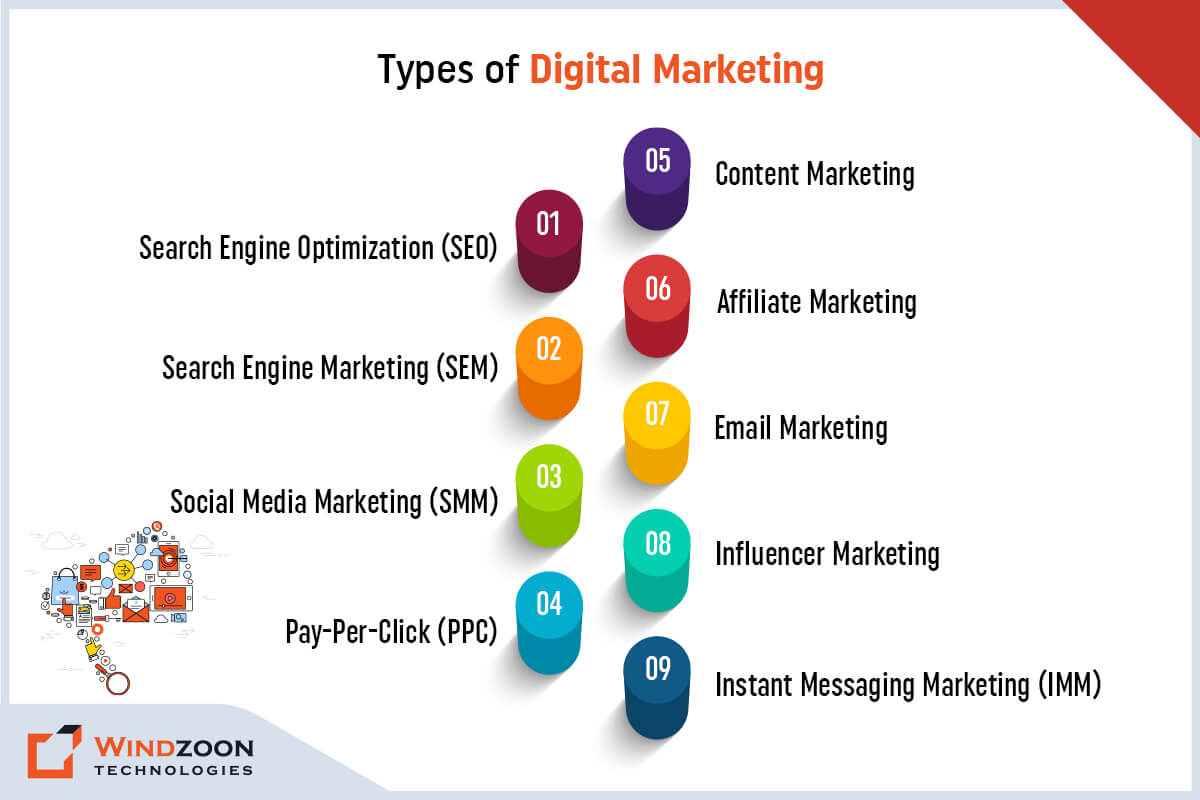
With the integration of visual search tools, such as Google Lens and Bing Visual Search, users can leverage advanced visual search engines to find information, products, or inspiration by uploading images or using their mobile devices.
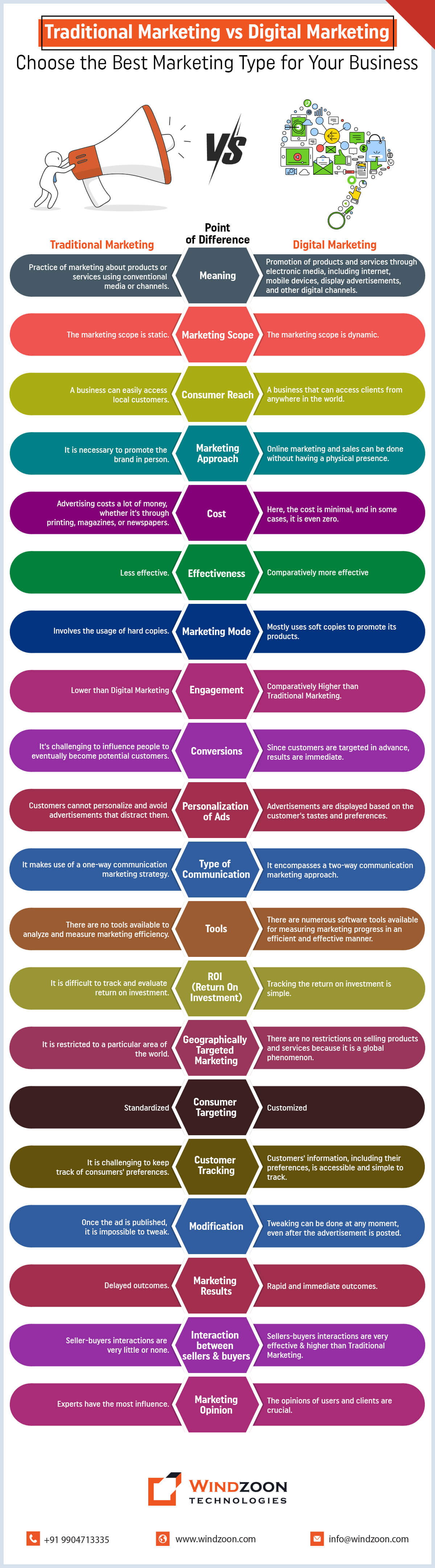
In this article, you will learn everything there is to know about visual search, including:

Visual search makes use of Artificial Intelligence (AI) technology to help users find items utilizing real-world images. Optimizing visual elements such as images and videos can improve the effectiveness of visual search by making content more discoverable and engaging. When someone conducts a visual search, they find the results using a picture instead of typing in a search phrase.
For example, assume you’re on a hike and come across a strange animal you’d like to learn more about. But don’t know how to describe it and get information from a search engine. So, you click the object’s photo and drag it to the search engine. Here’s how visual search works: the visual search engine analyzes the image using AI, machine learning, and computer vision to identify objects and return relevant images and information. The technology will recognize the object and provide relevant images and related information about what you are looking for.

What Is Visual Search Marketing?

Visual search marketing uses search engines’ visual search capabilities to drive traffic to a company’s website. This typically entails providing clear images of all available products that search engines can index. Optimizing images by ensuring they are relevant to the surrounding content, using relevant tags, and including descriptive alt text can significantly improve visual search marketing effectiveness and help your images rank higher in search results.

However, it’s essential to remember that most visual searches are conducted on mobile devices rather than desktop computers. Hence, it would help to make your web app compatible with mobile visual searches. You can do this by hiring the best SEO Service Provider Company in India & USA.

The majority of people confuse picture search and visual search. But these two concepts differ significantly from one another.

Image search is the technique of looking for images on the internet using words. In this case, the user query is a text phrase. In contrast, visual search involves looking for information online through the use of images, where the user query is an image.

How Does Visual Search Work?

When words fall short in expressing what the customer is looking for, visual search helps fill in the blanks. In visual search, the image itself acts as the search query, which the system analyzes to find matches. It recognizes objects in an image and looks for other images that are similar.

Visual search solutions make use of artificial intelligence and machine learning technologies. This is how visual search works: the system uses pictures as “queries” and evaluates forms, colors, and sizes to discover the most relevant search results by comparing the uploaded image to other images in the database. E.g., If you take a picture of the dress, the visual search might help you find & shop for identical or strikingly similar dresses.

The Main Players in The Visual Search Market

The following companies operate some of the most popular visual search engines in the market and are major players in the visual search market:

– Pinterest
– ViSenze
– Turing Analytics
– Cortexica Vision Systems
– Alphabet
– Snap
– Veritone
– Amazon
– Microsoft

Creating High Quality Images for Visual Search

High-quality images are the foundation of any successful visual search optimization strategy. Search engines rely on clear, high resolution images to accurately interpret and index visual content, which in turn helps deliver relevant results to users. To ensure your images stand out in visual search results, always use high quality images that are sharp, well-lit, and free from unnecessary clutter.

Beyond just the image itself, it’s crucial to optimize the supporting information. Use descriptive, keyword-rich image file names and alt text to help search engines understand the content and context of each image. For example, instead of naming a file “IMG1234.jpg,” use a descriptive name like “red-leather-handbag.jpg.” This not only improves your chances of appearing in relevant image searches but also enhances accessibility for users relying on screen readers.

Don’t forget to apply these best practices to your website and social media posts alike. Consistently using high quality images with optimized metadata across all your online platforms increases your visibility in visual search and ensures your content is discoverable by both users and search engines. By focusing on image quality and descriptive details, you’ll be well-positioned to capture more traffic and engagement through visual search.

Top 11 Benefits of Visual Search That Take Your Business Next Level

Top 11 Benefits of Visual Search That Take Your Business Next Level

Top 11 Benefits of Visual Search That Take Your Business Next Level

As search evolves beyond its traditional forms and new technologies emerge, it is critical to comprehend and capitalize on them as quickly as feasible. Optimizing images specifically for visual search (visual search optimizing images) is crucial for maximizing the visual search experience, as it helps users find products more efficiently and enhances overall engagement.

With 35% of marketers aiming to optimize for visual search in the future, it is best to stay ahead of the competition early rather than late. The following are the main advantages of optimizing for visual search, including the integration of augmented reality to create immersive and interactive shopping experiences that further enhance the visual search experience in e-commerce.

1. To Match your Customers’ Raising Expectations for Digital Transformation

Think back to the most reliable digital experience you’ve ever had. you were buying on an eCommerce website and discovered a fabulous product at an incredible rate.

That is what visual search is going to do for your brand, whether you practice it or not.

It is astounding how consumer expectations evolve, isn’t it?

In today’s time, consumers expect to be able to discover products using visuals or pictures.

2. Impactful Search Engine Optimization For Better Ranking On SERPs

SEO is meticulous work, often because of all the tagging.

Visual search benefits SEO Services providers to work smarter, on their optimization. The technology allows tagging, an image-to-text, and gives interpretability for search engines. To further improve search engine understanding, it is important to label images with descriptive alt text, optimize image file names, and optimize image titles. Including detailed image metadata also enhances SEO and discoverability.

This is why visual search is much more robust. Utilizing the potential of visual search, your pictures are now SEO-ready & and most, can be found by consumers.

3. Giving Consumers What They Were Not Aware That They Wanted

Customers are adopting visual search because they are watching for inspiration. Which means they need to be told what they must. Doing so appears in the form of absolute interpreting & analyzing what consumers are seeking. AI is used to serve the most similar products.

As marketers, we ought to cater to their evolving desires through artistic sources.

Visual search will have an impact that reaches well exceeding what it was designed to do.

4. Social Influencer Optimization To Increase Your Sales

Now, social influencers tend to post about a particular product they are wearing and tell consumers to buy that particular piece.

A visual search can scan the image of the influencer and tag the products of the outfit by type. Customers can then search every product of the outfit to get the whole look.

To put it, you can invest in influencer marketing to sell your products.

5. Growing Use of Shoppable Content To Match the Latest Market Trends

Businesses are pouring millions into content marketing, without a comprehensive way of getting accurate ROI. The whole content needs to be shoppable. By piercing pictures into the content that takes customers to the product they are looking to buy, your content completely comes to life. A visual search will support your team and see the real impact of the content you create.

Visual search marketing is now just getting more popular, there is no looking back after this. With the young generations trying to embrace all new trends, many businesses are performing distinct aspects of visual search in their marketing strategies.

6. Better Product Discovery To Promote A Better User Experience

It can be difficult for some people to precisely define an object they are seeking for. However, a photo or image may accurately describe every aspect of a product in great detail.

Allowing users to search for products using images can significantly increase product discovery. Rather than scrolling through countless search results, it quickly presented customers with the closest match available for sale.

7. Streamlined Product Recommendations To Provide A Plethora of Product Options

Visual search provides the technology for a product suggestion system. And this technology is based on actual product resemblance rather than other users’ preferences.

Hence, brands utilize it to generate similar product suggestions to provide their customers with a wider range of options.

8. Provide Product Substitutes For Out-Of-Stock Items

Visual search can help to reduce the shopping cart abandon rate by providing an alternative to out-of-stock products.

Visual search enhances product discovery and delivers results where text search fails. It increases conversions, reduces shopping cart abandonment, and provides users with a rich media experience.

9. It Exposes Your Brand to a Larger Customer Base Than Ever

Given that so many different platforms are starting to use visual search. Your product has a better chance than ever of reaching a larger number of users.

However, to do so, you’ll need to list your product both online and on Amazon and Pinterest. This will increase the chances of your product appearing in search results.

10. Combination Of Online & Offline Buying For A Multichannel Shopping Experience

Customers increasingly expect a multichannel shopping experience. And visual search caters to their desire to transition seamlessly between the online and offline worlds.

For example, Google Maps now integrates visual search features to provide location-based information, such as highlighting popular items on restaurant menus or offering historical data about landmarks, which enhances the shopping journey by delivering relevant contextual details.

E.g., Tommy Hilfiger’s visual recognition app. It enabled the brand’s fans to shop for items straight from the 2017 Tommy Hilfiger show in Los Angeles. That resulted in customers spending twice as much time on Tommy Hilfiger’s e-commerce site.

11. Acquire Consumers’ Attention By Standing Out From The Crowd of Competitors

It cannot be easy to stand out on Google with so many e-commerce stores.

However, since visual search is still relatively new, it helps firms differentiate themselves from the competition and ensure that customers see items from their product catalogs.

You must optimize your website and product images to improve the chances that your product will appear in visual searches. Optimizing images and image file names is essential for better search engine rankings. Creating an image sitemap or image sitemaps helps search engines discover and index your website’s images across all web pages, improving visibility in visual search results. And to do so, you should follow the tips provided below. Or you can hire a Local SEO Agency to help you with this task.

– Include SEO keywords in your website’s images
– Design a website with plenty of images
– Always include alt text in your image captions.
– Use the right file formats and sizes for your images
– Optimize image size and dimensions for faster loading
– Compress images to improve website load speed without sacrificing quality
– Use responsive images to enhance user experience on all devices
– Whenever necessary, add captions to your images
– Make use of high-resolution images
– Ensure that images appear on your sitemap and create an image sitemap for better indexing

As more of our favorite apps and sites integrate visual search, it will soon become a routine aspect of life. Visual search provides some intriguing new marketing prospects to which brands should react.

And if you’re a brand trying to boost website traffic & conversion, you shouldn’t just be aware of visual search queries—you need to work hard to seize this important market.

If you need help doing this important task, you may hire a qualified Digital Marketing Agency. At Windzoon, we offer a wide range of Digital Marketing Services. Our skilled and experienced SEO specialists can help you optimize your website for visual search. To for our digital marketing services and to learn more about us, please visit wzadmin.windzoon.in/.

Best Practices for Visual Search Optimization

To maximize your website’s performance in visual search, it’s important to follow a set of proven best practices. Start by using high quality images that are visually appealing and accurately represent your products or services. Next, optimize your image file names and alt text with relevant keywords that reflect what users might search for. For example, use descriptive image titles like “blue-cotton-summer-dress” instead of generic names.

Incorporate structured data, such as schema markup, to provide search engines with additional context about your images. This helps search engines interpret images more effectively and can improve your rankings in search engine results pages. Make sure to use relevant keywords in your image file names, alt text, and descriptive text to further boost your online visibility.

Leverage popular visual search tools like Google Lens and Bing Visual Search to test how your images perform and identify areas for improvement. These tools can help you understand how your content appears in visual search results and guide your optimization efforts. By consistently applying these best practices—using high quality images, optimizing metadata, and implementing structured data—you’ll enhance your website’s visibility, attract more visitors, and stay ahead in the competitive world of visual search.

What is Voice Search? & How to Optimize it That Benefits Your Business?

Ok, Google! Which is the best nearby restaurant to eat continental food?

Alexa, what are the best places to visit in the summer?

Siri! How to bake chocolate cookies for Christmas?

Don’t these questions sound familiar? Of course, they do. We all have heard & used this kind of question while doing web searches through voice commands. Since its inception, the popularity & usage of voice research has gradually increased over time. But after COVID, more & more people have been turning toward voice search.

A report from Gartner states that 32% of consumers are interested in hands-free technology that limits touching or contamination. Unquestionably, voice chat is appealing since it is quick, hands-free, and allows for multitasking. Google states that around 27% of all online users use voice search on their mobile devices. And according to Statista, the number of digital voice assistants will reach 8.4 billion units by 2024, surpassing the world’s population.

Digital Voice Assistants in use Worldwide

As a business entity, you need to consider the impact that voice search is having (and will have) on your digital marketing strategy. As voice search grows more popular, ensuring your website is optimized for this type of search is important. And for that, it would be beneficial to take help from a competent Digital Marketing Agency.

In this post, you’ll get complete knowledge about Voice search that includes:

So, let’s move toward our very first question.

In the 2000s, IBM’s Watson speech recognition sparked the development of voice technology devices, which Google and Apple later followed up on with Voice Search and Siri, respectively.

Voice search is a technology that recognizes your voice. It allows you to search for queries by speaking them rather than typing them. Voice search software and devices are capable of understanding our voices. They can even identify the various accents and contexts in which we speak. Now, we’ll move forward to know how voice search works.

How Does Voice Search Work?

Any time a voice search request is made, a voice search assistant will, in turn:

  • Filter the sounds to keep the speech request distinct from outside noises.
  • Transform the voice search request into digital data by digitizing it.
  • Analyze the voice by processing digital information.
  • Connect to outside data sources, like Google Search, to locate and present relevant information.
  • Translate the data to meet the searcher’s requirements.
  • Recognize patterns and contrast the query with the database’s existing samples.

According to market share, these companies dominate the US market for smart speakers:

  • Amazon (63.2%)
  • Google (31%).
  • Other (5.8%)

However, it’s crucial to remember that most voice searches actually take place on mobile devices rather than smart speakers. Apple (Siri) and Google are the two main rivals for smartphone assistants. Make your web app compatible with Siri & Google assistance by hiring the Best SEO Company in India & USA.

After learning about how voice search works, let’s move to our next question.

Here are a few points that describe the difference between voice & traditional searches.

  • Compared to standard search, voice search keywords are longer and more conversational.
  • Voice queries are more popular in local listing searches than traditional searches.
  • The search results in voice search are clear and concise. In contrast, the results of traditional searches are repetitive and redundant.
  • Voice search is more convenient, faster, and easier than traditional search.

Now, with our next question, let’s understand what impact voice search made on SEO.

How Does Voice Search Impact SEO?

The impact of voice-enabled technology on SEO is clear, given the developing trends and rising adoption rate in the use of mobile searches. This means that firms dependent on digital marketing solutions will either succeed or struggle, which is why understanding the impact of voice search is critical. Voice search can assist the Top SEO Consultants, digital marketers, and business owners in surviving the competition, achieving their marketing objectives, and increasing income.

After this, we’ll move forward to know some useful tips for optimizing your website for voice search.

Top Voice Search Optimization Tips

You can optimize your website for web search by following the below-mentioned tips. Or you can take help from a competent Local SEO Agency to do this job.

Around 73% of voice search results will appear in the top three SERP positions. Brands like to be at the top of the list of featured snippets rather than at the bottom.

Google Featured Snippets increase the visibility of your business. Considering that Featured Snippets are usually the best response (rich answer) to a search query.

Snippets are short, to-the-point sentences that are typically pulled directly from your website or blog. They connect your audience to your brand without requiring them to visit your website. It is a fantastic approach to increasing brand recognition and establishing authority in that field.

Contextual Search prioritizes the context of the moment of search behaviour in evaluating and ranking results. It considers the user’s purpose and context to provide the most relevant set of results.

Your web app’s content needs to be optimized for contextual search queries if you want to make it voice search-friendly.

3. Write Considering Your Customers’

Great voice search web content should provide answers to your customers’ questions. Always keep your audience in mind when writing blog posts, social media updates, and web pages.

What concerns might your customers have with the subject? Understanding how to assist your readers enables you to create more appealing content.

4. Add FAQs to Every Webpage

Including FAQs on every page is an excellent strategy to improve your website’s voice search functionality. For example, Web App Solutions may offer FAQs concerning the development technique, pricing, and estimated schedule for project completion.

Service pages may address inquiries regarding your team, processes, or equipment. These sections make it easier for your clients to find the required information.

5. Write Naturally in Content & Keep it Simple

People can sense the difference between natural writing and artificial writing. Although keywords are crucial, they should never come off as forced. If you want your readers to think of you as a friend who is giving them good advice. Use normal language that your audience understands.

Even search engines also like simple and direct explanations. They typically select short and simple replies for voice searches. Hence, try to explain concepts using everyday terminology, even when replying to challenging inquiries regarding web design or development.

6. Target Conversional or Long-tail Keyword Ideas

People tend to concentrate on a single word while entering a query, but when using voice search, they ask for something in a whole question. For instance, if someone wanted to purchase dark chocolates, they may write dark chocolates into a text search box.

But when using voice search, they’ll say, “Where can I find an assorted collection of dark chocolates nearby?” You can certainly make up the search results if you target a long-tail phrase like “assorted collection of dark chocolates.”

But how can you tell which questions are frequently asked about particular subjects? You must conduct some independent research. For that, you can use “Answer the Public App.” It is a very helpful & free tool for research.

Thus, focusing on long-tail keywords in your niche increases relevant traffic and boosts conversion rates.

7. Schema Markup

It can be noticed that websites with schema markup and structured data appear most frequently in voice search results. For search engines like Google to comprehend your page, schema markup offers information about your webpage.

Your webpage will only be ranked for relevant search queries when the search crawlers comprehend the information on it. Therefore, don’t forget to provide schema markup to your web pages.

8. Make Your Web App Mobile-Friendly

Smartphones and voice searches go hand in hand. Optimizing your website for Siri and Alexa also makes it appealing to mobile users.

To make your website mobile-friendly, design scrolling pages that are more pleasurable to read. Furthermore, having a clean sitemap turns navigation much easier. And to add visual appeal, don’t forget to use bullet points and brief paragraphs.

Because mobile is the future of searches, which includes voice queries. And a mobile responsive website is the best SEO practice that should not be overlooked.

The majority of voice searches are for local search results and shopping. Hence, ensure that your content is optimized to rank for local search results.

For that, you don’t need to include the word “near me” in every keyword. Instead, it would be best if you made it simple for Google, Siri, Alexa, and Cortana to locate information about your company’s location.

Thus, ensure Yelp, Apple Maps, & Google My Business have the correct information for your company’s address and phone number.

10. Reduce the Website Loading Speed

The website’s loading speed is important in ranking higher on SERPs. No one wants to wait long for results, and the average person waits only 2-3 seconds for a website to load.

And if the website takes longer than that to load, visitors leave it to go for another. Therefore, Google searches for relevant results that load quickly to be included in voice search results. Hence, to speed up page loading, avail of a Professional SEO Services provider.

Now, let’s understand the benefits of optimizing your website for voice search.

How does Voice Search Benefit Businesses?

Businesses benefit from voice search in the following ways:

  • It allows you to capitalize on its growing popularity.
  • It enables you to gain dominance in search results.
  • It greatly increases your local traffic.
  • It holds the potential to increase your e-commerce sales.
  • It helps you to stand out from the crowd of your competitors.

Conclusion

Over the last ten years, voice search has developed into a significant player in the SEO industry. And it isn’t going anywhere anytime soon. If you’re a local business looking to increase website traffic & foot traffic, you shouldn’t just be aware of voice search queries—you should work diligently to capture this crucial market.

If you require any assistance in doing this vital task, you can take help from a competent Digital Marketing Company. We at Windzoon provide a plethora of Digital Marketing Services. Our experienced & talented team of SEO executives can aid you in optimizing your website for voice search. To avail of our digital marketing services & want to know more about us, kindly visit wzadmin.windzoon.in/ and get a quote.

SEO vs PPC Pros and Cons: 15 Striking Differences and How They Affect Your Business

Google processes more than 5.6 billion searches daily, approximately 63,000 per second. How will you get your brand noticed in this sea of traffic? & raise Your website’s ranking above your competitors’.

Traffic is what keeps a website running & business thriving. Though, only a small number of your potential customers will pay you to use your products or services among the many users who visit your website.

That’s why having a large amount of traffic to your site is necessary for the success of your business. SEO is a cost-effective strategy for generating relevant traffic, helping you attract visitors who are more likely to become customers. And if you’re having difficulty driving traffic to your website, then you are not the only one. In this fiercely competitive industry, many business owners face similar challenges in attracting clients.

The reason is it’s challenging to strike a balance between various digital marketing strategies, their upkeep, and outcomes. However, there are two marketing strategies that are used to solve this problem: search engine optimization (SEO) or pay-per-click (PPC) campaigns. An SEO agency can help businesses optimize their organic search presence and integrate SEO with other marketing channels for better results. Or you can take help from the Best Digital Marketing Agency in the USA

What technique is best for you, though?

In response to the question above, this article discusses what you can expect from each marketing strategy. We’ve included some pros and cons of both SEO and PPC strategies. In addition, a detailed explanation to guide you in choosing which strategy is best for you.

Now, let’s learn more about SEO & PPC and how they are different from each other.

What is SEO?

Businesses require higher rankings on search engine result pages for their websites to remain visible to customers. Getting your website or content to the top of search engine results pages (SERPs) is critical. These top positions are known as organic listings, which are natural search results that appear based on relevance and effective SEO efforts. And businesses can reach this milestone only with the help of a Local SEO Service Provider Company

SEO (Search Engine Optimization) Services use natural methods to improve a website’s search engine rankings, and must continually adapt to evolving search engine algorithms to maintain or enhance visibility. It employs search engine rules and regulations to increase the number of website visitors.

As a result, it assists business organizations in expanding and increasing their consumer reach by growing their online network. A well executed seo strategy combines content optimization, earning quality backlinks, and adaptability to changing ranking factors for sustained success.

After learning about what SEO is, let’s go further to know its different types & activities.

Types of SEO

The six types of areas that fall under SEO are as follows:

  • Keyword research entails determining what people are looking for.
  • On-page SEO entails creating and optimizing SEO content that searchers want, including writing effective meta descriptions to improve search engine results snippets and page visibility.
  • Off-page SEO entails gaining trust and authority from other websites.
  • Technical SEO entails ensuring that search engines can find, crawl, and index your content.
  • Competitive analysis entails gathering detailed information & doing an analysis of what our competitors are doing to promote their business.
  • Content creation & curation entails creating unique & engaging content, doing its optimization, & marketing.

Now, let’s see which activities come under SEO

SEO Activities

Despite having six different areas, SEO mainly focuses on On-page & Off-page activities. These activities help to improve your business ranking on various search engines like Yahoo, Google, Bing, and other search engines. Following is the list of On-page SEO activities & Off-page SEO activities.

On-page Activities

1. Keywords research
2. Keyword planning
3. Creating Meta title & Meta description
4. Creating user-friendly content (ensure your content aligns with search intent to improve relevance and rankings)
5. Image optimization
6. Forming URL structures
7. Internal linking
8. Optimize Body Content
9. Enhancing page performance

Off-page Activities

1. Competitor Analysis
2. Commenting/Blog Commenting
3. Influencer Outreach
4. Guest Author/Posting
5. Link Building
6. Content Marketing
7. Newsletters
8. Forum and Ques Ans
9. Google Local Business Listing

After learning about SEO activities, let’s move further to know its Pros & Cons.

Advantages & Disadvantages of SEO

Advantages of SEO

1. Cost-Effective Approach

SEO is neither easy nor cheap. It is, however, less expensive than other digital marketing strategies.

2. Long-term effects of brand awareness

The effects of organic SEO are long-term. They may take some time to appear, but you can be certain that they will grow over time as the results begin to pour in.

3. It increases your brand credibility

In practice, most people trust websites that appear near the top of a Search engine results page(SERPs). Hence, SEO focuses on increasing your SEO rankings on SERPs to establish your brand credibility. A high ranking in organic search results can help you gain trust & reputation while increasing CTR.

4. Increase ROI

Seeing as SEO is free, the ROI is significantly higher when compared to other paid digital marketing strategies.

5. Higher CPC

Since organic SEO doesn’t charge for each click, it offers a lower cost per click.

Disadvantages of SEO

1. SEO is time-consuming

SEO is much slower than paid digital marketing mediums. It may take months after optimizing your site to see results, whereas paid mediums will generate leads immediately.

2. SEO is a continuous process

SEO is a continuous process. Your website will never be completely “optimized,” but it will continue to improve as you continue to work on it. The good news is that it will continue to improve your rankings in the future, and you will hopefully reap the benefits of your SEO investment.

3. SEO never compromises the quality of content

It demands unique and trustworthy content. If you want people to read, share, and link to your website. And for that, you must be perceived as an authority on the subject.

4. Intense competition

Numerous business owners like you desire better rankings. Plan better SEO techniques to rank higher than your competitors, and be prepared to confront the competition.

Now, we know the pros & cons of SEO, so let’s know when you should use SEO techniques.

When to Use SEO?

==> If you have long-term business objectives,

==> If you want to build the authority of your brand

==> If you have enough patience to wait for the unforeseen ROI with minimal investment,

==> If you want to create a high-quality CTR that is both affordable and long-lasting,

==> If you want your website to appear to the most relevant search users, focusing on relevant keywords that match user intent,

==> If you want to create content that reaches your audience at various stages of the sales funnel, it’s important to identify and optimize for target keywords,

==> After learning about SEO in detail, we can move on to PPC.

What is PPC?

Pay-per-click (PPC) is a type of search engine marketing (SEM) in which an advertiser pays a publisher (like Google Ads or Facebook) for each time a user clicks on the ad. These PPC ads appear in paid search results above organic listings on search engine results pages (SERPs).

This concept enables firms to pay only when customers interact with their advertisements, meaning advertisers pay each time their ad is clicked. It helps businesses to attract customers who are eager to take advantage of your offer.

Besides, PPC advertisements always coexist with organic search results. And the cost of PPC advertisement is typically determined by your industry and the search volume of the keyword you’re targeting.

You can use PPC Marketing Services to stay competitive in a crowded industry. It helps you reach your target audience even if your site lacks the domain authority for organic rankings.

Now that we know what SEO is let’s go further to know its different types & activities.

Types of PPC Advertising

Like SEO, there are also six areas that come under PPC advertising.

==> Search Ads

==> Shopping Ads

==> Display Ads

==> Video Ads

==> Social Media Ads
Social media ads can quickly boost brand visibility and promote time-sensitive offers, making them ideal for short-term campaigns and immediate results.

==> Mobile App Install Ads

After this, let’s see which activities come under PPC.

Activities of PPC Advertising

PPC advertising activities help businesses to remain competitive in a crowded market and gain quick access to their target audience. Here is the list of activities that come under PPC advertising.

==> Do a detailed study about the nature of business & its marketing requirements.

==> Keywords research to reach the maximum audience, focusing on selecting the right search keywords for effective targeting.

==> Landing page optimization.

==> Campaign creation (creating ad groups, making ads, adding extensions), with attention to strategic ad placement to maximize visibility.

==> Copywriting for advertisement.

==> Negative keyword research.

==> Campaign optimization & maintenance.

Now, let’s move further to learn the Pros & Cons of PPC.

Advantages & Disadvantages of PPC Advertising

Advantage of PPC

1. Increase your brand visibility

Search engines(Google) place paid ads above organic results, giving them more eyes.

2. Easy to target the right audience

With PPC, you can easily target customers by using the right keywords, brands, language, demographics, location, device, and more. By focusing on specific keywords, you enable precise audience segmentation in PPC campaigns, ensuring your ads reach the most relevant users.

3. It gives you complete control over your marketing strategy

Here, you’ll get to choose which keywords to include, as well as the CTA, pricing, and landing page.

4. It raises the visibility and recalls the value

Visual ads’ utilization helps businesses increase recall and CTR.

5. It generates quick and consistent results

When the PPC campaign is launched, you can expect to see almost immediate results in the form of clicks, traffic, and conversions.

Disadvantages of PPC

1. Continuous investment is required

Paid ads stop when you stop investing in them, as you might expect. And with that, the traffic, clicks, and conversions all come to a halt.

2. Many people feel skeptical about paid advertisements

Paid advertisements do not guarantee to give 100% results. Many people still feel uncertain about its results & effectiveness.

3. ROI may not be very encouraging

In PPC, you will have to spend more money to make more money. However, even after spending a significant amount of money, you might not get the return on investment you’re expected to get.

As we know about the pros & cons of PPC, so let’s get ahead to learn when you should use it.

When to Use PPC Advertising?

==> If your product is unique or one-of-a-kind

==> If you are willing to take the risk of making a significant investment

==> If you require immediate results for a specific time period (for example, by launching paid search campaigns or a PPC ad to quickly drive targeted traffic)

==> If you wish to run a short-term seasonal offer sale

==> If you intend to divert more leads to your business

==> If you want to target specific demographics and locations (using paid search ads for precise audience targeting)

Finally, we have reached the most significant part of our article:

15 Significant Differences Between SEO and PPC Advertising

[wpdatatable id=2 table_view=regular]

Learn more about the difference between SEO & SMO and how they affect your business.

Now, we know the difference between SEO and PPC, so let’s find out which marketing strategy benefits you the most. Integrating SEO with PPC can provide a holistic digital marketing approach, improving overall performance and decision-making.

Which Marketing Channel is Preferred for Your Business?

It is often asked which SEO strategy is better for your business growth: PPC or SEO. The best choice between SEO or PPC will depend on your goals, growth plans, and other marketing strategies. It is crucial to select the right strategy by understanding how SEO and PPC align with your business objectives and available resources.

Paid search is the best option if you want to get targeted traffic, clicks, and conversions immediately. If you want to achieve long-term goals like brand credibility, exposure, and scaling your business within a reasonable budget, then organic SEO should also be on your priority lists. Experts agree that you shouldn’t run these strategies in parallel. Instead, find a way to combine them to benefit your company.

How Do Both SEO and PPC Work for Your Business?

We would love to see both SEO and PPC in the same world. Both have their pros and cons, but they work best when used in conjunction. When SEO and PPC work together, you’ll often achieve results that surpass the sum of their parts.

There are many benefits to running SEO and PPC simultaneously:

  • PPC data can be used to feed keywords and conversions into organic search (SEO), and ongoing SEO efforts can be informed by insights gained from PPC campaigns.
  • Targeting clicks in paid & organic for high-performing keywords can increase traffic to your site, as PPC ads can complement organic search performance for maximum reach.
  • Keywords that are high in cost, high volume, or low-converting (but still important) can be moved from PPC into organic search.
  • You can feed your landing pages and organic listing with A/B testing of ad copy and landing page content.
  • Remarketing lets you stay in front of visitors after an initial touch via search engines and tailor messaging to their engagement with your website.
  • Before you commit to long-term SEO strategies, test your keyword strategy in PPC.
  • All customer journey stages should be for targeted users, from comparison to purchase to research.
  • Having strong organic and paid visibility can increase your confidence & brand awareness. Additionally, strong organic visibility reduces reliance on paid ads, making your marketing more cost-effective over time.

Read More: Important Reasons Why Business Need a Digital Marketing Strategy

Conclusion

The decision between SEO and PPC ultimately comes down to your business situation. Therefore, take your time and evaluate both SEO and PPC to determine which one is best for you. And to get even better results for your company, you can even combine the strategies.

If you lack time or resources to optimize your SEO and PPC strategies, you can seek help from a professional digital marketing company. At Windzoon, we have experienced & skilled SEO and PPC experts that can proficiently handle your company’s digital marketing activities.

Besides, we also provide SEO, SMO, & PPC Marketing Services. If you want to avail of our digital marketing services & want to know more about us, then visit wzadmin.windzoon.in/ and get a quote.

Effective Digital Marketing Strategies for Business Success

Marketing has always been an essential part of business activities. It provides visibility to a company. The visibility creates brand awareness & helps the company grow its business by connecting with its customers.

However, to create this brand awareness company uses different marketing strategies. These strategies include both traditional & contemporary ways of marketing. Traditionally, newspapers, pamphlets, magazines, billboards, & salespersons have been used for brand building.

Nonetheless, with the advent of the internet, traditional marketing has lost its lustre to digital marketing. Now comes the question: What is digital marketing?

Digital marketing, also known as online marketing, is a modern way of Marketing. It uses the internet, computer, & other online/digital platforms for marketing. However, for effective digital marketing, companies need to implement some competent digital marketing strategies. So now comes the question;

What is a Digital Marketing Strategy?

As the name implies, a digital marketing strategy outlines how your business will achieve its marketing goals through various online channels. These online channels consist of search & social media platforms.

Hence, the plan summarizes which online channel & marketing tactics you use and how you will implement them. Plus, it also mentioned how much the business would invest in these channels & tactics.

After learning about digital marketing strategy, let’s understand its importance for businesses.

Why are Digital Marketing Strategies Crucial Nowadays?

Nowadays, people have started to rely more & more on the internet to acquire anything they want. And globalization, the increasing number of mobile users, & covid-19 pandemic are the reasons behind this drastic change.

As per Statista, in 2021, global e-commerce sales accounted for around 20% of total retail sales. However, forecasts indicate that by 2025, it will make up close to a quarter of total global retail sales.

Digital Advertising Spending Worldwide From 2021 to 2026

Digital Advertising Spending Worldwide From 2021 to 2026

It shows that a lot of business has turned toward online platform. And this change has made them choose digital means to market their products & services.

According to Statista, global digital advertising spending amounted to $521.02 billion in 2021. However, the source projected that by 2026, the spending would reach 876 billion dollars.

These statistics clearly show how famous & influential digital marketing has become. Businesses must prepare good digital marketing strategies to avail of optimum benefits from it. Hence, hiring a professional Digital Marketing Agency is advisable to build excellent marketing strategies.

Now after learning about the importance of digital marketing strategy, let’s see some of its examples.

Some of The Significant Examples of Digital Marketing Strategies

You can’t gain the full advantage of digital marketing if you stick with only one tactic. There are various strategies for digital marketing. And to attain better results, you need to use multiple tactics. It will help you to increase your brand awareness and keep you ahead of your competitors. Below we have mentioned a few examples of digital marketing strategies.

– Content Marketing

– Search Engine Optimization

– Search Engine Marketing / PPC

– Social Media Marketing

– Email Marketing

– Affiliate Marketing

– Influencer Marketing

– Instant Messaging Marketing

– Video Marketing

– Audio Marketing

– Mobile Marketing

Top 12 Reasons behind Having a Digital Marketing Strategy for Business

Types of Digital Marketing Strategies

Even after reading all this information & data on digital marketing, you may still feel hesitant. And you think that it is worth it for your business? Well, read the reasons we have mentioned below. It will certainly clear all the doubts in your mind.

1. It will significantly expand your consumer/audience reach

Expanding your business in a new geographical region is challenging with traditional marketing. However, with the help of the internet & social media platforms, you can make this task easy & effective.

Social media platforms like Facebook, Twitter, Youtube, & Instagram enable you to establish communication with a worldwide audience. With a digital marketing strategy, you can effectively utilize these mediums to reach a wide range of audiences.

Moreover, it helps your business by expanding your consumer base.

2. It gives accuracy in targeting your potential customers

If you want to increase your business’s conversion rate, you need to have information about your customer. And the primary purpose of any marketing strategy is to target the right audience.

It will help you to know about your potential customers. However, with a digital marketing strategy, you can target your customers with more accuracy & ease. It uses analytics tools that can target the precise audience based on location, demographic, & psychographics.

Besides, digital marketing allows you to take on a highly targeted campaign. And that helps you to make your campaigns more effective.

3. It increases conversion rate by converting your lead into sales

You can evaluate the success of your business by how many target audiences are turned into your customer.

The significant amount of traffic on your website won’t make any difference if your conversion rate is low. Conversion rate means converting your lead into sales. It plays a significant role in the success of the business enterprise.

With a well-planned digital marketing strategy, you can successfully convert leads into sales and increase conversion rates.

4. It helps you choose the best strategy & earns you better revenue & ROI

The implication of digital marketing strategy in your company can enhance your revenue generation. According to Google, companies using digital marketing strategies have 2.8 times better conversion rates and revenue growth.

Additionally, digital marketing will improve your ROI using analytical tools. These tools help you to understand which strategy will be good for your business & gives high ROI.

Hence, you can choose your business’s most appropriate digital marketing strategy based on your budget.

5. It is more cost-effective than traditional marketing strategies

In comparison to traditional marketing, digital marketing is a more cost-effective option. It promotes your business/brand to a vast audience within your budget.

Especially in cases of small & medium businesses, it becomes a ray of hope. Digital marketing helps them reach the maximum number of people without any significant investment.

6. It uses Artificial intelligence-driven data to prepare & improve your marketing strategies

A significant reason behind having a digital marketing strategy for every SME is, that it uses Artificial intelligence to accumulate & analyze data.

AI is an assemblage of various technologies that can execute the tasks that usually require human intelligence. And the use of AI in marketing is called AI marketing. It is a game-changer for small & medium businesses. As per a recent survey, around 13.6% of small & medium business owners have invested in AI marketing solutions.

They can utilize AI to collect data & customer insights. To anticipate customer behavior and make automated decisions. For that, businesses can use various AI tools like Import.io, Uberflip, Tact.ai, NGDATA, Crystal Dash, & OptinMonster. Plus, they can also apply machine learning & AI-infused CRM in their organization.

It will provide a better understanding of customer behavior to business owners & marketers. Thus, they can use this information to implement the right strategies that suit their target market. So that they can gain more customer retention. It will also provide them with benefits like cost reduction & time efficiency. Plus, improvement in results & responsiveness.

7. It utilizes Augmented & Virtual Reality to enhance user experience & boost sales

Another reason to have a marketing strategy for business is it utilizes Augmented & Virtual Reality to enhance user experience & boost sales.

The creation of a simulated world with the help of computer technology is called virtual reality(VR). While using computer-generated perception to provide real-life experience is called augmented reality(AR).

SMEs can adopt these futuristic technologies by using different AR & VR tools. These tools are not so expensive. Instead, they are more versatile & potent than many other tools businesses use nowadays. Using AR & VR tools in business elevates the efficiency of marketing & sales efforts.

Additionally, SMEs can use these technologies on their website or preferred social medial platforms. It will enhance its customers’ shopping experience by providing features to test products or services without paying for them. And this will increase customers’ trust in the brand & also boost sales.

Besides, businesses can also use AR & VR tools to record customers’ interests, preferences, & purchase patterns. This information helps businesses to customize their marketing plan. And also redefine their target audience goals.

8. It employs a Video Marketing tool to provide your brand with effective customer engagement

Social Media platforms hold the most crucial place in digital marketing. Nowadays, social media platforms have provided a new space for enterprises to promote their product & services. And many enterprises utilize that space for video marketing to increase their customer base.

Video Marketing is a significant digital marketing tool. It can effectively engage the targeted audience. Besides, it is a cost-effective way to reach the maximum people and promote the brand. And that’s why many SMEs have included this tool in their digital marketing strategy.

They use this tool by developing & posting content-rich & enthralling videos on Linkedin & various social media platforms. (Ex. Facebook. Instagram, TikTok, YouTube)

These videos can easily attract people’s attention & even influence their buying decisions. And if they become viral, they can provide the business with overnight publicity & recognition.

9. It operates Omnichannel Marketing to attract customers & engaging them even after sales

Omnichannel Marketing is one of the valuable ways of digital marketing. Digital marketers utilize it to reach the target audience. And for that, they use various digital mediums to promote, engage, & serve customers. Omnichannel marketing has numerous benefits, some of which we have mentioned below.

– It draws new customers & market segments.

– It keeps engaging customers even after sales.

– It enhances customers’ trust & loyalty toward the brand.

– It increases sales & customer satisfaction.

– It helps business owners & digital marketers to understand customers’ demands & needs.

These benefits have made omnichannel marketing a popular marketing tool among SMEs. Because it provided them with equal opportunity to compete & make their place in the market.

10. It helps you to utilize Social Media Shopping for selling your products & services

With time, Social media platforms add new features to facilitate businesses. And social media shopping indeed comes under these features. Social media shopping is an integration of social media & e-commerce.

It has created a new marketplace for customers to buy products & services that match their expectations. And digital marketing strategy helps businesses with effective use of social media shopping to sell their products & services. Plus, establishing close contact with their targeted audience.

Read More: Social Media Optimization (SMO) Tactics for Faster Growth

11. It helps you to gain reputation & customer loyalty through Long-Form Content Marketing

Content marketing is indeed a crucial part of online marketing. And in content marketing, long-form content holds a significant part of it. It is often used by businesses( especially SMEs) to promote their product & services.

Long-form content usually contains blog posts or articles that have around 3000 words. It helps businesses to increase their visibility & showcase their industry expertise. Besides, it also provides some other benefits:

– It draws traffic to the website

– Increase website ranking on search engine research pages

– And boost customer engagement & interaction.

Moreover, long-form content helps companies to interact with & educate their audiences. And that facilitates them with increased reputation & customer loyalty.

12. It helps you to avail benefits from Influencer Marketing to enhance your revenue

Social media platforms like Facebook, Instagram, YouTube, & TikTok hold significant power to influence the general public. And that becomes the reason behind the birth of the influencers.

Social media influencers are individuals or groups who have a large fan following. They use their incredible power to influence the decision of their fan following. Digital marketing utilizes the power of influencers’ image & goodwill to promote brands & boost sales & revenue for businesses.

Conclusion

We hope this blog has given you a better understanding of digital marketing & why it is necessary for your business.

We live in the digitalization era, where so many activities are done online. And to keep pace with this change & avail it to flourish our business, digital marketing is crucial. It doesn’t matter in which industry you are working or the size of your business. It helps to grow every type of business.

However, you ought to prepare a solid digital marketing strategy to get the best from digital marketing. And for that, you require assistance from a professional digital marketing agency.

Windzoon is a prominent Digital Marketing Company that helps businesses to form well-researched & robust digital marketing plans. If you want to avail of our digital marketing services & want to know more about us, then visit wzadmin.windzoon.in/ and get a quote.

SEO vs SMO: Key Differences You Need to Know

There was a time when businesses did marketing and brand building through newspapers, pamphlets, billboards, salespersons, radio, and TV advertisements. These all are popular forms of marketing new products and businesses before the evolution of the internet & the world wide web.

Although these old forms of marketing are still in use, the rise of the internet and the world wide web have given birth to digital marketing. Digital marketing, also called online marketing, uses the internet and other digital/online platforms for marketing.

Statista, It was calculated that digital advertising spending worldwide amounted to $521.02 billion in 2021. The source projected that by 2026, the spending would reach 876 billion dollars.

Digital Advertising Spending Worldwide

It is one of the most famous & influential means of marketing in the contemporary world. To take the optimum benefit of this modern way of marketing, contact Windzoon, a top Digital Marketing Agency in India & USA

However, the most vital & effective components of digital marketing are SEO & SMO. Both SEO and SMO are each a type of digital marketing method. SMO is a marketing method that leverages social media platforms to promote brands and connect with audiences. The term SEO stands for search engine optimization, while SMO stands for social media optimization. Understanding common digital marketing abbreviations, such as SEO, SEM, and SMO—often referred to as terms SEO—is important for anyone looking to improve their digital marketing strategy and online visibility. SEO is mainly used to improve the website’s ranking on search engines. On the other hand, SMO uses social media to increase traffic to a website.

Though both SEO & SMO are utilized to bring organic traffic to a website yet, they are pretty different from each other. However, to survive in this highly competitive market, businesses would require an effective SEO & SMO plan, preferably developed by the Best Local SEO Agency

Read More: Google Business Profile: A Beginner’s Guide To Optimize Your Profile For Local Sales

Now, let’s learn more about SEO & SMO and how they are different from each other.

What Is Search Engine Optimization (SEO)?

When we search for any information on a search engine, we mainly evaluate only the first two or three pages of the search engine result pages (SERPs). Thus, businesses need higher rankings for their websites on search engine result pages to remain in customers’ visibility. Getting your website or content to the top of a SERP is crucial. Achieving a high ranking position in search engine results significantly increases your website’s visibility and drives more organic traffic. However, to fulfill this task, businesses require the help of SEO services.

SEO or Search Engine Optimization Services use organic ways to improve a website’s rankings on search engines. SEO methods include keyword research, content creation, link building, and technical optimization. It uses search engine rules & regulations to increase the number of visitors to a website.

Hence, it helps business organizations to expand and boost their consumer reach by growing their network online.

To grow website traffic and consumer, we need to do SEO activities or methods.

SEO uses two different modes of activities to enhance your business ranking on various search engines like Yahoo, Google, Bing, etc. Optimizing meta tags and understanding search engine algorithms are also important for improving ranking position. These two modes are On-page SEO activities & Off-page SEO activities.

Following are the On-page & Off-page Activities of the SEO:

On-page Activities

  • Keywords research
  • Keyword planning
  • Creating Meta title & Meta description
  • Creating user-friendly content
  • Image optimization
  • Forming URL structures
  • Internal linking
  • Body tag
  • Enhancing page performance

Off-page Activities

  • Competitor analysis
  • Commenting/Blog Commenting
  • Influencer outreach
  • Guest author/posting
  • Link building
  • Content marketing
  • Newsletters
  • Forum and Ques Ans
  • Google local business listing

What Is Social Media Optimization (SMO)?

Social Media Optimization (SMO) is one of the effective methods of Digital marketing. SMO refers to Social Media Optimization, a strategic digital marketing approach that leverages social media platforms to enhance engagement and content distribution. Social media platforms like Facebook, Instagram, Twitter, LinkedIn, and Pinterest are effective ways to reach the maximum number of people.

SMO activities increased brand visibility and conversion rates by developing engaging social media profiles & content. Developing and optimizing social media accounts and social media channels is essential to increase online visibility. Networking sites and social sites such as Facebook, Twitter, and LinkedIn play a crucial role in building brand awareness and engaging with audiences. Also, it provides an opportunity to build a strong bond between customers & business organizations.

Thus, it helps business organizations to promote their brand or website more accurately & effectively. However, to utilize social media platforms effectively and manage social channels for business growth, get in touch with our Social Media Marketing Company in India and USA

Which Activities Come Under SMO?

Social media optimization or SMO uses various social media sites to promote your business. It increases brand awareness of your business through different organic activities. Sharing content such as posts, images, and videos is essential to engage audiences and boost your social media presence. To maximize the impact of SMO activities, it is important to create and distribute relevant content and authoritative content that resonates with your target audience.

Read More: 15 Social Media Optimization (SMO) Tactics for Faster Growth 

The following are some of the significant activities of the SMO.

Social Media Optimization (SMO) Activities

SMO Activities

  • Page & profile creation on social media platforms
  • Competitor analysis
  • Creates posting material/content based on the product & services of the organization
  • Creates engaging images & videos to provide better visualization of products & services
  • Hashtag research to enhance user outreach
  • Sharing & posting content in various niche groups
  • Analyze post engagement & its reach
  • Creation of different paid campaigns
  • Campaign maintenance & management
  • Reporting

The Main Differences Between SEO and SMO

[wpdatatable id=25 table_view=regular]

Differences between SEO and SMO

Both SEO and SMO can be used together to achieve more traffic and generate leads, as combining organic search engine optimization with social media optimization helps build a strong online presence essential for digital marketing success. In addition to organic methods, paid traffic, paid ads, paid advertisements, and paid advertising are alternative ways to drive immediate results. Strategies like search advertising and search engine marketing (SEM) use pay per click models, such as Google AdWords and Bing Ads, to target specific search terms and reach potential customers. Advertisers pay for ad placements based on selected search terms, and these paid ads appear in Google search results and Bing search results to drive targeted traffic. Building high quality links from other websites is crucial to improve SEO rankings, while social signals and content sharing can affect SEO rankings indirectly. Various factors affect SEO rankings, including social media activity and the quality of backlinks.

Read More: SEO Vs PPC Advertising – Pros, Cons, & Which Strategy is Useful?

How Do SEO & SMO Strategies Help Your Brand to Grow?

There are numerous benefits that businesses can leverage by implementing SEO or SMO or both in their organizations. These digital marketing strategies enable businesses to effectively reach a specific audience, resulting in improved engagement and better targeting of potential customers. It will significantly help them to improve their relations with their both present & prospective clients. Plus, help them to drive more revenue & qualitative leads to their business. Now, let’s learn in detail about the benefits of including SEO & SMO activities in your business.

Benefits of SEO For Your Business

  • An effective SEO strategy can derive organic traffic to your website. It helps your website to rank higher for relevant search results and become more visible to users. With more people visiting your website, you can expect more customers for your Business.
  • SEO optimizes your site with high-quality content, relevant products, and services. Plus, it also enhances the page performance on your site. As a result, your site will become more visible to the right set of audiences or target markets.
  • SEO is the most cost-effective method of marketing in comparison to other marketing methods.
  • An effective SEO strategy provides you with an edge over your direct competitors. It will help you to gain a higher ranking for relevant searches making your brand popular & bringing you new customers.
  • Though SEO strategy takes time to deliver your desired results, it can help you build trust & reputation among your target audience. This trust & reputation will put your brand in a promising position to become a thought leader in the relevant industry.

Benefits of SMO For Your Business

  • SMO helps brands through regular engagement with their audience on social media. This regular engagement builds trust among the users, and your users start recommending your brand/product/services fervently.
  • A strong SMO strategy is essential for building & maintaining a solid online presence. It will help your business get more earned promotions from followers as more users start getting familiar with your brand.
  • Websites with high backlinks from social media platforms will receive more views on search engines. This increased visibility of the website significantly affects the ranking factors of search engines. Hence, your strong presence on social platforms will complement your SEO efforts.

How Do SEO & SMO Work Together to Increase Your Business?

Although both SEO and SMO operate in different spheres, they have one common goal; to drive maximum traffic to your website. SEO focuses on enhancing website ranking while SMO brings traffic to a website via social media platforms.

However, no one knows the factors contributing to a website’s ranking on Google. Still, it has become clear that a larger presence on social platforms drives traffic & increases brand awareness of the business. It also indirectly affects the website’s ranking on SERPs. Which describes the effects of SMO activities on SEO

Similarly, when you redirect visitors to your website & try to obtain leads for your businesses through social media, you must have a high-quality website with good UX. If you don’t have a faster website with good functionality, then your site visitors will bounce back to your rival’s website. Here, the important point is the user-friendliness of the website, which comes under SEO. Thus, it is proven that SEO also has an impact on SMO.

Hence, this proves that both SEO & SMO are equally important for the development of the Business. They both are the two faces on the same coin; no one is less than the other.

Read More: Important Reasons Why Business Need a Digital Marketing Strategy

You have to make a lot of efforts to balance SEO & SMO activities. Nevertheless, you can get help from professionals if you don’t know much about this field or don’t want to hire internal SEO and SMO experts. You can take help from WIndzoon Technologies, and we can take care of all the digital marketing activities on your behalf.

We have experienced & skilled SEO and SMO experts that can smoothly handle your company's digital marketing activities. Besides, we also provide SEO, PPC, & Social Media Consulting Services. If you are interested in our digital marketing services & want to know more about us, then visit wzadmin.windzoon.in/ and .

Google Business Profile: A Beginner’s Guide To Optimize Your profile For Local Sales

In today’s hush and rush google search and google maps are life saviours. I was new to the city and in the early morning, I wanted to visit the nearby repair store, with the help of google I was able to find the right store without even wasting time!

This shows how technology has taken another step by introducing digital platforms.

Digital platforms have enhanced the collaboration between end-users and producers to transact with each other and digital marketing agency are the helping hand. However, managing a google business profile connects the end-users, and google search and google maps are the main tools. This platform has become easier and more influential in terms of appealing to people.

Many raised a question stating that “how can they find me?” The answer is “Google Business Profile”.

Below you’ll find detailed information on the following topics:

  • What is Google Business Profile?
  • Benefits and uses of this platform
  • Creation of an account
  • Enhancing your Google My Business?

About Google My Business

It is an easy-to-use tool and cost-free platform for businesses and organizations to manage their online presence across Google, including Search and Maps. This means they can also manage their business listing (information shown on the search engine).

Look at the results I found:

Google Local Business Listing


Here in the above image, I searched for ‘repair stores in the USA’, which shows a map with listings ranked per distance, rate, and timely relevance.

Benefits and uses of Google business profile

1. Easily Accessible

Managing your listing is easy as it can be done anytime and anywhere via the dashboard or mobile app.

They have an app on the play store which allows you to manage your listing on the app itself.

2. Acquire Customers’ Trust

According to the Trust pilot, 89% of people check reviews online before buying any product and 90% of consumers say that online reviews influenced their purchase decisions.

Reviews give potential customers and build loyalty with those who use your services or frequent your business.

3. Cost-free platform

Most of the platforms charge some amount of cost but this platform is free of charge for creating your google my business. There are features that can be accessed for free.

There is no expiration date and no premium version. The features include a free website that is automatically created for your business as soon as the profile is filled.

4. Direct communication (B to C)

Public dialogue with your customers is created while communicating with customers via updates or replying to positive or negative reviews.

Direct communication resolves misunderstandings and helps prospective customers see how you interact with customers and solve any issues.

5. Obtain good insights

To obtain good insights it is necessary to listen to the customers as well as review all the essential needs of the customers.

To reach greater insights detailed statistics are very necessary.

  • Number of views
  • Number of clicks on the website
  • Number of search queries
  • Number of direction queries

How to set up Google My Business?

Creating a google my business account is smooth going, Just follow these steps:

Step 1 – Signing in

To sign in, Go to www.google.com/business and enter the credential asked for. You can either enter a pre-existing Google account or create a new one. If you have signed in already then skip this step.

Step 2 – Affix your business

In the first place enter your business name and check if it appears in the listing. If you are unable to find your business then don’t worry you can click on add your business to google and fill up all the categories and credentials.

Step 3 – Add your business location

In the next step you will be asked, “ Do you want to add your location customers can visit, like a store or office?” select yes. As the location is something very important to reach your customer and if your business does not have a location but you provide services then you can list them in the service area.

Note: While adding your address be very careful and confirm your location on the map.

Step 4 – Include your contact information

By including your contact you can reach your customers with better connectivity.

You can fill in your contact number as well as a website link or any social media account you use.

Note: A website would be preferable.

Step 5 – Manage and complete your profile

You will be asked to enable notifications, click yes if you agree. Then click Finish, and you will be asked to verify details.

Optimize your Google My Business Profile

Google My Business Profile Dashboard
This is what Google My Business looks like.

1. Complete every section of the Google my business account

Completing your account will enhance your business profile and provide detailed information to the customers.

The list of sections to be completed are:

  • Name
  • Address
  • Phone
  • Website
  • Hours
  • Category and Attributes
  • Products and services
  • From the business
  • Questions and answers (Owner-generated queries)
  • Posts and reviews
Optimize Google My Business Profile

2. Claim your business profile

Although your account is made it is necessary for the customers to know the name of the owner.

Google My Business Profile Verification


To verify your account log in to the dashboard, and click verify now.

In most cases google allows you to verify your identity by email or phone number.

3. Engage with your customers

Engaging with customers will keep the conversation going and it will keep customers in touch.

Keep uploading new photos weekly, publish google posts weekly, and respond to the reviews with integrity.

Show interest in your customers and provide valuable insights by improving your service.

Reply to Customer Review of Google My Business Profile

4. Maintain your business profile

Ultimately, you must keep your business as well as customers up to date on all events and promotions.

You must also:

  • Edit your profile: Easily update your business information, adjust your hours, or add a menu.
  • Promote your business: Add photos or updates to stand out on Google.
  • Connect with your customers: Connect with your customers by responding to reviews and questions.

Conclusion

Hence, Google my business is a tool that not only helps the business grow but also makes it easier for people to find it on the digital platform. Our digital marketing company can help you enhance your business and guide you throughout.

This platform is worth investing time! You can achieve heights of success, increase your marketing strategies and also Identify your customers.

For further details, you can contact us or connect with us at +1 (332) 322-6901, [email protected].