9 Simple Steps in the Process of Web Design for Success

Some people claim that web designing is an art. However, it’s not entirely correct. What distinguishes design from art is that design is intended to be functional.

And every functional thing requires a process to build.

The process of designing a modern website involves art, technology, and psychology. Apart from that, it also requires technical skill, knowledge of users’ expectations, and a visual sense. If this procedure is successfully followed, it will shorten the time needed to finish the project, increase productivity, and guarantee you don’t miss any important tasks. This approach is often referred to as the modern web design process, which is a structured framework that includes goal setting, understanding target audiences, and aligning design objectives with client needs. Website development and the web development process are comprehensive terms that encompass all stages from planning, design, and coding to testing and launching a website.

As a prominent  web design company in India and USA, we have compiled our decade of web design experience and developed this nine-step procedure for creating engaging site designs. Many users also turn to the best website builders, which offer a drag and drop interface, making it easy to create professional websites without any coding experience.

But before we move to our web designing procedure, let’s get a brief understanding of the importance of web design.

What is the Significance of Web Design?

A well-structured and informative website not only improves traffic but also helps visitors comprehend the business, product, or service by combining text, graphics, and sometimes animations. A well-crafted website’s design and website’s content can significantly enhance engagement and make a strong impression on website visitors, ensuring they instantly recognize the brand and find the information they need. As a result, a better user experience allows the company to reach out to more customers.

Now, we will move towards the most awaited part of this article, and that is:

Understanding Your Target Audience

A successful web design process begins with a deep understanding of your target audience. Before diving into the design process, web designers must identify who will be using the website and what their needs, preferences, and behaviors are. This involves conducting thorough market research, analyzing competitors’ websites, and creating detailed user personas that represent your ideal visitors.

By understanding your target audience, you can tailor the website’s design, content, and functionality to meet their expectations. For example, a website aimed at young professionals may prioritize sleek visuals and mobile-friendly navigation, while a site for seniors might focus on larger text and straightforward layouts. This user-centric approach not only enhances the user experience but also increases the likelihood of achieving your website’s goals, whether that’s generating leads, selling products, or sharing information.

Additionally, considering search engine optimization (SEO) from the outset ensures that your website is easily discoverable by your target audience through search engines. By aligning your web design with the needs and search habits of your users, you set the foundation for a website that is both engaging and effective.

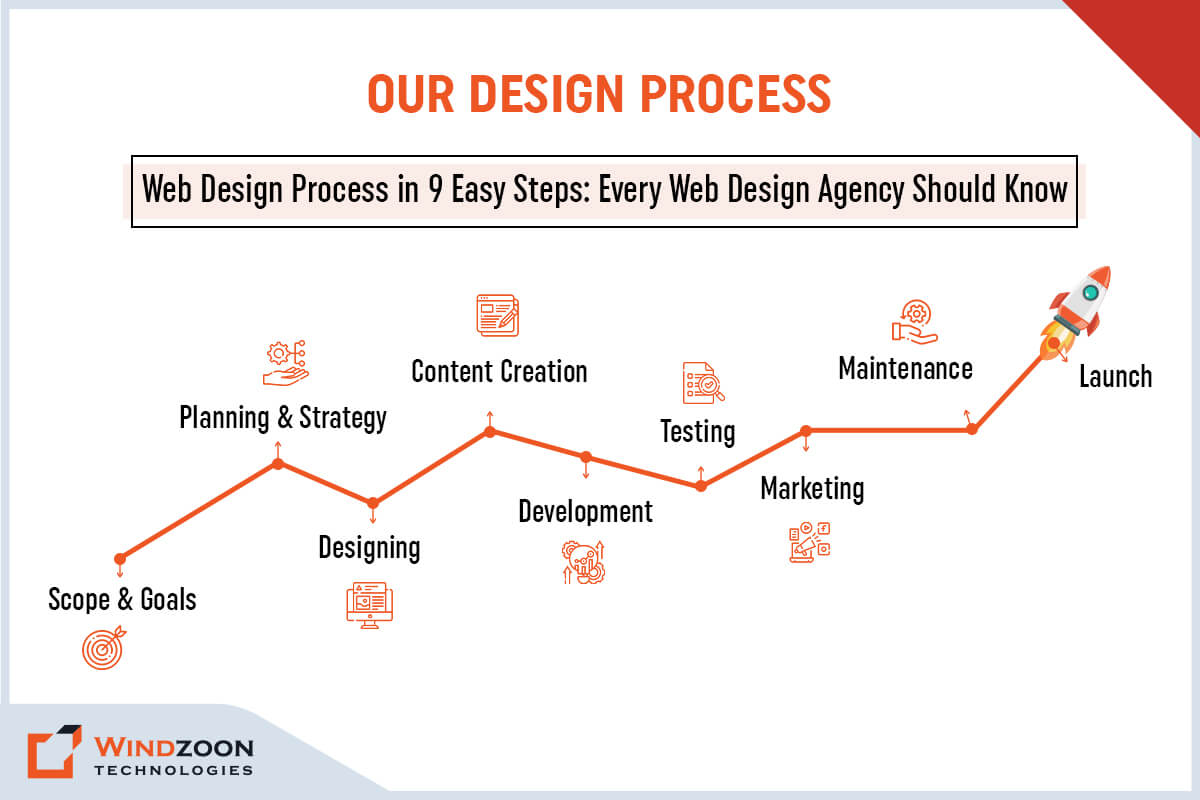
Complete Web Designing Process in 9 Simple Steps
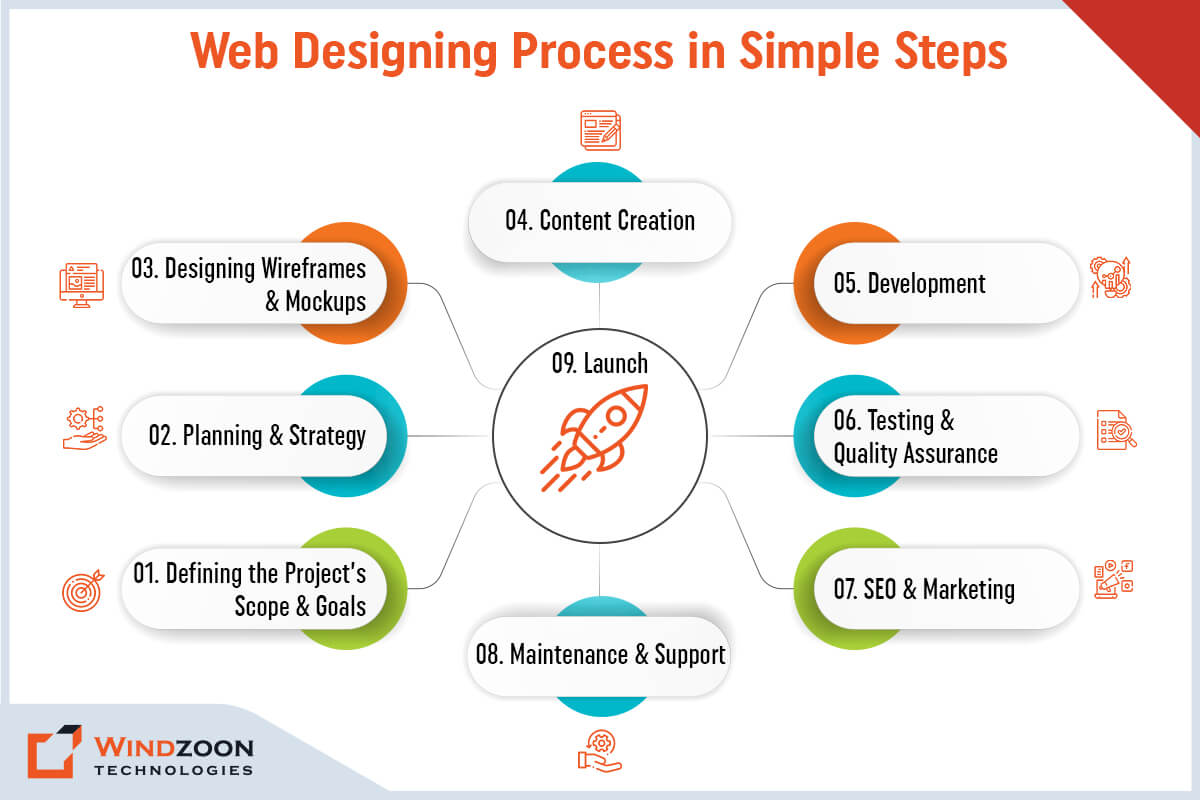
Web Designing Process in Simple Steps

It is important to consider many factors when designing a website’s look and feel. And that is why, to keep you from becoming overwhelmed, we have divided the site design process into ten simple parts. The website design process and development process are structured methodologies that guide you through each stage of building an effective website. When planning your site, focusing on the primary elements—such as sitemaps, wireframes, and content strategy—is essential for successful web design.

1. Defining the Project’s Scope and Goals

This step involves clearly defining the website’s objectives and determining the features and functionality required to achieve those goals. At this stage, it is crucial to identify your website’s target audience and establish your website’s information architecture and site architecture, as these foundational elements will shape your design, content organization, and user experience. Thus, before you begin the process of website design, you should ask yourself the following questions:

  • What is the purpose of your website?
  • Who is the audience you’re aiming for?
  • What primary goals do you want your website to achieve?
  • What products and services are you hoping to provide your clients?
  • What advantages does your current website offer, if any?
  • What changes do you need to redesign the existing website that helps you achieve your business objectives?
  • How well are your rivals doing?

After you’ve answered all these questions, you can easily go on to the next step in the web page design process. This precise information will guide you in the correct way throughout the entire process.

2. Planning and Strategy

It is the second most important step in web design. A web design agency must first do some planning & make strategies to gather useful information related to its target audience & competitors.

Keyword research is essential at this stage. It is important to conduct keyword research to identify relevant keywords that will guide your content and SEO strategy. Additionally, using online resources for gathering design assets, such as images, videos, and fonts, as well as information, can enhance the quality and appeal of your website.

Understanding the goals and objectives of the target audience and competitors before creating a website always help you to stay one step ahead. And will help to create a website that meets the client’s needs and stands out in the market.

Apart from that, you can also utilize Gantt charts or other project development tools to develop realistic project planning for the entire procedure. It will not only assist you in meeting deadlines, but it will also enable you to generate products that will delight your clients. Integrating marketing tools into your planning process will further support website promotion and business growth.

3. Choosing the Right Website Platform

Selecting the right website platform is a pivotal decision in the web design process. With a wide array of website builders and content management systems (CMS) available, it’s important to choose a solution that aligns with your website’s primary aim and the needs of your target audience. Web designers should evaluate platforms based on ease of use, customization capabilities, scalability, and the ability to integrate with essential third-party tools.

Popular website builders like Wix, Squarespace, and WordPress offer user-friendly drag and drop interfaces, making it easier for anyone to create a mobile friendly and visually appealing website without extensive coding knowledge. These platforms also provide a variety of templates and design options, allowing you to customize your site to reflect your brand and engage your audience.

When choosing a website builder, consider the features you need—such as ecommerce functionality, blogging tools, or portfolio galleries—and ensure the platform can support your long-term growth. A well-chosen platform streamlines the web design process, empowers web designers to create a successful website, and ensures your site remains adaptable as your business evolves.

4. Designing Wireframes and Mockups

A site cannot be built without a sitemap, just as a house cannot be built without a blueprint.

The sitemap is the backbone of any well-designed website. It clarifies the relationships between the various pages and content parts and gives web designers a clear picture of the website’s information architecture.

A further step is to develop a wireframe mockup using some design ideas. Wireframes serve as a framework for storing the site’s visual design and content elements, and they can aid in identifying potential difficulties and gaps in the sitemap. Important website elements such as navigation menus, headers, footers, and the inclusion of a dedicated FAQ page should be considered at this stage to improve user experience and provide quick access to essential information.

It helps the website look visually appealing, easy to navigate, and responsive. The design should also be consistent with the client’s brand and target audience.

5. Visual Design Elements

Visual design elements are at the heart of an engaging and effective website. Web designers must thoughtfully combine colors, typography, images, and layouts to create a cohesive and attractive user interface. The right visual aspects not only capture attention but also guide users through the website, making navigation intuitive and enjoyable.

A balanced approach to visual design ensures that the website is both aesthetically pleasing and highly functional. For instance, using a consistent color palette and readable fonts enhances brand recognition and accessibility, while high-quality images and well-structured layouts keep visitors engaged. Visual elements also play a significant role in search engine optimization (SEO), as search engines favor websites that load quickly and are optimized for mobile devices.

To achieve the best results, web designers can utilize design tools like Adobe XD or Sketch to prototype and refine visual elements. Usability testing is essential to gather feedback and ensure that the visual design supports a seamless user experience for all visitors, including those with disabilities. By prioritizing both beauty and usability, you can create a website that stands out in search engines and delights your audience.

6. Content Creation

Once the design and layout are complete, the next stage is to develop high-quality content that is informative, entertaining, and relevant to the target audience. Optimizing your website’s content for both users and search engines is essential for improving rankings and user engagement. When original images are not available, using professional stock photos can enhance the visual appeal of your site and maintain a polished look.

Because if your content is compelling and strong, you can keep clients’ attention and persuade them to make a purchase. When it comes to popular web design trends, content is something that can offer value to your website design.

Aside from increasing engagement, website content improves site visibility for SEO. Therefore, if you want your design process to go quickly and successfully, you should never disregard the content component. Additionally, including a dedicated contact page with essential contact details such as phone number, email, and address is crucial for connecting with your visitors.

7. Development

After the design, layout, and content are finalized, the next step is to develop the website.

As you are aware, hundreds of websites are available online; therefore, for a website to rank well in Google, it must be developed flawlessly. That is why it is crucial to hire expert web developers. The development team plays a key role in translating the visual design into a fully functional website and ensuring all features work as intended. A web developer is responsible for coding the site, maintaining its performance, and handling both front-end and back-end development tasks.

Although coding is always an option for website creation, non-technical people may always use visual page builders, basic themes, and templates to construct personalized sites without wasting time and money. Using a content management system (CMS) like Wix can make it much easier to update and manage your website content. The development process can also include building web apps, which add interactive or complex features beyond traditional websites. Templates can be tailored for specific needs, such as ecommerce sites that require product listings and payment integration, or event websites that benefit from single-page layouts for concise information delivery.

Building your own website using available tools allows for greater customization and control without needing to hire professionals. For businesses, integrating an online store enables direct product sales, order tracking, and payment processing, supporting business growth.

Once you have built a website, make sure to get feedback and update as necessary.

8. Testing and Quality Assurance

Before launching the website, it is important to test it thoroughly to ensure it functions properly and is free of errors. User testing should be conducted to evaluate usability and gather feedback from real users. The web design company should also perform quality assurance checks to ensure the website meets the client’s requirements and industry standards. All the links on the website should be checked to ensure there are no broken links, which can negatively impact user experience and SEO. Additionally, all website functions should be tested to confirm they work as intended. Verifying the website’s accessibility is also essential to ensure it meets accessibility standards and provides an inclusive experience for all users.

Testing for Site Speed and Performance

Ensuring your website loads quickly and performs reliably is a crucial part of the web design process. Site speed and overall website performance directly impact user satisfaction and search engine optimization (SEO). Slow-loading web pages can frustrate visitors and lead to higher bounce rates, while search engines may rank sluggish sites lower in search results.

Web designers should regularly test website speed using tools like Google PageSpeed Insights, which provide actionable recommendations for improvement. Common strategies to boost site speed include optimizing images, minifying CSS and JavaScript files, and leveraging browser caching. These optimizations not only enhance the user experience but also contribute to better rankings in search engines.

Usability testing and collecting user feedback are also important during this phase. By monitoring how real users interact with your site and identifying any performance bottlenecks, you can make targeted improvements that keep your website fast, responsive, and aligned with the needs of your target audience. Consistent testing and optimization ensure your website remains competitive and effective long after launch.

9. SEO and Marketing

SEO and marketing are crucial for the success of any website. A web design agency should optimize the website for search engines and ensure it is easily discoverable by potential customers. Implementing on page seo techniques, such as optimizing meta tags, using internal linking, and providing descriptive alt text, is essential for improving search engine rankings. The company should also use seo tools to audit and improve website performance, and integrate tracking tools to monitor user behavior and traffic sources. Connecting the website to Google Analytics provides detailed performance insights, helping to make informed decisions for ongoing optimization. The company should also create a marketing plan to promote the website and attract more traffic.

10. Maintenance and Support

A website is never truly finished. Because a website requires regular maintenance and updates to ensure it remains relevant and secure. In addition, it’s important to monitor the website’s performance by analyzing metrics such as traffic, user behavior, and engagement to ensure continued success. A web design company should provide ongoing support and maintenance services to keep the website up-to-date and functioning properly.

11. Launch

Launching a website design is the culmination of a comprehensive web design process. After months or even years of planning and development, your website is finally ready to be shared with the world. Launching a new website is an exciting milestone, marking the beginning of your online presence and the importance of ongoing updates and maintenance. While the journey may have been long and arduous, ensuring your website is ready for launch day is important.

This includes everything from ensuring that all content is up-to-date, testing the website for any bugs and glitches, and double-checking that all security protocols are in place. Once you’re confident that your website is fully functional and error-free, you can officially launch it to the public.

After this, we will understand some basic points to keep in mind while designing a website

Things to Consider While Designing A Website

  • One important aspect that a web design company should consider is making the website accessible to all users, including those with disabilities. This includes implementing web accessibility guidelines such as WCAG and ensuring that the website is compatible with assistive technologies such as screen readers.
  • Additionally, a web design company should ensure that the website is built with a responsive or cross-platform design, which will ensure that the website is optimized for viewing on multiple devices and screen sizes.
  • It is also essential to pay attention to key website elements, such as navigation menus, headers, footers, and responsive layouts. Well-designed website elements enhance usability, improve site performance, and contribute to a positive user experience.
  • Another important aspect is the website’s performance; it is crucial to load as fast as possible; this can be achieved by optimizing images, minifying code, and using a Content Delivery Network (CDN). This will not only improve the user experience but also help with search engine rankings.
  • Finally, security is another essential aspect that should not be overlooked. A web design agency should protect the website against common security threats such as SQL injection, cross-site scripting, and cross-site request forgery. This can be done using secure coding practices, implementing SSL, and regular security testing.
  • All in all, a top-notch web design company should always take into account user experience, accessibility, performance, and security to provide a website that meets customer expectations and satisfies their demands.

Conclusion

Web design is a complex process that requires a combination of technical skills and creative thinking. Following these 10 basic steps, a web design company can create a website that meets clients’ needs, stands out in the market, and drives business growth.

Windzoon is a leading web design agency in India and the United States with over ten years of experience. We provide professional web design and development services at competitive rates. Our expert team of web designers and developers is skilled at creating websites that fit the needs and budgets of our clients.

Visit wzadmin.windzoon.in/ to learn more about our web design services or to get a quote.

Conclusion and Final Thoughts

The web design process is a multifaceted journey that requires careful planning, creativity, and technical expertise. From understanding your target audience to selecting the right website platform, focusing on visual design elements, and rigorously testing for site speed and performance, each step plays a vital role in building a successful website.

Effective web design goes beyond aesthetics—it incorporates search engine optimization (SEO), user experience, and the latest web design trends to ensure your business website stands out in a crowded digital landscape. By following a structured design process and leveraging the expertise of skilled web designers, you can create a website that not only meets your goals but also delights your visitors.

Remember, a successful website is never truly finished. Ongoing monitoring, maintenance, and adaptation to new technologies and user expectations are essential to keep your site relevant, secure, and high-performing. Whether you’re launching a new business website, an ecommerce site, or a personal project, investing in a thoughtful web design process will help you achieve lasting online success.
A Complete Guide on ChatGPT: Is it Friend or Foe for Businesses?

Most of us had seen both Terminator and Marvel’s Age of Ultron, but have you ever wondered what the two movies have in common? Well, let me tell you. The idea of AI-powered robots destroying humanity and taking over the world appears in both films.

Let me add one more thing: neither of these films is entirely based on fiction. There is some truth to it, and many eminent scientists, including Dr Stephen Hawking, have acknowledged it. And this AI takeover has already begun in our daily and professional lives. Although it is not as fatal as it is depicted in the movies, it is present in many significant disciplines.

Literature and art are among those disciplines. Yes, the AI invasion begins in the arts and literature, and unless you’ve been living in a cave, you’ve definitely observed the world going crazy over ChatGPT, an AI-powered chatbot.

ChatGPT has been being discussed for quite a while now. But what is ChatGPT exactly, and how does it support business growth? If these are some of your concerns, don’t worry; we’ve got you covered.

So, let’s start this insightful article with our very first question what is ChatGPT? And how does it works?

What is ChatGPT?

ChatGPT is a powerful language generation model developed by OpenAI that can be used in a variety of business applications. Here is a detailed explanation of how ChatGPT works and how it can be used in a business setting:

How to Use ChatGPT?

  • ChatGPT is based on the GPT (Generative Pre-trained Transformer) architecture and is trained on a massive dataset of text from the internet.
  • The model uses this data to learn patterns in language and generate human-like text.
  • ChatGPT uses a technique called unsupervised learning, which means that it learns from the data without any explicit labels or guidelines.
  • This allows the model to generate text in a variety of styles and formats, making it well-suited for a wide range of applications.

Now, we will see the method to access ChatGPT for Commercial purposes.

How Can Businesses Use ChatGPT?

  • To use ChatGPT in a business context, you must first gain access to the model using the OpenAI API.
  • This can be accomplished by registering for an account on the OpenAI website and acquiring an API key.
  • Once you have access to the API, you can use it to generate text by asking the model a question and getting a generated answer in return.

After this, we will understand the popular use case of ChatGPT in various business activities.

What are the Benefits of ChatGPT in Business?

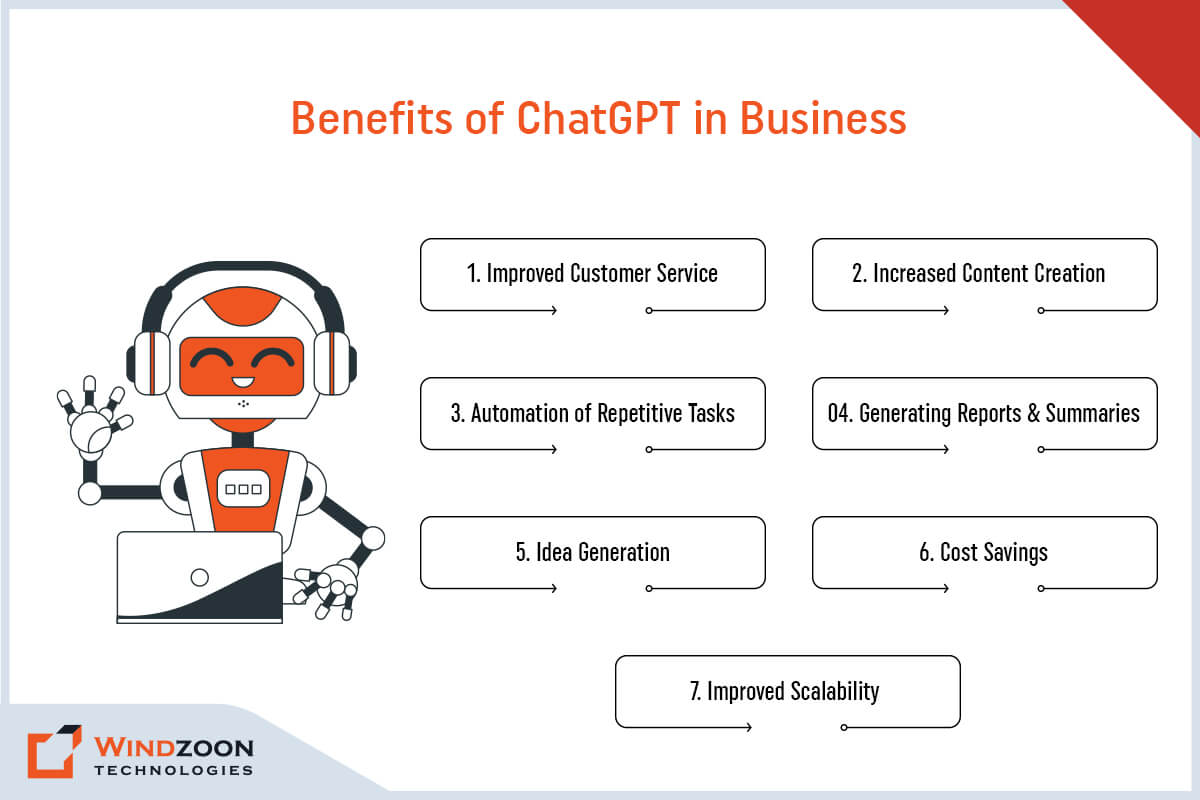
Benefits of ChatGPT in Business

Following are the important use cases of ChatGPT in business operations.

1. Improved Customer Service

  • ChatGPT can be trained on a dataset of customer service interactions and can be used to generate responses to common customer inquiries.
  • This can save time and resources for customer service teams, and improve the overall customer experience.
  • By using ChatGPT, customer service teams can handle more customer interactions in less time, which can lead to increased efficiency and cost savings for the business.

2. Increased Content Creation

  • ChatGPT can be trained on a dataset of written content and can be used to generate new articles, blog posts, or social media updates.
  • This can be especially useful for businesses that need to produce a lot of content on a regular basis.
  • By using ChatGPT, businesses can increase the amount of content they produce, which can lead to increased visibility and engagement on social media, and ultimately more leads to sales and revenue.

3. Automation of Repetitive Tasks

  • ChatGPT can be used to generate automated messages, such as email responses, SMS messages, and chatbot responses.
  • This can help businesses save time and resources by automating repetitive tasks and allowing customer service teams to focus on more complex issues.
  • By using ChatGPT for automation, businesses can reduce the number of human resources required for repetitive tasks, which can lead to increased efficiency and cost savings.

4. Generating Reports and Summaries

  • ChatGPT can be used to generate reports, summaries, and other types of written content.
  • This can help businesses save time and resources by automating the process of generating reports and summaries.
  • By using ChatGPT for report generation, businesses can make data-driven decisions more quickly and easily.

5. Idea Generation

  • ChatGPT can be used to generate ideas for new products and services.
  • This can help businesses generate new ideas for products and services more quickly and easily, which can lead to increased innovation and revenue.

6. Cost Savings

  • ChatGPT can help businesses save time and resources by automating repetitive tasks and increasing the efficiency of customer service teams.
  • This can lead to cost savings for the business in terms of human resources and operational costs.

7. Improved Scalability

  • ChatGPT can handle a large volume of data and can be trained on a large dataset, making it ideal for businesses with high scalability needs.
  • This can help businesses handle increased customer volume and generate more content without increasing costs.

Now, we’ll learn how including ChatGPT in SEO will help businesses to grow further.

How the Combination of ChatGPT and SEO Would Help the Business?

Combination of ChatGPT and SEO for business

Combination of ChatGPT and SEO for business

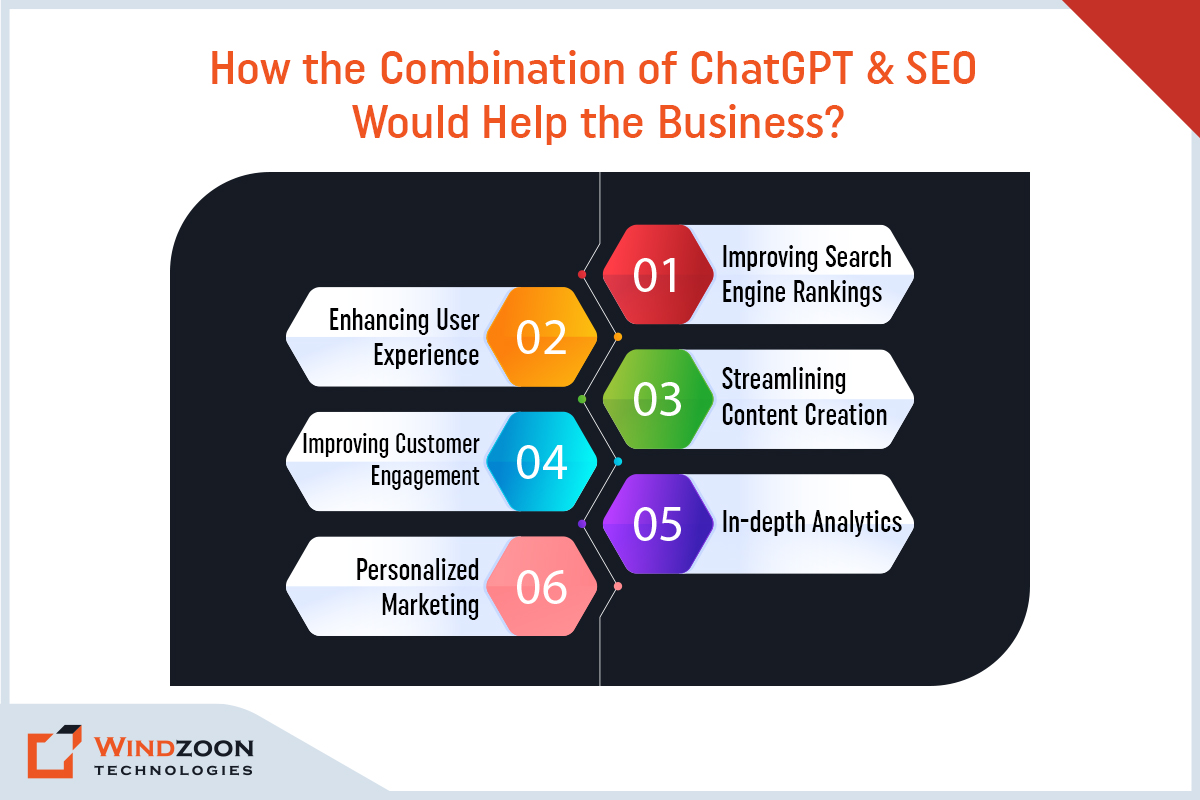
Here are the benefits or 6 ways of combining ChatGPT with SEO that helps business to increase their marketing capabilities.

1. Improving Search Engine Rankings

ChatGPT can be used to generate high-quality and original content. By integrating ChatGPT with SEO techniques, businesses can optimize their website and online content for search engines. This can help increase visibility and drive more traffic to the website, ultimately leading to higher search engine rankings.

2. Enhancing User Experience

ChatGPT can be used to create personalized and engaging content for users. This can help improve the overall user experience and increase the likelihood of users returning to the website.

3. Streamlining Content Creation

ChatGPT can be used to automate the content creation process, saving businesses time and resources. This can help businesses focus on other important aspects of their online presence, such as marketing and customer engagement.

4. Improving Customer Engagement

ChatGPT can be used to create personalized and engaging customer interactions. This can help businesses build stronger relationships with their customers, leading to increased customer loyalty and repeat business.

5. In-depth Analytics

ChatGPT can be integrated with analytics tools to track user engagement and behavior on the website. This can help businesses understand their audience better, and make data-driven decisions to improve their online presence.

6. Personalized Marketing

ChatGPT can be integrated with marketing automation tools to create personalized marketing campaigns that are tailored to individual users. This can help businesses increase conversions and drive more sales.

Overall, the combination of ChatGPT and SEO can help businesses improve their search engine rankings, enhance user experience, generate high-quality content, streamline content creation, improve customer engagement, and provide in-depth analytics.

It can also help them to cut costs and increase conversions by creating personalized marketing campaigns. For better utilization of ChatGPT and to prepare custom marketing campaigns take the assistance of a competent local SEO agency in USA.

After this, we will understand the limitations of using ChatGPT in business.

What Are the Problems Associated with ChatGPT?

Problems Associated with ChatGPT

Problems Associated with ChatGPT

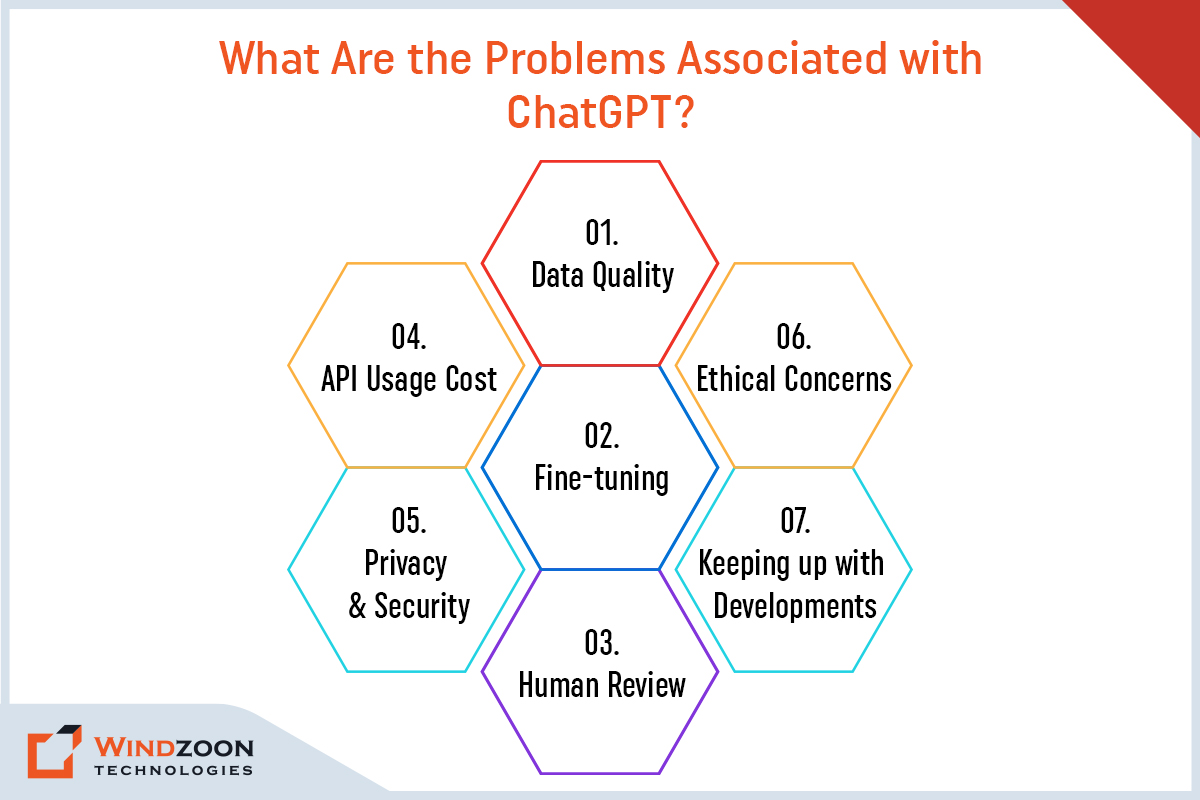
One thing to keep in mind is that ChatGPT, like all language models, is not perfect and may not always produce the desired results. Therefore, there are several things that businesses should consider before using ChatGPT. Here is a detailed explanation of some of the key limitations of ChatGPT to keep in mind:

1. Data Quality:

  • ChatGPT is trained on a massive dataset of text from the internet.
  • The quality of this data can affect the performance of the model.
  • Businesses should ensure that the data used to train the model is accurate, relevant, and appropriate for their specific use case.

2. Fine-tuning:

  • ChatGPT is a pre-trained model and needs to be fine-tuned for specific use cases.
  • Businesses should determine the dataset and training parameters that will be used to fine-tune the model for their specific use case.
  • This process can take time and resources and should be factored into the overall cost of using ChatGPT.

3. Human Review:

  • ChatGPT can generate human-like text, but it is not perfect and may not always produce the desired results.
  • Businesses should have a human review of the generated text before using it in any official capacity, to ensure that it is accurate and appropriate.

4. API Usage Cost:

  • ChatGPT is accessed through the OpenAI API, which charges based on usage.
  • Businesses should factor in these costs when evaluating the potential benefits of using ChatGPT in their business.

5. Privacy and Security:

  • ChatGPT uses a large dataset of text from the internet, which can include personal and sensitive information.
  • Businesses should ensure that they have the necessary privacy and security measures in place to protect this data.

6. Ethical Concerns:

  • ChatGPT can be used to automate repetitive tasks, which can lead to job displacement.
  • Businesses should consider the ethical implications of using ChatGPT and take steps to mitigate any negative impacts.

7. Keeping up with Developments:

  • ChatGPT, like other AI models, is constantly improving.
  • Businesses should stay informed about the latest developments in the field and consider how they may impact their use of ChatGPT.

Now, we’ll learn about the process to implement ChatGPT into your business.

How ChatGPT Can Transform Marketing Of Your Business?

You can effectively utilize ChatGPT in your business by following the simple below-mentioned steps:

1. Define your Objectives

Clearly define what you want to achieve by using ChatGPT in your business. This could be to improve customer service, generate leads, or automate certain tasks.

2. Identify Use Cases

Identify specific areas where ChatGPT can be used to improve your business operations. For example, it can be used to answer frequently asked questions, generate personalized product recommendations, or analyze customer data.

3. Train your Model

Provide ChatGPT with the necessary data and training so that it can understand your business and customers. This includes providing it with information about your products, services, and industry.

4. Test and Evaluate

Test ChatGPT’s performance and evaluate its effectiveness in achieving your objectives. Use this information to make adjustments and improvements to the model.

5. Integrate with Existing Systems

Integrate ChatGPT with existing systems such as CRM, ERP, and e-commerce platforms to streamline business operations and improve customer engagement.

6. Continuously Monitor and Update

Continuously monitor and update the model with new data and feedback to improve its performance and accuracy.

7. Be Transparent

Be transparent about the use of ChatGPT and inform customers of its capabilities and limitations.

By following these steps, you can successfully utilize ChatGPT in your business to improve customer engagement, increase sales, and streamline business operations.

Conclusion

In conclusion, ChatGPT is a powerful language generation model that can be used in a variety of business applications. It can help businesses save time and resources by automating repetitive tasks and allowing customer service teams to focus on more complex issues. It can also be used for content creation and idea generation.

As with any new technology, it’s important to approach the implementation of ChatGPT with a clear strategy and well-defined goals to ensure you are able to realize the full potential of this powerful tool. If you need any help in this endavour then you can always look up to an expert digital marketing agency in India, USA.

Windzoon is a well-known digital marketing company. We have seasoned and knowledgeable digital marketing specialists who can expertly develop your business's digital marketing strategies.

Additionally, we offer SEO, SMO, and PPC marketing services. If you want to learn more about us and our digital marketing services, go to wzadmin.windzoon.in/ and request a quote.

Is Shopify Dropshipping Profitable? Helping Businesses Earn Profit in 2023

Shopify dropshipping is considered a low risk business model and an attractive business model for entrepreneurs. With no product storage and low overhead costs, it is possible to build your own internet business and have all three of these elements. Using Shopify and the dropshipping concept makes it definitely possible.

The COVID pandemic caused dropshipping Shopify to become popular among online store owners in 2022 and beyond. If you want to launch an online business, dropshipping Shopify should be at the top of your list. This low risk business model allows entrepreneurs to sell online without significant upfront investment, making it an attractive business model in the ecommerce space. However, if you want to create an online store, you need to seek assistance from a reputable Shopify Dropshipping Store Development Company.

But many of you might be wondering if it’s actually worth it to invest in Shopify dropshipping. In this article, all of your questions about Shopify Dropshipping will be answered. We have explained all of the related aspects affecting your doubt, so you can make the right decision.

However, before we get to the point, let’s first understand some basic details regarding Shopify dropshipping.

What is Shopify, and How to Use It for Your Shopify Dropshipping Store?

Shopify is an e-commerce platform that allows people and businesses to develop and manage online stores. It provides a wide range of tools and features to help users sell products and manage their business, including inventory management, payment processing, and shipping integration. Shopify does not require advanced technical knowledge, making it accessible for beginners who want to launch an ecommerce store without coding skills.

However, to use Shopify for dropshipping you have to follow the below steps:

  • To use Shopify for dropshipping, you will first need to sign up for a Shopify account and set up your ecommerce store. Once your store is set up, you can begin adding products to it using the platform’s inventory management tools.
  • Next, you will need to find a dropshipping supplier or a dropshipping app that integrates with Shopify. These suppliers will typically offer a wide range of products that you can add to your store and will handle the fulfillment of orders on your behalf. You can find these dropshipping apps in the Shopify App Store, which serves as a central resource for discovering and evaluating relevant dropshipping tools.
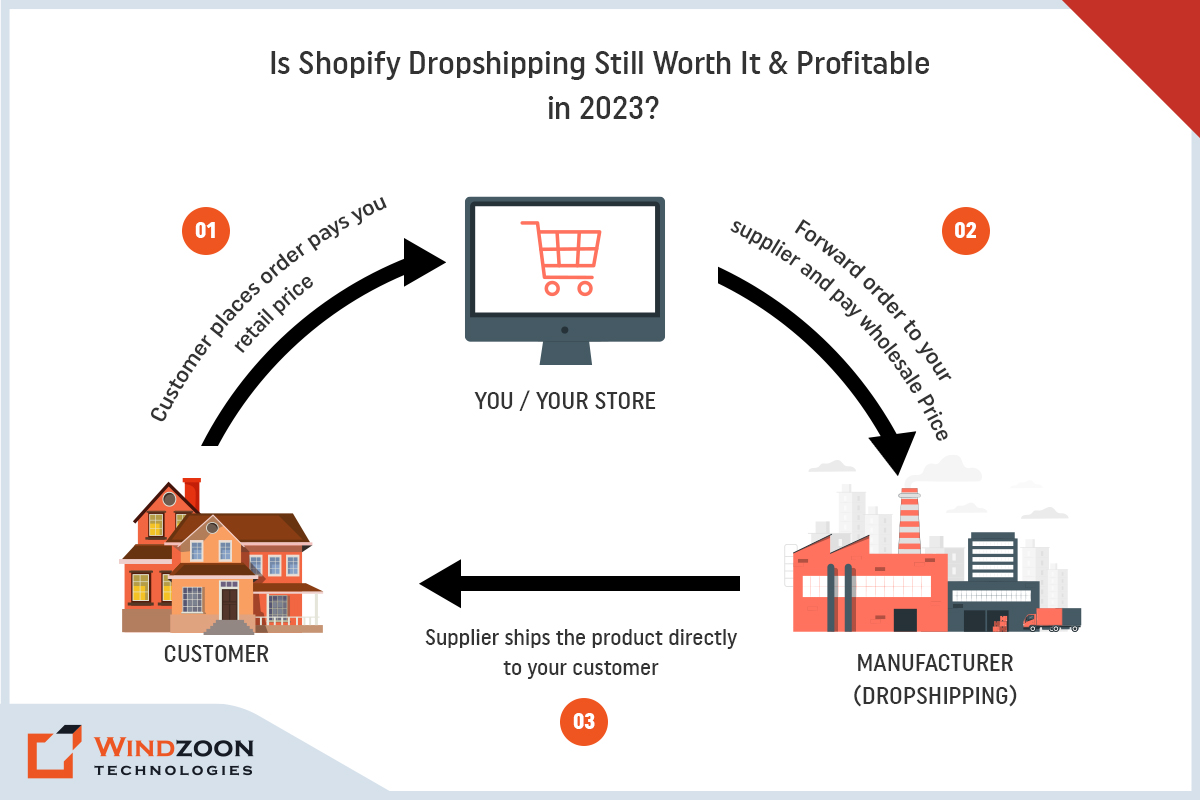
  • When an order is placed on your store, you will simply need to forward the order details to the supplier, who will then ship the product directly to your customer. Suppliers manage order fulfillment, including picking, packing, and shipping products directly to customers.
  • Once your store is set up and you have added products from a supplier, you can start promoting your store through various marketing channels such as social media, SEO and paid advertising.
  • Shopify also provides many apps that can help you to improve your store functionality and increase sales. Examples include apps for email marketing, product reviews, and upselling.
  • Shopify offers a variety of customizable themes, allowing you to tailor your store design to optimize the customer experience and boost conversions.
  • Efficiently managing customer orders is crucial for smooth operations and maintaining good customer support.

Overall, Shopify is a powerful e-commerce platform that makes it easy to set up and manage an online store, and it provides a great solution for those looking to start a dropshipping business.

Is Dropshipping Saturated in 2022?

Well, we would not all is perfectly well with the dropshipping model. There are a few reasons that are affecting the roaring popularity of the dropshipping model. And those reasons are as follows:

Increased awareness: As the popularity of dropshipping has grown, more and more people are becoming aware of the business model and are starting their own stores. This leads to increased competition. In a competitive market, many stores may end up selling the same product as other stores, making it challenging to differentiate and attract customers.

Easy to start: With platforms like Shopify making it easy for anyone to start an e-commerce store, more and more people are entering the market.

Low barrier to entry: The low startup costs associated with dropshipping make it accessible to a wide range of people, which further increases competition.

Low-profit margins: With more competition, the profit margins on dropshipped products can become increasingly thin, making it harder for new businesses to be profitable. To attract customers in such a saturated market, implementing competitive pricing is essential.

Saturation of Niche: Popular niches such as clothing and grocery delivery are becoming saturated, making it difficult for new players to enter the market and stand out.

However, it’s important to note that while the dropshipping market is becoming increasingly competitive, it’s not impossible to be successful. To be successful as a dropshipper, you need to find a unique niche and offer something that sets you apart from the competition. Focusing on a particular audience or target audience can help you build a strong brand and foster customer loyalty.

You should also focus on building a strong brand, offering excellent customer service, and continually testing and optimizing your store to improve conversions. Additionally, keeping an eye on trends in the market, and being adaptable to changes in the industry can also help to stay ahead of the competition.

Why Start Dropshipping On Shopify in 2023?

Here are the top reasons to start dropshipping on Shopify in 2023. Building a Shopify store is a straightforward process, making it an ideal choice for entrepreneurs and Shopify store owners looking to launch or grow their eCommerce business.

User friendliness: Shopify is renowned for its intuitive user interface and simplicity of usage.

It’s a great platform for beginners who are new to e-commerce and dropshipping.

Large App Store: Shopify has a large app store with a wide range of apps that can help you automate and streamline your business, making it easier to scale. Many dropshipping apps integrate seamlessly with your Shopify store, allowing you to connect with suppliers like AliExpress, Dsers, and Spocket for efficient product listing and order fulfillment.

Customizable Themes: Shopify offers a wide variety of customizable themes that can help you create a professional-looking store quickly and easily.

Strong Support: Shopify has a large community of users and a wide range of resources available, including a knowledge base, forums, and a support centre. This makes it easy to find answers to any questions you may have.

Mobile optimization: Shopify stores are optimized for mobile devices, which is important as a large percentage of online shopping is done on mobile devices now.

SEO friendly: Shopify platform is SEO friendly, supporting search engine optimization strategies such as keyword research and long-tail keywords to improve your store’s visibility in search engine results and attract targeted traffic.

Strong Security: Shopify provides a secure platform to run your business, which is important to build trust with your customers.

Growing market: The e-commerce market is growing rapidly, and with the ongoing pandemic, more and more people are turning to online shopping. This creates a lot of opportunities for dropshippers and Shopify store owners to tap into this growing market.

Promote your store: Utilize social media platforms as part of a comprehensive marketing strategy to attract customers and boost sales.

Multiple marketing channels: Take advantage of various sales channels, such as online marketplaces like Amazon, to reach more customers and diversify your revenue streams.

Would Shopify Dropshipping Be Worth It in 2023?

The answer is “absolutely!” The dropshipping business model is a type of retail business model where sellers act as intermediaries between customers and suppliers, and dropshipping businesses have seen significant growth globally. But first, consider the following facts and figures:

  • As per Market Data Forecast, the global dropshipping market would be worth $128 billion in 2020.
  • The same report predicts a 32% compound annual growth rate (CAGR) dropshipping market from 2021 to 2026.
  • Grand View Research predicts that by 2025, the global dropshipping industry would expand at a 28.8% CAGR.
  • According to a market report by Research & Markets, the worldwide dropshipping industry will grow to $591.77 billion by 2027.
  • The dropshipping approach is presently used by between 22 and 33% of online businesses.
  • About half of Amazon’s online sales are made by third-party sellers that use retail strategies such as dropshipping.
  • Shopify’s revenue for the fiscal year ended March 31, 2021, was $3.44 billion, representing a 99.58% rise year over year.
  • Retailers who use the dropshipping strategy can profit by 50% more than those who use the traditional model of stocking inventory.
  • A Statista analysis states that in 2021, Shopify dropped-shipped around 1.9 million items whereas Oberlo dropped-shipped only roughly 33,000.

These statistics show that the dropshipping business model is not only established but also rapidly expanding, making dropshipping businesses a significant force in the eCommerce sector. Dropshipping is considered dropshipping worth pursuing because it offers low overhead, scalability, and minimal risk, and dropshipping still profitable in 2023 due to ongoing market growth and adaptability to changing trends.

When evaluating the financial benefits, it’s crucial for dropshipping businesses to maintain a healthy profit margin by carefully managing costs and pricing strategies. Increasing the average order value through upselling and cross-selling can further boost profitability. Additionally, when calculating expenses, remember to factor in transaction fees from payment processors and ecommerce platforms, as these can impact your overall profit.

How to Begin a Profitable Dropshipping Business in 2023?

Becoming successful on dropshipping websites does not happen in one day. It takes lots of effort, hard work, and failures to earn well finally. The seller alone is responsible for whatever happens to his business. To increase your chances of success, it is essential to conduct thorough market research and market research to identify potential customers and products in high demand. They must be well-researched before taking a step ahead.

Investing Time and Money into the Business

They should learn how a business operates and understand the consumer and markets. They will benefit from developing new skills to become a good entrepreneur. Building a business means creating an asset. Though monetary expenses in dropshipping are low, it is good to invest some money into it for growth and promotion.

Choosing the Right Suppliers

Without suppliers, a dropshipping business will cease to exist. Hence, finding the best and most compatible suppliers is important. It is crucial to choose reliable suppliers and a reliable dropshipping supplier to ensure smooth operations and minimize risks. The sellers should find retailers with high-quality products and services, and pay close attention to quality control and product quality by evaluating reviews, samples, and customer feedback. Shopify connects potential suppliers through Oberlo to the store.

Getting Hold of Finances

Dropshippers should decide on how they want finances handled. Some sellers open separate account for the sales and profits they make. The accounting should happen in one place to not cause confusion.

Promoting the Dropshipping Business

Advertisements and promotions are essential for any business to prosper. After setting up a business, sellers should make efforts to market their products. Most dropshippers promote through paid advertisements, content marketing, or influencer marketing. Running targeted marketing campaigns on social media platforms is also crucial to attract customers and increase sales.

If someone asks you after reading this post, “Is dropshipping Shopify worth investing in?” You can tell them it’s most certainly yes. The likelihood of the dropshipping industry collapsing is essentially zero, especially in light of how heavily the world relies on online shopping and the eCommerce sector.

However, keep in mind that if you want to thrive, you should concentrate on selecting in-demand products, choose suppliers carefully, and keep up with market developments.

Windzoon is a well-known Shopify Dropshipping Store Development Company in India and the United States. We have created hundreds of Dropshipping websites for various niches. Hire Shopify Dropshipping Experts from us to create a strong online presence on Shopify and increase your online sales.

Please contact us if you’d like to know more about our services or .

10 AngularJS Performance Tools to Optimize Your App in 2023

Your Google rankings, AdWords, Facebook ads, and all leads generated via your website are all affected by the speed and user experience of your web app. Therefore, using a strong web app-building framework is essential while constructing web applications, especially since AngularJS is widely used in web development for building dynamic web applications.

AngularJS is one of the most prominent JavaScript frameworks around the world. It contains various attributes like directives, data binding, dependency injection, and superior MVC architectural implementation. And that’s why AngularJS is well known for creating high-performing apps and web solutions. AngularJS is supported by a large community of developers, which provides extensive resources, documentation, and support, making it easier for developers working on angular applications.

However, not everything is as perfect as it seems. The web apps created using AngularJS have started to get slow ever since their original release. Almost all developers have experienced performance problems with Angular. Developers often face unique challenges when optimizing angular applications for performance, especially as these web applications grow in complexity.

But don’t worry. As a seasoned Angular development company, we frequently run into these performance problems in our projects and have several tricks and shortcuts to improve speed and performance.

As a result, we’ve developed a list of ten tips to boost AngularJS speed. These tips and solutions will help you solve the issues in your Angular web app and improve its performance.

Introduction to AngularJS App Optimization

AngularJS is a powerful framework that enables developers to build robust web apps with rich features and dynamic user experiences. However, as web applications grow in complexity, performance issues can arise if the AngularJS app is not properly optimized. Improving AngularJS performance is essential for delivering fast, responsive, and scalable web apps that meet user expectations and perform well across multiple browsers.

Optimizing an AngularJS app involves more than just writing efficient code—it requires a deep understanding of the framework’s internal mechanisms and a proactive approach to identifying and resolving performance bottlenecks. By leveraging proven optimization techniques, developers can enhance the speed and efficiency of their web applications, ensuring a seamless user experience. In the following sections, we’ll explore practical strategies and tools that can help you improve AngularJS performance and get the most out of this powerful framework.

Most Typical Angular Web App Performance Problems

Some of the most frequent problems that Angular web apps encounter are listed below:

  • Excessive server use
  • Sluggish page response
  • Sudden app failure
  • Frequent slowdowns
  • The migrated technology is not producing the intended results
  • Unexpected mistakes resulting from a real-time data stream

These issues can significantly reduce an AngularJS application’s performance and negatively affect the overall success of your project.

With the use of Angular optimization techniques, these problems can be resolved. Read our AngularJS vs ReactJS blog for a detailed explanation of this framework. In the following topic, we’ll demonstrate how to make your Angular app smaller, quicker, and more responsive. Let’s get going.

Understanding Performance Bottlenecks

Performance bottlenecks in AngularJS applications can significantly impact the speed and responsiveness of your web app. These bottlenecks often stem from excessive DOM manipulation, unnecessary digest cycles, and inefficient data bindings. For example, overusing directives like ng-show or ng-repeat can lead to a large number of DOM elements and watchers, which slows down the digest cycle and degrades performance.

To pinpoint these issues, developers can utilize tools such as the Chrome DevTools Profiler and Timeline. These tools provide deep insights into how your AngularJS app processes data, manages DOM elements, and handles time binding. By analyzing performance data, you can identify which parts of your application are causing slowdowns and apply targeted optimizations. For instance, replacing ng-show with ng-if can reduce the number of active DOM elements, while implementing one-time binding can minimize unnecessary data bindings and improve digest cycle efficiency. Understanding where and why bottlenecks occur empowers developers to make informed decisions that enhance AngularJS application performance.

Top 10 Tips to Enhance AngularJS App Performance

Top 10 Tips to Enhance AngularJS App Performance

1. Pay Close Attention To Your AngularJS App’s Digest Cycle

The digest cycle is thought to be the most reliable indicator of how well an AngularJS application is doing. It is a looping cycle that verifies and keeps track of any changes to the variables. The digest cycle operates as a function that checks for changes and updates the view accordingly. Therefore, the shorter your digest cycle will be the faster your software runs.

It will unquestionably enhance the functioning of the application and yield favorable client feedback. A well-performing app will immediately gain more users and increase its market share.

2. Put Limit On Watcher and Scope Usage

In most cases, having too many watchers is the primary cause of your app becoming slow. AngularJS employs dirty checking to keep track of all code changes. If two watchers are linked together, the digest cycle is repeated twice to guarantee that all data is up to date. Watchers are responsible for detecting changes and automatically update values in the view whenever the underlying model changes.

In big applications with several interconnected watchers, the digest cycle will continue to run until they are updated and stable. This will make the app lag a lot and make it slow. Therefore, you must limit the usage of watchers and scopes in your app. Using dom filters, such as the $filter provider, can help optimize performance by pre-processing data and reducing unnecessary DOM parsing and updates.

We recommend keeping the number of watchers at under a few hundred to improve Angular JS performance.

3. Deactivate CSS

In AngularJS, you can utilize a directive as an element, attribute, CSS class, or comment. However, if you do not require CSS class and comment directives, you can disable them for improved speed.

When CSS is enabled, images and text take longer to load on the web apps. Manipulating the css display property, such as toggling visibility with ng-show, can also impact rendering speed and overall performance, since elements remain in the DOM even when hidden. As a result, it’s best to disable it if you don’t need it or if you only require it sometimes. The reason is it helps your app to load faster.

4. Reduce DOM Access

The DOM is the core of your application, representing the complete ideology of the page documents. You may quickly access the DOM for AngularJS performance optimization suggestions and make changes to the page.

However, if these phases are not handled carefully, excessive manipulation can create too many dom nodes and result in large dom trees, which could be highly expensive. Therefore, you should only utilize DOM when absolutely essential. Additionally, to prevent difficulties, keep the DOM tree as minimal as possible. Keeping dom trees small is crucial for optimal performance, as large dom trees can increase the cost of DOM access and manipulation.

5. Dismiss ng-model

The ng-model directive is used to connect data between the Model and View layers. Using ng-model-options, you may debounce the inputs. It gives you complete control over the timing and frequency of the digest cycle for that input.

Now, you can control how long your digest cycle lasts by setting a limit. By doing this, you can greatly enhance AngularJS performance and prevent UI lags.

6. Implement One-Time Binding

The majority of frameworks compel developers to use two-way data binding. It allows developers to load & change data as many times as they wanted. But it can also decrease the app’s performance at some point.

The AngularJS framework gives developers the option to bind the data only once to an object. You can accomplish this by placing a double colon before the value. Only one instance of the object’s data is provided to the user interface (UI) in one-time binding.

Such data doesn’t have an updating mechanism. This works best with data that just needs to be loaded once and doesn’t need to change over time. One-time data binding significantly boosts performance. Therefore, this is among the best AngularJS performance tips.

7. Rather Than Using ng-show, Use ng-if Or ng-switch

Every programming language relies heavily on conditionals. AngularJS development also follows the same pattern.

Developers utilize ng-show to check the supplied condition and show or hide the CSS display for that element. In contrast, ng-if manipulates a statement based on a single condition, while ng-switch is utilized when there are many criteria. Another commonly used directive is the ng repeat directive, which renders lists by duplicating HTML elements for each item, but overusing it can impact performance.

Therefore, to delete an element from the DOM, the developer must utilize ng-if and ng-switch. It’s a difficult task, hence, hire AngularJS developers for a seamless procedure.

8. Utilize External Performance-Improving Instruments

For improving code efficiency, we advise you to try third-party tools like Batarang, Chrome Profiler, and Timeline. With the help of these AngularJS performance enhancer tools, you may uncover code fragments that are degrading performance and possibly update your application to improve overall results. These tools can drastically drive performance improvements in AngularJS applications by identifying inefficiencies and suggesting optimizations.

The Record Allocation Timeline tool logs and examines each action taken by your application as it runs. It’s the ideal starting point for your investigation into alleged performance difficulties with your application.

While Chrome Prolifer is a useful tool with numerous sub-extensions, like Record Allocation Profiler, Memory Profiler, and Take Heap Snapshot, it will improve AngularJS performance.

Additionally, the Angular team’s Batarang Tool will help you locate and troubleshoot AngularJS performance bottlenecks.

9. AOT Collection

Typescript is the standard language for Angular. You must convert the Typescript code into JavaScript for the browser to interpret it and launch web apps. And for that, you’ll need the help of compilation.

There are two different compilation options offered by Angular: AOT (Ahead of time) and JIT (Just In Time).

You should use Ahead of time Compilation throughout the development phase. It solely generates compiling templates and uses the Angular compiler from the deployment package. This method improves application performance and cuts down on payload time.

10. Make Use of Lodash or Native JavaScript

The use of Lodash and the writing of code in native JavaScript will improve performance. Lodash is a JavaScript library that will rework the essential logic of your application. Using Lodash in place of the native AngularJS methods will conserve both time and memory.

Now, let’s look at a few AngularJS performance and testing tools.

Template Optimization Techniques

Optimizing templates is a key step in boosting your AngularJS app’s performance. Well-structured templates help keep the number of DOM elements manageable, reduce digest cycle overhead, and ensure your web applications run smoothly. One effective technique is to use ng-if instead of ng-show, as ng-if removes elements from the DOM entirely when they’re not needed, while ng-show simply toggles their visibility—keeping them in the DOM and increasing processing load.

Limiting the use of ng-repeat is another important strategy. While ng-repeat is convenient for rendering lists, overusing it can create a large number of watchers and DOM nodes, slowing down your app. Instead, consider using the ng-switch directive, which can help manage complex conditional rendering with fewer DOM elements. Additionally, leveraging one-time binding (using the double colon syntax) for static data ensures that AngularJS only checks the data once, reducing the digest cycle’s workload.

Using HTML templates with ng-bind-html can also help minimize the number of watchers and streamline data updates. By applying these template optimization techniques, developers can create AngularJS apps that are not only efficient but also scalable and easier to maintain.

Optimizing Dependency Injection in AngularJS

Dependency injection is a core feature of AngularJS that simplifies the management of components and services within your web applications. However, if not handled carefully, it can introduce performance issues, especially in large-scale AngularJS apps. To optimize dependency injection, developers should consider strategies such as lazy loading, which loads dependencies only when needed, and caching, which stores frequently used services for quick access.

For example, utilizing the $cacheFactory service allows you to cache dependencies and reduce the overhead associated with repeated injections. Minimizing the number of dependencies injected into each component also helps streamline the application and avoid unnecessary processing. In some cases, replacing built-in AngularJS methods with native JavaScript functions can further enhance performance by reducing abstraction layers.

Incorporating automated testing tools like Protractor and WebDriverIO into your development process ensures that optimizations do not introduce new issues and helps maintain a high-quality user experience. By refining dependency injection practices, developers can create AngularJS applications that are faster, more efficient, and capable of delivering a superior user experience across all devices and browsers.

Popular Performance Testing Tools for AngularJS Applications

Popular Performance Testing Tools for AngularJS Applications

Performance testing tools play a crucial role in ensuring that AngularJS applications run smoothly and efficiently. In the context of front end development, these tools are essential for building, testing, and optimizing AngularJS-based web applications, helping developers enhance user interfaces and streamline development workflows. By identifying bottlenecks and optimizing code, developers can deliver a better user experience and maintain high application standards.

1. Protractor

The Angular team has created the Protractor. This software package makes it simple to do automated end-to-end testing. Protractor is built on top of webDriverJS and Selenium server, so it has access to all of those functionalities. It means you can utilize the Selenium grid functionality to run tests in multiple browsers at once. You can even create your own test suites with Mocha or Jasmine.

2. WebdriverIO

The WebdriverIO tool enables you to control a browser or a mobile application with just a few lines of code. It gives the test code a clear, concise, and easy-to-read appearance. Developers can write asynchronous instructions synchronously using this integrated test runner. Because of this, the developers are free to ignore the racing conditions. Additionally, it handles the Selenium session and eliminates all the difficult setup efforts.

3. TestingWhiz

Due to its codeless scripting capability, TestingWhiz is one of the most user-friendly test automation solutions for AngularJS optimization. This tool provides an end-to-end testing solution for AngularJS web and mobile applications. Its codeless scripting capability makes it popular, particularly among non-programmers.

4. NightwatchJS

NightwatchJS is a modified version of the W3C webdriver API. This tool is simple to modify and customize and includes its own testing framework and assertions techniques. However, it lacks the level of assistance that WebDriverIO and Protractor have.

Conclusion

Despite your best efforts, not all of these Angular performance optimization suggestions can be applied in full to your app to enhance speed. You must apply the advice that will help your app and business while taking into account the needs of your app. Optimizing AngularJS performance leads to smoother user interaction and a better user experience, ensuring your application responds efficiently to your users’ actions.

And it’s likely that after reading the aforementioned performance optimization advice, you now realize that it’s not as simple as it first appears to optimize the Angular app’s performance. It necessitates the skills and support of a seasoned professional who can assist you in optimizing your application to the greatest extent possible.

The Angular developers at Windzoon are masters in using AngularJS to create simple to enterprise-grade web applications. Visit wzadmin.windzoon.in/ to take advantage of our outstanding AngularJS development services and to request a quote.

Know 10 Best Web Development Frameworks to Use in 2023

A decade ago, if someone had told us that applications would govern our lives, we probably would have laughed it off. But it did in fact become a startling reality of the world we live in today.

Most of our everyday activities are managed by apps, from alarm clocks to fitness trackers and reminders, from food and grocery delivery services to banks and work management systems.

But have you ever wondered who is responsible for making these apps work? A web app development framework and the efforts of a web app development company to create them.

These frameworks make it possible to build various web applications that work on a variety of platforms. Additionally, their code can be used to create mobile and progressive web applications. And as a developer, marketer, or business owner, you might want to take advantage of using a web app development framework for your app-building project. Correct?

This blog post has covered several excellent frameworks that may be used to create best-in-class web apps.

However, before we go any further, let’s get some basic understanding of web development frameworks.

What Is a Framework For Web Application Development?

A framework is a bundle of programming tools that acts as a basic “roadmap” for developing well-structured, reliable software and systems. A web development framework is created to assist in the creation of web applications, including web services, web resources, and web APIs.

A web framework gives access to pre-made components, code snippets, or templates that are used to speed up the creation of web apps through a library.

Top 3 Advantages of Utilizing Web App Development Frameworks

There are various web development frameworks to select from. But they all have these three benefits in common:

1. Simplified development

Web development frameworks “bootstrap” the development process by offering templates to jumpstart a project or code for aspects that are common to many projects.

2. Enhanced security and reliability

Web app development frameworks are supported by developer communities that regularly provide updates to guarantee that components are consistent with web standards, secure, and stable.

3. Better performance and scalability

Frameworks aid in creating a structure for web application development that is both scalable and optimized for performance—aspects that also make these applications simpler to debug and manage.

Types of Web App Development Framework

Web frameworks come in two varieties:

Backend (Server-side): The backend framework is responsible for the application’s internal, background operations.

Frontend (Client-side): Frontend, which refers to the exterior component of a web application framework, is the view of the application that the user sees when they access it.

Now, we will move towards to know some famous web app development frameworks to use in 2023.

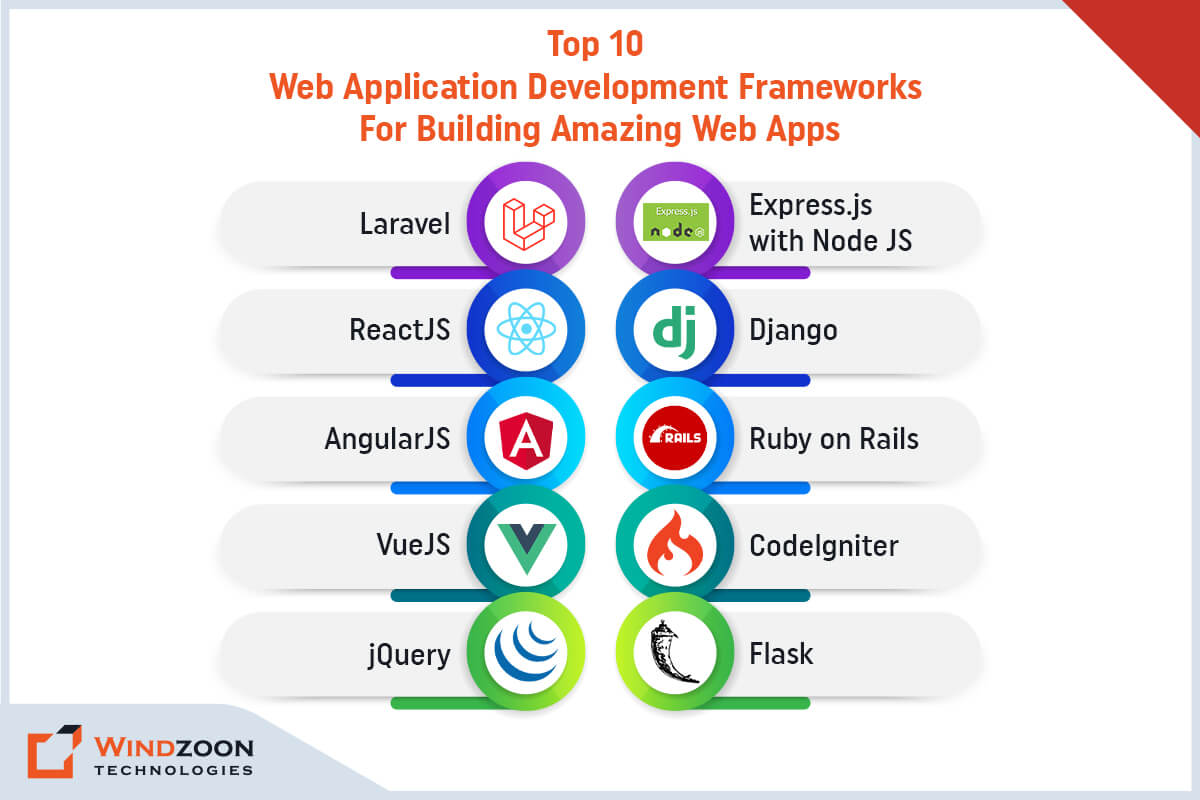
Top 10 Web Application Development Frameworks For Building Amazing Web Apps

Top 10 Web Application Development Frameworks

Top 10 Web Application Development Frameworks

1. Laravel Framework

The Laravel framework is a popular open-source backend framework that uses PHP for scripting. It was developed by Taylor Otwell in 2011. The MVC architecture enables quicker development and simpler maintenance. With built-in API support, Laravel has a sizable number of packages.

Web developers utilize it to make web development work easier. It has the power to simplify real-time event broadcasting and develop a comprehensive background and task processing. Therefore, Laravel is the perfect for developing secure and large-scale web applications.

Applications built with Laravel framework:

  • Alison
  • MyRank
  • Invoice Ninja
  • Euromobil kitchens

2. ReactJS Framework

In 2013, Facebook launched React JS, an open-source JavaScript library. React is a web framework that is mostly used to create single-page front-end apps. In addition, it allows for the creation of mobile applications, something the majority of other frameworks often do not allow for.

React seamlessly connects with a variety of different libraries to successfully carry out routing, state management, and API interface tasks. That’s why many developers using ReactJS for their next web application project.

Applications built with ReactJS framework

  • Facebook
  • Skype
  • Shopify
  • Discord
  • Instagram
  • Uber
  • Netflix
  • Tesla

3. AngularJS Framework

Google and a group of developers created the web framework known as AngularJS in 2009-10, which is based on JavaScript. This web development framework got famous because it makes front-end development extremely simple and quick. One of its most important aspects is code reuse.

The AngularJS framework has high performance and scalability. It is typically used to create single-page web applications and is used to build the front end of web applications. Choose the AngularJS web development framework if you want to build engaging social sites.

Application built with AngularJS Framework

  • Google Translate
  • YouTube
  • Google Search

4. VueJS Framework

Another state-of-the-art open-source JavaScript-based front-end framework was created by Evan You in 2014 and is maintained by him and the rest of the active core team members. It is well-known for its usage of Glorifying UI and the rapid building of single-page applications. It takes advantage of the best features of the React.js and Angular.js frameworks.

VueJS’s adaptable design framework & growing popularity is a reason that have piqued the interest of a number of small and large enterprises.

Application built with VueJS Framework

  • Trustpilot
  • Nintendo
  • Behance

5. jQuery Framework

jQuery is an open-source front-end JavaScript library built by John Resig in 2006. It is used to create app user interfaces. JQuery is renowned for its straightforward methodology and cross-browser interoperability. The framework makes it easier for DOM elements and its syntactic structure to interact.

The framework is well-known for its capacity to produce outstanding effects and animations in the developed apps. jQuery is a lightweight framework with a variety of plugins that make it simple to include new features.

Applications built with jQuery Framework

  • WordPress
  • Facebook,
  • IBM
  • Google

6. Express.js with NodeJS Framework

The pairing of Node JS and Express.js results in an open-source front-end & a back-end framework for web development. TJ Holowaychuk, StrongLoop, and others developed the ExpressJS framework, while Rayn Dahl developed NodeJS in 2009-10. They are the greatest JavaScript web development frameworks for creating web applications and writing server code.

These frameworks are highly regarded by full-stack developers and allow you to create fully functional web apps with ease. ExpressJS and NodeJS work together to construct real-time streaming, payment gateways, eCommerce, and on-demand solutions.

Applications built with the combination of ExpressJS & NodeJS Framework

  • PayPal
  • Netflix
  • Uber
  • LinkedIn
  • eBay

7. Django Framework

Django is an open-source, Python-based back-end web development framework used for the quick creation of APIs and the spick-and-span layout of web applications. It was developed by the Django Software Foundation in 2005. Django growing in popularity among organisations and developers because web apps produced with Django are quick, safe, and scalable. Django offers its consumers a great level of scalability.

Django is one of the most organised frameworks. However, Django is better suited for web applications that are adept at managing backends. Django is a good option when there are too many visitors or transactions occurring. Django can be used to develop inventory management systems, CRM systems, and social networking sites. It is pretty popular in the computer and electronics industries.

Application built with Django Framework

  • Opera
  • Pixaby
  • Prezi
  • Disqus
  • Instagram
  • Spotify

8. Ruby on Rails Framework

Ruby on Rails is an open-source back-end framework developed by David Heinemeier Hansson in 2004. It is based on the Ruby programming language. Ruby runs on Linux and is built on the model-view-controller (MVC) architecture. Ruby on Rails is secure and scalable, and it takes advantage of massive third-party libraries to accelerate development.

Choose the Rails framework if you want your web developers to build your app by automating repetitive and simple operations. Ruby on Rails is used to create a Minimum Viable Product (MVP) for startups. And is great for database-backed web applications.

Applications built with Ruby on Rails Framework

  • WeTransfer
  • GitHub
  • Airbnb,
  • Dribble
  • Kickstarter

9. Codelgniter Framework

Codelgniter was developed by Rick Ellis in 2006 and it supports both front-end & back-end web development. It is a lightweight PHP framework with one of the smallest footprints, which saves time by requiring less coding. Because CodeIgniter has many built-in capabilities and few external dependencies, developers value its quickness. MVC architecture is also used by CodeIgniter.

Applications built with Codelgniter Framework

  • Nissan
  • Casio Computers
  • Buffer

10. Flask Framework

Flask is another popular open-source Python-based back-end framework developed by Armin Ronacher in 2010. It is well-known for its flexibility and as a lightweight “micro-framework” with little or no dependencies on third-party applications. It does, however, offer extensions that can provide your web app with essential extra features, such as form validation, upload handling, and authentication. If you want to create basic web applications that utilize NoSQL databases, you should pick Flask.

Applications built with Flask Framework

  • Netflix
  • Lyft
  • Trivago
  • Reddit
  • HotJar

Conclusion

The world of web development has advanced rapidly, and knowing only HTML, CSS, and JavaScript is no longer sufficient.

You need to keep up to date on the newest development frameworks and technologies if you want to stay afloat. Depending on your preferred programming language, you can initially choose one framework from the front end and one from the back end. You might even enlist the assistance of a capable Web app development services provider for your project.

If you’re looking for a specialist to help you with your web app development project, Windzoon is a great choice. Hire web app developers from our company that have more than ten years of experience providing a wide range of app development services to our diverse business clients.

For more information about us or to obtain a quote, go visit wzadmin.windzoon.in/.

How to Hire Flutter Developers?

It used to be difficult to create apps that function across various platforms and devices. But now that cross-platform app development technologies like Flutter exist, which is a powerful cross platform framework, it’s not a problem. With Flutter, you can easily find Flutter developers who can build high-quality iOS apps as well as Android apps, ensuring your mobile application reaches a wider audience.

Flutter makes it simple for businesses to create cross-platform apps. With Flutter, you can build apps for both iOS and Android from a single codebase, making development more efficient. This allows businesses to create mobile applications that run seamlessly on multiple platforms, maximizing reach and performance. However, to leverage this framework, you must hire Flutter app developers who are capable of meeting your specific business requirements.

But, since Flutter is a new technology, it can be difficult to locate skilled Flutter developers. Therefore, we have created this hiring guide to make things easier for you. It will provide you with in-depth information about hiring the best Flutter experts for your short- or long-term project.

Additionally, you will receive a comprehensive description of the hiring procedure and the qualifications you should consider when choosing Flutter professionals, including how to find Flutter developers for your project.

So, let’s start this guide by getting some basic information about Flutter.

What Is Flutter Development Platform?

You may already be aware of Flutter, which is a framework for creating cross-platform mobile applications. It builds multiple applications from a single codebase. However, its capabilities do not stop there. It has a variety of features like a rendering engine, hot reload, powerful SDKs, and more. The framework provides various features that enhance functionality, user experience, and ease of development. These incredible Flutter features make the process of developing apps faster and simpler.

Flutter uses the Dart programming language as its core language, which is essential for creating well-structured and maintainable code. The Flutter SDK is a key component, providing the necessary tools and libraries for efficient app development and seamless project collaboration.

In addition to cross-platform mobile apps, Flutter offers specialized assistance for building web and embedded applications. It also allows you to extend the functionality and features of your existing apps. Flutter supports different operating systems, including iOS, Android, and more, by managing platform-specific code and utilizing platform channels to ensure compatibility across various operating systems. Above all, it is supported by Google, giving it the credibility and appeal necessary to be considered one of the most promising platforms for future app creation.

Now that you are aware of the Flutter app development technology, let’s find out why business requires Flutter app developers.

Why Would a Business Need Flutter Developers?

Flutter experts support businesses in creating digital products, applications, and solutions for cross-platform devices. The following are some major advantages of hiring a Flutter developer for your upcoming project.

  • Hire an experienced app developer skilled in Flutter to build high-quality mobile applications with optimized code and performance.
  • Access to a flexible and responsive user experience that works with many different platforms, supported by a well-designed user interface that is visually appealing and user-friendly.
  • Quick and simple conversion from iOS or Android apps to Flutter apps, as well as full support for freshly built apps.
  • Integration of cutting-edge technology, such as artificial intelligence and machine learning, to make the apps future-proof.
  • Benefit from third party integration, as Flutter developers can implement custom API development to connect external services and enhance app functionality.
  • 360-degree consultation and support to produce software products and solutions that are quality-driven, following software development best practices for efficient and reliable results.
  • Ensure the highest level of security for Flutter apps and safeguard client privacy and data.
  • Detailed analytics to monitor the appropriate KPIs and metrics of the app to make the required alterations.
  • Develop apps with the necessary customizations for various platforms whenever required.
  • For the best user experience, maintain apps after they are released, correct bugs, and address any potential app vulnerabilities.
  • Update & optimize apps on a frequent basis to take advantage of the most recent innovations & maintain the functionality of the application. If you are interested to know how Flutter app developers optimize the speed & functionality of your application, learn it through our Flutter app performance optimization guide.

A Flutter developer is in charge of creating, developing, testing, optimizing and deploying cross-platform applications that help businesses achieve their objectives. However, for hiring the best Flutter expert for your project, you should take into account the following crucial factors:

Important Factors to Take into Account When Hiring Flutter App Developers

Factors to Take Account When Hiring Flutter App Developers

Before you hire a Flutter app developer, it’s crucial to clearly define your project requirements. This ensures that the scope, skill needs, and specific criteria are well understood from the outset, setting the foundation for a successful project.

3.1 Experience

When evaluating potential Flutter developers, consider their experience not only in Flutter but also in project management. Strong project management skills are valuable for coordinating a development team, organizing tasks, and ensuring smooth collaboration throughout the project.

3.2 Skills

Look for developers with a solid grasp of Dart, Flutter, and mobile app development best practices. Additionally, prioritize candidates who demonstrate clear communication and provide regular updates during the development process. This helps maintain transparency, fosters collaboration, and keeps the project on track.

3.3  Portfolio

Review the developer’s portfolio to assess their previous work and ability to deliver high-quality Flutter apps similar to your project.

3.4 Project Delivery Time

Discuss expected delivery timelines and ensure the developer can meet your deadlines. Setting project milestones is essential to track progress and ensure timely delivery, as well as to facilitate payment processing upon milestone completion.

3.5 Development Strategy

Ask about their development strategy and preferred workflows. Many successful teams use agile methodology to structure, manage, and iterate throughout the application development lifecycle, ensuring flexible and efficient delivery. Also, inquire about their approach to project documentation, as organized and detailed records of objectives, scope, and technical details are vital for clarity and streamlined development.

3.6 Communication and Support

Effective communication is key to a successful partnership. Ensure the developer is responsive and provides ongoing support. Comprehensive project documentation further supports clarity and smooth collaboration.

For complex projects, consider hiring a dedicated development team. A well-coordinated team can offer specialized skills, better project oversight, and more efficient collaboration, leading to a higher chance of project success.

1. Experience

It’s important to keep in mind while selecting a professional developer that they can help you get the best outcomes. However, businesses do need to devote a lot of time to training and other components to achieve that. Therefore, employing experienced professionals can help you save plenty of time and money. As well as enable developers to quickly tackle complicated issues. Experienced Flutter developers often possess strong project management skills, which help coordinate teams and ensure project success.

2. Skills

In the development cycle, skills are the most crucial component. It affects a number of things, including performance and development. Make sure the developers have both the soft and hard skills necessary to complete your project successfully. Clear communication and providing regular updates throughout the development process are essential soft skills, as they help maintain collaboration, track progress, and ensure project momentum.

3. Review the Portfolio

The developer’s portfolio is the next important factor. However, it goes without saying that a developer with experience will have a legitimate portfolio. You must connect with their former clients and learn about their working experience with developers. It will give you an indication of the types of projects they have worked on previously.

4. Project Delivery Time

Your success is primarily determined by how quickly you complete projects. Thus, discuss the project schedule during the interview and make a strict note that there will be no project delays. Clearly defining project milestones at the outset is crucial for tracking progress and managing expectations throughout the project. Choose a time that works for you and the developer by asking them all at the meeting. Talking about this can also help you to understand how seriously developers take a project’s delivery.

5. Talk About the Development Strategy

A process for app development is another important aspect. Discuss the development approach to understand the process concept and standards the developer will adhere to for effective project delivery. The methodological concept will make it simpler to monitor progress and guarantee the consistency of the procedure. Most of the time, Flutter developers use agile methodology as a preferred strategy for structuring, managing, and iterating throughout the application development lifecycle to ensure flexible and efficient delivery. Additionally, maintaining thorough project documentation is essential to ensure clarity, consistency, and streamlined development.

6. Knowledge of Current Market Trends

The only way to remain competitive in this technological world is to stay up to date. The same applies to developers, who must stay current with market norms. Their updated knowledge will show their enthusiasm and assist you in achieving your business objectives.

Now, we will understand the qualifications of the different Flutter app developers.

Flutter App Development: Everything You Need to Know

Qualifications Of Flutter App Developers

Flutter developers come in three different subcategories. These are their names:

When building a successful Flutter project, it’s important to consider not only Flutter developers but also skilled Flutter programmers and experienced software developers, as they each play a crucial role in delivering high-quality results. For complex or long-term Flutter development needs, hiring a dedicated team can provide ongoing, committed resources and flexible staffing options to ensure your project is completed efficiently and to a high standard.

1. Junior Flutter developers

Most developers start their careers knowing just one programming language. As a result, if you’re hiring Flutter developers with no to little experience, be patient. They might not be fully familiar with the framework. Additionally, learning the architecture and logic of the framework will take extra time for novice developers.

2. Mid-level Flutter developers

The common experience range for mid-level Flutter developers is two to four years. Mid-level Flutter developers are capable of working alone on minor projects. Thus, businesses can consider hiring such developers immediately into the core development process to accelerate development.

3. Senior Flutter developers

Senior Flutter developers have a minimum of four years of industry experience. Hiring them will help you produce a high-end cross-platform solution. Besides, they not only oversee the development process but also mentor junior and mid-level developers.

Senior Flutter developers bring a higher degree of knowledge to the table, but they also charge a lot more than novice and mid-level developers.

After this, let’s look at the necessary skills required from the Flutter app developers

Skills To Look For When You Hire Flutter App Developers

Essential Hard Skills Required to Hire Flutter App Developers

  • Extensive knowledge of Flutter technology and version control systems such as Git.
  • A strong grasp of the Scooped Model or Business Logic Components.
  • A deep understanding of Dart (the programming language used by the Flutter framework) and back-end web services such as Node.js or Firebase.
  • Proficiency in state management techniques for organizing and handling application state effectively in Flutter projects.
  • Experience with third-party integration, such as connecting APIs or external services to enhance app functionality.
  • Exceptionally skilled at creating Android or iOS mobile apps.
  • Practical knowledge of Kotlin or Swift.
  • Excellent knowledge of various architectural patterns
  • SQL proficiency

Essential Soft Skills Needed to Hire Flutter App Developers

  • Communication and collaboration abilities
  • Excellent command of the English language
  • Capability to work as a team
  • Creative thinking
  • Work-related Dedication

Now that you are aware of the knowledge and skill sets that your Flutter developers need to possess, let’s take a closer look at some of their most important roles and responsibilities.

Responsibilities Of Flutter App Developers

The following are some of the roles and responsibilities of a Flutter developer:

  • Design and build cross-platform applications from scratch. When necessary, incorporate essential features.
  • Work on a variety of Flutter projects, tackling diverse tasks and challenges that arise during app development.
  • Running tests (automated and manual) to evaluate the functioning of the app in a real, controlled setting.
  • Construct readable, clean code. Adhere to the best coding conventions, procedures, and guidelines.
  • Locate any potential flaws, problems, or vulnerabilities in the application. Take the required action to address them as soon as possible.
  • Migrate an existing app to Flutter, ensuring that core functionalities are preserved and risks are managed effectively.
  • Follow the most recent developments in Flutter development tools and technologies to offer suggestions for changes to app architecture.
  • Work with cross-functional teams of project managers, UI/UX designers, QA specialists, and other professionals to keep track of the whole app development life cycle.
  • To introduce upgrades and changes; keep up with the newest trends and market expectations.
  • Take responsibility for delivering the product on time and within the allotted budget.

The development journey of creating and deploying Flutter applications involves a structured, milestone-based approach, highlighting ongoing progress, testing, and deployment stages throughout the process.

Types Of Engagement Models to Hire Flutter App Developers

Types Of Engagement Models to Hire Flutter App Developers

As we continue with our discussion of how to hire developers, let’s also cover another crucial idea: the kind of team that works best for development projects. There are several options available to you, like hiring freelancers, hiring remote teams, or hiring in-house developers. You can also hire Flutter programmers from various regions, which allows you to access top talent and experience from countries known for their expertise in Flutter app development.

1. In-house

You shouldn’t look beyond the typical full-time engagement model if your project is long-term and your budget is flexible. When you employ skilled Flutter app developers, they are in charge of helping your business with all of its software-related problems. This model also calls on you to implement a successful onboarding procedure to find candidates that are a good fit for the job description.

While doing so, it’s also important to consider other factors like the cost of accommodation, taxes, social security, employee benefits, insurance, and the price of maintaining appropriate working conditions, among others. As a result, selecting this model might be expensive and time-consuming.

Where to find in-house Flutter app developers?

One can find flutter app developers from the following talent-hunting sites.

  • LinkedIn
  • Indeed
  • Glassdoor
  • Dice

2. Freelancer

The simplest approach to accessing flutter expertise is to hire freelancers. Freelance developers are self-employed experts who work on specific projects for a variety of businesses. This engagement model is ideal for businesses with short-term objectives and a small budget.

However, because the developers are hired on a part-time basis, this strategy carries the greatest risk. Their level of engagement is also lesser because they are serving multiple clients at the same time. It becomes challenging to receive both quality and quantity in this situation.

Where to find freelance Flutter app developers?

Following are the places where you can find skilled freelance developers

  • Upwork
  • Fiverr
  • com
  • Guru
  • Peopleperhour

3. Outsourcing

Outsourcing combines the best elements of the two aforementioned methods. It enables your business to connect with the top talent worldwide. It is a cost-effective solution to establish a full team or hire a skilled Flutter developer.

In this model, you collaborate with a reputable Flutter app development company that can assist you in selecting qualified developers without having to deal with the difficulties of hiring. Additionally, you receive 24/7 support to address potential faults and persistent problems.

Where to find competent outsourcing firms for Flutter app development?

Following are the places where you can find the best outsourcing firms for your project.

  • Clutch
  • GoodFirms
  • GlassDoor
  • IT Firms

Now, let’s learn to pick the right company to hire seasoned Flutter app developers for your app development project.

How Do You Pick the Best Company to Hire Flutter App Developers?

Each app development project is distinct and has particular needs. As a result, not all developers can offer the optimal solution for your app project. For this reason, you should do extensive research on the business or individual you plan to hire to develop Flutter apps. Here are a few things to think about before hiring Flutter developers or companies.

  • For a deeper understanding of the developer/company and their working methods, look for verified reviews, client testimonials, and case studies.
  • Check their prior work to see if they have the aptitude to offer the abilities you require. You can also speak with their previous clients to learn about their working experience with the developer/company.
  • Check to see if they are open to genuine cooperation with a clear understanding of the objectives and goals of the customer.
  • Before hiring, thoroughly assess the developer/company to ensure that you can keep a long-term partnership for as long as the app is in the market.

After this, we’ll learn about the steps to follow while hiring Flutter app developers.

Steps to Follow While Hiring Flutter App Developers

Steps to Follow While Hiring Flutter App Developers

When you want to hire Flutter app developers, it’s important to follow a structured process. Start by identifying your project requirements, then find Flutter developers who match your needs. The next steps involve screening and interviewing candidates to ensure you hire developers with the right skills and experience for your project.

1. Define Your Project Requirements

Clearly outline your project goals, features, and timeline. This will help you communicate your expectations and find Flutter developers who are best suited for your specific needs.

2. Source Candidates

Use reputable platforms and networks to find Flutter developers. Look for professionals with proven experience in Flutter app development and a strong portfolio.

3. Screen Candidates

Evaluate each candidate’s technical expertise and experience. Pay special attention to their app developer skills, including their ability to solve problems and build high-quality mobile applications.

4. Conduct Interviews

Interview shortlisted candidates to assess their communication skills, problem-solving abilities, and cultural fit. Ask about their previous projects and how they approach challenges in app development.

5. Finalize and Hire Developers

Once you have identified the right talent, discuss terms, finalize the contract, and hire developers who can deliver your project successfully.

1. Finalize your Hiring Model

First and foremost, you must determine your hiring approach based on your company’s needs. It is critical to pick how you want to hire a Flutter developer for your project from the options listed above: hire an in-house team, outsource, or recruit freelancers.

2. Create a Job Description

Now that you are aware of what you need, it is time to write a job description. Clearly defining the project requirements at this stage is crucial to ensure all expectations and needs are communicated. You should outline the project’s requirements, relevant skills, and the job’s precise tasks and responsibilities in the job description.

3. Start Screening Candidates

Once you receive all of the candidates’ resumes, you must go through them. During this process, it is important to assess each candidate’s app developer skills and experience to ensure they meet the technical requirements of your project. After that, you must narrow down the group to a select few who best fit your project idea or the other hiring requirements. On that premise, you must select the most adaptable options for working on your projects.

4. Set up an Interview

An important step in the process is the interview. It is the ideal chance to learn in-depth information about the prospects and their working profiles. During the interview, inquire about their previous projects and experiences. It will give you a sense of their expertise, originality, and working manner. Plus, do ask a variety of questions about their hard and soft skills to confirm that the skills shown on their résumé correspond to those they have.

5. Choose the Best Ones

After the interview, inquire about candidates’ prior clients’ work if feasible by connecting on various social media networks or reading reviews on various platforms. It will help you determine the developers’ credibility. Choosing the best Flutter developers is crucial to ensure your project benefits from top-tier expertise and proven experience. This will assist you in selecting the best team members and avoiding future problems.

6. Sign the Contract

Once you’ve chosen a developer, you should execute agreements with them that should specify the project’s timeframe and confidentiality. By signing a contract, you can legally save your personal and other crucial data. Timing and the bond period should also be mentioned to ensure business continuity.

Flutter is the greatest choice for businesses that need to create apps fast for both Android and iOS. It meets all of your cross-platform development requirements while also offering unique capabilities that can take your projects to the next level. It enables you to get lucrative results while sharply reducing expenses.

However, to get the intended results, hiring the right talent is essential. If you are having trouble locating skilled Flutter app developers, you can seek assistance from any Flutter app development company.

As a prominent mobile app development company, Windzoon has assisted businesses in creating exceptional cross-platform apps since 2017. Our skilled team of Flutter app developers will assist you in creating cutting-edge, industry-specific mobile apps. You can also benefit from our exceptional Flutter app development services by visiting wzadmin.windzoon.in/ and requesting a quote.

8 Top Mobile App Development Frameworks to Build Top Apps in 2023

Who would have predicted two decades ago that we would be able to manage most of our daily activities with just a palm-sized smartphone? Most likely not. But it turns out true. Our lives have become incredibly easy and convenient thanks to various smartphone apps and the internet.

However, this growing reliance on applications has considerably expanded the market for app development. While there are many frameworks and libraries available for creating mobile apps. You need a framework that will enable you to deploy fresh concepts and keep up with the competitors in this rapidly shifting ecosystem.

As a renowned mobile app development services provider, we have suggested some leading mobile app development frameworks in this blog. These frameworks will elevate your app design and development experience to the next level in 2023.

However, before we get to know about these frameworks, let’s learn some basic information about the mobile framework.

What Exactly Is a Mobile Development Framework?

Mobile app development frameworks are software libraries or sets meant to aid in the creation of mobile apps for certain contexts. You can think of them as the skeletons supporting the various connecting components of mobile development.

Frameworks for mobile development are crucial because they enable developers to avoid starting from scratch, which speeds up project development. Additionally, frameworks lessen the need for complicated programming languages.

Frameworks for developing mobile applications include React Native, Swiftic, Java, HTML, and many others. These frameworks are divided into three categories: Native, Web, and Hybrid. Each sort of mobile app framework has specific uses and situations in which it excels.

Different Mobile App Development Frameworks

Frameworks for creating mobile applications can be divided into three categories:

1. Native Apps

These frameworks are used to create native mobile applications for particular platforms. Typically, they are created to meet the requirements of a particular operating system (OS), such as Windows, iOS, or Android.

2. Web Apps

It is a framework that makes it easier to develop slick web applications for web API, web servers, and web service interfaces. It is referred to as a framework or platform for creating various web applications.

3. Cross-Platform Apps

Cross-platform mobile apps can be created using several frameworks that are specifically designed for developing hybrid apps. It is equipped with both native and web development framework capabilities.

Before learn about the top mobile app development framework, you can also read 14 mobile app development trends you should consider in 2023

Now, Let’s learn about the top mobile app development framework to use in 2023

8 Top-Notch Mobile App Development Frameworks to Use in 2023

Top-Notch Mobile App Development Frameworks

Top-Notch Mobile App Development Frameworks

1. Flutter Framework

Flutter is Google’s UI toolkit that enables the creation of aesthetically pleasing, native-like applications for various operating systems and devices using a single codebase. This open-source mobile app SDK makes use of widgets to create responsive mobile applications. Additionally, it has the 2D graphics engine Skia, which enables developers to generate a fully native feel as the client requested.

Key Features of Flutter Framework

  • Hot reloading
  • Google Firebase assistance
  • Flexible User Interface
  • Integrated material design
  • Integrated Cupertino (iOS-style) widgets
  • Rich motion APIs
  • It supports both Android and iOS
  • Powerful widget support

Apps Created Using Flutter Framework

  • Google Ads
  • Cryptograph
  • Reflectly
  • Alibaba’s Xianyu

2. React Native Framework

In 2018, Facebook released React Native, a JavaScript-based app development framework. This framework is in high demand among app developers worldwide, with around 42% of mobile app programmers using it on a regular basis. The platform’s popularity can be attributed to the fact that it enables developers to build mobile apps with a native appearance and feel for both iOS and Android devices. However, to get the most out of this framework it is advisable to take help from a competent react native app development company to build an application.

Key Features of React Native Framework

  • Live reloading to view the most recent code modifications
  • It works with both iOS and Android.
  • Reusable components
  • capable of working with external plugins
  • A single code base for all platforms
  • Component-based GUI creation for front-end apps
  • Declarative API for Predictive User Interface
  • NPM for installation

Apps Created Using React Native Framework

  • Tesla
  • Skype
  • Airbnb
  • Amazon Prime

3. Xamarin Framework

Microsoft’s Xamaerin is a cross-platform, open-source mobile application framework. This framework enables the creation of world-class mobile applications using programming languages like C# and Net. A large community that supports the framework works with the developers to develop environments with diverse components, APIs, backends, and other features by using various tools, programming languages, and libraries.

Key Features of Xamarin Framework

  • A single codebase
  • Android SDK manager
  • Application Loader
  • Google emulator manager
  • Storyboard files
  • Diagnostic tools
  • compatible with a multitude of devices
  • Flexible backend architecture

Apps Created Using Xamarin Framework 

  • The World Bank
  • UPS mobile app
  • Alaska Airlines
  • Azure mobile app

4. Apache Cordova Framework

Apache Cordova, formerly known as PhoneGap, is a well-known technology platform that developers use to create mobile apps. It is an open-source framework for creating apps that makes use of HTML5, CSS3, and JavaScript. This framework basically serves as a container that successfully aligns online applications with native mobile functionality.

Key Feature of Apache Cordova Framework

  • Rapid prototyping deployment
  • Integrates WebView with native app components
  • Utilize device-level APIs.
  • A single source of code
  • Command Line Interface (CLI)
  • Plugins that integrate smartphone hardware features
  • Third-party app management tools

Apps Created Using Apache Cordova Framework

  • Localeur
  • Untappd
  • SparkChess

5. Ionic Framework

Ionic is another app framework that has garnered popularity among the developer community. It is an open-source, AngularJS-based platform that enables the development of powerful web, native, and hybrid apps using CSS, JavaScript, and HTML. Ionic apps can be successfully published across different app stores and deployed on all available devices using Cordova or Capacitor.

Key Features of Ionic Framework

  • Lazy Loading
  • Ion-Ripple Effect
  • Attractive UI components
  • Live reloading in the emulator or browser
  • Ion-Searchbar
  • Shorter time to development
  • Strong and stable development environment
  • Complete control over the creation of apps
  • An active developer community

Apps Created Using Ionic Framework

  • Firstly
  • ChefSteps
  • DieselOn
  • Market Watch
  • McLaren Automotive
  • GE Transportation

6. Framework 7

Framework7 is one of the popular open-source frameworks that are simple to learn and utilize. It enables you to create web, desktop, and mobile applications with a native appearance and feel. Additionally, it is a crucial prototyping tool for displaying functional app prototypes as quickly as possible. Framework7 has a fantastic collection of pre-built UI components and widgets, including dialogue boxes, pop-up windows, action sheets, list views, tabs, side panels, layout grids, and many more.

Key Features of Framework 7

  • Integrated grid layout, the FastClick library, and the Helper libraries
  • Page animation with high-performance
  • Easy-to-use JS API and adaptable router API
  • Pre-styled components and widgets
  • Simple and well-known jQuery syntax
  • It can be used with React, Angular, and other frameworks.
  • Default UI components
  • Enables support for Svelte, React, and Vue.js

Apps Created Using Framework 7

  • My Shopper
  • AvtarGen
  • GoDial
  • PricePoint
  • Rabbit Mail

7. Kotlin Multiplatform Mobile (KMM)

It is an SDK that makes it simple to create cross-platform mobile apps. With this cross-platform technology, which is based on a single code base, you can create high-end apps that are prepared to run on both iOS and Android devices. This implies that you only need to develop platform-specific code for specific use situations, such as the implementation of a native UI.

Key Features of Kotlin Framework

  • High performance
  • Kotlin Multiplatform Mobile Plugin for Android Studio
  • Integration of Cocoapods
  • Xcode 13 will be used to launch an iOS device.
  • Debug type evaluation in Kotlin/Native
  • Modern tools and language
  • A very active community

Apps Created Using Kotlin Multiplatform Mobile

  • VMware
  • Space by Jetbrains
  • PlanGrid

8. Swiftic Framework

Swiftic was created as a user-friendly framework for mobile app development. And it doesn’t need any special code to use its key functions. In fact, Swiftic allows novice developers to create iOS apps quickly and easily without having to write a lot of code. Swiftic can even compete with the top and finest framework for developing mobile apps on this list when it comes to the user interface.

Key Features of Swiftic Framework

  • Remarkable user experience
  • Support for third-party integration
  • Extensive analytics
  • Supports in application promotion and publication
  • Helps in creating mobile web stores
  • Insightful push notifications
  • Beginner-friendly and user-friendly
  • Does not require in-depth expertise in coding or app development

Apps Created Using Swiftic Framework

  • Royal Bagel Co.
  • Lakeside Fitness
  • Remix Coffee Co.
  • The Gentlemen’s Barber
  • Spa Café

Conclusion

Among all of the choices available on the market, picking the best mobile app development framework is a crucial step. However, you can simplify it by being aware of your final objectives and what you hope to achieve with your selection. We anticipate that after reading this post, you’ll be better able to decide which mobile app development framework is appropriate for your endeavor.

If you select an appropriate mobile development framework, your business can succeed. However, if you are unsure of which framework will work best for your company, you can enlist the help of a specialist to verify your hypothesis.

Windzoon is a fantastic option if you’re looking for a specialist to assist you with your app development project. Hire mobile app developers and designers from us who have over ten years of expertise delivering a wide range of app development and design services.

Visit wzadmin.windzoon.in/ to request a quote or to discover more about us.

How to Hire Vue.js Programmer: A Comprehensive Guide for 2023

A company’s online presence can drastically impact its success regardless of industry. That is why the majority of businesses today want to build websites and applications, especially leveraging Vue.js’s strength in building interactive web interfaces, to secure their position in the online marketplace.

These days, JavaScript frameworks are a preferred technology for creating interactive and user-friendly web applications. And among JavaScript frameworks, Vue.js is one of the most competitive technologies for web app development. As a result, many businesses are looking for developers with extensive experience with it. Specifically, the demand for a skilled Vue JS developer is higher than ever, as companies seek specialists who can deliver robust and scalable solutions.

If you are also one of those businesses that want to hire Vue.js developers but don’t know where or how to begin the process? Then you are in the right place. This article has discussed some of the most important aspects of hiring Vue.js developers. It will help you finish this time-consuming and difficult hiring task for Vue.js developers.

Now, before we learn how to hire Vue.js developers, let’s get some knowledge regarding Vue.js.

What is Vue.js?

Vue.js is a well-known open-source progressive JavaScript framework. It is commonly used to create adaptive and intuitive user interfaces as well as Single-Page applications. Vue.js has many features in common with AngularJS and other JavaScript frameworks like React. However, it is a more lightweight framework than AngularJS.

Vue.js features a component-based architecture, enabling developers to build self-contained, reusable components that enhance code reusability, maintainability, and scalability. This architecture is central to building efficient and organized applications. Vue.js allows developers to work separately on the front end and back end by utilizing the MVVM (model-view-view-model) approach. It helps to distinguish between a graphical user interface and business logic. Vue.js also has data binding, event handling, parent-child communication between components, built-in directives, routing, and other notable features.

Vue.js leverages modern JavaScript, including ES6+ syntax, to help developers build efficient and scalable applications. Its reactivity system is enhanced by computed properties, which efficiently manage derived state and contribute to performant, organized code. The Vue.js ecosystem also supports state management through tools like Vuex, which help maintain data consistency and optimize performance in complex applications.

Learn more about Vue.js with our in-depth article The Top 12 Reasons Why VueJS is Growing in Popularity in 2023.

Why Does Your Company Need Vue.js Developers?

Every business requires a strong online presence to attract new clients and retain existing ones. With the aid of Vue.js, businesses can easily launch their web applications. Additionally, it saves time and money because Vue.js developers can utilize web components from already established web apps rather than having to start from scratch. Skilled developers and skilled professionals are essential for building high-quality web applications and interactive web interfaces.

Furthermore, Vue.js developers are adept at front-end work and have experience managing the graphic user interfaces of high-end websites and single-page apps. A Vue developer or full stack developer may also handle backend development and database management, ensuring seamless integration and robust application performance. They often have a solid understanding of HTML and CSS and are adept at integrating additional technologies with the framework. Additionally, when compared to competing JavaScript frameworks like React and Angular, developers using Vue.js write simpler code. JS developers and web developers with experience in Vue.js are in high demand for performance optimization and integration with backend technologies.

Moreover, Vue.js is simple to learn for developers who are already familiar with JavaScript frameworks. Nonetheless, if you are planning to have innovative Vue.js-based apps, you must give Vue.js experts top priority. Companies looking to hire Vue or hire Vue JS developers benefit from engaging Vue JS experts and accessing specialized Vue development services.

Things To Consider Before Hiring A Vue.js Developer

Things To Consider Before Hiring A Vue.js Developer

Hiring a developer is a serious business. If not, there is a good risk that you will hire an expert whose technical abilities won’t meet your needs or won’t be enough to finish the assigned responsibilities. To attract the best developers, it is crucial to craft a clear job description that outlines technical requirements, project details, and growth opportunities. This is why we’ve put up some useful tips for you in this part on what to look out for when you employ a vue.js app developer.

1. Educational Qualification

Today, most employers who are looking to hire developers no longer insist on candidates having a college degree. However, in the development space, most developers can benefit from a degree in Computer Science. Because a theoretical background aids developers in understanding algorithms, networks, and computers. And increases the decision-making capacity of a developer. Therefore even if you don’t have a degree requirement, make sure the applicants are familiar with computer systems.

2. Experience Level

You must consider it carefully because it is the primary factor that will determine the developer’s cost and ability to complete the tasks you assign. Depending on your requirements, you can hire a junior, mid-level, or senior developer. In the following section, you will learn about the various developer qualification levels. It will assist you in determining the kind of specialist you require for your project.

3. Determine a Budget

Setting a budget and keeping it in mind is crucial before you begin the hiring process. Because it will be difficult to proceed if you don’t have an estimated time and cost value before you hire a Vue.js developer. Therefore, determine the type of developer and employment you can afford by making a rough estimation of the cost.

4. Search for Professionals

Finding a developer who strives for perfection is beneficial. If you want your project to be successful, it must be flawless throughout the development period. Before the final version of your product is launched, your developer should be very good at tracking issues and removing defects. And this can only be possible if you hire a pro to work on your Vue.js development project.

5. Engagement models

Selecting the appropriate model of interaction is essential for cooperation to succeed for both parties. Select your preferred outsourced, in-house, or freelancing model.

Before you hire Vue.js developers, take into consideration the engagement models we’ve covered in detail below. Let’s go over which engagement model to use, as well as the benefits and drawbacks of each, so you can pick the ideal one for your company.

Which Engagement Model to Choose Hire Vue.js Developer?

Engagement Model to Choose Hire Vue.js Developer

1. In-house

Hiring an in-house Vue.js developer is a conventional employment model. It entails assembling a permanent group of developers who will receive monthly payments and other standard employment benefits. These developers could be based locally or remotely, but they all share one thing in common: they work for your business. In-house hiring is appropriate for large organizations working on projects that require constant maintenance and functionality extension.

Pros of In-house Model

  • You are completely in charge of your team and the entire development process.
  • Direct connection with your staff is quite beneficial, especially in an emergency.
  • Internal staff is better able to communicate with coworkers face-to-face and understand how the company runs.

Cons of In-House Model

  • Recruiting in-house developers usually takes a very long period. You are responsible for handling every aspect of recruiting, including searching, interviewing, hiring, training, and retention.
  • A possibility of hiring developers with a lack of talent. Simply put, your region might not have access to developers who are skilled in Vue.js or specialists with a wide range of experience.
  • In this model, the organization must spend a significant amount of money on hiring and equipping the developer in order to better prepare them for the development work.
  • There is a possibility that developers will leave your organization in search of better employment alternatives. It may become difficult and time-consuming to replace developers, causing a lack of flexibility.

2. Freelancing

People who require assistance with basic Vue.js development tasks frequently turn to hire freelance Vue.js developers. You can employ Vue.js developers directly from contractors or through a third-party network like Upwork. Freelance developers are generally hired to accomplish little jobs or projects.

Pros of the Freelance Model

  • You can save a significant sum of money by working with freelancers. It’s because freelancers typically charge cheaper hourly rates than in-house employees. Hence, you can save money by avoiding expenses like labor, taxes, office maintenance, and other charges.
  • Another advantage of hiring freelance developers is their flexibility. You can engage them for a specific amount of time and terminate the agreement as soon as the services are no longer required.
  • Freelancers go to considerable lengths to ensure client happiness because they rely heavily on feedback and ratings.

Cons of the Freelance Model

  • Since no one verifies the skill of freelancers, there is a possibility that they may greatly overstate their experience on their resumes.
  • Freelancers do not provide commitments, and there is a possibility that they will vanish with your project information.
  • Freelance developers are amongst the most difficult to manage. In contrast to outsourcing, where the agency is accountable for the work of the developers you hire, you don’t have a trustworthy intermediary here.
  • Due to the inability to keep track of freelancers’ work, deadlines are regularly missed, considerably raising the risk to the project.
  • After the project ends, no maintenance assistance is provided.

3. Outsourcing

Outsourcing is the process of giving some or all of the work to a different IT company. You can choose to outsource your Vue.js Development services onshore (within your own nation), nearshore (in a neighboring nation or within the same time zone), or offshore (in a more distant nation). Outsourcing is an effective way to access specialized software engineers for Vue.js development, ensuring you have the right expertise for your project.

Offshore & nearshore outsourcing has traditionally been utilized to cut costs. Famous enterprises like Slack, WhatsApp, and even Google have effectively incorporated outsourcing and grown significantly with its support.

Pros of the Outsourcing Model

  • You can swiftly scale up your development staff or replace ineffective employees. Outsourcing firms are always eager to make adjustments in order to provide the finest option for you.
  • Lowered development expenses. When you outsource a specific amount of work, you save a lot of money on employee maintenance compared to hiring them in-house. There won’t be any costs for things like office maintenance, taxes, or labor.
  • When you work with outsourcing firms that have a strong market reputation, they cherish their credibility. They are accountable for the outcome because it is in their best interest to provide the greatest product for you.
  • Increases your business’s productivity. By outsourcing a set of activities, you may concentrate on your core business objectives while your provider handles the development.

Cons of the Outsourcing Model

  • It is possible that there will be communication gaps. But they can be overcome by recruiting developers that speak English well and have effective communication skills that enable them to work with the clients.
  • Lack of management & control. Many people may have a problem with this because managing a team remotely is more difficult than managing in-house employees.
  • A disparity between internal and external staff. Existing in-house personnel may be hostile to the incoming outsourcing team, causing disruptions in workflow.
  • Data leaking is a potential concern, but this too may be avoided by signing a Non-Disclosure Agreement (NDA) with the outsourcing firm to assure data privacy.

Which Pricing Model to Choose Hire Vue.js Developer?

Pricing Model to Choose Hire Vue.js Developer

It is worthwhile to consider your project’s nature and aim when deciding which pricing model to choose. Here, we’ve outlined the four most common price models so you can decide which one is best for you and your project.

1. Fixed Pricing Mode

This popular pricing strategy is commonly referred to as a transaction-based pricing model. In this approach, there is an agreement to be paid at a set rate for services that will be provided within a predetermined window of time. If your requirements are well-defined and won’t change over the software development cycle, this model will work effectively for you.

2. Dedicated Hiring Model

A dedicated team pricing model performs well for long and complex projects with ambiguous needs that frequently change. This strategy is especially useful when the client’s own team lacks specific skills or knowledge. The dedicated team pricing model is based on a monthly payment per team size, which includes fixed service expenses. Working with a dedicated team allows the client to communicate with the team and regulate the project development process.

3. Time & Material Model

In this arrangement, payment is made for the time and effort spent on web app development. It is widely used in outsourcing and is regarded as convenient, adaptive, and flexible. This strategy is best suited to long-term projects with shifting needs.

This approach is completely customizable and can offer services on an hourly, daily, weekly, or monthly basis. It tends to work for projects where circumstances alter in response to operational requirements. Or projects that are reliant on market conditions and projects without a defined precise specification. This pricing structure is more flexible than the fixed pricing structure.

4. Resource On-site Model

In this arrangement, the software company you hired sends its developers to your workplace to work. It is a common practice nowadays and is viewed as practical, adaptable, and flexible. This approach works best for projects with medium- to long-term timelines and variable needs.

This strategy is completely adaptable and can provide services on an hourly, daily, weekly, or monthly basis. It usually works for projects where a close-knit team is required to enhance the Business’s resources on-site and wants to have an expert on call at all times to meet deadlines.

Essential Skills of Vue.js Developers

Generally, a Vue.js developer must have the following skills to develop a full-stack project with the Vue.js framework.

  • Proficient with the current ES6+ syntax and features of the JavaScript language.
  • Familiar with the fundamentals of the Vue.js framework, including components, reactivity, and the virtual DOM.
  • Understand the Vue.js ecosystem, which includes Vuex, Vue Router, Nuxt.js, and Vue CLI.
  • Good knowledge of HTML5 and CSS3
  • Aware of server-side rendering and its various advantages and use cases.
  • Sufficient knowledge of object-oriented and functional programming paradigms.
  • Skilled at creating JavaScript code that is clear, safe, effective, and well-documented.
  • Experience with unit testing tools and integration tests, using frameworks like Jest or Mocha to ensure code quality and application stability.
  • Able to use contemporary development technologies like Webpack, Git, and Babel with ease.
  • Proficient with version control systems such as Git for managing code integrity and facilitating team collaboration.
  • Proficient in both consuming and designing RESTful APIs.
  • Knowledge of performance optimization techniques for Vue.js applications to enhance efficiency and responsiveness.
  • Familiarity with database management and backend technologies, which are essential for a full stack developer working on comprehensive Vue.js applications.
  • Understanding of agile methodologies to support efficient project management, collaboration, and iterative development processes.

Vue.js Developers Responsibilities

In this section, we have described the skills and responsibilities of VueJS developers as per their experience level. It will help you choose developers with experience suitable to your project requirements.

Expertise levels of different Vue.js developers

1. Junior Level Developer

Years of Experience: 1 to 2 Years

Knowledge required: Understanding of Git and GitFlow, as well as technical expertise in HTML, CSS, and JavaScript. Expertise in TypeScript, JavaScript ES6, and ECMAScript 2015 standards

Proficiency in English: Intermediate and above

Junior Vue.js developers are just starting out in their professions. At this level, developers frequently work on projects, performing simple duties delegated by management or client. Junior programmers frequently need a mentor to check their work. They are appropriate for doing small jobs and bug repairs.

2. Middle-Level Developer

Years of experience: 2+ years

Knowledge required: Familiarity with Vuex. Extensive knowledge of the Vue.js framework and related components such as Vuex and Vue Router. Deep  understanding of the most latest ECMAScript updates, React JS, and JavaScript

Proficiency in English: Intermediate and superior

Most mid-level Vue.js developers no longer need a manager to evaluate the quality of their work. They have the ability to start a project from scratch and address problems with an ongoing project.

3. Senior Level Developer

Years of experience: 4+ years

Knowledge required: Familiarity with popular software development tools and services, including GitHub, Git, HTML5, Laravel, Angular, Node.js, and npm.

Proficiency in English: Upper-intermediate to advanced

Senior Vue.js engineers have the skills necessary to start from scratch, configure, and deploy a product. This level of skill enables the developer to oversee a team, create the product’s architecture, and advise you on the technology stack and solution implementation.

What Is The Cost Of Hiring A Vue.js Developer?

In this section, we will examine the average pay of Vue.js developers based on their strategic location. It will assist you in finding Vue.js developers who meet your needs and budget. When comparing salaries, it’s important to note that Vue.js developer salaries can differ from those of software developers in general, with Vue.js specialists often commanding higher wages in certain regions.

The pay of Vue.js developers varies depending on their location. Compared to recruiting developers from the US or Eastern Europe, India and Ukraine are far more affordable.

Vue.js developers in the USA make about $100K annually. On the other hand, the average wage for Vue.js developers in Ukraine and India is around $60k and $20k, respectively. Therefore, it is apparent that the cost of recruiting Vue.js developers in India is far lower than in any other country. Platforms like Stack Overflow Jobs can provide up-to-date salary data for both Vue.js and other software developer roles, helping you make informed hiring decisions.

However, lower rates do not imply lower quality. India’s development agencies and independent developers are renowned for providing top-notch Vue.js development services.

Why Should You Hire Vue.js Developers From Windzoon?

Due to the popularity of the Vue.js JavaScript framework, it can be difficult to discover and hire a skilled Vue.js developer. However, in this article, we highlighted some approaches for finding the finest Vue.js developer for your project.

So, if you’re looking for a competent Vue.js development company for your project, we’re the perfect fit for you.

Windzoon is a prominent Vue.js mobile app development company with more than ten years of web app development experience. We have a dedicated team of efficient and experienced Vue.js developers who can create industry-specific web app solutions to meet your requirements. To avail of our exceptional Vue.js development services, please visit wzadmin.windzoon.in/ and .

12 Important Facebook Video Marketing Tips for Better Engagement, and Shares

Facebook videos… Isn’t it amazing..!!

Definitely…

It’s short, simple as well as effective.

Let me remind you of Apple’s famous video Taylor Vs Treadmill. The video is terribly connecting and it shows Apple’s efficiency to connect with the audience at a niche level.

Why am I telling about this video?

Yeah… the reason is that this hilarious video is wondrously promoting Apple Music.

So, this was how Apple used Facebook Video for marketing and you can use it too.

In this blog, I m going to tell you some flawless strategies to use Facebook videos as a potent marketing tool.

It should be noted that daily about 8 billion videos are viewed on Facebook, you can reach the extensive public at a movement.

Here, are some amazing strategies for your Facebook video marketing mix.

How to Implement Facebook Video Marketing Strategies For Your Business?

Facebook Video Marketing Strategies

Facebook Video Marketing Strategies

1. Become a Storyteller

Now it is right to tell your success story to people. Storytelling is a significant way to add life to your brand.

It will help you to grab the attention of your audience along with entertainment. Just tell them your story and try to attach them at their level.

Surely, this would help your customers to know your product or service. Show them that you are working to fulfill their expectation at your best.

Always remember that your video should be thought-provoking.

2. Spot Your Prowess

Here, you have to bring your expertise under the spotlights. Highlight your prowess and intelligence in your business.

Make a video that shows your working capabilities and procedure. Just like many companies show their documentary film on TV channels.

You can even take the help of industry experts by interviewing them. Probably your video can go viral if it contains ample information.

3. Enlighten Your Audience

You can interact with your audience with Video. You can release tutorial series relevant to your product or service.

You can add a video that will solve the problems and pinch out the pain points of the customers.

If you sell products then you can create a video showcasing the features of your product and how it can be beneficial to the customers.

While in the case of services, you can guide your customers in hiring the appropriate standards of services.

4. Customer Endorsement

Almost every business website consists of testimonials and it is considered one of the most crucial parts to attain customers’ trust.

You can make testimonial videos showing your happy customers. Show your customers whatever they expect from you.

Your retained customers can easily attach with your prospective customers.

5. Make the Best Use of the First Few Seconds

Making sure that viewers of your video don’t quickly scroll over its material is the most difficult aspect of the whole process. That is why the initial few seconds are critical in capturing your audience’s attention. Allegedly 20% of viewers will most likely click away from the video in just 10 seconds.

An outstanding social video should clearly and creatively convey your key messages to the audience. The more you feed them, the fewer they’ll remember. Thus, keep it simple, pleasant, and to the point. The less you explain, the more likely your audience will remember everything.

6. Utilize Most Facebook Features for Videos

Utilize all video tools on Facebook, such as Facebook Live and Facebook 360. These capabilities enable you to interact with your audience more sincerely.

With the use of Facebook 360 videos. Your viewers can roam around their screens and view your video from whatever angle and perspective they choose. The videos on Facebook Live are real-time. This kind of video reveals a more genuine aspect of you that is impossible to disguise.

7. Optimize the Facebook Videos for Mobile

Around 78% of video content is seen on a mobile device, thus your content must be created to be mobile responsive. Furthermore, 85% of Facebook is viewed without sound. Thus, ensure your videos are interesting and simple to understand, both with and without sound.

Adding captions to your videos is an excellent approach to get around this. In this method, even if the video is muted, your message will still be understood. Why not give it a shot? Adding captions to your movies can greatly boost your view time.

8. Add a Call to Action in the Videos

Including a call-to-action (CTA) tells Facebook users exactly what you want them to do. It appears as though the user has an easy-to-follow manual.

CTAs can increase click-through rates (CTRs), conversions, and other outcomes.

The following are the best places to add a CTA:

  • Inside the post copy.
  • Throughout the entire video.
  • At the end of the video clip, with a text overlay.

9. Use the Right Video Formats

In most cases, MP4 is the best video format for Facebook. Even though Facebook accepts a wide range of file types, they strongly advise using the MP4 or MOV formats. Additionally, MP4 is normally the ideal format for Facebook video ads.

10. Shape of the Video Is Important

Consider carefully whether to use a square video or a landscape video when formatting your Facebook videos.

Square videos are more likely to be seen, engaged with, and shared—especially on mobile.

This makes sense given that the majority of Facebook users access the social media platform through mobile devices and that square videos occupy the majority of the mobile News Feed’s space.

11. Give Users a Synopsis of the Video

Describe the substance of your video in your Facebook post’s copy. This will persuade users to watch the video.

Some people may feel that stopping to watch a video online requires a significant time commitment.

By giving Facebook users a summary of the content, you can improve the likelihood that the video will pique their interest and entice them to view it.

This is simply accomplished with instructive text and a suitable thumbnail.

12. Post Directly On Facebook

Directly uploading videos to Facebook makes them more visible in the News Feed.

If you have a YouTube video that you want to share on Facebook as well, don’t copy and paste the YouTube link—instead, publish the video straight to Facebook. It will increase its visibility and provide you with more user engagement.

Conclusion

There you have it, then! a comprehensive twelve-step roadmap for developing your video marketing plan. We hope that this gives your company some ideas for your upcoming batch of videos. Consult a reputable social media marketing company if you want to dive deeper into your approach with analytics.

Windzoon is a well-known Ahmedabad-based social media consulting service provider. Our SEO and SMO artisans will work with you to efficiently grow your brand through social media platforms and search engines.

To enjoy the benefits of our services, please visit wzadmin.windzoon.in/ and get a quote.