Webflow Vs Wix: Which Has Better Features for Web Development in 2023?

As an entrepreneur, with a vision for your business that extends far beyond the brick-and-mortar storefront. You are aware that in the current digital era, a website is essential for reaching a larger audience and having a more significant impact. However, the idea of creating a website from scratch is daunting.

This is where Wix and Webflow come in. With respective market shares of 3.7% and 0.9%, they are the emerging stars of the website development industry. These website builders guarantee to make the process of building a website simpler than ever. However, how can you choose one over the other?

As a top website development company, we’ve helped businesses of various sizes and industries from all over the world establish an online presence.

This blog post will take you on a journey through the worlds of Wix vs Webflow. We’ll look at their distinctive qualities and key distinctions. And will assist you in making a wise decision about which is most suitable for your business.

Therefore, unwind and let us be your tour guide through the fascinating world of website builders.

So first, let’s start with getting some basic information about web builders.

What is Web Builder?

Website builders are tools that often make it possible to create websites without manually modifying the code. There are basically two different kinds of website builders: offline as well as online.

An offline website builder is software that you download to build a website on your computer. (for instance, WYSIWYG, Mobirise, and Template Toaster)

While web-based online website builders let you develop and edit your website right on the host company’s server. ( for instance, Squarespace, Wix, and Weebly)

Now, we will get to know about Wix and Webflow.

What is Wix?

Wix is a state-of-the-art website builder that makes it simple to create appealing websites, even if you have no design or coding knowledge. It is widely recognized among bloggers, entrepreneurs, and small business owners. And currently used by around 10,839,692 websites.
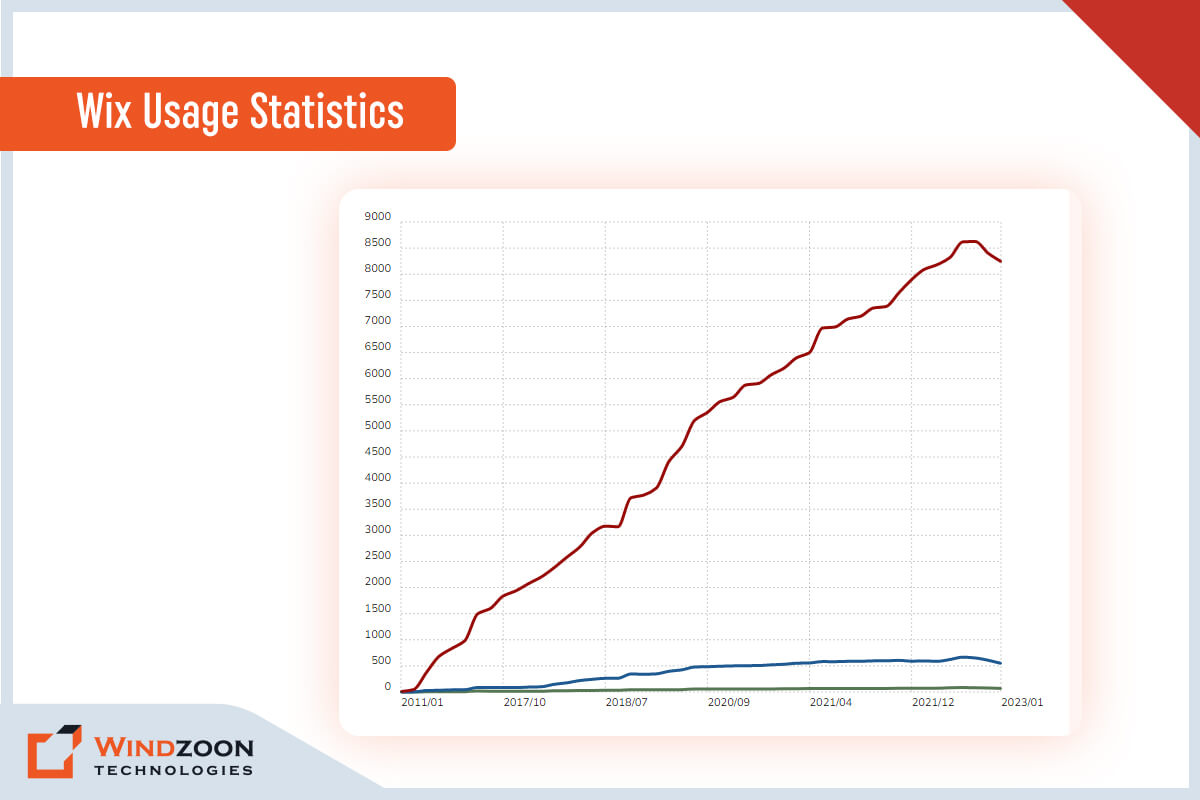
Wix Usage Statistics

Moreover, the cost-effective Wix plans are worth taking a closer look at if you want to create a website without spending a lot of money. Wix provides both free and premium plans, hundreds of design templates, integrated search engine optimization (SEO), and a full spectrum of in-demand tools that assist you in building an effective and appealing online presence.

13 Wix Features to Take Your Website to Next Level
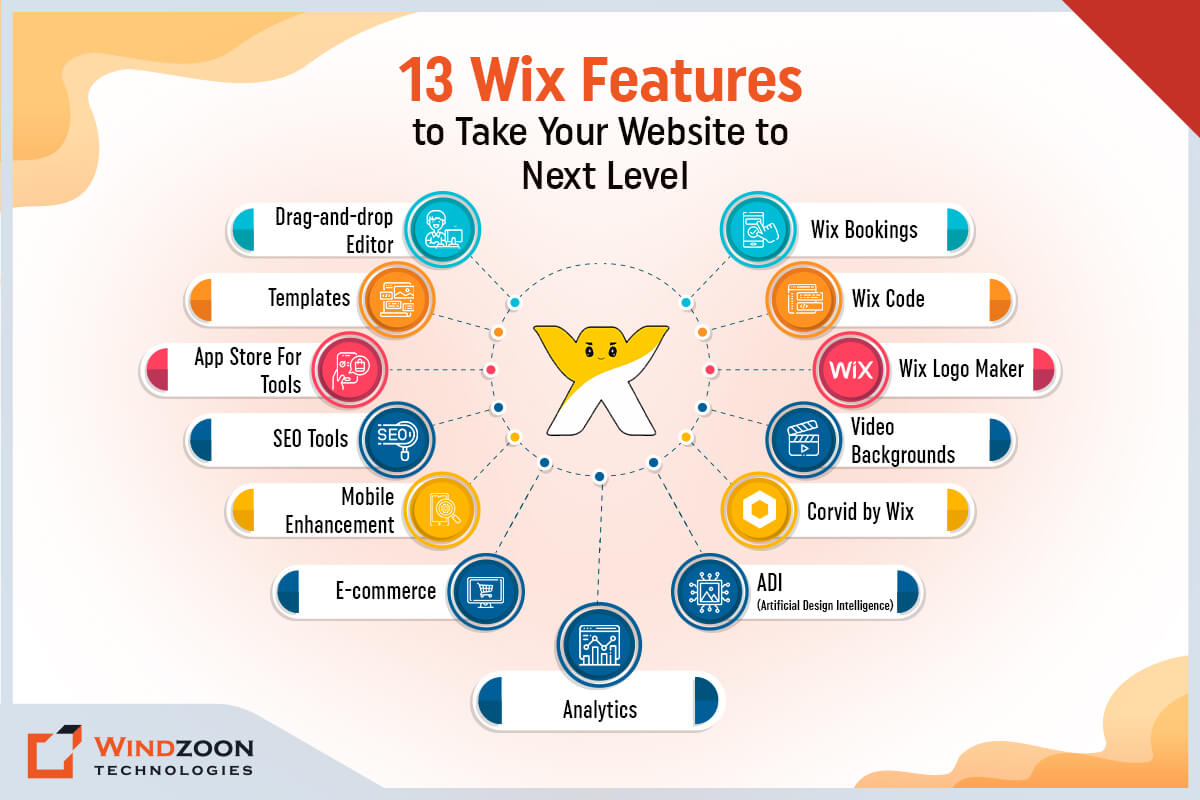
Wix Features to Take Your Website Next Level

1. Drag-and-drop Editor

Wix provides an easy-to-use drag-and-drop editor that allows users to easily add and arrange website elements such as text, images, videos, and more. As a result, beginners without any coding experience can easily establish a website.

2. Templates

Wix provides users with access to hundreds of expertly created templates that can be altered to meet their needs. It saves time and effort when creating a website from the ground up.

3. App Store For Tools

The Wix app market provides an array of external apps that may be incorporated into websites. This includes tools for online bookings, social media integration, email marketing, and more.

4. SEO Tools

Users can optimize their websites for search engines with the help of Wix’s integrated SEO tools. It has resources for meta tags, keyword research, and other things.

5. Mobile Enhancement

Websites built with Wix are automatically optimized for mobile use, making sure they look great and work well on all screen sizes.

6. E-commerce

Wix comes with integrated e-commerce features that let customers build an online store and sell goods straight from their website.

7. Analytics

Wix offers in-depth data on user behavior and website traffic, which users may use to enhance the functionality and usability of their websites.

8. ADI (Artificial Design Intelligence)

The ADI function of Wix employs artificial intelligence to build websites based on a user’s responses to a few straightforward questions. It is an excellent solution for those who do not have the time to create a website from scratch.

9. Corvid by Wix

Wix’s open development platform, Corvid, enables users to create sophisticated web applications and unique integrations. Developers that wish to build complicated web applications or combine their websites with outside services will find this functionality to be very useful.

10. Video Backgrounds

With the help of Wix, users can add video backdrops to their websites, which can produce a visually spectacular impact and draw in visitors.

11. Wix Logo Maker

Wix’s Logo Maker enables customers to quickly create a professional-looking logo for their website. This is a wonderful alternative for individuals with no design experience.

12. Wix Code

The Wix Code tool enables users to build unique functionality using JavaScript and APIs. It is an excellent choice for users who wish to give their websites cutting-edge functionality.

13. Wix Bookings

A tool called Wix Bookings enables users to provide online booking services straight from their website. Users who provide services through appointments, classes, or consultations will find it to be very helpful.

Overall, Wix is a user-friendly website builder that offers a range of features to help users create and manage their websites with ease.

What is Webflow?

Cloud-based, SaaS ( Software as a Service ) design tool Webflow functions in a web browser and can be subscribed to on a monthly or yearly basis. It is renowned for being very customizable, making it an outstanding choice for creatives, perfectionists, or anyone who are exceptionally meticulous or design-oriented. Currently, it is utilized by around 658,043 websites worldwide.
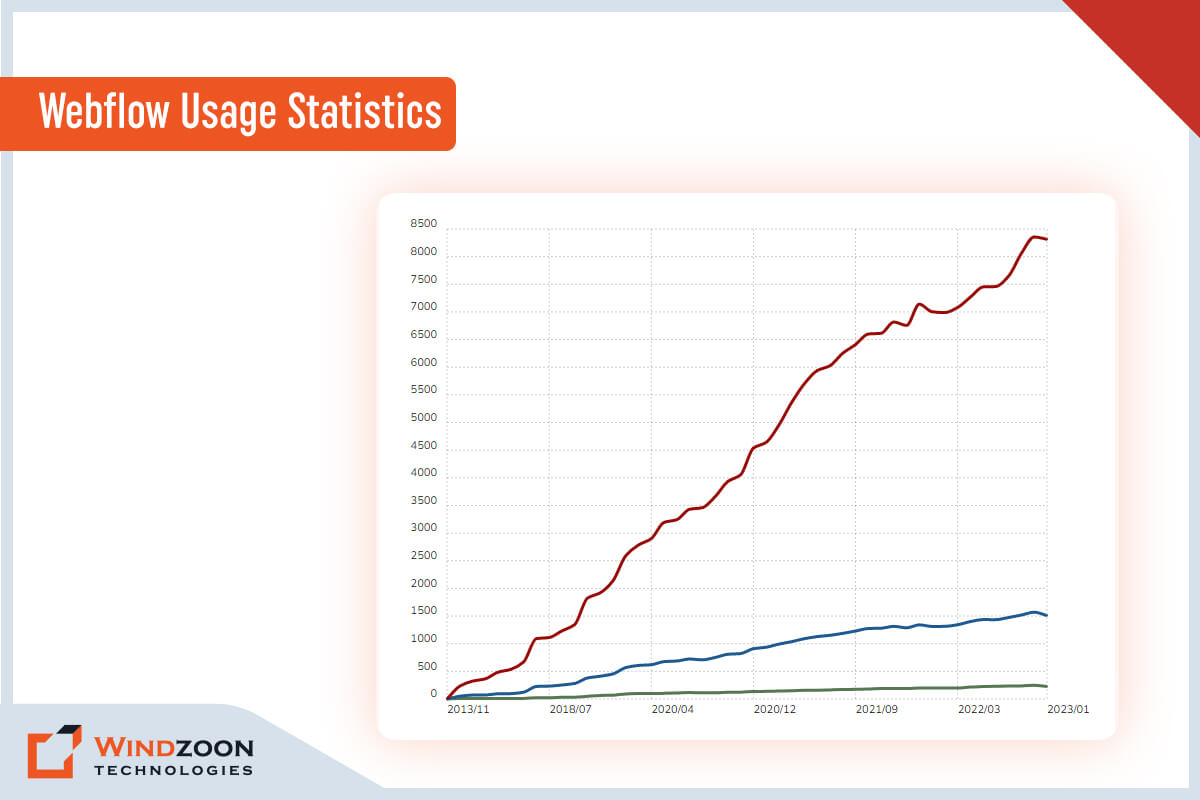
Webflow Usage Statistics

Additionally, Webflow empowers anyone to design gorgeous websites with animations and parallax scrolling without writing a single line of code.

11 Important Webflow Features You Should Know About
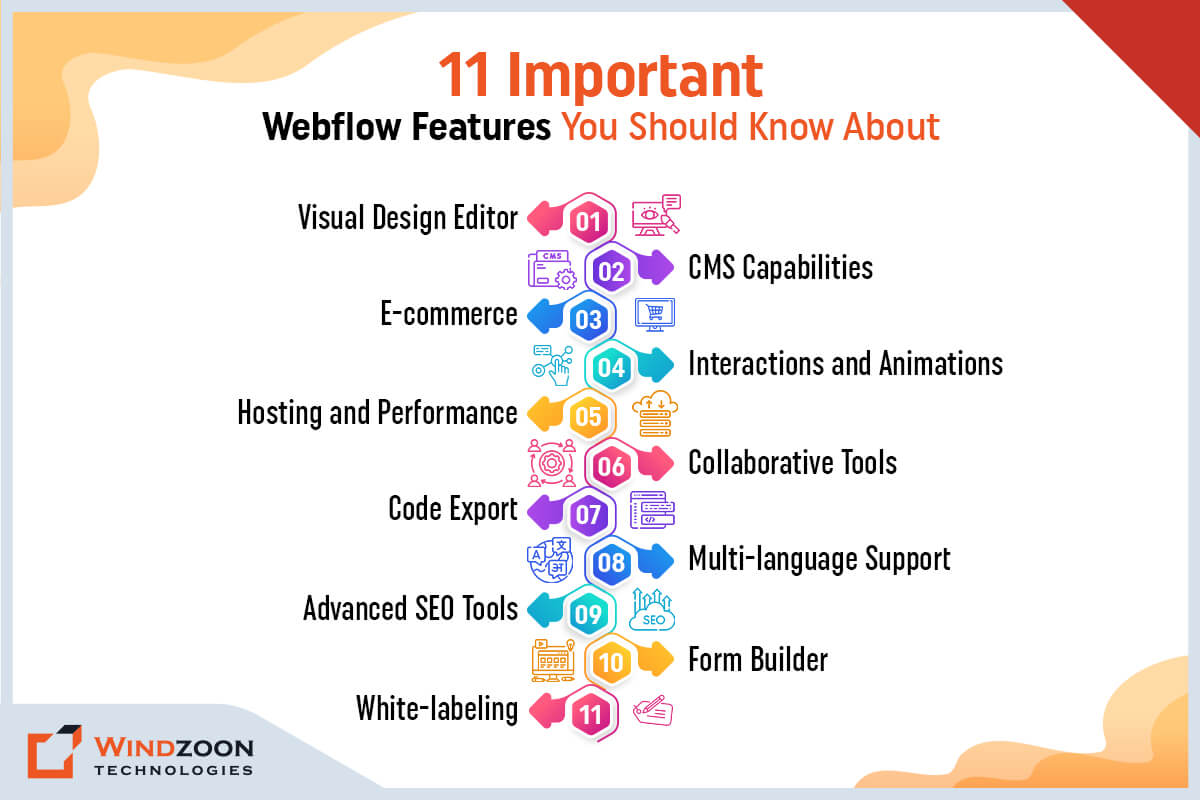
Important Webflow Features You Should Know

1. Visual Design Editor

Webflow’s visual design editor allows users to create responsive websites visually without any coding knowledge. The editor uses a flexible box model and intuitive interface to make it easy for users to design websites.

2. CMS Capabilities

Webflow offers a content management system (CMS) that allows users to create and manage complex websites with dynamic content. This includes the ability to create custom content types, add and edit content, and manage data relationships.

3. E-commerce

Webflow has built-in e-commerce functionality that allows users to create an online store and sell products directly from their website. This includes features like product catalogs, shopping carts, and payment integrations.

4. Interactions and Animations

Webflow allows users to create custom interactions and animations for their websites. This includes hover effects, scrolling animations, and other interactive elements that can enhance the user experience.

5. Hosting and Performance

Webflow provides hosting and performance optimization features to ensure that websites load quickly and perform well. This includes features like content delivery network (CDN) hosting, image optimization, and more.

6. Collaborative Tools

Webflow provides collaborative tools that allow teams to work together on website design and development projects. This includes features like team accounts, live collaboration, and version control.

7. Code Export

Webflow allows users to export their website code and use it on any hosting platform. This is a great option for users who want more control over their website’s hosting and performance.

8. Multi-language Support

Webflow offers multi-language support, allowing users to create websites in multiple languages. This includes features like automatic language detection and translation, which can help to improve the user experience for global audiences.

9. Advanced SEO Tools

Webflow provides advanced SEO tools to help users optimize their websites for search engines. This includes features like meta tags, sitemaps, and structured data, which can help to improve a website’s visibility and search engine ranking.

10. Form Builder

Webflow’s form builder allows users to create custom forms for their websites. This includes features like custom fields, conditional logic, and submission confirmation messages.

11. White-labeling

Webflow offers white-labeling options for agencies and designers, allowing them to brand their websites and client portals with their own logos and colors.

After this, we will get to know in detail the comparison between Wix and Webflow.

Read More: Best Web Development Frameworks to Use

A Comparison of Wix and Webflow Website Builder

[wpdatatable id=14]

Wix or Webflow: Which Web Builder is The Best for Your Business?

After reading all this information you’re likely wondering which platform is the best choice for your website: Wix or Webflow? Well, the answer isn’t as straightforward as you might think. It all comes down to what you’re looking for in a website builder.

If you’re a beginner or have little technical skills, Wix might be the perfect fit with its user-friendly interface and drag-and-drop design options. However, if you’re a web design pro and want more advanced customization options, Webflow might be the better choice.

Both platforms have their strengths and weaknesses when it comes to e-commerce capabilities, but Wix offers an all-in-one solution while Webflow integrates with popular e-commerce platforms.

Ultimately, it’s important to do your research and choose the platform that aligns best with your goals and the level of control you want over your website.

Conclusion

In the end, Wix and Webflow are both well-known website builders. However, their intended audiences differ. Therefore, you must determine which is more important: a straightforward design process or complete control over your site design.

Because Wix is your best option if you have the first. And Webflow is a superior choice if the latter is more important to you.

However, if you are unable to select the finest alternative among them, we propose that you talk with any reputable web development company.

Windzoon is a leading web development agency in India & the USA with more than a decade of experience in developing avant-garde websites. Contact us to leverage our expert web development services and to get a quote.
SEO for Hotels – Improve Your Hotels Online Visibility by 12 Tips

Picture this: you’re a weary traveler, trudging through a new city, looking for a place to rest your head. You whip out your trusty smartphone and type in “hotels near me.” The search results pop up, and you scroll through the options. Which hotel catches your eye? Is it the one with the poorly lit photos and sparse reviews, or is it the one with glowing reviews and stunning visuals?

For hotels and tourism businesses, standing out in the vast sea of online searches is crucial. The size of the worldwide online industry was estimated to be 475 billion dollars in 2022. According to projections, this amount will exceed 521 billion US dollars in 2023 and reach over a trillion US dollars by 2030. And with the pandemic driving more people to domestic travel, it’s more important than ever to have a strong online presence.

So, how can hotels and tourism businesses optimize their online presence for maximum visibility and bookings? As a leading digital marketing agency with years of experience in offering services to the tourism industry, we have prepared some SEO tips for hotel & travel websites. The application of these tips will help you increase your brand visibility and bookings.

So, let’s dive into some SEO tips and tricks that will make your business stand out from the competition.

What is SEO for Hotel & Travel Websites?

We’ll provide a very basic explanation for this question. As an illustration, visualize your hotel or travel website as a magical castle that you want to invite as many guests to explore. From the warm rooms to the stunning vistas, you’ve worked so hard to create a magical experience. But how are people supposed to locate your castle in the big, crowded, internet kingdom?

That’s where SEO enters into play. Search engine optimization, or SEO, is a kind of mystical wand that can raise the ranking of your website in search engine results. By using strategic keywords, optimizing your website structure, and crafting captivating content, you can attract more visitors to your castle and ensure that they have an unforgettable experience. So, cast your SEO spell and watch as the kingdom flocks to your magical castle.

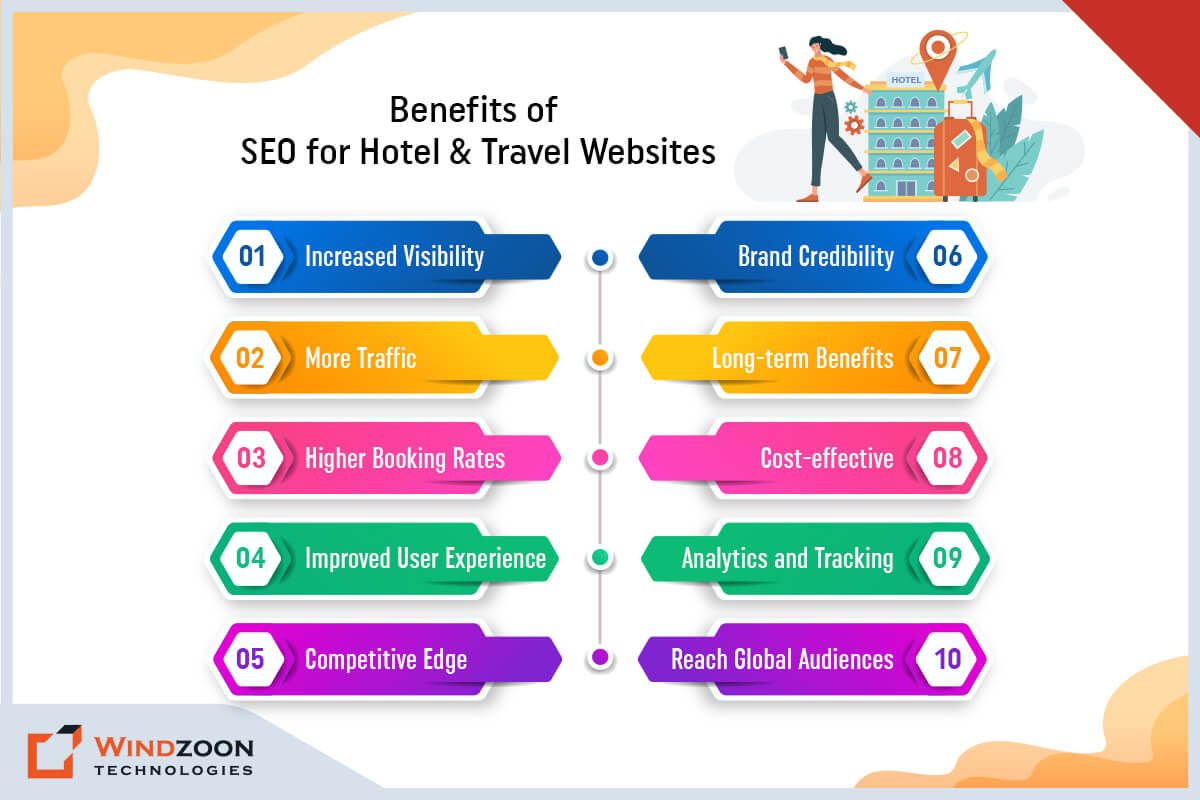
Benefits of SEO for Hotel & Travel Websites

Benefits of SEO for Hotel & Travel Websites

  1. Increased Visibility: SEO helps your website appear higher in search engine results pages (SERPs), which means more people are likely to find and visit your website.
  2. More Traffic: With increased visibility comes more traffic to your website, as people are more likely to click on links that appear higher in search results.
  3. Higher Booking Rates: By optimizing your website for search engines, you can attract more qualified leads who are more likely to book directly on your website.
  4. Improved User Experience: SEO involves optimizing the structure and content of your website, making it more user-friendly and easier to navigate.
  5. Competitive Edge: SEO helps you stand out from the competition by showcasing your unique offerings and value proposition.
  6. Brand Credibility: By appearing higher in search results, you can boost brand awareness and credibility, as people are more likely to trust websites that appear at the top of search results.
  7. Long-term Benefits: SEO is a long-term strategy that can continue to drive traffic and bookings to your website for months or even years to come.
  8. Cost-effective: Compared to other forms of digital marketing, such as paid advertising, SEO can be a more cost-effective way to drive traffic and bookings to your website.
  9. Analytics and Tracking: With SEO, you can track and analyze the performance of your website and adjust your strategy accordingly.
  10. Reach Global Audiences: With SEO, you can target specific keywords and phrases that are relevant to your target audience, including global travelers.

Read More: Hire Digital Marketing Agency For Small Businesses: 8 Useful Tips

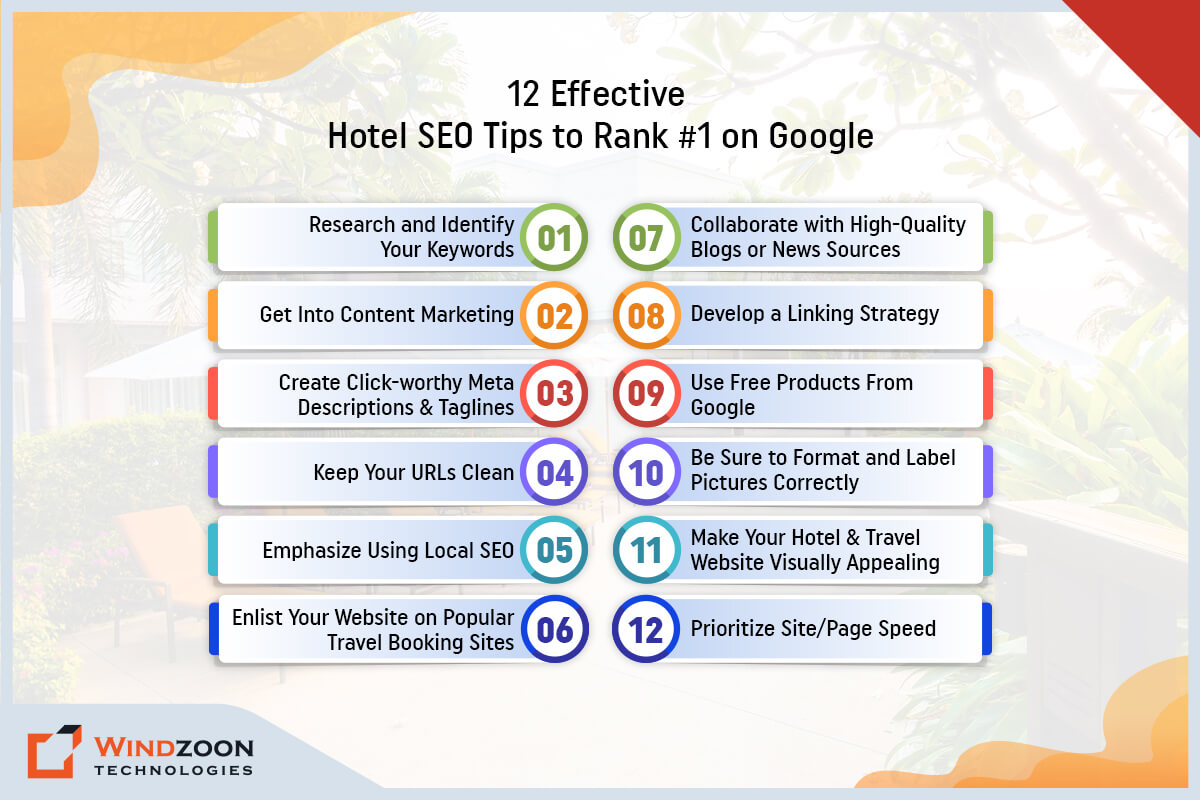
12 Effective Hotel SEO Tips to Rank #1 on Google

Hotel SEO Tips to Rank #1 on Google

1. Research and Identify Your Keywords

Any SEO strategy should start with a study and keyword identification phase. These are the keywords or sentences that people type into search engines to find your products or services.

Additionally, by focusing on the right keywords, you can draw pertinent traffic to your website and raise the likelihood that users will become paying customers.

To discover the most pertinent and lucrative keywords for your business, you can use a variety of keyword research tools, such as Google Keyword Planner, Ahrefs, or SEMrush. Once you’ve chosen your keywords, incorporate them into the text, meta descriptions, headings, and URLs of your website.

2. Get Into Content Marketing

The next piece of advice is to do content marketing well. It is an effective SEO strategy that entails creating high-quality, informative content. So that, it can attract, engage, and convert your target audience.

However, to do that you need to publish the more recent and pertinent material on your website. It will help your website to gain more authority on SERPs. In addition to increasing your brand reputation and helping you receive backlinks from other websites.

Apart from that, you can demonstrate your expertise and value proposition using a variety of content forms like blog posts, infographics, videos, or guides. However, it’s crucial to produce content that is in line with the interests and requirements of your target audience as well as your company’s objectives.

3. Create Click-worthy Meta Descriptions & Taglines

Meta descriptions and taglines are the short and concise texts that appear below your website’s title in search engine results. They provide a brief summary of your website’s content and value proposition and encourage users to click on your link.

Therefore, it’s crucial to craft compelling and relevant meta descriptions and taglines that entice users to visit your website. You can use action-oriented language, include your target keywords, and highlight your unique selling points to create click-worthy meta descriptions and taglines.

4. Keep Your URLs Clean

Your website’s URLs or web addresses are also critical for SEO. They should be short, descriptive, and easy to read and remember. Avoid using long and complicated URLs that contain random letters or numbers, as they can confuse both users and search engines.

Instead, use hyphens to separate your words and include your target keywords in your URLs. For example, a clean URL for a blog post about the best hotels in Paris could be www.yourwebsite.com/best-hotels-in-paris.

5. Emphasize Using Local SEO

As a hotel or travel website, one of your top priorities should be to rank for local search terms. When people search for hotels or travel destinations, they usually look for options that are nearby. That’s why it’s crucial to optimize your website for local SEO.

Local SEO involves optimizing your website for location-based keywords, such as “hotels in London” or “best restaurants in New York.” You can do this by including your location in your website’s content, titles, and meta descriptions.

Moreover, it’s essential to have a Google My Business listing. It’s free, and it can help you rank higher in local search results. Make sure to provide accurate information about your hotel or travel business, including your address, phone number, and hours of operation.

6. List Your Website on Popular Travel Booking Sites

Getting your hotel or travel website listed on popular travel booking sites can effectively drive traffic and increase bookings. These sites, such as Booking.com or Expedia, are visited by millions of people every day, and they can help you reach a wider audience.

However, keep in mind that these booking sites usually charge a commission for every booking made through their platform. That’s why it’s crucial to find a balance between the commission you pay and the benefits you get from the listing.

7. Collaborate with High-Quality Blogs or News Sources

Collaborating with high-quality blogs or news sources can be an effective way to get backlinks and increase your website’s authority. When you get a backlink from a reputable website, it tells search engines that your website is also trustworthy and relevant.

To find blogs or news sources to collaborate with, you can use tools like BuzzSumo or Ahrefs. These tools allow you to search for websites that are relevant to your niche and have high domain authority.

When reaching out to these websites, make sure to offer them something valuable in return, such as a guest post or a discount for their readers.

8. Develop a Linking Strategy

Internal linking is an essential aspect of on-page SEO. It helps search engines understand the structure of your website and the relevance of each page.

When creating content for your hotel or travel website, make sure to link to other relevant pages on your site. For example, if you’re writing about the top attractions in Paris, you can connect to your page about hotels in Paris or your page about Paris tours.

Moreover, it’s essential to get external links to your website. As mentioned earlier, getting backlinks from reputable websites can help increase your website’s authority and improve your search engine rankings.

You can develop a linking strategy by creating shareable content, such as infographics or guides, and reaching out to relevant websites to ask for backlinks.

9. Use Free Products From Google

Google offers several free products that can help improve your hotel or travel website’s SEO. These products include Google Analytics, Google Search Console, and Google My Business.

Google Analytics allows you to track your website’s traffic, user behavior, and conversions. It can assist you in determining which sites are effective and which ones require improvement.

Google Search Console can assist you in monitoring the success of your website in search results. It allows you to see which keywords your website is ranking for, how many clicks you’re getting, and how many impressions your website is receiving.

Google My Business can help you manage your online presence on Google. It allows you to create a business profile, respond to reviews, and manage your location on Google Maps.

10. Be Sure to Format and Label Pictures Correctly

Images play an essential role in any hotel or travel website. They can capture a visitor’s attention and provide a visual representation of your property, destination, or services. However, search engines cannot “see” images as humans do, so it’s essential to properly format and label them to improve your website’s SEO.

Firstly, make sure that the images you use on your website are high-quality, optimized for the web, and relevant to your content. Secondly, add descriptive and keyword-rich alt tags to your images to help search engines understand what they are about. Alt tags also help visually-impaired visitors understand what the image is about when using a screen reader.

11. Make Your Hotel & Travel Website Visually Appealing

A visually appealing website can significantly improve your visitors’ experience and keep them on your website longer. A visually-pleasing website can also improve your website’s bounce rate, which is an important factor in search engine rankings.

Ensure that your website’s design is attractive, easy to navigate, and user-friendly. Use high-quality images and videos to showcase your hotel or travel destination and use engaging content to tell your story. Additionally, make sure that your website’s layout is consistent, and that the content is organized and easy to read.

12. Prioritize Site/Page Speed

In today’s digital age, website speed is crucial. A slow website can negatively impact user experience, increase bounce rates, and ultimately affect your website’s SEO. As a result, optimizing your website’s performance is critical.

Start by compressing your images and videos, which can significantly reduce your website’s loading time. Additionally, choose a reliable web host, minimize HTTP requests, and leverage browser caching to improve your website’s performance. You can use Google’s PageSpeed Insights tool to evaluate your website’s speed and identify areas of improvement.

Read More: Reasons Why Businesses Need a Digital Marketing Strategies

Conclusion

In conclusion, SEO is critical for any hotel or travel website to gain visibility, attract more visitors, and increase bookings or sales. The above 12 tips can help you optimize your website for search engines and improve your online presence.

By implementing these tips, you can significantly improve your website’s SEO, attract more visitors, and ultimately increase your hotel or travel website’s revenue. However, bear in mind that SEO is a continuous process that requires continuous monitoring and optimization.

Therefore, to get the most out of SEO for your hotel and travel site, you should collaborate with the best SEO service provider company.

Windzoon is a reputable provider of digital marketing services that help companies develop effective digital marketing strategies. Please get in touch with us and request a quote to learn more about our services that are focused on outcomes.

ECommerce SEO: 12 Useful Tips to Rank Higher and Grow Sales

In the current digital era, having a strong online presence is essential for any company, especially for eCommerce websites. With millions of online shoppers looking for products and services every day, a well-optimized website can mean the success or failure of a business.

You might be surprised to discover that 93% of online activities begin with a search engine. And this data indicates that if your eCommerce website is not listed highly in search engine results pages (SERPs), you are losing out on a sizable chunk of potential consumers.

In this scenario, a digital marketing company could help. Working with experts in the field, you can create a comprehensive SEO strategy that will improve your website’s search engine rankings, boost traffic, and ultimately grow your eCommerce company.

In this blog, we’ll explore the top 12 SEO tips for optimizing your eCommerce websites.

So, let’s delve into the realm of SEO and see how you can optimize your eCommerce website for success!

First of all, we’ll learn about what exactly SEO means for any eCommerce website.

Read More: eCommerce Web Design Trends

What is SEO for ECommerce?

SEO for eCommerce is a tactic that aids online stores in rising in search engine results. High-quality content on a well-designed, search-engine-optimized website will help it rank higher in Google and other search engines, boosting its visibility and generating traffic for your online store.

In other words, SEO for eCommerce focuses on optimizing your site so that leads and conversions are simpler to generate.

But unlike SEO for content-focused websites, SEO for eCommerce involves more than just incorporating keywords, creating blog entries, and acquiring links. Here, you must comprehend how search engines function and what they reward.

That entails understanding the fundamentals of SEO for eCommerce, taking into account Google’s recommendations, figuring out what the target audience wants, and carefully putting it to use.

Now, we will get to know about the benefits of availing SEO for an eCommerce website.

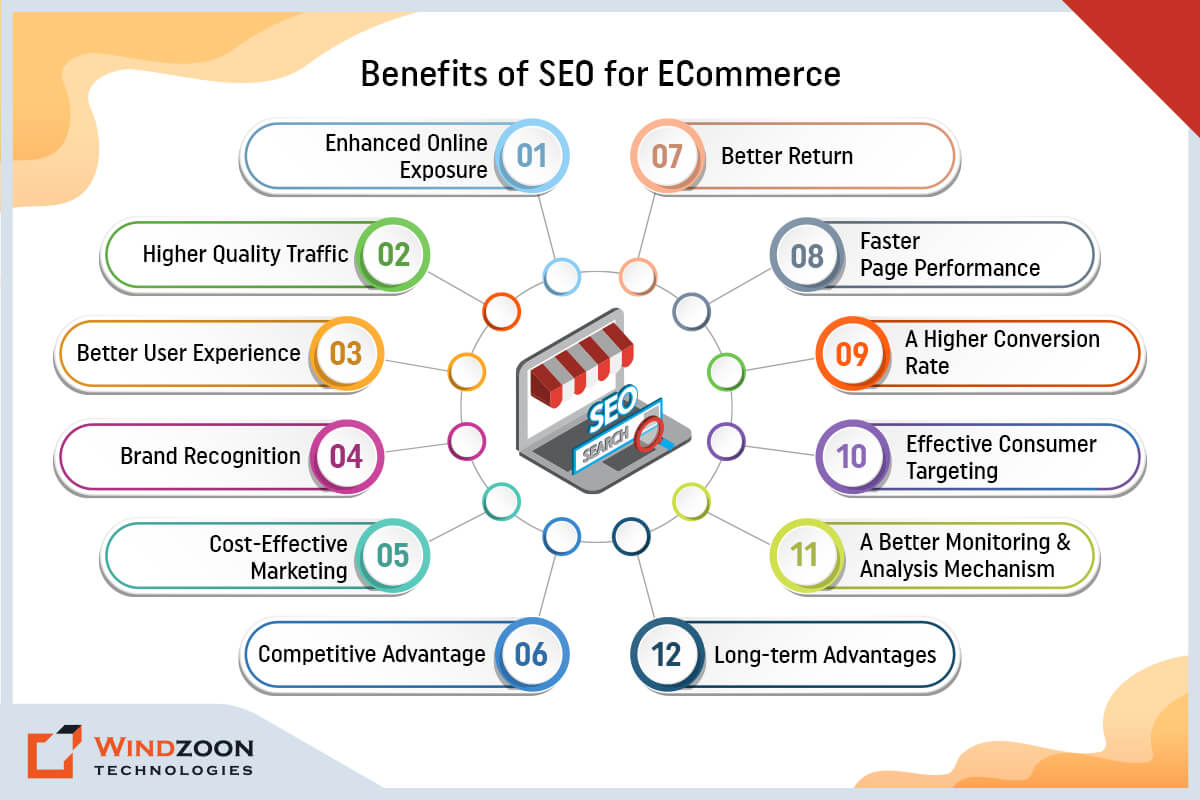
Benefits of SEO for ECommerce

Benefits of SEO for ECommerce

Search Engine Optimization (SEO) is one of the essential parts of any successful eCommerce business. It’s a powerful tool that helps significantly raise your online store’s sales by boosting traffic and conversions. Here are a few of the major benefits of SEO for eCommerce:

1. Enhanced Online Exposure

Your website’s search engine ranking can be improved with the aid of SEO, making it more likely that users who are looking for relevant keywords will find it.

2. Higher Quality Traffic

SEO helps you draw in customers who are truly interested in your offerings, which increases the likelihood that they will make a purchase.

3. Better User Experience

SEO involves making your website more user-friendly, not just for search algorithms but also for human visitors. By enhancing the speed, usability, and general design of your website, SEO aids in the formation of a better user experience.

4. Brand Recognition

A better search engine ranking can increase your brand’s authority and credibility in your sector, boosting the probability that customers will believe in you and use your services.

5. Cost-Effective Marketing

SEO is a low-cost marketing strategy that can help you save your hard earned money and benefits your eCommerce company in the long run.

6. Competitive Advantage

You can outperform other eCommerce companies who don’t optimize their websites for search engines by adopting SEO.

7. Better Return

As it can produce long-term results without requiring continuous investment, SEO can offer a higher return on investment (ROI) than most other marketing strategies.

8. Faster Page Performance

For any website, its page loading speed holds so much importance in its success and failure. By optimizing your website for SEO, you can increase its loading speed, make it more user-friendly, and reduce bounce rates.

9. A Higher Conversion Rate

SEO can improve conversion rates and sales by driving higher-quality traffic and generating more leads.

10. Effective Consumer Targeting

You can more effectively target your ideal customer base by optimizing your website for particular keywords and phrases.

11. A Better Monitoring and Analysis Mechanism

With SEO, you can monitor and assess your website’s performance and take data-driven actions to enhance your eCommerce company.

12. Long-term Advantages

By gradually raising your website’s ranking and exposure, SEO can benefit your eCommerce company in the long run in contrast to other marketing strategies that might only have short-term benefits.

Read More: Why WordPress is the Best for Online Store Development?

After this, we have finally come to the main topic of our discussion and that is effective SEO eCommerce tips.

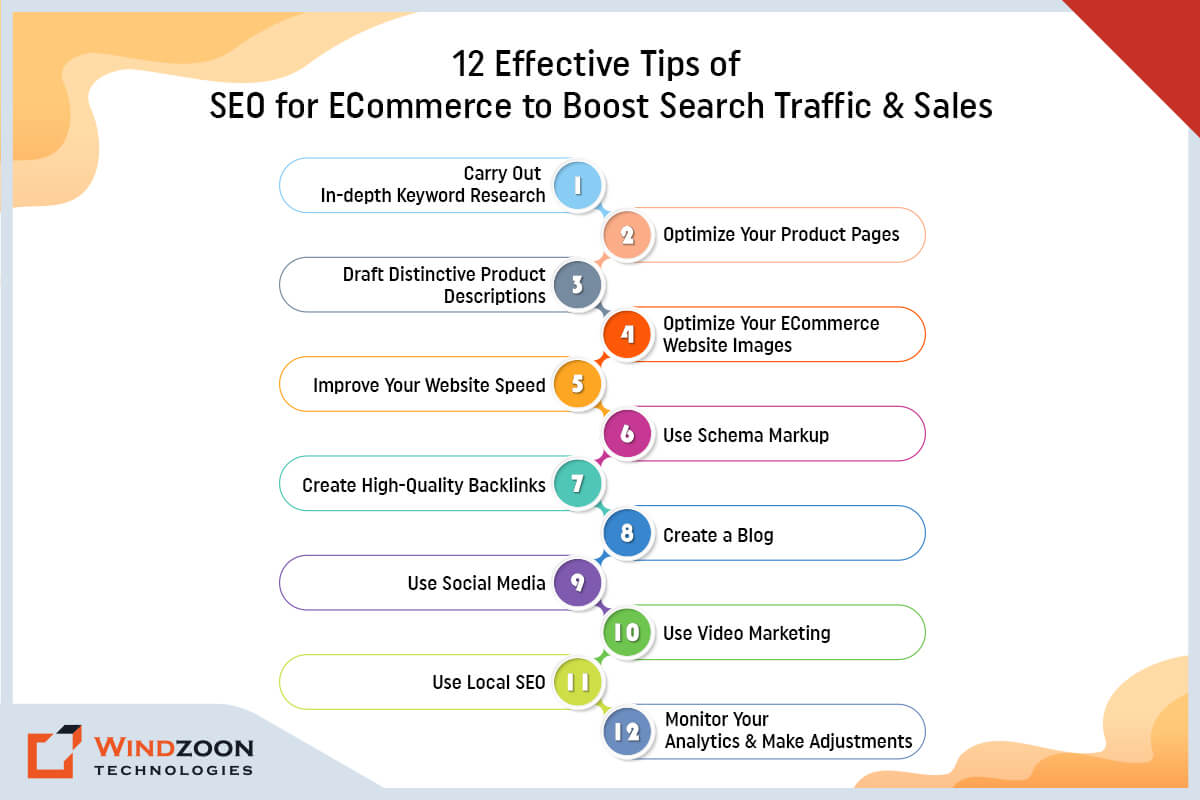
12 Effective Tips of SEO for ECommerce to Boost Search Traffic & Sales

Tips of SEO for ECommerce to Boost Traffic and Sales

1. Carry Out In-depth Keyword Research

You must use the appropriate keywords on your website in order to draw prospective customers there. You can grasp the words and phrases your prospective customers use to search for goods and services online by conducting in-depth keyword research. To discover the ideal keywords for your company, use tools for keyword research like Google AdWords or SEMrush.

How to Perform a Phrase Analysis:

  • Make a list of possible keywords by brainstorming.
  • Utilize keyword research tools to evaluate the competition and search traffic.
  • Think about using long-tail keywords (phrases containing more than two words).
  • Make sure your keywords accurately describe your products or services.
  • Look for keywords with a lot of search activity but a little rivalry.

2. Optimize Your Product Pages

Your product pages are essential to the success of your website. They ought to be tailored to the keywords you’ve selected. However, make sure the details on your product pages about the products and services you provide are correct.

How to Improve Your Product Pages:

  • The title, URL, and meta description of the page should all contain the target keywords.
  • Utilize relevant and high-quality images of your products & services.
  • Create original and thorough product descriptions.
  • Utilize client testimonials to boost credibility and social evidence.
  • Ensure the page is user-friendly and simple to navigate.

3. Draft Distinctive Product Descriptions

Your product descriptions ought to be interesting and distinctive. Thus, refrain from using descriptions that are generic and easily available on other websites. Because search engines are better able to comprehend the substance of your pages when you use unique product descriptions. And will improve your website’s position in search results.

How to Create Creative Product Descriptions:

  • Use language that is precise and illustrative.
  • Emphasize the qualities and advantages of your products and services.
  • Avoid keyword stuffing and organically incorporate keywords.
  • Write for your intended audience instead of search algorithms.
  • Make the description easy to comprehend by using formatting (like bullet points).

4. Optimize Your ECommerce Website Images

Product images are essential when it comes to online shopping. They can assist prospective customers in visualizing the product and deciding whether or not to purchase it. And SEO optimizing your product images can significantly enhance your website’s page loading speed and user experience.

How to Optimize Your Product Images:

  • Make use of pertinent, high-quality images for your products.
  • Reduce the file size of your images by compressing them.
  • Make use of alt tags and descriptive file titles.
  • Ensure your images can be viewed on any platform and are responsive.
  • Utilize image sitemaps to assist search engines in indexing your images.

5. Improve Your Website Speed

Website speed is essential for a seamless user experience. A sluggish eCommerce website can turn away potential customers and damage your search engine ranking.

How to Boost Your eCommerce Website Speed:

  • To pinpoint places where your eCommerce site needs work, use tools like GTmetrix or Google PageSpeed Insights.
  • Cut down on the number of page elements to minimize HTTP requests.
  • To lessen server burden and accelerate page load times, use browser caching.
  • Optimize images and decrease file size.
  • Utilize a content delivery network (CDN) to send information to users more quickly.
  • Make use of a dependable web hosting provider.

6. Use Schema Markup

A code called schema markup makes it easier for search engines to comprehend the content of your website. Using schema markup, you can enhance your eCommerce website’s visibility on SERPs as well as attract more customers.

How to Use Schema Markup:

  • To describe your goods, testimonials, and ratings, avail of schema markup.
  • Use structured data markup to provide context for your content.
  • Utilize Google’s Structured Data Testing Tool to test your schema code.
  • Make use of schema markup that is specific to your business or niche.

Backlinks are connections to your website that come from other websites. They are an important ranking element for search engines because they show how well-known and credible your website is. The more high-quality backlinks you have, the higher you are likely to appear in search results.

How to Generate High-Quality Backlinks:

  • Guest posts on relevant websites to your industry or niche.
  • Engage in online dialogues and communities and post a link to your website there.
  • Make content that people will want to share and refer to.
  • To discover broken links on other websites, use broken link-building techniques. Then, provide your own content in their place.

8. Create a Blog

Blogging is a powerful tool to increase web traffic, position yourself as an expert in your field, and raise your search engine results. By frequently publishing high-quality, informative blog posts on your eCommerce store, you can ensure that your site remains refreshing and engaging for both visitors and search engines.

How to create a successful blog:

  • Pick issues that concern your target audience and are worthwhile and interesting.
  • Optimize your blog articles for relevant keywords and include internal and external links.
  • Make your material simple to read and share by using captivating headlines and formatting.
  • To increase traffic and grow your following, advertise your blog on social media and other appropriate platforms.

9. Use Social Media

With millions of users worldwide, social media has established itself as a vital component of our everyday lives. You should use social media platforms as a business owner to build your brand recognition, generate leads, and increase traffic to your eCommerce site.

How to leverage social media:

  • Select the social media networks that are most pertinent to your brand and your target market.
  • Make a social media strategy that involves communicating with your followers and posting regular updates.
  • To attract more attention and boost engagement, use visual material such as images and videos.
  • Create targeted social media ads to reach a wider population and increase website traffic.

10. Use Video Marketing

Video marketing is an excellent tool for engaging your audience, promoting your products or services, and driving traffic to your eCommerce site. It can help you increase your customer base and cultivate a devoted following by making educational, entertaining, or inspirational videos that promote your business.

How to utilize video marketing:

  • Make eye-catching videos that significantly promote your brand’s name and products.
  • Also, post your videos to your eCommerce site and social media accounts.
  • To make your videos more search engine friendly, utilize video SEO tactics.
  • Engage followers by regularly responding to their comments and social media shares.

11. Use Local SEO

Businesses with a physical presence in a certain region can benefit greatly from local SEO. If you have a brick-and-mortar store, or if you offer services to customers in a specific location, optimizing your eCommerce store for local search can help you grow your clientele.

How to benefit from local SEO:

  • Activate and optimize your profile on Google My Business listing.
  • Put regional keywords in the text and meta tags of your website.
  • Generate local backlinks from appropriate websites and networks.
  • Promote client testimonials on Google and other review platforms.

12. Monitor Your Analytics and Make Adjustments

Understanding the performance of your website, finding potential areas for improvement, and making well-informed decisions about your marketing strategy all depend on regularly reviewing your website analytics. You can make data-driven decisions to enhance your eCommerce site’s performance and raise your online exposure by routinely reviewing your analytics data.

How to keep an eye on your website analytics and make the required changes:

  • Install tracking software such as Google Analytics to keep an eye on website traffic and user activity.
  • Evaluate the bounce rate, conversion rate, and other significant performance indicators of your eCommerce store on a regular basis (KPIs).
  • Improve your KPIs by utilizing A/B testing to evaluate various website elements.
  • To enhance the functionality of your website and meet your marketing objectives, make data-driven choices.

Read More: WordPress Website Development Cost: Top Factors to Consider

Conclusion

As the world continues to shift towards a more digital landscape, eCommerce has become an absolute necessity for businesses of all sizes. But with so many online retailers vying for the same customer base, it’s essential to have a strong SEO plan in place to stand out from the crowd.

By implementing the 12 helpful SEO tips outlined in this article, you can optimize your online store for success and raise your odds of driving more visitors and revenue. However, keep in mind that SEO is a continuous process that needs ongoing attention and optimization.

Therefore, to maximize the benefits of SEO, you should work with a digital marketing agency to manage SEO for your eCommerce site.

Windzoon is an esteemed provider of digital marketing services that assist businesses to create effective digital marketing strategies. To discover more about our results-oriented services, please contact us and obtain a quote.