Flutter App Development: Everything You Need to Know

They claim that the world now lies in our hands and knowledge is at our fingertips. There is no doubt about it. The increasing use of the internet and applications has completely transformed how we connect with others, share information, and live our lives.

The majority of people’s time is spent online or on apps. It could be done for a variety of purposes, such as making a purchase, using a service, reading a blog, having fun, or anything else.

Given the amount of time people spend on apps, the majority of businesses want to have their own apps. If you are one of these businesses, you should consider leveraging Flutter and Flutter App Development Company.

Currently, Flutter is one of the well-liked open-source software development kits that makes it simple and easy to create cross-platform apps. In this article, we will provide you with an in-depth insight into the Flutter app development platform.

However, before we begin our discussion, let’s learn about some basic terms that will help you understand this topic well.

Some Common Web App Development Jargon

Following are the three common web app development terms.

Library:

It includes several reusable user interface (UI) components, such as sliders, buttons, codes, and text input, that you may use in your app to carry out a variety of common functions.

Framework:

It is the architecture or structure of an application. However, it comprises numerous tools that create the foundation of an app, requiring you to write code to complete the entire structure and get the required results.

SDK:

It consists of a variety of tools that will meet all of your software development needs, including libraries, documentation, APIs, frameworks, and many more.

Now, let’s get detailed knowledge about Flutter framework technology.

What is Flutter?

Google introduced the open-source technology Flutter in 2017. It enables you to create cross-platform mobile apps for Android, iOS, and Windows from a single codebase.

Flutter is neither a framework nor a library; it is a software development kit(SDK). Moreover, it provides both its widget-based UI library and SDK. Therefore, everything required to create cross-platform apps is provided by Flutter framework technology.

In a word, Google’s Flutter is a UI toolkit for creating cross-platform mobile applications from a single code base for multiple devices.

Now, let’s get to know about the architecture of Flutter SDK.

Flutter SDK Architecture
Flutter SDK Architecture

Flutter SDK Architecture

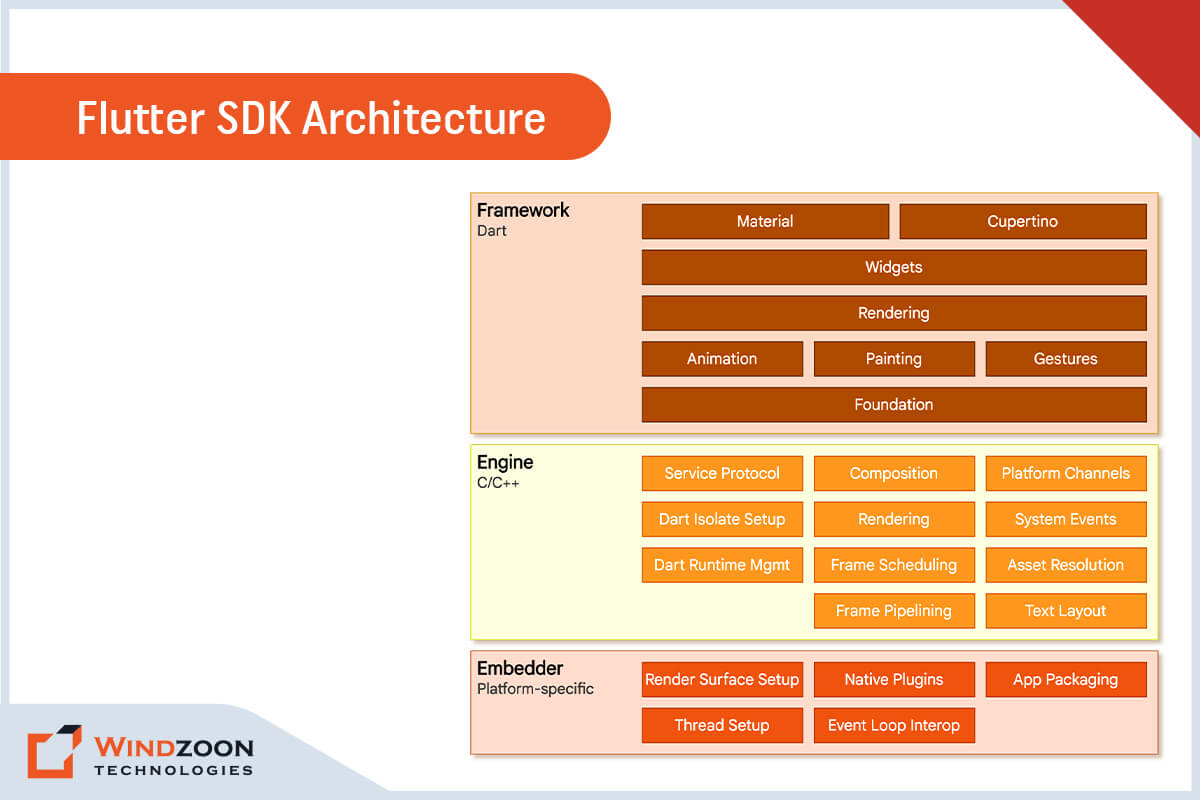
The Flutter SDK includes a rendering engine, testing, integration APIs, and widgets that are ready to use. Flutter’s architecture layer comprises several components, as seen in the graphic below. Let’s examine it and discover how it functions basically.

The primary structural layers are classified into three types. Let’s begin from the bottom and move upward.

Embedder:

It incorporates a platform-specific programming language, enabling the application to run on any platform or operating system.

Engine:

An engine written in C/C++ supports the Flutter core APIs at a low level. The engine includes components for graphics (via the Skia 2D graphics library), text layout, file and network I/O, accessibility support, plugin architecture, a runtime for Dart, and a compilation toolchain.

Framework:

The Dart programming language is the foundation of the Flutter framework. Additionally, it offers a vast collection of libraries that are separated into four categories.

  • Fundamental Foundational Classes
  • Rendering Layer
  • Widgets Layer
  • Cupertino Libraries and Materials

Flutter’s Widget-Based UI Library

The development process for Flutter apps is fairly unique due to its declarative UI writing. Flutter’s main objective is to enable developers to construct the whole user interface by merging various widgets.

Widgets are critical components of the user interface in Android, iOS, and classic web apps that follow design standards. The Flutter app interface contains a number of nested widgets that can be any object.

The developer can utilize widgets to customize the app, which applies to everything from buttons to padding. Furthermore, it allows you to change existing widgets and create your own.

App Testing in Flutter

Flutter provides a simple method for testing. It offers an automated testing toolset for its several forms of testing, including unit testing, widget testing, and integration testing.

What Programming Language is the Foundation of Flutter?

The Google-created Dart programming language serves as the foundation for the Flutter SDK. It aims to replace traditional JavaScript. Dart programs can be run directly on a server, but in a browser, they are transcompiled into JavaScript using the Dart2js transcompiler.

Dart is used to creating apps for Google’s new platform, Fuchsia. It has a structure that is reminiscent of popular object-oriented programming languages like Java or C#.

After learning about what exactly Flutter is, let’s see what kind of applications you can and can not build using Flutter.

What Kind of Apps Can You Develop with Flutter?

Flutter is an excellent choice for developing 2D cross-platform apps that will run on both iOS & Android devices. It is already being used by numerous organizations worldwide, including some Fortune 500 corporations.

With the release of Flutter 2.0, you may now construct the following:

  • Android and iOS cross-platform mobile applications
  • Web apps, such as Progressive Web Apps (PWAs) and Single-Page Apps (SPAs), as well as the web-based expansion of current Flutter mobile apps
  • Desktop apps with Flutter 3.0 (Windows, Mac, and Linux)

What Kind of Apps are not Suitable to Build with Flutter?

Flutter has severe limitations in terms of video apps. Because of this, Flutter is unsuitable for applications that require UI rendering.

Additionally, Flutter isn’t ideal for apps that closely interface with the hardware that powers them. These apps, like mobile stock market apps, require extensive performance optimization.

Furthermore, if you are developing an augmented reality (AR) app, you should avoid Flutter. AR demands deep integration with native systems; therefore, creating a cross-platform app would be useless.

What Makes Flutter Different from Other App Development Frameworks?

Have you ever created a mobile app with a cross-platform framework like React Native or Xamarin? If so, you would be aware that before your code is rendered on the device, it will pass through a bridge or switch that converts it into a WebView using JavaScript.

But Flutter renders apps natively rather than leaving that up to the platform. All Flutter requires is a canvas to render widgets on the screen and access events like tap and services like the device’s camera.

By using Dart’s capabilities for just-in-time and ahead-of-time compilation, Flutter targets the ARM of the device by converting the code into native ARM code. It improves consistency and makes Flutter apps incredibly fast and responsive.

Advantages of Flutter Framework

Advantages of Flutter Framework

Advantages of Flutter Framework

1. Increased Productivity and Cost Saving

Flutter enables developers to construct iOS and Android apps using the same code. As a result, they can save time and costs by avoiding the need to develop two separate apps. The native widgets in Flutter help minimize testing time by ensuring compatibility with various operating systems. It significantly increases the developers’ productivity and allows you to get the functionality of two apps for the price of one.

2. A Faster and Smoother Development Process

Flutter developers can design mobile apps without relying on OEM widgets or a large amount of code, making the process considerably easier and simpler.

3. Strong Community And Comprehensive Documentation

The extensive documentation and tools that aid developers in finding solutions are among the factors influencing many businesses to adopt Flutter. Additionally, Flutter has fantastic community hubs like Flutter Community and Flutter Awesome, where developers can share ideas and find solutions to problems.

4. Accelerated Time-To-Market

As a cross-platform mobile development solution, Flutter significantly shortens app delivery time. Since it makes one code reusable across two target platforms, it aids businesses in reducing delivery times and acquiring users on both Android and iOS.

5. Allows for Customization

One of the most significant advantages of adopting Flutter is the flexibility to customize everything on the screen, regardless of its complexity. Although native platforms also permit customization, it is typically far more difficult to accomplish the same thing.

6. Developing Apps Beyond Mobile

Flutter enables developers to do more than create mobile apps. Flutter for Web and Flutter Desktop Embeddings are further options. Developers can launch Flutter applications in a browser using one of these technologies without changing the source code. Even though the framework’s non-mobile components aren’t yet ready for production, a skilled Flutter developer can run a Flutter app on web browsers, Windows, macOS, and Linux.

7. A Wonderful User Experience

Flutter certainly lives up to Google’s claim that it makes it possible to create a “flexible and expressive UI.” Developers are able to design beautiful user interfaces with the help of a large array of reusable, adaptable widgets. Additionally, Flutter’s native capabilities enable a smooth user experience and exceptional app performance.

8. Hot Reload Feature

Flutter’s “hot reload” feature allows developers to make changes to the code and see the results in the app preview without having to recompile it. In this manner, developers may quickly fix bugs and experiment with other UI elements and functionality later.

9. International Exposure

Businesses looking to enter international markets will be pleased to learn that Flutter supports localization in over 20 languages. With built-in currencies, dates, and units, along with other built-in features, the SDK also makes localizing the software for your app simple.

Disadvantages of Flutter Framework

Disadvantages of Flutter Framework

Disadvantages of Flutter Framework

1. A Relatively New and Untested Platform

Flutter is still a new framework, despite its popularity among cross-platform developers. It indicates that few learning resources are available, along with a shortage of plugins and packages.

Thus, developers might need to utilize custom scripts to implement some functions. It will take some time for Flutter to build specific tools, increase functionality, and grow the community.

2. It is Still Difficult to Find Flutter Developers

While Flutter is easy to use, finding developers that are familiar with it might be tough. Flutter utilizes the Dart programming language for app development. Compared to JavaScript, it has a much smaller community of app developers.

As a result, the pool of Flutter-fluent developers will be considerably less than that of other tools and frameworks.

3. Extensive App Size

In software development, there’s always some give and take. Although Flutter offers fast time to market and excellent UI, its apps are usually incredibly large. It might become a concern when creating apps for devices that cannot handle large applications.

However, the size of the Flutter app can be decreased by using particular libraries and packages, asset compression, and the deletion of unneeded resources. Furthermore, you can Hire Flutter App Developers to reduce your Flutter app’s size and optimize its performance.

4. Subpar iOS Support

Since Flutter is a Google product, iOS support is far inferior to Android support. Even the majority of SDK features that operate correctly on Android behave poorly on iOS.

5. Complicated Upgrading

Flutter modules must be updated to stay up with changing programming needs. Since the modules are integral components of the program, they must be rebuilt and reinstalled onto devices.

Read More: Flutter App Performance Tips

Popular Applications Built Using Flutter
Applications Built Using Flutter Framework

Applications Built Using Flutter Framework

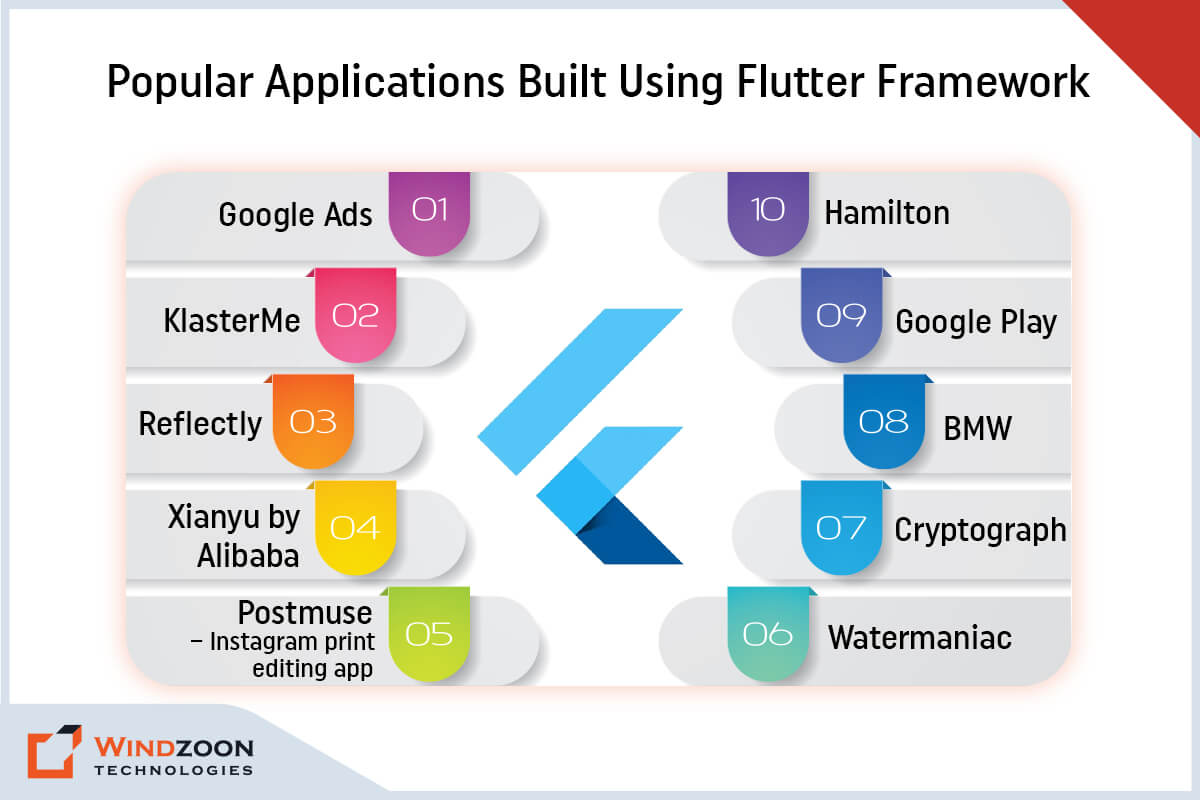
The following is a list of the most popular apps that were built entirely with Flutter or recently upgraded to Flutter.

List of Apps:

  1. Google Ads
  2. KlasterMe
  3. Reflectly
  4. Xianyu by Alibaba
  5. Postmuse – Instagram print editing app
  6. Hamilton
  7. BMW
  8. Google Play
  9. Watermaniac
  10. Cryptograph

Conclusion

Although Flutter has a few small but real drawbacks, they are outweighed by its advantages. Due to its numerous unique features, Flutter has become a remarkably rewarding and exceptionally powerful tool for app development. These capabilities are expanding even further with the release of Flutter 3.0.

If you want to create a cross-platform application, enlisting the assistance of one of the best Mobile app development companies and utilizing Flutter may be your best option.

At Windzoon, we have a team of experienced developers. They would be delighted to hear your ideas and assist you if you require guidance or assistance as you embark on your app development journey.

Visit wzadmin.windzoon.in/ to learn more about our excellent Flutter App Development Services and to request a quote.
Benefits of Having a Website for Your Small Business Growth

Over the years, web development has advanced significantly. Gone are the days when only big enterprises could afford web development for their businesses. Now, even if you have a limited budget, you can afford to have a fantastic business website with the aid of the top Web Development company in the USA.

In today’s digital world, having a website is essential for small businesses to stay competitive and reach new audiences. In the digital age, a well-designed website is a crucial component of any modern business strategy.

Then again many people ask, why should you invest in web development? Isn’t social media sufficient for connecting with your target audience? Why do you need a website to help your company thrive? Well, continue reading and you’ll get to know the importance of developing a website for your business.

Before we move toward our main topic, let’s get to know about a few things, including the numerous benefits a website can offer to small businesses.

What Exactly is Web Development?

Web programming, also referred to as web development, is the process of constructing, designing, and maintaining a website. It encompasses numerous aspects, including web design, publishing, programming, and database management.

There are two types of web development processes; one is front-end, and another is back-end web development.

A website’s front end consists of everything you can see and interact with. Therefore, front-end development refers to the process of creating the visual part. JavaScript, CSS, and HTML are used to create the graphical user interface of a website.

While back-end development is the process of creating the server-side logic. It runs the background operations of websites and apps. And contains every piece of code required to construct the database, server, and website.

Today, modern web development companies can handle all the technical details for you, so small business owners don’t need to worry about technical details or understanding computer code.

Now, let’s understand why depending only on social media platforms isn’t sufficient for your business.

Is It Necessary to Have a Website if you’re Already Active on Social Media?

Businesses usually leverage social media platforms as their primary means of marketing. Furthermore, these channels provide several advantages for business promotion. However, many business owners still lack a strong web presence, and having your own website is essential for small business owners to remain competitive.

For instance, they assist you in expanding your audience and even in conducting market research. However, your business website shouldn’t be replaced by a social media page or account. A strong online presence through your own website offers advantages that social media alone cannot provide. Here are a few reasons why.

1. Your Social Media Page or Account Is Not Yours To Keep

What would happen if Facebook decided one day not to support businesses anymore? All of your customers and followers would probably disappear if your Facebook page was your only online presence. And that would put your business in an extremely dire situation.

2. Social Media Platforms Have Search Engine Optimization Limitations

Think about this. Where do you turn when you’re searching for a nearby shop or firm? Google or Facebook? Naturally, Google would be your first choice. The 3.5 billion daily searches on Google demonstrate that most people prefer search engines to social networks when looking for information.

Search engine optimization (SEO) is crucial to improve SEO rankings and increase your website’s visibility on search engines like Google, Bing, and Yahoo.

3. The Social Media Page/Account Lacks Credibility

A business website is a symbol of trust. And customers only make purchases from businesses they know, like, and trust. So, while creating a social media page/account may be faster, you will not be able to command more authority and trust with it. Only a business website can make it happen.

To further boost credibility, it is essential to showcase customer testimonials and positive customer reviews directly on your website. Displaying testimonials directly helps establish trust, demonstrates social proof, and sets your business apart from competitors.

4. On Social Media Platforms, Attention is Fleeting

Social media platforms are fiercely competitive. If your company is listed on them, you must constantly compete with numerous other businesses.

Furthermore, you even have to compete with your potential client’s social media friends. As many people find ads annoying, particularly when they want to interact with friends, which causes them to ignore your business posts or ads.

We hope you now understand why relying solely on social media is insufficient for your business. Though social media platforms can help your business and its website, they cannot replace it. Instead, use social media in conjunction with your website to improve your marketing results.

Read More: Web Design Trends for 2023: Which You Should Use?

Now, let’s come over our prime topic of this article; and that is:

Top 12 Benefits of a Website for Small Businesses

Top 12 Benefits of a Website for Small Businesses

Having a website is essential for small businesses in today’s digital world. Before diving into the details, let’s look at the key benefits of having a website for your business: it enhances professionalism, increases online visibility, allows for effective storytelling, and gives you full ownership of your brand online. These advantages make a website a powerful tool for growth and credibility.

1. 24/7 Online Presence

One of the biggest benefits of having a website is that it is available to anyone, from anywhere, at any time. Customers can access your website and use your service online or obtain information even after business hours, increasing convenience and accessibility.

And this is one of the most important aspects of having a company website. The website is continuously working to ensure that visitors are always provided with the information they require from the comfort of their homes.

2. Round-the-clock Customer Support

Customer service is a challenging task for any business. However, offering customer support online is much simpler and less expensive than hiring staff to do so. Here, the value of having a website is evident because there are many ways to offer 24/7 customer support via a website:

  1. FAQs: It is the most popular medium to answer customers’ queries. On the website, all frequently asked questions by customers are addressed. It gives customers accurate and pertinent information while saving you time and resources.
  2. Chatbots: Chatbots on websites can also answer common customer queries 24/7 using pre-written responses. In addition, chatbots can inform users of a variety of other crucial details, such as how to sign up and details on various services and products.

These digital tools, such as FAQs and chatbots, perform the same essential function as traditional customer support channels by providing accessible and timely assistance. This ultimately leads to better customer service for your business.

3. Create Credibility and Develop Trust

Anyone can set up a company page on Facebook; it’s simple and quick. The credibility of a business social media page is significantly diminished by this low entry barrier. Because here customers are unaware of the identity, location, and legitimacy of those operating a Facebook page.

However, building a website for your business is not free and shows that you take your business seriously. You can more effectively gain people’s trust this way. A website is like “a large brochure” where you can display reliable details about your skills and experience, whether they come in the form of certifications or testimonials. Showcasing any industry award on your website can further enhance your credibility and authority.

A website also helps build brand recognition and brand loyalty by consistently presenting your business and engaging customers through features like newsletters or loyalty programs.

Hence, having a business website enhances your credibility and professionalism.

4. Improves Your Online Visibility

A little more than 5.03 billion people (or 63.1% of the world’s population) were using the Internet as of September 2022. That percentage is significantly higher in many countries. For instance, more than 90% of people in the US use the internet.

Your company is practically invisible to these clients if it doesn’t have an online presence. As we advance into the digital era, your company will lose visibility if you don’t invest in a website. A well-optimized website can attract free traffic from search engines, increasing your reach without additional advertising costs.

Therefore, your company needs to go online if it wants to remain competitive in this increasingly digital world.

5. Provides Social Proof

The opinions of your clients may influence whether or not other people choose to use your services. Therefore, even though review websites are good, the best place for people to learn more about your company is your website.

Showcasing your best testimonials on your website is an excellent way to build trust and social proof. Furthermore, it serves as a backup archive. It implies that you will still have access to your best reviews even if independent review websites close down in the future.

Read More: Benefits of Responsive Web Design to Boost Your Business

6. Provides Long-term Value

A business website is an excellent investment because it keeps paying off for you years after you first built it.

When you pay for social media ads, your potential clients will only see them for as long as you keep them running. You’ll have to pay again to run the advertising campaign if they don’t see it.

A business website, on the other hand, will provide you with ROI over time. If it doesn’t yield returns in the first year, you still have time to make adjustments until it does. Having a website is a cost-effective way to market your business and can help you save money compared to traditional advertising methods.

7. Enables Online Sales

It is anticipated that by 2023, e-commerce sales will exceed $6.3 trillion. Clearly, none of these sales occurs with businesses that do not have websites.

If your business sells products, setting up an e commerce store on your website allows you to sell products online and reach a wider audience.

Even if you don’t operate a traditional e-commerce company, having an online storefront can help you draw in more clients. And enables you to carry on doing business even when your physical store is closed.

8. It Aids Clients in Locating Your Physical Office or Store

One of the many advantages of being online is that others can easily find you. This concept is also applicable to your physical store. Simply having a website makes it easier for people to locate your location and visit it more frequently.

Including your store locations, store details, and business address on your website helps customers find your brick and mortar locations and increases the chances they will find your store online. Tracking visits to your brick and mortar location can also be complemented by analyzing online data from your website to better understand customer interest and engagement.

A map embedded in your website is useful for potential customers who are looking for your location. In other words, having a website enables Google to list your website on Google Maps. As a result, customers can direct their GPS to your location with a single click, rather than visiting your competitors.

9. Display Your Products/Services/Portfolios in a Fascinating Way

If you want people to buy your goods or services, presentation is key. It is crucial, especially for startups where each client is vital.

In that case, it’s also critical that we can demonstrate our competence in the best way possible, and having a website can help with that. It allows you to be creative. You can present your products, services, and portfolios however you want. By creating different web pages dedicated to each product or service, you can provide as much detail as possible, making it easier for visitors to find exactly what interests them.

You can use eye-catching pictures, quick video guides, and printable PDF instructions. Additionally, publishing informative articles on your website helps showcase your expertise and assists potential customers in solving common problems. It will significantly increase website visitors’ engagement. And ultimately assists you in developing a loyal customer base.

10. New Markets Are Accessible to You Through Your Website

Your website serves as a gateway to the global markets. You can connect with audiences in remote locations using a website. Normally, it would take a lot of resources to accomplish this with physical locations.

A website helps you attract new customers from different regions and markets, expanding your reach beyond your local area.

Any potential customer in the world who has internet access can visit your website and conduct business with you. This advantage makes it possible to grow and expand more quickly, which can support the growth of your physical stores.

11. Reach More People by Using Website Advertisements

A website aids in expanding your audience, whether you’re looking for a quick boost or a scaling-up strategy. Using adverts on well-known platforms like Google Ads and Facebook Ads, you can present your products to potential customers who otherwise wouldn’t be interested in them.

Integrating your website with marketing campaigns and marketing strategies across social media channels can maximize your reach and engagement.

Facebook is the largest social media platform, with  2.7% of the world’s population actively using it. Similarly, Google’s 86.6% market share in search ensures that your ads are seen by the appropriate people who are already looking for your products.

These platforms assist you in developing highly targeted offers that draw in the appropriate audiences. For instance, based on the user’s search activity (keywords), the websites they visit, or their interests, the platform may determine what information is relevant to them.

12. Increases Leads & Revenue

A well-built website is a perfect tool for businesses to connect with more & more users. Businesses can use it to boost traffic, produce more leads, and increase ROI conversions. Analyzing web visitor data helps you understand customer behavior and improve your offerings.

Businesses can expand their offerings to attract more clients and encourage them to spend more time on a website. Providing excellent service and support through your website encourages repeat business. Creating a 'Careers' page on your website helps attract potential job candidates more effectively than relying solely on job websites. Including your website address on all existing promotional material and traditional promotional materials, such as business cards and brochures, increases brand recognition. Combine traditional promotional materials with web marketing materials for a comprehensive marketing approach. Using custom email addresses provided by hosting providers enhances your business's professional image. Your website can support point of sale situations by providing up-to-date information that is more flexible and cost-effective than printed materials. Tracking average foot traffic at your physical location and using online data from your website can give a complete picture of customer engagement. Building an easily accessed database of customers through your website's mailing list enables targeted marketing. Highlighting your family business and sharing the story of how your family business started builds trust and authenticity. A former customer can refer new clients who find you through your website, expanding your reach.

The website has transformed the way many businesses operate. So, whether you're a solopreneur or a small business looking to make a name for yourself, a good website will be at the core of it. However, to create a website, you require the assistance of a custom web development company.

With more than 10 years of experience, Windzoon is a well-known web development company. We have a team of seasoned web developers who successfully completed over 100 web development projects. To avail of our top-notch web development services, visit us at wzadmin.windzoon.in/ and .

15 E-Commerce Web Design Trends to Design impressive Stores in 2023

We all are living in the digital age, surrounded by a plethora of gadgets and equipment that make our lives more convenient and vibrant. Now, we only need to make a few clicks to send a message, obtain information, or purchase the desired products.

By 2024, eCommerce will account for over 20% of all retail sales and more than $1 trillion in sales. It amply proves that e-commerce businesses are expanding globally. And it has motivated lots of businesspeople to spend money creating eCommerce websites.

However, creating the ideal eCommerce website is not as simple as it appears. You’ll need careful planning and the assistance of an experienced e-commerce web design company. That company’s professionals will assist you in applying the latest trends to your e-commerce site and making it market-ready. When developing websites, trends are crucial to consider because they show us how to build competitive websites. Know about 15 Amazing Web Design Trends for 2023: Which You Should Use.

In this article, we will discuss the top eCommerce website design trends for 2023 to create modern and productive eCommerce websites.

E-Commerce Web Design Trends Look Out

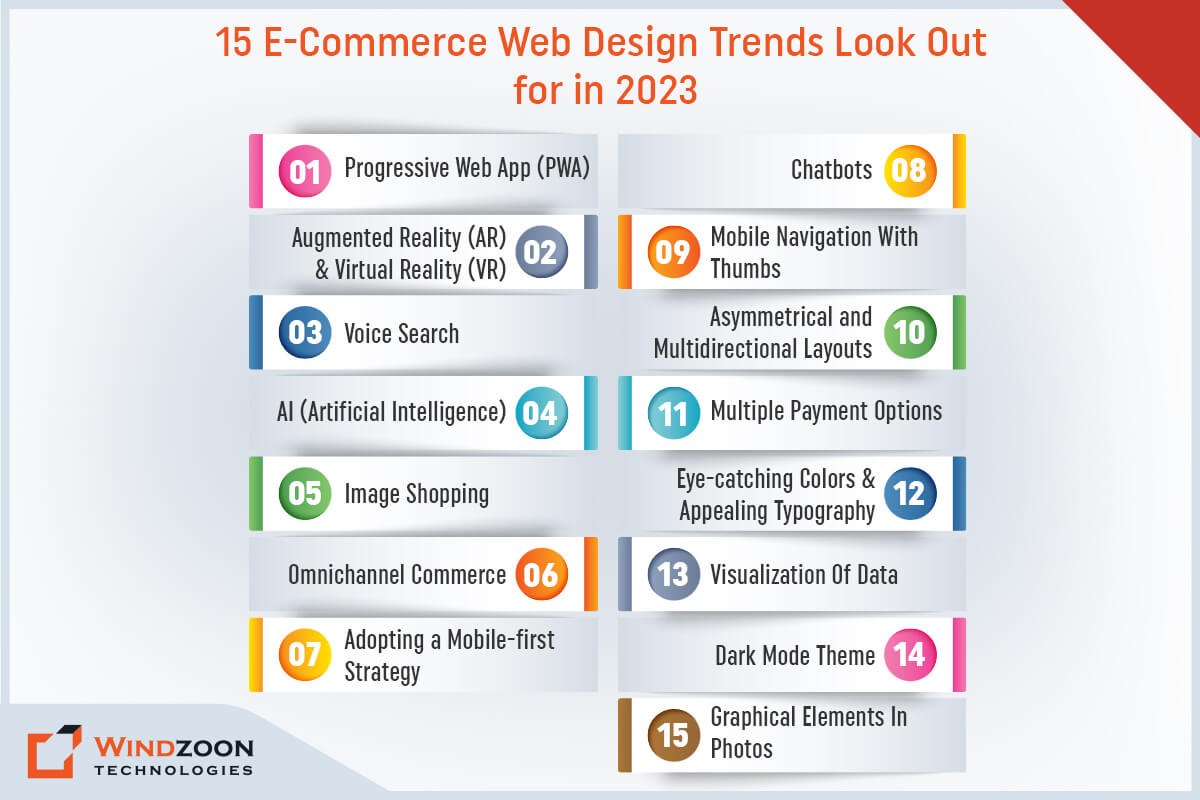
15 E-Commerce Web Design Trends Look Out for in 2023

1. Progressive Web App (PWA)

Progressive Web Apps (PWAs) are a recent development that will soon be crucial in the growth of eCommerce. Online businesses are constantly looking for innovative ways to enhance the customer experience while boosting revenue and profitability.

PWA has several significant advantages, including low development costs, an app-like interface, quick installation, offline operation, and a push notification feature. If implemented properly, these features will make sure that your e-commerce businesses stay one step ahead of their rivals.

2. Augmented Reality And Virtual Reality (AR/VR)

These technologies remove many obstacles that arise during online shopping, making them a huge boon to the eCommerce sector. Augmented reality (AR) is essential when previewing goods or using services before making a purchase.

Having this type of visualization aids users in determining whether a product will satisfy their needs. Businesses that provide eCommerce platforms with Augmented Reality (AR) will be able to broaden their market reach.

Several surveys and reviews attest to the effectiveness of VR experiences. Take Airbnb as an example, which enables you to view a rental before booking. It’s similar to how IKEA can display how a specific sofa would look in your room.

VR can be a reliable tool for websites to deliver useful, captivating content in a way that aids visitors in making a purchasing decision.

People’s lives have changed and become easier in many ways since the introduction of smart speakers and voice assistants like Google Assistant, Alexa, Siri, etc. These technologies improve people’s lives by assisting them in transitioning from “typing” to “speaking.”

Voice tools and devices are made to take specific voice commands, which give users access to a wide range of services. The popularity of voice search is growing, and it will do so even in 2023.

Many eCommerce platforms offer different Voice User Interface options that let users search for products using voice commands. By optimizing your website for voice search, you can successfully grow your business.

4. AI (Artificial Intelligence)

AI is revolutionizing the eCommerce industry by predicting consumer purchasing patterns. Based on past purchases, product searches, and online browsing habits, AI is influencing customers’ eCommerce purchasing decisions. Personalized product recommendations have a significant impact on higher conversion rates.

AI in eCommerce can help online businesses by analyzing trends and customer behavior to determine the best time to launch a product, set a price, and list these items on the best channel (or channels). It will undoubtedly have a positive impact on businesses’ sales and marketing efforts.

5. Image Shopping

There will be an increase in image shopping in e-commerce. To purchase a product from an online store, users will point their camera at the item they wish to purchase. Like CamFinder, there are numerous photo apps available, and this year, many more will appear. This trend will also result in the sale of affiliate products via photoshopping.

For instance, Pinterest recently unveiled its very own photo camera. It identifies and analyzes images to provide a precise product description. It has already partnered with numerous e-commerce sites and top search engines. It gives them pertinent information they can use to categorize and interpret images.

6. Omnichannel Commerce

Omnichannel selling has become critical for online businesses because it allows them to reach every customer touchpoint. Due to their ability to sell through Omni channels, they can serve clients using a variety of platforms and devices, including websites, PWA, social media platforms, and more.

Regardless of where a customer starts their shopping journey, eCommerce businesses can target all different types of customers with omnichannel selling. This trend in eCommerce development has made online shopping more flexible and unrestricted.

For instance, today consumers can purchase goods on any website or platform, including Facebook, eBay, and Amazon. It has established a new standard in the eCommerce sector and will help you expand your company greatly.

7. Adopting Mobile-first Strategy

Mobile technology has become prevalent in our time. According to reports, 79% of smartphone users have made online purchases using their mobile devices. Additionally, search engines will favor websites that are mobile-friendly from a ranking perspective.

Therefore, developing responsive e-commerce websites and mobile apps that can adjust to different screen sizes will become more and more important in 2023. If you want to learn more about the importance of responsive design read our article on how a responsive web design can help your business.

8. Chatbots

Chatbots are one of the most pervasive eCommerce development trends. Chatbots are extremely beneficial to eCommerce businesses because they automate human-to-human interactions. It implies that users can communicate with chatbots on an e-commerce website to quickly and easily obtain a variety of services.

Custom support has frequently proven to be an Achilles’ heel for many online businesses. But with the aid of chatbots powered by artificial intelligence, businesses can offer quick and convenient customer support.

Customers don’t have to wait very long to find solutions because chatbots can respond to their questions and interact with them to solve any problems that may arise. You can hire e-commerce web designers to design a feature-rich website with a smart chatbot.

9. Mobile Navigation With Thumbs

The majority of smartphones that have been released in recent years have bigger screens.

Users primarily use their thumbs to navigate through an app while holding the phone in one hand. Of course, the majority of clickable items and important navigation buttons in the mobile user interface must be easily accessible with the thumb. The comfortable reaching area surrounding the user’s thumb is known as the mobile-thumb zone.

Although larger displays are excellent for precise finger tapping, the larger area that needs to be covered makes single-handed thumb navigation more challenging. Naturally, app developers must prioritize thumb-friendly design more than ever before.

10. Asymmetrical and Multidirectional Layouts

One of the most crucial elements of your e-commerce website is the product gallery. It provides information to visitors that might influence their decision to buy. A typical gallery serves its purpose admirably, but there are other ways to enhance it.

Many companies will be experimenting with grid-based multi-product galleries in 2023. Given that it addresses mobile-first design and interactive shopping experiences, this e-commerce design trend is pertinent.

11. Multiple Payment Options

It should be expected that there will be more methods of online payment as a result of technological advancement.

In addition to conventional methods such as credit and debit cards, the use of digital wallets, cryptocurrency, and even biometrics would significantly increase. The desire for faster, more secure transactions is driving this trend.

Thus, providing a variety of payment options is a great way to increase conversion rates.

12. Eye-catching Colors and Appealing Typography

The worst thing you can do this year is to build an eCommerce app with a lot of white space in between. According to the most recent eCommerce Design Trends, you should experiment with bold, bright colors more to create attractive websites with eye-catching homepages.

Make wise color choices that appeal to customers, send messages, and enhance the shopping experience. Use interesting typography and highlighted letters as well.

13. Visualization Of Data

Information delivery that is both entertaining and informative is difficult. However, you can accomplish that using data visualization. Implementing it won’t be simple, but the payoff will be worthwhile.

You can use infographics and graphs to present your data in an engaging, original way. Data visualization increases the chances that your audience will learn about the information you’re trying to share.

14. Dark Mode Theme

It serves a number of functions when websites are designed in dark mode. One benefit is that it lessens eye fatigue as we spend more and more time in front of screens these days. On the other hand, websites in dark mode have this contemporary appearance that is very attractive. It made the increasing popularity of dark mode not surprising.

15. Graphical Elements In Photos

Images with overlapping graphics grab the audience’s attention more easily. The combination of these two approaches gives the images a distinctive quality.

You can help your business establish a memorable brand by combining the strength of graphics and photos. It will maintain visitors’ interest in what is happening on your website and boost conversion rates!

Conclusion

It is challenging to stay current in the ever-evolving and changing world of eCommerce. However, if you want to keep your brand relevant while offering the best shopping experience for your customers, you must stay up to date on the latest industry trends.

In order for your business to succeed and to be ready for 2023, you must begin implementing these trends into your e-commerce site as soon as possible. If web development languages are not your strong suit, you can hire a website design company and creative agencies to assist you. For that, you can read our blog on how to choose the right web design & development company in 2023.

As a renowned e-commerce web design agency, Windzoon provides premium web design services at the most competitive rates with minimum turn-around time. Our talented web designers can create one-of-a-kind e-commerce web solutions that are customized to your business’s requirements.

For more information about our web design services or to get a quote, visit wzadmin.windzoon.in/.

Enterprise WordPress Development: 9 Tips for Successful Growth

Enterprise businesses require a reliable and scalable web presence more than most organizations do to stay competitive. To that end, many large businesses have historically looked to pricey web solutions requiring exclusive support contracts as a quality assurance measure. Enterprise platforms are often selected because they allow for tailoring development and marketing strategies specifically to the needs of large organizations.

But is it necessary that only expensive web solutions will provide a quality guarantee while others won’t? Because this isn’t the case, especially with regard to WordPress.

The fact that WordPress has been around for more than ten years and now powers 43.0% of the web makes it clear that even the biggest companies need to pay attention to it.

Currently, WordPress powers many Fortune 500 businesses, including Xerox, Sony, Tesoro, The Walt Disney Company, Best Buy, and many more. Your business deserves a custom WordPress solution that is tailored to meet its unique needs and expectations. You can also join this league by working with a reliable Custom WordPress Development Company

In this article, we’ll discuss the unique requirements of larger organizations and examine the many benefits of using WordPress for enterprise businesses.

What is an Enterprise?

“Enterprise” is obviously a generic term, but when applied to a specific type of business, it generally refers to a large, usually multinational organization. These organizations typically consist of separate organizational parts with separate budgets and goals.

Although there are many different definitions of what an enterprise business is. But when it comes to web technology, most enterprise websites need to be able to handle a lot of traffic, especially if they are media or e-commerce sites. It is also crucial that website development is aligned with the organization’s business objectives to ensure the site effectively supports overall goals.

Now, let’s move toward our next question, that is:

6 Must-have Features in Every Enterprise CMS Website

6 Must-have Features in Every Enterprise CMS Website

Based on our experience as the preferred WordPress Website Development Company, we have identified a few key criteria for any CMS to serve as an enterprise-grade solution. High code quality is essential for ensuring reliability, security, and standards compliance in enterprise environments. Additionally, custom websites tailored to enterprise needs are crucial for providing the flexibility and scalability required for business growth. They are listed below:

1. Easy Administration

An enterprise needs a CMS that provides a variety of user-friendly and effective administrative tools in a single software package. Site administrators must be able to manage notifications, add assets, track scheduled content, and adjust plugins without switching between different programs.

2. Workflow Controls

Enterprises require a CMS with efficient workflow controls. As they are one of the most useful components of a good CMS. In essence, they offer your marketing team a planned environment for content creation. For ex.: Writers produce the content for your website, and editors edit it before sending it to the company’s legal department for a final review. Every team member has a profile with the proper permissions to speed up workflow. Managing access permissions is crucial to ensure efficient and secure workflow, especially in enterprise environments where multiple users and roles are involved.

3. Multi-Platform Capabilities

Enterprises are bound to grow their customer base over time. Having a flexible website solution from the start will allow them to launch various mobile applications, web applications, and websites as they grow. For enterprises managing multiple websites, leveraging multisite functionality enables centralized control and streamlined management from a single platform, making it easier to scale and customize as needed. To meet any of these requirements, a CMS must be capable of supporting multiple platforms.

4. Headless Content Management

Enterprises are under increasing pressure to support omnichannel digital experiences across a wide range of devices. As a result, they require a headless CMS that can store frontend agnostic content and allow marketing teams to optimize and deliver it on whatever devices or channels their audience requires.

5. Detailed Analytics

Any online marketing campaign’s success depends on how much the marketing team is aware of its target market and potential customers. Enterprises are well aware of this fact. As a result, they need a CMS that either has popular analytics tools built in or can integrate the necessary plug-ins.

6. Robust security

Serious security lapses have catastrophic effects on businesses of all sizes. Therefore, enterprises need a CMS platform that prioritizes security and can be quickly updated to fix vulnerabilities as they appear. Implementing advanced security measures, such as two-factor authentication, is essential to protect sensitive enterprise data from evolving cyber threats. Anything less is simply unacceptable.

After learning about the enterprise’s expectations from the CMS, let’s see what exactly WordPress CMS is.

What is the WordPress CMS?

WordPress has long been recognized as a blogging platform. Or a system that offers small business owners and aspiring entrepreneurs incredible flexibility. Although it still offers small businesses reliable solutions, WordPress has grown to be much more.

WordPress for big enterprises includes a slew of features tailored to enterprises of all sizes. It is built using web technologies, which are extremely scalable. Professional WordPress web design services can deliver scalable and secure solutions for large organizations, ensuring the platform meets enterprise-level demands. With WordPress, businesses can also create a custom theme that reflects their unique branding and functional requirements, providing a tailored and brand-consistent online experience. WordPress is one of the most popular content management systems (CMS), so there are a lot of WordPress service providers to choose from

Thanks to the abundance of plugins available, it shouldn’t be difficult to customize the default enterprise WordPress platform to deliver the precise experience you need.

Now, Let’s learn about some of the myths related to WordPress for Enterprise Website Development.

What are the Common WordPress Misconceptions for Enterprise Website Development?

Common WordPress Enterprise Development Misconceptions

While WordPress is an excellent platform for many reasons, many people have misconceptions about its limitations and capabilities. Successful enterprise WordPress projects require technical expertise to ensure security, scalability, and reliability. Here are a few examples of common WordPress enterprise development misconceptions:

1. WordPress is not a True CMS and is Only for Blogs

As previously stated, WordPress powers nearly 42% of all websites, implying that it is capable of much more than just blogging.

2. WordPress is not Very Secure

Although there may be some risks associated with third-party plugins, the core system is actually very secure. Besides, WordPress has also recently begun to invest in rapid security releases, which are managed by a team of 50 experts. Regular security updates are essential to protect enterprise websites from emerging threats and ensure ongoing website security.

3. At the Enterprise Level, Open-source is not Trustworthy

This is untrue because large websites like Facebook and Google also rely on open-source software to power their technology.

4. WordPress Leaves you on your own and Provides no Support

It is not true. Due to its sizable open-source community, developers and contributors are constantly producing fresh plugins, themes, and features in addition to responding to user inquiries and fixing bugs as they appear. For enterprise WordPress sites, ongoing support is available to ensure continuous website maintenance, security updates, performance optimization, and feature enhancements, keeping your site secure, fast, and up-to-date after launch.

With this, we have come to the main topic of our discussion and that is:

9 Benefits of WordPress for Enterprise Website Development

Compared to other content management systems, WordPress is easier to use, cost-effective, and more flexible when it comes to customizing enterprise-level websites. Some of the exceptional benefits of WordPress are as follows:

1. Robust Security

Of course, an enterprise CMS needs to be completely secure. It guarantees the security of both user and organizational data. To achieve this, robust security measures are implemented, including vulnerability assessments, regular updates, and industry-leading security practices to protect against emerging threats.

WordPress meets and even exceeds these requirements. WordPress provides regular updates and security releases to protect users from common hacks. You can further secure your site by utilizing security plugins, as well.

While WordPress handles some minor core updates automatically, major updates and server updates frequently require manual intervention. An enterprise company can lessen its technical workload and risk of error by selecting a managed WordPress host rather than a generic host.

2. Third-Party Tools

With WordPress, you have access to a wide range of third-party tools that are compatible with your setup. This includes the ability to integrate marketing automation tools, which can enhance website functionality and support enterprise marketing strategies. As a result, your enterprise business can quickly add features and update the website without having to spend money on pricey custom solutions. There are lots of free tools and paid plugins with extra support available for enterprise businesses!

3. Substantial Flexibility and Scalability

The most crucial factors for businesses in general, or for enterprises in particular, are flexibility and the ability to grow over time. WordPress provides that with the aid of thousands of highly customizable themes and more than 54,000 plugins.

WordPress enables scalable solutions that can handle high-traffic websites and complex enterprise requirements, making it ideal for organizations with growth ambitions. Additionally, innovative solutions can be implemented to address unique business challenges, ensuring your website remains competitive and adaptable.

With respect to other CMS, this is a sizable number—possibly the largest. There’s a good chance that everything you need for your website is already available. And even if it isn’t, you can speak with a qualified WordPress website development company to create a unique solution that is completely tailored to your needs.

4. Media Management

Media management is an important aspect to consider when designing an enterprise website. For instance, whatever solution you choose must make it simple to manage organizational documents, visual media like photos and videos, and even audio.

Fortunately, WordPress allows you to upload (and manage) almost any type of media. However, managing media is not limited to the back end. Using WordPress’ built-in functionality, you can also display it conveniently on the front end in places like pages and posts.

5. Industry Support and Integration

Beyond user support, many major industry players are capitalizing on WordPress’ popularity. These companies, which include software providers and marketing services, provide integrations and support that benefit many users. In addition, collaborating with hosting partners such as WP Engine and Pantheon ensures high performance and security for enterprise WordPress sites. Enterprise-grade hosting solutions also offer scalability and dedicated support, making them ideal for large-scale or high-traffic WordPress websites.

Plugins are the most popular method of industry support and integration, and they are an inherent feature of WordPress. These specific pieces of software work to enhance WordPress’ functionality.

In fact, these plugins are specifically designed for WordPress by companies like MailChimp, Constant Contact, Buffer, and even Google Analytics. It allows you to easily integrate these companies’ services into your website, which improves UX and site flexibility.

6. Multisite Management

Operating an enterprise website entails managing multiple subdomains or microsites and restricting access to a select group of team members.

A user role in WordPress called “Super Admins” gives users the ability to build networks and control user permissions across numerous sites. Utilizing a multisite network with WordPress multisite allows you to efficiently manage multiple websites from a single WordPress installation, providing centralized content management and streamlined workflow across all sites. With this, you can safeguard your website and its contents, especially sensitive data, from unauthorized access. We have worked with many enterprise clients to implement and manage complex WordPress multisite environments, ensuring scalable and secure solutions for large organizations.

7. Multilingual

Large corporations must have a website that customers from all over the world can access. WordPress supports more than 100 languages, which means you can effectively communicate with a global audience.

8. Headless Functioning Capabilities

Headless is a new trend in enterprise website development. It’s a method of separating the back end of the CMS from the front end. By doing this, you can create a unique user interface based on a framework, such as JavaScript, and link it to the back end (WordPress) using an API.

As a result, you get the best of both worlds: remarkable content management and a more responsive front end.

The REST API in WordPress allows it to support this approach out of the box. Not only that, but the API can populate almost any other object with content, including mobile apps.

As a result, headless can transform WordPress from a basic website to an omnichannel publishing tool. If you are interested in this headless concept and want to know more about it, then read our Complete Guide on Headless WordPress Development.

9. SEO Friendly

Another technical benefit of WordPress is its SEO-friendliness. WordPress naturally works well in this area, though you might need to install a plugin to make managing on-page SEO a little simpler (the Yoast SEO plugin and All-In-One SEO Pack are two popular options that come to mind). WordPress sites can be optimized for search engines by using proper site structure, clean code, and SEO plugins, which help improve visibility and ranking in search engine results. It is a key selling point for enterprise sites with potentially enormous amounts of content.

Now, let’s get to know about some easy steps to develop a WordPress website for an enterprise.

How To Develop Enterprise Websites With WordPress?

Here are the six steps you must follow to make WordPress enterprise-ready.

  • Step 1: Select a Reputable WordPress Host, such as WordPress VIP, to ensure high-security, enterprise-grade managed hosting.
  • Step 2: Configure Plugins for Advanced SEO and leverage plugin development for custom features and feature enhancements.
  • Step 3: Add multilingual support to your enterprise WordPress site and integrate an online store for seamless e-commerce functionality.
  • Step 4: Add performance-enhancing plugins and implement performance optimization strategies to optimize WordPress for speed, scalability, and reliability.
  • Step 5: Strengthen the security of your enterprise WordPress site with custom themes, custom WordPress solutions, and tailored enterprise solutions.
  • Step 6: Improve the publication process by assessing your existing tech stack to develop a customized implementation plan and ensure minimal downtime during data migration.

WordPress is an excellent CMS for large organizations and complex solutions. It is expandable, secure, and provides practical and simple solutions to complex needs. However, these features would never suffice for enterprise websites without comprehensive WordPress enterprise solutions and enterprise WordPress development services.

Enterprises require continuous website monitoring, proactive maintenance, and ongoing maintenance, which are essential services for enterprise sites. Performance monitoring and performance optimization are critical for maintaining WordPress performance, security, and scalability. Specialized enterprise WordPress development agencies have senior developers and designers with extensive experience in project management, data migration, and delivering enterprise solutions for enterprise clients. They also provide feature enhancements, plugin development, and custom features to extend website functionality, as well as custom themes to align with enterprise branding.

Maintaining a strong digital presence is vital for enterprise clients, and working with a WordPress VIP Gold Partner ensures access to the highest level of expertise and support within the WordPress VIP ecosystem. Our experience with enterprise clients includes developing custom WordPress solutions, integrating online stores, and optimizing WordPress websites for high performance and scalability. We deliver enterprise WordPress development services tailored to your unique business needs.

If your company requires WordPress Development services, partnering with Windzoon Technologies is a wise decision. We are one of the best and most remarkable WordPress Development Companies in India, recognized as a WordPress VIP Gold Partner.

Hire WordPress Developersfrom us who are experienced in creating complex and industry-specific enterprise websites. Visit us at wzadmin.windzoon.in/ to or to learn more about our WordPress website packages

14 Inspiring Mobile App Development Trends You Should Consider in 2023

The global pandemic has hastened the shift toward mobile-first solutions in all industries. As more modern customers use their smartphones to pay bills, order items, connect with coworkers, and make new friends, the demand for high-quality mobile apps has skyrocketed.

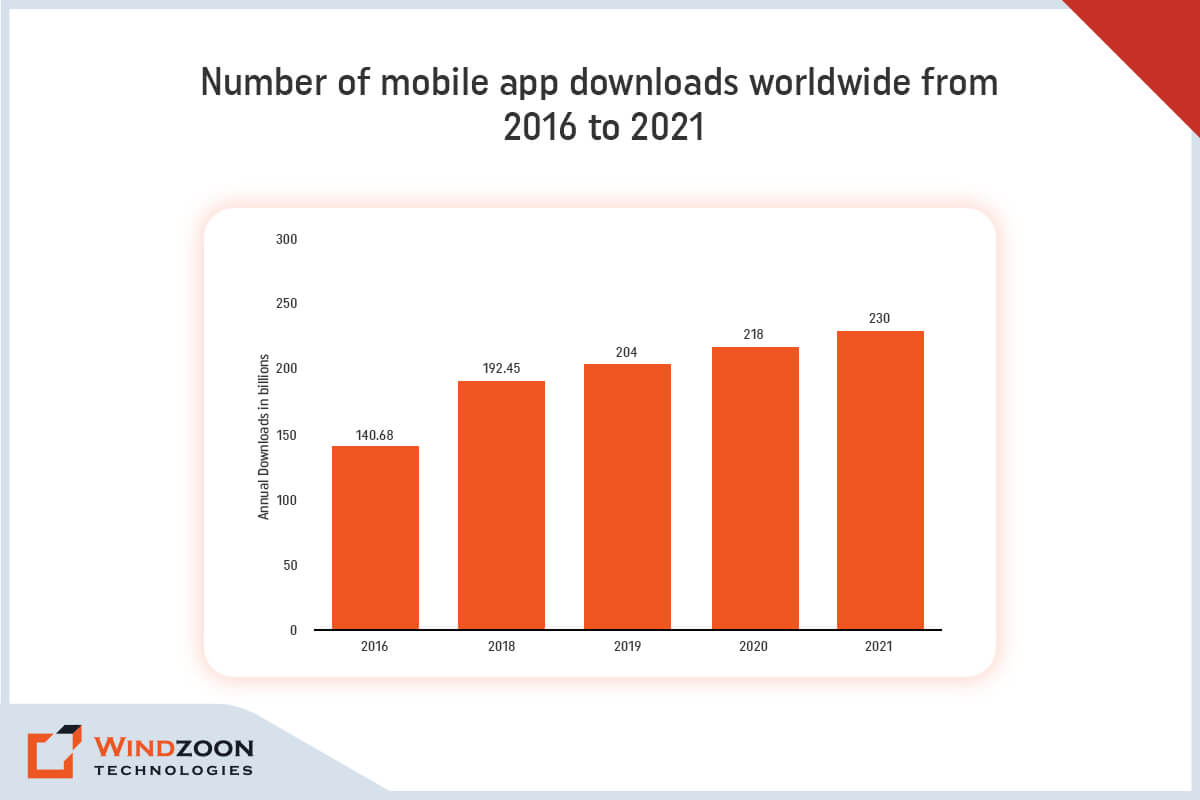
Therefore, developing a market-leading app becomes essential for both startups and established businesses. Since app downloads increase steadily each year, this is not surprising. Annual mobile app downloads were as high as 230 billion in 2021, and it is still rising. A mobile app is undoubtedly a highly lucrative project that you can undertake with the aid of any mobile app development company.

mobile app downloads worldwide

Number of mobile app downloads worldwide from 2016 to 2021

But in order for a mobile app to succeed, it must adhere to the most recent trends in mobile app development. Because if it doesn’t, the app, which seems cutting-edge now, might be considered outdated later on.

Here are some outstanding mobile app development trends for 2023 that every Indian company should be aware of.

Mobile App Development Trends You Need Follow

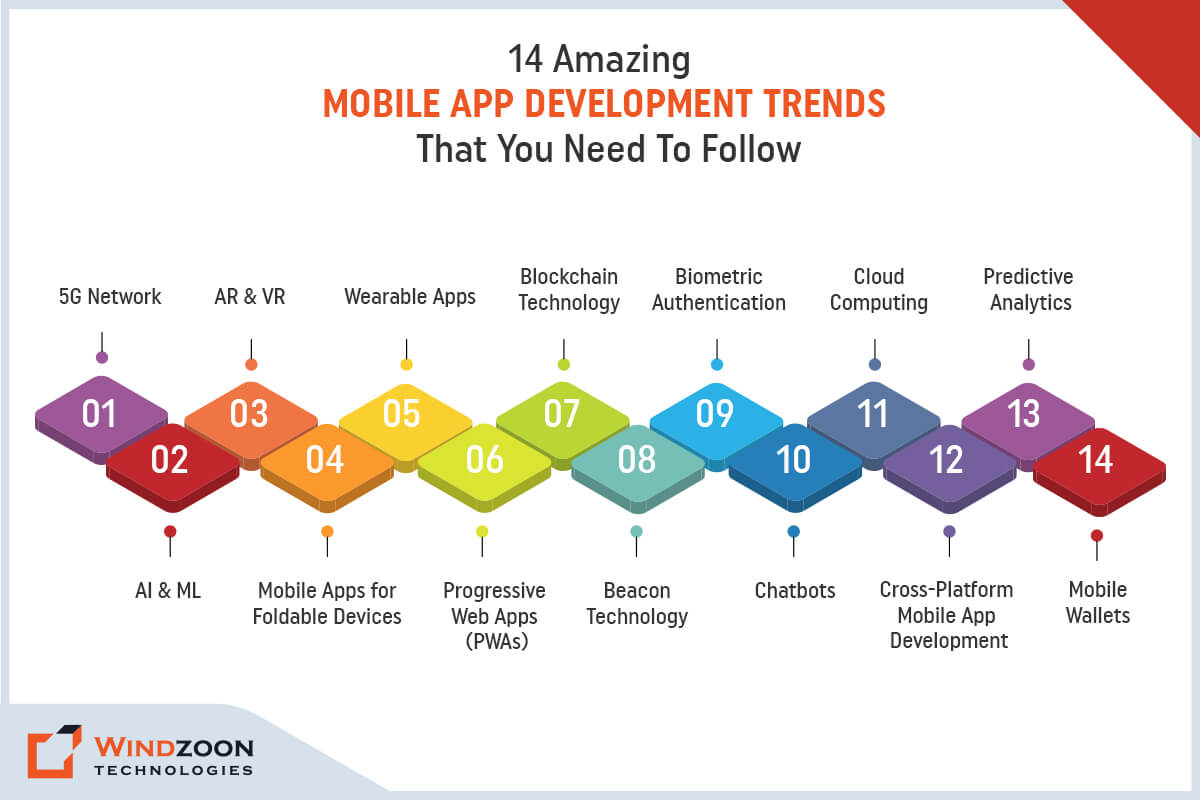
Amazing Mobile App Development Trends You Need To Follow

1. 5G Network

The fifth generation of mobile connectivity, or 5G, is soon to arrive. It will transform the creation of mobile apps in ways we never imagined. By 2026, it’s predicted that 5 billion people will be using 5G, which is also seen as the start of the Fourth Industrial Revolution.

Unlike its predecessor, 5G has a latency of less than one millisecond. It will boost data transfer rates up to 100 GB/s.

5G will stimulate app development in areas such as the Internet of Things (IoT), augmented reality (AR) and virtual reality (VR), connected driverless vehicles, wireless health, and others. Next-generation apps will use this power and speed to accomplish things we never thought possible.

2. AI and ML

Mobile apps and systems are already using artificial intelligence and machine learning. Face App, Prisma, and other AI-powered applications have taken AI to the next level.

In 2023, AI will have a more significant impact on our daily lives. Along with current technologies, AI advancements like AI-based cameras, speech translations, and user projections will find a new home in smartphones.

Many businesses recognize the advantages of AI because it enables them to deliver top-notch services while significantly reducing operating costs.

3. AR and VR

A growing number of businesses are using augmented and virtual reality to improve the user experience of their mobile apps. In 2023, the AV/VR market is projected to reach $160 billion, a significant rise from $12 billion in 2020. And in the ensuing years, this trend is not likely to reverse itself.

Numerous apps in the market are already utilizing the power of AR/VR, including Google Maps, Ikea, Nike, and many others. So, if you want to use augmented or virtual reality to enhance your company’s offerings, the time is now.

4. Mobile Apps for Foldable Devices

Devices with folding displays are called foldable devices. It is still uncommon to use this construction technique. However, major manufacturers like Samsung, Huawei, LG, and others actively promote their first smartphones with foldable displays.

Both manufacturers and app developers can benefit from this trend. In the coming years, digital products that can be customized for special foldable screens may become very popular. At the very least, nearly all mobile applications will be equipped with the technology necessary to adapt app size and layouts to foldable screens.

5. Wearable Apps

As the market for wearable technology expands, more digital solutions are required to support electronics. Every type of wearable device, including jewelry, smart watches, and bands needs a full-featured app.

It assists in collecting the device wearer’s data, measuring and analyzing vital signs, producing advanced statistics, and more.

6. Progressive Web Apps (PWAs)

Progressive web apps are a different mobile app innovation that is anticipated to gain traction in the coming years (PWA). These applications serve as a user interface for websites and native mobile applications.

PWAs are less dependent on the network, take up less space, and load faster. Even though they aren’t a brand-new development trend for mobile apps, they are here to stay and help companies achieve their goals at a reasonable cost.

Progressive web apps are more accessible and simple to design than traditional apps. That is because they are simply web pages with app functionality. PWAs are interactive, updated automatically, and very flexible.

7. Blockchain Technology

According to current trends in mobile app development, blockchain technology is all about better user experience, data privacy, and security.

Blockchain can be used for various purposes, including storing passwords on decentralized networks, using smart contracts to feature in-app transactions between users, blockchain gaming or metaverses, and more.

With the proliferation of blockchain technology and mobile banking, more and more apps will incorporate blockchain solutions.

8. Beacon Technology

Beacons are one of the most recent innovations in proximity marketing and location technology. They are discreet wireless transmitters that communicate with nearby smart devices using low-energy Bluetooth technology. And that way, they link to smart devices and transmit data, facilitating and improving location-based interaction and search.

It makes purchasing goods and services simple and convenient. Hence, many businesses are now using beacon trends to promote their products and services. Additionally, it helps them to learn more about their customers’ purchasing habits and preferences. And enables businesses to make shopping more personalized.

9. Biometric Authentication

App development trends have become more stringent and significant in terms of security. As a result, biometric authentication has become an essential data protection feature for every modern app. It intensified the security several times, allowing for quick authentication and operation.

Face recognition, fingerprint scanning, and computer vision are all examples of this technology. Such a trend has the potential to significantly improve the security of users’ data and money.

10. Chatbots

Chatbots are transforming how companies interact with their customers. In the past, companies used mobile calls to reach out to their clients (which was time-consuming).

Chatbots are a form of communication that aids businesses in meeting customer expectations. Here are some popular chatbot options:

  • Google Assistant
  • Alexa
  • Siri

Chatbots make it easier and faster to respond to customer requests. This technology is widely used in various applications, including online shopping, transportation, food delivery, etc.

11. Cloud Computing

As cloud computing gains popularity, developers can use the strength of the cloud to improve mobile apps. With this innovation, mobile apps can complete complex tasks and obtain all the data they require from the cloud. This enhances the functionality and speeds up the app.

12. Cross-Platform Mobile App Development

The development of cross-platform apps will be one of the most popular mobile app trends in 2023. It enables you to create your app once and release it on various platforms, such as iOS and Android.

Cross-platform development not only saves time and money but also guarantees that your app will look and feel the same on all devices.

13. Predictive Analytics

Predictive analytics includes data modeling, artificial intelligence, machine learning, and data mining. This trend effectively uses data analysis to assist businesses in making future-ready decisions.

It can detect trends and opportunities, improve business processes, and forecast customer behavior. Businesses can improve their chances of success by employing this trend early in developing their mobile applications.

14. Mobile Wallets

Customers are particularly fond of mobile wallets. People prefer not to frequently pay with cash or type account or card information as the economies of various countries become more digital. For better throughput, they prefer to pay using integrated digital payment.

By integrating popular payment gateways with mobile wallets, the payment process is sped up and simplified.

A growing number of mobile wallets have gained popularity, including Google Pay, PhonePe, Amazon Pay, Paytm, and others. Because the industry has not yet reached saturation, there is still an opportunity for future growth.

Conclusion

The mobile app industry is expanding and evolving at a rapid pace. How can you ensure your app stands out from the millions of others on the market and offers what users want? The answer is simple: by using the most recent trends in app development when creating your application.

And if you require assistance in putting these trends into action, please do not hesitate to contact us. As a preeminent Mobile App Development Company, Windzoon offers top-notch mobile application development services at the most affordable prices.

Hire Mobile App Developers from us to create a bespoke application tailored to your business needs and the latest industry trends.

For more information about our services or to get a quote, go to wzadmin.windzoon.in/.

Flutter App Performance: Best Tips for How to Measure & Optimize It

App performance is an essential aspect of any cutting-edge mobile application. Unfortunately, a lot of things, like skipped frames and freezes, make the app less reliable and usable. It creates a negative impression on users, eventually harming the company’s reputation.

In most cases, the performance outcomes are adequate when you build apps in Flutter. It is used by around 3.76% of total applications with more than 12 billion downloads. However, this does not mean that your flutter apps are immune to issues like performance leg.

That’s why you must pay close attention to best practices and performance enhancements for your Flutter app during its development. You can also hire Flutter App Developers to help you troubleshoot and optimize the app’s performance.

In this article, we will walk you through some of the best practices for optimizing the performance of your Flutter app.

However, before we go deep into our discussion, let’s learn about the methods to measure the performance of your flutter application.

How to Measure Flutter App Performance?

Flutter performance testing is essential for determining whether or not your app is performing well. You can do this testing by yourself or by taking help from any reliable Flutter App Development Services provider. There are various tools and methods for conducting flutter performance testing. However, the most efficient ones are listed below.

1. Performance Overlay

The Performance widget is one of the methods for running Flutter performance tests. The overlay widget places two graphs on top of the app.

The top ‘GPU’ graph displays raster thread performance or communication between the app’s layer tree and the device’s GPU. Although it is labeled “GPU,” the graph depicts how CPU resources are used.

Flutter Overlay Widget

Flutter Overlay Widget

The lower “UI” graph displays the UI thread, which contains the written code that the Flutter framework executes.

If a frame is displayed for more than 16.6 milliseconds (indicating that the app’s performance has dropped below 60 frames per second), the blue graph will collapse to reveal a white background and a red vertical line.

If this occurs in the “FPS” graph OR ‘GPU’ graph, it indicates that the visual elements on the screen are too complex to render in time. And if it occurs in the “UI” graph, it indicates that the Dart code is too expensive to execute in time. If both graphs show a red bar, look into the UI thread for any problems.

There are several ways to start the performance overlay, including:

  • Flutter inspector: Run the application in Profile mode, startup DevTools, and switch to Inspector view. The Performance Overlay button can be found there.
  • The command line: To activate the performance widget, first use the flutter run -profile command, and then use the P key.

2. Performance View

Another way to test the performance of the flutter app is to use the performance view, which includes three tools:

1. Flutter frames chart:

It includes details about each frame, including what work is done during rendering from the UI thread and the raster (GPU) thread.

2. Timeline events chart:

It monitors all events occurring within the application, including scene drawing, frame building, HTTP traffic, and other events.

3. CPU profiler:

It displays how much time each frame takes up on the CPU and method trace.

3. Benchmark

Flutter performance benchmark tests can also be used to assess app performance. Developers use integration testing to conduct benchmark tests. These tests demonstrate metrics like startup time, battery usage, and jank (skipped frames).

Now, let’s get to know about some of the key Flutter app performance issues.

Significant Flutter Performance Issues

Here are some of the most common performance issues with Flutter development.

  • Compared to other development methods, the Flutter application’s APK size is larger. As a result, you’ll see that it uses up more CPU resources, takes up more memory, and potentially slows down your device.
  • When it comes to CPU-intensive performance, Flutter is noticeably slower than native languages Swift and Objective-C.
  • When using the animation builder or any other development feature, you frequently use multiple widgets. These widgets can have a negative impact on performance. It might be necessary to recognize the widgets and integrate them effectively into your systems.
  • You might experience UI lags during the Dart Engine through Skia interfacing, which is characterized as slow performance.
  • Image assets or other aspects of your graphics could also be to blame for the poor performance of your application.

With this, we have come to the most important aspect of our discussion and that is:

10 Ways to Improve Your Flutter App Performance

Ways to Improve Your Flutter App Performance

Ways to Improve Your Flutter App Performance

1. Use Stateless Widgets to Build Your App

What occurs when an application uses too many stateful widgets? It may extend build times, hamper app performance and raise the cost of the entire app development process. Stateless widgets are a good alternative to setState() for all the functions you want to create.

A few tips for better performance:

  • Rebuild widgets with setState(); only if you believe it will improve the interface without affecting performance.
  • Make sure you have a solid plan before you use rebuilding widgets.
  • Make sure you’ve divided complex widgets into several primary and sub widgets. And to define the sub-widgets, use Stateless functions.
  • Make sure you don’t render the UI by using helper functions during interface development. There might be a few performance gaps. You should try to create Stateless widgets whenever possible for all rendering operations. It will save time, simplify the process, and boost performance.
  • Please keep in mind that stateless widgets should only be used for functions that do not change dynamically.

2. Incorporate the Constant Keyword into your Code

After breaking up the widgets in your app into smaller sub-widgets and using stateless widgets whenever possible, it’s time to optimize the resulting widgets. One way to accomplish this is to reduce the memory usage of my app’s widgets.

You can accomplish this by using the constant keyword wherever it is applicable. It can be an effective way to lower memory usage, which could affect rendering. As a result, your app will run more effectively. At the same time, you can avoid the time- and memory-intensive widget-rebuilding process.

3. Create and Display Frames in 16ms

There are two sections on the display: the structure and the image. For an ideal 60 Hz display, developers need 8 ms for the picture and an additional 8 ms for the structure.

If you observe that the app skips frames, check which frames require more than 16 milliseconds to build and render. As there are separate threads for building and rendering, you should aim for each frame to be built in 8ms or less and rendered in 8ms or less to achieve a total of 16ms or less.

If frames are rendered in less than 16ms, it will not make a significant visual difference for users, but it may improve battery life and cause the device to heat up less.

4. Ignore Widget Rebuilding in AnimatedBuilder

Animation is one of the most appealing features of any web or mobile application. Although it draws the user’s attention, it also decreases the application’s performance.

During app development, developers typically use AnimationController. But, it rebuilds a number of widgets in AnimatedBuilder, and this is the usual cause of Flutter’s poor performance.

To avoid poor performance, use CounterWidget, which allows you to create animation without having to rebuild multiple widgets.

5. Utilize List Items Wisely

You might add several list items when creating the interface or business layer for your Flutter application. Due to the method used to load them, these items may take a while to render.

It can get a little tangled, especially when dealing with long and complex lists. The reason for this is that each item in the list is gradually rendered into the system and viewed from there.

Use the ListView() function to optimize the performance and shorten the rendering time. It can speed up list loading and enhance rendering. It might be beneficial for you to stay away from widgets like SingleChildScrollView() and Column().

6. Avoid Using the Opacity Widget

Many developers use the Opacity Widget when creating business applications. The primary purpose of this is to conceal another widget. While wrapping it in opacity widgets is common in programming languages such as Objective-C, it may cause performance issues in Flutter app development.

As an alternative, you can rebuild the widget in a way that also reconstructs the text widget to conceal the widget. If you want it to be visible on the screen, you can use the visibility widget.

7. Find Out Whether The Code is Async or Sync

Before you begin compiling the code, you should decide whether you want it to run asynchronously or synchronously.

It’s important to keep in mind that debugging async codes can be challenging, which can delay testing and launch times. However, incorporating this into your code can enhance both readability and performance. Over time, it might affect how well the application performs.

You should therefore locate the places where you intend to use async codes and incorporate them quickly.

8. Don’t Use Build ()

When you use the Build() method in your code to create interface elements or widgets, you may consume a lot of memory. It can be costly because it consumes CPU power as well.

If you use the Build method in your code repeatedly, it will have an impact on overall performance and slow down your app. Instead of utilizing this technique to create a large application, divide your code into numerous small iterations. In this manner, you can easily render the method without having to use it everywhere.

9. Use Operators Carefully

Operators are language-specific and, when used properly, can improve the performance of your application. To save time when developing the Flutter application, use the null-check and nullable operators. It can also aid in the development of a robust solution and improve code readability. Furthermore, it also aids in error logging and effective solution coding.

10. Reduce The Size of the Application

We considered having solid code, plugins, and numerous features when creating the app to ensure that users would have a positive experience. However, we forget one thing: storing all of this data takes a lot of memory, which reduces performance.

Gradle, one of Flutter’s internal tools, aids in minimizing the size of applications. You can optimize flutter performance by reducing the size of the flutter application. Google has introduced a packaging system, which allows you to assemble collections of Android apps. The best thing about the app bundle is that you can download the original code directly from the Play Store.

Conclusion

Flutter is Google’s framework for developing high-performance mobile apps. It is intended to shorten the development process and enhance app performance. However, if you don’t spend the time optimizing your Flutter app for Performance, your users will receive a poorer-than-expected experience.

The best way to avoid this is to keep the advice we’ve given in mind as you create your next Flutter project. By doing so, you’ll be well on your way to giving your customers a quick, easy user experience.

You can even seek help from a reliable Flutter App Development Company if you’re still unsure how to optimize your Flutter application.

The Flutter developers at Windzoon are experts at creating high-quality, well-coded cross-platform apps. To reap the benefits of our top-notch cross-platform app development services and to receive a quote, visit wzadmin.windzoon.in/.

12 Awesome WordPress Development Trends to Apply in 2023

Due to the dynamic nature of the digital world, there are occasional shifts in trends. As a business, you must adapt to these latest trends to keep up with the ever-increasing competition.

Because if you don’t, then your web solutions, which right now appear to be state of the art, might be outdated later. And it will harm your company’s reputation and customer base.

WordPress is an open-source platform that is also one of the most widely used web development platforms. Individuals and businesses use it to build highly customizable websites and online stores.

The primary advantage of WordPress is that the platform is constantly evolving with new upgrades and technological trends. And to keep pace with these changes, working with a Custom WordPress Development Company is always a smart move. In this blog post, we have explained the top WordPress web development trends for 2023.

WordPress Usage Statistics

You must be familiar with names like BBC America, TechCrunch, Sony Music, The Walt Disney Company, and Katy Perry. Do you know what they all have in common? A WordPress website. They all have used WordPress for developing their websites.

WordPress is the most well-known website builder and a widely used content management system.

To better understand this, let’s look at some statistics.

  1. Around 43%of websites on the internet are powered by WordPress.
  2. WordPress holds 63.9% of the CMS market share.
  3. WordPress powers 25% of the top 1000 websites.
  4. The most recent version of WordPress has been downloaded over 48 million times.
  5. WordPress has been the fastest-growing CMS platform for the past 11 years in a row.
  6. The WordPress plugin directory currently contains 60,031
  7. The most widely used eCommerce plugin is WooCommerce.
  8. The WordPress theme directory currently contains 10,273

Now, let’s understand why one should consider using WordPress for website development.

Why WordPress is Important for Website Development?

WordPress is an open-source and powerful content management system used by millions of people worldwide. With a wide variety of themes and plugins, WordPress is very customizable. It helps developers to create feature-rich bespoke websites that cater to the business’s needs.

Here are five reasons why you should use WordPress for web development and design:

  1. The first point to mention is that it is free and open source. Anyone, from bloggers to business owners, can use WordPress to tailor their service to their intended audience.
  2. It is fully customizable with a plethora of themes. WordPress Themes give you the ability to make websites with various designs & styles. It is a significant benefit for non-techies.
  3. Since it is scalable, you can expand your website using the WordPress plugin directory to add the features you want. WordPress provides both free and paid plugins. With plugins from every specialized area you require, you will never run out of options.
  4. WordPress websites are search engine optimized. Additionally, you can find an SEO plugin (such as Yoast SEO) that offers recommendations for your website’s content optimization, including suggestions for the meta title, metadata, H1 titles, and content length.
  5. It supports a range of media types, including images, videos, audio, and gifs. If you want to display media files, you can either upload them or insert their URLs.

With this, we have come to our primary subject of discussion and that is:

top-wordpress-development-trends

Top-notch WordPress Development Trends

Here are some of the top WordPress website development trends for 2023, including brand-new use case scenarios, features, and breakthroughs to this well-known content management system.

1. WordPress 6.1 with ReactJS

wordpress6.1-with-reactjs

WordPress is a popular Content Management System (CMS) for creating simple to complex websites. It continues to release version updates on a regular basis, and the most recent version, WordPress 6.1, was released in November 2022.

WordPress 6.1 now supports the use of ReactJS as a frontend technology alongside WordPress as a backend platform. You’re probably wondering why ReactJS was chosen for WordPress 6.1.

The answer is that ReactJS has many advantages, including virtual DOM, code reuse, and others, which make it easier to develop a website or web application. It enables greater flexibility when building intricate WordPress websites.

However, to start building a WordPress website with React you might require the help of a competitive WordPress Development Company.

If you want to know more about WordPress with ReactJS (or we can also say headless WordPress), read our Complete Guide: How to Develop Advanced Headless WordPress Website with React.

2. WordPress VIP

wordpress-vip

WordPress usage is now not just limited to small and medium-sized businesses. If you’re a big enterprise looking to develop a WordPress website, WordPress VIP is the way to go.

Unlike WordPress.com, which offers shared hosting, WordPress VIP is designed with enterprises and high traffic in mind. It is the fastest and most secure managed hosting platform, with strict coding standards.

The features and capabilities that come with WordPress VIP include efficient content management, analytics, security, performance features, and others.

Furthermore, with WordPress VIP, you will receive an SSL certificate, anti-spam features, built-in spam optimization, and round-the-clock malware monitoring and scanning.

If you have an enterprise website development project, investing in WordPress Development Services will allow you to reap the benefits of the WordPress VIP platform.

Utilizing WordPress VIP is now a significant WordPress web development trend that satisfies the demand of businesses looking to revolutionize and scale their operations.

3. Additional Gutenberg Improvements

improvement-in-gutenberg

WordPress’s most recent Gutenberg Project follows a four-phase plan that reimagines how content is created on the web. The objective is to offer the audience simple, ready-to-use tools for creating an online presence from the beginning.

Currently, there are four phases of Gutenberg. They are easy editing, fluid customization, cooperation capability, and multilingualism.

Easy editing and complete site customization are two changes that are already apparent from the first two phases. Additionally, the WordPress 6.1 upgrade added new enhancements for accessibility, block editing, and making unique layouts.

The following two phases – collaboration and multilingual support – will make content management considerably easier for website owners. We anticipate their inclusion in the forthcoming releases.

4. The shift of Larger Enterprises towards WordPress

increased-usage-by-enterprise

Originally a haven for bloggers and small enterprises, WordPress has transformed into the leading content management system worldwide, earning the trust of even substantial corporations.

Esteemed enterprises such as BBC America, Vogue, The Walt Disney Company, and even The White House utilize it for their digital platforms. This is largely because WordPress is not only user-friendly and simple to customize and maintain but also SEO-optimized and capable of managing vast web traffic.

Moreover, WordPress boasts a vibrant community composed of developers, freelancers, hosting services, and agencies, all of whom play a vital role in perpetually enhancing the platform.

Given its plethora of plugins, themes, and bespoke solutions, WordPress has emerged as the go-to choice for companies seeking to bolster their online presence.

5. Drag and Drop Page Builder

drag-drop-page-builders

Page builders are one of the significant trends in the WordPress web development platform. They enable you to create a customized website solution that is tailored to your specific business needs. They make it possible to create a website even without prior technical or coding knowledge.

Page builders allow developers to quickly edit and customize the layout of your page. Furthermore, they provide developers with a live view of how that specific page appears on mobile devices and the front end. As a result, they can easily create a unique website using the drag-and-drop functionality of a page builder.

However, before using any page builder for your website, remember to check its compatibility, builder type, and responsiveness. The most recent drag-and-drop plugins for WordPress are Elementor, WPBakery, and Genesis.

If you are interested in learning more about WordPress plugins for Page Building then read our detailed article on the 10 Best Drag and Drop WordPress Page Builders Plugins Comparison.

6. Chatbot Integration

chatbot-integration

Chatbot integration is one of the major WordPress trends that will assist you in effectively resolving customer queries. It facilitates communication between humans and machines. This enjoyable and quick method of answering questions will free up valuable time that you can devote to other business activities.

Businesses that invest in custom WordPress development can use chatbot integration to provide quick and efficient customer support. It also allows them to respond to customer inquiries more quickly.

7. Voice Search Integration

voice-search-integration

Customers in the digital age seek convenient options to make website exploration easier. One of the fastest-growing WordPress web development trends is voice search optimization. Due to this, customers no longer have to type their queries because they can get results with simple voice commands.

Voice Search will be even more useful in an online store, where a site visitor can search for and explore products simply by using voice commands.

The popularity and success of voice search assistants such as Siri and Alexa encourage business owners to incorporate such a concept into their WordPress websites. And a WordPress developer can help you achieve your goal of incorporating such a significant trend into your website.

If you want to know how to optimize your website for voice search then read our detailed article on What is Voice Search? & How to Optimize it That Benefits Your Business?

8. Increased Usage of AI & ML

increased-usage-of-ai-ml

Other major trends affecting WordPress development 2024 include artificial intelligence (AI) and machine learning (ML). The technologies are constantly evolving and beginning to be applied in a wide range of contexts.

The creation of content is one of the significant ways of applying AI in WordPress. Artificial intelligence-based WordPress plugins are now available that can assist you in improving the content on your website. A Jetpack plugin, for example, includes an Editorial Calendar feature that uses artificial intelligence to recommend post ideas.

AI and ML are also used for security in WordPress websites. Many machine-learning plugins are now available to scan your site for malware and other threats. The use of these plugins can add an extra layer of security to your WordPress Site.

9. WordPress for SaaS

wordpress-for-saas

The use of WordPress to create fully functional SaaS websites is a growing market trend.

For both B2B and B2C clients, SaaS products can be used in a variety of ways, such as automating processes, improving business workflows, introducing new features, or substituting for pricey custom-coded solutions.

The use of WordPress and a suite of plugins will allow more entrepreneurs to create and launch interesting SaaS products at a lower cost.

10. WordPress for E-Commerce

wordpress-for-ecommerce

You must have noticed that the e-commerce market is expanding rapidly. To leverage the benefits of this market, businesses can create new eCommerce websites using the WordPress WooCommerce plugin. Furthermore, this WordPress plugin can convert an existing WordPress website to an eCommerce site with a few clicks.

According to Statista, it is the world’s most popular eCommerce platform, with a market share of 36.68%. These figures suggest that in the upcoming years, WordPress web development will increasingly incorporate WooCommerce.

This plugin stands out from the crowd due to its versatility and simplicity. The WooCommerce plugin is regularly updated with new features to meet the evolving needs of eCommerce businesses. However, to take maximum advantage of it hire WordPress developers for your project.

11. Multilingual Content

multilingual-content

A website caters to a worldwide audience, which increases the demand for multilingual content on websites. WordPress websites are anticipated to make extensive use of multilingual content in the upcoming years.

Although the core functionality of WordPress does not support multilingual or bilingual functionality, the WordPress community has developed plugins that enable developers to build multilingual WordPress websites.

Multilingual websites are user-friendly, they offer the same content in various languages depending on the visitor’s location. As most users prefer to visit websites in their native language, it increases user engagement for the website owner.

The multilingual features of a website help boost the reputation of the company by improving the user experience. It can also improve your website’s conversion and bounce rates.

12. Custom Post-Type Development

Custom Post type development, also known as “CPT,” enables any user to create a custom post regardless of the default WordPress post type. It is one of the essential features that is gaining popularity in the developer community.

It improves WordPress functionality by allowing developers to create custom post types and posts. Since CPT features require customized post layouts and product information, e-commerce websites are the ideal platform for their development.

Popular CPT plugins include Pods, ACF, and Meta Box. So, in the near future, CPT will be in charge of the content management aspects of WordPress site development.

What is the Future of WordPress Development?

The future of WordPress development looks promising, with a focus on enhancing user experience, security, and scalability.

Gutenberg, the block-based editor, will continue to evolve, making content creation more intuitive.

Artificial intelligence and automation will play a bigger role, simplifying tasks like customization and content recommendations.

Improved performance and mobile responsiveness will be priorities to cater to changing user expectations.

Additionally, there will be a strong emphasis on sustainability and eco-friendly practices in WordPress development.

Overall, WordPress will adapt to emerging technologies and user needs, ensuring its continued relevance and growth in the ever-evolving digital landscape.

Conclusion

We sincerely hope that our article on the most recent trends in WordPress website development has given you enough information. And if you’re planning to update your business website in 2023, these top WordPress trends are worth considering.

From AI advancements to the rise of chatbots, there are numerous new features and advancements that can take your site to the next level. By using these trends, you can ensure that your company’s website stays ahead of the curve and offers a first-rate experience to visitors.

You can also work with a WordPress Web Development Company to incorporate these trends and create a market-ready website.

Windzoon has more than ten years of experience creating WordPress website solutions. We have a team of talented WordPress developers who can develop any complex & custom website as per your needs.

Connect with us to get a quote and to learn more about our WordPress Development Packages.

Why Laravel Framework is Perfect for Developing Secure Web Applications?

Backend technology plays a crucial role in mobile app development. Having reliable and trustworthy technology to handle data and back-end operations is critical for the App’s success.

Currently, the market offers a variety of backend development technologies. However, only a few of them are considered capable of developing web applications. And Laravel is undoubtedly one of those few powerful backend technologies. With nearly 71549 stars, it is also one of the most popular repositories on GitHub.

The Laravel framework can serve as a fantastic starting point for the creation of any kind of web application. That is why, each year, a large number of businesses collaborate with Laravel Development Service providers to create cutting-edge applications.

So, what is the reason for this framework’s enormous popularity, and how does it cover everything your web application requires? You will find all the answers in this blog, so keep reading.

Our first topic of discussion is to learn about the key features of Laravel.

What are the Significant Features of Laravel?

The Laravel framework is extremely well-liked by developers all over the world because of its features. Its robust and extensive features make coding the backend process easier. Here, we’ve listed a few of Laravel’s intriguing features that you can quickly take advantage of by working with a Laravel development company.

Features of Laravel Consists Of:

  1. Easy And Expressive Syntax
  2. URL Routing Configuration
  3. Effective Queue Service
  4. Ability To Handle Configurational Errors
  5. Open-Source Platform
  6. Massive Community Support + Assistance
  7. Authentication and Authorization System
  8. Laravel’s Unit Testing Environment
  9. File Caching Support
  10. MVC Architecture
  11. Artisan (Command-Line Interface)
  12. Blade Templates Engine

With this, we have arrived at the main point of our discussion.

11 Reasons that Make Laravel The Best for Web App Development

Reasons that Make Laravel The Best for Web App Development

Reasons that Make Laravel The Best for Web App Development

Laravel has a lot to offer in terms of developing applications. The following are a few reasons for choosing this framework for the development of your web application:

1. Flexibility in App Size

Technology changes all the time, and anyone who has ever done online business is well aware of this fact. So it makes sense to design a scalable app that can meet the demands of a growing user base. And with Laravel, you can certainly get this type of web app.

Because it offers the greatest degree of application size flexibility for building web apps. By using advanced caching techniques, developers can build Laravel applications that scale easily and meet business needs.

2. Convergent Testing Alternatives

One of the significant benefits of using Laravel for web app development is its exceptional testing support. You cannot ensure that a web app is bug-free and meets the initial requirements unless it is thoroughly tested.

The Laravel framework provides automation testing to ensure that your web app works properly. It enables developers to evaluate every module or element of the application. So they can make sure the integrated application works properly once all the modules have been combined. It will accelerate unit testing and debugging while decreasing development time and costs.

3. Clearly Written and Detailed Documentation

Laravel developers are very effective at learning as much as they can about the framework before starting any project. And Laravel has some of the best-written documentation among its competitors.

The Laravel community provides excellent documentation & tutorials to have a better understanding of the Laravel framework & its usage. It helps developers during the web app development process and makes the process more effective and efficient.

4. Prodigious Pool of Skilled Developers

You should consider the developer base before selecting any backend framework for development. This is beneficial when you are recruiting new developers to work on web apps.

Furthermore, rather than focusing on cost-cutting, the emphasis should be on quality and skills. Laravel has everything. It has a sizable pool of gifted developers who are highly qualified and knowledgeable.

Hence, you won’t face any difficulty in hiring a Laravel developer or Laravel Development Company for your project.

5. Exceptional Templating Engine-Blade

Laravel uses the Blade Templates engine, which is simple, lightweight, and incredibly powerful when compared to other PHP templating engines. It enables developers to build lightweight class-based components using built-in templates that can be reused throughout a PHP application.

The main goal in doing this is to utilize dynamic content seeding to produce amazing layouts. It improves the speed and flexibility of web app development.

6. Powerful Routing

Every time a server receives a request, a specific action is launched to deal with it. We refer to this procedure as routing. In Laravel, routing is particularly powerful.

Furthermore, Laravel’s routing code is very intuitive. Compared to the code used in other frameworks, it is clear and straightforward.

The app/http/routes.php file categorizes the Laravel routes that the framework automatically loads. Laravel routes accept a URL and a Closure, making it possible to define routes in a very simple manner.

After a URL is acknowledged by the route-defining method, all that is left for the user to do is embed the topic’s name, and the appropriate URL will then be added automatically. It significantly enhances app usability and user experience.

7. Strong ORM

The Eloquent ORM is a key component of Laravel. It improves the development process by using an object-oriented approach. The developer saves a significant amount of time by not having to write plain SQL queries for the program.

Additionally, ORM offers users the ability to specify the relationship right within the model class. It works well with SQL, MySQL, SQLite, and Postgres databases.

8. Migration of Databases

One of the most difficult tasks for developers during the app development process is synchronizing databases between various machines.

Laravel helps to solve this problem by allowing team developers to share the database. This method of development saves time. Due to this ability, Laravel differs from other similar frameworks.

9. Packaging System

A Laravel packaging system deals with various libraries or support programs that allow the web app to automate the procedure. It makes use of the composer as a dependency manager to keep track of all the information needed to manage packages.

Packages are the simplest way to speed up the process and add new features to an app. Furthermore, Laravel debugs bar and IDE helper are two of the best Laravel packages.

10. Effective Traffic Handling

Laravel contains a message queue system that helps to balance activities with other framework systems. A message queue system maintains the data without slowing down the web app even when it experiences increased traffic.

As a result, traffic management is carried out in the most efficient manner and the server maintains health even during periods of high traffic.

11. Robust Security

Another significant reason why Laravel is regarded as an ideal framework for web application development. Laravel is well-known among developers and companies for its security. Its ability to block malware protects the app’s data from any threats or hacking attempts.

No matter how simple or complex the app, it needs a high level of security, so creating web applications with Laravel would make the apps resistant to online attacks.

Now. Let’s move toward our next topic.

Important Laravel Packages for Web Application Development

Laravel facilitates software development by allowing for the integration of various modules, plugins, components, and packages.

And all of these plugins, modules, and packages—especially the Laravel packages—help to enhance the functionality of your web apps. Therefore, we have created a list to help you decide which Laravel packages are best for your web apps.

It includes the best Laravel packages that can significantly improve the performance and user experience of your application.

Top Laravel Packages to Improve Website Performance

1. Laravel Email Tools & Packages

  • Beauty mail
  • Sendgrid
  • MailGun
  • Spatie Laravel Mail Preview

2. Laravel Ecommerce Packages

  • Bagisto
  • Aimeos
  • GetCandy
  • AvoRed

3. Laravel Blogging Packages

  • Botble
  • Laravel Publishing Platform: Canvas

4. Laravel Authentication and Authorization Package

  • Laravel Jetstream
  • User Verification
  • NoCaptcha
  • Socialite
  • Entrust

5. Laravel Testing and Debugging Packages

  • Behat
  • Tinker
  • Laravel Telescope
  • Laravel Debugbar

6. Laravel Payment Packages

  • Laravel Paypal
  • Omnipay

7. Laravel SEO Packages

  • Laravel Meta Manager
  • Laravel SEOable
  • AutoMeta

8. Laravel Auditing Packages

  • Sentry
  • Bugsnag

9. Laravel Notifications Packages

  • Laravel Notification Channels
  • Easy Flash Messages
  • Laravel Slack

10. Laravel Admin Panel Generation Packages

  • Voyager
  • Orchid

11. Laravel Localization Packages

  • Laravel Translatable
  • Laravel Lang

12. Other Top Laravel Packages and Tools

  • Eloquent-Sluggable
  • Laravel Charts
  • Laravel Form Builder
  • Laravel GraphQL

After this, we will see examples of famous web applications built with Laravel.

Top 14 Web Apps Built Using the Laravel Framework

  • MyRank
  • Neighbourhood Lender
  • Toyota Hall of Fame
  • Invicta Watch Group
  • Camber
  • Koel
  • Barchart
  • Laravel Snippets
  • Faith Properties
  • World Walking
  • Studio Stomp
  • Creative Spaces
  • Specfox
  • Startups.co

Conclusion

Finally, it appears clear why Laravel is the best web application development framework. As it is currently the best option for companies looking to release creative, scalable, and industry-ready web apps.

If you are interested in using this framework for your web app development project, contact the best Laravel Development company as your remote development partner.

At Windzoon, we have a team of seasoned Laravel developers who are adept at developing web applications regardless of their type and complexity. Hire Laravel Developers from us to add skilled developers to your current team for producing top-notch web solutions with the utmost precision.

Contact us today at wzadmin.windzoon.in/ to take advantage of our top-notch services and get a quote.