7 Reasons to Hire Best Laravel Developers for Your Business

In today’s digital-first world, your website or web application is often your customer’s first impression of your business. A beautifully designed platform isn’t enough if it fails to perform smoothly, load quickly, or scale as your business grows. Behind every effective web solution is not just an idea, but a smart framework and a skilled development team.

One of the most trusted frameworks used globally for web development is Laravel. But even the best tools can fall short in the hands of inexperienced developers. That’s why hiring the best Laravel developers isn’t just a technical decision – it’s a strategic business move. When you hire Laravel developers, you benefit from quick onboarding, flexible hiring models, and the ability to scale your team as needed. The process to hire Laravel or hire a Laravel developer gives your business a strategic advantage by ensuring you have access to top talent for custom solutions. By hiring expert Laravel developers and skilled professionals for your project, you ensure your web application is scalable, secure, and feature-rich. Experienced Laravel developers offer a wide range of Laravel development services, from custom application development to ongoing support and maintenance.

Before we dive into the reasons why this matters, let’s understand Laravel better.

What Is Laravel?

Laravel is a PHP-based web development framework that helps developers build powerful, secure, and scalable web applications faster. Compared to other PHP frameworks, the Laravel framework stands out for its elegant syntax, comprehensive features, and strong community support. PHP, being one of the most used server-side programming languages, forms the foundation, while Laravel builds on top of it with more structure and pre-built features.

Laravel provides developers with ready-to-use libraries, logical coding practices, and security features out of the box. Its MVC architecture enables the development of robust web applications by promoting organized code structure, seamless integration of frontend technologies, and adherence to best practices. Think of it like a toolkit for building modern websites and web apps efficiently. It’s like having a fully stocked kitchen; a good chef (developer) can prepare a great dish faster with the right tools, and Laravel is exactly that for web development.

Laravel is also ideal for building custom web applications tailored to unique business needs.

How Laravel Works

Laravel follows a system called MVC architecture (Model-View-Controller), which enables organized development, scalability, and improved security for robust web applications.

  • Model: Manages the data and logic (like your business rules).
  • View: Handles what users see on the screen (like the design and interface).
  • Controller:Acts like a manager that handles requests and connects Models with Views.
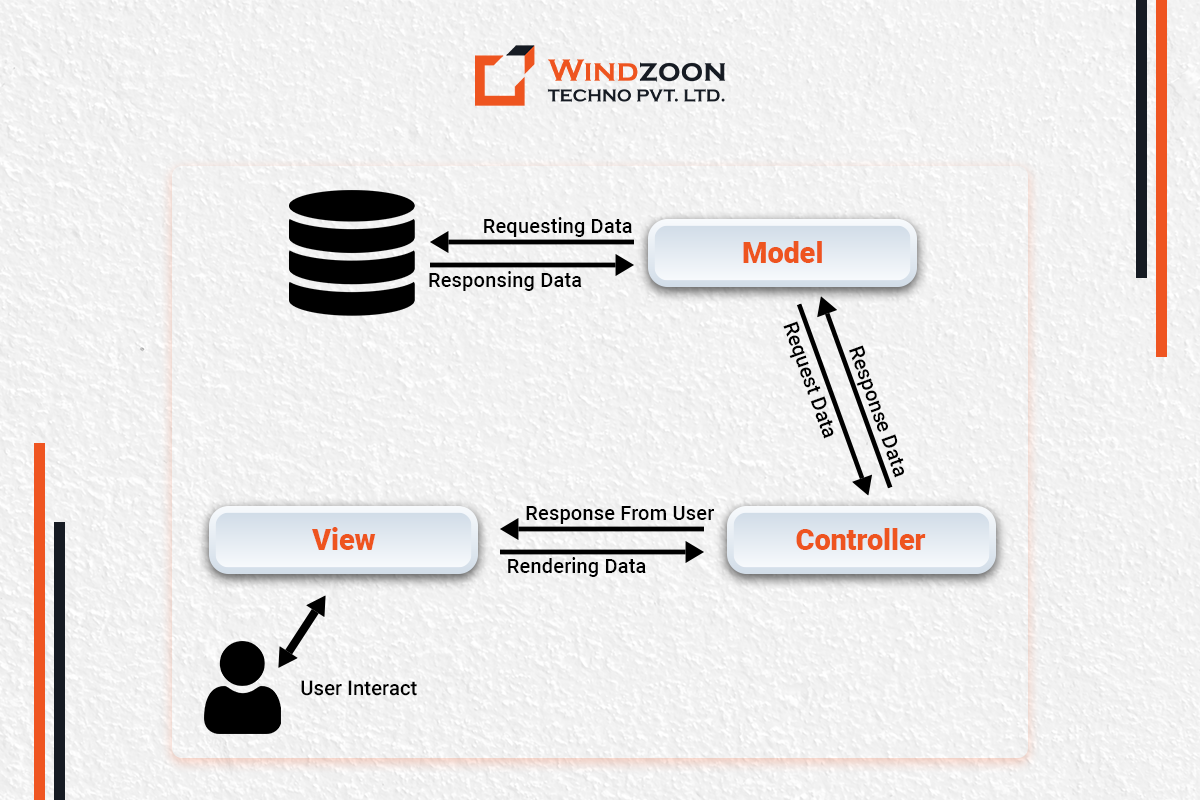
how-laravel-works

This separation helps keep code clean and organized. When a user clicks a button or fills a form, Laravel uses a router to decide what should happen. It may trigger a controller, which may pull or save data via a model, and then return a result using a view. All of this happens seamlessly.

Laravel also includes tools like:

  • Artisan CLI: A command-line tool to generate files quickly.
  • Blade: A simple templating engine for layouts.
  • Eloquent ORM: Helps interact with databases using PHP instead of raw SQL, making database management efficient and straightforward.

Laravel supports custom api development and api development, allowing seamless integration of modules, online portals, and third-party services tailored to your business needs.

What Sets Laravel Apart from Other Frameworks

Laravel isn’t the only PHP framework available—other PHP frameworks like Symfony, CodeIgniter, and Zend are also widely used—but Laravel consistently ranks as one of the most preferred options for developers and businesses alike due to its robust features, scalability, and ease of use. Here’s what makes Laravel truly stand out:

1. Cleaner Syntax

Laravel is known for its elegant and readable code. This means that developers can write less code to achieve more functionality, and it becomes much easier for teams to collaborate and maintain the codebase. Cleaner syntax leads to faster onboarding for new team members and reduces the likelihood of bugs or confusion.

2. Built-In Tools and Features

Unlike many other frameworks that require external libraries or packages for common functions, Laravel includes a wide range of built-in features right out of the box. These include authentication, routing, caching, email handling, and more. These built-in features enable efficient development and seamless development by streamlining workflows and reducing the need for third-party integrations. This reduces setup time and helps developers build faster with confidence in Laravel’s native support.

Additionally, Laravel’s built-in tools help optimize performance and streamline the development process, ensuring robust and scalable applications.

3. Strong Community and Ecosystem

Laravel has a large, active community of developers who constantly contribute tutorials, open-source packages, and support. This strong ecosystem makes it easier for new developers to learn, get help quickly, and follow best practices. Skilled Laravel developers and any experienced Laravel developer benefit from the community’s in-depth knowledge and resources, which help them efficiently implement advanced features, maintain security, and optimize project performance. Regular updates from the community also mean that Laravel stays modern and well-maintained.

4. Focus on Security

Security is a big concern in web development, and Laravel handles this well. It includes built-in tools to protect against major threats like CSRF (Cross-Site Request Forgery), XSS (Cross-Site Scripting), and SQL Injection. Developers can use Laravel’s secure authentication system with minimal effort, giving businesses peace of mind about data protection.

5. Flexibility and Scalability

Laravel works equally well for small business websites and large enterprise-level applications. Its structure supports modular development, which allows features to be added as the business grows. Laravel enables teams to develop scalable and custom development projects, ensuring tailored solutions that meet unique business requirements. Combined with tools like Laravel Vapor (for serverless deployment), Laravel becomes a future-proof choice that adapts to both current needs and long-term expansion.

In short, Laravel combines simplicity with power, making it a trusted framework for businesses that want reliable, scalable, and secure web applications. Laravel supports scalable solutions for businesses of all sizes.

Laravel is not just a framework, it’s a full ecosystem packed with tools that streamline development and improve the performance, scalability, and security of applications. These tools offer major business benefits by reducing development time, minimizing errors, and making ongoing maintenance easier.
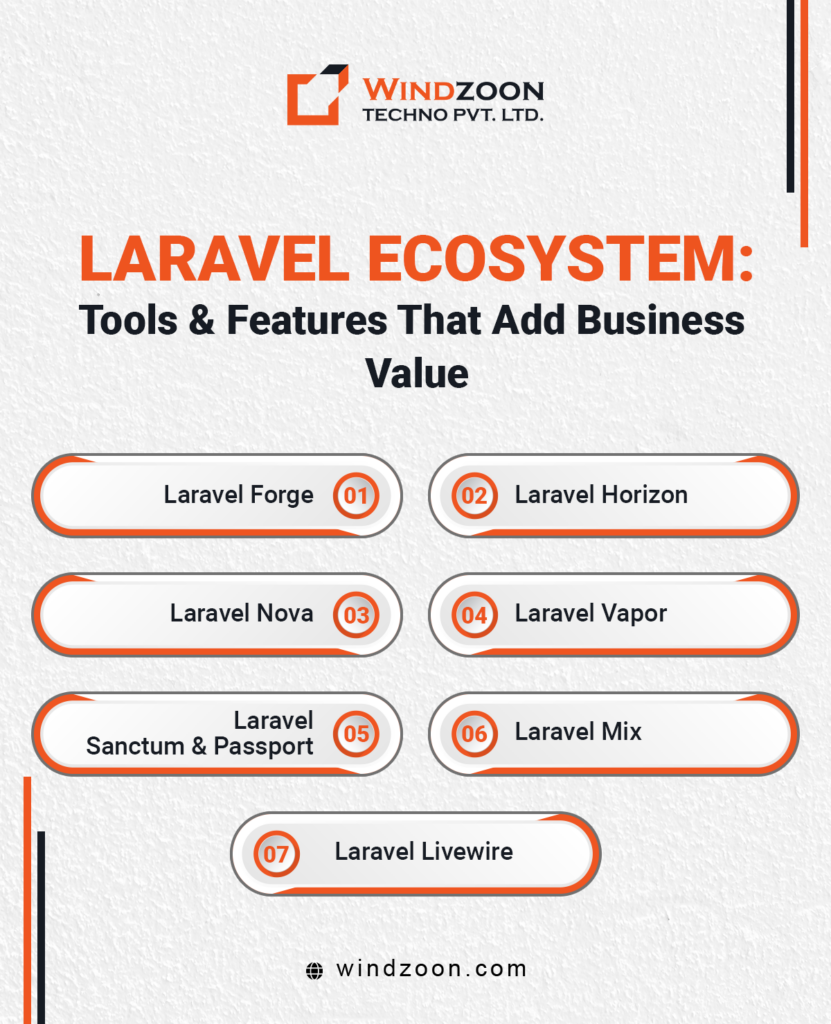
laravel-ecosystem

Laravel Forge

This tool simplifies server management and automates deployment. With Forge, developers can set up and configure web servers in minutes instead of hours. This reduces launch delays and ensures more secure and optimized hosting environments. Additionally, Laravel Forge supports cloud integration and laravel cloud storage, making it easy to connect various cloud services and manage data efficiently for modern web applications.

Laravel Nova

Nova is an elegant admin panel solution for Laravel applications. Instead of building backend dashboards from scratch, Nova offers a ready-to-use, customizable admin interface. It saves development time and allows clients to manage content, users, or data easily through a sleek backend UI.

Laravel Horizon

For apps that use background processing (like sending emails or notifications), Horizon provides a dashboard to monitor queues and jobs. As one of the performance monitoring tools, Horizon helps ensure application health by proactively detecting and resolving issues in background processes. This is critical for real-time or high-traffic applications. Businesses can ensure that tasks are running as expected and troubleshoot quickly if something fails.

Laravel Vapor

Vapor is Laravel’s serverless deployment platform built on AWS. It allows apps to scale automatically with no server management required. This is especially useful for businesses expecting large traffic spikes, like during product launches or seasonal sales.

Laravel Sanctum & Passport

These are Laravel’s tools for user authentication and API security. Sanctum is great for simple token-based authentication, while Passport is ideal for OAuth2 needs. Both are vital for apps that handle user accounts, permissions, or third-party integrations.

Laravel Mix

Managing CSS and JavaScript can get messy, especially in large projects. Laravel Mix makes it easy to compile, bundle, and optimize these assets. This leads to faster-loading websites and a better user experience.

Laravel Livewire

Livewire allows developers to build dynamic, interactive frontend features using PHP alone – no JavaScript required. This speeds up the development of interactive interfaces while maintaining Laravel’s backend power. These ecosystem tools give Laravel developers a powerful toolbox to build better applications faster. However, only experienced developers know when and how to use them effectively, which is why hiring the best talent truly matters.

7 Reasons to Hire the Best Laravel Developers
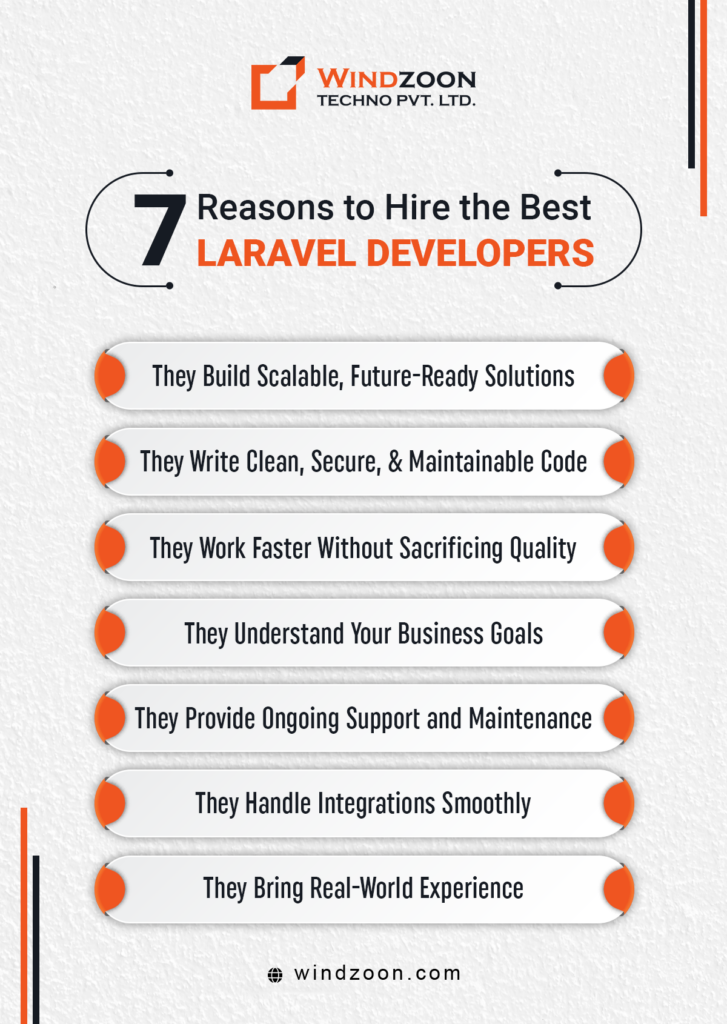
7-reasons-to-hire-the-best-laravel-developers

1. They Build Scalable, Future-Ready Solutions

Great developers plan ahead. They don’t just solve today’s problem, they build systems that grow with your business. Laravel developers can build complex web applications for diverse industries, including scalable and secure commerce and CMS websites. This saves money in the long run by avoiding rebuilds or messy upgrades.

2. They Write Clean, Secure, and Maintainable Code

Poor code causes bugs, security issues, and makes updates difficult. The best Laravel developers, including a skilled Laravel programmer and a dedicated developer, follow proper coding practices, use Laravel’s built-in security features, and write code that’s easy to manage. Experienced Laravel programmers add value by ensuring your application remains secure and maintainable over time.

3. They Work Faster Without Sacrificing Quality

Experienced developers use Laravel’s built-in tools effectively. They know shortcuts, avoid rework, and use time smartly. You get faster results without compromising quality—especially when you hire freelance Laravel developers or remote Laravel developers, which helps manage development costs while maintaining high standards.

4. They Understand Your Business Goals

The best Laravel developers, including dedicated Laravel developers and the ideal Laravel developer, ask questions about your goals and focus on understanding and achieving your business objectives. They don’t just build what you say; a dedicated developer will also suggest better ways to achieve results through smart features and functionality.

5. They Provide Ongoing Support and Maintenance

Web apps aren’t a one-time task. After launch, you need updates, security patches, new features, and ongoing module development and app development to keep your application current. Experienced developers stick around to support your growth.

6. They Handle Integrations Smoothly

Today’s apps need to talk to many services like payment gateways, CRMs, and analytics tools. Top Laravel developers handle these integrations with ease, excelling in commerce development, e commerce development, and delivering custom solutions for your business, keeping your system connected and efficient.

7. They Bring Real-World Experience

The best developers, including senior Laravel developers, senior developers, and experienced software developers, have faced real challenges, solved real problems, and know what works. Their experience reduces risks, ensures smoother launches, and avoids common development pitfalls.

Final Thoughts: Don’t Settle for Average Development

Laravel is a smart and powerful framework, but its real value is unlocked only by skilled developers. Investing in the right people means saving time, reducing risk, and building a platform you can trust. For your next project, consider hiring expert Laravel developers or hire dedicated Laravel developers to ensure success.

Looking for the Best Laravel Development in USA? Let’s talk. Choose a provider that offers the best Laravel development services, including professional Laravel migration services, for comprehensive support.

FAQs

1. Is Laravel suitable for small businesses?

Yes. Laravel works great for both startups and large companies. It’s flexible, scalable, and cost-effective.

2. What kind of apps can be built using Laravel?

Laravel can power eCommerce stores, CRM systems, content platforms, admin dashboards, and even SaaS products. In addition, Laravel is well-suited for mobile app development and custom software development, enabling the creation of high-quality mobile applications and personalized, industry-specific software solutions.

3. How is Laravel different from plain PHP?

Laravel offers structure, built-in tools, and security features that plain PHP lacks. Among PHP frameworks, Laravel stands out due to its advanced features and the technical expertise of its developer community, resulting in faster, cleaner development.

4. Do I need a Laravel developer for ongoing support?

Yes. Regular updates, security patches, and improvements need expert attention. It’s wise to have developers on standby.

5. How long does a Laravel project take?

It depends on the scope. Small sites may take weeks, while larger systems can take months. Experienced developers help speed things up.

6. What should I look for when hiring a Laravel Development company USA?

Look for a company with Laravel experience, a solid portfolio, clear communication, and post-launch support. Skilled Laravel developers and experienced Laravel developers are essential for delivering high-quality web solutions that are secure, scalable, and tailored to your business needs. Make sure they understand business needs and can work in your time zone. Checking reviews and past work helps ensure reliability.

7. Is Laravel good for mobile apps, too?

Laravel is best for web apps, but it can serve as the backend (API) for mobile apps built using frameworks like Flutter or React Native.

17 Useful Laravel Developer Technical and Soft Skills to Know for Hiring

Life is constantly changing. You can either choose to cooperate with it, adapt to it, and learn how to take advantage of it, or you can fight it and risk being run over by it.

One such change that has fundamentally altered the history of web app development is the emergence of websites and applications. There are many frameworks for web app development, including HTML, PHP, JavaScript, Python, etc.

But out of all of these frameworks, the Laravel PHP framework has completely revolutionized the web development industry. It is a framework that enables developers to create robust, dynamic websites and applications easily.

And Laravel Developers are the architects of this digital revolution. They are the ones who bring life to the code, turning ideas into reality. But what exactly does a Laravel Developer do?

As a seasoned Laravel development company, we will dive deep into the world of Laravel and help you explore the role of these experts in creating stunning web applications. Get ready to be inspired and discover the magic behind the code!

First of all, we will understand some basics about a Laravel developer.

What is a Laravel Developer?

A Laravel Developer is a web developer who specializes in building web applications using the Laravel PHP framework. Laravel is a free, open-source PHP web framework designed for building modern, robust, and scalable web applications. That’s why we choose the Laravel framework for building secure web applications.

Here is a detailed explanation of the roles and responsibilities of a Laravel developer, as well as the technical and soft skills required for the job:

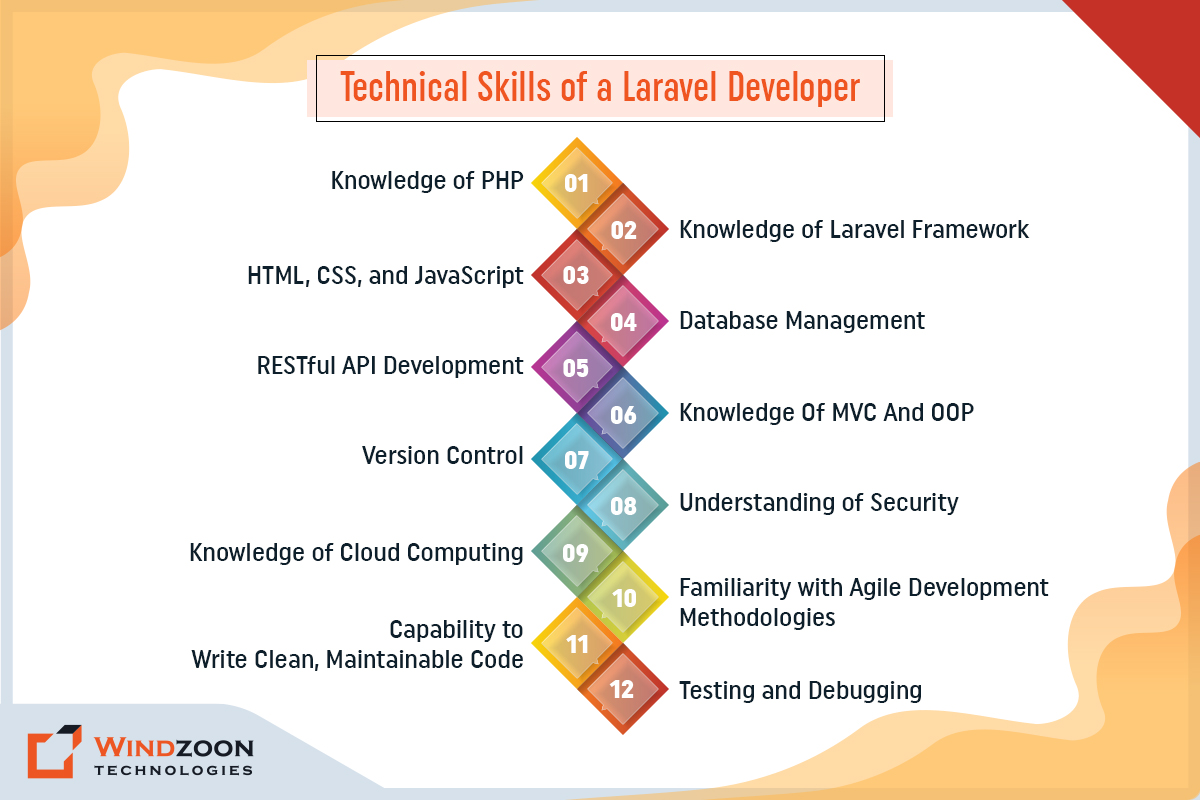
Technical Skills of a Laravel Developer

Technical Skills of Laravel Developer

1. Strong Knowledge of PHP

Laravel is built on PHP, so a Laravel developer must understand PHP well. And also have some experience working with other PHP frameworks.

A Laravel developer should have knowledge of every detail of PHP, including OOP concepts, data types, functions, error handling, and security. They should also be familiar with various PHP extensions and libraries, such as Composer.

2. Knowledge of Laravel Framework

A Laravel developer should understand the Laravel framework well, including its components, routing, controllers, views, models, migrations, and middleware. They should also be familiar with Laravel’s security features, such as password hashing, encryption, and authentication.

3. HTML, CSS, and JavaScript

A Laravel developer should understand HTML, CSS, and JavaScript well, including how to create responsive and user-friendly web pages. They should also be familiar with front-end JavaScript frameworks, such as Vue.js or React and be able to integrate these frameworks into a Laravel application.

4. Database Management

Laravel developers must be familiar with database management systems such as MySQL, PostgreSQL, and MongoDB. And be able to design and implement database schemas, write complex SQL queries, and optimize database performance. They should also be familiar with Laravel’s Eloquent ORM and be able to write efficient database queries.

5. RESTful API Development

A Laravel developer should have experience with RESTful API development and be familiar with API authentication and authorization methods. They should also be able to write clean and maintainable API code and be familiar with API testing tools, such as Postman.

6. Knowledge Of MVC And OOP

MVC architecture is the foundation of Laravel. It is a technique frequently used to connect user interfaces to underlying data models. Since MVC and Laravel are used together to structure web apps, a Laravel developer has to have a firm understanding of MVC. And that is really advantageous for maintenance.

Like most frameworks, Laravel follows the Object-oriented programming (OOP) methodology. It is the foundation of all Laravel techniques. Therefore, it’s crucial to have a firm understanding of the principles of object-oriented approaches.

7. Version Control

A Laravel developer should have experience with version control systems, such as Git. And be familiar with branching, merging, and resolving conflicts.

They should also be able to use version control to manage code changes and collaborate with other developers. And be able to write clear and descriptive commit messages.

8. Understanding of Security Best Practices

Laravel developers must have a good understanding of security best practices and be able to implement security measures such as authentication, authorization, and encryption to protect sensitive data and prevent hacking attacks.

9. Knowledge of Cloud Computing

Cloud computing technology is trending right now. The major players in the tech sector, including IBM, Google, and Microsoft, are making significant investments in and emphasizing cloud computing.

As a result, other businesses and startups quickly adopt cloud computing services, including SaaS, PaaS, and IaaS. Why? Mainly because it saves a significant amount of time and money.

Therefore, a Laravel developer must have a solid understanding of cloud computing. He should be able to work with Google Cloud Platform, Microsoft Azure, or Amazon Web Service (AWS).

10. Familiarity with Agile Development Methodologies

Laravel developers should have experience working in an agile development environment and be familiar with agile methodologies such as Scrum and Kanban.

11. Capability to Write Clean, Maintainable Code

Laravel developers must be able to write clean, well-documented, and maintainable code that is easy to understand and modify.

12. Testing and Debugging

A Laravel developer should have experience with testing and debugging their code, including unit testing, integration testing, and functional testing. They should also be familiar with testing tools, such as PHPUnit, and be able to write efficient and effective tests.

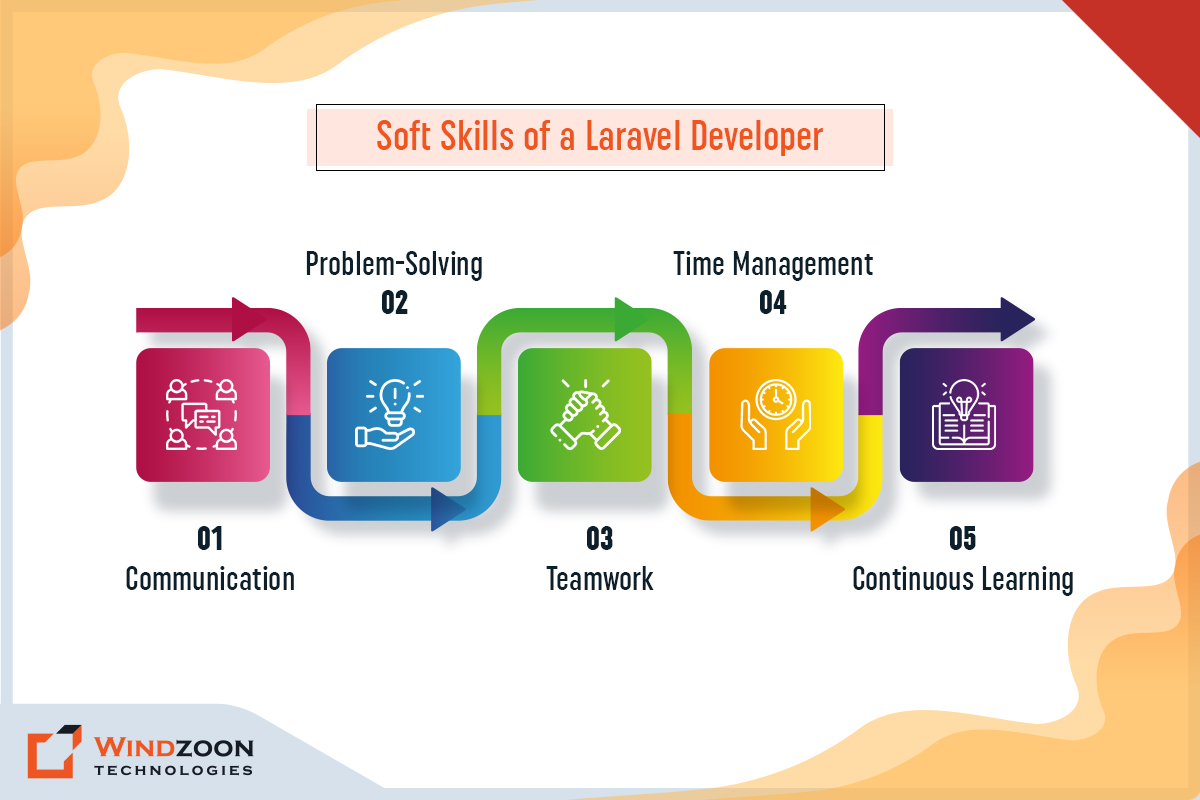
Soft Skills of a Laravel Developer

Soft Skills of a Laravel Developer

1. Communication

A Laravel developer should have excellent communication skills, including the ability to clearly and effectively communicate technical information to non-technical stakeholders. They should be able to explain complex technical concepts in simple terms and provide regular updates on project progress.

2. Problem-Solving

A Laravel developer should have strong problem-solving skills, including identifying and resolving complex technical issues. They should be able to think creatively and find innovative solutions to challenging problems.

3. Teamwork

A Laravel developer should be able to work effectively in a team environment, including collaborating with other developers, designers, and stakeholders. They should be able to contribute to the development process and provide constructive feedback to their team members.

4. Time Management

A Laravel developer should have strong time management skills, prioritize tasks, meet deadlines, and manage multiple projects simultaneously. They should be able to balance their workload and ensure that projects are delivered on time and within budget.

5. Continuous Learning

A Laravel developer should have a passion for continuous learning and be able to stay up-to-date with the latest web development technologies and trends.

He should also be familiar with best practices and conventions in the Laravel community. This includes regularly reading documentation, participating in online forums, and attending meetups and conferences.

By continuously improving their skills and knowledge, Laravel developers can deliver high-quality, innovative solutions for their clients.

After this, we will learn about the roles & responsibilities of a Laravel developer.

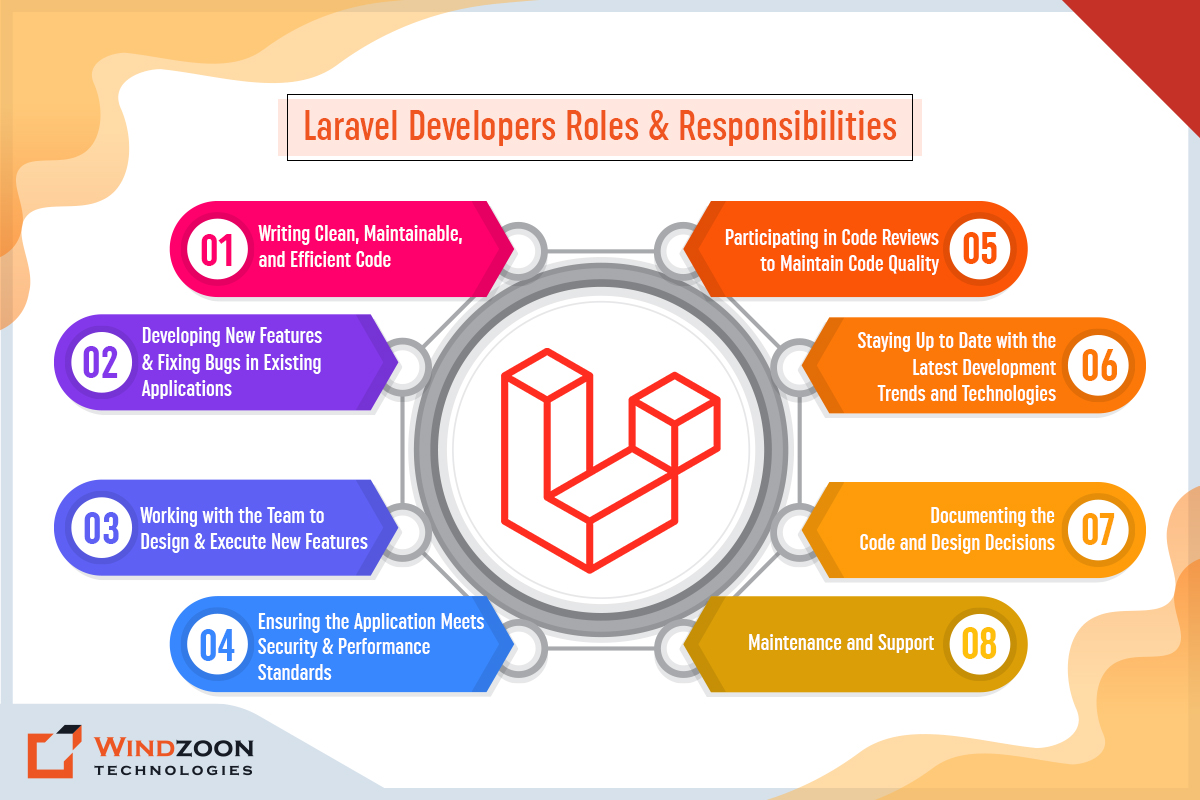
What Are Laravel Developers Roles and Responsibilities?

Laravel Developers Roles and Responsibilities

A Laravel developer is responsible for developing and maintaining web applications using the Laravel framework. The following are the key responsibilities of a Laravel developer:

1. Writing Clean, Maintainable, and Efficient Code

The Laravel developer is responsible for writing easy to read and understand code and follows best practices for performance and security.

2. Developing New Features and Fixing Bugs in Existing Applications

The Laravel developer is responsible for adding new functionality & fixing bugs. It also includes testing and debugging their code, including writing unit tests, integration tests, and functional tests. They should also be able to identify and resolve bugs and performance issues promptly and efficiently.

3. Working with the Team to Design and Execute New Features

A Laravel developer is responsible for collaborating with other developers, designers, and stakeholders to add new features and ensure the successful delivery of a web application. They should also be able to share their knowledge and learn from others.

4. Ensuring the Application Meets Security and Performance Standards

The Laravel developer is responsible for ensuring that the application meets all security and performance standards and implementing measures to prevent security breaches and performance issues.

5. Participating in Code Reviews to Maintain Code Quality

The Laravel developer participates in code reviews to ensure that the code is of high quality and to identify any areas for improvement.

6. Staying Up to Date with the Latest Development Trends and Technologies

The Laravel developer is responsible for staying up-to-date with the latest development trends and technologies and incorporating these into the application as appropriate.

7. Documenting the Code and Design Decisions

The Laravel developer is responsible for documenting the code and design decisions. It includes writing clear and concise comments and creating technical documentation for clients and stakeholders.

8. Maintenance and Support

A Laravel developer is responsible for maintaining and supporting existing web applications, including fixing bugs and implementing new features. They should also be able to provide technical support to clients and stakeholders and be able to resolve technical issues in a timely and efficient manner.

Conclusion

A Laravel developer is responsible for designing, developing, and maintaining web applications using the Laravel framework. They should have a strong understanding of PHP, HTML, CSS, and JavaScript and experience with database management, API development, and testing and debugging.

Additionally, a Laravel developer should have strong communication, problem-solving, teamwork, and time management skills and be able to work effectively in a team environment.

If you want to Hire Laravel developers with such skills, you should connect with any reputed Laravel development company.

Windzoon has a team of talented Laravel developers skilled at creating websites and applications of any kind and complexity. Utilize our Laravel development services to put our developers’ abilities to work, creating outstanding online solutions with the highest accuracy.

To benefit from our excellent services and to request a quote, get in touch with us.

Why Laravel Framework is Perfect for Developing Secure Web Applications?

Backend technology plays a crucial role in mobile app development. Having reliable and trustworthy technology to handle data and back-end operations is critical for the App’s success.

Currently, the market offers a variety of backend development technologies. However, only a few of them are considered capable of developing web applications. And Laravel is undoubtedly one of those few powerful backend technologies. With nearly 71549 stars, it is also one of the most popular repositories on GitHub.

The Laravel framework can serve as a fantastic starting point for the creation of any kind of web application. That is why, each year, a large number of businesses collaborate with Laravel Development Service providers to create cutting-edge applications.

So, what is the reason for this framework’s enormous popularity, and how does it cover everything your web application requires? You will find all the answers in this blog, so keep reading.

Our first topic of discussion is to learn about the key features of Laravel.

What are the Significant Features of Laravel?

The Laravel framework is extremely well-liked by developers all over the world because of its features. Its robust and extensive features make coding the backend process easier. Here, we’ve listed a few of Laravel’s intriguing features that you can quickly take advantage of by working with a Laravel development company.

Features of Laravel Consists Of:

  1. Easy And Expressive Syntax
  2. URL Routing Configuration
  3. Effective Queue Service
  4. Ability To Handle Configurational Errors
  5. Open-Source Platform
  6. Massive Community Support + Assistance
  7. Authentication and Authorization System
  8. Laravel’s Unit Testing Environment
  9. File Caching Support
  10. MVC Architecture
  11. Artisan (Command-Line Interface)
  12. Blade Templates Engine

With this, we have arrived at the main point of our discussion.

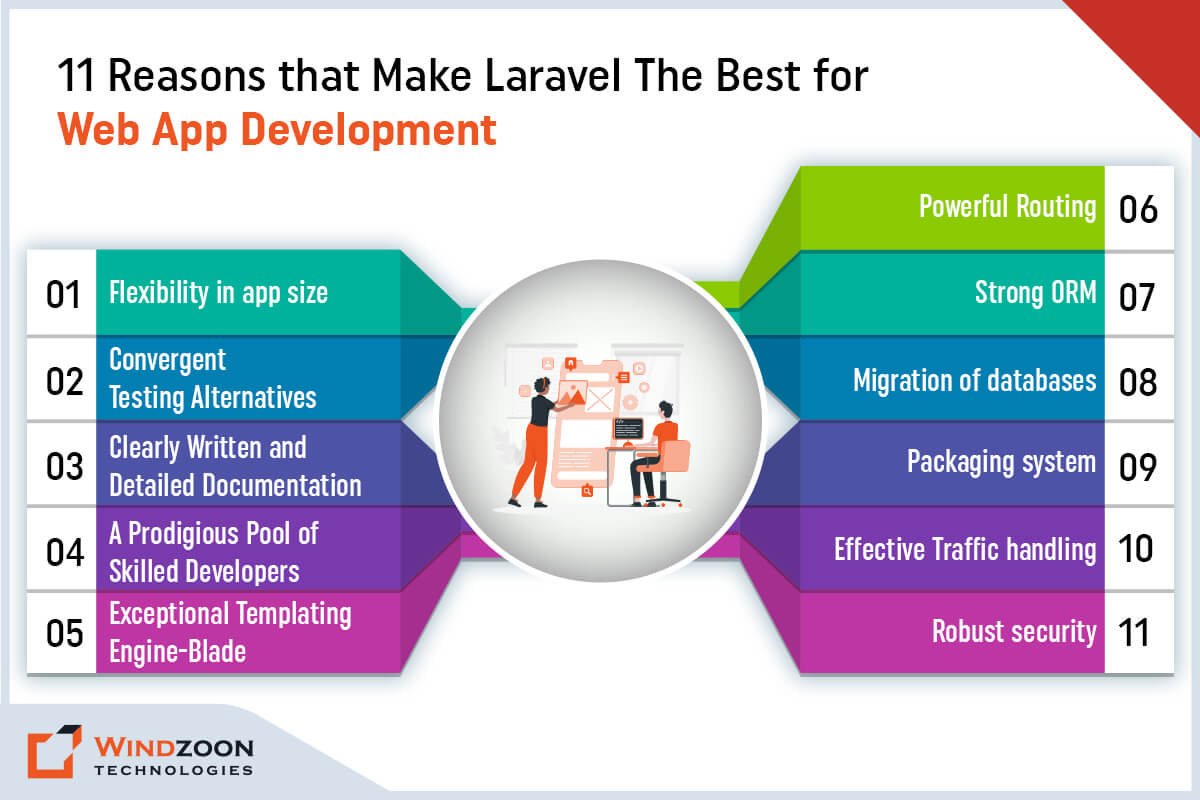
11 Reasons that Make Laravel The Best for Web App Development

Reasons that Make Laravel The Best for Web App Development

Reasons that Make Laravel The Best for Web App Development

Laravel has a lot to offer in terms of developing applications. The following are a few reasons for choosing this framework for the development of your web application:

1. Flexibility in App Size

Technology changes all the time, and anyone who has ever done online business is well aware of this fact. So it makes sense to design a scalable app that can meet the demands of a growing user base. And with Laravel, you can certainly get this type of web app.

Because it offers the greatest degree of application size flexibility for building web apps. By using advanced caching techniques, developers can build Laravel applications that scale easily and meet business needs.

2. Convergent Testing Alternatives

One of the significant benefits of using Laravel for web app development is its exceptional testing support. You cannot ensure that a web app is bug-free and meets the initial requirements unless it is thoroughly tested.

The Laravel framework provides automation testing to ensure that your web app works properly. It enables developers to evaluate every module or element of the application. So they can make sure the integrated application works properly once all the modules have been combined. It will accelerate unit testing and debugging while decreasing development time and costs.

3. Clearly Written and Detailed Documentation

Laravel developers are very effective at learning as much as they can about the framework before starting any project. And Laravel has some of the best-written documentation among its competitors.

The Laravel community provides excellent documentation & tutorials to have a better understanding of the Laravel framework & its usage. It helps developers during the web app development process and makes the process more effective and efficient.

4. Prodigious Pool of Skilled Developers

You should consider the developer base before selecting any backend framework for development. This is beneficial when you are recruiting new developers to work on web apps.

Furthermore, rather than focusing on cost-cutting, the emphasis should be on quality and skills. Laravel has everything. It has a sizable pool of gifted developers who are highly qualified and knowledgeable.

Hence, you won’t face any difficulty in hiring a Laravel developer or Laravel Development Company for your project.

5. Exceptional Templating Engine-Blade

Laravel uses the Blade Templates engine, which is simple, lightweight, and incredibly powerful when compared to other PHP templating engines. It enables developers to build lightweight class-based components using built-in templates that can be reused throughout a PHP application.

The main goal in doing this is to utilize dynamic content seeding to produce amazing layouts. It improves the speed and flexibility of web app development.

6. Powerful Routing

Every time a server receives a request, a specific action is launched to deal with it. We refer to this procedure as routing. In Laravel, routing is particularly powerful.

Furthermore, Laravel’s routing code is very intuitive. Compared to the code used in other frameworks, it is clear and straightforward.

The app/http/routes.php file categorizes the Laravel routes that the framework automatically loads. Laravel routes accept a URL and a Closure, making it possible to define routes in a very simple manner.

After a URL is acknowledged by the route-defining method, all that is left for the user to do is embed the topic’s name, and the appropriate URL will then be added automatically. It significantly enhances app usability and user experience.

7. Strong ORM

The Eloquent ORM is a key component of Laravel. It improves the development process by using an object-oriented approach. The developer saves a significant amount of time by not having to write plain SQL queries for the program.

Additionally, ORM offers users the ability to specify the relationship right within the model class. It works well with SQL, MySQL, SQLite, and Postgres databases.

8. Migration of Databases

One of the most difficult tasks for developers during the app development process is synchronizing databases between various machines.

Laravel helps to solve this problem by allowing team developers to share the database. This method of development saves time. Due to this ability, Laravel differs from other similar frameworks.

9. Packaging System

A Laravel packaging system deals with various libraries or support programs that allow the web app to automate the procedure. It makes use of the composer as a dependency manager to keep track of all the information needed to manage packages.

Packages are the simplest way to speed up the process and add new features to an app. Furthermore, Laravel debugs bar and IDE helper are two of the best Laravel packages.

10. Effective Traffic Handling

Laravel contains a message queue system that helps to balance activities with other framework systems. A message queue system maintains the data without slowing down the web app even when it experiences increased traffic.

As a result, traffic management is carried out in the most efficient manner and the server maintains health even during periods of high traffic.

11. Robust Security

Another significant reason why Laravel is regarded as an ideal framework for web application development. Laravel is well-known among developers and companies for its security. Its ability to block malware protects the app’s data from any threats or hacking attempts.

No matter how simple or complex the app, it needs a high level of security, so creating web applications with Laravel would make the apps resistant to online attacks.

Now. Let’s move toward our next topic.

Important Laravel Packages for Web Application Development

Laravel facilitates software development by allowing for the integration of various modules, plugins, components, and packages.

And all of these plugins, modules, and packages—especially the Laravel packages—help to enhance the functionality of your web apps. Therefore, we have created a list to help you decide which Laravel packages are best for your web apps.

It includes the best Laravel packages that can significantly improve the performance and user experience of your application.

Top Laravel Packages to Improve Website Performance

1. Laravel Email Tools & Packages

  • Beauty mail
  • Sendgrid
  • MailGun
  • Spatie Laravel Mail Preview

2. Laravel Ecommerce Packages

  • Bagisto
  • Aimeos
  • GetCandy
  • AvoRed

3. Laravel Blogging Packages

  • Botble
  • Laravel Publishing Platform: Canvas

4. Laravel Authentication and Authorization Package

  • Laravel Jetstream
  • User Verification
  • NoCaptcha
  • Socialite
  • Entrust

5. Laravel Testing and Debugging Packages

  • Behat
  • Tinker
  • Laravel Telescope
  • Laravel Debugbar

6. Laravel Payment Packages

  • Laravel Paypal
  • Omnipay

7. Laravel SEO Packages

  • Laravel Meta Manager
  • Laravel SEOable
  • AutoMeta

8. Laravel Auditing Packages

  • Sentry
  • Bugsnag

9. Laravel Notifications Packages

  • Laravel Notification Channels
  • Easy Flash Messages
  • Laravel Slack

10. Laravel Admin Panel Generation Packages

  • Voyager
  • Orchid

11. Laravel Localization Packages

  • Laravel Translatable
  • Laravel Lang

12. Other Top Laravel Packages and Tools

  • Eloquent-Sluggable
  • Laravel Charts
  • Laravel Form Builder
  • Laravel GraphQL

After this, we will see examples of famous web applications built with Laravel.

Top 14 Web Apps Built Using the Laravel Framework

  • MyRank
  • Neighbourhood Lender
  • Toyota Hall of Fame
  • Invicta Watch Group
  • Camber
  • Koel
  • Barchart
  • Laravel Snippets
  • Faith Properties
  • World Walking
  • Studio Stomp
  • Creative Spaces
  • Specfox
  • Startups.co

Conclusion

Finally, it appears clear why Laravel is the best web application development framework. As it is currently the best option for companies looking to release creative, scalable, and industry-ready web apps.

If you are interested in using this framework for your web app development project, contact the best Laravel Development company as your remote development partner.

At Windzoon, we have a team of seasoned Laravel developers who are adept at developing web applications regardless of their type and complexity. Hire Laravel Developers from us to add skilled developers to your current team for producing top-notch web solutions with the utmost precision.

Contact us today at wzadmin.windzoon.in/ to take advantage of our top-notch services and get a quote.

Laravel vs Yii: Difference Between These PHP Frameworks

Have you ever thought about the digital industry without frameworks? It’s like imagining life without oxygen! While developing a new app, there are chances that your work gets complex. Ultimately, it reaches the end where just retaining libraries is not enough. A design, layout, and structure are required in the chaos of codes. This is when Frameworks comes to the rescue.

Among the most popular PHP frameworks used for web development, Laravel and Yii stand out as two popular PHP frameworks. In this article, we will compare Yii and Laravel, diving into the Yii vs Laravel debate to help you understand their strengths, features, and suitability for different projects.

If you think these frameworks are not your cup of tea, then you can also connect to Laravel Development Company & Yii Development Company for the best assistance. But now, without any further ado let’s jump to the agenda of this blog! This article will help you decide which is the best PHP framework for your project.

What is a Framework & its Type?

A software framework is a portal that provides a base for designing or developing applications. It is a working program that can be customized or modified by coding. Frameworks play a vital role in streamlining web application development by offering reusable components and tools that speed up the process and improve efficiency. It operates on shared resources like the library and places them jointly in one package. This package can be revised to serve the specific requirements of any project. With the use of a framework, developers can modify segments to give unique functionality to the app. Understanding the key factors involved in selecting a framework is essential for successful web application development.

Types of frameworks are popularly divided into three:

1. Back-End Web Frameworks

2. Front-End Web Frameworks

3. Mobile Development Frameworks

Back-End Web Frameworks

It is the most commonly operated programming framework. These frameworks entirely transform the way web development is done. Rather than constructing websites operating HTML, JavaScript & CSS, back-end frameworks operate programming languages to connect with a database to render content. Many back-end frameworks, including Laravel and Yii, are based on the MVC pattern, which structures applications into models, views, and controllers to improve code organization and maintainability.

Choosing the right back-end framework can also significantly impact application performance.

Front-End Web Frameworks

Unlike back-end, front-end frameworks are enforced in a user’s browser. They enable developers to develop what the users witness on the website. It gives web developers a platform to design & gives them power over what the outcome looks like.

Mobile Development Frameworks

With the advancement of mobile rapidly attaining interest, this framework witnesses an equally remarkable uptick. Like their desktop replicas, mobile development frameworks offer designers a system that helps the mobile app-building procedure. Through this research & survey, you can easily judge which framework is popular. In this blog, we will be covering a very heated & popular topic about two frameworks Laravel & Yii!

What is Laravel?

Laravel is open-source with a strong and feasible PHP framework. Laravel reutilizes the existent features of various frameworks which assists in building a web application. It helps design apps in a more structured and practical way.

Laravel is known for its expressive syntax and elegant syntax, making it easy for developers to learn and use. Its features streamline the process of developing web applications and can reduce the learning curve for new developers.

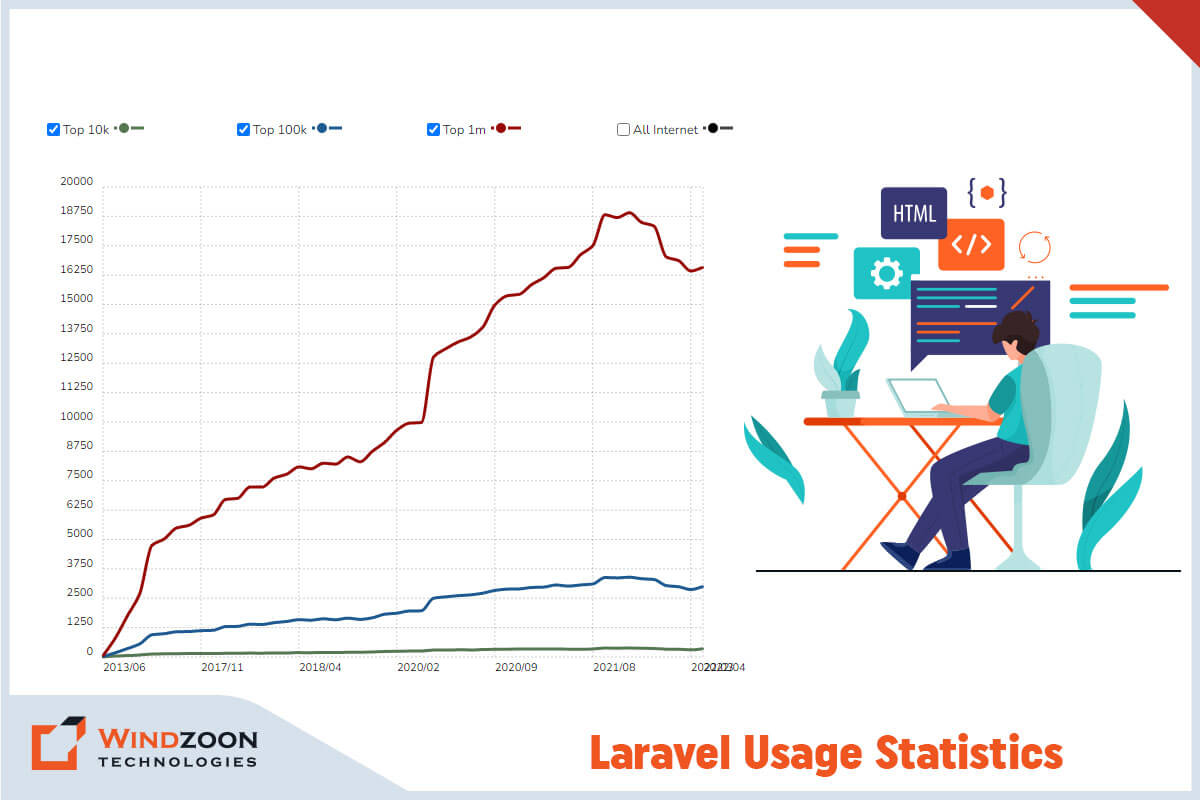
Laravel Usage Statistics

Laravel Usage Statistics

Laravel has now been accepted globally & the usage of laravel is growing rapidly! It delivers a rich set of functionalities that includes the essential features of the framework, such as the Blade templating engine for simplified view rendering, and Eloquent ORM, which provides object relational mapping to make database interactions more intuitive. Resource routing and route caching are also included to optimize application structure and performance. These features help boost the speed of the whole web app development process. Laravel is well-suited for developing complex applications and helps developers build robust web solutions. If you are planning to build a website straight from the scratch, then it saves a lot of time. Also for the best hassle-free development, you can avail of Laravel Development Service in India. Moreover, a website constructed in Laravel is protected and controls bugs entering the website.

What is Yii?

The pronunciation of “Yii” is “Yee”, which is derived from a Chinese word that means “simple and evolutionary”. It is appropriate for projects of every size as it highly optimizes performance.

Yii is a powerful framework that enables rapid development of high performance PHP framework solutions. It is known for its easy installation process, making installing Yii straightforward for developers. Yii offers a command line interface that helps Yii developers generate code and manage projects efficiently. The framework is supported by an active community and extensive documentation, which assist developers in building modern web apps.

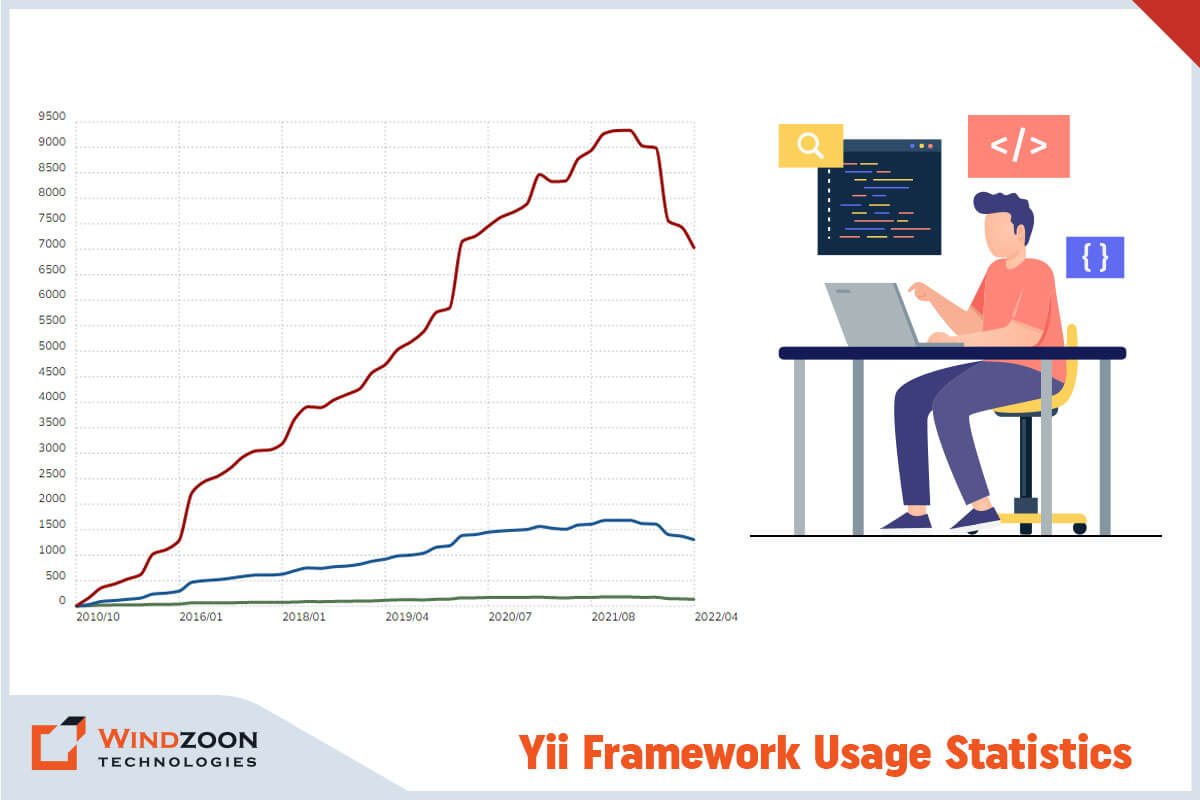
Yii Framework Usage Statistics

Yii Framework Usage StatisticsYii Framework Usage Statistics

Yii is an open-source, PHP-based lightweight framework utilized to design an entire application more quickly. As per statistics, Yii framework usage is growing as it is appropriate for designing Web 2.0 apps. It rapidify the web development process. It comprises a code generator named Gii, which composes the code for you & also saves you time. You can easily Hire Yii Developer for the best assistance. But now, first, understand the difference between Yii & Yii2.

Difference between Yii & Yii2

Since its launch in 2008, Yii has constantly shown progress after numerous years of intensive outcomes with every version. As this framework is absolutely performance-optimized, it is an ideal pick for a task of any size. Yii2 offers a robust active record implementation, which simplifies database interactions by allowing developers to work with database records in an object-oriented way, define relationships, validations, and behaviors easily. The release of Yii 2, in July 2014 with its beta version initiated a wave of enthusiasm about its characteristics and advantages. Yii2 also provides efficient tools for managing and updating the database schema through its migration system, ensuring data integrity and supporting various database engines. While comparing Yii2 and Yii1 we will jot down multiple aspects of progress that will answer all the queries about both versions.

1. PHP

Yii1 code can be deplored, modified, and replaced whereas, Yii2 code needs a complete migration. If you like to migrate from Yii1 to Yii2, unfortunately, you have to completely migrate your whole code. Conceptually, both versions are quite similar, however, Yii2 drives on newer PHP versions and uses namespaces, attributes, etc.

2. Console Application

In Yii1, console apps are composed of controllers, just like web applications! Whereas, in Yii2, to run console control, Yii1 is utilized where the controller route is.

Additionally, Yii provides an integrated debugging console, allowing developers to inspect variables, trace code execution, and troubleshoot errors directly within the development environment.

3. Query Builder

Query builder is spread among various categories in the Yii1. Whereas, compared to the Yii2 where the database query is represented as an object! Yii2’s query builder simplifies writing and managing database queries by providing an intuitive interface for constructing and executing complex database interactions.

4. Controllers

In Yii1 the controller class for action categories is [[yii\base\Action]], whereas Yii2 utilizes [[yii\web\Controller]] as a base controller category. Other than these 4 differences, there are a few more Yii1 & Yii2 differences from Basic to Advanced. Yii overall is effortless to install, uses modern technologies, is admiringly expandable, facilitates safety, provides adequate performance, and lessens the development time.

Reasons why Laravel is best for your Next Web Development Project

Reasons why Laravel is best for your Next Web Development Project

The IT industry is fully filled with the best Laravel development firms that deliver amazing assistance and also have a team of skillful Laravel developers. Laravel is a powerful tool for building custom web applications, offering robust, secure, and scalable solutions for various business needs. So below are seven reasons why laravel is a good option to choose!

When considering Laravel, it’s important to base your decision on your specific project requirements.

1. Model-View-Controller support & Object-Oriented Approach

MVC i.e Model, View, & Controller is a design in software that is commonly used to execute data & user interfaces. The foremost and amazing benefit of the Laravel framework is that it heeds – MVC-based architectural design & it has an explicitly attractive syntax that drives it object-oriented. Laravel’s mvc architecture helps organize code and improve maintainability, making it easier to manage large applications.

2. Built-In Authentication

Laravel framework caters to out-of-the-box formatting for a more authenticated design. Merely in a few artisan orders, your app will be set with protected Authentication and Authorization.

3. Packaging System

A packaging system deals with numerous libraries that allow the web app to automate the procedure. This framework utilizes a composer that composes all the data required to manage the package. Picture, Laravel Debug section, & Laravel integrated development environment (IDE) assistant is the best Laravel package.

4. Multiple File System

Laravel framework has in-built support for the cloud system for local storage as well. It’s exceptionally easy to switch between these cloud storage options as the Application programming interface stays the same for every system.

5. Templating engine

This framework comes with an in-built template named Blade templating engine. The Blade templating engine simplifies view rendering by allowing developers to separate presentation logic from application logic within the MVC architecture. Blade templating incorporates multiple templates with an information model to make views. By transpiring the templates into PHP code the performance also improves. Blade also delivers a collection of its control structures like conditional statements, that are internally mapped to their PHP look-alikes.

6. Scheduling Tasks

The scheduler was launched in Laravel 5.0, it is an expansion to the Artisan command that enables programmatic scheduling of periodic managed tasks. Internally, the scheduler depends on the cron daemon to execute a single Artisan task that executes all the configured tasks.

7. Testing

For the testing of an app, Laravel itself by default offers the unit test for the app. Laravel provides built-in support for unit testing to ensure code quality, making it easier for developers to catch bugs early in the development process. This itself includes tests that witness and control reversals in the framework. With the integration of PHP, the testing framework has become very easy in the Laravel-built app. Apart from the above-discussed characteristics, the Laravel framework also has official packages that are convenient when incorporating additional features in the app.

Reasons why Yii is best for your Upcoming Web Development Project

Reasons why Yii is best for your Upcoming Web Development Project

Yii is a popular PHP framework known for its high performance, security, and flexibility. For many web development projects, Yii may be considered the best framework, especially when evaluating options based on specific business requirements. Its robust features and active community support make it a strong choice for developers seeking efficient and scalable solutions.

1. Easy Installation Process

For each developer, time is very precious. Thus, it is significant to handle a framework whose installation process is easy & less time-consuming. However, it will cost only the designers valuable time that they need to execute & build a web or app. It is because of a not-so-complicated, effortless installation and structure process that comes with the Yii.

2. Modern Technologies

Yii framework utilizes an Object-oriented programming framework and takes advantage of PHP’s cutting-edge features. This comprises the modern static binding and System Programming Language classes function.

3. Highly Extensible

The ability to be customized & tailored to fit all your requirements is what makes Yii framework so popular & approachable. Each & every feature & segment of this stunning framework is virtually extensible.

4. Simplified Security

Appropriate security is important for every application & this is where Yii can assist you. Yii framework has comprehensive security features, including input validation, output filtering, and role based access control (RBAC), that help developers build safer and more secure apps. These features work together to protect against common security vulnerabilities such as SQL injection, cross-site scripting (XSS), and unauthorized access.

5. Less Development Time

Yii framework allows you to spend a shorter time completing your task so that you get more time to customize your app as per your suitable needs. For the same purpose, Gii is the tool that comes into action. It is a code that is a web-based structured tool that enables you to swiftly form codes. It also assists you with the templates for models, controllers, modules, & extensions. Additionally, Yii’s tools, including Gii, facilitate data validation during model and form creation, ensuring the correctness and integrity of user input.

6. Easy Error Handling

Yii is a comprehensive error-handling framework. It is based on PHP5’s exceptional mechanism. When any sort of unnoticeable happens during app execution, the error handlers will control and begin the required error-controlling procedure.

7. Using Theme

Themes are a fantastic way of systematically personalizing the layout of web pages. The appearance of an app or website can be greatly enriched with an appropriate & attractive theme. In the Yii framework, every theme has a guidebook consisting of design files, JavaScript, and CSS files. It also has additional applicable resource files containing pictures, view files, & more. Each theme is available under the same guidebook WebRoot/themes and only one theme can be created at a time.

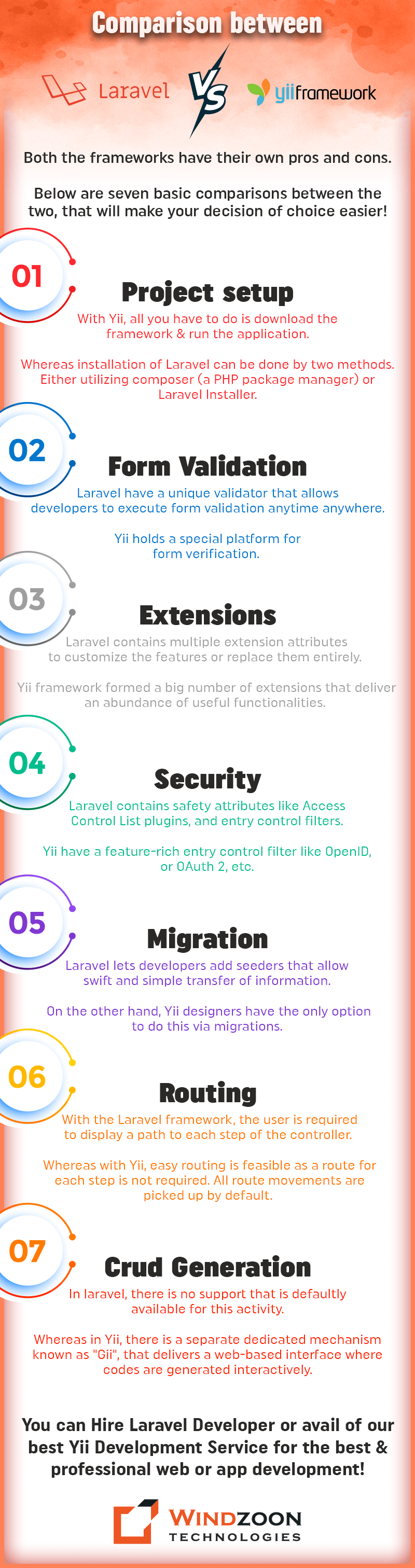
Comparison between Laravel vs Yii

Both frameworks have their own pros and cons. However, both of these fantastic frameworks are great to be integrated with PHP. This section will highlight the key differences between yii laravel and other popular frameworks, helping you understand which is best suited for your needs. Below are seven basic comparisons between the two, that will make your decision of choice easier!

Difference between Laravel and Yii Framework

When comparing Yii vs Laravel, it’s important to note that both frameworks are highly suitable for building complex web applications and enterprise grade applications. Choosing between yii laravel often comes down to specific project requirements, and having an in depth understanding of both frameworks is necessary to make an informed choice. Additionally, hiring skilled php developers is crucial for leveraging the full potential of either framework.

In terms of validation, Yii offers scenario based validation, which can be beneficial for certain use cases, while Laravel provides a more flexible approach. When it comes to performance, both frameworks offer robust caching support, including object caching, fragment caching, and data caching, which are essential for optimizing application speed and efficiency. These features make both Yii and Laravel strong contenders for projects that require high performance and scalability.

1. Project setup

When judging Laravel & Yii, on the basis of their project setup. Even though both comprise a simple installation process, Yii stands a bit ahead of Laravel. With Yii, all you have to do is download the framework & run the application. You get a swift & thriving installation without any difficulties. It has an isolated front-end & back-end, which can be used for creating the admin space and a user-friendly site. Whereas installation of Laravel can be done by two methods. Either utilizing composer (a PHP package manager) or Laravel Installer. This framework comes with an easy help that fastens the installation with a command-line mechanism.

2. Form Validation

As compared to Laravel, form validation of Yii consumes more time. Laravel has a unique validator that allows developers to execute form validation anytime anywhere. For convenience purposes, we can expand the Elevated class by utilizing personalized methods. One con of it is that we have to tailor the code to define attributes with properties derived from numerous systems. Yii holds a special platform for form verification. We can fix the rules and validate if the data is received directly in ActiveRecord. The entire mechanism functions well but we have to examine the controllers directly, that is something the Laravel framework delivers with its validator itself.

3. Extensions

Any disadvantage of a framework can easily become its advantage with the use of the extension’s support. Both frameworks have a group of amazing extensions. Laravel contains multiple extension attributes to customize the features or replace them entirely. Likewise, the Yii framework formed a big number of extensions that deliver an abundance of useful functionalities. These extensions are very easy and convenient for both naive and experienced developers.

4. Security

Safety & Security is a significant aspect to consider while exploring frameworks. Laravel & Yii both contain tools for password security, two-factor authentication, security from Cross-Site Scripting, Structured Query Language injections, etc. The unique safety features in Yii contain Role-based entry control. It has a feature-rich entry control filter like OpenID, OAuth 2, etc. Whereas, Laravel contains safety attributes like Access Control List plugins, and entry control filters. Laravel framework lacks shelf entry control tools. It doesn’t indicate that Laravel is not appropriate in terms of safety components.

5. Migration

Laravel & Yii, both contain incredible migration mechanisms allowing designers to manage their working procedures in a smooth & suitable way. Laravel lets them add seeders that allow swift and simple transfer of information. This attribute gives amazing help for testing and refilling static guidebooks. On the other hand, Yii designers have the only option to do this via migrations.

6. Routing

With the Laravel framework, the user is required to display a path to each step of the controller. Laravel considers that the framework must provide a default routing. Whereas with Yii, easy routing is feasible as a route for each step is not required. All route movements are picked up by default.

7. Crud Generation

There is a CRUD (Create, Read, Update, Delete) for the admin panel for diverse tables. In Laravel, there is no support that is default available for this activity. Whereas in Yii, there is a separate dedicated mechanism known as “Gii”, that delivers a web-based interface where codes are generated interactively. Laravel vs Yii, which one to choose? It entirely relies on the needs of the client & developer. Both frameworks have their own share of pros and cons. Where Yii delivers elevated security and quicker performance, Laravel delivers an explicit syntax framework. Hence in this debate of Laravel vs Yii — it’s the developer’s preference to determine between both of these. If you are scrutinizing a framework to construct a large-scale web app, the Laravel framework is the perfect selection you can make. And in case you desire to construct simple small-to-medium-grade apps, then Yii can be our preferred option for you. Our extremely skillful team of developers is always up to assist you & deliver your specifications. You can Hire Laravel Developer or avail yourself of our best Yii Development Service for the best & professional web or app development! We deliver Custom-Built Mobile applications & Web Solutions. To avail of our services connect us at [email protected] to get a quote or know more about our services.

Ultimate Laravel Performance Optimization Guide

If you have landed on this blog post then it’s quite obvious that you are looking for ways that help you improve the speed of your website.

According to the research, if a website takes more than 3.21 seconds to load then approximately 38% of visitors switch to your competitors. So, it’s immensely vital from a business perspective to ensure that you safely stay under that 5-sec threshold.

Any business would invest a lot of time, exertion, and creativity to develop an engaging & responsive site that performs well and is feature-rich.

Contents

When working with a Laravel application, optimizing it for better performance is crucial to ensure fast and efficient web applications.

If you are working on any existing projects, then consider hiring a Laravel Development Company. They will ensure to optimize the code as much as possible and always try to apply techniques to revamp slow-running codes to enhance the user experience.

As per the research, 719,739 live websites are developed through Laravel and an additional 817,000 websites have used Laravel historically, and over 15,000 websites in India.

Laravel is recognized as one of the most popular PHP frameworks and is widely regarded as a popular PHP framework due to its widespread adoption among the most popular PHP frameworks. Laravel is ideal for building web applications and is commonly used for developing scalable web applications.

Laravel Usage Statistics

If you are looking for thriving methods to speed up your Laravel website’s performance then you’ve landed on the right blog!

Why is it important to optimize Laravel performance?

Laravel framework is a very popular choice for designing business-focused websites, including eCommerce platforms. The important element of this popularity is its performance optimization which enables designers to tweak the execution of Laravel websites.

The way a website performs and its optimization are two key elements that decide the victory of any website. Ensuring the performance of the website is vital & every designer must be able to deliver that to their clients. The benefits of Laravel performance optimization include improved user experience, reduced server load, and easier maintenance. As Laravel is more often utilized to create a business website, the execution of Laravel has a lot of importance for the website to get hit. Considering all of the factors, which is why it is essential to optimize your Laravel website’s speed & performance.

Laravel Popularity Google Trends

As per Google Trend, Laravel is presently the most popular backend mechanism for PHP. The latest launched Laravel 9 delivers performance improvements. Laravel 9 even contains an efficient Query Builder Interface and many more additional features. Optimizing Laravel application performance leads to significant performance improvements and improved performance for end users.

The design of Laravel framework and the libraries makes sure that designers form powerful code with less struggle. Yet, there is still room for code optimization that one can use for Laravel performance after the deployment.

However, there are chances that the performance can slow down but can get fixed if the right optimization ways & techniques are used.

We have rounded up the 12 most useful optimization ways that you can follow for the optimization. Following these best practices can help improve Laravel performance.

Read this to know the Top Features of Laravel PHP Framework For Web App Development

Top 12 Laravel Performance Optimization Tips For Your Web Application

Top 12 Laravel Performance Optimization Tips For Your Web Application

Here are 12 ways to optimize your Laravel web application for better performance.

Laravel performance optimization is an ongoing process that requires regular performance monitoring to identify performance bottlenecks and maintain high efficiency as your application evolves.

1. Consider using eager loading

Laravel framework offers an incredible object-relational mapper named Eloquent. It is used to enjoyably connect your databases.

Eloquent is a creation tool that outlines database tables from the designers. Eloquent can be utilized by designers to endure all CRUD operations (create, retrieve, update, delete) using simple layouts. One drawback of the ORM attribute is that it utilizes the lazy loading of one object at a time, which can result in multiple database queries and negatively impact database query performance. Developers must use eager loading and execute the further procedure. Eager loading helps optimize database queries by reducing the number of database queries executed, which improves overall database query performance.

Therefore, considering eager loading is a more convenient way that helps speed up the website.

2. Configuration Caching

The configuration caching command is one of Laravel’s popular aspects. Laravel’s config cache feature uses the config cache command to speed up request processing by caching all configuration files into a single file. The config cache command is executed using php artisan, specifically with php artisan config:cache, which is especially useful for optimizing performance in production environments.

This command means that any modifications you make to the code do not impact the website as a whole.

This command must be utilized when deploying a task as the configuration choice will keep revising throughout the process.

Therefore, web development companies consider this as an ideal technique to enhance the website’s overall execution.

3. Route Caching

The way Laravel functions, it kicks up the framework and parses the route file with just a request. It includes parsing the content and keeping it in a structure that your website can utilize and understand.

Hire Laravel developer, who can present a command that enables you to form a single route file that can be parsed more quicker. Route caching also expedites the website’s loading time.

Therefore, route caching helps reduce the overall time, speeds up the whole process, and enhances the performance of your website. To generate the route cache and improve performance, you can use the following command: php artisan route:cache.

4. Minimize the usage of plugins

While designing websites with the Laravel framework, a standard error is not clearing unused plugins. Laravel is a full-fledged framework. It loads an immense number of plugins while starting it. Multiple of these are of no use to your website.

Even Though these plugins are not active, they take up a lot of memory and the system.

Therefore, determine & minimize the number of plugins you need and only keep the ones that are necessary. Additionally, disabling unused service providers and customizing default framework settings can further reduce memory usage and improve performance. Reviewing the list of service providers in the configuration files, such as config/app.php, is a good practice to ensure only essential service providers are loaded. This way you can speed up your app performance.

5. Get rid of unwanted packages

While adding a composer library to your task, there are chances that you add an extra code that gets carried forward unnecessarily during development. Even though this will not greatly affect the performance of single-page websites, you will see a difference while developing complex ones.

Designers must consider whether they need all of the existing packages. Due to time limitations, it is not possible for them to compose the code as they will have to first write, test, and then maintain it.

Therefore, if any unwanted package is installed it has to be cleared out for easy and speedy app performance. Additionally, using multiple cache storage options can help manage cached data more efficiently when optimizing your Laravel application’s dependencies.

6. Make use of queues

Designers can usually queue the code that operates in the controller that isn’t necessary for the web browser to respond. Laravel supports multiple queue drivers, such as Beanstalkd, Redis, and Amazon SQS, making it easy to configure and use different back-ends. Queue workers can be managed and monitored using the command line interface, allowing you to run, optimize, and scale background job processing efficiently. This method will unify the Application programming interface for multiple queue back-ends & helps speed up the loading time of your website.

However, using queues is one amazing technique to speed up your website.

Example configuration for the Beanstalkd queue driver in Laravel’s config/queue.php file:
‘connections’ => [
‘beanstalkd’ => [
‘driver’ => ‘beanstalkd’,
‘host’ => ‘localhost’,
‘queue’ => ‘default’,
‘retry_after’ => 90,
],
],

7. Think of using a new relic

An Application Performance Management mechanism is a New Relic that is integrated by designers in their websites.

It can help you set your Apdex score and calculate how your website reaches opponents in the market. It also allows you to build alert policies relying on your criteria.

Monitoring tools like New Relic provide detailed analytics to measure Laravel performance and help identify performance issues. Using a monitoring tool is essential for ongoing performance optimization, as it helps analyze & monitor stats to optimize efficiency and sidestep interruptions which leads to a speedy app.

8. Put limitations on adding unnecessary libraries

Laravel provides you with the freedom to add multiple libraries as per your desire. Stuffing & binging the libraries to the heap set a lot of strain on your website’s performance. This can also lead to an impact on the complete UX.

Therefore it is crucial to scan the library’s information within the code. You can easily navigate to these libraries in the config/app.php file.

While analyzing the libraries, clear the ones that are no longer functional & useful to you. Removing unnecessary libraries not only boosts your app’s speed but also decreases memory usage, improving overall application efficiency.

9. Employ asset bundling

Each Laravel website contains Laravel Mix by default.

It is a user-friendly Application programming interface utilized for forming web pack builds for your PHP websites.

Laravel Packer is a command-line mechanism that is installed through a Composer. It enables you to lessen and bundle your JavaScript and CSS code. Yet, it’s more difficult to operate than Laravel Mix.

To crack this problem, make use of Laravel Mix to shrink your files by executing the “npm run prod” command. Combining CSS and JavaScript files with Laravel Mix reduces HTTP requests, enhances page load speed, and improves user experience.

Thus, considering asset bundling can help speed up the app.

10. Compress the image size

Pictures play a vital role in a designing website. They’re important for improving the UX and increasing search rankings.

The average website’s loading time is 2 seconds. Heavy pictures slow down your website’s loading speed. With a slow website, there are major chances that you’ll end up losing multiple visitors.

Therefore, compressing images minimizes the dimension of your original file without compromising its quality & aids to a speedy app. Compressing images also helps reduce page load times and improves overall load times for users.

11. Consider using Lumen for single-page projects

Single page website doesn’t need a full-stack framework like Laravel to get developed. In such situations, consider using Lumen rather than a heavy framework.

Lumen is a micro-framework designed by the creators of Laravel. It is like a lighter interpretation of Laravel. Lumen needs fewer settings when designing websites. It allows the development process to be faster. While Lumen is ideal for lightweight projects, full-featured laravel apps benefit from the advanced optimization techniques discussed in this guide.

The lumen can easily hold 100 requests per sec. Moreover, it helps all platforms and lets you elevate to Laravel.

To more about both read this: Laravel VS Lumen – Which is The Best PHP Framework?

12. Use the deployment mechanism for commands

A deployer is a deployment mechanism that enables you to deploy your code to various servers. It contains scripts for widespread frameworks, such as Symfony, CakePHP, Laravel, Magento, Zend, and more.

Using this mechanism can automatically start its deployment operations, like cloning to a remote server, monitoring a remote host, & launching the server.

It has settings for the optimization process in the Laravel website with the “php deployer.phar deploy production” command. During deployment, it is important to configure the php configuration file and optimize web server settings to maximize server efficiency, ensuring your Laravel application runs smoothly and can handle increased traffic.

We know that it isn’t a great performance tip, but it’s an excellent time-saving method for designers that is essential to enhancing speed.

A must-read: 5 Ways Laravel Development Services Give a Boost to Your Business

Laravel is indeed the fastest-growing framework.

When it comes to UI & UX, a website’s loading speed & performance are crucial aspects of establishing a robust digital presence. It’s no surprise that businesses are dedicating time and resources to delivering a high-quality UI/UX.

If you’re a business owner or even a Laravel designer, you can definitely consider using the techniques outlined above. You’ll see considerable performance progress and be able to retain a smooth-running website.

So, are you looking for the best Laravel Development Service?

Pick our skillful team for the best responsive website development. At Windzoon Technologies, we offer Custom-Built Mobile applications & Web Solutions for your Business. Contact us at [email protected]get a quote

Top Features of Laravel PHP Framework For Web App Development

Laravel, which Taylor Otwell builds, is one of the prevalent and powerful open-source PHP frameworks with much expressive and elegant syntax.

Laravel helps you build modern, state of the art web applications through its variety of tools and frameworks.

Laravel is the framework web developers constantly search to make their work accessible, enjoyable, and truly fulfilling. Laravel is a progressive framework that grows with developers and helps them learn and gain expertise through its extensive library of documentation, tutorial videos, and guides.

Don’t you think? With more than 2,28,000 websites built with it, makes Laravel exceptional than other frameworks!

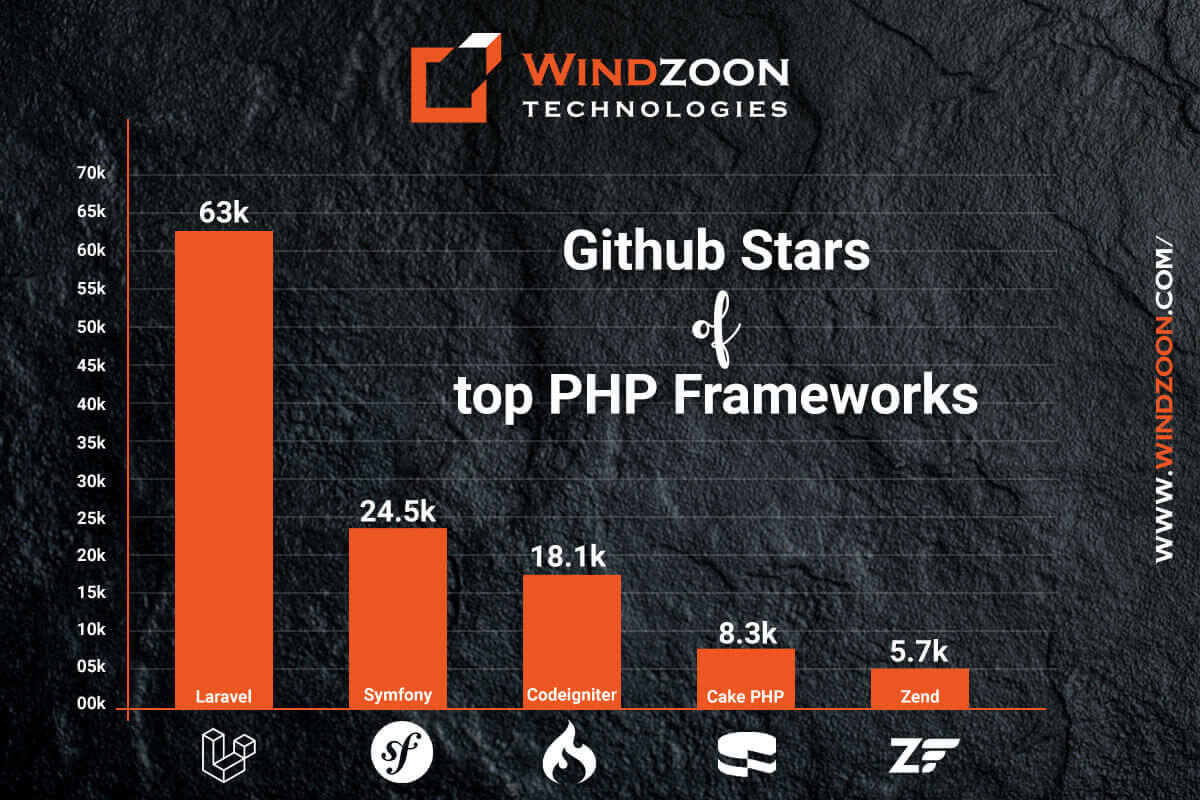
Github Stars of Top PHP Frameworks

Also have questions like What makes Laravel so widely popular, and why do so many web developers depend on it? What are the interesting facts that make Laravel better than any other framework?

That’s why Every year, many people join their hands with the Laravel web development services in India to create cutting-edge applications.

Now let’s see which preeminent benefits make Laravel world widely in vogue and stand out from the crowd of its competitors.

Here are twelve spectacular features of Laravel Web Development that you would love to know!

Top 12 Benefits / Features of Laravel PHP Framework

Top 12 Benefits / Features of Laravel PHP Framework

1. Easy And Expressive Syntax

Laravel has one of the simplest coding languages compared to other frameworks. Web developers are constantly looking for ways to make their work easier. Laravel has proved to be a great resource to web developers for all kinds of projects.

Developers find the expressive syntax of this web application framework very easy to use for their work. Its features help them to create diverse applications to meet the requirements of various clients.

2. URL Routing Configuration

Users use web applications by clicking or typing links. They will expect to see the desired content, such as an article, a contact form, a product description, and so on. If there is no URL routing, the web application will never understand what the user wants to see and will instead display a blank or error page.

app/http/routes.php file classifies the Laravel routes, which the framework loads automatically. The Laravel routes accept a URL and a Closure, allowing for a very simple method of defining routes.

3. Effective Queue Service

Communication between different parts of the application, or between two or more applications takes place constantly. The more traffic a web application receives, the more requests it must handle per second. Hence it is possible that hosting this application will be ridiculously expensive or that the webserver will fail.

To avoid situations like this, developers may choose to use the message queue system at the start of project development, among other techniques. This aids in load balancing, speeding up applications and maintaining data integrity.

In Laravel, developers choose to use the Queue service to effectively manage the traffic on web applications and avoid situations like server failure. That allows developers to adjourn the processing of time-consuming tasks like sending emails up to a later time. Which radically speeds up web support to your application.

Laravel framework has a command schedule that allows developers to articulately and expressively define their command schedule in the laravel application.

4. Impact of Laravel on Market Shares

Laravel is commonly used in several domains. Since early 2019, there has been a spike in interest in Laravel and is expected to continue at a rapid pace over time.

According to current statistics, Laravel has built approximately 2,28,000 websites around the world. In India alone, 10,000 websites are created using Laravel Services India. As a result of the framework’s widespread popularity, the number is expected to rise in the coming years.

The most common domains that use Laravel are Computers, Technology, Electronics, Real Estate, Arts & Entertainment, Science & Education, and Business & Customer Service.

5. Ability To Handle Configurational Errors

The way a software application handles errors can have a significant impact on user satisfaction and app usability.

Data-entry forms are one of the most common places where errors are detected and displayed after users click “Submit”. Without proper error handling, the user may conclude that the problem is with the web application and stop using it. Losing clients can be a major downside to a poorly coded website.

For any new Laravel-based project, error and exception handling are already configured. Furthermore, Laravel is integrated with the Monolog logging library, which supports a wide range of powerful log handlers.

6. Open-Source Platform and Massive Community Support + Assistance

Laravel is an open-source framework that makes it readily available for developers in their time of requirement.

Laravel’s popularity in the software development community stems from its simplicity and finesse. Laravel has its virtual assistance space where programmers can have discussions, clear doubts and take assistance 24/7!

The community is made up of some prominent experts who work hard to improve the framework by producing creative documentation that allows other members to join the resource pool. The Laravel framework is one the most optimal framework in the IT community.

7. Authentication and Authorization System

Web application creators and owners must ensure that users are who they claim to be, to prevent unauthorised users from accessing secure/paid resources.

The Laravel PHP Framework makes it simple to create authorisation logic that restricts access to only secure resources. It is more appealing because it has a logical approach that prevents unauthorised users and provides security against threats. Laravel already includes an authorisation system for validating data requests.

8. Laravel’s Unit Testing Environment

How can anyone be certain that the software will perform without crashes, bugs, or errors and in line with the actual application requirements unless the developer tests and verifies what they have created? Automation testing saves time and is often more accurate than manual testing.

Every module of the web application is tested in Laravel’s unit testing before the site goes live, making sure that no part of the website is broken. Fine unit testing ensures that the web application contains no bugs or exceptions, resulting in a high-performance and ultimately trouble-free application for end-users.

9. File Caching Support

Hundreds of Internet users visit popular websites at the same time, sending requests to the database server. Web developers may require high-end equipment to handle them all as quickly as possible.

But transferring the most frequently requested pages once, caching them, and then serving future requests directly from the cache is far more efficient. Laravel is configured by default to use the file cache driver, which stores encrypted items in the file system. Multiple cache configurations can even be set up for the same driver.

10. MVC Architecture

Laravel framework is based on MVC ( Model View Controller) Architecture. MVC is an application design pattern that separates application, domain, and business logic from the remaining user interface, which is done by ensuring separation between the model, the view, and the controller.

MVC Architecture has many extended features like fast intuition, easy extension, robust security, high performance, and scalability.

11. Artisan Tool

The developer would need a command line to develop and manage the Laravel project environment. Laravel contains a command-line interface named Artisan.

Artisan allows developers to perform a large number of repetitive and tiresome programming tasks that the majority of developers would abstain from executing manually.

12. Blade Templates

Laravel administers a Blade Templates engine that is simple, lightweight, yet remarkably powerful compared to other PHP templating engines.

It allows developers to use the pre-defined code templates that don’t restrict the web developers from using their codes and ultimately make the web development process faster.

These facts are some of the many reasons why web developers are inclined to use Laravel development. Its simplicity and power-packed features have made coding easier for them.

Final Thoughts

As we have seen, Laravel is one of the mightiest contenders in the PHP system because it possesses the features required to develop modern web applications and also has massive community support and an extensive market share.

This makes Laravel one of the most cost-effective, efficient, and faster web-developing PHP frameworks. And If you are facing any difficulty regarding the Laravel web development framework, then kindly get in touch with our talented team for the best Laravel Web Development Service.