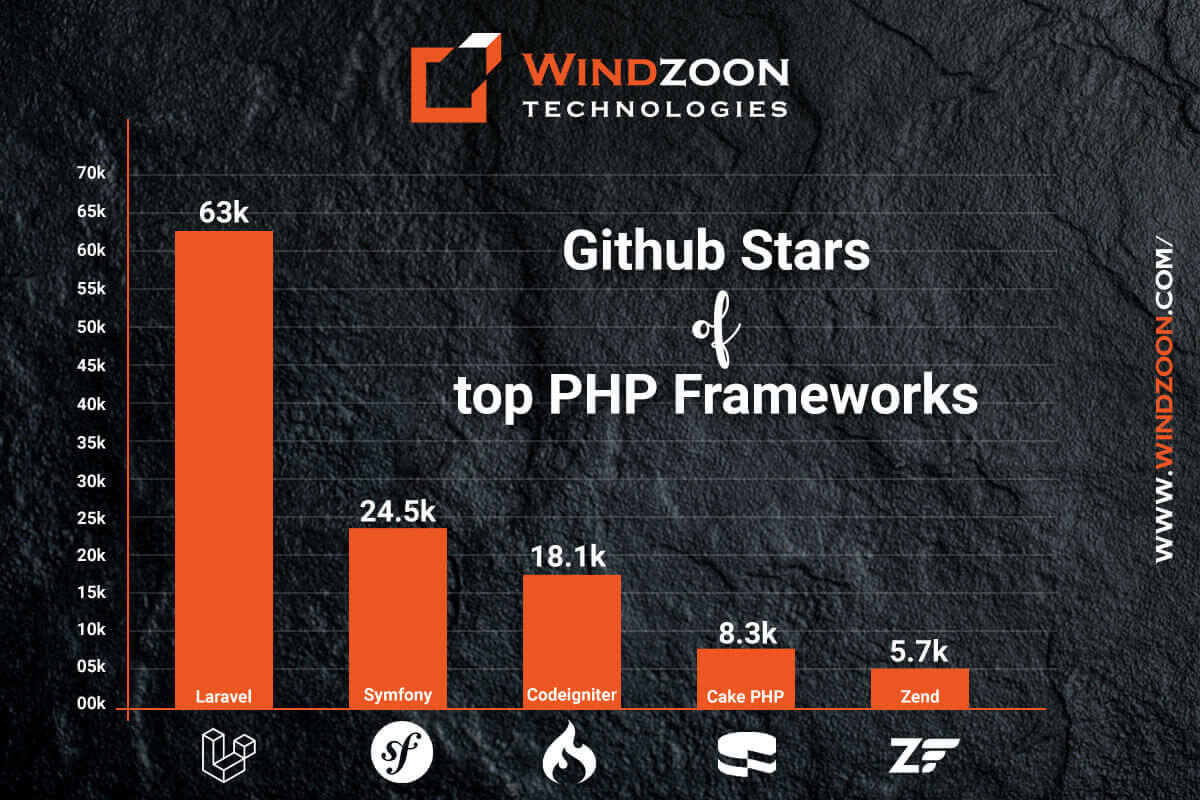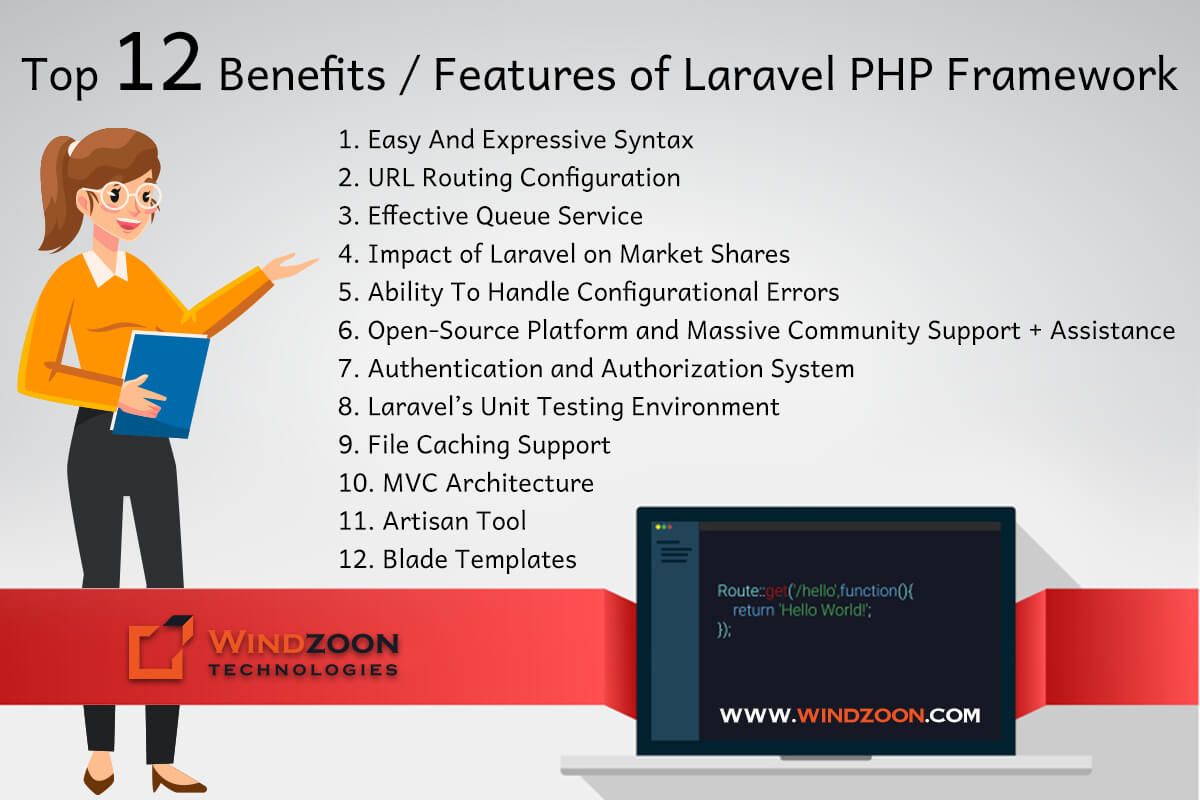
There are moreover 40+ PHP frameworks.
Before getting into the depth of which framework is the best, first, let us understand PHP and its framework respectively.
Usually, a framework is characterized as a programming mechanism. These frameworks have many pre-defined libraries & features. They enable you to cut down on the coding work & save you a lot of time. Frameworks work on the Model-View-Controller pattern & have beautiful features too.
Now let’s talk about PHP.
PHP is one of the top 10 prevalent programming languages in the industry. It helps you build astonishing web applications.
A PHP-based framework delivers a basic foundation for your development project. It is useful as they offer great speed & standardize the entire development procedure.
Laravel and Lumen are widely used for developing modern mobile, web, and desktop applications, including mobile apps.
If you are too launching your website & contemplating which PHP framework you should consider, we will help you choose one between Laravel & Lumen.
Laravel vs Lumen is undoubtedly a debate that is going around for all the good reasons.
We will be going deeper into the world of Laravel & Lumen, the two amazing frameworks of PHP! Both frameworks were created by Taylor Otwell to address specific needs in web and API development. Laravel and Lumen are open-source and licensed under the MIT license.
Keep reading till the wrap-up!
What is Laravel?
Laravel is a framework with an expressive & elegant syntax. Many Laravel developers choose the Laravel framework for development.
You must be wondering, what is Laravel & what it has to offer. Well, simply put; Laravel is an open-source framework that offers full-stack development and provides a rich set of features for web application development. Laravel enables developers to create scalable and robust web applications, making it suitable for enterprise-level projects. It has strong support for third party tools and integrations, which enhances its flexibility and allows seamless incorporation of external libraries. Laravel is also known for its robust security features, making it a preferred choice for secure web application development. Additionally, Laravel is widely used for API development due to its comprehensive features and strong community support. There is multiple Laravel development company that can assist you in Developing one.
Being a PHP framework, it is indeed an adequate choice to develop any type of web or app. It can easily help you develop complex as well as easy interfaces that carry astonishing features.
These are small yet impactful reasons why Laravel is preferred by every scale of business or organization.
Consequently, let us quickly look at the Advantages & Disadvantages of this incredible framework.
Advantages and Disadvantages of Laravel Framework
Advantages and Disadvantages of Laravel Framework
As exceptional as the Laravel framework is, it definitely has advantages and disadvantages. Laravel is built on the MVC architectural pattern, which helps organize and develop web applications effectively. Its modular components, such as routing, validation, and authentication, contribute to its flexibility and make it easier to build secure, reliable applications. Laravel’s configuration options allow developers to implement a wide range of features efficiently. For a better understanding, let’s closely have a look at its pros & cons.
Advantages of Laravel Framework
1. Excellent Documentation
Laravel is believed to develop any interface easily as it has robust documentation features. Every version of Laravel has appropriate documentation that helps you find thorough descriptions of widgets, coding styles, methods, etc.
2. It Supports Famous Cache Backends
Laravel actively supports famous caching backends, like Memcached, DynamoDB, & Redis out-of-the-box.
3. Artisan
It is not feasible to do duplicative programming, this is highly time-consuming. Artisan is a command-line mechanism. It assists in forming the structure code & handles the database system robustly.
Disadvantages of Laravel Framework
1. Absence of Continuation in Between Versions
The transition from Laravel 4 to 5 is barely seen. It can efficiently shatter the app if you push to revise the code.
2. Some of the Upgrades can be Challenging
It is one of the PHP frameworks con. It always shows some problems when the version is updated. With this, the user has to be cautious while revising the version.
3. Development
While inspecting the development of different frameworks, we encounter that the development is relatively quicker in distinction with Laravel.
What is Lumen?
Lumen is a new-age stunning PHP micro-framework. It is specially devised to meet every requirement for microservices-based apps and is optimized for API and microservices development, efficiently handling high volumes of requests. Lumen is commonly used to implement specific components within a microservices architecture, making it ideal for scalable and modular applications. It is used to develop apps with explicit & agile syntax, and its minimal configuration allows for fast development and deployment. Lumen includes essential features like error handling and routing, which are crucial for building APIs and microservices. Lumen is undeniably an excellent framework that offers all these amazing attributes, making it a top choice for API development and microservices.
The foundation of Lumen is quite similar to Laravel. Yet, there are plenty of differences. We will surely discuss the differences between the two, but first, let’s understand the Pros & Cons of Lumen!
Moving on, let us quickly have a look at the pros and cons of the Lumen Framework (micro-development framework).
Advantages and Disadvantages of Lumen Framework
Advantages and Disadvantages of Lumen Framework
Lumen is a micro-framework developed by the creators of Laravel, designed for building lightning-fast APIs and microservices. It is often considered a faster version of Laravel, making it ideal for performance-critical applications. Lumen is frequently used to build microservices because of its lightweight architecture, which allows developers to design small, independent services within a larger application. Additionally, Lumen integrates seamlessly with other tools such as Docker, Kubernetes, AWS, and Google Cloud, which are commonly used for microservices deployment and scaling.
Like any framework, Lumen has its own set of advantages and disadvantages. Below, we’ll explore the key pros and cons to help you decide if it’s the right choice for your next project.
Advantages of Lumen Framework
1. It allows the Ability to Upgrade
This framework enables the ability to upgrade Lumen to Laravel whenever you desire. This pro makes it more convenient if compared to the other frameworks.
2. Comparatively Less Complicated Features
Most expert & naive developers find Lumen easier to use as it has less complicated features.
3. Incredible Speed
Lumen is the quickest micro-framework in the market with an exceptional speed of 100/reps.
However, Lumen omits features like HTTP sessions to optimize performance for APIs and microservices, which can be a limitation if your application requires session management.
Disadvantages of Lumen Framework
1. It is Restricted to Specific Solutions
It is one of the biggest drawbacks that Lumen comes up with. It is limited to working on specific solutions solely, like lesser features to customize & is a smaller version of Laravel.
2. Made to Develop Smaller Apps
Lumen supports the development of smaller apps which is also the biggest con of why developers don’t choose more.
3. It is Majorly Dependent on Laravel
Another con of Lumen is it performs well mostly with Laravel.
What are the Differences and Similarities Between Lumen and Laravel Framework?
Differences and Similarities Between Lumen and Laravel Framework
Both Laravel and Lumen are the finest development frameworks of all time, but there is a key difference: Laravel is a full-stack framework packed with features for building robust applications, while Lumen is a lightweight microservice framework optimized for speed and minimalism.
Both frameworks are widely used for creating scalable web applications and microservices, helping developers save time by providing built-in tools instead of building everything from scratch.
Lumen and Laravel are both suitable for implementing microservices architecture, depending on your project requirements and the level of features or performance you need.
Here we are going to see a head-on between a Microservice Framework (Lumen) & Laravel (Full-stack Framework).
Now let’s quickly dive into the comparison between both frameworks for a better understanding.
1. Architecture
Let’s first look at the architectural characteristics of Lumen vs Laravel. Lumen is a kind of Micro-Framework, however, Laravel is a Full-Stack Development Framework. Yet, you should also understand that Lumen is a subdivision of Laravel.
2. Artisan Generators
An artisan is a command-line tool for Laravel & Lumen. Both of these frameworks utilize the same design.
On Laravel, you have to generate commands on the code. Whereas in Lumen, you have to copy & paste the commands. But it doesn’t cause any contrast in the application programming interface performance.
3. Usage
The usage of Lumen and Laravel both is entirely different from each other. Lumen is the lighter version of Laravel. Lumen is used for developing small apps with lesser attributes.
If you have a startup, Lumen is always a suitable choice for you. And if you have a large firm, go for Laravel Framework.
4. Integration
Lumen & Laravel, both have diverse kinds of integration facilities.
For instance, integration in Laravel is with the PHP programming framework.
On the other hand, integration in Lumen is with 3rd party tools that help in accessing new features. So, the basic integration dissimilarity always remains.
5. Community
Even Though Lumen is a subgroup of Laravel, the community backing is larger in the case of Lumen. You can simply strive for support from numerous individual contributors in case you face any difficulty with the Lumen framework.
Whereas, Laravel has comparatively less community support.
6. Response Time
Lumen is quicker & its time of response is considerably lesser compared to Laravel.
Lumen is faster than Laravel & also it is quicker if compared to other Micro Frameworks. Therefore, For a startup, without any doubt go for Lumen over Laravel.
7. Template
There are multiple libraries & templates that are in-built within Laravel. This quality of Laravel puts it apart in the Laravel vs Lumen debate. A web developer has better tool options to design a cool interface by using Laravel. On the other hand, as Lumen is majorly used for small projects it only has a bunch of templates available for you!
Overall talking about Laravel Vs Lumen,
Laravel is comparatively full of features and more stable. Whereas, Lumen is suggested for smaller apps that do not require more performance.
So, the option of determining the framework between Laravel & Lumen entirely relies on the parameters needed for the solution you need to develop.
Read More: Why Build Your E-commerce Project With a Laravel CMS Framework?
Let’s quickly wrap up this wholesome debate on framework.
Okay, so it’s time to wrap up the most debatable Lumen vs Laravel discussion. There is not one specific framework you can consider ideal. Laravel & Lumen both have their own sets of advantages & disadvantages. Both have their own unique & reliable features. So it’s up to you, your business requirements & objectives that the selection of framework depends on. Pick the one that pleasingly fits your objectives.
In our opinion, if you’re developing a small Application programming interface that performs for a specific purpose, choose Lumen. And, If you intend to develop a feature-rich website, go with Laravel.
We hope you find this blog insightful.
If you are desiring to develop a feature-rich website, you can consider us. We cater to the exceptional Lumen & Laravel development service. We will support you in saving time & building a responsive, customizable website.
Connect to our techies at [email protected] to or know more about our services.