12 Must-Follow Web Application Security Best Practices for 2024

Data is the new oil that keeps the world going. It’s like virtual gold that can earn you a lot more than real gold. This is why security breaches and data theft have become quite a norm in the digital world.

As per Security Magazine, every 39 seconds, a cyber attack occurs somewhere in the world. The global cost of these cyberattacks was estimated to be $6 trillion in 2021 and might rise to $10.5 trillion annually by 2025.

Hence, understanding and implementing robust web application security measures is crucial for businesses of all sizes to safeguard their integrity and trust. As an experienced web app development company in India and the USA, we have compiled a list of the best web app security measures based on our years of expertise.

This guide navigates through the intricate layers of web security, offering a comprehensive approach to protecting your digital assets. Hence, join us to transform your web applications into impregnable fortresses, ensuring that your business thrives in the secure and trusty realm of the internet.

However, before we learn the best web app security practices, let’s first know about some of the most common web app security vulnerabilities.

Common Web App Security Vulnerabilities
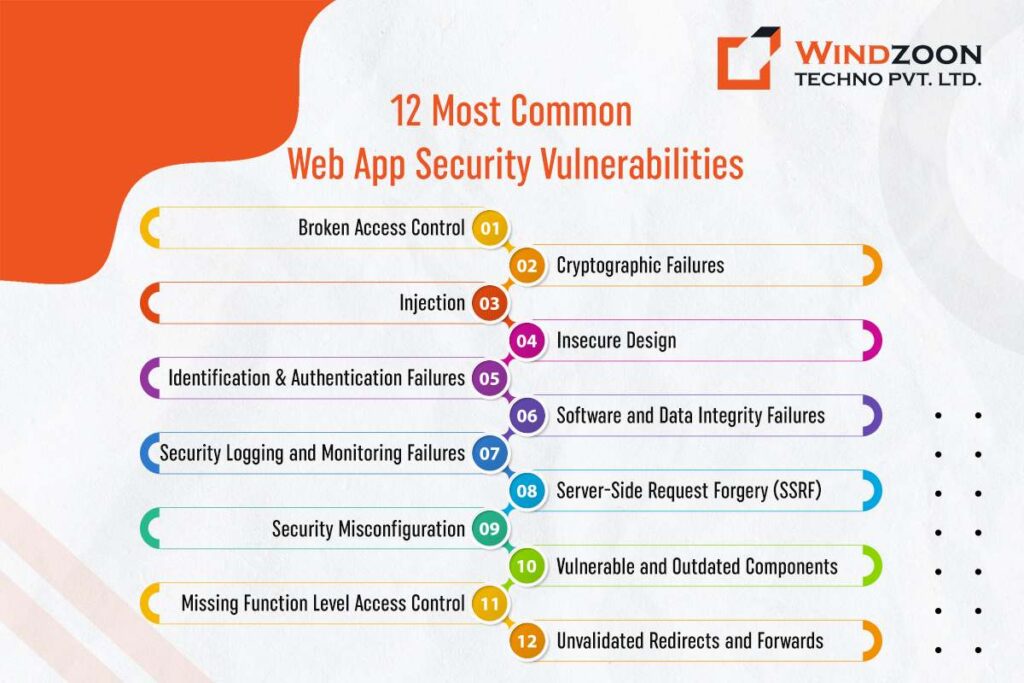
common-web-app-security-vulnerabilities

According to the Open Web Application Security Project (OWASP), the ten most common vulnerabilities in web applications are:

1. Broken Access Control

  • Here, a hacker accesses a user’s profile by compromising their login details.
  • This can often be prevented through multi-factor authentication.

2. Cryptographic Failures

  • Previously known as ‘Sensitive Data Exposure’. Here, hackers can easily access unencrypted data.
  • Moreover, it involves failing to protect sensitive data, like financial, healthcare, or PII, with adequate encryption.

3. Injection

  • Attackers can send malicious data as part of a command or query, tricking the application into executing unintended commands or accessing unauthorized data.
  • Common examples include SQL, NoSQL, and LDAP injection.

4. Insecure Design

  • This is a broad category that includes risks related to design flaws in software.
  • It emphasizes the need for a threat modelling process and secure design patterns and principles.

5. Identification and Authentication Failures

  • It happens when session management and authentication features are implemented improperly.
  • Attackers can compromise passwords, keys, and session tokens, or exploit other flaws to assume users’ identities.

6. Software and Data Integrity Failures

  • This vulnerability arises when assumptions regarding software updates, critical data, and CI/CD pipelines are not verified.
  • It can lead to unauthorized access or modification of software and data.

7. Security Logging and Monitoring Failures

  • Insufficient logging and monitoring, coupled with ineffective or non-existent integration with incident response, allow attackers to further attack systems without detection.

8. Server-Side Request Forgery (SSRF)

  • The server can be tricked into making outbound requests to unintended services, allowing attackers to interact with these services.

9. Security Misconfiguration

  • This involves incorrect configuration settings in software and systems, leaving them vulnerable to attacks. For example, issues like flaws that haven’t been patched, unused pages, unprotected files or directories, outdated software, and running software in debug mode.

10. Vulnerable and Outdated Components

  • Using components (mostly third-party components) with known vulnerabilities or failing to update components can leave an application vulnerable to attacks.

11. Missing Function Level Access Control

  • If server-side authorization is poorly configured, nonexistent, or compromised, it leaves your app’s backend vulnerable to attacks.

12. Unvalidated Redirects and Forwards

  • Hackers can redirect users to malicious websites to steal their data.

Most of these vulnerabilities stem from issues with authentication, flaws in user input, and data validation. Therefore, protecting your authentication and validation mechanisms is crucial. Any web app development service should include a comprehensive security strategy, regular security checks during and after development, and adherence to best practices in web security.

Now, let’s get to know about some of the best web app security best practices for 2024.

Web Application Security Best Practices
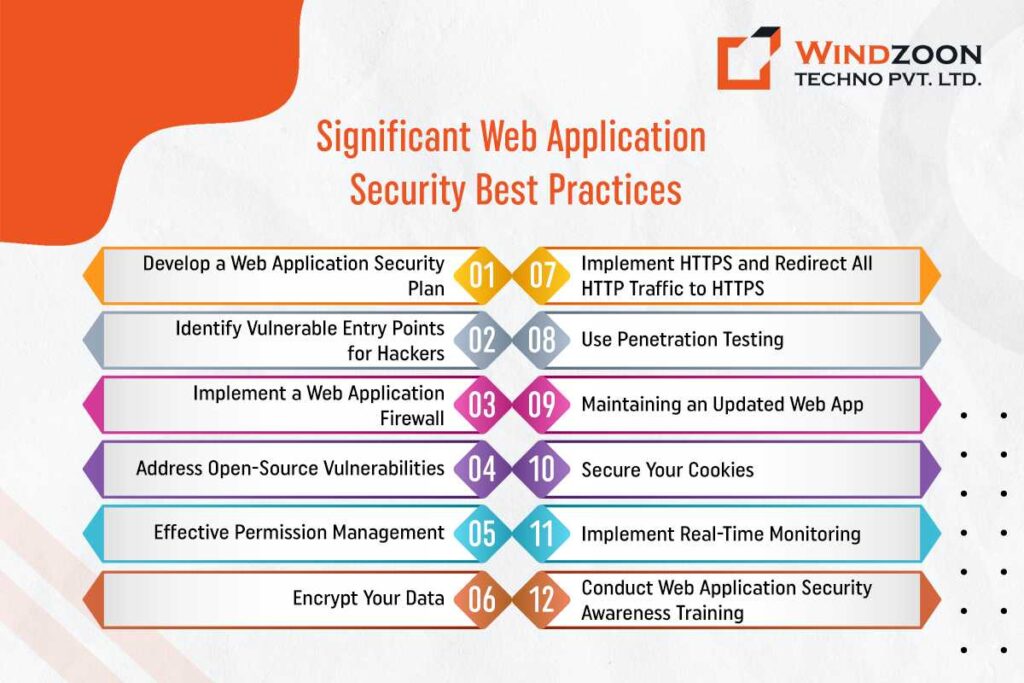
significant-web-app-security-best-practices

Following are the best web app security practices every business should follow in 2024.

1. Develop a Web Application Security Plan

To effectively adhere to web application security best practices, having a structured plan is essential. Many companies fail to manage web security properly due to a lack of organization, leading to minimal results.

Collaborate with your IT security team or professional web app development company to create a comprehensive and executable plan for web application security. This plan should clearly define the objectives of your organization, such as improving compliance or strengthening brand protection.

The plan should also prioritize which applications need immediate security measures and outline the methods for testing these applications, whether it be manually, via cloud solutions, on-site software, managed service providers, or other strategies.

Each organization’s security plan will be unique, and tailored to its specific infrastructure. For larger organizations, the plan should specify key personnel responsible for upholding web application security practices continuously.

Additionally, it’s important to consider and include the costs associated with these security measures in your plan. This foresight ensures that your organization is prepared and resourced to maintain high standards of web application security.

2. Identify Vulnerable Entry Points for Hackers

A crucial aspect of web application security is identifying potential entry points that hackers might exploit. Certain parts of your software are inherently more susceptible to attacks, particularly those that are customer-facing and handle data transactions. To strategically focus your security efforts, it’s advisable to categorize the features of your software into modules based on their security sensitivity:

Critical Modules: These include the most vulnerable aspects of your application that are directly exposed to the internet and are, therefore, prime targets for hackers. Critical modules often comprise customer-facing features like login screens and checkout pages.

Serious Modules: These modules are integral parts of your software where sensitive company or user information is stored. Although they might not be directly exposed to the internet, their protection is crucial due to the valuable data they hold.

Normal Modules: While these modules may not have direct access to sensitive data within your application, they still require regular monitoring and security checks. Ensuring these modules are secure is also important for overall application integrity.

Understanding and categorizing these modules help in prioritizing security measures and focusing resources where they are most needed to safeguard your web application effectively.

3. Implement a Web Application Firewall

A key practice in web app security is the use of web application firewalls (WAFs). A WAF acts as a barrier for HTTP traffic between a server and a client, effectively filtering out and blocking malicious requests that could compromise your databases.

Firewalls are highly regarded for safeguarding software at the network’s entry points. They scrutinize all incoming traffic and halt any activities that appear suspicious. One of the advantages of WAFs is that they do not require developers to modify the source code, making them a user-friendly security solution.

However, it’s important to note that traditional firewalls have limitations, particularly in identifying certain types of cyber attacks. For enhanced security, it’s advisable to use advanced WAFs. These are equipped to shield your application from more sophisticated threats like SQL injection attacks and cross-site scripting, ensuring a higher level of protection for your web applications.

4. Address Open-Source Vulnerabilities

Many web applications utilize open-source components due to their cost-effectiveness and functionality. However, these components can bring vulnerabilities into your application. It’s essential to regularly scan these open-source components for any known security flaws.

There are many tools available that can automatically detect vulnerabilities in your software’s dependencies. Once identified, these vulnerabilities must be promptly addressed, either by updating the component, applying a patch, or replacing it with a more secure alternative.

Managing the security of open-source components is a continuous process, as new vulnerabilities are discovered regularly.

5. Effective Permission Management

Ensuring data security in your organization crucially involves controlling user access to sensitive information. It’s essential to understand that not every employee needs access to all data. Over-privileging users can lead to increased risks of unauthorized access, data breaches, and internal threats.

Implementing differentiated access levels within your system offers two key benefits. Firstly, it limits the damage if an external party compromises an employee’s credentials, as they can only access areas permitted by those credentials.

Secondly, in case an employee poses a risk to your company, restricted access ensures they cannot access all sensitive data on their own. A best practice in web application security includes revoking access rights of former employees and updating passwords whenever a developer or staff member departs, further safeguarding your organization’s data integrity.

6. Encrypt Your Data

Encryption is a critical method for encoding information, primarily used to protect it from unauthorized access. While encryption does not directly prevent data interference during transmission, it ensures that the data becomes unintelligible to anyone who isn’t authorized to view it.

Not only is encryption vital for securing data in transit, such as information being sent over the internet, but it also plays a key role in protecting data at rest. This includes data stored in databases or other storage mediums, where it remains shielded from unauthorized access.

Encrypting the data exchanged with Web Services and APIs is just as important as establishing a solid authentication strategy for access control. Without encryption, web services are highly vulnerable. Hackers, who are becoming increasingly skilled at using sophisticated algorithms, can easily locate and exploit these vulnerabilities.

Therefore, implementing robust encryption measures is not just a precaution but a necessity. It is indispensable for safeguarding against unauthorized access and ensuring the overall security of data, whether in transit or at rest.

7. Implement HTTPS and Redirect All HTTP Traffic to HTTPS

In addition to the encryption methods discussed earlier, encrypting information at the service level is also crucial. This is commonly achieved through HTTPS (SSL or Secure Sockets Layer).

SSL technology creates a secure, encrypted connection between a web server and a browser. It ensures the privacy of data exchanged between the browser and the server, making it essential for the protection of online transactions. Used by millions of websites, SSL is the industry standard for securing online interactions.

Moreover, it’s recommended to uniformly implement SSL across your entire website. This comprehensive approach not only safeguards your site but also prevents potential issues with resources like stylesheets and JavaScript files, which may encounter problems if not accessed via HTTPS through an SSL-encrypted connection.

8. Use Penetration Testing

Penetration testing is a crucial and advanced aspect of security testing. It simulates near real-world scenarios where a Quality Assurance (QA) specialist assumes the role of a hacker. The specialist attempts to breach the system through various means, ranging from sophisticated programming techniques to physical breaches.

The primary advantage of penetration testing is its effectiveness in uncovering a wide range of vulnerabilities. The process culminates in a comprehensive report that not only serves as a foundation for future security checks but also acts as a reference to pinpoint the vulnerabilities responsible for any security breaches. Penetration testing encompasses several techniques to ensure all potential threat scenarios are evaluated.

Given that software, especially a medium-complexity web app can have numerous potential entry points for hackers — including cloud access — penetration testing becomes indispensable. It enables a QA specialist to explore numerous scenarios, attempting to breach the system with as much knowledge as an actual hacker would have.

If your organization does not have in-house penetration testing expertise, you should hire web app developers or testers from a reputed web app development firm. A third-party expert does more than just test your web application; they conduct a comprehensive security audit while performing the penetration testing. Having an outsider audit your software often reveals overlooked flaws, providing valuable insights for you and your team.

9. Maintaining an Updated Web App

Updating your web application encompasses more than just the software itself; it includes all third-party services and libraries within its infrastructure. Hackers often exploit these third-party components to breach the main system, so it’s crucial to be aware of these vulnerabilities. Your web app’s documentation can be a key resource in this process.

A common challenge is the reluctance of developers to update third-party services, due to fears of compatibility issues with new versions. This hesitation, however, can lead to significant security risks.

To manage updates effectively, review your documentation to identify the libraries you’re using. Eliminate any that don’t contribute significantly to your app and prioritize updating the rest. Developing an update strategy is essential, as updating libraries can be more complex than anticipated.

Ensure that you’re using only the necessary libraries and always opt for the latest stable versions to avoid potential vulnerabilities in any framework or library. This approach is critical for keeping your web application secure and functional.

10. Secure Your Cookies

Cookies are essential for most websites, benefiting both website owners and users. They help websites gather user information for more insightful analytics, while users enjoy a faster, more personalized browsing experience. However, cookies can also be a gateway for hackers, so ensuring their security is vital.

There are three key aspects to consider for cookie security:

Information Stored in Cookies: Be cautious about the type of data stored in cookies. Avoid storing sensitive information like passwords, as hackers can easily access them and use them to infiltrate your system through another user’s account.

Expiration Date: Set a reasonable lifespan for your cookies. They shouldn’t last indefinitely. Ideally, cookies should expire in less than a month. Regularly requesting user authorization, perhaps every two weeks enhances your web app’s security and ensures that each access is by an authorized user.

Encryption: Encrypt all data stored in cookies. This step adds an extra layer of security, making the information much harder for unauthorized parties to decipher.

Implementing these procedures will dramatically improve the security of your online application, protecting both your data and the privacy of your users.

11. Implement Real-Time Monitoring

The Ponemon Institute reveals that it takes companies an average of six months to detect a major security breach. For businesses handling large volumes of sensitive data, promptly identifying and addressing breaches is paramount. Utilizing specialized monitoring software can track all activities on employee workstations. This surveillance ensures adherence to security protocols.

The reason for doing this is that the Chief Executive reports that 90% of security breaches stem from human error. By monitoring employee actions, businesses can swiftly pinpoint which specific action on which computer led to a system compromise.

It becomes possible because all activities are systematically recorded, allowing for quick identification and rectification of security lapses. Hence, implementing such real-time monitoring is a crucial step in enhancing your organization’s cybersecurity measures.

12. Conduct Web Application Security Awareness Training

In many businesses, a comprehensive understanding of web application security is often limited to a few individuals, while the majority of employees may have only a basic awareness. This limited knowledge can lead to a lack of vigilance and an inability to recognize potential security risks.

To address this, educating your entire staff about web application security is crucial. This approach empowers employees to identify vulnerabilities proactively. Essentially, equipping everyone with knowledge about web application security transforms your workforce into an active part of the solution, enhancing the overall security framework.

Consider hiring a web application security specialist to provide awareness training for your employees. By ensuring that everyone is informed and understands how to respond to security threats or vulnerabilities, you significantly bolster your web application security measures.

Conclusion

To safeguard your bespoke web application development process, you should use all available security measures. We at Windzoon value security above all else, and our skilful developers safeguard every tech solution by including tried-and-true security procedures.

As an established firm, we have a solid reputation in the market for providing creative solutions that are fully secured to prevent unauthorized access.

To avail of our custom web app development services, get in touch with us to get a quote.

Shopify Development Experts: Hiring or DIY – What’s Best?

When you are in the e-commerce business, one of the most important decisions that any business owner must make is whether to engage skilled Shopify developers or go the DIY path and set up their online store. Choosing skilled Shopify developers who are also official Shopify experts adds a layer of credibility and trust, as these professionals are recognized for their expertise and adherence to Shopify’s standards. This choice is more than a mere operational consideration; it’s a strategic decision that can significantly impact the trajectory of a business.

Opting for a DIY approach offers the appeal of hands-on involvement and potentially lower upfront costs, fostering a sense of personal accomplishment and control. Conversely, hiring expert Shopify developers brings in specialized expertise, advanced customization, and efficiency, albeit at a higher initial investment.

Also, this critical decision weighs heavily on factors such as budget, technical skill level, and long-term business goals. Understanding the implications of this choice is crucial, as it can profoundly influence the success, growth, and competitive edge of your ecommerce venture in an increasingly digital marketplace.

In this blog, we aim to dissect both paths, providing a comprehensive overview of the pros and cons associated with each. Our goal for doing this is to empower you with the insights needed to make an informed decision that aligns with your online business’s long-term success and growth.

Contents

Now, let’s look at the first approach, which is DIY.

The DIY Approach to Shopify

In the digital era where e-commerce platforms like Shopify have democratized online retail, many aspiring entrepreneurs and business owners grapple with a crucial decision: Should they dive into building their online store independently, or is hiring a Shopify expert developer the better route? Let’s explore the Do-It-Yourself (DIY) approach to Shopify, a path many tread in pursuit of digital storefronts. In fact, many businesses have successfully launched their stores using the DIY approach.

Understanding the DIY Approach

The DIY approach in the context of Shopify involves setting up, designing, and managing an online store without professional assistance. This route is facilitated by Shopify’s user-friendly interface, which offers a range of templates, drag-and-drop tools, and intuitive controls. Moreover, it’s about taking the reins of your e-commerce journey, from conceptualizing the store’s look and feel to integrating various functionalities like payment and shipping.

Development Services and Solutions for DIY

For businesses that prefer a hands-on approach to building their online presence, Shopify offers a wealth of DIY development services and solutions. The Shopify platform provides a variety of customizable themes, allowing store owners to tailor the look and feel of their site to match their brand. With intuitive theme customization options, even those without a technical background can create a fully responsive and user-friendly Shopify store that stands out in the crowded e-commerce landscape.

App integrations further enhance the functionality of Shopify stores, enabling businesses to add features such as advanced analytics, customer reviews, and seamless payment gateways. Shopify experts have developed a robust ecosystem of apps and plugins, making it easy to extend your store’s capabilities as your business grows. Additionally, Shopify’s extensive support resources—including tutorials, webinars, and active online forums—empower businesses to develop their skills, troubleshoot issues, and stay up-to-date with the latest platform updates. By taking advantage of these development services, businesses can confidently build and manage their own e-commerce stores, ensuring they remain agile and competitive in the ever-evolving digital marketplace.

Pros of DIY

pros-of-diy

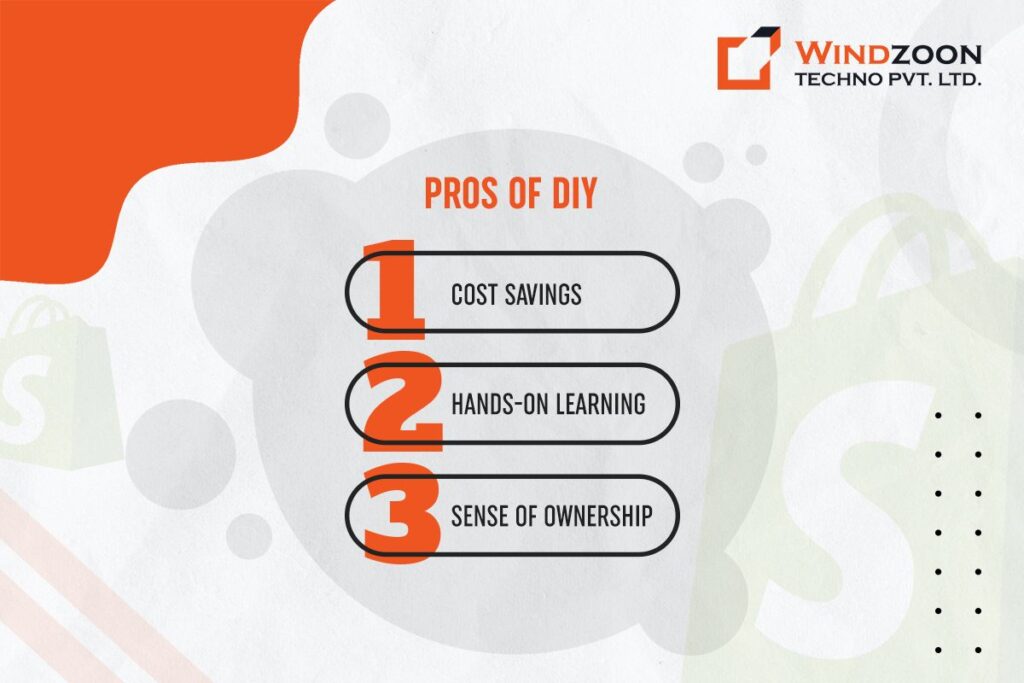
When you adopt a DIY approach for Shopify development, it presents several compelling advantages. These are:

1. Cost Savings: A Smart Financial Move

One of the most significant benefits of DIY Shopify development is the potential for cost savings. By handling the development process yourself, you eliminate the need for hiring external experts, thus significantly reducing expenses. This approach is particularly advantageous for startups or small businesses with limited budgets, allowing them to allocate resources more effectively across other critical business areas.

2. Hands-On Learning: Gaining Valuable Skills

Embarking on DIY development is not just about cutting costs; it’s a journey towards acquiring valuable skills. This hands-on experience allows you to gain a deeper understanding of the Shopify platform. Also, it equips you with the knowledge to make swift changes, adapt to new e-commerce trends, and understand the intricacies of online store management. This knowledge is invaluable, as it empowers you to maintain and update your store independently, without always relying on external help.

3. Sense of Ownership: Taking Control of Your Vision

Lastly, a DIY approach to Shopify development instils a strong sense of ownership and control. When you’re directly involved in building your online store, you have the freedom to shape it precisely as you envision. This direct involvement ensures that every aspect of the store, from layout to functionality, aligns perfectly with your brand identity and business goals.

Cons of DIY

cons-of-diy

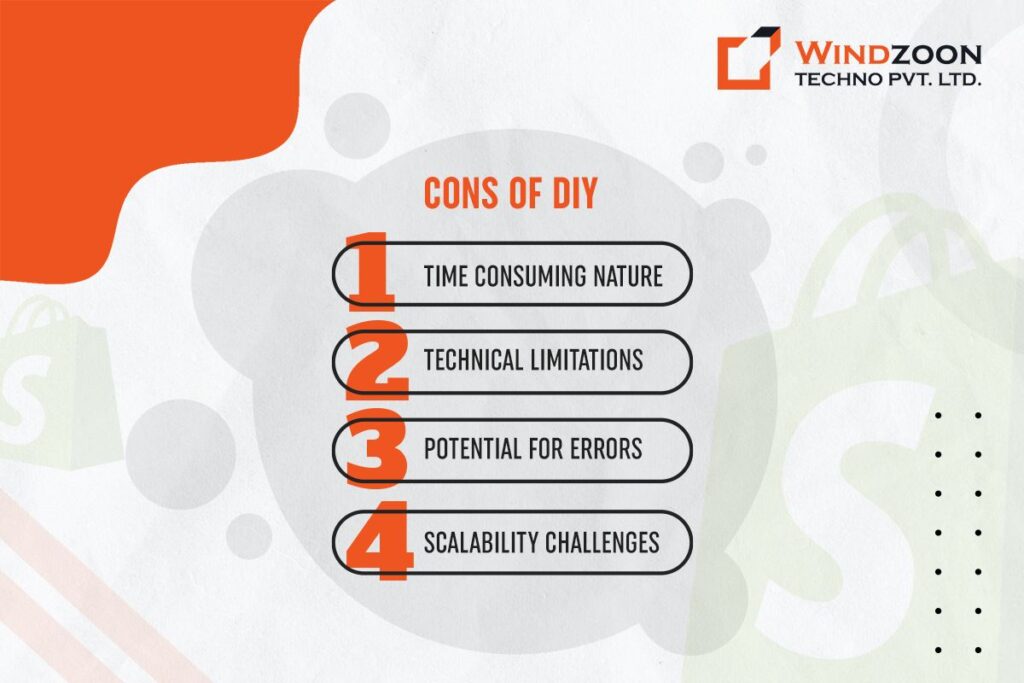
The DIY approach to Shopify development, while appealing for its autonomy and cost-effectiveness, carries certain disadvantages that can impact the efficiency and potential growth of an e-commerce business.

1. Time-Consuming Nature: A Major Hurdle

Firstly, the DIY route is inherently time-consuming. For those without extensive experience in web development, navigating through Shopify’s functionalities and customizations can be daunting. Also, the learning curve is steep, and significant time must be invested in understanding the platform’s nuances.

This time investment can be a major setback, especially for business owners whose primary focus should be on other critical aspects of their business, such as product development, market research, and customer relations.

2. Technical Limitations: A Barrier to Customization

Another issue is the technical limitations that DIY developers might face. While Shopify is user-friendly, creating a truly unique and fully functional e-commerce store often requires in-depth coding and web design knowledge.

Without these skills, one might be restricted to basic templates and functionalities, limiting the ability to stand out in a competitive digital marketplace.

3. Potential for Errors: Compromising Store Integrity

DIY development also increases the risk of errors, which can range from minor glitches to significant issues affecting user experience or transaction security.

Such errors not only require additional time to resolve but can also diminish the credibility and professionalism of the store, potentially leading to lost sales and damaged reputation.

4. Scalability Challenges: Restricting Business Growth

Finally, scalability can be a challenge in DIY Shopify development. As the business grows, the store must adapt to increased traffic, more products, and expanded customer service needs.

Without professional input, scaling up the store to meet these evolving demands can be difficult, potentially hindering long-term business growth and sustainability.

Now, we will move forward to our second approach which is hiring Shopify developers. Thus, let’s get a basic understanding of the role of Shopify developers and the benefits of working with them.

Hiring Expert Developer for Shopify Development

While the DIY approach to setting up a Shopify store offers autonomy and cost savings, the complexities of e-commerce often call for a more professional touch. This is where a Shopify expert developer comes into the picture, bringing a wealth of knowledge and skills to the table. Let’s delve into their role and evaluate the pros and cons of hiring these professionals.

Understanding the Role of Shopify Website Developers

Shopify store setup experts are not just coders; they are architects of the digital marketplace. Their role extends beyond basic website development to include strategic planning of the store’s design, functionality, and user experience. These experts often work as trusted partners, collaborating closely with businesses to achieve their goals. They work on crafting a unique online presence, implementing custom features, and ensuring that the store operates seamlessly across various platforms and devices. In addition, Shopify development experts help create a strong brand identity for ecommerce businesses, supporting effective branding that differentiates stores and enhances customer engagement. Their expertise also includes Shopify app and Shopify app development, allowing them to build custom Shopify apps that add unique features and improve store functionality.

Pros of Hiring Shopify Expert Developers

pros-of-hiring-expert-shopify-developer

Hiring Shopify store setup experts offers numerous advantages to businesses seeking a robust online presence. These professionals bring in a combination of skills and insights that can significantly enhance your e-commerce platform. With extensive experience working with a wide range of clients, they build trust through ongoing support and reliable service.

1. Professional Expertise: A Foundation for Success

When you hire Shopify store developers, they come equipped with extensive knowledge and experience in Shopify platform intricacies. This expertise is invaluable in navigating the platform’s vast functionalities and leveraging them to your advantage.

Also, their understanding of the latest e-commerce trends and Shopify’s evolving features means they can implement cutting-edge solutions, ensuring your store is not only functional but also ahead of the curve.

This professional guidance can help you avoid common pitfalls and make informed decisions, saving both time and resources in the long run.

2. Advanced Customization: Tailoring to Your Unique Needs

Employing skilled developers in your Shopify project can transform your store from a standard template to a unique reflection of your brand.

Additionally, they possess all the necessary skills to create custom themes, integrate bespoke functionalities and robust security. They ensure every aspect of the e-commerce store aligns with your business identity and goals.

This level of customization sets your store apart from competitors and resonates more effectively with your target audience.  So, the idea that only you can create a Shopify store that matches your vision is not true.

3. Time Efficiency: Accelerating Your Journey to Market

Another significant benefit of hiring Shopify store developers is time efficiency.  When you don’t need to do development work, you will get quite a good time at your hand. You can invest that time in other important strategic business decisions or operations.

Also, Shopify developers streamline the development process, enabling a quicker launch or update of your online store. This rapid deployment is crucial in the fast-paced world of e-commerce, where being first to market can be a game-changer.

4. Long-Term Scalability: Preparing for Future Growth

Like all businesses, you too want yours to grow and earn more profits. When you want to expand your business, you will also need an online store that can grow with you. To build a store with that kind of scalability, you need to get help from a skilled Shopify developer.

Seasoned Shopify developers build Shopify dev stores with scalability in mind. They ensure that your Shopify store can grow alongside your business, accommodating increased traffic, more product lines, and expanding market needs.

This foresight in development spares you the need for constant overhauls. Additionally, it allows for a smoother scaling process as your business evolves. Moreover, employing competent Shopify developers might save you a lot of money in the long run by preventing the costs of developing another store.

5. Enhanced User Experience: Winning Customer Loyalty

User experience is paramount in e-commerce. Shopify experts specialize in creating intuitive, engaging, and user-friendly store designs.

They focus on optimizing site navigation, load times, and mobile responsiveness, all of which contribute to a satisfying customer experience. A well-designed store not only attracts customers but also encourages repeat business and word-of-mouth referrals.

6. Ongoing Support and Updates: Ensuring Continuous Excellence

Finally, hiring expert developers means you have ongoing support and access to regular updates. E-commerce is dynamic, with constant changes and new challenges.

Having a dedicated team of developers ensures your store remains up-to-date, secure, and efficient. This continuous support helps in promptly addressing any issues, adapting to new trends, and keeping your store at the forefront of e-commerce developments.

Cons of Hiring Shopify Expert Developers

cons-of-hiring-expert-shopify-developer

Hiring Shopify store developers, while beneficial in numerous ways, does come with certain considerations that businesses should be aware of. These aspects, often perceived as cons, can be reframed to highlight how they may ultimately benefit your business.

1. Higher Upfront Costs: Investing in Quality

One of the primary considerations of hiring Shopify developers is the higher upfront cost. Expert developers typically charge more due to their specialized skills and experience.

However, this should be viewed as an investment rather than a cost. The expertise of these developers often leads to a more robust, efficient, and scalable online store. This means fewer issues in the long run, saving money that might otherwise be spent on frequent fixes or redesigns.

Furthermore, a well-developed store can lead to higher customer satisfaction and increased sales, offering a return on investment that far outweighs the initial expenditure.

2. Potential Over-reliance: Fostering a Collaborative Approach

Another concern is the potential over-reliance on hired developers. While relying too much on outside help can leave you feeling disconnected from your own e-commerce platform. However, you can mitigate it through a collaborative approach.

Working closely with Shopify experts results in a superior product and provides an opportunity for you and your team to learn from their expertise. This collaboration can enhance your understanding of the platform, making you feel connected to it and more self-reliant over time.

3. Time for Collaboration: Path to Make Your Vision Real

When you work with experts, it requires time for effective collaboration and communication. This might seem like a slow-down of your project in the short term. But this time is invaluable for ensuring your vision is accurately translated into the digital space.

Through detailed discussions, developers can tailor the platform precisely to your business needs, which can lead to a more successful outcome than a rushed, less personalized approach.

4. Having External Team On Board: Gaining Diverse Perspectives

Finally, the notion of having an external team on board is a con worth re-evaluating. Bringing in Shopify experts means introducing fresh, unbiased perspectives to your project.

These professionals can offer innovative solutions and ideas that might not have been considered internally. Their experience with a variety of projects equips them with insights that can significantly benefit your store’s design and functionality.

Next, we will study some of the significant examples of Shopify stores developed with the help of skilled developers.

Choosing the Right Shopify Developer or Agency

Selecting the right Shopify developer or agency is a crucial step in building a successful e-commerce store. It’s important to choose a trusted Shopify agency with a proven track record of delivering high-quality, custom Shopify themes and innovative app integrations. Start by reviewing the agency’s portfolio to assess their experience with projects similar to yours, and read client testimonials to gauge their reputation for delivering results.

Look for a Shopify partner that demonstrates deep expertise in the platform, from theme customization to advanced integrations, and has a history of supporting businesses through every stage of their e-commerce journey. A reputable agency will offer transparent communication, reliable support, and a collaborative approach to ensure your vision is brought to life. By partnering with a skilled Shopify developer or agency, you can be confident that your store will benefit from the latest e-commerce solutions and ongoing support, setting your business up for long-term success.

Victoria Beckham Beauty

When you engage Shopify developers or experts, you can expect a comprehensive suite of services tailored to your business’s unique needs. These professionals offer everything from custom app development and theme customization to complete store setup and ongoing maintenance. A trusted Shopify agency will provide a dedicated team of developers, designers, and marketing specialists who work together to optimize your store for search engines, enhance user experience, and drive conversions.

Beyond technical development, Shopify experts can assist with email marketing, social media integration, and SEO optimization, ensuring your store attracts more traffic and converts visitors into loyal customers. Ongoing support and maintenance mean your store remains secure, up-to-date, and fully responsive to the latest Shopify updates and e-commerce trends. By partnering with a reputable Shopify agency, you gain access to a wealth of expertise and resources, empowering your business to grow and succeed in the competitive online marketplace.

Case studies of successful stores built by expert developers

shopify-projects-build-by-experts

Victoria Beckham Beauty

Co-founded by the renowned Victoria Beckham and Sarah Creal, Victoria Beckham Beauty places a strong emphasis on clean beauty in its skincare and cosmetics range. The brand, aiming for distinctiveness and precision, required extensive customization beyond Shopify’s standard themes. Their chosen Shopify agency adeptly utilized Shopify’s flexible APIs, particularly enhancing the checkout user interface to meet the company’s unique design and user experience needs.

Whole Foods Market by Amazon

Amazon’s Whole Foods Market, a leading supermarket chain specializing in natural and organic foods, operates over 350 stores. Its online presence, powered by Shopify Plus, allows customers to effortlessly order from Whole Foods’ extensive inventory, with Amazon facilitating delivery or pickup.

Quad Lock

Quad Lock, an Australian success story since 2011, has made a name for itself with its innovative smartphone mounting solutions. The brand’s Shopify store delivers a smooth shopping experience, featuring an intuitive interface where customers can easily explore various mounting options. The store enhances customer decision-making with detailed product information, instructional videos, and reviews.

Condor Cycles

Condor Cycles, a premier cycling retailer in London with a rich history dating back to 1948, collaborated with a top Shopify development company. This partnership was forged to revolutionize its e-commerce presence on Shopify 2.0, focusing on a premium image, improved functionality, a leaner and faster online store, and increased sales.

Fitbit

Fitbit, a trailblazer in the fitness wearables sector since its 2007 inception in San Francisco, quickly set the trend for fitness trackers. Its Shopify-powered online store showcases an array of products, including smartwatches, fitness trackers, smart scales, and accessories, reflecting its innovative spirit and commitment to health and fitness.

With this, we have come to the most crucial part of your effective decision-making.

Cost-Benefit Analysis

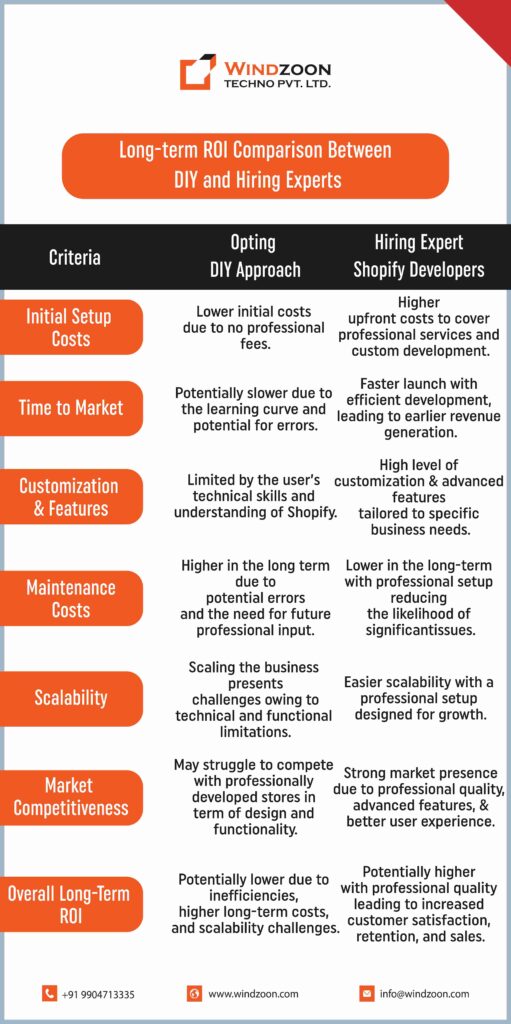
One of the most critical aspects of deciding between a DIY approach and hiring Shopify expert developers is understanding the financial implications of each choice. It’s not just about the initial investment but also about considering the long-term Return on Investment (ROI) and how each option affects your business’s growth and market competitiveness.

The Financial Implications of DIY vs. Hiring Experts

The DIY route, at first glance, appears more budget-friendly. It typically involves lower initial costs since you’re not paying for professional services. However, this option may lead to higher long-term costs due to potential inefficiencies, technical limitations, and the need for future professional intervention.

Conversely, hiring Shopify expert developers requires a higher upfront investment. This cost covers their expertise, custom development, and a strategic approach to your online store’s creation. The long-term benefits, including a professionally built store, enhanced customer experience, and better scalability, often lead to a higher ROI.

Long-term ROI Comparison Between DIY and Hiring Experts

shopify-development-diy-vs-hiring-expert

[wpdatatable id=22 table_view=regular]

The Impact of Both the Options on Business Growth and Market Competitiveness

The choice between DIY and professional development also impacts your business’s growth trajectory and competitiveness in the market. A DIY store, while initially cost-effective, might lack the sophistication and functionality needed to stand out in a competitive digital marketplace. It could limit your ability to attract and retain customers, ultimately impacting sales and growth.

On the contrary, a store developed by Shopify experts is more likely to offer a superior customer experience. It comes with a professional design, seamless functionality, and advanced features. Additionally, this level of quality attracts customers and fosters brand loyalty, enhancing your store’s competitiveness and market position.

Here comes the last but the most vital part of this blog post.

Making the Right Choice for Your Business

Navigating the decision between hiring Shopify expert developers and adopting a DIY approach hinges on several factors unique to each business. This choice not only impacts your immediate Shopify store development but also aligns with broader market trends and evolving consumer expectations. However, to make an informed decision, let’s assess some usual business scenarios and the latest market trends. It will help you choose which solution is best for your business and market trends.

Assessing Business Scenarios

  • Startups with Limited Budgets: For startups operating on tight budgets, the DIY approach might seem appealing. However, consider the long-term trajectory. If your business model relies heavily on e-commerce, investing in expert developers could provide a more robust foundation, essential for scaling up in the future.
  • Businesses with a Strong Brand Vision: If you have a clear, distinct brand vision, professional developers can help bring this to life more effectively than a DIY approach. Customization and unique user experiences that resonate with your brand can be better achieved with expert assistance.
  • Time Constraints and Resource Availability: Evaluate your time and resources. If your team can afford the time to learn and manage a DIY store without detracting from other business areas, it could be a viable option. However, if time is of the essence, expert developers can expedite the process, allowing you to focus on other aspects of your business.
  • Evolving Market Trends: The e-commerce landscape is constantly evolving, with emerging trends like augmented reality (AR) shopping experiences, voice commerce, and AI-driven personalization. Professional Shopify developers stay abreast of these trends and can integrate them into your store, keeping you ahead of the curve.
  • Rising Consumer Expectations: Today’s consumers expect seamless, engaging, and personalized online shopping experiences. A professionally developed Shopify store can offer advanced features, better performance, and a higher level of personalization compared to a DIY store, meeting and exceeding these customer expectations.
  • Competitive Edge: In a market crowded with e-commerce stores, standing out is crucial. A professionally developed store not only looks and feels premium but also functions smoothly, offering the competitive edge needed in today’s market.

Go for the Best

Choosing between DIY and hiring a Shopify store developer is a strategic decision impacting your e-commerce success. DIY offers initial cost savings and a personal touch, but may lack in technical expertise and scalability. Expert developers, while costing more upfront, bring professional customization, technical proficiency, and long-term growth potential, aligning with market trends and customer expectations.

This decision shapes not just your store’s present but its future in the competitive digital landscape. Consider your business needs, resources, and vision for growth. For those seeking professional excellence, partnering with experienced developers like Windzoon Techno Pvt. Ltd. can transform your e-commerce aspirations into a thriving reality.

Contact us to obtain a quote for our Shopify Development Services and elevate your online store to new heights.

The Future of Artificial Intelligence in Digital Marketing Services

The grand entry of ChatGPT has successfully made AI (artificial intelligence) the talk of the town. Before, it was just a topic for deep discussion among technocrats, scientists and thinkers. But now, it has become a subject of intrigue and concern for even the ordinary people.

The reason is; that the advancement of technology has led to AI saturating every industry and working field. One such industry is digital marketing. The incorporation of artificial intelligence (AI) in digital marketing has transformed the way businesses communicate with their consumers, personalize experiences, and optimize campaigns for optimal efficiency.

As per Statista, the market for artificial intelligence (AI) in marketing was projected around 15.84 billion dollars in 2021. The same source reveals that, by 2028, the value will be increased to above 107.5 billion dollars.

In this blog post, we’ll look at the incredible influence of AI in digital marketing. In addition, learn how collaborating with a digital marketing agency in India or the USA may help you redefine strategy, improve customer interaction, and pave the road for a more effective and data-driven future with AI.


What is Artificial Intelligence?

Artificial Intelligence, commonly known as AI, is akin to a highly intelligent computer brain. This advanced technology enables computers and machines to think, learn, and tackle problems much like humans do. It does so by processing data – both historical and current – to make informed decisions without human intervention.

Remember when you’re playing a video game and the characters you play against seem to think and make decisions on their own? That’s AI in action. Or when you talk to Siri or Alexa, and they understand you and respond, that’s also AI.

AI’s applications are vast and varied. It powers self-driving cars, allows smartphones to recognize faces, and even enables chatbots to assist customers efficiently. In essence, AI is like having a really clever helper that can process lots of information quickly and help us in our daily lives.

Now, let’s learn about the role of artificial intelligence in digital marketing.

Role of AI in Digital Marketing Services

When we talk about the role of Artificial Intelligence (AI) in digital marketing, it is like a highly intelligent partner that assists businesses in efficiently reaching and engaging with a larger online audience.

To know it better, here is an example, when you’re shopping online, AI analyzes your previous purchases and browsing habits. It’s as if the website ‘remembers’ what you like, suggesting new products that align with your interests.

Additionally, AI excels in crafting compelling advertisements designed to grab the attention of the right audience. Its ability to process vast amounts of data enables businesses to understand their customers better. AI can identify the likelihood of a product appealing to different demographic groups, such as a 20-year-old woman or a 50-year-old man. This helps businesses to do more targeted and effective advertising.

Furthermore, AI-powered chatbots on websites offer instant assistance to customers. They answer their queries in no time, thereby enhancing customer service and experience.

Moreover, AI in digital marketing is about leveraging advanced technology to accurately showcase products to the appropriate audience, create more engaging ads, and deliver prompt and efficient customer service.

Examples of AI’s Role in Digital Marketing Services

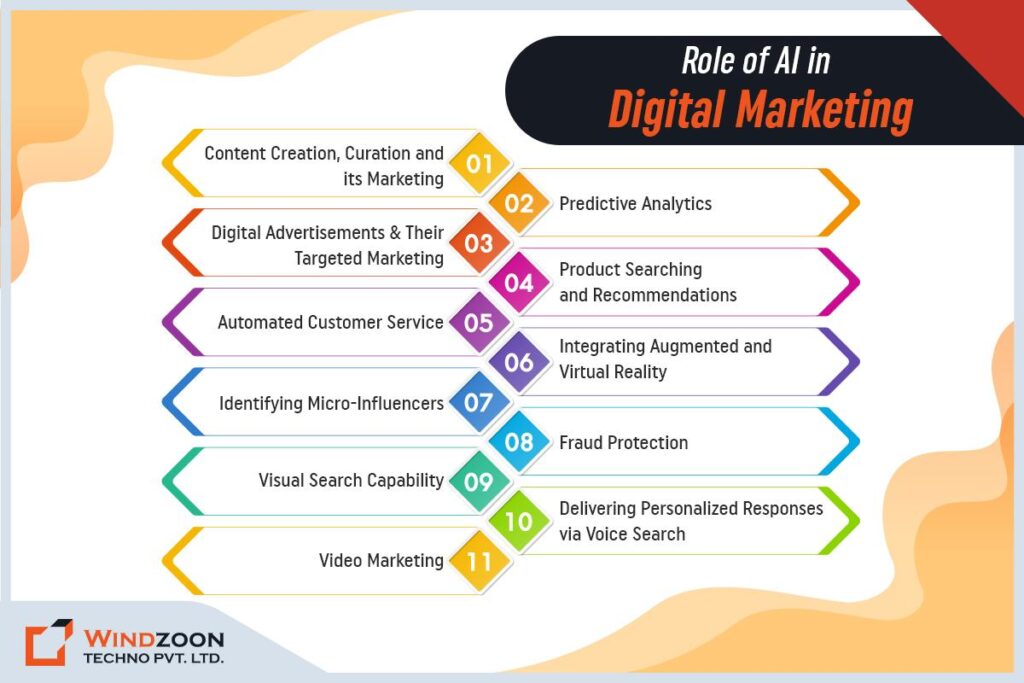
role-of-ai-in-digital-marketing


Following are some routine AI in digital marketing examples:

1. Content Creation, Curation and its Marketing

Artificial Intelligence (AI) is revolutionizing the field of content creation by automating routine tasks and enabling the generation of personalized content on a large scale. Natural Language Generation (NLG) algorithms, such as ChatGPT and BARD, are at the forefront of this change. They can produce various forms of content including blog posts, product descriptions, and social media updates, all while adhering to specific brand guidelines and catering to audience preferences.

In addition to content creation, AI plays a crucial role in content curation. AI-powered tools are adept at navigating the vast sea of online content to pinpoint relevant and trending topics. These tools are not just limited to content discovery; they also aid in determining the most suitable type of content for different platforms and the optimal timing for distribution. This ensures that the content reaches the intended audience effectively and efficiently.

Furthermore, in the realm of AI-driven content marketing, these technological advancements extend to providing data-driven insights and feedback to content creators. By establishing a continuous feedback loop, these tools empower marketers to refine their content creation strategies continuously. They can track and analyze their performance relative to competitors, paving the way for enhanced content quality and more successful marketing outcomes.

2. Predictive Analytics

The use of AI-driven predictive analytics has revolutionized the process of generating and nurturing leads. AI excels in sifting through millions of social media trends and posts, identifying patterns in text, images, and hashtags. Through this analysis of historical data, AI algorithms are capable of pinpointing potential customers with a higher likelihood of conversion. This enables marketers to concentrate their resources on more promising leads.

Additionally, AI is adept at anticipating customer behaviors, such as the likelihood of them discontinuing service, known as churn. This predictive capability allows for preemptive actions to maintain customer loyalty. This adaptability is crucial for marketers to respond to changing market dynamics, ultimately boosting the brand’s performance as new data unfolds.

3. Digital Advertisements & Their Targeted Marketing

Aside from assisting marketers in reaching the correct audience, AI in digital marketing brings up a plethora of chances for businesses to construct new ad campaigns across platforms such as Google, Facebook, and Instagram. These platforms examine user data, including gender, age, interests, demographics, and other personal characteristics, to deliver the optimal experience.

AI ensures, for instance, that people who have been searching for bicycles online get more advertisements for bicycles or riding gear rather than irrelevant items like lawnmowers in their search results.

Targeted Marketing allows AI algorithms to ensure that the user receives the most relevant adverts, therefore boosting the performance of the digital ads provided.

Here, since you are paying for each ad that is shown to a user, you have the choice of who sees your adverts. To provide personalized client experiences, you must first anticipate different consumer categories and include smart designs in digital marketing campaigns.

4. Product Searching and Recommendations

Artificial intelligence improves the accuracy of finding things that customers wish to purchase and presents recommendations for those products. AI-powered product recommendations help consumers locate the products they want to buy.

This is like a friendly store associate who can recall everything you’ve ever liked or purchased. When you look for products online, AI leverages your previous searches and purchases to suggest other items you might be interested in.

On the other side, the right AI tools allow digital marketers to make more accurate and timely forecasts about which things people will purchase. This boosts sales and allows firms to showcase products to potential buyers who have previously decided that they are worthwhile and efficient.

5. Automated Customer Service

Artificial intelligence facilitates automated customer service. It encompasses tasks like sending out messages, providing automated responses through chatbots, delivering results from surveys, and responding to inputs on various online platforms.

Chatbots, powered by AI, are a prominent example of this technology in action. They have revolutionized customer support by offering immediate assistance to users around the clock.

These AI-driven virtual assistants are capable of handling standard inquiries, supplying information about products, and assisting customers throughout their purchasing journey.

Equipped with Natural Language Processing (NLP), chatbots can comprehend and interact with human language, creating a smooth and individualized conversation experience. This level of automation not only conserves time and company resources but also ensures uniformity in customer service across multiple channels.

6. Integrating Augmented and Virtual Reality

Artificial Intelligence (AI) is set to significantly boost the development of Virtual Reality (VR) and Augmented Reality (AR) in the coming years. This emerging marketing approach is outshining traditional methods like billboards and print advertisements.

By blending the virtual world with real-world settings, it offers customers an entirely new and engaging experience. AR, in particular, opens the door to limitless immersive experiences.

Imagine offering interactive product demonstrations or transporting customers directly into your store through virtual showrooms. AR is the key element in transforming standard marketing efforts into extraordinary, memorable journeys.

Hence, prepare to amaze your customers as they interact with your brand in unprecedented ways. Remember, the future of marketing transcends mere product selling; it’s about crafting unforgettable experiences.

7. Identifying Micro-Influencers

This is about finding the right people online to promote products. Micro-influencers are like mini-celebrities on social media; they have fewer followers than big stars but are often more connected to their audience.

AI helps businesses find these micro-influencers. It looks at data like who’s talking about certain topics or products and how people respond to them. This way, businesses can partner with the right micro-influencers who fit with their brand and will appeal to their target customers.

8. Fraud Protection

AI in digital marketing services is like a digital security guard. It helps protect online transactions from fraud. AI systems can learn to spot unusual patterns, like if someone tries to buy a lot of things in a very short time or from a different country than usual.

This can signal a fraudulent transaction. By identifying these patterns, AI can alert the business and help prevent fraud, making online shopping safer for both the business and the customers.

9. Visual Search Capability

Visual search technology, driven by AI algorithms, enables consumers to search using images instead of text or keywords. This advanced search method allows users to find items online by simply using pictures. Google Lens stands as a prime example of this AI-powered Visual Search Capability in the digital marketplace.

This technology is particularly beneficial for those who may not know how to accurately describe what they are looking for, or for those who are not familiar with the specific vocabulary of an item. Consequently, visual search offers a practical solution, bypassing the challenges people encounter when they input incorrect terms in a search bar.

Voice recognition technology, like Alexa playing music or Siri setting alarms, is gaining global popularity. Marketers must recognize the importance of optimizing websites for voice search, as this shift underscores its growing significance.

Artificial Intelligence enables devices to understand and respond to voice commands using natural language. Have you come across Machine Translation Post-Editing? This advanced technology combines native translators’ expertise to create accurate multilingual content that effectively communicates marketing messages, all while minimizing errors. In digital marketing, AI is paving the way for swift conversion of content into multiple languages, catering to diverse customers.

Furthermore, companies can now obtain immediate insights into customer interactions across various communication channels. Backend teams can use this information to automatically route issues to the right support group and employ statistical models to identify the most effective next steps.

11. Video Marketing

Videos have emerged as a potent tool for disseminating knowledge and information. In the past year, there has been a significant surge in video consumption, particularly in live-streaming content.

In response to this trend, businesses are increasingly leveraging artificial intelligence to enhance the effectiveness of their video marketing strategies. AI aids companies in gaining deeper insights into their consumers’ viewing patterns, helping them understand customer behavior, provide tailored content, and ultimately, increase the Return On Investment (ROI) of their video content.

All the digital marketing applications discussed are integral to the Real-Time Optimization approach in ongoing marketing strategies, setting a foundation for automated sales predictions. Future advancements in AI will further enable businesses to operate at optimal profitability, elevate sales, and make adjustments based on concrete data.

Benefits of AI in Digital Marketing Services

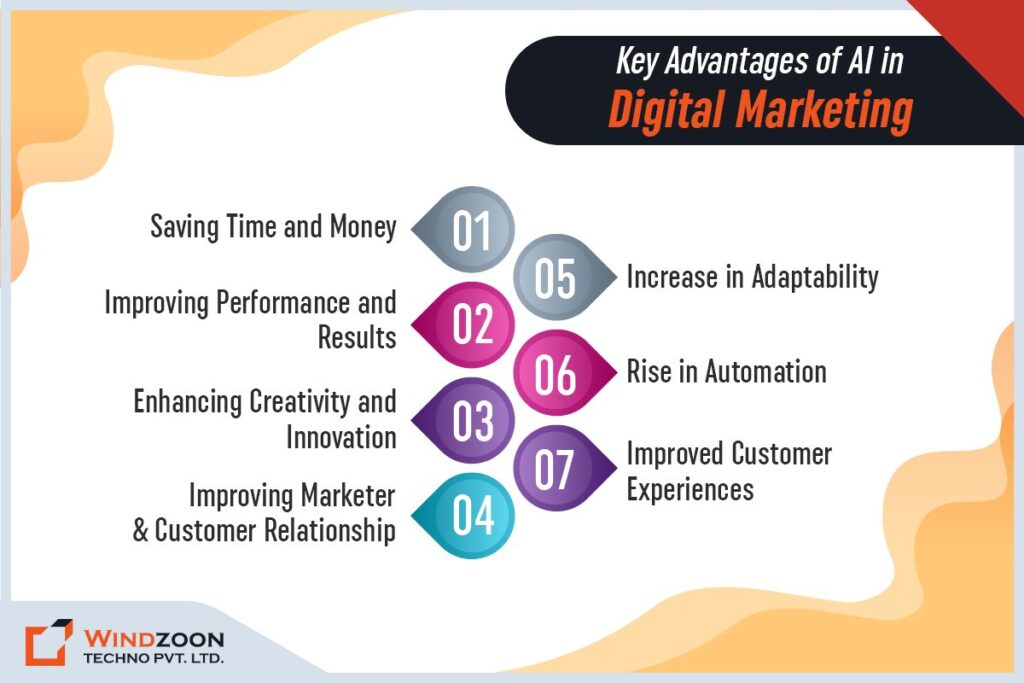
advantages-of-ai-in-digital-marketing

Here are some of the significant advantages of Artificial Intelligence in Digital Marketing.

  1. Saving Time and Money: AI streamlines marketing processes, automating tasks that humans usually perform. This automation saves considerable time and reduces costs, as AI can handle tasks like data analysis and customer service inquiries quickly and efficiently.
  2. Improving Performance and Results: AI’s ability to analyze vast amounts of data helps businesses make more informed decisions. It can predict customer trends and preferences, leading to more effective marketing strategies and better results in terms of sales and customer engagement.
  3. Enhancing Creativity and Innovation: AI provides marketers with new tools and insights, sparking creativity. It can suggest content ideas, design layouts, and even help in creating personalized marketing messages, pushing the boundaries of traditional marketing.
  4. Improving Marketer and Customer Relationship: AI helps in personalizing customer interactions, making them more meaningful. By understanding customer behavior and preferences, AI enables marketers to communicate with customers more effectively, building stronger relationships.
  5. Increase in Adaptability: With AI, marketers can quickly adapt to changes in the market or consumer behavior. AI’s real-time data analysis helps businesses stay agile and responsive to new trends or customer needs.
  6. Rise in Automation: Automation in digital marketing, powered by AI, includes everything from automated email campaigns to chatbots handling customer service inquiries. Due to this efficiency, businesses can concentrate on more strategic responsibilities.
  7. Improved Customer Experiences: AI enhances the customer experience by providing personalized recommendations, quick responses to inquiries, and more engaging content. This tailored approach makes customers feel understood and valued, increasing their loyalty to a brand.

Significant AI Tools for Digital Marketing Services

The following are 19 AI marketing tools you need to try in 2024:

  1. Jasper AI: For copywriting
  2. Surfer SEO: For SEO content writing
  3. Content at Scale: For generating SEO blog posts
  4. Originality AI: For detecting AI-generated content
  5. Writer.com: Content writing tool for teams
  6. FullStory: For analyzing digital experiences
  7. Zapier: For automating various tasks
  8. Hemingway App: For editing and improving content
  9. Chatfuel: For creating chatbots
  10. Grammarly: For content editing and grammar checking
  11. Albert.ai: For digital advertising
  12. Headlime: For designing landing pages
  13. Userbot.ai: For managing conversations
  14. Browse AI: For web page scraping
  15. Algolia: For search and recommendation APIs
  16. PhotoRoom: For removing backgrounds from images
  17. Reply.io’s AI Sales Email Assistant: For managing email replies
  18. Brand24: For media monitoring
  19. Influencity: For influencer marketing

Wants to Leverage AI-Enabled Digital Marketing Services?

The incorporation of AI in digital marketing is poised to alter the industry, increasing the effectiveness and efficiency of marketing efforts while providing improved customer experiences. With fresh and fascinating advancements anticipated in the upcoming years, artificial intelligence in digital marketing has a bright future.

To take advantage of this bright future, you will need the help of a next-gen AI-enabled digital marketing company that helps businesses grow and thrive in the digital world.

We at Windzoon offer innovative AI-enabled digital marketing services to scale up our clients’ businesses. Our team of professional digital marketers love going above and beyond to achieve our clients’ goals.

Hence, don’t wait any longer; contact us now to get a quote and leverage our services.