
Data is the new oil that keeps the world going. It’s like virtual gold that can earn you a lot more than real gold. This is why security breaches and data theft have become quite a norm in the digital world.
As per Security Magazine, every 39 seconds, a cyber attack occurs somewhere in the world. The global cost of these cyberattacks was estimated to be $6 trillion in 2021 and might rise to $10.5 trillion annually by 2025.
Hence, understanding and implementing robust web application security measures is crucial for businesses of all sizes to safeguard their integrity and trust. As an experienced web app development company in India and the USA, we have compiled a list of the best web app security measures based on our years of expertise.
This guide navigates through the intricate layers of web security, offering a comprehensive approach to protecting your digital assets. Hence, join us to transform your web applications into impregnable fortresses, ensuring that your business thrives in the secure and trusty realm of the internet.
- Common Web App Security Vulnerabilities
- 1. Broken Access Control
- 2. Cryptographic Failures
- 3. Injection
- 4. Insecure Design
- 5. Identification and Authentication Failures
- 6. Software and Data Integrity Failures
- 7. Security Logging and Monitoring Failures
- 8. Server-Side Request Forgery (SSRF)
- 9. Security Misconfiguration
- 10. Vulnerable and Outdated Components
- 11. Missing Function Level Access Control
- 12. Unvalidated Redirects and Forwards
- Web Application Security Best Practices
- 1. Develop a Web Application Security Plan
- 2. Identify Vulnerable Entry Points for Hackers
- 3. Implement a Web Application Firewall
- 4. Address Open-Source Vulnerabilities
- 5. Effective Permission Management
- 6. Encrypt Your Data
- 7. Implement HTTPS and Redirect All HTTP Traffic to HTTPS
- 8. Use Penetration Testing
- 9. Maintaining an Updated Web App
- 10. Secure Your Cookies
- 11. Implement Real-Time Monitoring
- 12. Conduct Web Application Security Awareness Training
- Conclusion
However, before we learn the best web app security practices, let’s first know about some of the most common web app security vulnerabilities.
Common Web App Security Vulnerabilities
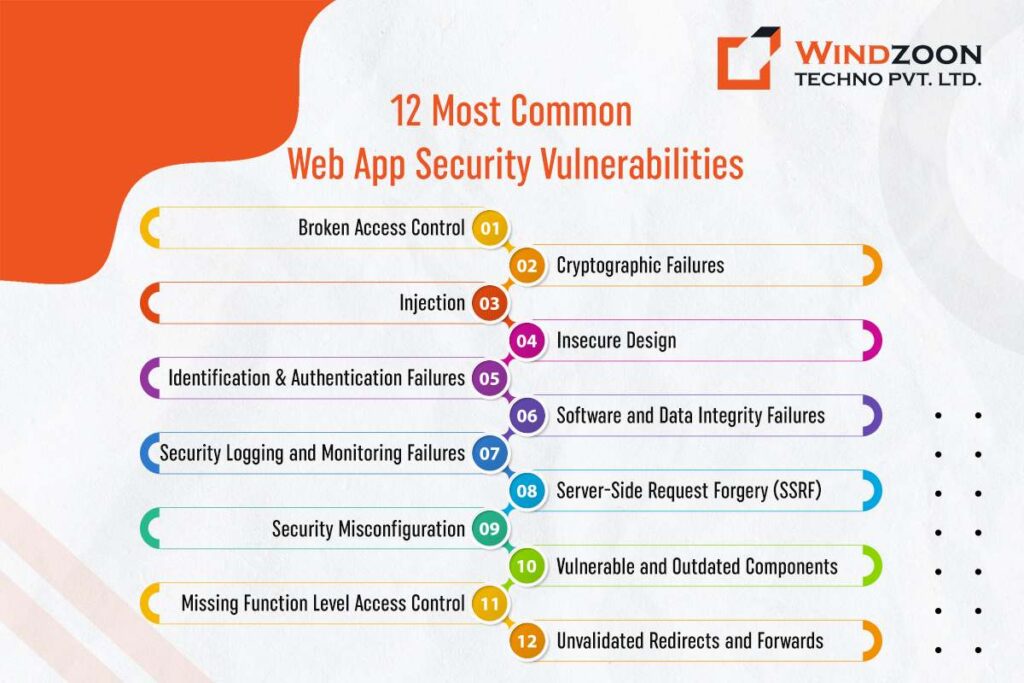
According to the Open Web Application Security Project (OWASP), the ten most common vulnerabilities in web applications are:
1. Broken Access Control
- Here, a hacker accesses a user’s profile by compromising their login details.
- This can often be prevented through multi-factor authentication.
2. Cryptographic Failures
- Previously known as ‘Sensitive Data Exposure’. Here, hackers can easily access unencrypted data.
- Moreover, it involves failing to protect sensitive data, like financial, healthcare, or PII, with adequate encryption.
3. Injection
- Attackers can send malicious data as part of a command or query, tricking the application into executing unintended commands or accessing unauthorized data.
- Common examples include SQL, NoSQL, and LDAP injection.
4. Insecure Design
- This is a broad category that includes risks related to design flaws in software.
- It emphasizes the need for a threat modelling process and secure design patterns and principles.
5. Identification and Authentication Failures
- It happens when session management and authentication features are implemented improperly.
- Attackers can compromise passwords, keys, and session tokens, or exploit other flaws to assume users’ identities.
6. Software and Data Integrity Failures
- This vulnerability arises when assumptions regarding software updates, critical data, and CI/CD pipelines are not verified.
- It can lead to unauthorized access or modification of software and data.
7. Security Logging and Monitoring Failures
- Insufficient logging and monitoring, coupled with ineffective or non-existent integration with incident response, allow attackers to further attack systems without detection.
8. Server-Side Request Forgery (SSRF)
- The server can be tricked into making outbound requests to unintended services, allowing attackers to interact with these services.
9. Security Misconfiguration
- This involves incorrect configuration settings in software and systems, leaving them vulnerable to attacks. For example, issues like flaws that haven’t been patched, unused pages, unprotected files or directories, outdated software, and running software in debug mode.
10. Vulnerable and Outdated Components
- Using components (mostly third-party components) with known vulnerabilities or failing to update components can leave an application vulnerable to attacks.
11. Missing Function Level Access Control
- If server-side authorization is poorly configured, nonexistent, or compromised, it leaves your app’s backend vulnerable to attacks.
12. Unvalidated Redirects and Forwards
- Hackers can redirect users to malicious websites to steal their data.
Most of these vulnerabilities stem from issues with authentication, flaws in user input, and data validation. Therefore, protecting your authentication and validation mechanisms is crucial. Any web app development service should include a comprehensive security strategy, regular security checks during and after development, and adherence to best practices in web security.
Now, let’s get to know about some of the best web app security best practices for 2024.
Web Application Security Best Practices
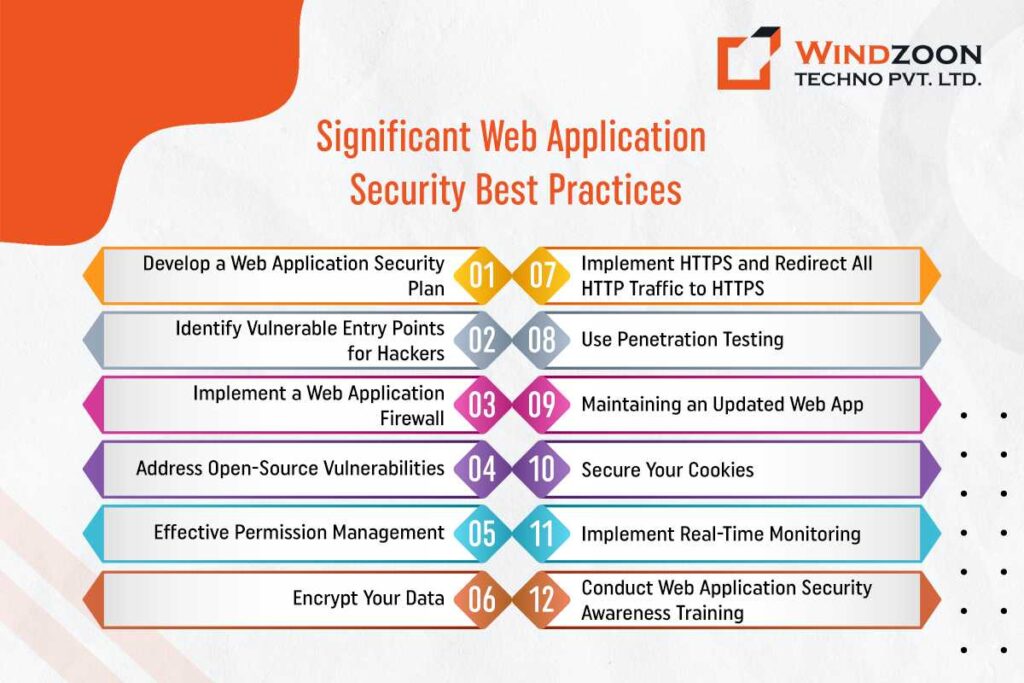
Following are the best web app security practices every business should follow in 2024.
1. Develop a Web Application Security Plan
To effectively adhere to web application security best practices, having a structured plan is essential. Many companies fail to manage web security properly due to a lack of organization, leading to minimal results.
Collaborate with your IT security team or professional web app development company to create a comprehensive and executable plan for web application security. This plan should clearly define the objectives of your organization, such as improving compliance or strengthening brand protection.
The plan should also prioritize which applications need immediate security measures and outline the methods for testing these applications, whether it be manually, via cloud solutions, on-site software, managed service providers, or other strategies.
Each organization’s security plan will be unique, and tailored to its specific infrastructure. For larger organizations, the plan should specify key personnel responsible for upholding web application security practices continuously.
Additionally, it’s important to consider and include the costs associated with these security measures in your plan. This foresight ensures that your organization is prepared and resourced to maintain high standards of web application security.
2. Identify Vulnerable Entry Points for Hackers
A crucial aspect of web application security is identifying potential entry points that hackers might exploit. Certain parts of your software are inherently more susceptible to attacks, particularly those that are customer-facing and handle data transactions. To strategically focus your security efforts, it’s advisable to categorize the features of your software into modules based on their security sensitivity:
Critical Modules: These include the most vulnerable aspects of your application that are directly exposed to the internet and are, therefore, prime targets for hackers. Critical modules often comprise customer-facing features like login screens and checkout pages.
Serious Modules: These modules are integral parts of your software where sensitive company or user information is stored. Although they might not be directly exposed to the internet, their protection is crucial due to the valuable data they hold.
Normal Modules: While these modules may not have direct access to sensitive data within your application, they still require regular monitoring and security checks. Ensuring these modules are secure is also important for overall application integrity.
Understanding and categorizing these modules help in prioritizing security measures and focusing resources where they are most needed to safeguard your web application effectively.
3. Implement a Web Application Firewall
A key practice in web app security is the use of web application firewalls (WAFs). A WAF acts as a barrier for HTTP traffic between a server and a client, effectively filtering out and blocking malicious requests that could compromise your databases.
Firewalls are highly regarded for safeguarding software at the network’s entry points. They scrutinize all incoming traffic and halt any activities that appear suspicious. One of the advantages of WAFs is that they do not require developers to modify the source code, making them a user-friendly security solution.
However, it’s important to note that traditional firewalls have limitations, particularly in identifying certain types of cyber attacks. For enhanced security, it’s advisable to use advanced WAFs. These are equipped to shield your application from more sophisticated threats like SQL injection attacks and cross-site scripting, ensuring a higher level of protection for your web applications.
4. Address Open-Source Vulnerabilities
Many web applications utilize open-source components due to their cost-effectiveness and functionality. However, these components can bring vulnerabilities into your application. It’s essential to regularly scan these open-source components for any known security flaws.
There are many tools available that can automatically detect vulnerabilities in your software’s dependencies. Once identified, these vulnerabilities must be promptly addressed, either by updating the component, applying a patch, or replacing it with a more secure alternative.
Managing the security of open-source components is a continuous process, as new vulnerabilities are discovered regularly.
5. Effective Permission Management
Ensuring data security in your organization crucially involves controlling user access to sensitive information. It’s essential to understand that not every employee needs access to all data. Over-privileging users can lead to increased risks of unauthorized access, data breaches, and internal threats.
Implementing differentiated access levels within your system offers two key benefits. Firstly, it limits the damage if an external party compromises an employee’s credentials, as they can only access areas permitted by those credentials.
Secondly, in case an employee poses a risk to your company, restricted access ensures they cannot access all sensitive data on their own. A best practice in web application security includes revoking access rights of former employees and updating passwords whenever a developer or staff member departs, further safeguarding your organization’s data integrity.
6. Encrypt Your Data
Encryption is a critical method for encoding information, primarily used to protect it from unauthorized access. While encryption does not directly prevent data interference during transmission, it ensures that the data becomes unintelligible to anyone who isn’t authorized to view it.
Not only is encryption vital for securing data in transit, such as information being sent over the internet, but it also plays a key role in protecting data at rest. This includes data stored in databases or other storage mediums, where it remains shielded from unauthorized access.
Encrypting the data exchanged with Web Services and APIs is just as important as establishing a solid authentication strategy for access control. Without encryption, web services are highly vulnerable. Hackers, who are becoming increasingly skilled at using sophisticated algorithms, can easily locate and exploit these vulnerabilities.
Therefore, implementing robust encryption measures is not just a precaution but a necessity. It is indispensable for safeguarding against unauthorized access and ensuring the overall security of data, whether in transit or at rest.
7. Implement HTTPS and Redirect All HTTP Traffic to HTTPS
In addition to the encryption methods discussed earlier, encrypting information at the service level is also crucial. This is commonly achieved through HTTPS (SSL or Secure Sockets Layer).
SSL technology creates a secure, encrypted connection between a web server and a browser. It ensures the privacy of data exchanged between the browser and the server, making it essential for the protection of online transactions. Used by millions of websites, SSL is the industry standard for securing online interactions.
Moreover, it’s recommended to uniformly implement SSL across your entire website. This comprehensive approach not only safeguards your site but also prevents potential issues with resources like stylesheets and JavaScript files, which may encounter problems if not accessed via HTTPS through an SSL-encrypted connection.
8. Use Penetration Testing
Penetration testing is a crucial and advanced aspect of security testing. It simulates near real-world scenarios where a Quality Assurance (QA) specialist assumes the role of a hacker. The specialist attempts to breach the system through various means, ranging from sophisticated programming techniques to physical breaches.
The primary advantage of penetration testing is its effectiveness in uncovering a wide range of vulnerabilities. The process culminates in a comprehensive report that not only serves as a foundation for future security checks but also acts as a reference to pinpoint the vulnerabilities responsible for any security breaches. Penetration testing encompasses several techniques to ensure all potential threat scenarios are evaluated.
Given that software, especially a medium-complexity web app can have numerous potential entry points for hackers — including cloud access — penetration testing becomes indispensable. It enables a QA specialist to explore numerous scenarios, attempting to breach the system with as much knowledge as an actual hacker would have.
If your organization does not have in-house penetration testing expertise, you should hire web app developers or testers from a reputed web app development firm. A third-party expert does more than just test your web application; they conduct a comprehensive security audit while performing the penetration testing. Having an outsider audit your software often reveals overlooked flaws, providing valuable insights for you and your team.
9. Maintaining an Updated Web App
Updating your web application encompasses more than just the software itself; it includes all third-party services and libraries within its infrastructure. Hackers often exploit these third-party components to breach the main system, so it’s crucial to be aware of these vulnerabilities. Your web app’s documentation can be a key resource in this process.
A common challenge is the reluctance of developers to update third-party services, due to fears of compatibility issues with new versions. This hesitation, however, can lead to significant security risks.
To manage updates effectively, review your documentation to identify the libraries you’re using. Eliminate any that don’t contribute significantly to your app and prioritize updating the rest. Developing an update strategy is essential, as updating libraries can be more complex than anticipated.
Ensure that you’re using only the necessary libraries and always opt for the latest stable versions to avoid potential vulnerabilities in any framework or library. This approach is critical for keeping your web application secure and functional.
10. Secure Your Cookies
Cookies are essential for most websites, benefiting both website owners and users. They help websites gather user information for more insightful analytics, while users enjoy a faster, more personalized browsing experience. However, cookies can also be a gateway for hackers, so ensuring their security is vital.
There are three key aspects to consider for cookie security:
Information Stored in Cookies: Be cautious about the type of data stored in cookies. Avoid storing sensitive information like passwords, as hackers can easily access them and use them to infiltrate your system through another user’s account.
Expiration Date: Set a reasonable lifespan for your cookies. They shouldn’t last indefinitely. Ideally, cookies should expire in less than a month. Regularly requesting user authorization, perhaps every two weeks enhances your web app’s security and ensures that each access is by an authorized user.
Encryption: Encrypt all data stored in cookies. This step adds an extra layer of security, making the information much harder for unauthorized parties to decipher.
Implementing these procedures will dramatically improve the security of your online application, protecting both your data and the privacy of your users.
11. Implement Real-Time Monitoring
The Ponemon Institute reveals that it takes companies an average of six months to detect a major security breach. For businesses handling large volumes of sensitive data, promptly identifying and addressing breaches is paramount. Utilizing specialized monitoring software can track all activities on employee workstations. This surveillance ensures adherence to security protocols.
The reason for doing this is that the Chief Executive reports that 90% of security breaches stem from human error. By monitoring employee actions, businesses can swiftly pinpoint which specific action on which computer led to a system compromise.
It becomes possible because all activities are systematically recorded, allowing for quick identification and rectification of security lapses. Hence, implementing such real-time monitoring is a crucial step in enhancing your organization’s cybersecurity measures.
12. Conduct Web Application Security Awareness Training
In many businesses, a comprehensive understanding of web application security is often limited to a few individuals, while the majority of employees may have only a basic awareness. This limited knowledge can lead to a lack of vigilance and an inability to recognize potential security risks.
To address this, educating your entire staff about web application security is crucial. This approach empowers employees to identify vulnerabilities proactively. Essentially, equipping everyone with knowledge about web application security transforms your workforce into an active part of the solution, enhancing the overall security framework.
Consider hiring a web application security specialist to provide awareness training for your employees. By ensuring that everyone is informed and understands how to respond to security threats or vulnerabilities, you significantly bolster your web application security measures.
Conclusion
To safeguard your bespoke web application development process, you should use all available security measures. We at Windzoon value security above all else, and our skilful developers safeguard every tech solution by including tried-and-true security procedures.
As an established firm, we have a solid reputation in the market for providing creative solutions that are fully secured to prevent unauthorized access.
To avail of our custom web app development services, get in touch with us to get a quote.