12 Must-Follow Web Application Security Best Practices for 2024

Data is the new oil that keeps the world going. It’s like virtual gold that can earn you a lot more than real gold. This is why security breaches and data theft have become quite a norm in the digital world.

As per Security Magazine, every 39 seconds, a cyber attack occurs somewhere in the world. The global cost of these cyberattacks was estimated to be $6 trillion in 2021 and might rise to $10.5 trillion annually by 2025.

Hence, understanding and implementing robust web application security measures is crucial for businesses of all sizes to safeguard their integrity and trust. As an experienced web app development company in India and the USA, we have compiled a list of the best web app security measures based on our years of expertise.

This guide navigates through the intricate layers of web security, offering a comprehensive approach to protecting your digital assets. Hence, join us to transform your web applications into impregnable fortresses, ensuring that your business thrives in the secure and trusty realm of the internet.

However, before we learn the best web app security practices, let’s first know about some of the most common web app security vulnerabilities.

Common Web App Security Vulnerabilities
common-web-app-security-vulnerabilities

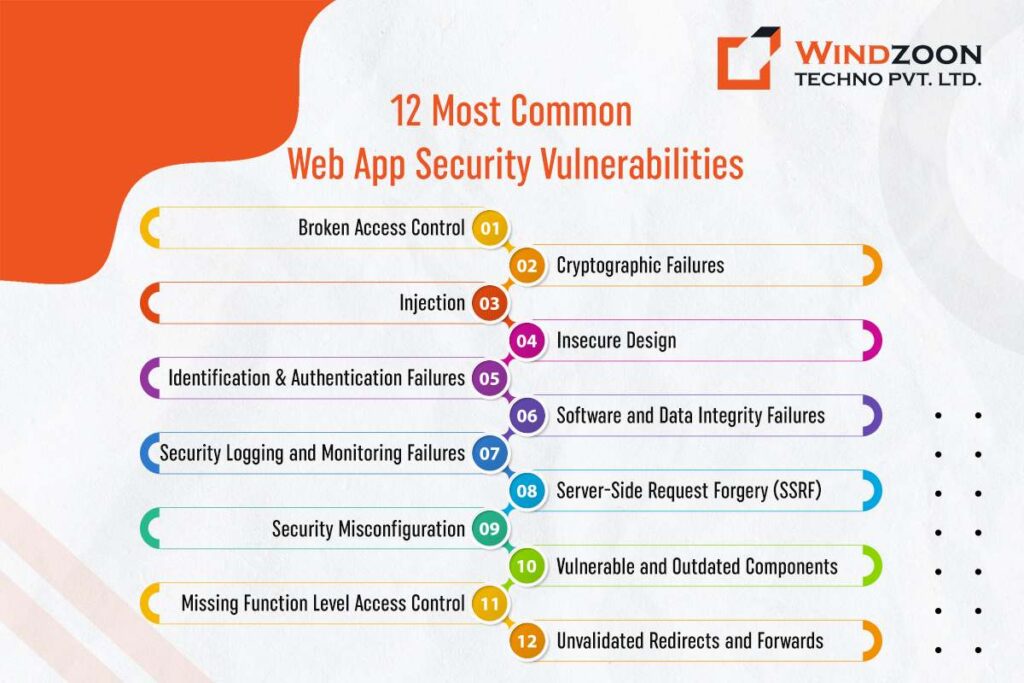
According to the Open Web Application Security Project (OWASP), the ten most common vulnerabilities in web applications are:

1. Broken Access Control

  • Here, a hacker accesses a user’s profile by compromising their login details.
  • This can often be prevented through multi-factor authentication.

2. Cryptographic Failures

  • Previously known as ‘Sensitive Data Exposure’. Here, hackers can easily access unencrypted data.
  • Moreover, it involves failing to protect sensitive data, like financial, healthcare, or PII, with adequate encryption.

3. Injection

  • Attackers can send malicious data as part of a command or query, tricking the application into executing unintended commands or accessing unauthorized data.
  • Common examples include SQL, NoSQL, and LDAP injection.

4. Insecure Design

  • This is a broad category that includes risks related to design flaws in software.
  • It emphasizes the need for a threat modelling process and secure design patterns and principles.

5. Identification and Authentication Failures

  • It happens when session management and authentication features are implemented improperly.
  • Attackers can compromise passwords, keys, and session tokens, or exploit other flaws to assume users’ identities.

6. Software and Data Integrity Failures

  • This vulnerability arises when assumptions regarding software updates, critical data, and CI/CD pipelines are not verified.
  • It can lead to unauthorized access or modification of software and data.

7. Security Logging and Monitoring Failures

  • Insufficient logging and monitoring, coupled with ineffective or non-existent integration with incident response, allow attackers to further attack systems without detection.

8. Server-Side Request Forgery (SSRF)

  • The server can be tricked into making outbound requests to unintended services, allowing attackers to interact with these services.

9. Security Misconfiguration

  • This involves incorrect configuration settings in software and systems, leaving them vulnerable to attacks. For example, issues like flaws that haven’t been patched, unused pages, unprotected files or directories, outdated software, and running software in debug mode.

10. Vulnerable and Outdated Components

  • Using components (mostly third-party components) with known vulnerabilities or failing to update components can leave an application vulnerable to attacks.

11. Missing Function Level Access Control

  • If server-side authorization is poorly configured, nonexistent, or compromised, it leaves your app’s backend vulnerable to attacks.

12. Unvalidated Redirects and Forwards

  • Hackers can redirect users to malicious websites to steal their data.

Most of these vulnerabilities stem from issues with authentication, flaws in user input, and data validation. Therefore, protecting your authentication and validation mechanisms is crucial. Any web app development service should include a comprehensive security strategy, regular security checks during and after development, and adherence to best practices in web security.

Now, let’s get to know about some of the best web app security best practices for 2024.

Web Application Security Best Practices
significant-web-app-security-best-practices

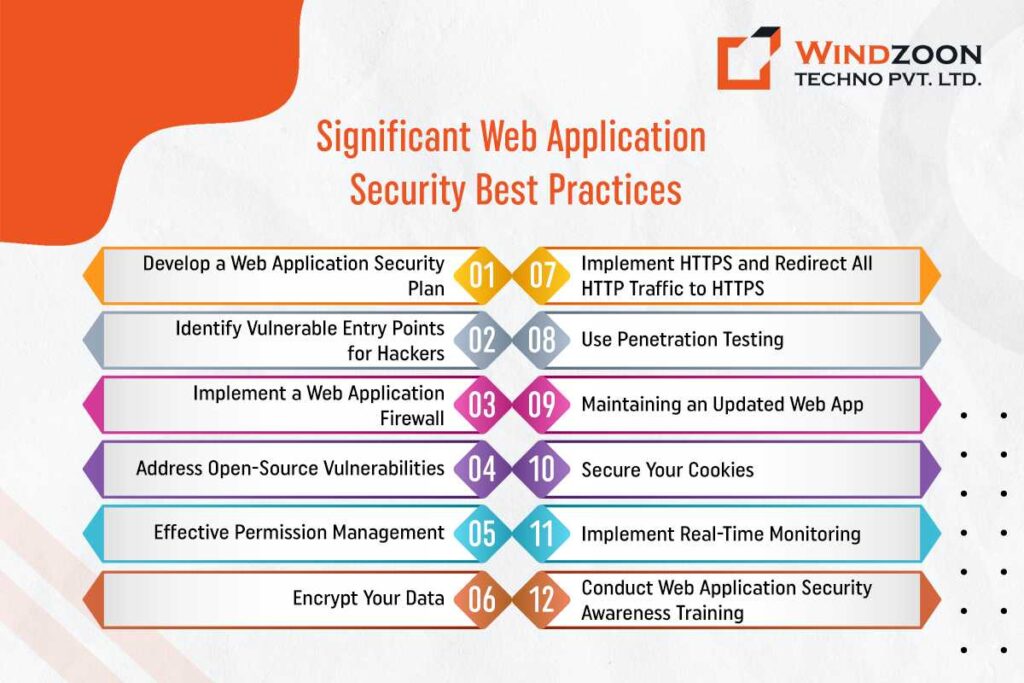
Following are the best web app security practices every business should follow in 2024.

1. Develop a Web Application Security Plan

To effectively adhere to web application security best practices, having a structured plan is essential. Many companies fail to manage web security properly due to a lack of organization, leading to minimal results.

Collaborate with your IT security team or professional web app development company to create a comprehensive and executable plan for web application security. This plan should clearly define the objectives of your organization, such as improving compliance or strengthening brand protection.

The plan should also prioritize which applications need immediate security measures and outline the methods for testing these applications, whether it be manually, via cloud solutions, on-site software, managed service providers, or other strategies.

Each organization’s security plan will be unique, and tailored to its specific infrastructure. For larger organizations, the plan should specify key personnel responsible for upholding web application security practices continuously.

Additionally, it’s important to consider and include the costs associated with these security measures in your plan. This foresight ensures that your organization is prepared and resourced to maintain high standards of web application security.

2. Identify Vulnerable Entry Points for Hackers

A crucial aspect of web application security is identifying potential entry points that hackers might exploit. Certain parts of your software are inherently more susceptible to attacks, particularly those that are customer-facing and handle data transactions. To strategically focus your security efforts, it’s advisable to categorize the features of your software into modules based on their security sensitivity:

Critical Modules: These include the most vulnerable aspects of your application that are directly exposed to the internet and are, therefore, prime targets for hackers. Critical modules often comprise customer-facing features like login screens and checkout pages.

Serious Modules: These modules are integral parts of your software where sensitive company or user information is stored. Although they might not be directly exposed to the internet, their protection is crucial due to the valuable data they hold.

Normal Modules: While these modules may not have direct access to sensitive data within your application, they still require regular monitoring and security checks. Ensuring these modules are secure is also important for overall application integrity.

Understanding and categorizing these modules help in prioritizing security measures and focusing resources where they are most needed to safeguard your web application effectively.

3. Implement a Web Application Firewall

A key practice in web app security is the use of web application firewalls (WAFs). A WAF acts as a barrier for HTTP traffic between a server and a client, effectively filtering out and blocking malicious requests that could compromise your databases.

Firewalls are highly regarded for safeguarding software at the network’s entry points. They scrutinize all incoming traffic and halt any activities that appear suspicious. One of the advantages of WAFs is that they do not require developers to modify the source code, making them a user-friendly security solution.

However, it’s important to note that traditional firewalls have limitations, particularly in identifying certain types of cyber attacks. For enhanced security, it’s advisable to use advanced WAFs. These are equipped to shield your application from more sophisticated threats like SQL injection attacks and cross-site scripting, ensuring a higher level of protection for your web applications.

4. Address Open-Source Vulnerabilities

Many web applications utilize open-source components due to their cost-effectiveness and functionality. However, these components can bring vulnerabilities into your application. It’s essential to regularly scan these open-source components for any known security flaws.

There are many tools available that can automatically detect vulnerabilities in your software’s dependencies. Once identified, these vulnerabilities must be promptly addressed, either by updating the component, applying a patch, or replacing it with a more secure alternative.

Managing the security of open-source components is a continuous process, as new vulnerabilities are discovered regularly.

5. Effective Permission Management

Ensuring data security in your organization crucially involves controlling user access to sensitive information. It’s essential to understand that not every employee needs access to all data. Over-privileging users can lead to increased risks of unauthorized access, data breaches, and internal threats.

Implementing differentiated access levels within your system offers two key benefits. Firstly, it limits the damage if an external party compromises an employee’s credentials, as they can only access areas permitted by those credentials.

Secondly, in case an employee poses a risk to your company, restricted access ensures they cannot access all sensitive data on their own. A best practice in web application security includes revoking access rights of former employees and updating passwords whenever a developer or staff member departs, further safeguarding your organization’s data integrity.

6. Encrypt Your Data

Encryption is a critical method for encoding information, primarily used to protect it from unauthorized access. While encryption does not directly prevent data interference during transmission, it ensures that the data becomes unintelligible to anyone who isn’t authorized to view it.

Not only is encryption vital for securing data in transit, such as information being sent over the internet, but it also plays a key role in protecting data at rest. This includes data stored in databases or other storage mediums, where it remains shielded from unauthorized access.

Encrypting the data exchanged with Web Services and APIs is just as important as establishing a solid authentication strategy for access control. Without encryption, web services are highly vulnerable. Hackers, who are becoming increasingly skilled at using sophisticated algorithms, can easily locate and exploit these vulnerabilities.

Therefore, implementing robust encryption measures is not just a precaution but a necessity. It is indispensable for safeguarding against unauthorized access and ensuring the overall security of data, whether in transit or at rest.

7. Implement HTTPS and Redirect All HTTP Traffic to HTTPS

In addition to the encryption methods discussed earlier, encrypting information at the service level is also crucial. This is commonly achieved through HTTPS (SSL or Secure Sockets Layer).

SSL technology creates a secure, encrypted connection between a web server and a browser. It ensures the privacy of data exchanged between the browser and the server, making it essential for the protection of online transactions. Used by millions of websites, SSL is the industry standard for securing online interactions.

Moreover, it’s recommended to uniformly implement SSL across your entire website. This comprehensive approach not only safeguards your site but also prevents potential issues with resources like stylesheets and JavaScript files, which may encounter problems if not accessed via HTTPS through an SSL-encrypted connection.

8. Use Penetration Testing

Penetration testing is a crucial and advanced aspect of security testing. It simulates near real-world scenarios where a Quality Assurance (QA) specialist assumes the role of a hacker. The specialist attempts to breach the system through various means, ranging from sophisticated programming techniques to physical breaches.

The primary advantage of penetration testing is its effectiveness in uncovering a wide range of vulnerabilities. The process culminates in a comprehensive report that not only serves as a foundation for future security checks but also acts as a reference to pinpoint the vulnerabilities responsible for any security breaches. Penetration testing encompasses several techniques to ensure all potential threat scenarios are evaluated.

Given that software, especially a medium-complexity web app can have numerous potential entry points for hackers — including cloud access — penetration testing becomes indispensable. It enables a QA specialist to explore numerous scenarios, attempting to breach the system with as much knowledge as an actual hacker would have.

If your organization does not have in-house penetration testing expertise, you should hire web app developers or testers from a reputed web app development firm. A third-party expert does more than just test your web application; they conduct a comprehensive security audit while performing the penetration testing. Having an outsider audit your software often reveals overlooked flaws, providing valuable insights for you and your team.

9. Maintaining an Updated Web App

Updating your web application encompasses more than just the software itself; it includes all third-party services and libraries within its infrastructure. Hackers often exploit these third-party components to breach the main system, so it’s crucial to be aware of these vulnerabilities. Your web app’s documentation can be a key resource in this process.

A common challenge is the reluctance of developers to update third-party services, due to fears of compatibility issues with new versions. This hesitation, however, can lead to significant security risks.

To manage updates effectively, review your documentation to identify the libraries you’re using. Eliminate any that don’t contribute significantly to your app and prioritize updating the rest. Developing an update strategy is essential, as updating libraries can be more complex than anticipated.

Ensure that you’re using only the necessary libraries and always opt for the latest stable versions to avoid potential vulnerabilities in any framework or library. This approach is critical for keeping your web application secure and functional.

10. Secure Your Cookies

Cookies are essential for most websites, benefiting both website owners and users. They help websites gather user information for more insightful analytics, while users enjoy a faster, more personalized browsing experience. However, cookies can also be a gateway for hackers, so ensuring their security is vital.

There are three key aspects to consider for cookie security:

Information Stored in Cookies: Be cautious about the type of data stored in cookies. Avoid storing sensitive information like passwords, as hackers can easily access them and use them to infiltrate your system through another user’s account.

Expiration Date: Set a reasonable lifespan for your cookies. They shouldn’t last indefinitely. Ideally, cookies should expire in less than a month. Regularly requesting user authorization, perhaps every two weeks enhances your web app’s security and ensures that each access is by an authorized user.

Encryption: Encrypt all data stored in cookies. This step adds an extra layer of security, making the information much harder for unauthorized parties to decipher.

Implementing these procedures will dramatically improve the security of your online application, protecting both your data and the privacy of your users.

11. Implement Real-Time Monitoring

The Ponemon Institute reveals that it takes companies an average of six months to detect a major security breach. For businesses handling large volumes of sensitive data, promptly identifying and addressing breaches is paramount. Utilizing specialized monitoring software can track all activities on employee workstations. This surveillance ensures adherence to security protocols.

The reason for doing this is that the Chief Executive reports that 90% of security breaches stem from human error. By monitoring employee actions, businesses can swiftly pinpoint which specific action on which computer led to a system compromise.

It becomes possible because all activities are systematically recorded, allowing for quick identification and rectification of security lapses. Hence, implementing such real-time monitoring is a crucial step in enhancing your organization’s cybersecurity measures.

12. Conduct Web Application Security Awareness Training

In many businesses, a comprehensive understanding of web application security is often limited to a few individuals, while the majority of employees may have only a basic awareness. This limited knowledge can lead to a lack of vigilance and an inability to recognize potential security risks.

To address this, educating your entire staff about web application security is crucial. This approach empowers employees to identify vulnerabilities proactively. Essentially, equipping everyone with knowledge about web application security transforms your workforce into an active part of the solution, enhancing the overall security framework.

Consider hiring a web application security specialist to provide awareness training for your employees. By ensuring that everyone is informed and understands how to respond to security threats or vulnerabilities, you significantly bolster your web application security measures.

Conclusion

To safeguard your bespoke web application development process, you should use all available security measures. We at Windzoon value security above all else, and our skilful developers safeguard every tech solution by including tried-and-true security procedures.

As an established firm, we have a solid reputation in the market for providing creative solutions that are fully secured to prevent unauthorized access.

To avail of our custom web app development services, get in touch with us to get a quote.

Unlock Global Talent: Your Guide to Hire Web Developers India for Superior Tech Solutions

In today’s competitive business landscape, the demand for high-quality web development solutions is on the rise. But where can businesses find top-notch professionals without breaking the bank? The answer lies in the booming tech scene of India, where an array of talented web developers offers cost-effective, innovative, and high-quality web development services. In this blog post, we’ll guide you through the process of how to hire web developers from India and the key benefits they bring to the table.

Key Takeaways

  • Hire web developers from India for cost-effective, innovative solutions with a skilled talent pool.
  • Evaluate portfolios and client testimonials to find the right company in India that offers quality work & advanced technologies.
  • Ensure successful collaboration by emphasizing clear communication, managing time zones, demonstrating cultural sensitivity & considering legal/security aspects such as data protection and NDAs.

Why Hire Web Developers from India?

why-hire-web-developers-india

India has become a global hub for web development, thanks to the combination of cost-effective solutions, a skilled talent pool, and a penchant for innovation. Collaborating with Indian web developers allows businesses to access a vast pool of expertise, harness cutting-edge technologies, and enjoy cost savings without compromising on quality. This winning combination has made India an attractive destination for organizations worldwide seeking top-tier web development services.

1. Cost-Effective Solutions

Indian web developers are known for providing cost-effective solutions without sacrificing quality, including custom web development services. Businesses can reduce their web development costs by up to 30-40% when they hire web developers from India, as opposed to their counterparts in Western Europe, the US, or Canada. The cost of engaging a web development company in India may range from $500 to $5000, depending on factors such as project scope, developer expertise, project complexity, and timeline for completion.

Opting for Indian web developers offers several benefits for businesses:

  • It allows businesses to allocate their resources more efficiently and shift their focus to core business activities.
  • The cost savings do not compromise the quality of work.
  • Indian web developers are known to consistently produce high-quality work.
  • They have technical expertise and adopt the latest industry trends.

2. Skilled Talent Pool

India boasts a substantial pool of skilled web developers with expertise in various technologies and frameworks, including web application development, and software development, ensuring the ideal fit for your project needs. Indian web developers are proficient in technologies such as mobile app development, HTML5, CSS 3, Progressive Web Apps (PWA), JavaScript, PHP, Python, Ruby, Java, React, Angular, Vue.js, and Bootstrap.

They also have experience with content management systems like WordPress, Drupal, Joomla, etc.

Indian web developers also bring their experience from diverse industries to the table, ranging from banking and finance to e-learning and digital marketing. Hiring Indian web developers enables businesses to tap into a large talent pool that can craft solutions tailored to their unique needs and objectives.

3. Quality Work and Innovation

Indian web developers have a reputation for delivering quality work and innovative solutions that help businesses stay ahead of the competition. They are adept at employing advanced technologies and methods to generate solutions of superior quality, addressing the requirements of various industries. India’s tech scene is continuously evolving, and Indian web developers stay at the forefront of technological advancements, bringing innovative approaches to projects.

For example, Alpha Information System, a leading Indian web development company, utilizes advanced technologies like Magento, SpreeCommerce, and PrestaShop for eCommerce solutions. Partnering with Indian web developers allows businesses to utilize advanced technologies and creative approaches, helping them achieve exceptional results and maintain their competitive edge in the market.

To know more about the benefits of outsourcing web development in India, read our detailed blog on “Advantages of Outsourcing Web Development Project to an Indian Company“.

Finding the Right Web Development Company in India

how-to-find-right-developers

Choosing the right leading web development company in India involves evaluating their portfolio, client testimonials, and technical proficiency in various technologies and frameworks, including those of a mobile app development company. Considering these factors enables businesses to select the best web development company from the best web development companies and web development firms for their web development needs.

1. Portfolio and Client Testimonials

A company’s portfolio and client testimonials provide valuable insights into their capabilities and the quality of their work. Reviewing a web development company’s portfolio allows you to evaluate their design and development abilities, while client testimonials offer insights into the company’s standing and client satisfaction.

To assess a company’s portfolio, it is important to evaluate the following:

  • Design and user experience
  • Variety of projects
  • Mobile responsiveness
  • Functionality and features
  • Performance and loading speed
  • Client testimonials
  • Case studies

Examining the portfolio and client testimonials allows businesses to gauge the competence and reliability of a web development company, helping them choose the most suitable partner for their project.

2. Technologies and Frameworks

Assessing a company’s expertise in various technologies and frameworks ensures they can deliver the desired results for your project. Indian web developers are proficient in a wide array of technologies, such as:

  • Angular.js
  • WordPress
  • Drupal
  • Joomla
  • Node.js
  • Vue.js

Evaluating a web development company’s technical expertise helps businesses ensure that they are partnering with a company that can address their unique needs and objectives, including website development services.

Moreover, expertise in multiple technologies and frameworks provides flexibility, scalability, and innovation, allowing the company to adapt to the needs of each project and provide the most suitable solution. Choosing a web development company with a diverse range of technical expertise ensures businesses receive a solution tailored to their specific needs.

3. Communication and Project Management

Effective communication and project management are crucial for successful collaboration with development companies in India, especially when working with a web development company. Indian developers are renowned for their excellent communication skills and proficiency in English, which is the language of choice in the tech industry. The web development company in India is committed to meeting deadlines and keeps the client informed through regular communication.

Establishing clear and consistent communication channels helps businesses stay updated on the project progress, address any concerns, and provide timely feedback to the development team. This fosters a positive working relationship and enables smooth collaboration between teams, ultimately leading to the successful completion of the project.

To know more about how to find the right web development company, read our comprehensive blog “11 Useful Tips To Choose the Right Web Design & Development Company in 2023“.

Different Engagement Models for Hiring Indian Web Developers

different-engagement-models

There are various engagement models for hiring Indian web developers, including dedicated teams, staff augmentation, and project-based engagements. Each model caters to different project needs and budgets, providing businesses with flexible options to choose from based on their unique requirements.

1. Dedicated Teams

Dedicated teams provide a complete team of web developers focused solely on your project, ensuring efficient and timely delivery. A dedicated team typically comprises roles such as:

  • Business Analyst
  • Project Manager
  • Product Manager
  • Solution Architect
  • UI/UX Designer
  • Web Developer
  • Front-End Developer

These team members collaborate to accomplish the project objectives and deliverables.

Hiring a dedicated team of web developers from India offers numerous benefits, such as:

  • Cost-effectiveness
  • Improved productivity
  • Expedited responses to urgent matters
  • Access to specialized expertise

Engaging a dedicated team allows businesses to retain full control over the development process and work with a team experienced in efficient and effective collaboration.

2. Staff Augmentation

Staff augmentation allows you to add skilled Indian web developers to your existing team, providing flexibility and scalability. This model entails the temporary hiring of specialized remote development teams on either a part-time or full-time basis through an outsourcing company, allowing businesses to benefit from a pool of talented Indian web developers who can work on specific projects or tasks.

The benefits of staff augmentation include:

  • Cost-effectiveness
  • Flexibility
  • Access to skilled and experienced developers
  • Retaining control over the development process

By leveraging the skills and expertise of Indian web developers through staff augmentation, businesses can achieve superior tech solutions.

3. Project-Based Engagements

Project-based engagements involve hiring Indian web developers for specific projects, ensuring a focused approach and cost-effective solutions. This model is ideal for developing custom software applications, constructing new websites, or assessing and optimizing existing systems.

Employing a project-based engagement model offers businesses benefits such as:

  • a well-defined scope and deliverables
  • cost-effectiveness
  • flexibility
  • expertise in specialized areas

This model enables a dedicated and concentrated approach to completing the project within the specified scope, budget, and timeframe.

Tips for Effective Collaboration with Indian Web Developers

tips-for-effective-collaboration

Maintaining clear communication, effectively managing time zones, and displaying cultural sensitivity are key to ensuring successful collaboration with Indian web developers. Adhering to these best practices will help foster a positive working relationship with Indian web developers and ensure the successful completion of your project.

1. Clear Communication

Clear communication is essential for successful collaboration, ensuring both parties understand project requirements and expectations. Establishing and maintaining open lines of communication allows businesses to provide timely feedback, address concerns, and keep all parties on the same page throughout the project.

Utilizing tools such as:

  • Google Hangouts
  • Shift
  • 1Fellow
  • Slack
  • Zoom
  • Trello
  • Google Drive

can facilitate clear communication in remote collaborations. These tools enable teams to communicate effectively and collaborate efficiently in remote work settings, reducing the risk of miscommunication and fostering a positive working environment.

2. Time Zone Management

Time zone management is crucial for coordinating work schedules and meetings, ensuring smooth collaboration between teams. Scheduling periodic meetings and developing comprehensive action plans can help businesses manage projects across different time zones effectively.

Proactively addressing time zone differences can minimize delays in decision-making and progress, ultimately leading to successful project completion. Implementing effective time zone management practices ensures seamless collaboration with Indian web development partners.

3. Cultural Sensitivity

Being culturally sensitive and respectful of differences fosters a positive working relationship with Indian web developers. Here are some tips to help you achieve that:

  • Understand and respect communication styles
  • Build trust-based relationships
  • Recognize hierarchies and formalities
  • Be open to gut feelings and intuition

By following these tips, you can establish effective collaboration and a positive working environment.

Acknowledging and respecting cultural differences can help to build trust and understanding between the client and development team, ultimately leading to a successful collaboration and the completion of the project.

legal-and-security-consideration

Legal and security aspects such as data protection, intellectual property rights, and non-disclosure agreements should be considered when hiring Indian web developers. Ensuring these measures are in place helps safeguard sensitive information and maintain client trust.

1. Data Protection

Ensuring data protection measures are in place helps safeguard sensitive information and maintain client trust. Indian web developers use encryption techniques like HTTP and SSL to secure the integrity, confidentiality and authentication of data. These methods also prevent unauthorized access to personal and sensitive information.

Moreover, India has implemented the Digital Personal Data Protection Act, 2023 (DPDP Act), which further strengthens data privacy standards in the country. Prioritizing data protection helps businesses safeguard their sensitive information and uphold client trust.

2. Intellectual Property Rights

Establishing intellectual property rights ensures ownership of the work produced by Indian web developers. The relevant laws pertaining to Intellectual Property Rights in the field of web development in India are The Copyrights Act, 1957, The Trade Marks Act, 1999, and The Patents Act, 1970.

Drafting comprehensive work-for-hire agreements, registering copyrights, trademarks, and patents, and creating confidentiality and non-disclosure agreements can help businesses protect their intellectual property rights and ensure they retain ownership of the work produced by Indian web developers.

3. Non-Disclosure Agreements

Non-disclosure agreements protect confidential information and maintain the privacy of your project. These legally binding contracts ensure that confidential information shared between parties is not disclosed to third parties without consent.

Establishing NDAs helps businesses safeguard sensitive project details, trade secrets, proprietary information, and other valuable assets. In addition, NDAs provide legal recourse in case of any breaches or unauthorized disclosures, ensuring the confidentiality and integrity of your project.

Summary

In conclusion, hiring Indian web developers offers numerous benefits, such as cost-effective solutions, access to a skilled talent pool, and high-quality work with innovative approaches. By finding a professional website development company in India, employing different engagement models, and following best practices for effective collaboration, businesses can leverage the skills and expertise of Indian web developers for superior tech solutions. So, don’t hesitate to unlock the potential of India’s thriving tech scene and enjoy the benefits of collaborating with web developers in India for your next project.

At Windzoon, we have an amazing team of skilled and experienced web developers who can go to any length to fulfil our clients’ requirements. Hire web developers from us to leverage customized services that meet your project needs.  Get in touch with us to get a quote and to know more about us.

Frequently Asked Questions

How much does it cost to hire a Web Developer in India?

Hiring a Web Developer in India can cost anywhere between 50,000 – 2,50,000 ($600 – $7200), depending on the type of website.

How can I find a Web Developer in India?

If you are looking for a Web Developer in India, you can find the best Web developers from us. Get in touch with us to find the perfect match for your needs.

How do I hire a good Web Developer?

To hire a good Web Developer, use reliable platforms and tools to find potential candidates, create a detailed job description and budget, review applications and portfolios, and interview qualified candidates before agreeing to any contracts. To learn about the process of hiring web developers from India, kindly refer to this post “How to Hire Web Developers from India in 2024

What are the main benefits of hiring web developers from India?

Hiring web developers from India offers cost-effective solutions, access to a skilled talent pool, and high-quality work with innovative approaches.

What are the different engagement models for hiring Indian web developers?

The different engagement models for hiring Indian web developers include dedicated teams, staff augmentation and project-based engagements. These options provide flexibility in terms of resource allocation and engagement duration.

Top 11 Reasons to Choose PHP for Your Web App Development Needs

Technologies are evolving at the speed of light. And the advancement in computer technology is happening much faster than ever before. One of the most important aspects of this technological advancement is the internet. Nowadays, it has become the most important medium to find any information in the blink of an eye.

And the source that provides information on the internet is websites. Currently, numerous programming languages are used in web development. These languages include PHP, HTML, JavaScript, and Python.

However, given the variety of alternatives, picking the best programming language for web development could be challenging. But don’t worry; I will help you to overcome this challenge. And for that, I’ll discuss the advantages of one such programming language, PHP.

Through this article, you’ll learn what PHP is, why PHP is so popular & how to hire a PHP Web Development company for your project.

So, let’s begin our journey of knowledge by addressing the first question: What is PHP Framework, and Why PHP Framework is Still Popular & Widely Used?

What is PHP Framework?

PHP, commonly referred to as Hypertext Preprocessor, is a server-side programming language used in web development. Rasmus Lerdorf first developed it in 1994 and then made it public in the early months of 1995.

This programming language is mostly used to create dynamic and interactive web content, eCommerce websites, session tracking, and databases. It was one of the first open-source server-side languages in the development community to be integrated into HTML. Developers can use it on all major operating systems. As a result, it is easier to integrate additional web pages without having to load external files data when they are accessed.

PHP is also compatible with some well-known databases, including MySQL, PostgreSQL, Oracle, Sybase, Informix, and Microsoft SQL Server.

PHP, along with HTML, CSS, and JavaScript, is a popular open-source programming language for web development. It was first released in 1995. The PHP programming language was developed to create interactive and dynamic websites.

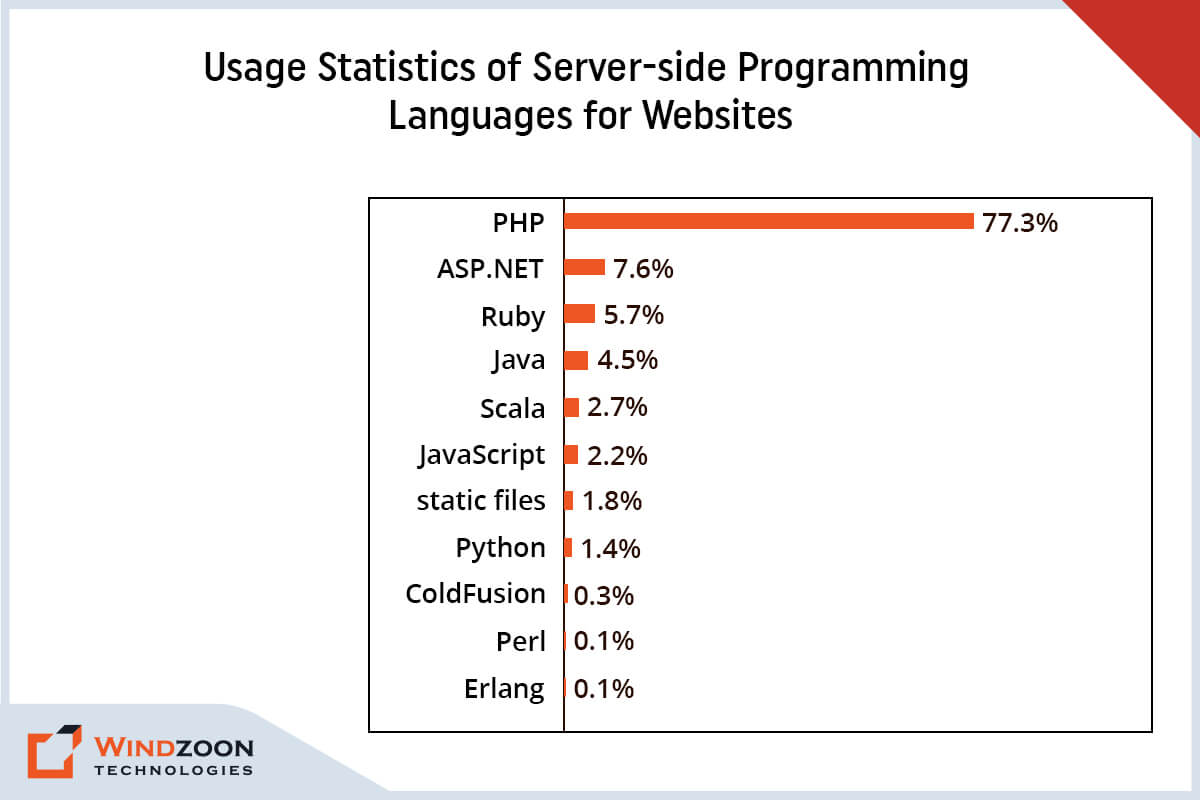
Usage Statistics of Server-side Programming Languages for Websites

According to W3techs, it powers approximately 77.3% of all websites, including some well-known sites such as Facebook, Yahoo, and Wikipedia. PHP’s popularity is eight times greater than its closest competitor, ASP.NET.

Why is PHP Still Widely Used?

Given the popularity of modern languages like Python and Ruby, it is apparent that PHP is no longer the preferred programming language. However, PHP is not dead, despite what everyone thinks. In contrast, it is still among the most popular programming languages. Developers throughout the world value its numerous advantages over other programming languages. Here we described, Top 11 reasons why you should choose PHP for your next web application development project are listed below.

Top 11 Reasons Why You Should Choose PHP For Your Web App Development Project

1. It’s easy to learn and use (and that would simplify the web development process)

PHP is simple to learn, and its codes are well-organized. Anyone who can code in any language will quickly learn to code in PHP due to its simple sentence format. The quick learning curve for PHP as a scripting language is advantageous for new developers.

Additionally, the well-structured and clean code makes it simpler for new PHP developers to join the team mid-project without getting lost in the code. You’ll Hire PHP developers for your project’s objectives, and you’ll have no trouble doing it again if you decide to bring on other PHP developers later.

2. It’s open source (and therefore, it is free to use for your web development project)

PHP is free since it is an open-source server-side programming language. Utilizing PHP lowers the cost of developing your website. Besides, there are no recurring maintenance fees for PHP or any paid updates you would need to install. Simply appoint a PHP Development Company to get your website up and running.

3. It’s versatile ( and that’s why it is compatible with all operating systems)

One of the primary advantages of PHP is that it is platform-independent. It means it can be used on Mac OS, Windows, and Linux and is compatible with the majority of web browsers. PHP also supports all major web servers, making it simple to deploy on various systems and platforms at a low cost.

4. It has strong community support (that means it provides plenty of resources for development)

PHP is a seasoned scripting language that is extensively used & has a large and devoted community to back it up. There are numerous tutorials, FAQs, and tips available to assist new PHP developers and to continue pushing the language’s capabilities through regular updates.

Read More: Key Features of Moodle LMS

5. It’s fast & secure (this would increase your website’s functionality & security)

Every company wants its website or application to be both fast and secure. PHP utilizes its own memory and performs well in terms of speed, especially when using the latest versions.

There have been concerns raised about PHP’s security in the past. However, it is crucial to emphasize that it is not intrinsically more or less safe than other programming languages. But it does have some advantages over other programming languages.

One of the significant advantages is that, due to its extensive use and community support, numerous tools, frameworks, and best practices are now available to help resolve vulnerabilities and protect against cyberattacks.

6. It is well connected with databases (so that you can have the best database for your project)

When it comes to database connectivity, PHP is an extremely flexible language. It is compatible with many different databases, including MySQL, MongoDB, PostgreSQL, and others.

Although MySQL is the most commonly used database with PHP, other databases can also be used to build a PHP web application. PHP’s database versatility allows it to be leveraged in a variety of application environments to create bespoke web apps or websites.

7. It is tried and tested (that would make it more stable & trusted by the developers)

One significant advantage of being around for 25 years is that PHP code has been tested in various real-life settings. The major bugs have been identified and addressed, making the language more reliable and trustworthy among developers.

Furthermore, various frameworks and tools have been developed throughout time to assist in making PHP web development more secure, faster, and effective.

8. It is scalable and flexible (which makes it a best-suited option for custom web development)

Change is necessary for businesses, whether they are expanding or starting new ventures. A successful website or application should be able to accommodate this changing need in a seamless and efficient manner.

As a result, scalability should always be on a developer’s mind. They need to design a flexible and scalable website that can accommodate an expansion or contraction of a program without upsetting the site’s users.

Developers have used PHP for over two decades to create flexible web applications. It is highly scalable and simple to create dynamic web pages.

PHP allows you to modify your code at any point in the software development life cycle. Programmers don’t need to rewrite the code or command function.

Moreover, the scripting language is able to handle large traffic loads and multiple requests at once.

Read More: Amazing Reasons to Choose VueJS for Building Promising Web Applications

9. It provides robust solutions with PHP frameworks (for quick & easy web development)

Many frameworks based on PHP have been developed, allowing developers to create web apps easily. Businesses can benefit from frameworks like CakePHP, Laravel, Symfony, Zend Framework, CodeIgniter, Yii, and others.

Developers can use these frameworks to create high-quality web apps or websites. Most of these frameworks support MVC (Model View Controller) architecture, which speeds up coding and allows developers to develop effective solutions.

10. It works well with CMSs (this would allow you to use CMS for your project)

One significant benefit of using PHP as your web development technology is that it is commonly used in a variety of content management systems. Many of the most popular CMSs, including WordPress, Drupal, Magento, PrestaShop, Joomla, and others, are written in PHP or are powered by a PHP-based framework.

You will be able to work with a variety of CMSs if you use PHP as the primary technology for your PHP website development project. A content management system based on PHP can be used to create high-functional & customized websites.

11. It is compatible with cloud solutions (to make your web app solution future-ready)

Many modern web solutions now use cloud computing solutions such as Amazon Web Services for a variety of purposes. Even various cloud services, including AWS Lambda, for instance, support PHP-based applications.

As a result, PHP web apps can be deployed on a cloud server and obtain great scalability and other benefits. Furthermore, PHP has replaced other coding languages in such implementations since the field of cloud computing is not dominated by them.

After learning about the reason behind the rising popularity & usefulness of PHP, let’s go ahead to know:

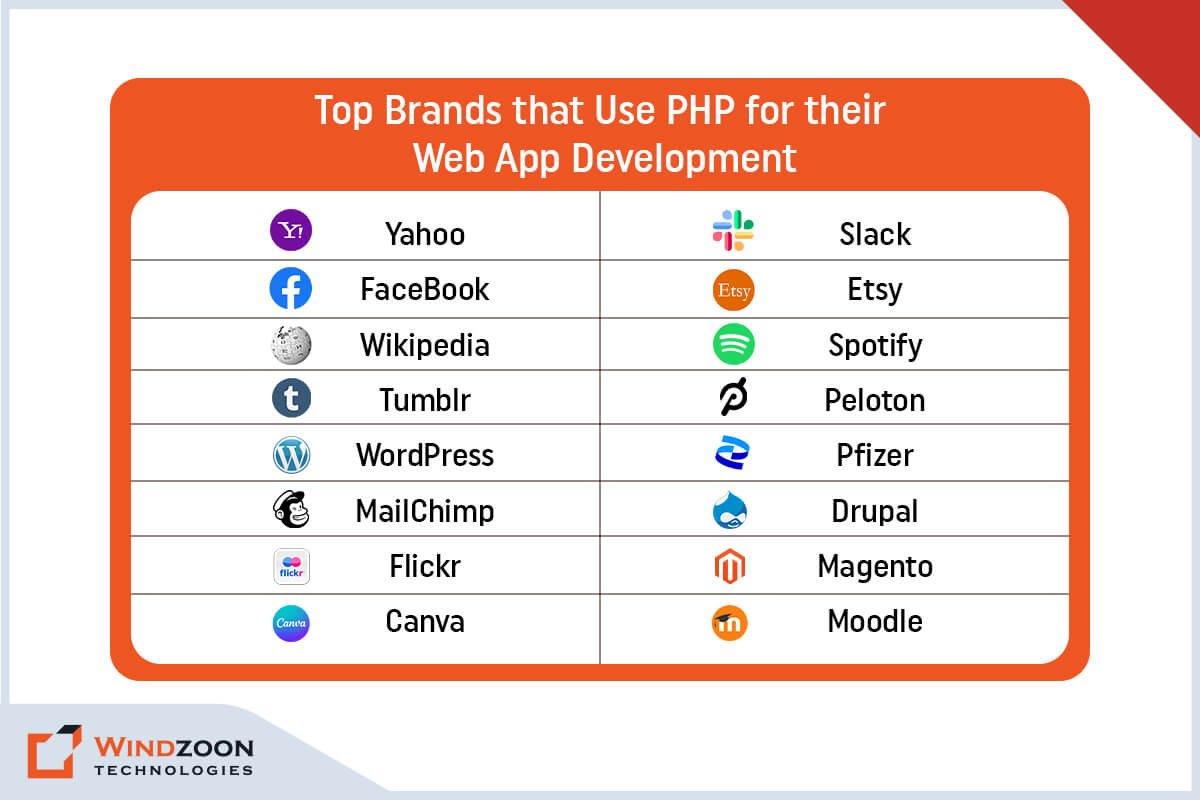
Top Brands that Use PHP for their Web App Development

Many prominent industry leaders regard PHP as one of the most demanding frameworks due to its excellent scalability and robust security. Below we have listed some well-known companies that have used PHP in their web applications.

Top Brands that Use PHP for their Web App Development

1. Yahoo

2. Facebook

3. Wikipedia

4. Tumblr

5. WordPress

6. MailChimp

7. Flickr

8. Canva

9. Slack

10. Etsy

11. Spotify

12. Peloton

13. Pfizer

14. Drupal

15. Magento

16. Moodle

Now, let’s move forward toward our last but most important question.

How to Choose the Best PHP Development Company for Your Project?

Suppose you don’t have PHP development skills or don’t want to hire in-house PHP developers. The decision to hire professional PHP developers can be a wise one.

A dedicated PHP Development Company will save you time and money while delivering high-quality results. Take the actions listed below when hiring a PHP web development company.

Step 1: First, look over the company’s portfolio.

Step 2: Navigate to their website.

Step 3: Go through the testimonials on their site or business listing websites.

Step 4: Examine their total work experience through their case studies.

Step 5: Inquire about the methodologies & technologies they use.

Step 6: Obtain the Questionnaire from the PHP development company.

Step 7: Do they fit within your financial constraints? Request a price quote.

Step 8: Evaluate their customer support services.

Conclusion

We hope our article has satisfied your curiosity regarding PHP & reasons behind its still intact popularity. Now, you aren’t left with any doubts regarding the competence of PHP for your web development project.

Because for a business, a website is a medium that connects it with its potential customers. And also help it to increase its revenue by increasing its conversion rate.

That’s why it is essential to build a website that attracts & engages visitors. And to develop a user-friendly website, you’ll require the help of a prominent Web Development Company.

With 10+ years of experience in developing PHP web app solutions, Windzoon is competent enough to fit this description. We have talented PHP developers who can build any complex & custom web solution.

For availing of our services, kindly visit us at wzadmin.windzoon.in/ to get a quote & to learn more about us.