Unlock Global Talent: Your Guide to Hire Web Developers India for Superior Tech Solutions

In today’s competitive business landscape, the demand for high-quality web development solutions is on the rise. But where can businesses find top-notch professionals without breaking the bank? The answer lies in the booming tech scene of India, where an array of talented web developers offers cost-effective, innovative, and high-quality web development services. In this blog post, we’ll guide you through the process of how to hire web developers from India and the key benefits they bring to the table.

Key Takeaways

  • Hire web developers from India for cost-effective, innovative solutions with a skilled talent pool.
  • Evaluate portfolios and client testimonials to find the right company in India that offers quality work & advanced technologies.
  • Ensure successful collaboration by emphasizing clear communication, managing time zones, demonstrating cultural sensitivity & considering legal/security aspects such as data protection and NDAs.

Why Hire Web Developers from India?

why-hire-web-developers-india

India has become a global hub for web development, thanks to the combination of cost-effective solutions, a skilled talent pool, and a penchant for innovation. Collaborating with Indian web developers allows businesses to access a vast pool of expertise, harness cutting-edge technologies, and enjoy cost savings without compromising on quality. This winning combination has made India an attractive destination for organizations worldwide seeking top-tier web development services.

1. Cost-Effective Solutions

Indian web developers are known for providing cost-effective solutions without sacrificing quality, including custom web development services. Businesses can reduce their web development costs by up to 30-40% when they hire web developers from India, as opposed to their counterparts in Western Europe, the US, or Canada. The cost of engaging a web development company in India may range from $500 to $5000, depending on factors such as project scope, developer expertise, project complexity, and timeline for completion.

Opting for Indian web developers offers several benefits for businesses:

  • It allows businesses to allocate their resources more efficiently and shift their focus to core business activities.
  • The cost savings do not compromise the quality of work.
  • Indian web developers are known to consistently produce high-quality work.
  • They have technical expertise and adopt the latest industry trends.

2. Skilled Talent Pool

India boasts a substantial pool of skilled web developers with expertise in various technologies and frameworks, including web application development, and software development, ensuring the ideal fit for your project needs. Indian web developers are proficient in technologies such as mobile app development, HTML5, CSS 3, Progressive Web Apps (PWA), JavaScript, PHP, Python, Ruby, Java, React, Angular, Vue.js, and Bootstrap.

They also have experience with content management systems like WordPress, Drupal, Joomla, etc.

Indian web developers also bring their experience from diverse industries to the table, ranging from banking and finance to e-learning and digital marketing. Hiring Indian web developers enables businesses to tap into a large talent pool that can craft solutions tailored to their unique needs and objectives.

3. Quality Work and Innovation

Indian web developers have a reputation for delivering quality work and innovative solutions that help businesses stay ahead of the competition. They are adept at employing advanced technologies and methods to generate solutions of superior quality, addressing the requirements of various industries. India’s tech scene is continuously evolving, and Indian web developers stay at the forefront of technological advancements, bringing innovative approaches to projects.

For example, Alpha Information System, a leading Indian web development company, utilizes advanced technologies like Magento, SpreeCommerce, and PrestaShop for eCommerce solutions. Partnering with Indian web developers allows businesses to utilize advanced technologies and creative approaches, helping them achieve exceptional results and maintain their competitive edge in the market.

To know more about the benefits of outsourcing web development in India, read our detailed blog on “Advantages of Outsourcing Web Development Project to an Indian Company“.

Finding the Right Web Development Company in India
how-to-find-right-developers

Choosing the right leading web development company in India involves evaluating their portfolio, client testimonials, and technical proficiency in various technologies and frameworks, including those of a mobile app development company. Considering these factors enables businesses to select the best web development company from the best web development companies and web development firms for their web development needs.

1. Portfolio and Client Testimonials

A company’s portfolio and client testimonials provide valuable insights into their capabilities and the quality of their work. Reviewing a web development company’s portfolio allows you to evaluate their design and development abilities, while client testimonials offer insights into the company’s standing and client satisfaction.

To assess a company’s portfolio, it is important to evaluate the following:

  • Design and user experience
  • Variety of projects
  • Mobile responsiveness
  • Functionality and features
  • Performance and loading speed
  • Client testimonials
  • Case studies

Examining the portfolio and client testimonials allows businesses to gauge the competence and reliability of a web development company, helping them choose the most suitable partner for their project.

2. Technologies and Frameworks

Assessing a company’s expertise in various technologies and frameworks ensures they can deliver the desired results for your project. Indian web developers are proficient in a wide array of technologies, such as:

  • Angular.js
  • WordPress
  • Drupal
  • Joomla
  • Node.js
  • Vue.js

Evaluating a web development company’s technical expertise helps businesses ensure that they are partnering with a company that can address their unique needs and objectives, including website development services.

Moreover, expertise in multiple technologies and frameworks provides flexibility, scalability, and innovation, allowing the company to adapt to the needs of each project and provide the most suitable solution. Choosing a web development company with a diverse range of technical expertise ensures businesses receive a solution tailored to their specific needs.

3. Communication and Project Management

Effective communication and project management are crucial for successful collaboration with development companies in India, especially when working with a web development company. Indian developers are renowned for their excellent communication skills and proficiency in English, which is the language of choice in the tech industry. The web development company in India is committed to meeting deadlines and keeps the client informed through regular communication.

Establishing clear and consistent communication channels helps businesses stay updated on the project progress, address any concerns, and provide timely feedback to the development team. This fosters a positive working relationship and enables smooth collaboration between teams, ultimately leading to the successful completion of the project.

To know more about how to find the right web development company, read our comprehensive blog “11 Useful Tips To Choose the Right Web Design & Development Company in 2023“.

Different Engagement Models for Hiring Indian Web Developers

different-engagement-models

There are various engagement models for hiring Indian web developers, including dedicated teams, staff augmentation, and project-based engagements. Each model caters to different project needs and budgets, providing businesses with flexible options to choose from based on their unique requirements.

1. Dedicated Teams

Dedicated teams provide a complete team of web developers focused solely on your project, ensuring efficient and timely delivery. A dedicated team typically comprises roles such as:

  • Business Analyst
  • Project Manager
  • Product Manager
  • Solution Architect
  • UI/UX Designer
  • Web Developer
  • Front-End Developer

These team members collaborate to accomplish the project objectives and deliverables.

Hiring a dedicated team of web developers from India offers numerous benefits, such as:

  • Cost-effectiveness
  • Improved productivity
  • Expedited responses to urgent matters
  • Access to specialized expertise

Engaging a dedicated team allows businesses to retain full control over the development process and work with a team experienced in efficient and effective collaboration.

2. Staff Augmentation

Staff augmentation allows you to add skilled Indian web developers to your existing team, providing flexibility and scalability. This model entails the temporary hiring of specialized remote development teams on either a part-time or full-time basis through an outsourcing company, allowing businesses to benefit from a pool of talented Indian web developers who can work on specific projects or tasks.

The benefits of staff augmentation include:

  • Cost-effectiveness
  • Flexibility
  • Access to skilled and experienced developers
  • Retaining control over the development process

By leveraging the skills and expertise of Indian web developers through staff augmentation, businesses can achieve superior tech solutions.

3. Project-Based Engagements

Project-based engagements involve hiring Indian web developers for specific projects, ensuring a focused approach and cost-effective solutions. This model is ideal for developing custom software applications, constructing new websites, or assessing and optimizing existing systems.

Employing a project-based engagement model offers businesses benefits such as:

  • a well-defined scope and deliverables
  • cost-effectiveness
  • flexibility
  • expertise in specialized areas

This model enables a dedicated and concentrated approach to completing the project within the specified scope, budget, and timeframe.

Tips for Effective Collaboration with Indian Web Developers

tips-for-effective-collaboration

Maintaining clear communication, effectively managing time zones, and displaying cultural sensitivity are key to ensuring successful collaboration with Indian web developers. Adhering to these best practices will help foster a positive working relationship with Indian web developers and ensure the successful completion of your project.

1. Clear Communication

Clear communication is essential for successful collaboration, ensuring both parties understand project requirements and expectations. Establishing and maintaining open lines of communication allows businesses to provide timely feedback, address concerns, and keep all parties on the same page throughout the project.

Utilizing tools such as:

  • Google Hangouts
  • Shift
  • 1Fellow
  • Slack
  • Zoom
  • Trello
  • Google Drive

can facilitate clear communication in remote collaborations. These tools enable teams to communicate effectively and collaborate efficiently in remote work settings, reducing the risk of miscommunication and fostering a positive working environment.

2. Time Zone Management

Time zone management is crucial for coordinating work schedules and meetings, ensuring smooth collaboration between teams. Scheduling periodic meetings and developing comprehensive action plans can help businesses manage projects across different time zones effectively.

Proactively addressing time zone differences can minimize delays in decision-making and progress, ultimately leading to successful project completion. Implementing effective time zone management practices ensures seamless collaboration with Indian web development partners.

3. Cultural Sensitivity

Being culturally sensitive and respectful of differences fosters a positive working relationship with Indian web developers. Here are some tips to help you achieve that:

  • Understand and respect communication styles
  • Build trust-based relationships
  • Recognize hierarchies and formalities
  • Be open to gut feelings and intuition

By following these tips, you can establish effective collaboration and a positive working environment.

Acknowledging and respecting cultural differences can help to build trust and understanding between the client and development team, ultimately leading to a successful collaboration and the completion of the project.

legal-and-security-consideration

Legal and security aspects such as data protection, intellectual property rights, and non-disclosure agreements should be considered when hiring Indian web developers. Ensuring these measures are in place helps safeguard sensitive information and maintain client trust.

1. Data Protection

Ensuring data protection measures are in place helps safeguard sensitive information and maintain client trust. Indian web developers use encryption techniques like HTTP and SSL to secure the integrity, confidentiality and authentication of data. These methods also prevent unauthorized access to personal and sensitive information.

Moreover, India has implemented the Digital Personal Data Protection Act, 2023 (DPDP Act), which further strengthens data privacy standards in the country. Prioritizing data protection helps businesses safeguard their sensitive information and uphold client trust.

2. Intellectual Property Rights

Establishing intellectual property rights ensures ownership of the work produced by Indian web developers. The relevant laws pertaining to Intellectual Property Rights in the field of web development in India are The Copyrights Act, 1957, The Trade Marks Act, 1999, and The Patents Act, 1970.

Drafting comprehensive work-for-hire agreements, registering copyrights, trademarks, and patents, and creating confidentiality and non-disclosure agreements can help businesses protect their intellectual property rights and ensure they retain ownership of the work produced by Indian web developers.

3. Non-Disclosure Agreements

Non-disclosure agreements protect confidential information and maintain the privacy of your project. These legally binding contracts ensure that confidential information shared between parties is not disclosed to third parties without consent.

Establishing NDAs helps businesses safeguard sensitive project details, trade secrets, proprietary information, and other valuable assets. In addition, NDAs provide legal recourse in case of any breaches or unauthorized disclosures, ensuring the confidentiality and integrity of your project.

Summary

In conclusion, hiring Indian web developers offers numerous benefits, such as cost-effective solutions, access to a skilled talent pool, and high-quality work with innovative approaches. By finding a professional website development company in India, employing different engagement models, and following best practices for effective collaboration, businesses can leverage the skills and expertise of Indian web developers for superior tech solutions. So, don’t hesitate to unlock the potential of India’s thriving tech scene and enjoy the benefits of collaborating with web developers in India for your next project.

At Windzoon, we have an amazing team of skilled and experienced web developers who can go to any length to fulfil our clients’ requirements. Hire web developers from us to leverage customized services that meet your project needs.  Get in touch with us to get a quote and to know more about us.

Frequently Asked Questions

How much does it cost to hire a Web Developer in India?

Hiring a Web Developer in India can cost anywhere between 50,000 – 2,50,000 ($600 – $7200), depending on the type of website.

How can I find a Web Developer in India?

If you are looking for a Web Developer in India, you can find the best Web developers from us. Get in touch with us to find the perfect match for your needs.

How do I hire a good Web Developer?

To hire a good Web Developer, use reliable platforms and tools to find potential candidates, create a detailed job description and budget, review applications and portfolios, and interview qualified candidates before agreeing to any contracts. To learn about the process of hiring web developers from India, kindly refer to this post “How to Hire Web Developers from India in 2024

What are the main benefits of hiring web developers from India?

Hiring web developers from India offers cost-effective solutions, access to a skilled talent pool, and high-quality work with innovative approaches.

What are the different engagement models for hiring Indian web developers?

The different engagement models for hiring Indian web developers include dedicated teams, staff augmentation and project-based engagements. These options provide flexibility in terms of resource allocation and engagement duration.


How to Create an eCommerce Store?: Step-by-Step Guide

The foundation of the e-commerce business which we all are witnessing reaching new heights was laid back in 1969 by an American e-commerce company CompuServe. However, in 1995, when the launch of two major e-commerce companies Amazon and eBay took place it started to gain more global recognition and acceptance.

Since that day, the e-commerce sector has gone through many highs and lows. From initial weak response from the public to sky-scorching popularity it has seen it all. With around $6.3 trillion in retail sales, the e-commerce business has now, acquired approx. 20% of total retail sales worldwide.

This clearly indicates the growing desire or we can say the need of people to buy online. To take advantage of this growing public demand, building an e-commerce store is the wisest decision. But the question is how to build an e-commerce store that engages people and drives you to profit.

Well, as a leading e-commerce web development company, we have accumulated years of experience developing e-commerce stores to this guide. It will assist you with every piece of information you need to know to develop an excellent e-commerce store. Hence, let’s delve deep into the world of e-commerce and navigate a path to success.

A Step-by-Step Guide to Build e-Commerce Store

1. Determine Your e-commerce Business Model

It’s essential to establish your business concept before you start developing your online store. Your e-commerce business model specifies how you will operate, engage with customers, and ultimately sell your goods or services. When creating an e-commerce business strategy, keep the following things in mind:

Business-to-consumer (B2C): This is the most typical model, in which a company sells goods or services to customers.

Business-to-business (B2B): In this model, companies sell goods or services to other companies.

Customer-to-customer (C2C): This model is also referred to as online marketplaces that link consumers to traders and sell goods or services.

Customer-to-business (C2B): Here, individuals sell their products or services to various businesses.

Once you choose your desired business model, consider sales and marketing strategies for your products and services. Here are a few suggestions for it:

Direct-to-consumer (D2C): Sell your own products to customers directly, bypassing wholesalers and retailers. With this approach, you have more influence over how customers interact with your brand and how your brand is presented to them.

Drop shipping: Dropshipping involves partnering with suppliers who handle inventory and fulfilment. When a customer places an order on your e-commerce store, the supplier ships the product directly to the customer, eliminating the need for you to hold inventory. Additionally, Dropshipping also offers a multi-payment acceptance facility. Hence, it’s simple and affordable to launch a drop shipping business. Besides, Shopify dropshipping store development is much easier than developing a regular online store.

Print on demand products: The print-on-demand products business model is similar to dropshipping. It involves creating custom designs that are printed on various products such as t-shirts, mugs, or phone cases. When a customer places an order, the printing and fulfillment are outsourced to a supplier, who ships the finished product directly to the customer. This allows you to offer unique, personalized products without holding inventory.

Wholesaling: Purchase things in bulk from manufacturers and resell them in huge quantities at a discount to retailers or other businesses. Retailers then resell these products to end users.

White label: White-label products are manufactured by one company and marketed under a separate company’s name. In this case, your online store would buy products from a manufacturer and sell them under your brand name.

Private label: Employ a manufacturer to make a product that will only be available through you. In this case, you have more control over the product’s characteristics, packaging, and design.

Subscription: The subscription model provides products or services on an ongoing basis. Customers may receive ongoing services, access to premium content, or recurrent deliveries. For example, you may supply products like milk or fresh vegetable boxes on a weekly or monthly basis to regular clients who value convenience.

Bonus Tip: When you define your e-commerce business model, take time to analyze your target audience, industry trends, and competitive landscape. Understanding these factors will help you choose the most suitable model that aligns with your goals and ensures a successful e-commerce venture.

Remember, your e-commerce business model will influence various aspects of your store. (For ex. product sourcing, marketing strategies, pricing, and customer interactions.) Hence, careful consideration and research at this stage will set a strong foundation for your e-commerce journey.

2. Discover The Perfect Product To Sell

Once you’ve established your e-commerce business model, the next critical step is to find the ideal product to sell on your online store. Your e-commerce business’s success depends on picking the right product or market segment. Here are some key factors to consider while selecting the best products to sell on your online store:

Find Your Niche: Start by identifying a niche or a specific segment of the market that you are passionate about or have expertise in. A niche allows you to focus on a particular category of products or services. This makes it easier to target a specific audience and help you stand out from competitors.

Do Market Research: The next step is to conduct extensive market research to have a complete understanding of current trends, customer preferences, and demands. Then analyze all this information to know the desires and issues of your target market. Consider offering digital products, such as ebooks, music files, online courses, or images, which are well-suited for online sales and do not require physical shipping. And established products or services that can solve their issues or satisfy their needs.

Analyzing Your Competitors: Another most important thing to do is to research your rivals in both your niche and the whole e-commerce sector. Look for market gaps or places where you may provide a unique selling proposition (USP) to set your items apart from the competition.

Make Product Validation: The next important thing to consider before finalizing a particular product is to test selling that product on a small scale or by starting a pilot project to determine its likelihood of success. This will assist you in determining client interest and obtaining insightful feedback.

Consider Seasonality: Seasonality is one of the key things to consider before deciding on a particular product. Hence, depending on your product’s characteristics, think about how seasonal trends may affect your product. Because to ensure a regular flow of sales, you need to make sure that the demand for the product you have chosen is steady throughout the year.

Emphasizes Quality and Reliability: Now, pick products that are of excellent quality and obtained from dependable vendors. As building a loyal customer base depends on providing satisfying customer experiences and quality products.

Think About Scalability: When you are going to start selling particular products, you will find that process quite adventurous. However, during this product-selling process, you should always think about how your e-commerce store will grow by selling your products. So, consider how you might increase the range of your product offerings in the future to serve a larger clientele. Introducing and promoting new products regularly is important to meet market demand and keep your store aligned with the latest trends.

Keep Up with the Latest Trends: To make sure that your chosen product remains relevant over the long term, keep up with current market trends and project future demand.

Finally, it would help if you remember that selecting the ideal product to sell is a dynamic process that necessitates careful evaluation and deliberation. Thus, think about all of your alternatives carefully, and only make judgements after doing extensive research.

3. Determine The Prices Of Your Products

The third important step is to determine the prices of your product. Because the success of your e-commerce store depends on how well you price your products. Thus, calculate all costs associated with production or sourcing, including both direct costs (such as manufacturing and packing) and indirect costs (such as marketing and website upkeep).

Next, to understand market prices and position your items competitively, conduct a competitive study. Strike a balance between profitability and competitive pricing by taking into account the special value your items provide to clients.

Last, test several price points to find the best one. Then plan sporadic discounts and promotions on your product. However, before offering discounts and promotions make sure they don’t affect your profitability. To stay on top of market developments and uphold a successful pricing strategy, keep a close eye on performance and make necessary price adjustments.

Many new sellers ask, “How much does it cost to start selling products online?” When pricing your products, be sure to account for all associated costs, including setup, ongoing expenses, and any additional fees.

4. Research Your Shipping Costs And Options

Once you decide on your product pricing, the next important thing to consider is your product shipping options and their costs.

Because efficient shipping has a significant impact on consumer satisfaction and purchasing behaviour, it is essential in e-commerce. Thus, determine the cost of shipping considering the product’s weight, size, shipping distance, and carriers. To encourage customers, think about providing free shipping beyond a specific order threshold.

When evaluating shipping options, consider offering a flat rate shipping fee as a simple and predictable choice for customers.

Then investigate several shipping companies and services, evaluating aspects like responsiveness, dependability, and global reach. Use real-time shipping rate estimators to show customers accurate, live shipping prices during the checkout process by integrating real time shipping rates from carriers.

While doing all these, keep in mind customs laws and additional expenses when providing international shipping. Additionally, improves the packing for secure delivery and lowers shipping costs.

And last, for improved customer communication, provide shipping tracking information and order status updates. As well as Create a simple returns procedure to increase consumer loyalty and confidence. As a well-thought-out shipping strategy boosts the performance and consumer experience of your e-commerce store.

5. Decide a Brand Name, Choose a Hosting Provider & Purchase a Domain

Choosing the ideal brand name can completely transform your e-commerce business. However, it ought to be distinctive, memorable, and represent the products or services you offer.

Once you choose a brand name, your next task is to decide on a domain. Look for a hosting company that can supply your store with the dependability and speed it requires. Many hosting providers and website builders include a free domain or free domain name for the first year as part of their package, making it easier and more affordable to launch your online store. GoDaddy is a popular option for budding e-commerce business owners due to its reasonable plans and consistent support. They offer an all-in-one hosting solution and even make the process of purchasing a domain name simple. Additionally, some platforms allow you to sign up and get started with no credit card required, so you can explore their features risk-free before making a commitment.

However, keep in mind that your domain name should reflect your brand and be simple for clients to recall. If you get this trio perfect, your online store will start off strong.

6. Find Your Perfect E-commerce Website Builder

Selecting the ideal ecommerce platform is essential if you want to create your own online store. An ecommerce platform is a comprehensive solution that combines website building, sales channel integration, payment processing, and more. These platforms are built on a content management system (CMS), which serves as the foundational technology for building and managing your ecommerce website. Many ecommerce platforms also offer a free trial period, allowing you to test features before making any commitments. Here is a brief summary of some well-liked options for ecommerce platforms:

WooCommerce: WooCommerce is an open-source plugin for WordPress that allows for a great deal of customization. It allows you to establish a highly customised store, making it perfect for individuals with some technological know-how. Besides, considering the popularity of WordPress, you can easily find any Custom WordPress Development Company to help you build an e-commerce store to your liking.

Magento: If you want to scale, Magento is the best option. It’s ideal for growth because it has excellent features and flexibility. Despite requiring considerable technical know-how, it offers a wide range of customization options and third-party integrations.

Shopify & Square Online: Looking for a simple setup process? The solution is Shopify or Square Online. Both are all-in-one ecommerce platforms that serve both novices and specialists and are renowned for their user-friendly design, vast template library, and hosting options. To accommodate varying business needs, they provide multiple pricing tiers and often include a free trial so you can explore their features risk-free.

Customization, spending capacity, and technical proficiency are all important considerations when choosing a platform. To choose which is the greatest option for the success of your online store, compare their features, costs, and customer support.

7. Find a Skilled e-Commerce Developer

As your online business takes shape, think about hiring a qualified e-commerce developer.

A skilled developer can make final adjustments to your e-commerce website to make sure it runs smoothly and effectively.

Depending on the website builder you choose, Hire web developers with experience in e-commerce systems like WooCommerce, Shopify, or Magento. To evaluate their talents, look through their portfolio for prior e-commerce projects, client testimonials, and reviews.

Working with an experienced developer can help you save time, improve the performance of your online store, and handle technical difficulties successfully. Besides, it also enables you to concentrate on expanding your online store and improving the client experience.

8. Select an E-commerce Theme or Template

Now comes the exciting part: choosing the ideal e-commerce theme or template for the store design of your online shop. Store design is crucial, as the right theme not only complements your brand’s image but also improves the presentation of your products.

Many website builders have a large selection of pre-designed themes that you may modify to fit your preferences in terms of colours, fonts, and layouts. Paid or premium themes often come with more features, better design options, and easier customization, which can enhance your website’s functionality and appearance. To give clients a great browsing experience across devices, look for mobile responsiveness and user-friendly navigation.

Make sure the theme you choose is compatible with crucial e-commerce features like product galleries, shopping carts, and secure payment processors. With a well-selected theme, your e-commerce site will look polished and professional, paving the path for its success in the online market.

9. Customize Your E-commerce Site and Build Out Web Pages

Now that the structure is established, it’s time to customize your e-commerce site to give it a distinctive look.

You may begin personalizing your online store by making a customized design and selecting the proper color palette and layout that go with your brand identity.

These days, a lot of website builders provide simple customization options that enable you to tailor your store without any coding experience.

Therefore, when you begin customizing, don’t forget to develop and customize important web pages like the homepage, product pages, about us, contact us and FAQs. As part of this process, organize your product catalog to effectively showcase your products and improve your search engine ranking.

Following that, create captivating content that shows the benefits of your products and resonates with your target audience. After that, put in place easy-to-use navigation so that clients can find what they’re looking for.

Moreover, remember to make your website mobile-friendly to accommodate customers who are constantly on their mobile devices.

A well-customized website improves the purchasing experience and promotes return visits.

10. Add Necessary Plugins/Extensions/Apps

After customisation, your e-commerce store’s functionality should be improved. To do this, explore the world of plugins, extensions, and apps. There are a variety of add-ons available to improve the functionality of your site, depending on your website builder.

Integrate necessary plugins for analytics, social media integration, SEO optimization, and seo tools. Seo tools are essential for optimizing your website for search engines and tracking performance, helping you get discovered and analyze traffic and keywords directly from your dashboard. Additionally, to engage and delight your consumers, think about including facilities like live chat, client feedback, and a wishlist.

Also, don’t forget to include security plugins to secure client data from cyber threats.

However, before you install any plugins, make sure they are compatible with your website builder and will not slow down or degrade the user experience of your site.

Because a well-chosen selection of plugins can elevate your online store and provide clients with a seamless purchasing experience.

11. Secure Your E-commerce Store Using SSL And Install Backup Services

Security holds the greatest significance for any online store. Thus, to secure your online store, install an SSL (Secure Socket Layer) certificate. As it plays a pivotal role in protecting the confidential data of your customers.

SSL encrypts data while it is being transmitted, guaranteeing secure online transactions and fostering customer confidence. Most website builders make it simple to include SSL certificates for additional security.

Also, don’t underestimate the significance of regular backups. Install backup services to make sure that the data on your online store, including product details, customer information, and order history, is securely maintained.

Backups act as a lifeline in the event of a technical malfunction or data loss, allowing you to quickly recover your online store. Therefore, to safeguard the integrity of your e-commerce store, invest in reliable backup services or make use of built-in features provided by your website builder.

Knowing how well your store is performing is essential for its expansion since knowledge is power. Therefore, incorporate Google Analytics into your online store. It is a strong tool that offers insightful data on user behavior and website traffic.

By connecting your store to Google Analytics, you can track important data such as conversion rates, bounce rates, and popular product pages. Analyzing this data and user activity will assist you in optimizing your marketing strategy and improving the user experience.

Additionally, Google Analytics also offers e-commerce tracking. It allows you to keep track of sales, revenue, and other transaction-related statistics. With this knowledge, you can make data-driven decisions to improve the operation of your online store and boost its success in the cutthroat online market.

13. Configure an Inventory, Payment Gateway, and Tax Tools

Now at this point, your e-commerce store is almost ready to roll. But first, let’s make sure that inventory is managed effectively and transactions are seamless. Start by adding products to your store’s inventory, ensuring each item is accurately listed and categorized. And for smooth online transactions, install a trustworthy payment gateway and connect a payment processor that safely handles client payments, enabling efficient payment processing.

Popular choices like PayPal, Stripe, or Square improve customer confidence in your store by offering easy interfaces and supporting a variety of payment ways.

Following that, use inventory management software to keep track of product availability. They will handle product variations with ease and control your inventory while setting stock alerts. Make sure to maintain and sync customer data across all your sales channels for better inventory management and personalized marketing. A well-managed inventory guarantees prompt replenishment and eliminates overselling, which boosts customer satisfaction.

Lastly, remember to pay your taxes! Configure tax calculators to automatically determine and apply the proper tax rates on purchases based on your location and customer base. Stay compliant and save time by automating tax calculations, leaving you more room to focus on growing your business. Automating tax computations will help you stay compliant and save time, giving you more time to concentrate on expanding your e-commerce store.

14. Test and Launch Your E-Commerce Site

You’re almost there; now is the time to test your e-commerce site ahead of launching. Thoroughly test your website in all areas, including the contact forms, payment process, and product listings. Verify that all functions are working properly and that there are no broken links or formatting errors.

Make several test purchases to validate the payment procedure and ensure that customer orders are properly processed. To get feedback on the user experience and identify any potential problems, enlist the assistance of friends or relatives.

Once you’ve made the necessary changes and are confident in your store’s performance, you can proceed with officially launching your site. Use social media, email newsletters, and advertising efforts to spread the message.

And last, celebrate this achievement and look forward to the exciting road of running your e-commerce store. Success will come as a result if you continue to pay attention to customer feedback and look for ways to make your online store run more efficiently.

15. Begin Promoting Your E-commerce Website

Congratulations on opening your online store! It’s now time to spread the word and get customers to your online store. To do this and successfully sell online, put in place a comprehensive marketing strategy to increase visitors and sales.

Make use of social media networks to provide interesting content and promote your products or offer services. Social media platforms are an ideal platform to interact with your audience, address their inquiries, and develop a loyal following.

You can also use created email marketing campaigns to keep clients up to date on new items, discounts, and promotions. Because timely and customized emails often persuade customers to make repeat purchases.

Additionally, work with influencers or industry partners to reach a larger audience and attract new customers. Influencer collaborations and endorsements can generate buzz for your business.

Furthermore, invest in search engine optimization (SEO) to boost your website’s visibility on search engines and increase organic traffic. Use relevant keywords and optimize your product descriptions to appear higher in search results. Link building and outreach can further establish your site as an authoritative source.

Next, think about implementing loyalty programs, seasonal price reductions, or special offers to entice people to visit your online store again. Satisfied clients are more likely to recommend businesses to others and help them succeed in the long run.

To reach a larger audience and drive more sales, consider using paid ads on platforms like Google, Facebook, Instagram, or TikTok. Customize your adverts to appeal to certain demographics and interests. Created paid ads campaigns can help you target new customers and boost your store’s visibility.

And don’t forget to review website analytics on a regular basis in order to evaluate the success of your marketing initiatives and make fact-based judgments. Understanding your audience and their behavior can help you convert visitors into buyers, leading to more sales.

Because promoting your e-commerce website is an ongoing process. Therefore, to maintain your online store flourishing and expanding, always try out new marketing techniques, pay attention to client feedback, and adjust to industry trends. With dedication and persistence, your e-commerce venture is sure to flourish in the competitive digital landscape.

What are the Benefits of Selling Online and to Create Own Online Store?

Developing an E-commerce store is a fantastic method to expand your consumer base and diversify your customer channels.

Selling online is also a terrific strategy to enhance income because you may reach a broader audience than through traditional retail techniques.

statistics show that there are 268 million digital consumers in the United States, and this figure is anticipated to rise to 285 million soon. There is no question that you must be online if you want to reach a sizable customer base.

In addition to accessing a larger audience, online stores provide numerous other advantages, such as:

  • 24×7 accessibility: Customers may view products at any time, regardless of their time zone.
  • There are no restrictions based on location: Customers are able to buy from any part of the world.
  • Product selection: Compared to traditional retail establishments, e-commerce stores frequently have a far wider range of products available.
  • Customized shopping: Customers can shop based on their own requirements and individual tastes.
  • Direct-to-consumer sales channels: You may minimize costs for both you and your customers by doing business online and cutting out middlemen.
  • Faster reaction to market demands: Because e-commerce storefronts are digital, e-commerce proprietors can update their stores considerably more quickly in response to consumer demands and desires.

Ecommerce websites are highly versatile online platforms that can be tailored for various types of online stores, such as dropshipping, print-on-demand, or selling digital products. They often include features like free domain options, secure shopping carts, and support for multiple payment gateways, making them suitable for businesses of all sizes.

A quality e-commerce website offers more than just a platform to buy and sell products. It’s where a company can design an encounter that builds brand equity, attracts new clients, and turns occasional customers into ardent advocates.

Choosing the correct ecommerce platform is key to building a successful online store, as a feature-rich ecommerce platform supports multiple sales channels, social media integrations, and various payment options to help your business grow. Developing a marketing strategy to launch a successful online store can put you ahead of the competition.

If you require assistance in developing an e-commerce store, you can seek assistance from a professional e-commerce web development company.

As a reputable e-commerce web development company, Windzoon offers top-notch e-commerce website development services at the most economical rates and with the quickest turnaround times. Our expert developers can construct one-of-a-kind e-commerce web solutions tailored to your company’s needs.

Contact us to and more information about our e-commerce store creation services.

Know All About PWA & 9 Benefits to Use in Web App Development

Have you ever had trouble accessing a website on your phone or tablet? Maybe the website was slow to load, didn’t work properly, or required an internet connection to function. Well, businesses are facing the same issues with their web apps.

Native apps are expensive to develop and maintain, while responsive web apps often lack the functionality and features of their native counterparts.

However, don’t freak out, because there’s a solution on the horizon – Progressive Web Apps (PWAs). PWAs offer the best of both worlds, with the functionality of a native app and the accessibility of a web app.

Because of this, the market for progressive web applications reached USD 1.13 billion in 2019 and is anticipated to reach USD 10.44 billion by 2027, achieving a CAGR of 31.9% over the projected time frame.

And as a leading web app development company, in this blog, we’ll thoroughly explain to you why PWAs are becoming the future of web development and discuss some real-world examples of successful PWAs. So, without further ado, let us get started with our discussion!


Our first topic of discussion is to get basic information about Progressive web applications.

What are Progressive Web Apps?

Progressive Web Applications (PWAs) are lightweight applications developed utilizing tried-and-trusted web technologies such as HTML, CSS, and JavaScript. But what sets them apart is that they look and function just like a native app! Hold on, what exactly is a native app?

Well, a native app is a software application that’s designed specifically for a particular device platform like iOS or Android. And It’s also built using a specific programming language, which can be quite a hassle.

However, working with PWAs is a breeze. They are jam-packed with features including offline functionality and push notifications. The best thing is? They were created utilizing modern APIs, making them extremely reliable and installable on any device.

The real kicker is that PWAs make use of the vast web ecosystem. This encompasses plugins, community support, and simple deployment. PWAs, unlike native apps, can be created quickly and with little effort.

Next, we will learn about the architecture of PWAs.

How Progressive Web App (PWA) Works?

how-pwa-works

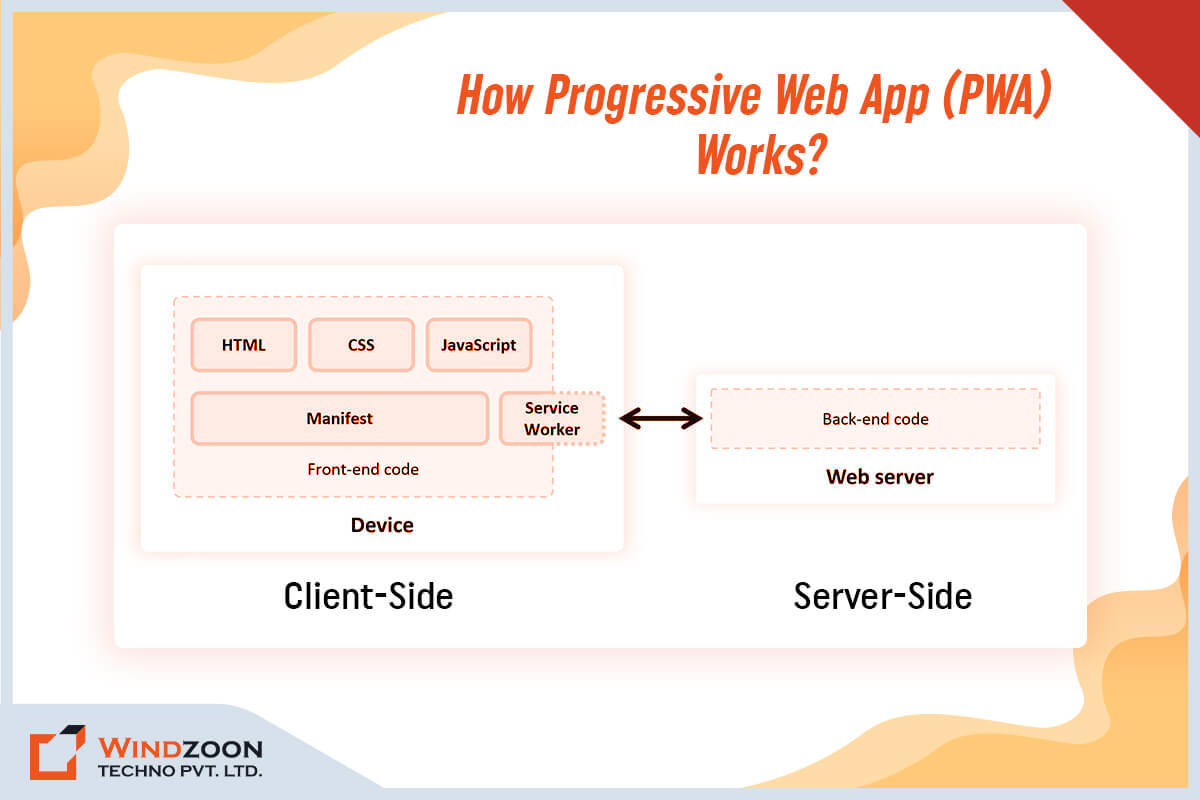
The architecture of a Progressive Web Application (PWA) is basically like a two-sided coin. On one side, you have the client which is where the user interacts with the app. And on the other side, you have the server which is where the app is hosted and managed.

The client-side of a PWA is built using web technologies that we all know and trust, like HTML, CSS, and JavaScript. This is where the magic happens, and where all the fun stuff takes place as here user interacts with the app.

The significant thing is that these web technologies let the PWA function like an actual native app. That means it can work on any device, from your desktop to your phone or tablet, without needing to be downloaded from an app store.

Now, let’s flip the coin over to the server-side. This is where things get more technical, but don’t worry, we’ll keep it simple. The server side of a PWA uses a combination of traditional web server technologies and modern APIs to deliver an app-like experience.

These APIs include Service Workers which allow the app to work offline by caching its content. It means that even if you’re in the middle of nowhere with no Wi-Fi or data, you can still use the app without any issues. Sounds great, right?

There is more, though. PWAs also make use of Web App Manifests, which describe the app’s metadata. It encompasses elements like the app icon, name, and theme color. This metadata is used to add the PWA to the user’s home screen, making it quickly accessible and identifiable.

Another feature worth noticing is the PWA architecture’s use of a secure HTTPS connection. This guarantees that all data sent between the client and server is encrypted and secure from malicious intrusions. It’s akin to having a bodyguard for your data.

Moreover, the PWA architecture is designed to provide users with a seamless, app-like experience while utilizing the power and flexibility of the web. However, to avail of its full potential it’s recommended to hire mobile app developer from a reputed web development agency.

Now, we will get to know about the fundamental pillars of progressive web apps.

The Three Pillars of Progressive Web Applications

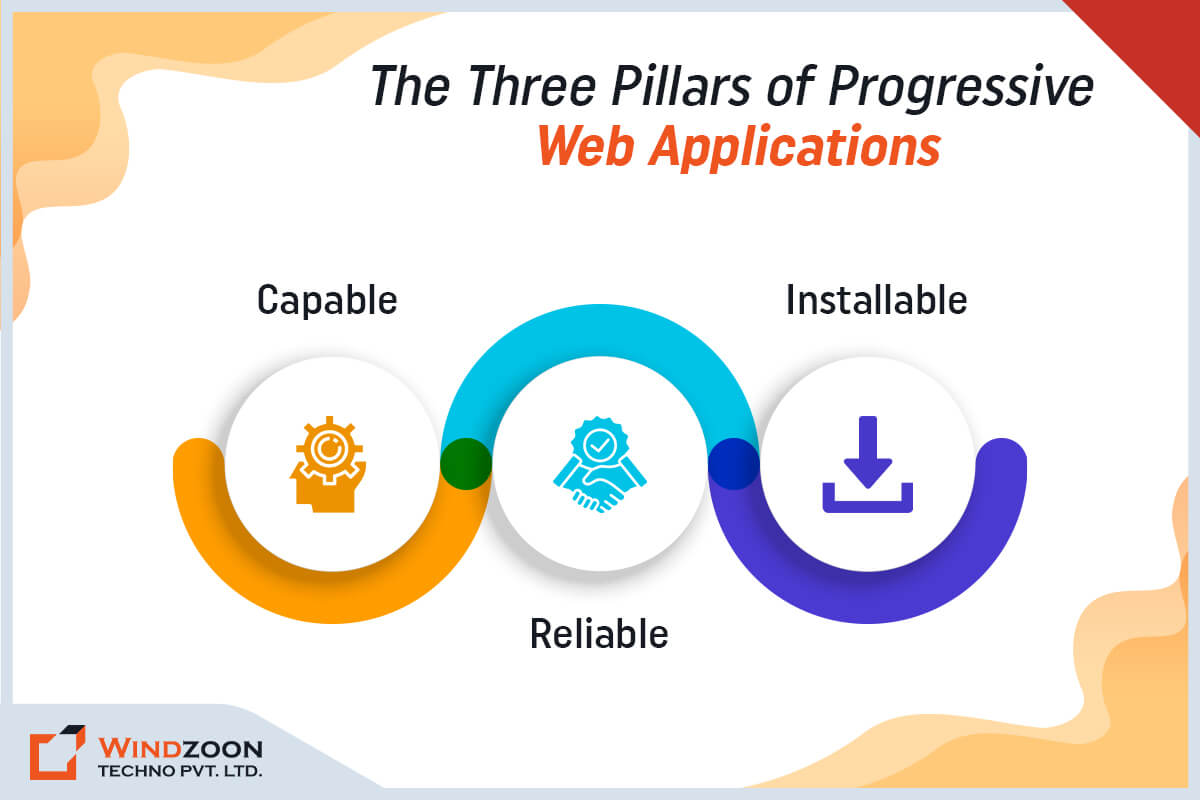
Progressive Web Apps (PWAs) are web-based applications that are capable, reliable, and installable. With the help of these three pillars, they become an experience that resembles a platform-specific application.

3-pillars-of-pwa

1. Capable

The first pillar of PWA applications is capability. It means that PWAs are capable of providing a range of functionalities that can compete with native applications.

They can access device hardware and leverage features like cameras, microphones, geolocation and sensors, just like a native app can.

Besides, PWAs provide the ability to receive push notifications, which is essential for keeping users engaged with the app.

2. Reliable

The second pillar of PWA apps is reliability. Basically, these apps are built to work smoothly no matter what kind of network you’re on, even if it’s weak or unstable. Plus, they can give you a seamless experience even if you don’t have internet, and they load super fast.

The question is, how do they accomplish it?

With the help of service workers, which are scripts that run in the background to cache the app’s content.

And caching frequently used resources also aids in accelerating the performance of the application.

3. Installable

The third and final pillar of PWA applications is all about being “installable”. Basically, this means that PWAs can be installed on a user’s home screen, just like a native app.

However, to achieve this, PWAs use something called a Web App Manifest which defines important things like the app’s icon, name, and even its theme color. All of this helps create an app-like experience that users can easily access and enjoy.

Plus, when you install a PWA, you don’t have to go through the hassle of downloading it from an app store. And that makes the installation process easy and hassle-free.

After this, let’s learn about some of the wonderful features of PWA.

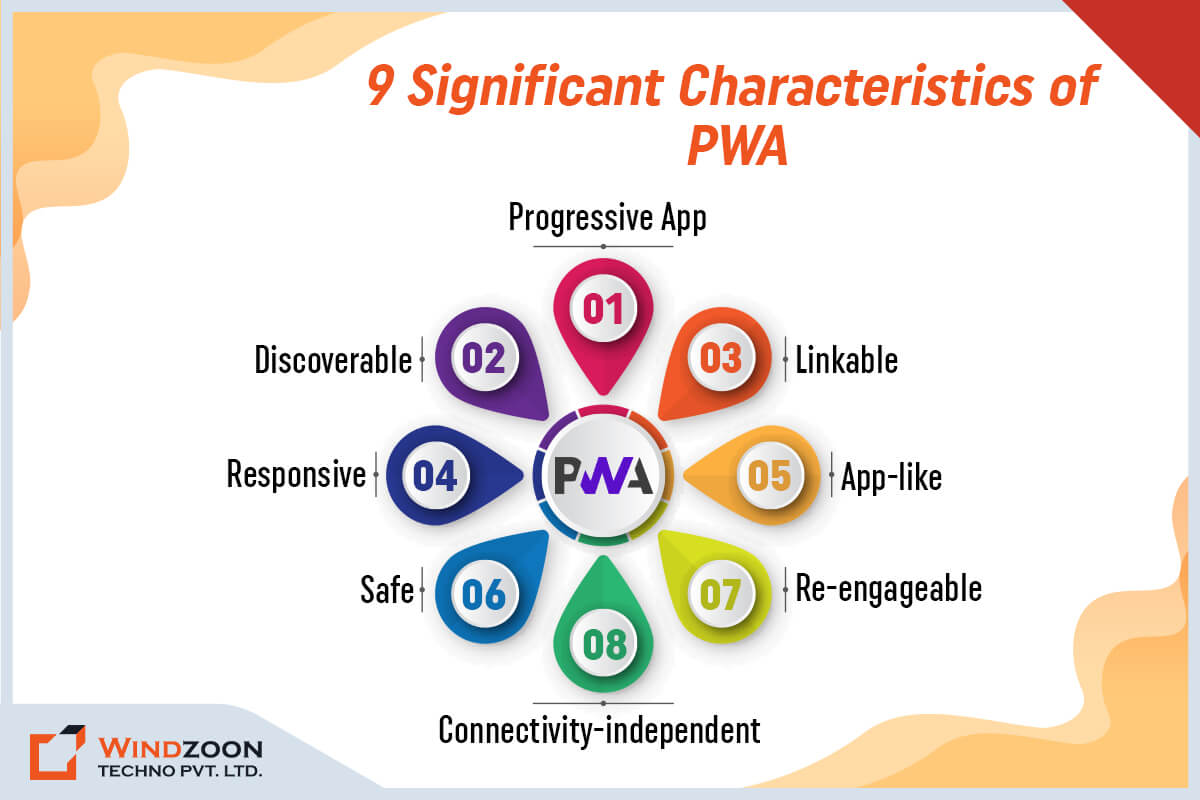
9 Significant Characteristics of PWA

characteristics-of-pwa

1. Progressive App

A progressive web app, by definition, must function on any device and improve progressively, taking benefit of any features available on the user’s device and browser.

2. Discoverable

A progressive web app should be findable in search engines since it is a website. This is a significant benefit over native apps, which are still not as searchable as websites.

3. Linkable

Another trait that has been carried over from websites is that a well-designed website should use the URI to denote the application’s present state. By doing this, the web app will be able to retain or refresh its current state when a user bookmarks or shares the app’s URL.

4. Responsive

A progressive web app’s UI has to adapt to the device’s form factor and screen size.

5. App-like

The application shell model should be used to create progressive web apps, which should have a native-app-like design and require a few page refreshes.

6. Connectivity-independent

It ought to function offline or in places with poor connectivity.

7. Re-engageable

Since users of mobile apps are more likely to re-use them, progressive web apps are made with the same objectives in mind and incorporate push notifications among other features.

8. Safe

A progressive web app must be hosted over HTTPS to prevent man-in-the-middle attacks because it offers a more personalized user experience and can intercept all network requests through service workers.

Next, we will understand the things to keep in mind before designing & developing progressive Web apps.

Things to Consider While Designing Progressive Web Apps

  • It’s crucial to put the user experience front and center while creating PWAs.
  • PWAs should be responsive, meaning they should adjust to multiple screen sizes and orientations.
  • Additionally, they ought to be created with accessibility in mind, with simple navigation, readable fonts, and high contrast.
  • Furthermore, PWAs ought to be created with offline usage in mind, offering users offline content and utilizing caching to boost performance.
  • Finally, PWAs should be made installable, with a clear call to action encouraging users to add the app to their home screen.

Things to Consider While Developing Progressive Web Apps

  • Developing PWAs necessitates an understanding of modern web development technologies as well as best practices.
  • PWAs can be created with a number of different frameworks and tools, such as React, Angular, Vue, and Ionic.
  • To deliver a smooth user experience, developers must make sure the app is quick, reliable, and engaging by leveraging service workers, caching, and push notifications.
  • Furthermore, developers must optimize the app for search engines and make it accessible to users with disabilities.

After this, our next topic of discussion is to know about the key difference between the three primary web app development techniques.

Comparison: Progressive Web Apps vs. Native Web Apps vs. Responsive Web Apps

1. Native Applications

Native Applications have been in existence for a while. They were the main forces behind the development of novel technologies and altered peoples’ perspectives on mobile phone usage. However, there are some drawbacks to a Native App, making Progressive Web Apps a preferable option.

For instance, developers must create native applications for particular operating systems using specific coding languages. To be transmitted to users, these applications must be released on an app distribution platform like the Play Store or the App Store, which might pave the way for monopolization over application distribution.

2. Progressive Web Applications

Progressive Web Applications (PWA) are websites that attempt to emulate the features of native mobile applications. Besides, they aren’t made accessible via platforms used for app release.

3. Responsive Web Applications

The motive behind the development of responsive web applications was to enhance user experience on an array of devices. Its other major purpose was to accommodate the variations in screen sizes among digital devices. However, it lacks features that are typical of native and progressive web applications, such as push notifications, offline support, etc.

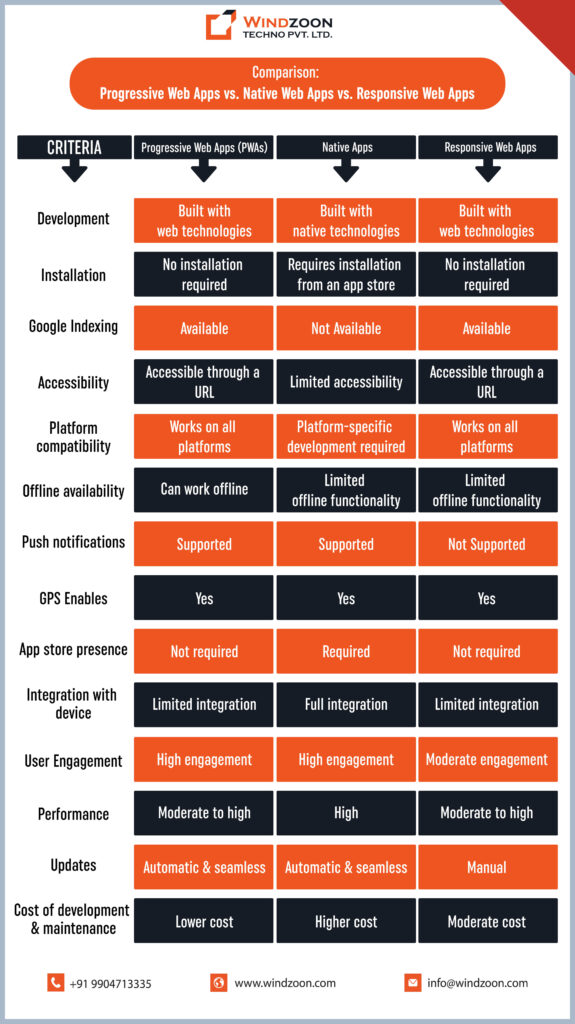
Below is a comparison of Progressive Web Apps, Native Apps, and Responsive Web Apps:

comparison-pwa-nativeapps-responsiveapps

[wpdatatable id=16 table_view=regular]

Read Also: Know Which one is better for your business; Flutter or PWA?

And here comes our main topic of discussion and that is:

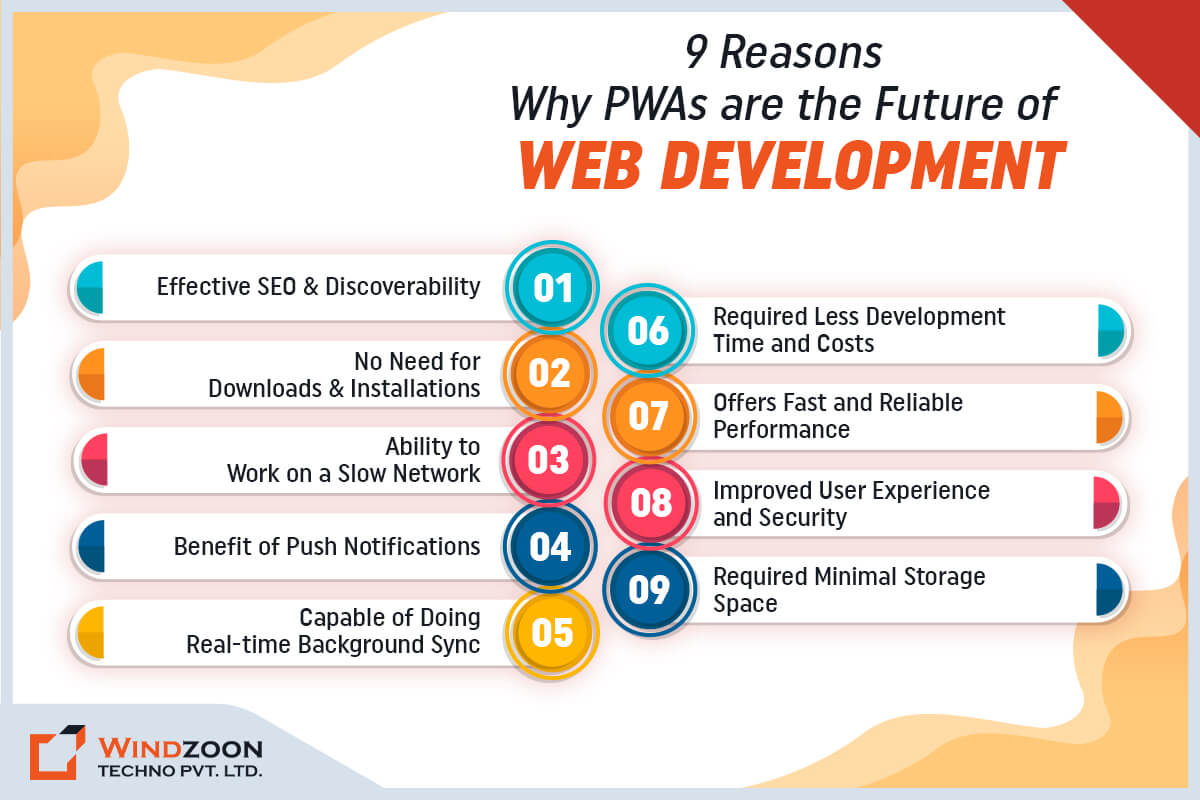
9 Reasons Why PWAs are the Future of Web Development

reasons-why-pwa-is-future-of-web-development

The popularity of Progressive Web Apps (PWAs) as a substitute for native apps has grown in recent years. They offer a lot of advantages that traditional web apps and native apps can’t provide. Here, we will discuss the nine reasons why PWAs are the future of web development.

1. Effective SEO and Discoverability

One of the most significant advantages of PWAs is that they are easily discoverable and search engine optimized. Due to the fact that they have extensive internet functionality, database access, and automatic data.

As a result, search engines like Google, Bing, and others can easily find and index them just like regular web pages. Thus, they can be found through search engine inquiries, increasing the visibility and traffic to your app.

Additionally, they can be shared via URLs, making promoting and sharing your app simpler.

2. No Need for Downloads and Installations

In contrast to native apps, PWAs don’t need to be downloaded or installed.

Instead, they can be accessed via a web browser, saving users the trouble of visiting an app store.

This drastically reduces the risk of customers abandoning an app during the installation process.

3. Ability to Work on a Slow Network

PWAs are made to work well in all kinds of network conditions, even sluggish or unstable ones.

This is made possible by using PWAs’ built-in service workers, which save and cache the content for subsequent display when your clients’ network connections fail.

Additionally, it makes the PWA accessible without having to download it, which is particularly helpful when connectivity is weak.

4. Benefit of Push Notifications

PWAs can notify users via push notifications exactly like native apps.

This implies that users can get updates and alerts even while they aren’t actively using the app. With the help of this PWA functionality, eCommerce businesses have great chances to retain clients.

Because it serves as a reminder to customers of things like forgotten deals and offers and abandoned shopping carts. Brands can interact with their customers more frequently and efficiently by using highly visible push notifications.

5. Capable of Doing Real-time Background Sync

PWA’s service workers can synchronize data in real-time in the background without the user having to interact with the app in any way.

Therefore, the user won’t have to wait for the app to refresh when they open it again because the data will already be up-to-date.

This functionality can be beneficial for apps that require real-time data synchronization, such as chat apps or collaborative software.

6. Required Less Development Time and Costs

Since PWAs only need a single codebase to deliver a consistent experience across all platforms and devices, they are less expensive to design, develop, launch, and maintain.

PWAs provide quick distribution of updates, new features, bug corrections, and other things, which saves money for organizations. In comparison to mobile apps, maintaining progressive web apps is 33% cheaper.

When compared to websites and mobile apps, PWAs allow businesses to deliver the same content across all touchpoints, saving time and money. The PWAs are a financially appealing choice because you don’t have to bother about routine upgrades if they’re functioning properly.

7. Offers Fast and Reliable Performance

Progressive web apps allow for content caching every time a user visits, resulting in a smoother and dramatically better user experience.

Additionally, content caching speeds up page loading. PWAs are fast and constant in their performance, which benefits conversion rates. Compared to native apps, conversion rates from progressive web apps are 52% higher.

Furthermore, a positive user experience aids businesses in customer retention and loyalty.

8. Improved User Experience and Security

When compared to regular web apps, PWAs can provide a better user experience. As they are developed to offer app-like features such as full-screen mode, offline mode, and a home screen icon.

Since PWAs use HTTPS encryption, they are also more secure than regular web apps. It blocks content manipulation, eavesdropping, and other harmful and unlawful activities.

On top of that, PWA takes advantage of web Bluetooth technology, and it comes with some additional security features.

9. Required Minimal Storage Space

PWAs are more compact than mobile apps in terms of size. As a result, PWAs load faster, take less memory to execute and place less strain on the user’s hard disk.

It is due to the manner in which PWAs have developed, which permits data caching in the background while a user interacts with a website.

Also, they do not require downloading or installation on the device. This feature is highly valuable for organizations with a target audience that is sensitive to device storage restrictions.

Next, we will learn about some of the promising examples of progressive web apps around the world.

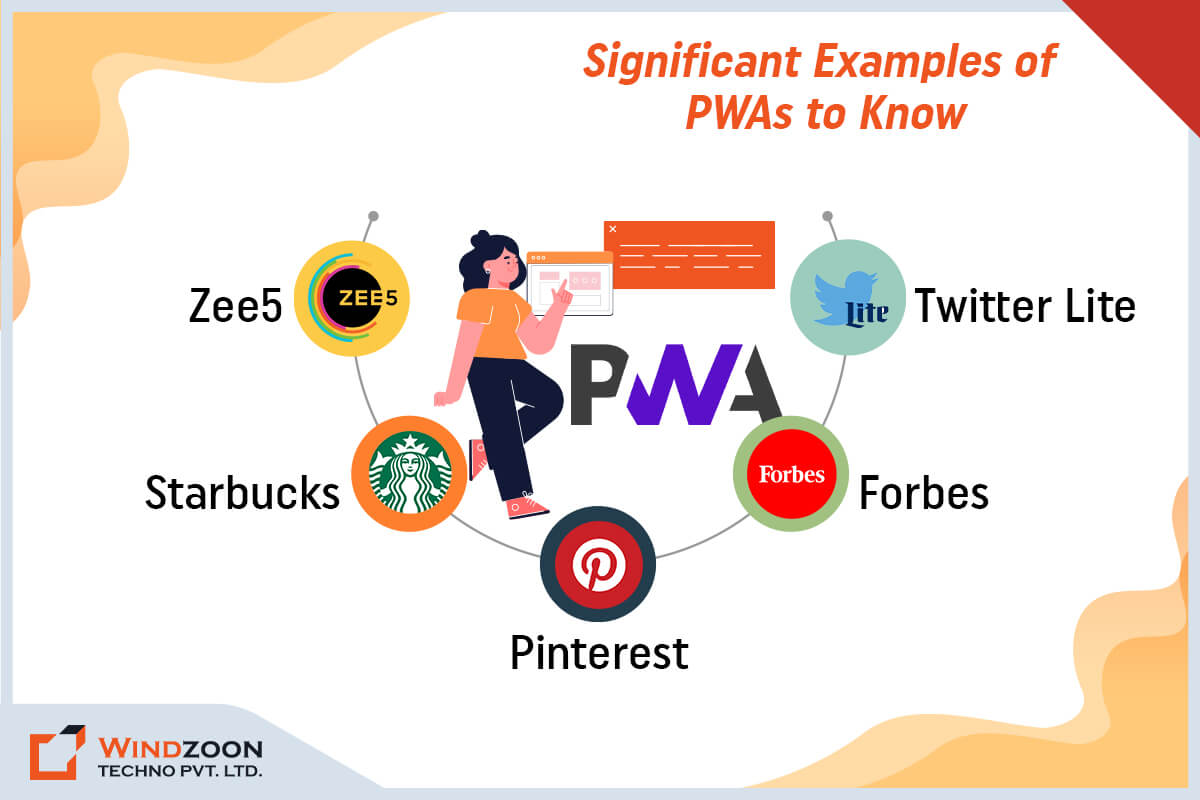
Some Striking PWA Examples to Know

examples-of-pwas

1. Zee5

ZEE5 built a PWA to streamline its platform and broaden its reach. It has increased app performance by three times and decreased buffering time by fifty percent.

2. Starbucks

Starbucks developed a PWA of their ordering platform that offers a comparable user experience to their current native app. Customers may quickly browse the menu, customize orders, add things to their basket, and do other tasks, whether they are doing so online or offline. It has raised the number of daily active users by twofold. And improve orders on desktop at almost the same rate as on mobile.

3. Pinterest

Pinterest revamped its mobile site as a PWA, which increased its core engagements by 60%. Furthermore, they saw a 44% increase in user-generated ad revenue, as well as a 40% increase in time spent on the site.

4. Forbes

Forbes is one of the prominent players in the news and media world. It has converted its website to a PWA. And now it loads in 2.5 seconds on mobile, compared to 6.5 seconds for its previous website. Additionally, there has been a 10% increase in impressions per visit.

5. Twitter Lite

Twitter has also employed PWA for its lite version, which is small, blazingly fast, and still retains the majority of the original app’s features. Twitter Lite reported a 65% increase in pages per session, a 75% rise in Tweets, and a 20% drop in bounce rate. Even on slow networks, Twitter Lite loads in under 3 seconds for repeat visits.

Conclusion

Progressive Web Apps is an innovative solution that combines the best of web and native app technologies. They provide a fast, reliable, and engaging experience for users while enabling developers to create apps that are cost-effective and easy to maintain.

With the rise of mobile usage and the growing demand for mobile-friendly solutions, PWAs are proving to be the future of web development.

Companies such as Starbucks, Pinterest, and Twitter have already leveraged PWAs to improve their user experience and boost their revenue. You can also become like them by joining hands with a skilled web development company to build PWA for your organization.

Windzoon is a prominent mobile app development services provider with exceptional experience and expertise in developing PWAs. To leverage our services, reach out to us and get a quote.

11 Benefits of Outsourcing Web Development Project to an Indian Company

Introduction to Web Development

Web development is the backbone of a strong online presence, encompassing the creation and maintenance of websites, web applications, and mobile applications. This multifaceted process involves everything from designing user interfaces to coding, testing, and deploying digital solutions. As businesses increasingly rely on digital channels for growth, web development has become essential for reaching new customers and staying competitive. Companies can choose to handle web development in house, building their own teams and processes, or they can outsource web development to external teams with specialized expertise. Outsourcing web development allows businesses to tap into a global talent pool, reduce labor costs, and accelerate project timelines, all while focusing on their core business activities. By leveraging the skills of experienced professionals, companies can ensure their web projects are executed efficiently and to the highest standards.

Websites represent businesses & people on digital platforms. And nobody puts forth the effort that your website does for you & your business. Websites function when everyone is asleep or even when you are away for a vacation. It works to establish your brand. And, if they are well-designed, they can constantly deliver conversions with little effort on your part.

Therefore, an excellent website should be at the top of every business’s list of objectives when they are going digital. It is not easy to develop a website—business owners are often torn about whether they should build, hire, or outsource the project to a web development company in India & USA. When considering outsourcing, it is crucial to select a reliable outsourcing partner and carefully evaluate web development outsourcing companies to ensure the success of your web project. You should also assess potential outsourcing vendors for their quality, reliability, and ability to deliver on your project requirements.

Thus, to relieve you from your dilemma, we have come forth with this article. It will help you understand the following points:

So, let’s start this blog with the very first and most important information.

Importance of Web Designing for Your Business

Your website design is crucial because the design is important to your customers. We all respond to visuals, whether consciously or unconsciously. And beautiful design inherently attracts people. Studies have repeatedly shown that users evaluate your company’s website solely on its visual attractiveness and will often abandon it if it is poorly designed.

Here are some startling statistics about the significance of website design:

  • Users establish an opinion about your website in roughly 50 milliseconds (0.05 seconds), which decides whether they will stay or leave.
  • 57% of internet users claim they won’t suggest a company if their mobile website is poorly developed.
  • According to 85% of individuals, a company’s website should be just as excellent as its desktop website when viewed on a mobile device.
  • 38% of visitors will stop visiting a website if the layout or content is unappealing.
  • 88% of online users are less likely to visit a website again after a negative encounter.
  • 39% of consumers will abandon a website if photos fail to load or take too long to load.
  • 47% of users anticipate an average website to load in no more than 2 seconds.
  • Each year, retailers lose $2.6 billion in sales due to slow-loading websites.
  • 75% of consumers acknowledge judging the credibility of a company based on the layout of the company’s website.
  • According to Google, 46% of consumers decided whether or not to trust websites based on how appealing and aesthetically pleasing they were.
  • As per Google, 94% of complaints about websites had to do with the design.
  • Google reports that 61% of visitors are reluctant to visit a mobile website again if they encountered access issues, and 40% instead go to a competitor’s website.
  • A smooth experience across all devices is extremely important to 83% of mobile users.

Now, let’s move forward to know what is outsourcing. And how outsourcing your web development project to an Indian company would benefit your business.

What is Outsourcing?

The practice of hiring a third party from outside a business to carry out tasks or produce commodities that were previously completed in-house by the business’s own staff members is known as outsourcing. For example, outsourcing software development and working with web development outsourcing teams are common approaches in the tech industry. Outsourcing companies specialize in providing these services to businesses looking to improve efficiency and reduce costs.

Outsourcing Models for Web Development

When it comes to outsourcing web development, businesses have several models to choose from, each tailored to different project requirements and organizational needs. The project-based outsourcing model is ideal for companies looking to complete a specific web development project with a clearly defined scope, budget, and timeline. In this model, a web development company takes full responsibility for delivering the finished product, making it a great choice for one-off or short-term projects.

For businesses seeking ongoing collaboration, the dedicated team model provides a team of skilled developers who work exclusively on the client’s projects. This approach offers more flexibility and control, allowing for long-term development and continuous improvement. It’s particularly beneficial for companies with evolving project requirements or those looking to scale their web development efforts.

Staff augmentation is another popular model, where businesses supplement their in house team with skilled developers from an outsourcing company. This allows organizations to quickly fill skill gaps, ramp up development capacity, and respond to changing project demands without the long-term commitment of hiring full-time staff. Each outsourcing model offers unique advantages, so it’s important to assess your business goals, budget, and project complexity before choosing the right approach for your web development needs.

Outsourced Web Development Process

A successful outsourced web development project follows a structured process designed to ensure quality and timely delivery. The journey typically begins with the planning stage, where project requirements are defined, goals are set, and budgets are established. This is followed by the design phase, which focuses on creating a visually appealing and user-friendly interface tailored to the target audience.

Once the design is approved, the development stage begins, involving coding, integration, and rigorous testing to ensure the website or application functions as intended. The testing phase is crucial for identifying and resolving any issues, ensuring the final product meets all quality standards. After successful testing, the deployment stage involves launching the website or application and making it accessible to users.

A reputable outsourcing company will also provide ongoing maintenance and support, ensuring your web solution remains up to date and continues to perform optimally. By following a well-defined development process, outsourced web development teams can deliver reliable, high-quality results that align with your business objectives and project requirements.

11 Reasons Why Outsourcing Web Development Services is Your Best Option

11 Reasons Why Outsourcing Web Development Services is Your Best Option

People have been debating whether outsourcing is necessary or not for more than a decade, and those who argue against it have unquestionably failed to recognize its substantial advantages.

Outsourcing web and mobile development services to India will always be a profitable proposition for businesses. By outsourcing, companies can address specific business needs and efficiently manage varying project scopes, ensuring solutions are tailored to their requirements. Outsourcing teams often bring well-defined development processes, which contribute to project success through structured workflows and enhanced efficiency. We’ve identified a few key reasons why businesses should outsource their web development projects to India.

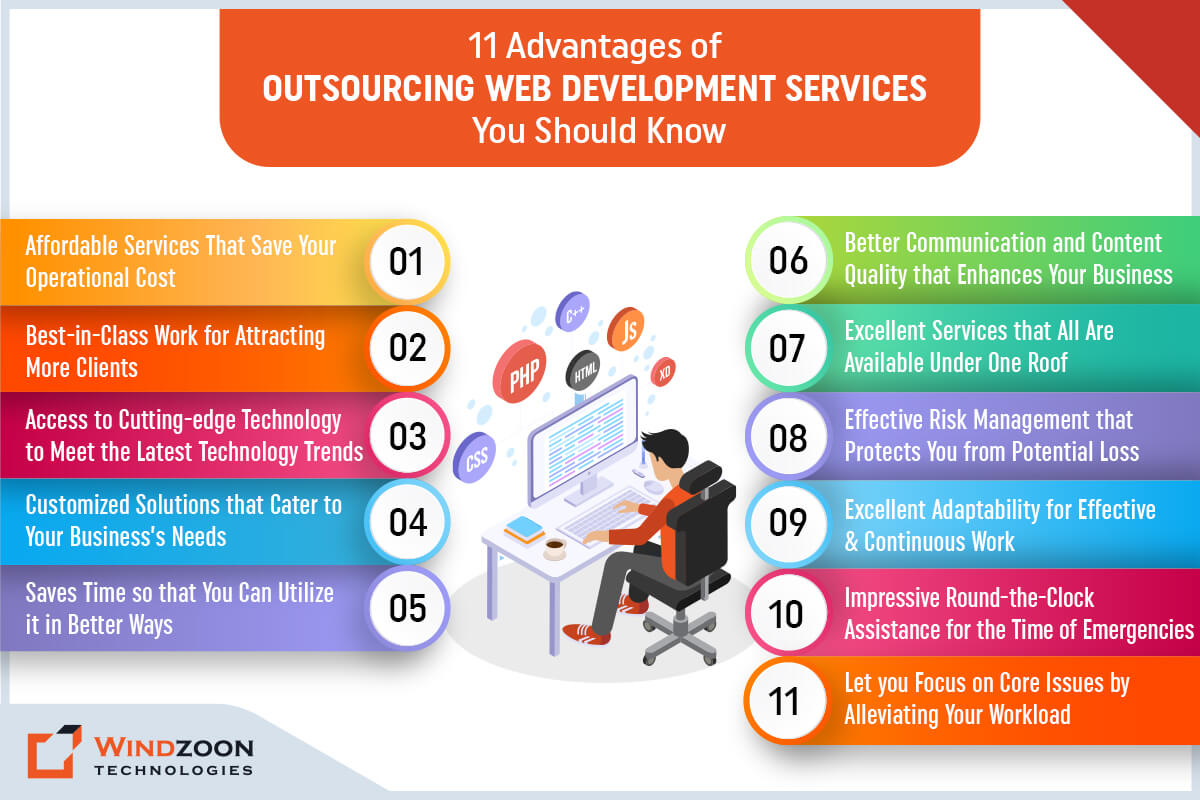
Advantage of outsourcing web designing and development work to a web designing company from India

1. Affordable Services That Save Your Operational Cost

In most cases, outsourcing the work will result in lower resource costs as well as additional expenses like salaries, infrastructure costs, and utility costs. By outsourcing, businesses can save money by eliminating the need for dedicated office space and the ongoing expenses associated with maintaining an in house dev team. You don’t need to be concerned about the equipment and software needed for web development. Simply hire web developers from India at reasonable rates and get your task done.

2. Best-in-Class Work for Attracting More Clients

There is fierce competition among Indian web development companies. Businesses are heavily influenced by market competition since they can’t survive unless they continue to be in demand. As a result, they are constantly under pressure to produce exceptional outcomes. Quality assurance plays a critical role in outsourced projects, ensuring the delivery of reliable and high-quality products while allowing clients to focus on strategic business activities. Additionally, evaluating the technical skills and communication skills of the team is crucial for achieving best-in-class results. However, before really choosing an outsourcing company, do verify its rating and comments so that you can be confident that quality will be top-notch.

3. Access to Cutting-edge Technology to Meet the Latest Technology Trends

Once again, competition is a major factor in this situation. The tech industry is constantly evolving, with new trends and technologies emerging rapidly. Therefore, Web development companies in India need to ensure they have the latest tools and equipment. Outsourcing web development companies in India ensures that you will receive quality service as well as the latest technological expertise in that field. Web app development and app development projects especially benefit from this access to advanced tools and specialized expertise, helping businesses stay ahead in a competitive market.

4. Customized Solutions that Cater to Your Business’s Needs

Regardless of the obstacles, the level of skill among Indian web developers ensures that you will find the majority of the solutions you seek. Whether it’s products, services, or market content, there are excellent solutions on the market that are created to meet particular business requirements. Unlike an internal team, which may face limitations in adapting to highly specialized or rapidly changing needs, outsourcing offers greater flexibility to customize solutions for unique business challenges.

5. Saves Time so that You Can Utilize it in Better Ways

Outsourcing web development services save you time and money on the hiring process. Hiring, training, and managing a web design and development team can take weeks, if not months. By leveraging outsourced teams, you can rapidly deploy skilled professionals to accelerate project delivery and free up your internal resources. Outsourcing allows you to focus on your core business activities while an outsourcing company in India manages the rest.

6. Better Communication and Content Quality that Enhances Your Business

One significant advantage of outsourcing web development services to India is proficiency in the English language. You can anticipate easy communication. However, when outsourcing internationally, it is important to be mindful of potential language barriers that may affect collaboration and understanding. Plus, content that is adhere to global standards and is user-friendly, engaging, & understandable. Users will return to your website because of its design and language.

7. Excellent Services that All Are Available Under One Roof

Most offshore web design and development service providers in India have teams comprised of qualified and skilled web developers, analysts, designers, project managers, and digital marketing experts.  This combination enables you to receive web solutions that are specifically tailored to your company’s needs.

8. Effective Risk Management that Protects You from Potential Loss

When you receive new projects or plans for your company, there is a good chance that your in-house team is inexperienced. It might cost your company greatly. To avoid this, you must hire experts from other countries. Because skills & technology are important in website designing, and outsourcing reduces the risk of mistakes.

When managing an outsourced project, it is crucial to identify and mitigate risks, including safeguarding your intellectual property. Proper risk management ensures that your business interests are protected throughout the outsourcing process.

9. Excellent Adaptability for Effective & Continuous Work

Assume you have some important tasks to complete on your website while your employees are on Christmas holidays. But you can’t just cancel the holidays, can you? If you have a team of techies in India, you can easily reach them and they can handle the work for you even if it is during the Christmas holidays. By outsourcing to a web development team, you gain continuous support and the flexibility to adapt to your business schedule, ensuring your website needs are met regardless of local holidays. This level of adaptability is only available from Indian web development firms. They will complete your task even if it is a holiday.

10. Impressive Round-the-Clock Assistance for the Time of Emergencies

When you choose to outsource your web design and development work to India, they will offer you services day and night. Time is of the essence for web-based businesses. If your website is down for even 15 minutes, you risk losing customers. When an emergency like that arises, you need a team that can support you. An Indian Company will assist you 24/7 so that you are never stranded on your website. Additionally, outsourcing companies provide ongoing support for maintenance, regular updates, and emergency fixes to ensure your website remains secure and up-to-date.

11. Let you Focus on Core Issues by Alleviating Your Workload

Outsourcing web development to India will allow you to focus on what you do best. Let the professionals deal with the hassle of designing your website. You can outsource web design to experienced experts, enabling you to concentrate on your business priorities while they handle the technical and creative aspects. You can concentrate on tasks that will benefit your business while they work on your website.

Choosing the Right Option: In-House Team vs Outsourcing

Deciding between an in-house team and outsourcing web development is a critical choice that depends on your company’s unique needs. An in-house team offers direct control over the development process and fosters close collaboration, which can be advantageous for projects requiring frequent communication or alignment with company culture. However, building and maintaining an in house team can be expensive and time-consuming, especially when it comes to recruiting skilled developers and managing ongoing training.

On the other hand, outsourcing web development provides access to a broader range of technical expertise, reduces labor costs, and allows for greater flexibility in scaling your development resources. Outsourced web development is particularly beneficial for complex projects or when specialized skills are required that may not be available internally. Effective project management and clear communication are essential to ensure successful collaboration with an external team.

Some companies opt for a hybrid approach, combining the strengths of both in-house and outsourced web development. This allows businesses to maintain control over core business processes while leveraging external expertise for specific tasks or projects. Ultimately, the best option depends on your budget, project complexity, technical requirements, and long-term business goals.

How Much Does It Cost to Outsource Website Development Service?

In general, outsourcing a web development service is always less expensive than handling it in-house. That’s because outsourcing provides you with a ready-to-go expert team with enough expertise, experience, and resources to complete the project successfully in a shorter period of time. Many businesses choose to outsource web app development to manage costs effectively and gain access to specialized skills.

However, determining the cost of an outsourced website development project without first conducting a thorough analysis is nearly impossible. That means you’ll need to consider a variety of factors that influence the overall project cost, such as:

– Project scope
– Project timeline
– Type of project
– The project’s complexity
– Technology preferences
– Clearly defined deadlines
– Predefined roles and responsibilities

Web development outsourcing offers flexible pricing models depending on the project’s requirements. Outsourcing to a third-party website development company provides numerous advantages to businesses. It gives your company a competitive edge while streamlining business operations.

And Windzoon is a fantastic option if you’re looking for a reliable Web Development Company to outsource your web design and development project. We’ve been offering a wide range of web development and design services for over ten years. To leverage our services or learn more about us, visit wzadmin.windzoon.in/ and request a quote.

Conclusion

Outsourcing web development services offers a wide range of advantages, from cost savings and access to specialized expertise to improved efficiency and scalability. By understanding the different outsourcing models and the typical development process, businesses can make informed decisions that align with their project requirements and strategic objectives. Whether you choose to build an in-house team, outsource web development, or adopt a hybrid approach, the key is to select the right development partner who can deliver high-quality results and support your business growth. As the digital landscape continues to evolve, leveraging the benefits of outsourcing web development can help your company stay competitive, innovative, and focused on what matters most—your core business.