Front End Development Outsourcing: A Guide with 6 Tips to Pick an Expert

Staying ahead of the competition in today’s fast-paced digital landscape necessitates a strong online presence. For that, businesses need to develop websites or applications as per their requirements. This is especially important for businesses seeking to improve their digital presence and reach a wider audience. Because every successful website or application must have flawless front-end development at its foundation.

However, not many businesses have the resources or skills in-house to handle this critical component of their digital ventures. This is when outsourcing front-end development becomes an appealing alternative. Working with an outsourced team can provide cost effective solutions and comprehensive services, allowing you to access a full range of web development expertise without the overhead of building an in-house team.

According to Statista, the outsourcing business generated $92.5 billion in revenue in 2019, and the demand is constantly rising. This growth is driven by the expertise of outsourcing companies in web development, offering industry-specific solutions and award-winning services. Outsourcing allows companies to access global talent and gain immediate access to skilled professionals, streamlining the process of building high-quality digital products. Because there are many benefits to outsourcing front-end development to a reputable Web app development company. However, in order to assess whether outsourcing coincides with your business goals, you must first comprehend both the pros and cons.

In this blog post, we will discuss the pros and cons of outsourcing front-end development. And will provide you with in-depth information on this subject that will help you make an informed decision for your business.

What is front-end development?

The portion of a website or application that users directly access and interact with is referred to as the front end, also known as front end web development or frontend development. It serves as the “face” of the digital experience.

Front-end development, or frontend development, entails bringing that face to life by turning designs into a user interface on the client side of the application, making it useful and user-friendly.

To create the structure, layout, and interactivity of a website, front-end developers use programming languages like HTML, CSS, and JavaScript. These programming languages are used to create and position static and interactive elements on web pages. Developers meticulously develop the visual and interactive elements, like fonts, colors, images, carousels, and animations, using CSS to position static content for consistency and to enhance user experience.

Besides, they also make sure that the website operates without a hitch across all platforms and browsers, changing its design and functionality to deliver a consistent user experience.

In a nutshell, front-end development involves creating the magic that users encounter and engage with whenever they visit a website or application.

Popular Front-end Frameworks Available in the Market

1. ReactJS

Despite being primarily a JavaScript toolkit for creating user interfaces, React is frequently referred to be a front-end framework. React was created in 2011 by Facebook developer Jordan Walke. After becoming an open-source framework in 2013, React began to gain popularity.

React is widely used for custom JavaScript development, enabling developers to build interactive and dynamic user interfaces. It is commonly chosen to create single web page applications that leverage client side routing, allowing seamless navigation without full page reloads.

Developers who work with React use JavaScript and declarative code. A distinct JSX feature allows them to use HTML to update the DOM (Document Object Model) and build a Virtual DOM, resulting in increased efficiency.

Another feature of React is the usage of reusable components organized in a tree-like structure, as well as one-way data binding, which limits data flow between components and views to only one direction.

2. Angular

A complex front-end framework, Angular was created by Google. It is an open-source framework for developing TypeScript-based web applications.

Angular is ideal for building large-scale web apps and supports client side routing, enabling seamless navigation without full page reloads. Angular developers write robust front end code to manage complex interfaces and ensure smooth user experiences.

Three essential components of Angular are two-way data binding, dependency injection, and a modular architecture that lets you divide your application up into reusable parts.

Building complex enterprise-level applications like large-scale e-commerce platforms, banking, and healthcare systems is a good fit for Angular.

3. VueJS

Developed by Evan You, Vue.js is a progressive front-end framework. It is a simple and lightweight JavaScript library that may be used to create user interfaces.

Vue’s fundamental characteristics are reactive and composable data bindings, a virtual DOM, and a component-based architecture. Vue makes it easy to add interactive elements to user interfaces, enhancing user engagement and experience.

Vue’s fundamental characteristics are reactive and composable data bindings, a virtual DOM, and a component-based architecture.

Vue can be used to create small to medium-sized applications, such as blogs, forums, and personal web pages. It is also well-suited for developing web apps with custom JavaScript development, allowing for tailored solutions that leverage Vue’s flexibility and efficiency.

4. jQuery

“jQuery” is a renowned front-end library created by John Resig. It is a lightweight and fast JavaScript package for streamlining HTML document traversal and manipulation, event handling, and animation. jQuery helps developers create interactive elements and efficiently manage both static and interactive elements on web pages.

jQuery is appropriate for enhancing existing websites with interactivity and animation as well as developing small-scale applications.

5. EmberJS

Yehuda Katz created the frontend framework known as EmberJS. It is a strong and independent JavaScript framework for creating large-scale online applications.

Two-way data binding, a component-based architecture, and a potent CLI for generating code and managing dependencies are some of Ember’s standout features.

Ember is suitable for creating complicated applications that need great scalability, such as corporate apps and enterprise-level systems. It is often chosen for scalable solutions and high quality projects that require close collaboration between front-end and back end developers, ensuring seamless integration and robust performance.

Benefits of outsourcing front-end development

1. Help you save cost

Outsourcing front-end development offers cost effective solutions compared to relying solely on in house resources. Instead of hiring and training a front-end development staff internally, you can save money by cooperating with a group or organization outside your company.

This eliminates the need for ongoing training expenditures, infrastructure costs, and salary and benefit costs associated with maintaining in house resources. It is especially helpful for small and medium-sized businesses with limited resources since you may save money and make better use of what you already have.

2. Enables you to cut down on time

It can take a while to recruit and hire individual front-end engineers or to assemble a competent front-end development team from scratch.

You can avoid this time-consuming recruitment procedure by outsourcing. This approach provides immediate access to a group of professionals who are already adept at front-end development.

Outsourced teams can quickly adapt to changing project needs and accelerate delivery, helping you meet tight deadlines and speed up time-to-market.

It saves you the time and effort needed for recruiting, screening, interviews, and onboarding of new employees. You can get started on projects quickly and efficiently to fulfil deadlines.

3. Allows you to focus on your core business objectives

Outsourcing front-end development frees up internal resources, allowing your in house team to focus on core business functions and core business activities instead of technical tasks.

You can focus on strategic planning, marketing, customer relations, and other areas crucial to the success of your company rather than dividing your attention and efforts among numerous duties.

Outsourcing allows you to harness the experience of front-end development professionals while redirecting your focus to activities that have a direct influence on your business’s success.

Outsourcing can be a simple solution if you need to rebuild or rework an existing front end. Renovating your current front end is a task best left to seasoned front-end development teams or agencies.

They are able to assess your needs, make suggestions for improvement, and carry out the redevelopment process without incident. Experienced teams consistently deliver high quality projects that deliver exceptional user experiences and boost user engagement. By contracting out this work, you can make sure that your front end is efficiently updated and adheres to the most recent standards for both user experience and design.

5. Provide you with extreme adaptability

You have more project scalability options when you outsource front-end development. Outsourcing provides scalable solutions that can easily complement your existing team and integrate with other team members as needed. This allows you to modify your resources accordingly, whether you need to expand your front-end staff for a short-term project or scale it down during quieter seasons.

The external personnel can quickly adjust to your project requirements, allowing you to scale up or down as required. With this scalability, you can maximize efficiency and productivity by having the appropriate knowledge and resources available at any step of your project.

Things to consider before outsourcing front-end development services

1. Back-end integration

Before outsourcing your front-end development, make certain that the external team or agency is capable of interacting with your existing back-end systems.

They ought to be well-versed in the back-end technologies, APIs, databases, and any other elements that communicate with the front end.

To achieve seamless integration and compatibility between the front-end and back-end systems, your internal team and the external developers must work together effectively. This collaboration should include close coordination with your back end development team, integration of third party services to enhance website functionality, and ensuring compatibility with your chosen content management system.

2. Synchronize and organize

To successfully outsource front-end web app development services, it’s crucial to establish efficient project management and communication procedures. Make sure you have a clear mechanism in place for exchanging comments, design assets, and project needs.

Incorporating user research and leveraging deep knowledge of workflows help teams gain access to best practices for coordination, ensuring that both user needs and project goals are met effectively.

Set up recurring conferences or check-ins to keep everyone in the loop and informed of the project’s advancement. To avoid confusion or overlapping duties, be sure to define roles and responsibilities.

Clarity, transparency, and efficiency will be preserved throughout the development process with the aid of workflow organization and coordination between your internal team and the external developers.

3. Time zone differences

When outsourcing front-end development, time zone differences may be a concern. Especially if you’re working with a team based in another part of the world. It’s crucial to assess how time zones affect project communication and development.

Adjust meeting schedules or use asynchronous communication techniques to strike a balance that enables productive collaboration. Consider the availability of important stakeholders and the probable requirement for overlap in working hours.

Timezone variations can be overcome and good coordination is ensured with the use of clear communication channels and project management technologies, which is essential for delivering a seamless user experience.

Cooperation Models For Outsourcing Front-end Development

1. Staff Augmentation Model

In this collaborative approach, you add external front-end developers to your current internal staff. These outsourced developers work alongside your existing team and collaborate with other team members to ensure seamless integration and efficient project execution. You can use the outsourced developers’ skills while maintaining complete control over your project and tasks.

This strategy is appropriate when you have specific short-term needs or require more expertise for a particular project. It gives you the freedom to scale your team up or down in accordance with your needs.

The outsourced developers blend easily into your current team and work closely with them to complete the tasks given to them.

2. Project-Based Model

In the project-based model, the whole front-end development project is contracted out to a third-party group or organization. The contracted team manages the entire development process from beginning to end as you specify the project’s scope, needs, and deadlines.

This approach is best suited for well-defined projects with precise objectives and set deliverables. It is convenient because the outsourced staff handles project management and execution, freeing you up to concentrate on other areas of your organization. By leveraging this model, you can better ensure desired outcomes and project success, as the team is focused on meeting your specific goals and delivering quality results.

3. Dedicated Team Model

In the dedicated team approach, you establish a sustained collaboration with an outside front-end development team. This group functions as an extension of your organization and only handles your projects.

You have complete control over team management, project prioritization, and work assignments. In addition, this model allows adaptability, scalability, and ongoing collaboration. Outsourced teams can help you reach a broader audience by providing the flexibility to scale resources and expertise as needed, ensuring your product is accessible across multiple platforms and user segments.

Hence, it is ideal for companies with complex, lengthy projects that call for devoted personnel and close collaboration. It also works well for companies that need continuing front-end development support.

Which Model is Best for You?

The partnership model you choose is determined by your specific demands, project requirements, and company objectives.

The staff augmentation strategy could be a good choice if you need specialized knowledge or have a short-term project.

The project-based approach can offer simplicity and targeted execution for projects that are well-defined and have defined deliverables.

The dedicated team model can be the ideal option if you need ongoing cooperation, committed resources, and total control over project management.

When choosing the cooperation model, take into account elements like project complexity, budget, timeframe, and the degree of control and involvement you want.

Additionally, make certain that the outsourcing partner you choose has a proven track record in delivering a unique online presence, along with the necessary knowledge and efficient communication routes to support your preferred strategy.

How to ensure successful outsourcing of front-end development

1. Choose the best front-end development firms

Take your time researching and locating the best front-end development businesses or agencies. Seek out businesses with a good standing, a proven track record of success, deep knowledge in front-end development, and relevant front-end development knowledge.

Ask for references and look through their portfolios and customer testimonials. It’s crucial to pick a business that complies with your project’s specifications and has the essential expertise to produce high-quality solutions.

So, while choosing a candidate, take into account qualities like communication prowess, responsiveness, and cultural fit.

2. Tell them about your development strategy

Clearly convey your development strategy to the front-end development firm you’ve chosen. Give specific details about the aims, goals, features, and design specifications of your project.

If you have any wireframes, mockups, or prototypes, share them with the development team so they can better grasp your vision. Providing user research, such as insights from Hotjar, Google Analytics, or user interviews, allows the team to gain access to valuable data that can inform development decisions and improve the final product. The more details you give the developers, the simpler it will be for them to tailor their work to meet your requirements.

3. Get them to give you a thorough estimate

Request a detailed quotation from the front-end development company. This estimate should detail the scope of work, deadlines, milestones, pricing structure, and clearly define the project scope. Additionally, request regular progress reports during development to monitor project advancement and maintain quality control. As it’s critical to have a thorough awareness of the project’s budget and schedule.

Go over the estimate in detail and talk through any queries or worries you may have. A thorough estimate makes sure that everyone is on the same page about the project’s goals and financial constraints.

4. Sign the contract with your preferred company

When you are completely content with the estimate and terms, it is time to sign a formal contract with the front-end development company.

The contract should include key details such as project deliverables, timeframes, payment conditions, intellectual property rights, confidentiality, and dispute resolution processes. It is also important to include clauses for intellectual property protection and specify the use of third party services, especially if integrating external solutions or tools is anticipated during development.

Make sure the conditions and obligations specified in the contract are understood by both parties. This action establishes a legal framework and safeguards the interests of both parties.

5. Maintain consistent communication with your outsourcing partner

For an outsourcing relationship to be successful, effective communication is essential. Create a method for ongoing communication with the front-end development team. Plan frequent check-ins, meetings, or video conferences to update project status, answer questions, and collect feedback.

To ensure seamless communication, make use of collaborative tools such as Slack or Zoom, along with project management platforms. These tools help bridge communication gaps, improve team coordination, and support transparency by making it easy to track work and share files. Maintaining open lines of communication will allow you to make sure that everyone is on the same page and deal with any problems as soon as they arise.

6. Rework the back-end integration with your outsourcing team

Work closely with the front-end development company to ensure that the front-end and back-end systems integrate well. Collaborate with back end developers to facilitate the integration of third party services and ensure compatibility with your content management system. Share any pertinent details or materials concerning your back-end system’s APIs, databases, and third-party integrations.

To make sure the integrated systems are flawlessly functional and satisfy your needs, evaluate and test them frequently. Resolve any issues or concerns that arise during the integration process as soon as possible, and work with the development team to identify effective solutions.

Cost of Outsourcing Front-end Development

Of course, the main goal of outsourcing front-end development is not to reduce costs or raise prices. Nevertheless, as your development partner’s location changes, so do the project development costs. For instance, it might fluctuate widely, from $15 per hour to $175 per hour.

Outsourcing, especially to nearshore providers, offers cost effective solutions and scalable solutions that can be tailored to fit different budgets and project sizes. This flexibility allows you to access high-quality development services without overspending, whether you have a small or large project.

The kind and duration of your project are two more key factors that affect pricing. In comparison to a straightforward, uncomplicated undertaking, a complex project will cost more. As a result, you are unable to determine the upfront costs of outsourcing front-end development for your project.

However, we have divided the top outsourcing nations into six categories based on their varying development costs.

8. Conclusion

Outsourcing front-end development offers numerous advantages, especially for enhancing your digital presence and increasing user engagement. While outsourcing front-end development has many advantages, there are drawbacks as well. On the plus side, it allows you to concentrate on your primary company objectives while saving money and time. It offers tremendous versatility and enables the seamless reconstruction of existing front ends.

However, it’s crucial to carefully choose the best outsourcing partner, maintain excellent communication, and take into account aspects like back-end integration and time zone differences.

As striking the correct balance and building solid teamwork will contribute to a positive outsourcing experience. And if you’re looking for a reliable outsourcing partner, Windzoon is the ideal option.

Our team of skilled front-end developers can create the front end of your app or website based on your needs. So, get in touch with us to request a quote to hire web app developers from us.

Know All About PWA & 9 Benefits to Use in Web App Development

Have you ever had trouble accessing a website on your phone or tablet? Maybe the website was slow to load, didn’t work properly, or required an internet connection to function. Well, businesses are facing the same issues with their web apps.

Native apps are expensive to develop and maintain, while responsive web apps often lack the functionality and features of their native counterparts.

However, don’t freak out, because there’s a solution on the horizon – Progressive Web Apps (PWAs). PWAs offer the best of both worlds, with the functionality of a native app and the accessibility of a web app.

Because of this, the market for progressive web applications reached USD 1.13 billion in 2019 and is anticipated to reach USD 10.44 billion by 2027, achieving a CAGR of 31.9% over the projected time frame.

And as a leading web app development company, in this blog, we’ll thoroughly explain to you why PWAs are becoming the future of web development and discuss some real-world examples of successful PWAs. So, without further ado, let us get started with our discussion!


Our first topic of discussion is to get basic information about Progressive web applications.

What are Progressive Web Apps?

Progressive Web Applications (PWAs) are lightweight applications developed utilizing tried-and-trusted web technologies such as HTML, CSS, and JavaScript. But what sets them apart is that they look and function just like a native app! Hold on, what exactly is a native app?

Well, a native app is a software application that’s designed specifically for a particular device platform like iOS or Android. And It’s also built using a specific programming language, which can be quite a hassle.

However, working with PWAs is a breeze. They are jam-packed with features including offline functionality and push notifications. The best thing is? They were created utilizing modern APIs, making them extremely reliable and installable on any device.

The real kicker is that PWAs make use of the vast web ecosystem. This encompasses plugins, community support, and simple deployment. PWAs, unlike native apps, can be created quickly and with little effort.

Next, we will learn about the architecture of PWAs.

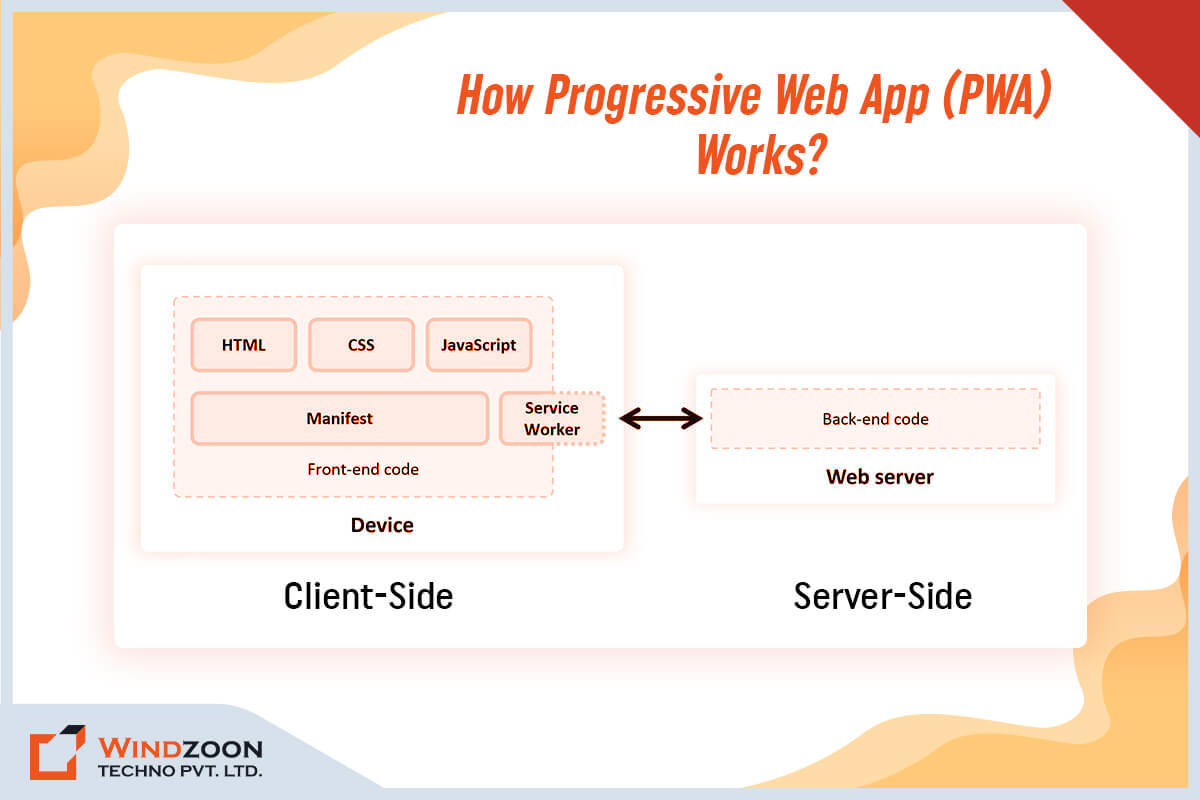
How Progressive Web App (PWA) Works?

how-pwa-works

The architecture of a Progressive Web Application (PWA) is basically like a two-sided coin. On one side, you have the client which is where the user interacts with the app. And on the other side, you have the server which is where the app is hosted and managed.

The client-side of a PWA is built using web technologies that we all know and trust, like HTML, CSS, and JavaScript. This is where the magic happens, and where all the fun stuff takes place as here user interacts with the app.

The significant thing is that these web technologies let the PWA function like an actual native app. That means it can work on any device, from your desktop to your phone or tablet, without needing to be downloaded from an app store.

Now, let’s flip the coin over to the server-side. This is where things get more technical, but don’t worry, we’ll keep it simple. The server side of a PWA uses a combination of traditional web server technologies and modern APIs to deliver an app-like experience.

These APIs include Service Workers which allow the app to work offline by caching its content. It means that even if you’re in the middle of nowhere with no Wi-Fi or data, you can still use the app without any issues. Sounds great, right?

There is more, though. PWAs also make use of Web App Manifests, which describe the app’s metadata. It encompasses elements like the app icon, name, and theme color. This metadata is used to add the PWA to the user’s home screen, making it quickly accessible and identifiable.

Another feature worth noticing is the PWA architecture’s use of a secure HTTPS connection. This guarantees that all data sent between the client and server is encrypted and secure from malicious intrusions. It’s akin to having a bodyguard for your data.

Moreover, the PWA architecture is designed to provide users with a seamless, app-like experience while utilizing the power and flexibility of the web. However, to avail of its full potential it’s recommended to hire mobile app developer from a reputed web development agency.

Now, we will get to know about the fundamental pillars of progressive web apps.

The Three Pillars of Progressive Web Applications

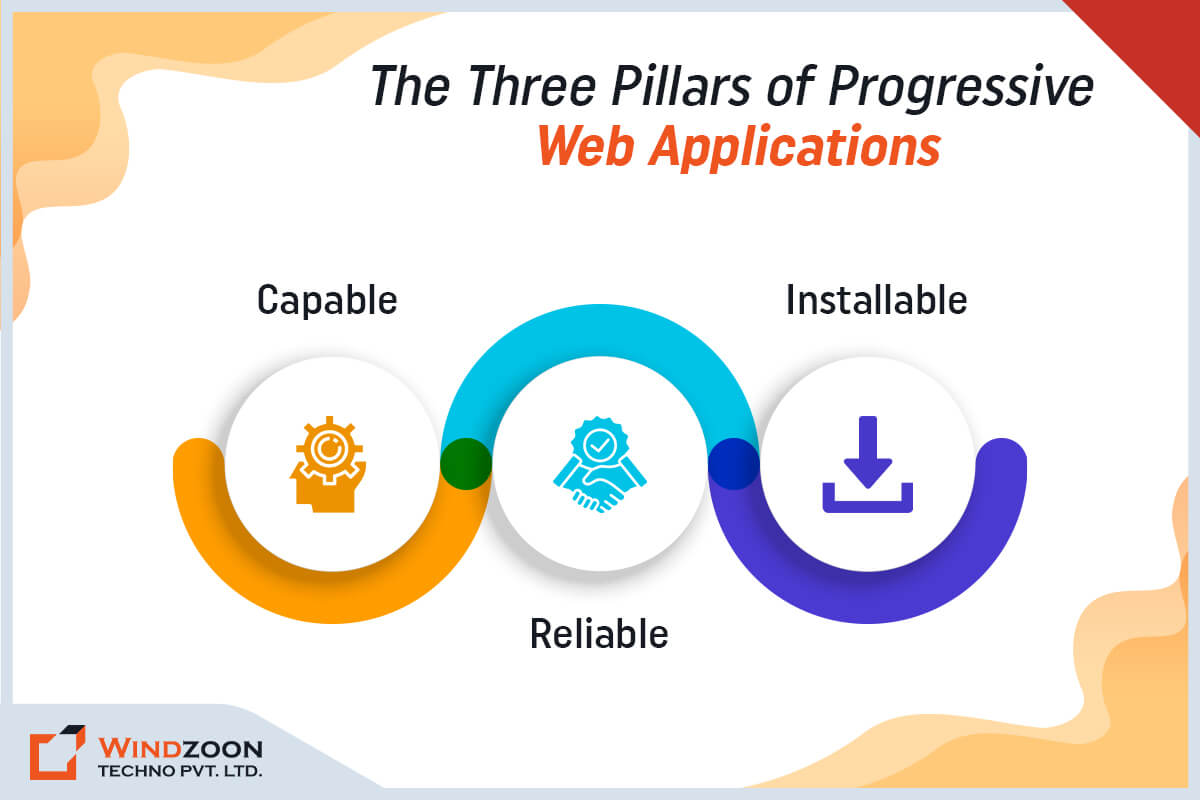
Progressive Web Apps (PWAs) are web-based applications that are capable, reliable, and installable. With the help of these three pillars, they become an experience that resembles a platform-specific application.

3-pillars-of-pwa

1. Capable

The first pillar of PWA applications is capability. It means that PWAs are capable of providing a range of functionalities that can compete with native applications.

They can access device hardware and leverage features like cameras, microphones, geolocation and sensors, just like a native app can.

Besides, PWAs provide the ability to receive push notifications, which is essential for keeping users engaged with the app.

2. Reliable

The second pillar of PWA apps is reliability. Basically, these apps are built to work smoothly no matter what kind of network you’re on, even if it’s weak or unstable. Plus, they can give you a seamless experience even if you don’t have internet, and they load super fast.

The question is, how do they accomplish it?

With the help of service workers, which are scripts that run in the background to cache the app’s content.

And caching frequently used resources also aids in accelerating the performance of the application.

3. Installable

The third and final pillar of PWA applications is all about being “installable”. Basically, this means that PWAs can be installed on a user’s home screen, just like a native app.

However, to achieve this, PWAs use something called a Web App Manifest which defines important things like the app’s icon, name, and even its theme color. All of this helps create an app-like experience that users can easily access and enjoy.

Plus, when you install a PWA, you don’t have to go through the hassle of downloading it from an app store. And that makes the installation process easy and hassle-free.

After this, let’s learn about some of the wonderful features of PWA.

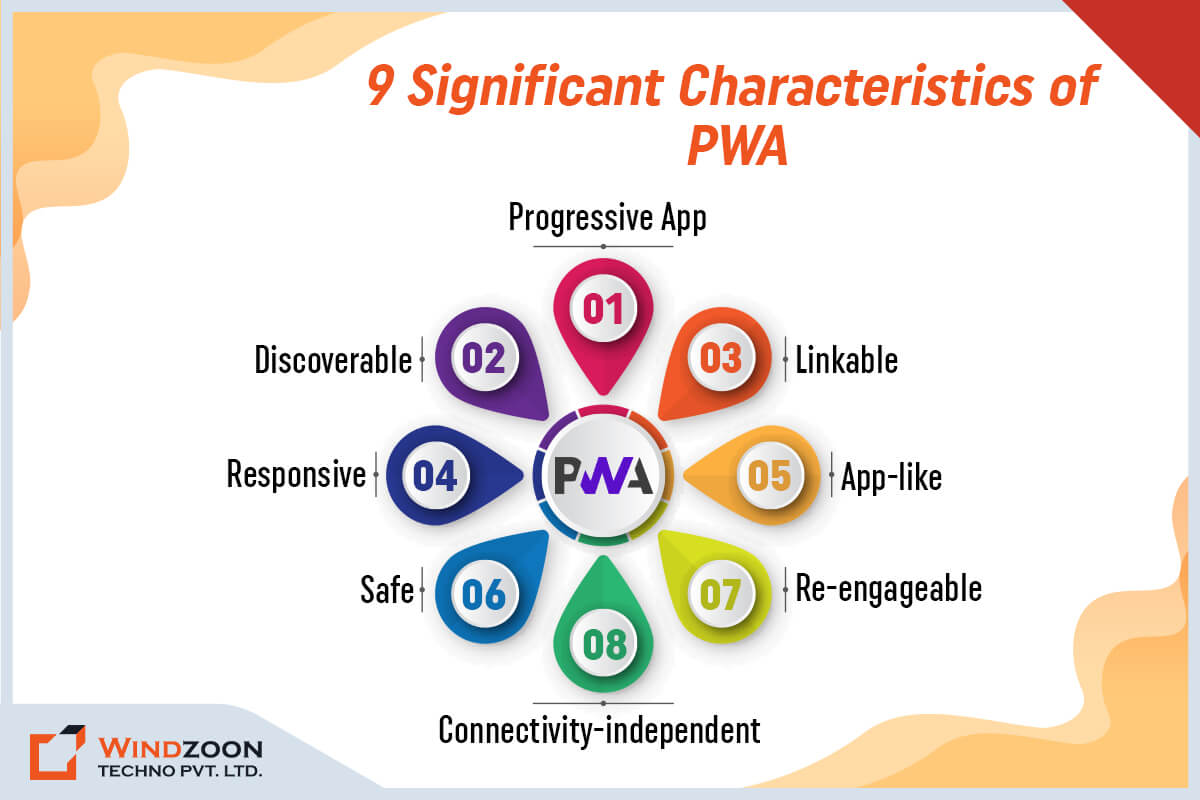
9 Significant Characteristics of PWA

characteristics-of-pwa

1. Progressive App

A progressive web app, by definition, must function on any device and improve progressively, taking benefit of any features available on the user’s device and browser.

2. Discoverable

A progressive web app should be findable in search engines since it is a website. This is a significant benefit over native apps, which are still not as searchable as websites.

3. Linkable

Another trait that has been carried over from websites is that a well-designed website should use the URI to denote the application’s present state. By doing this, the web app will be able to retain or refresh its current state when a user bookmarks or shares the app’s URL.

4. Responsive

A progressive web app’s UI has to adapt to the device’s form factor and screen size.

5. App-like

The application shell model should be used to create progressive web apps, which should have a native-app-like design and require a few page refreshes.

6. Connectivity-independent

It ought to function offline or in places with poor connectivity.

7. Re-engageable

Since users of mobile apps are more likely to re-use them, progressive web apps are made with the same objectives in mind and incorporate push notifications among other features.

8. Safe

A progressive web app must be hosted over HTTPS to prevent man-in-the-middle attacks because it offers a more personalized user experience and can intercept all network requests through service workers.

Next, we will understand the things to keep in mind before designing & developing progressive Web apps.

Things to Consider While Designing Progressive Web Apps

  • It’s crucial to put the user experience front and center while creating PWAs.
  • PWAs should be responsive, meaning they should adjust to multiple screen sizes and orientations.
  • Additionally, they ought to be created with accessibility in mind, with simple navigation, readable fonts, and high contrast.
  • Furthermore, PWAs ought to be created with offline usage in mind, offering users offline content and utilizing caching to boost performance.
  • Finally, PWAs should be made installable, with a clear call to action encouraging users to add the app to their home screen.

Things to Consider While Developing Progressive Web Apps

  • Developing PWAs necessitates an understanding of modern web development technologies as well as best practices.
  • PWAs can be created with a number of different frameworks and tools, such as React, Angular, Vue, and Ionic.
  • To deliver a smooth user experience, developers must make sure the app is quick, reliable, and engaging by leveraging service workers, caching, and push notifications.
  • Furthermore, developers must optimize the app for search engines and make it accessible to users with disabilities.

After this, our next topic of discussion is to know about the key difference between the three primary web app development techniques.

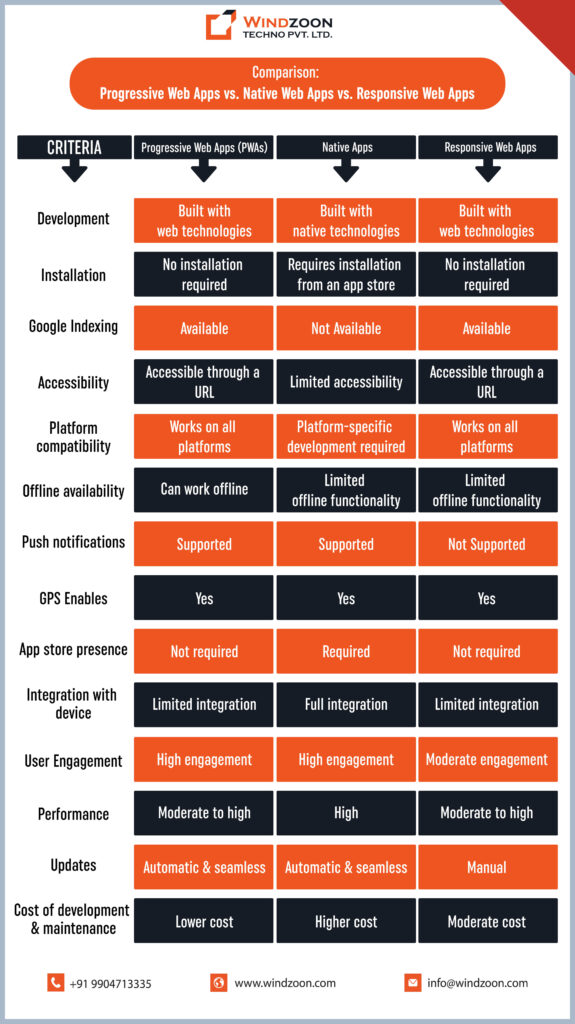
Comparison: Progressive Web Apps vs. Native Web Apps vs. Responsive Web Apps

1. Native Applications

Native Applications have been in existence for a while. They were the main forces behind the development of novel technologies and altered peoples’ perspectives on mobile phone usage. However, there are some drawbacks to a Native App, making Progressive Web Apps a preferable option.

For instance, developers must create native applications for particular operating systems using specific coding languages. To be transmitted to users, these applications must be released on an app distribution platform like the Play Store or the App Store, which might pave the way for monopolization over application distribution.

2. Progressive Web Applications

Progressive Web Applications (PWA) are websites that attempt to emulate the features of native mobile applications. Besides, they aren’t made accessible via platforms used for app release.

3. Responsive Web Applications

The motive behind the development of responsive web applications was to enhance user experience on an array of devices. Its other major purpose was to accommodate the variations in screen sizes among digital devices. However, it lacks features that are typical of native and progressive web applications, such as push notifications, offline support, etc.

Below is a comparison of Progressive Web Apps, Native Apps, and Responsive Web Apps:

comparison-pwa-nativeapps-responsiveapps

[wpdatatable id=16 table_view=regular]

Read Also: Know Which one is better for your business; Flutter or PWA?

And here comes our main topic of discussion and that is:

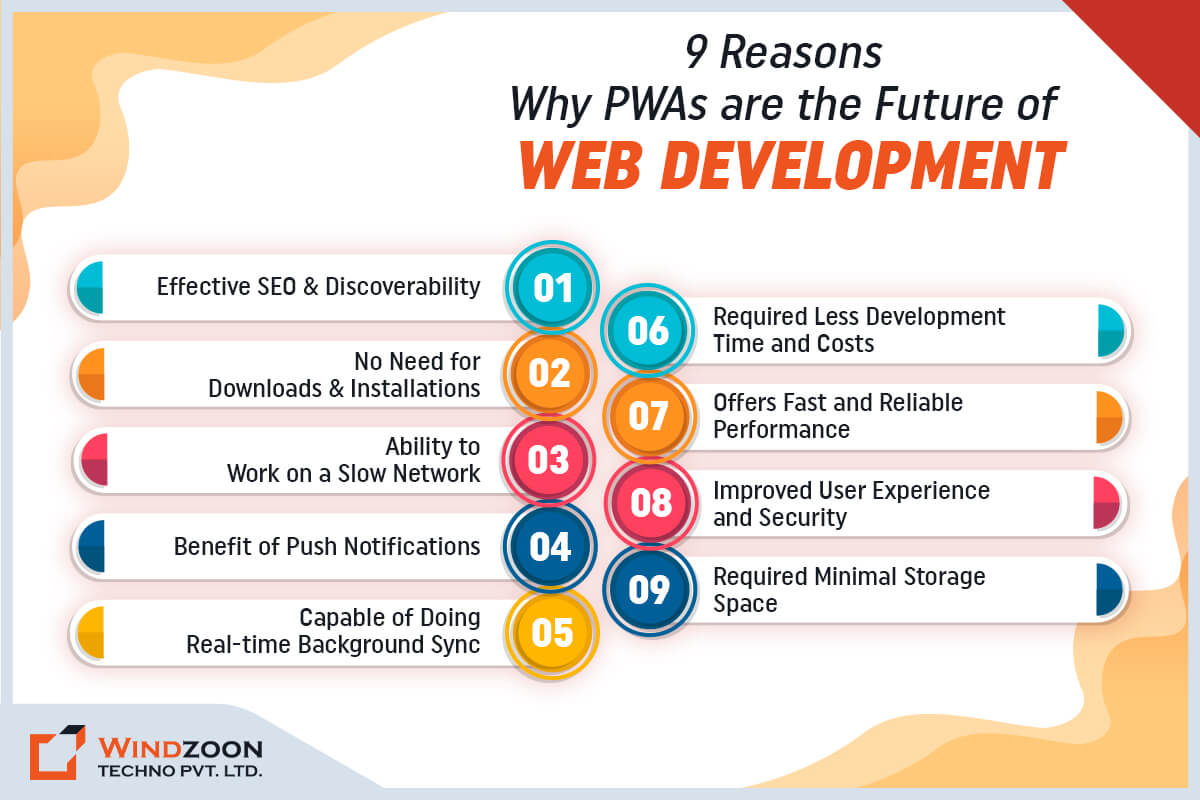
9 Reasons Why PWAs are the Future of Web Development

reasons-why-pwa-is-future-of-web-development

The popularity of Progressive Web Apps (PWAs) as a substitute for native apps has grown in recent years. They offer a lot of advantages that traditional web apps and native apps can’t provide. Here, we will discuss the nine reasons why PWAs are the future of web development.

1. Effective SEO and Discoverability

One of the most significant advantages of PWAs is that they are easily discoverable and search engine optimized. Due to the fact that they have extensive internet functionality, database access, and automatic data.

As a result, search engines like Google, Bing, and others can easily find and index them just like regular web pages. Thus, they can be found through search engine inquiries, increasing the visibility and traffic to your app.

Additionally, they can be shared via URLs, making promoting and sharing your app simpler.

2. No Need for Downloads and Installations

In contrast to native apps, PWAs don’t need to be downloaded or installed.

Instead, they can be accessed via a web browser, saving users the trouble of visiting an app store.

This drastically reduces the risk of customers abandoning an app during the installation process.

3. Ability to Work on a Slow Network

PWAs are made to work well in all kinds of network conditions, even sluggish or unstable ones.

This is made possible by using PWAs’ built-in service workers, which save and cache the content for subsequent display when your clients’ network connections fail.

Additionally, it makes the PWA accessible without having to download it, which is particularly helpful when connectivity is weak.

4. Benefit of Push Notifications

PWAs can notify users via push notifications exactly like native apps.

This implies that users can get updates and alerts even while they aren’t actively using the app. With the help of this PWA functionality, eCommerce businesses have great chances to retain clients.

Because it serves as a reminder to customers of things like forgotten deals and offers and abandoned shopping carts. Brands can interact with their customers more frequently and efficiently by using highly visible push notifications.

5. Capable of Doing Real-time Background Sync

PWA’s service workers can synchronize data in real-time in the background without the user having to interact with the app in any way.

Therefore, the user won’t have to wait for the app to refresh when they open it again because the data will already be up-to-date.

This functionality can be beneficial for apps that require real-time data synchronization, such as chat apps or collaborative software.

6. Required Less Development Time and Costs

Since PWAs only need a single codebase to deliver a consistent experience across all platforms and devices, they are less expensive to design, develop, launch, and maintain.

PWAs provide quick distribution of updates, new features, bug corrections, and other things, which saves money for organizations. In comparison to mobile apps, maintaining progressive web apps is 33% cheaper.

When compared to websites and mobile apps, PWAs allow businesses to deliver the same content across all touchpoints, saving time and money. The PWAs are a financially appealing choice because you don’t have to bother about routine upgrades if they’re functioning properly.

7. Offers Fast and Reliable Performance

Progressive web apps allow for content caching every time a user visits, resulting in a smoother and dramatically better user experience.

Additionally, content caching speeds up page loading. PWAs are fast and constant in their performance, which benefits conversion rates. Compared to native apps, conversion rates from progressive web apps are 52% higher.

Furthermore, a positive user experience aids businesses in customer retention and loyalty.

8. Improved User Experience and Security

When compared to regular web apps, PWAs can provide a better user experience. As they are developed to offer app-like features such as full-screen mode, offline mode, and a home screen icon.

Since PWAs use HTTPS encryption, they are also more secure than regular web apps. It blocks content manipulation, eavesdropping, and other harmful and unlawful activities.

On top of that, PWA takes advantage of web Bluetooth technology, and it comes with some additional security features.

9. Required Minimal Storage Space

PWAs are more compact than mobile apps in terms of size. As a result, PWAs load faster, take less memory to execute and place less strain on the user’s hard disk.

It is due to the manner in which PWAs have developed, which permits data caching in the background while a user interacts with a website.

Also, they do not require downloading or installation on the device. This feature is highly valuable for organizations with a target audience that is sensitive to device storage restrictions.

Next, we will learn about some of the promising examples of progressive web apps around the world.

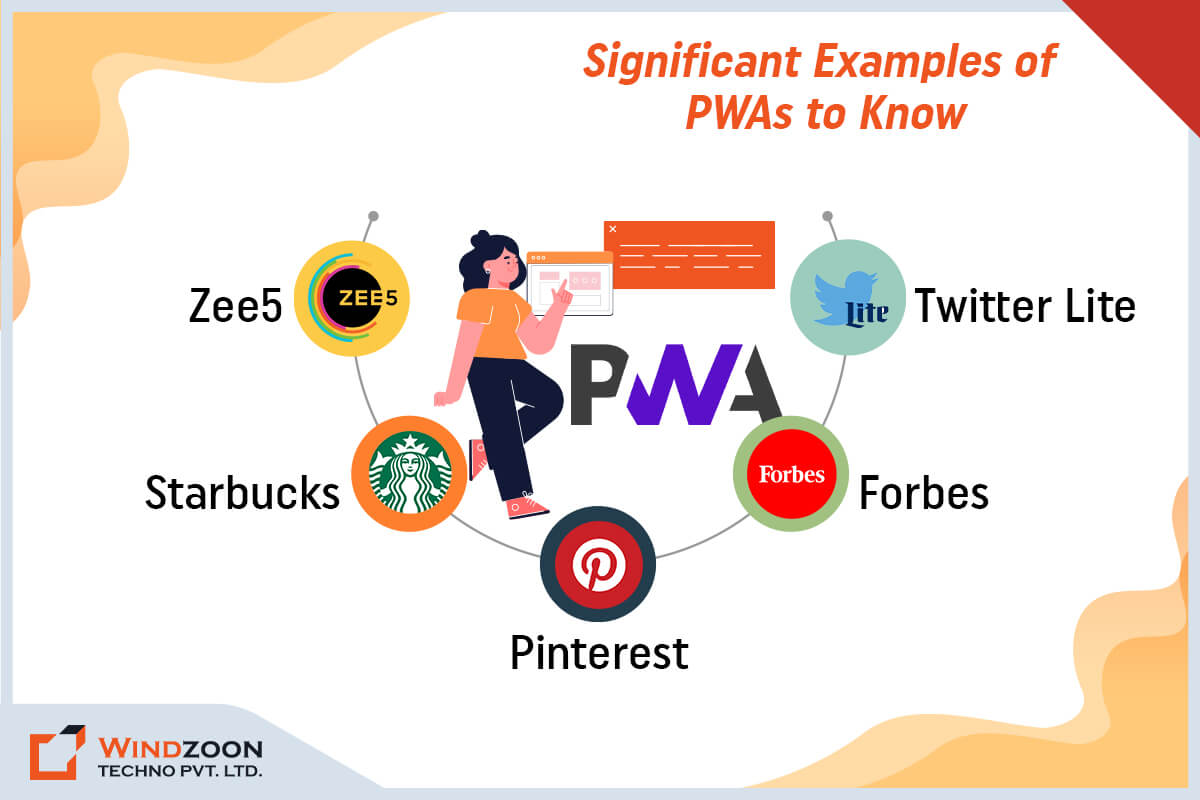
Some Striking PWA Examples to Know

examples-of-pwas

1. Zee5

ZEE5 built a PWA to streamline its platform and broaden its reach. It has increased app performance by three times and decreased buffering time by fifty percent.

2. Starbucks

Starbucks developed a PWA of their ordering platform that offers a comparable user experience to their current native app. Customers may quickly browse the menu, customize orders, add things to their basket, and do other tasks, whether they are doing so online or offline. It has raised the number of daily active users by twofold. And improve orders on desktop at almost the same rate as on mobile.

3. Pinterest

Pinterest revamped its mobile site as a PWA, which increased its core engagements by 60%. Furthermore, they saw a 44% increase in user-generated ad revenue, as well as a 40% increase in time spent on the site.

4. Forbes

Forbes is one of the prominent players in the news and media world. It has converted its website to a PWA. And now it loads in 2.5 seconds on mobile, compared to 6.5 seconds for its previous website. Additionally, there has been a 10% increase in impressions per visit.

5. Twitter Lite

Twitter has also employed PWA for its lite version, which is small, blazingly fast, and still retains the majority of the original app’s features. Twitter Lite reported a 65% increase in pages per session, a 75% rise in Tweets, and a 20% drop in bounce rate. Even on slow networks, Twitter Lite loads in under 3 seconds for repeat visits.

Conclusion

Progressive Web Apps is an innovative solution that combines the best of web and native app technologies. They provide a fast, reliable, and engaging experience for users while enabling developers to create apps that are cost-effective and easy to maintain.

With the rise of mobile usage and the growing demand for mobile-friendly solutions, PWAs are proving to be the future of web development.

Companies such as Starbucks, Pinterest, and Twitter have already leveraged PWAs to improve their user experience and boost their revenue. You can also become like them by joining hands with a skilled web development company to build PWA for your organization.

Windzoon is a prominent mobile app development services provider with exceptional experience and expertise in developing PWAs. To leverage our services, reach out to us and get a quote.

An Important 9-Step Guide on Mobile App Development Process

There was a time when people sent text messages on pagers. However, with the powerful features available in the form of applications, mobile phones have arisen as an ideal alternative to past technologies.

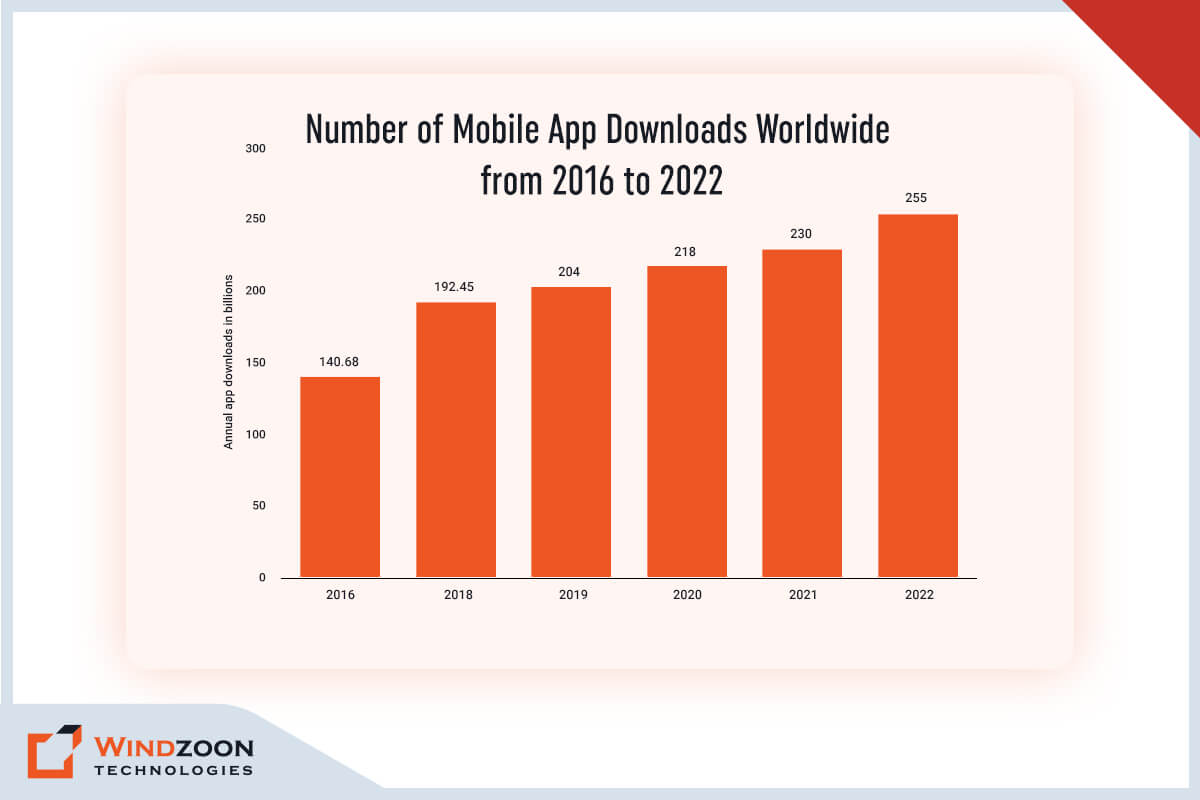
It has successfully crossed 6 billion users and has generated 59.16 percent of global website traffic in 2022. With this increasing usage of mobile phones, the mobile app development market is also growing with leaps & bounds.

Number of Mobile App Downloads Worldwide

In 2022, around 5 billion applications were in the different app stores. And the total number of mobile app downloads was 255 billion, with $430.90 billion in revenue generation.

Considering this significant number of applications on the internet, it is difficult to build an app that can stand apart from this cutthroat competition.

And for you to build such an app, you need a niche and unique development idea and a finely tuned development process.

As a seasoned mobile app development company with a decade of experience in app development, we have prepared a detailed step-by-step guide to explain the mobile app development process in a simple way. So stay tuned to this post to know further.

However, before we go further, let’s learn some basic information about mobile app development.

What is Mobile App Development?

Mobile app development refers to the process of producing software applications that run on mobile devices like smartphones, tablets, and smartwatches. These applications can be designed for a specific mobile operating system, such as iOS or Android, or cross-platform use, meaning they can run on multiple operating systems.

The mobile app development process involves various stages, including ideation, design, development, testing, and deployment. It often involves a team of developers, designers, project managers, and quality assurance professionals who work together to bring an app to life.

Mobile app development involves building & maintaining various types of apps, including games, social media, and e-commerce apps. However, the types of developed mobile apps depend on users’ needs and the business organizations’ goals.

In the next question, we will understand the people who need mobile applications.

Who Requires a Mobile App?

Everyone needs a mobile app! Okay, not everyone, but most people these days, use smartphones and rely on apps to make their lives easier. So whether you’re a business owner, a student, a fitness enthusiast, or just someone who wants to stay connected with friends and family, an app can help you achieve your goals.

For businesses, a mobile app can be a powerful tool for engaging with customers and increasing revenue. Apps can be used to showcase products and services, offer discounts and promotions, and provide a seamless user experience. They can also help businesses stay in touch with their customers, gather feedback, and improve their offerings.

For individuals, a mobile app can be a convenient way to manage daily tasks, stay informed about the world, and connect with others. In addition, apps can help you track your fitness goals, manage your finances, learn new skills, and even find love. With so many apps available, there’s something for everyone, no matter your interests or needs.

In short, mobile apps have become an integral part of modern life, offering convenience, entertainment, and utility. So whether you’re running a business or just trying to navigate your daily routine, a well-designed mobile app can be a game-changer.

Now, we will learn the significant reasons to invest money in mobile app development.

Important Reasons to Invest in Mobile App Development

Here are some reasons to invest in mobile app development in bullet points:

  • Increased customer engagement with proper UX and satisfaction
  • Potential for new revenue streams
  • Improved brand recognition and loyalty
  • Ability to gather user data and feedback
  • Greater accessibility to customers anytime, anywhere
  • Opportunity to showcase products and services in a unique and interactive way
  • Better communication and relationship-building with customers
  • Potential for cost savings and increased efficiency in business operations

These are just some of the many reasons businesses and individuals may invest in mobile app development services. By creating a well-designed and functional app, you can provide a valuable service to your customers while also achieving your business goals.

After this, we will learn the most common types of mobile apps.

Various Types of Mobile Apps

There are several types of mobile apps, each with its own set of advantages and disadvantages. Below are brief summaries of the four most common types of mobile applications:

Native Apps: Native apps are built specifically for a single mobile operating system, such as iOS or Android. They are developed using the platform’s software development kit (SDK) and optimized for its hardware and software. Native apps are fast, responsive, and provide the best user experience, but they can be expensive to develop and maintain.

Cross-Platform Apps: Cross-platform apps are designed to run on multiple mobile operating systems using a single codebase. These apps are typically built using web technologies such as HTML, CSS, and JavaScript and are wrapped in a native container that allows them to run on different platforms. As a result, cross-platform apps are less expensive to develop than native apps but may not perform as well or provide as good a user experience.

Hybrid Apps: A hybrid app combines features from both native and web apps. They are built using web technologies but are wrapped in a native container that allows them to access the device’s hardware and software features. Hybrid apps are less expensive to develop than native apps and can be deployed on multiple platforms, but they may not perform as well or provide as good a user experience as native apps.

Progressive Web Apps (PWAs): PWAs are web applications that are designed to look and feel like native apps. They can be accessed through a web browser and can be installed on the user’s device like a native app. PWAs are designed to be fast, reliable, and provide a good user experience. They are less expensive to develop than native apps and can be deployed on multiple platforms, but they may not have access to all of the device’s hardware and software features.

Read More: Top Mobile App Development Frameworks to Build Mobile Apps

Each type of mobile app has its advantages and disadvantages, and the choice of which type to use depends on various factors, including the app’s functionality, target audience, and budget.

Now, we will compare different alternatives for developing mobile apps.

Important Comparison of Various Alternatives for Developing Apps

[wpdatatable id=12]

After this, we will learn about the influence of the latest technology on the creation of mobile apps.

Impact of Modern Technology on the Creation of Mobile Apps

Mobile app development constantly evolves, with new technologies emerging and shaping how we interact with our devices. These new technologies have profoundly impacted the mobile app industry, both in terms of the apps themselves and the development process. Here are some ways new technology has impacted mobile app development:

  • Increased functionality through emerging technologies like AI, AR, and VR
  • Improved user experience as mobile devices become more capable
  • Streamlined development process through new tools and frameworks
  • Increased competition as more apps flood the market
  • Evolving security concerns with sensitive activities being performed on mobile devices
  • Greater emphasis on personalization and customization in app design
  • Integration with emerging technologies like wearables and smart home devices
  • The growing importance of data analytics and machine learning for app optimization
  • Increased adoption of cloud-based services for app development and hosting
  • Advancements in mobile payment and e-commerce capabilities for app users

The impact of new technology on mobile app development has been both positive and challenging. However, the continued evolution of mobile technology will bring further advancements and changes to the industry, making it an exciting time to be a mobile app developer.

Finally, we have come to the main topic of this blog post.

Read More: Mobile App Development Trends You Should Know

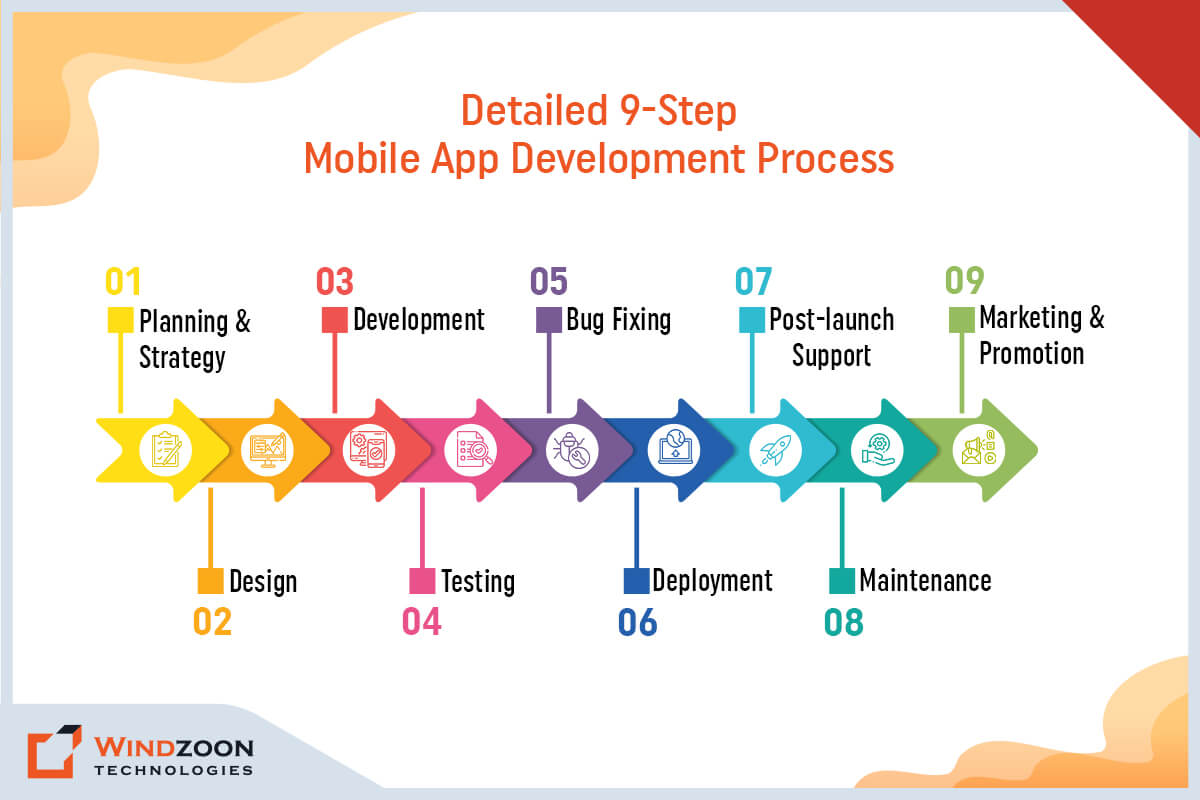
A Comprehensive 9-Step Process of the Mobile App Development

Detailed 9-Step Mobile App Development Process

1. Planning and Strategy

Define the app’s purpose, target audience, and goals: It is important to identify the specific problem or need that your app is trying to solve. You also need to determine who your target audience is and what their needs and preferences are. This will help you to design an app that meets their needs and expectations.

Conduct market research and competitor analysis: You need to understand the current market trends and what your competitors are offering. This will help you identify any gaps in the market and develop unique features for your app.

Determine the app’s features and functionality: Based on your research; you need to determine the features and functionality that your app should have. It’s called a Minimum Viable Product(MVP). While deciding on MVP, it is important to keep the user experience in mind and make the app as easy to use as possible.

Product Roadmap: The team creates a product roadmap to help keep development on track and ensure that the app meets business goals.

Develop a project timeline and budget: It is important to set a realistic timeline for the project and determine how much money you can allocate for the development process.

2. Design

Create wireframes and mockups of the app’s user interface: Wireframes are simple sketches of the app’s layout and interface. This helps to visualize the structure and layout of the app. And Mockups are a more detailed representation of the app’s interface with visual elements, colors, and typography.

Develop a visual design for the app, including color schemes, typography, and branding: You need to design a visual style for your app that is consistent and appealing to your target audience.

Develop the user interface (UI) design: The UI design determines how the app’s functionality will be presented to the user. It includes the layout, buttons, icons, and other elements with which the user will interact.

Create a user experience (UX) design: The UX design determines how the user will navigate the app and interact with its functionality. It includes the user journey, information architecture, and other elements that contribute to the user experience.

Create a clickable prototype: A clickable prototype is created to test the app’s design and functionality. This low-fidelity version of the app enables the development team to identify any potential issues and make necessary changes.

3. Development

Choose a mobile app development platform: There are different platforms available for mobile app development, including Android and iOS. The development team should choose the platform that aligns with the app’s objectives and target audience.

Create a database: The app’s database is developed, and the development team creates the schema and tables necessary to store data.

Develop the backend: The backend is developed to support the app’s functionality. This includes developing APIs, web services, and other components necessary to connect the app’s front end with its back end.

Develop the front end: The front end of the app is developed, including the screens, buttons, menus, and other elements that the user will interact with.

Integrating third-party APIs and services, if necessary: Third-party APIs and services can be used to enhance the app’s functionality, such as adding location-based services, social media integration, or payment processing.

Sprints: Development is broken up into sprints, which are short and focused periods of development that deliver a specific set of features.

Agile Methodology: The development team uses an agile development methodology, which means that they prioritize communication, collaboration, and flexibility.

4. Testing

Testing is a crucial step in the mobile app development process that ensures the app is functioning as intended.

Unit testing: This is the process of testing individual units or components of the app, such as a single function or module, to ensure it works as intended.

Integration testing: This is the process of testing how different units of the app work together to ensure that they function as expected.

Functional testing: This is the process of testing the app’s functionality to ensure it meets the requirements and performs as intended.

Performance testing: This is the process of testing the app’s performance, such as load time, response time, and stability, to ensure it can handle the expected user traffic.

User acceptance testing (UAT): This is the process of testing the app with real users to gather feedback and ensure it meets their needs and expectations.

5. Bug Fixing

After testing is complete, the development team will identify any bugs or issues that need to be addressed.

Identifying the root cause of the bug: The development team must determine the cause of the bug to be able to fix it.

Prioritizing bugs: Not all bugs are created equal, and the development team must prioritize which bugs to fix first based on their severity and impact on the user experience.

Fixing the bug: The development team will fix the bug and conduct additional testing to ensure the fix works as intended.

Updating the app: After the bug is fixed, the development team will update the app and release a new version to the app store.

6. Deployment

The deployment phase is when the app is released to the app store.

Build Files: The development team creates the necessary build files, which are used to package the app for deployment.

App Metadata: The development team creates app metadata, such as app descriptions, screenshots, and keywords, to help the app rank in the app store.

App Store Guidelines: The development team ensures that the app meets the app store guidelines and requirements for deployment.

Submit the app to the app store for review: Before the app can be released to the public, it needs to be reviewed by the app store for quality and compliance with their guidelines.

Release the app to the app store: Once the app has been approved, it can be released to the app store for users to download and use.

7. Post-launch Support

In the post-launch support phase, the app is monitored for bugs and crashes, and customer support is provided.

Debugging: The development team releases regular updates to the app to fix any bugs or issues that users report.

Customer Support: The development team provides customer support to users who experience issues with the app.

Analytics: The development team uses app analytics to track user behavior and make data-driven decisions about future updates.

8. Maintenance

In the maintenance phase, the app is kept up-to-date with the latest operating system and device updates.

OS and Device Compatibility: The development team ensures that the app is compatible with the latest operating systems and devices.

App Store Optimization: The development team regularly updates the app’s metadata to ensure that it ranks well in the app store.

Feature Updates: The development team releases regular updates to the app that add new features and improve user experience.

9. Marketing and Promotion

Create a marketing strategy for the app: You must develop a marketing plan to promote the app to your target audience. This can include social media marketing, content marketing, and paid advertising.

Analyze user feedback and make improvements: It is important to listen to user feedback and make necessary improvements to the app to meet their needs and expectations. This will help to increase user engagement and retention.

Conclusion

Mobile app development is an exciting and constantly evolving field that requires a diverse range of skills and expertise. From the initial concept and design phase to development and testing, and finally, to deployment and maintenance, the mobile app development process is a complex and multifaceted undertaking.

It requires a team of talented individuals with various skills, including designers, developers, project managers, and quality assurance specialists. And to get all these experts in one place, take assistance from a competent mobile app development company.

Windzoon is a leading web app development company with a decade of experience in web & app development. Hire mobile app developers from us to build a sophisticated and industry-specified app for varied business models.

Contact us to avail of our expert services and get a quote.

14 Inspiring Mobile App Development Trends You Should Consider in 2023

The global pandemic has hastened the shift toward mobile-first solutions in all industries. As more modern customers use their smartphones to pay bills, order items, connect with coworkers, and make new friends, the demand for high-quality mobile apps has skyrocketed.

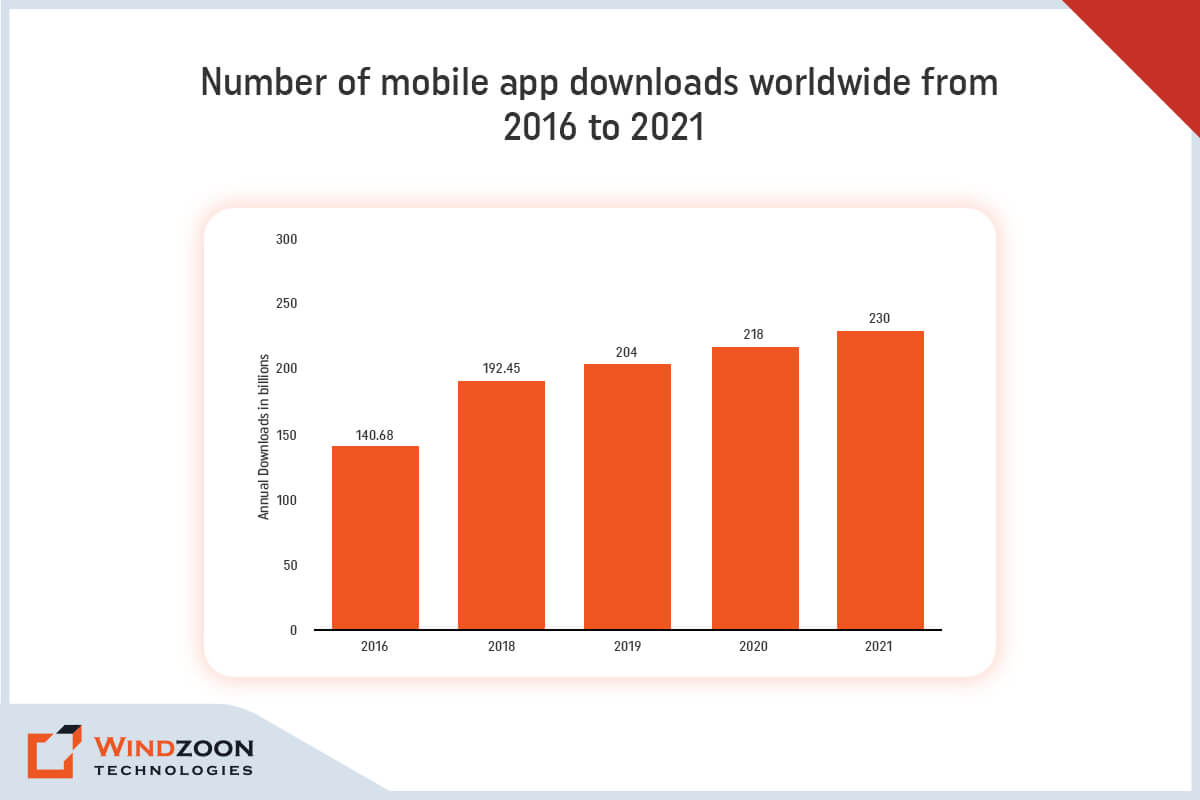
Therefore, developing a market-leading app becomes essential for both startups and established businesses. Since app downloads increase steadily each year, this is not surprising. Annual mobile app downloads were as high as 230 billion in 2021, and it is still rising. A mobile app is undoubtedly a highly lucrative project that you can undertake with the aid of any mobile app development company.

mobile app downloads worldwide

Number of mobile app downloads worldwide from 2016 to 2021

But in order for a mobile app to succeed, it must adhere to the most recent trends in mobile app development. Because if it doesn’t, the app, which seems cutting-edge now, might be considered outdated later on.

Here are some outstanding mobile app development trends for 2023 that every Indian company should be aware of.

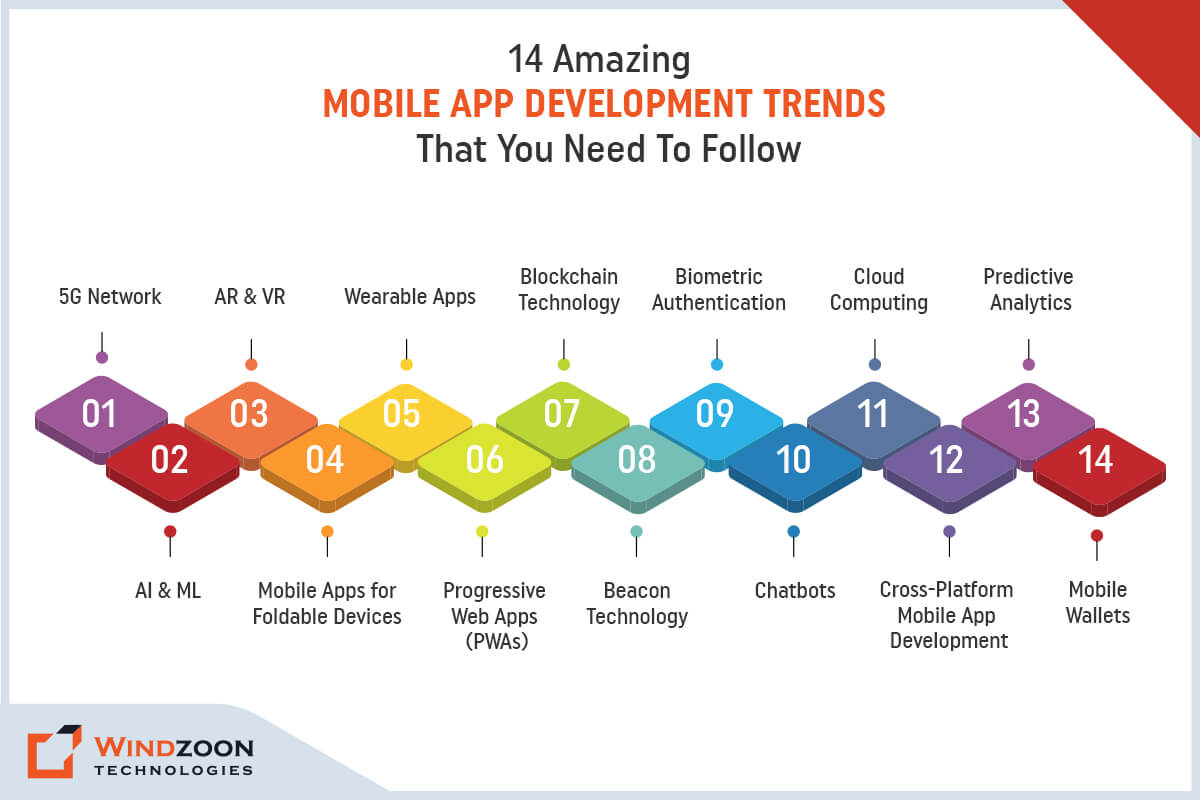
Mobile App Development Trends You Need Follow

Amazing Mobile App Development Trends You Need To Follow

1. 5G Network

The fifth generation of mobile connectivity, or 5G, is soon to arrive. It will transform the creation of mobile apps in ways we never imagined. By 2026, it’s predicted that 5 billion people will be using 5G, which is also seen as the start of the Fourth Industrial Revolution.

Unlike its predecessor, 5G has a latency of less than one millisecond. It will boost data transfer rates up to 100 GB/s.

5G will stimulate app development in areas such as the Internet of Things (IoT), augmented reality (AR) and virtual reality (VR), connected driverless vehicles, wireless health, and others. Next-generation apps will use this power and speed to accomplish things we never thought possible.

2. AI and ML

Mobile apps and systems are already using artificial intelligence and machine learning. Face App, Prisma, and other AI-powered applications have taken AI to the next level.

In 2023, AI will have a more significant impact on our daily lives. Along with current technologies, AI advancements like AI-based cameras, speech translations, and user projections will find a new home in smartphones.

Many businesses recognize the advantages of AI because it enables them to deliver top-notch services while significantly reducing operating costs.

3. AR and VR

A growing number of businesses are using augmented and virtual reality to improve the user experience of their mobile apps. In 2023, the AV/VR market is projected to reach $160 billion, a significant rise from $12 billion in 2020. And in the ensuing years, this trend is not likely to reverse itself.

Numerous apps in the market are already utilizing the power of AR/VR, including Google Maps, Ikea, Nike, and many others. So, if you want to use augmented or virtual reality to enhance your company’s offerings, the time is now.

4. Mobile Apps for Foldable Devices

Devices with folding displays are called foldable devices. It is still uncommon to use this construction technique. However, major manufacturers like Samsung, Huawei, LG, and others actively promote their first smartphones with foldable displays.

Both manufacturers and app developers can benefit from this trend. In the coming years, digital products that can be customized for special foldable screens may become very popular. At the very least, nearly all mobile applications will be equipped with the technology necessary to adapt app size and layouts to foldable screens.

5. Wearable Apps

As the market for wearable technology expands, more digital solutions are required to support electronics. Every type of wearable device, including jewelry, smart watches, and bands needs a full-featured app.

It assists in collecting the device wearer’s data, measuring and analyzing vital signs, producing advanced statistics, and more.

6. Progressive Web Apps (PWAs)

Progressive web apps are a different mobile app innovation that is anticipated to gain traction in the coming years (PWA). These applications serve as a user interface for websites and native mobile applications.

PWAs are less dependent on the network, take up less space, and load faster. Even though they aren’t a brand-new development trend for mobile apps, they are here to stay and help companies achieve their goals at a reasonable cost.

Progressive web apps are more accessible and simple to design than traditional apps. That is because they are simply web pages with app functionality. PWAs are interactive, updated automatically, and very flexible.

7. Blockchain Technology

According to current trends in mobile app development, blockchain technology is all about better user experience, data privacy, and security.

Blockchain can be used for various purposes, including storing passwords on decentralized networks, using smart contracts to feature in-app transactions between users, blockchain gaming or metaverses, and more.

With the proliferation of blockchain technology and mobile banking, more and more apps will incorporate blockchain solutions.

8. Beacon Technology

Beacons are one of the most recent innovations in proximity marketing and location technology. They are discreet wireless transmitters that communicate with nearby smart devices using low-energy Bluetooth technology. And that way, they link to smart devices and transmit data, facilitating and improving location-based interaction and search.

It makes purchasing goods and services simple and convenient. Hence, many businesses are now using beacon trends to promote their products and services. Additionally, it helps them to learn more about their customers’ purchasing habits and preferences. And enables businesses to make shopping more personalized.

9. Biometric Authentication

App development trends have become more stringent and significant in terms of security. As a result, biometric authentication has become an essential data protection feature for every modern app. It intensified the security several times, allowing for quick authentication and operation.

Face recognition, fingerprint scanning, and computer vision are all examples of this technology. Such a trend has the potential to significantly improve the security of users’ data and money.

10. Chatbots

Chatbots are transforming how companies interact with their customers. In the past, companies used mobile calls to reach out to their clients (which was time-consuming).

Chatbots are a form of communication that aids businesses in meeting customer expectations. Here are some popular chatbot options:

  • Google Assistant
  • Alexa
  • Siri

Chatbots make it easier and faster to respond to customer requests. This technology is widely used in various applications, including online shopping, transportation, food delivery, etc.

11. Cloud Computing

As cloud computing gains popularity, developers can use the strength of the cloud to improve mobile apps. With this innovation, mobile apps can complete complex tasks and obtain all the data they require from the cloud. This enhances the functionality and speeds up the app.

12. Cross-Platform Mobile App Development

The development of cross-platform apps will be one of the most popular mobile app trends in 2023. It enables you to create your app once and release it on various platforms, such as iOS and Android.

Cross-platform development not only saves time and money but also guarantees that your app will look and feel the same on all devices.

13. Predictive Analytics

Predictive analytics includes data modeling, artificial intelligence, machine learning, and data mining. This trend effectively uses data analysis to assist businesses in making future-ready decisions.

It can detect trends and opportunities, improve business processes, and forecast customer behavior. Businesses can improve their chances of success by employing this trend early in developing their mobile applications.

14. Mobile Wallets

Customers are particularly fond of mobile wallets. People prefer not to frequently pay with cash or type account or card information as the economies of various countries become more digital. For better throughput, they prefer to pay using integrated digital payment.

By integrating popular payment gateways with mobile wallets, the payment process is sped up and simplified.

A growing number of mobile wallets have gained popularity, including Google Pay, PhonePe, Amazon Pay, Paytm, and others. Because the industry has not yet reached saturation, there is still an opportunity for future growth.

Conclusion

The mobile app industry is expanding and evolving at a rapid pace. How can you ensure your app stands out from the millions of others on the market and offers what users want? The answer is simple: by using the most recent trends in app development when creating your application.

And if you require assistance in putting these trends into action, please do not hesitate to contact us. As a preeminent Mobile App Development Company, Windzoon offers top-notch mobile application development services at the most affordable prices.

Hire Mobile App Developers from us to create a bespoke application tailored to your business needs and the latest industry trends.

For more information about our services or to get a quote, go to wzadmin.windzoon.in/.