Have you ever had trouble accessing a website on your phone or tablet? Maybe the website was slow to load, didn’t work properly, or required an internet connection to function. Well, businesses are facing the same issues with their web apps.
Native apps are expensive to develop and maintain, while responsive web apps often lack the functionality and features of their native counterparts.
However, don’t freak out, because there’s a solution on the horizon – Progressive Web Apps (PWAs). PWAs offer the best of both worlds, with the functionality of a native app and the accessibility of a web app.
Because of this, the market for progressive web applications reached USD 1.13 billion in 2019 and is anticipated to reach USD 10.44 billion by 2027, achieving a CAGR of 31.9% over the projected time frame.
And as a leading web app development company, in this blog, we’ll thoroughly explain to you why PWAs are becoming the future of web development and discuss some real-world examples of successful PWAs. So, without further ado, let us get started with our discussion!
- What are Progressive Web Apps?
- How Progressive Web App (PWA) Works?
- The Three Pillars of Progressive Web Applications
- 9 Significant Characteristics of PWA
- Things to Consider While Designing Progressive Web Apps
- Things to Consider While Developing Progressive Web Apps
- Comparison: Progressive Web Apps vs. Native Web Apps vs. Responsive Web Apps
- 9 Reasons Why PWAs are the Future of Web Development
- 1. Effective SEO and Discoverability
- 2. No Need for Downloads and Installations
- 3. Ability to Work on a Slow Network
- 4. Benefit of Push Notifications
- 5. Capable of Doing Real-time Background Sync
- 6. Required Less Development Time and Costs
- 7. Offers Fast and Reliable Performance
- 8. Improved User Experience and Security
- 9. Required Minimal Storage Space
- Some Striking PWA Examples to Know
- Conclusion
Our first topic of discussion is to get basic information about Progressive web applications.
What are Progressive Web Apps?
Progressive Web Applications (PWAs) are lightweight applications developed utilizing tried-and-trusted web technologies such as HTML, CSS, and JavaScript. But what sets them apart is that they look and function just like a native app! Hold on, what exactly is a native app?
Well, a native app is a software application that’s designed specifically for a particular device platform like iOS or Android. And It’s also built using a specific programming language, which can be quite a hassle.
However, working with PWAs is a breeze. They are jam-packed with features including offline functionality and push notifications. The best thing is? They were created utilizing modern APIs, making them extremely reliable and installable on any device.
The real kicker is that PWAs make use of the vast web ecosystem. This encompasses plugins, community support, and simple deployment. PWAs, unlike native apps, can be created quickly and with little effort.
Next, we will learn about the architecture of PWAs.
How Progressive Web App (PWA) Works?
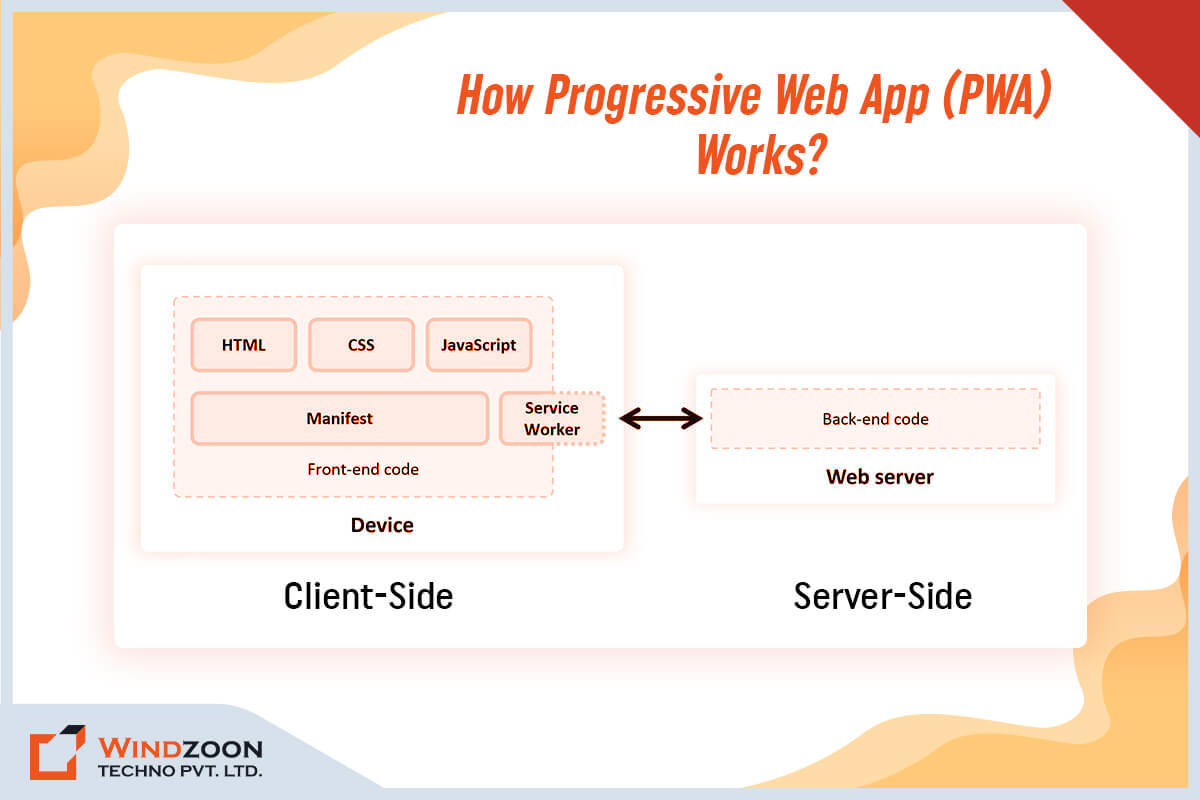
The architecture of a Progressive Web Application (PWA) is basically like a two-sided coin. On one side, you have the client which is where the user interacts with the app. And on the other side, you have the server which is where the app is hosted and managed.
The client-side of a PWA is built using web technologies that we all know and trust, like HTML, CSS, and JavaScript. This is where the magic happens, and where all the fun stuff takes place as here user interacts with the app.
The significant thing is that these web technologies let the PWA function like an actual native app. That means it can work on any device, from your desktop to your phone or tablet, without needing to be downloaded from an app store.
Now, let’s flip the coin over to the server-side. This is where things get more technical, but don’t worry, we’ll keep it simple. The server side of a PWA uses a combination of traditional web server technologies and modern APIs to deliver an app-like experience.
These APIs include Service Workers which allow the app to work offline by caching its content. It means that even if you’re in the middle of nowhere with no Wi-Fi or data, you can still use the app without any issues. Sounds great, right?
There is more, though. PWAs also make use of Web App Manifests, which describe the app’s metadata. It encompasses elements like the app icon, name, and theme color. This metadata is used to add the PWA to the user’s home screen, making it quickly accessible and identifiable.
Another feature worth noticing is the PWA architecture’s use of a secure HTTPS connection. This guarantees that all data sent between the client and server is encrypted and secure from malicious intrusions. It’s akin to having a bodyguard for your data.
Moreover, the PWA architecture is designed to provide users with a seamless, app-like experience while utilizing the power and flexibility of the web. However, to avail of its full potential it’s recommended to hire mobile app developer from a reputed web development agency.
Now, we will get to know about the fundamental pillars of progressive web apps.
The Three Pillars of Progressive Web Applications
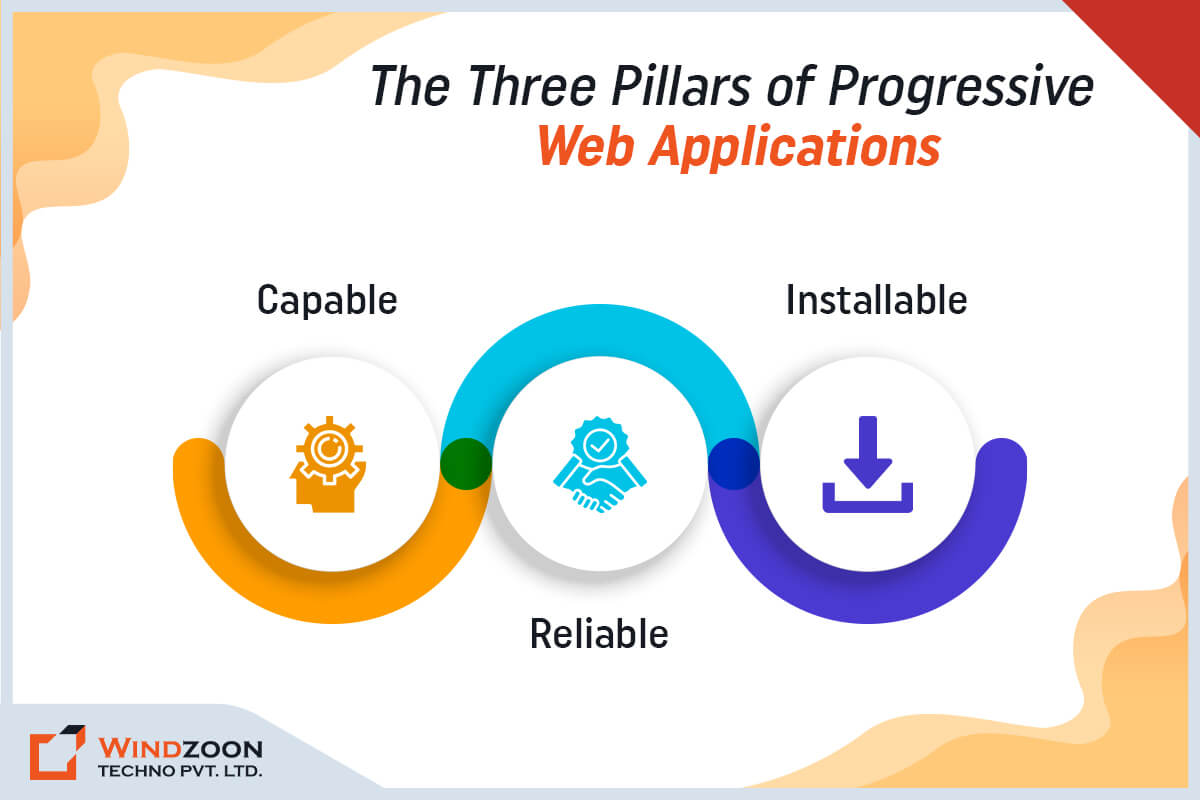
Progressive Web Apps (PWAs) are web-based applications that are capable, reliable, and installable. With the help of these three pillars, they become an experience that resembles a platform-specific application.
1. Capable
The first pillar of PWA applications is capability. It means that PWAs are capable of providing a range of functionalities that can compete with native applications.
They can access device hardware and leverage features like cameras, microphones, geolocation and sensors, just like a native app can.
Besides, PWAs provide the ability to receive push notifications, which is essential for keeping users engaged with the app.
2. Reliable
The second pillar of PWA apps is reliability. Basically, these apps are built to work smoothly no matter what kind of network you’re on, even if it’s weak or unstable. Plus, they can give you a seamless experience even if you don’t have internet, and they load super fast.
The question is, how do they accomplish it?
With the help of service workers, which are scripts that run in the background to cache the app’s content.
And caching frequently used resources also aids in accelerating the performance of the application.
3. Installable
The third and final pillar of PWA applications is all about being “installable”. Basically, this means that PWAs can be installed on a user’s home screen, just like a native app.
However, to achieve this, PWAs use something called a Web App Manifest which defines important things like the app’s icon, name, and even its theme color. All of this helps create an app-like experience that users can easily access and enjoy.
Plus, when you install a PWA, you don’t have to go through the hassle of downloading it from an app store. And that makes the installation process easy and hassle-free.
After this, let’s learn about some of the wonderful features of PWA.
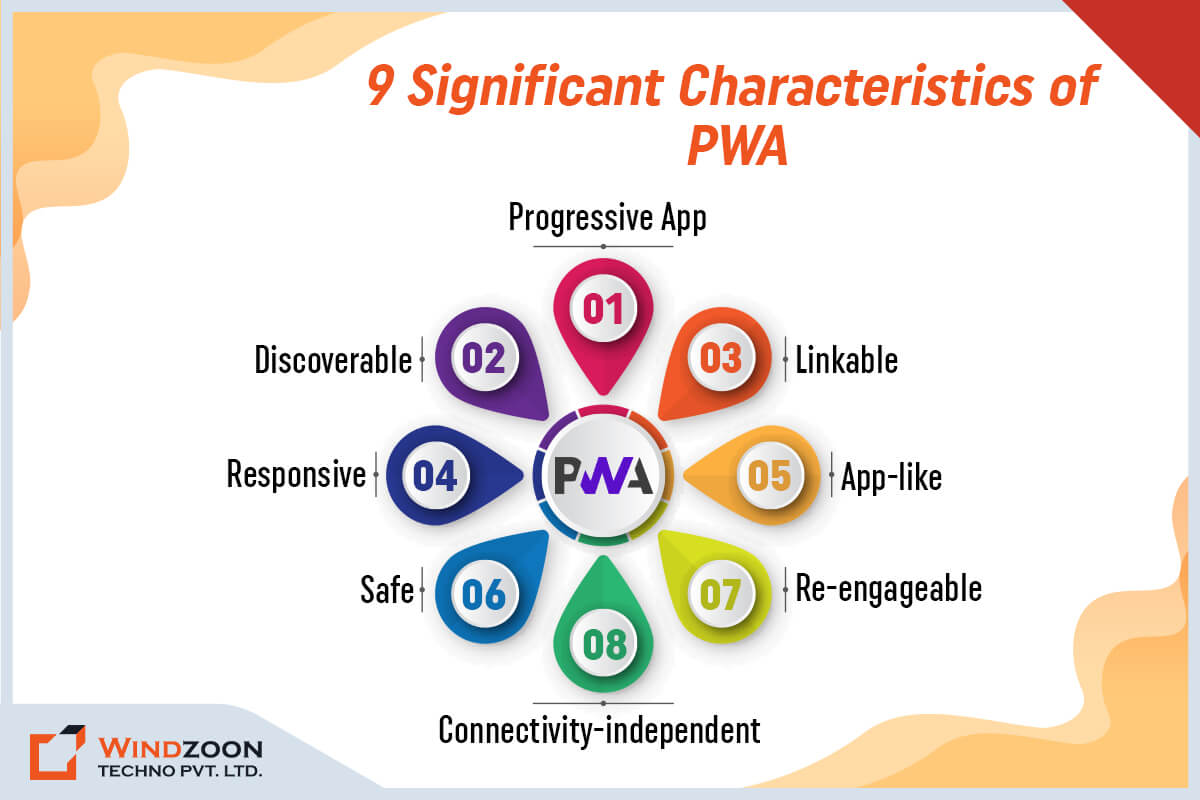
9 Significant Characteristics of PWA
1. Progressive App
A progressive web app, by definition, must function on any device and improve progressively, taking benefit of any features available on the user’s device and browser.
2. Discoverable
A progressive web app should be findable in search engines since it is a website. This is a significant benefit over native apps, which are still not as searchable as websites.
3. Linkable
Another trait that has been carried over from websites is that a well-designed website should use the URI to denote the application’s present state. By doing this, the web app will be able to retain or refresh its current state when a user bookmarks or shares the app’s URL.
4. Responsive
A progressive web app’s UI has to adapt to the device’s form factor and screen size.
5. App-like
The application shell model should be used to create progressive web apps, which should have a native-app-like design and require a few page refreshes.
6. Connectivity-independent
It ought to function offline or in places with poor connectivity.
7. Re-engageable
Since users of mobile apps are more likely to re-use them, progressive web apps are made with the same objectives in mind and incorporate push notifications among other features.
8. Safe
A progressive web app must be hosted over HTTPS to prevent man-in-the-middle attacks because it offers a more personalized user experience and can intercept all network requests through service workers.
Next, we will understand the things to keep in mind before designing & developing progressive Web apps.
Things to Consider While Designing Progressive Web Apps
- It’s crucial to put the user experience front and center while creating PWAs.
- PWAs should be responsive, meaning they should adjust to multiple screen sizes and orientations.
- Additionally, they ought to be created with accessibility in mind, with simple navigation, readable fonts, and high contrast.
- Furthermore, PWAs ought to be created with offline usage in mind, offering users offline content and utilizing caching to boost performance.
- Finally, PWAs should be made installable, with a clear call to action encouraging users to add the app to their home screen.
Things to Consider While Developing Progressive Web Apps
- Developing PWAs necessitates an understanding of modern web development technologies as well as best practices.
- PWAs can be created with a number of different frameworks and tools, such as React, Angular, Vue, and Ionic.
- To deliver a smooth user experience, developers must make sure the app is quick, reliable, and engaging by leveraging service workers, caching, and push notifications.
- Furthermore, developers must optimize the app for search engines and make it accessible to users with disabilities.
After this, our next topic of discussion is to know about the key difference between the three primary web app development techniques.
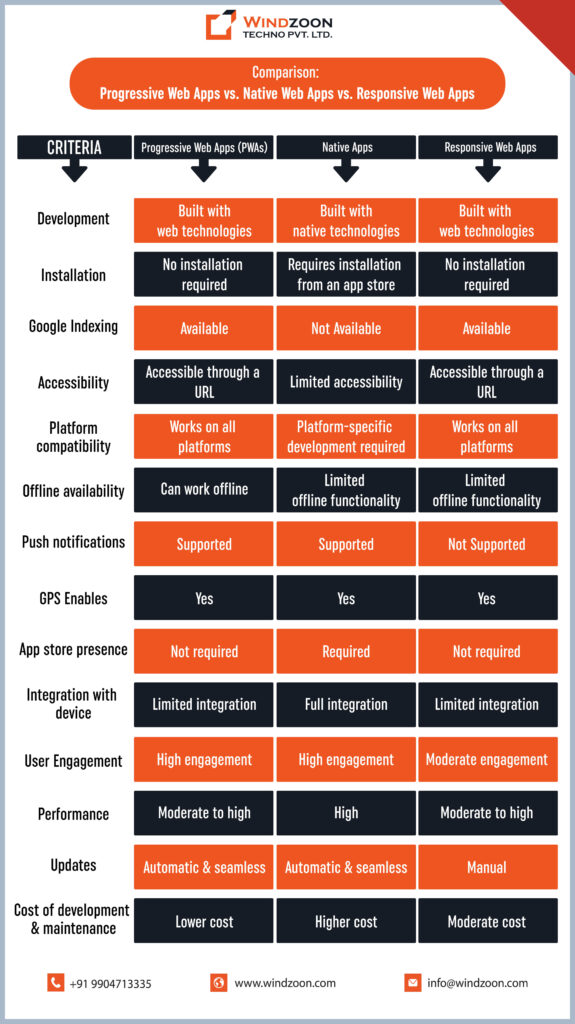
Comparison: Progressive Web Apps vs. Native Web Apps vs. Responsive Web Apps
1. Native Applications
Native Applications have been in existence for a while. They were the main forces behind the development of novel technologies and altered peoples’ perspectives on mobile phone usage. However, there are some drawbacks to a Native App, making Progressive Web Apps a preferable option.
For instance, developers must create native applications for particular operating systems using specific coding languages. To be transmitted to users, these applications must be released on an app distribution platform like the Play Store or the App Store, which might pave the way for monopolization over application distribution.
2. Progressive Web Applications
Progressive Web Applications (PWA) are websites that attempt to emulate the features of native mobile applications. Besides, they aren’t made accessible via platforms used for app release.
3. Responsive Web Applications
The motive behind the development of responsive web applications was to enhance user experience on an array of devices. Its other major purpose was to accommodate the variations in screen sizes among digital devices. However, it lacks features that are typical of native and progressive web applications, such as push notifications, offline support, etc.
Below is a comparison of Progressive Web Apps, Native Apps, and Responsive Web Apps:
[wpdatatable id=16 table_view=regular]
Read Also: Know Which one is better for your business; Flutter or PWA?
And here comes our main topic of discussion and that is:
9 Reasons Why PWAs are the Future of Web Development
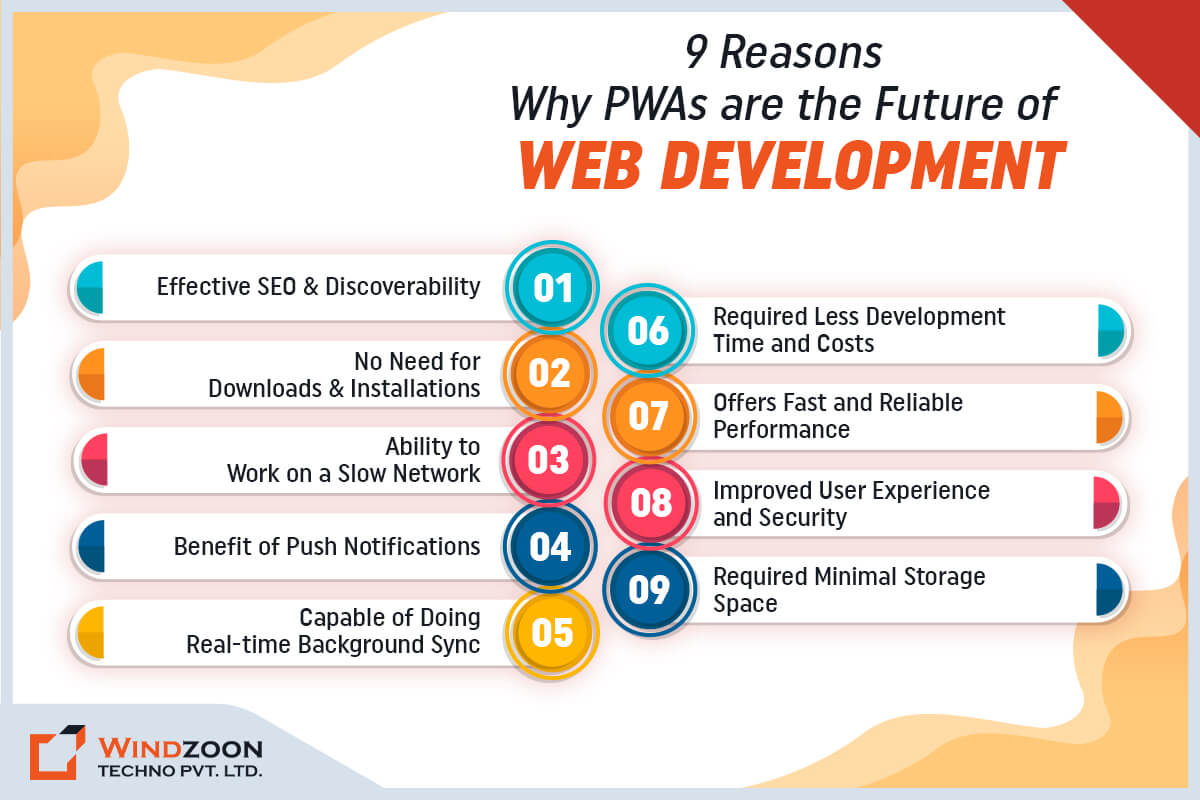
The popularity of Progressive Web Apps (PWAs) as a substitute for native apps has grown in recent years. They offer a lot of advantages that traditional web apps and native apps can’t provide. Here, we will discuss the nine reasons why PWAs are the future of web development.
1. Effective SEO and Discoverability
One of the most significant advantages of PWAs is that they are easily discoverable and search engine optimized. Due to the fact that they have extensive internet functionality, database access, and automatic data.
As a result, search engines like Google, Bing, and others can easily find and index them just like regular web pages. Thus, they can be found through search engine inquiries, increasing the visibility and traffic to your app.
Additionally, they can be shared via URLs, making promoting and sharing your app simpler.
2. No Need for Downloads and Installations
In contrast to native apps, PWAs don’t need to be downloaded or installed.
Instead, they can be accessed via a web browser, saving users the trouble of visiting an app store.
This drastically reduces the risk of customers abandoning an app during the installation process.
3. Ability to Work on a Slow Network
PWAs are made to work well in all kinds of network conditions, even sluggish or unstable ones.
This is made possible by using PWAs’ built-in service workers, which save and cache the content for subsequent display when your clients’ network connections fail.
Additionally, it makes the PWA accessible without having to download it, which is particularly helpful when connectivity is weak.
4. Benefit of Push Notifications
PWAs can notify users via push notifications exactly like native apps.
This implies that users can get updates and alerts even while they aren’t actively using the app. With the help of this PWA functionality, eCommerce businesses have great chances to retain clients.
Because it serves as a reminder to customers of things like forgotten deals and offers and abandoned shopping carts. Brands can interact with their customers more frequently and efficiently by using highly visible push notifications.
5. Capable of Doing Real-time Background Sync
PWA’s service workers can synchronize data in real-time in the background without the user having to interact with the app in any way.
Therefore, the user won’t have to wait for the app to refresh when they open it again because the data will already be up-to-date.
This functionality can be beneficial for apps that require real-time data synchronization, such as chat apps or collaborative software.
6. Required Less Development Time and Costs
Since PWAs only need a single codebase to deliver a consistent experience across all platforms and devices, they are less expensive to design, develop, launch, and maintain.
PWAs provide quick distribution of updates, new features, bug corrections, and other things, which saves money for organizations. In comparison to mobile apps, maintaining progressive web apps is 33% cheaper.
When compared to websites and mobile apps, PWAs allow businesses to deliver the same content across all touchpoints, saving time and money. The PWAs are a financially appealing choice because you don’t have to bother about routine upgrades if they’re functioning properly.
7. Offers Fast and Reliable Performance
Progressive web apps allow for content caching every time a user visits, resulting in a smoother and dramatically better user experience.
Additionally, content caching speeds up page loading. PWAs are fast and constant in their performance, which benefits conversion rates. Compared to native apps, conversion rates from progressive web apps are 52% higher.
Furthermore, a positive user experience aids businesses in customer retention and loyalty.
8. Improved User Experience and Security
When compared to regular web apps, PWAs can provide a better user experience. As they are developed to offer app-like features such as full-screen mode, offline mode, and a home screen icon.
Since PWAs use HTTPS encryption, they are also more secure than regular web apps. It blocks content manipulation, eavesdropping, and other harmful and unlawful activities.
On top of that, PWA takes advantage of web Bluetooth technology, and it comes with some additional security features.
9. Required Minimal Storage Space
PWAs are more compact than mobile apps in terms of size. As a result, PWAs load faster, take less memory to execute and place less strain on the user’s hard disk.
It is due to the manner in which PWAs have developed, which permits data caching in the background while a user interacts with a website.
Also, they do not require downloading or installation on the device. This feature is highly valuable for organizations with a target audience that is sensitive to device storage restrictions.
Next, we will learn about some of the promising examples of progressive web apps around the world.
Some Striking PWA Examples to Know
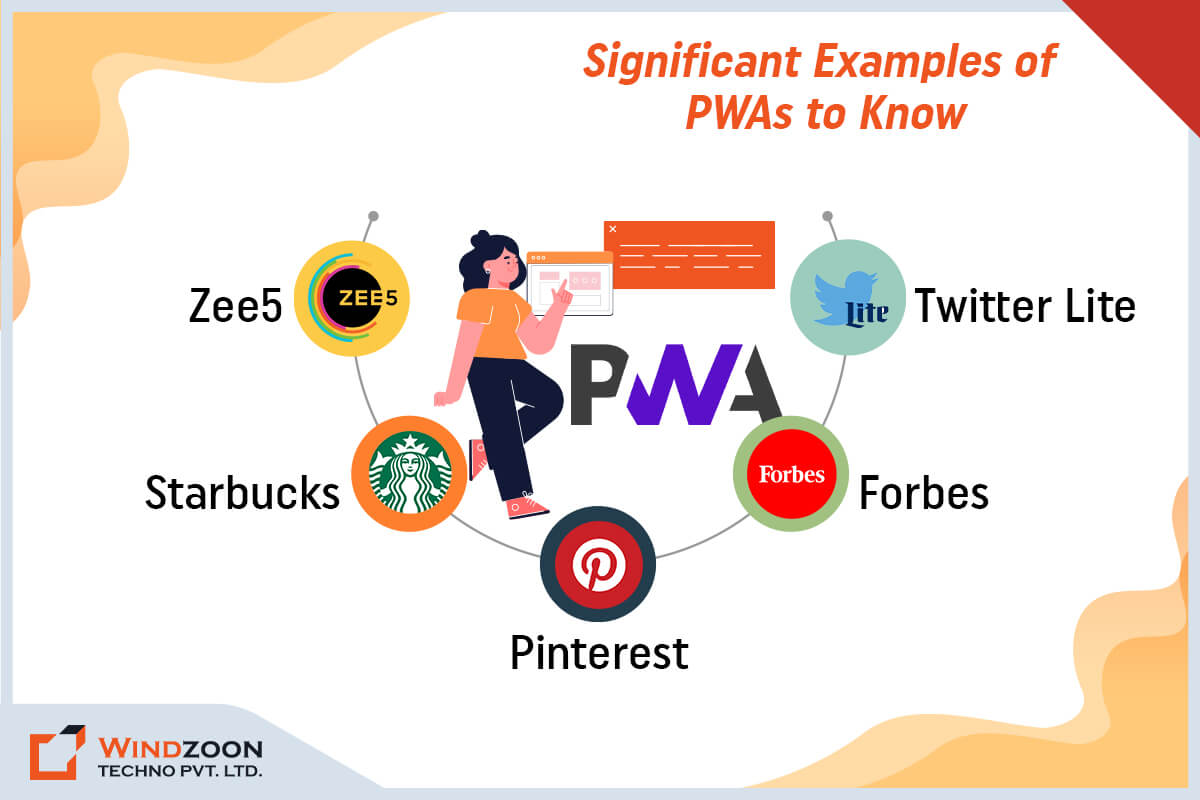
1. Zee5
ZEE5 built a PWA to streamline its platform and broaden its reach. It has increased app performance by three times and decreased buffering time by fifty percent.
2. Starbucks
Starbucks developed a PWA of their ordering platform that offers a comparable user experience to their current native app. Customers may quickly browse the menu, customize orders, add things to their basket, and do other tasks, whether they are doing so online or offline. It has raised the number of daily active users by twofold. And improve orders on desktop at almost the same rate as on mobile.
3. Pinterest
Pinterest revamped its mobile site as a PWA, which increased its core engagements by 60%. Furthermore, they saw a 44% increase in user-generated ad revenue, as well as a 40% increase in time spent on the site.
4. Forbes
Forbes is one of the prominent players in the news and media world. It has converted its website to a PWA. And now it loads in 2.5 seconds on mobile, compared to 6.5 seconds for its previous website. Additionally, there has been a 10% increase in impressions per visit.
5. Twitter Lite
Twitter has also employed PWA for its lite version, which is small, blazingly fast, and still retains the majority of the original app’s features. Twitter Lite reported a 65% increase in pages per session, a 75% rise in Tweets, and a 20% drop in bounce rate. Even on slow networks, Twitter Lite loads in under 3 seconds for repeat visits.
Conclusion
Progressive Web Apps is an innovative solution that combines the best of web and native app technologies. They provide a fast, reliable, and engaging experience for users while enabling developers to create apps that are cost-effective and easy to maintain.
With the rise of mobile usage and the growing demand for mobile-friendly solutions, PWAs are proving to be the future of web development.
Companies such as Starbucks, Pinterest, and Twitter have already leveraged PWAs to improve their user experience and boost their revenue. You can also become like them by joining hands with a skilled web development company to build PWA for your organization.
Windzoon is a prominent mobile app development services provider with exceptional experience and expertise in developing PWAs. To leverage our services, reach out to us and get a quote.