How to Create an eCommerce Store?: Step-by-Step Guide

The foundation of the e-commerce business which we all are witnessing reaching new heights was laid back in 1969 by an American e-commerce company CompuServe. However, in 1995, when the launch of two major e-commerce companies Amazon and eBay took place it started to gain more global recognition and acceptance.

Since that day, the e-commerce sector has gone through many highs and lows. From initial weak response from the public to sky-scorching popularity it has seen it all. With around $6.3 trillion in retail sales, the e-commerce business has now, acquired approx. 20% of total retail sales worldwide.

This clearly indicates the growing desire or we can say the need of people to buy online. To take advantage of this growing public demand, building an e-commerce store is the wisest decision. But the question is how to build an e-commerce store that engages people and drives you to profit.

Well, as a leading e-commerce web development company, we have accumulated years of experience developing e-commerce stores to this guide. It will assist you with every piece of information you need to know to develop an excellent e-commerce store. Hence, let’s delve deep into the world of e-commerce and navigate a path to success.

A Step-by-Step Guide to Build e-Commerce Store

1. Determine Your e-commerce Business Model

It’s essential to establish your business concept before you start developing your online store. Your e-commerce business model specifies how you will operate, engage with customers, and ultimately sell your goods or services. When creating an e-commerce business strategy, keep the following things in mind:

Business-to-consumer (B2C): This is the most typical model, in which a company sells goods or services to customers.

Business-to-business (B2B): In this model, companies sell goods or services to other companies.

Customer-to-customer (C2C): This model is also referred to as online marketplaces that link consumers to traders and sell goods or services.

Customer-to-business (C2B): Here, individuals sell their products or services to various businesses.

Once you choose your desired business model, consider sales and marketing strategies for your products and services. Here are a few suggestions for it:

Direct-to-consumer (D2C): Sell your own products to customers directly, bypassing wholesalers and retailers. With this approach, you have more influence over how customers interact with your brand and how your brand is presented to them.

Drop shipping: Dropshipping involves partnering with suppliers who handle inventory and fulfilment. When a customer places an order on your e-commerce store, the supplier ships the product directly to the customer, eliminating the need for you to hold inventory. Additionally, Dropshipping also offers a multi-payment acceptance facility. Hence, it’s simple and affordable to launch a drop shipping business. Besides, Shopify dropshipping store development is much easier than developing a regular online store.

Print on demand products: The print-on-demand products business model is similar to dropshipping. It involves creating custom designs that are printed on various products such as t-shirts, mugs, or phone cases. When a customer places an order, the printing and fulfillment are outsourced to a supplier, who ships the finished product directly to the customer. This allows you to offer unique, personalized products without holding inventory.

Wholesaling: Purchase things in bulk from manufacturers and resell them in huge quantities at a discount to retailers or other businesses. Retailers then resell these products to end users.

White label: White-label products are manufactured by one company and marketed under a separate company’s name. In this case, your online store would buy products from a manufacturer and sell them under your brand name.

Private label: Employ a manufacturer to make a product that will only be available through you. In this case, you have more control over the product’s characteristics, packaging, and design.

Subscription: The subscription model provides products or services on an ongoing basis. Customers may receive ongoing services, access to premium content, or recurrent deliveries. For example, you may supply products like milk or fresh vegetable boxes on a weekly or monthly basis to regular clients who value convenience.

Bonus Tip: When you define your e-commerce business model, take time to analyze your target audience, industry trends, and competitive landscape. Understanding these factors will help you choose the most suitable model that aligns with your goals and ensures a successful e-commerce venture.

Remember, your e-commerce business model will influence various aspects of your store. (For ex. product sourcing, marketing strategies, pricing, and customer interactions.) Hence, careful consideration and research at this stage will set a strong foundation for your e-commerce journey.

2. Discover The Perfect Product To Sell

Once you’ve established your e-commerce business model, the next critical step is to find the ideal product to sell on your online store. Your e-commerce business’s success depends on picking the right product or market segment. Here are some key factors to consider while selecting the best products to sell on your online store:

Find Your Niche: Start by identifying a niche or a specific segment of the market that you are passionate about or have expertise in. A niche allows you to focus on a particular category of products or services. This makes it easier to target a specific audience and help you stand out from competitors.

Do Market Research: The next step is to conduct extensive market research to have a complete understanding of current trends, customer preferences, and demands. Then analyze all this information to know the desires and issues of your target market. Consider offering digital products, such as ebooks, music files, online courses, or images, which are well-suited for online sales and do not require physical shipping. And established products or services that can solve their issues or satisfy their needs.

Analyzing Your Competitors: Another most important thing to do is to research your rivals in both your niche and the whole e-commerce sector. Look for market gaps or places where you may provide a unique selling proposition (USP) to set your items apart from the competition.

Make Product Validation: The next important thing to consider before finalizing a particular product is to test selling that product on a small scale or by starting a pilot project to determine its likelihood of success. This will assist you in determining client interest and obtaining insightful feedback.

Consider Seasonality: Seasonality is one of the key things to consider before deciding on a particular product. Hence, depending on your product’s characteristics, think about how seasonal trends may affect your product. Because to ensure a regular flow of sales, you need to make sure that the demand for the product you have chosen is steady throughout the year.

Emphasizes Quality and Reliability: Now, pick products that are of excellent quality and obtained from dependable vendors. As building a loyal customer base depends on providing satisfying customer experiences and quality products.

Think About Scalability: When you are going to start selling particular products, you will find that process quite adventurous. However, during this product-selling process, you should always think about how your e-commerce store will grow by selling your products. So, consider how you might increase the range of your product offerings in the future to serve a larger clientele. Introducing and promoting new products regularly is important to meet market demand and keep your store aligned with the latest trends.

Keep Up with the Latest Trends: To make sure that your chosen product remains relevant over the long term, keep up with current market trends and project future demand.

Finally, it would help if you remember that selecting the ideal product to sell is a dynamic process that necessitates careful evaluation and deliberation. Thus, think about all of your alternatives carefully, and only make judgements after doing extensive research.

3. Determine The Prices Of Your Products

The third important step is to determine the prices of your product. Because the success of your e-commerce store depends on how well you price your products. Thus, calculate all costs associated with production or sourcing, including both direct costs (such as manufacturing and packing) and indirect costs (such as marketing and website upkeep).

Next, to understand market prices and position your items competitively, conduct a competitive study. Strike a balance between profitability and competitive pricing by taking into account the special value your items provide to clients.

Last, test several price points to find the best one. Then plan sporadic discounts and promotions on your product. However, before offering discounts and promotions make sure they don’t affect your profitability. To stay on top of market developments and uphold a successful pricing strategy, keep a close eye on performance and make necessary price adjustments.

Many new sellers ask, “How much does it cost to start selling products online?” When pricing your products, be sure to account for all associated costs, including setup, ongoing expenses, and any additional fees.

4. Research Your Shipping Costs And Options

Once you decide on your product pricing, the next important thing to consider is your product shipping options and their costs.

Because efficient shipping has a significant impact on consumer satisfaction and purchasing behaviour, it is essential in e-commerce. Thus, determine the cost of shipping considering the product’s weight, size, shipping distance, and carriers. To encourage customers, think about providing free shipping beyond a specific order threshold.

When evaluating shipping options, consider offering a flat rate shipping fee as a simple and predictable choice for customers.

Then investigate several shipping companies and services, evaluating aspects like responsiveness, dependability, and global reach. Use real-time shipping rate estimators to show customers accurate, live shipping prices during the checkout process by integrating real time shipping rates from carriers.

While doing all these, keep in mind customs laws and additional expenses when providing international shipping. Additionally, improves the packing for secure delivery and lowers shipping costs.

And last, for improved customer communication, provide shipping tracking information and order status updates. As well as Create a simple returns procedure to increase consumer loyalty and confidence. As a well-thought-out shipping strategy boosts the performance and consumer experience of your e-commerce store.

5. Decide a Brand Name, Choose a Hosting Provider & Purchase a Domain

Choosing the ideal brand name can completely transform your e-commerce business. However, it ought to be distinctive, memorable, and represent the products or services you offer.

Once you choose a brand name, your next task is to decide on a domain. Look for a hosting company that can supply your store with the dependability and speed it requires. Many hosting providers and website builders include a free domain or free domain name for the first year as part of their package, making it easier and more affordable to launch your online store. GoDaddy is a popular option for budding e-commerce business owners due to its reasonable plans and consistent support. They offer an all-in-one hosting solution and even make the process of purchasing a domain name simple. Additionally, some platforms allow you to sign up and get started with no credit card required, so you can explore their features risk-free before making a commitment.

However, keep in mind that your domain name should reflect your brand and be simple for clients to recall. If you get this trio perfect, your online store will start off strong.

6. Find Your Perfect E-commerce Website Builder

Selecting the ideal ecommerce platform is essential if you want to create your own online store. An ecommerce platform is a comprehensive solution that combines website building, sales channel integration, payment processing, and more. These platforms are built on a content management system (CMS), which serves as the foundational technology for building and managing your ecommerce website. Many ecommerce platforms also offer a free trial period, allowing you to test features before making any commitments. Here is a brief summary of some well-liked options for ecommerce platforms:

WooCommerce: WooCommerce is an open-source plugin for WordPress that allows for a great deal of customization. It allows you to establish a highly customised store, making it perfect for individuals with some technological know-how. Besides, considering the popularity of WordPress, you can easily find any Custom WordPress Development Company to help you build an e-commerce store to your liking.

Magento: If you want to scale, Magento is the best option. It’s ideal for growth because it has excellent features and flexibility. Despite requiring considerable technical know-how, it offers a wide range of customization options and third-party integrations.

Shopify & Square Online: Looking for a simple setup process? The solution is Shopify or Square Online. Both are all-in-one ecommerce platforms that serve both novices and specialists and are renowned for their user-friendly design, vast template library, and hosting options. To accommodate varying business needs, they provide multiple pricing tiers and often include a free trial so you can explore their features risk-free.

Customization, spending capacity, and technical proficiency are all important considerations when choosing a platform. To choose which is the greatest option for the success of your online store, compare their features, costs, and customer support.

7. Find a Skilled e-Commerce Developer

As your online business takes shape, think about hiring a qualified e-commerce developer.

A skilled developer can make final adjustments to your e-commerce website to make sure it runs smoothly and effectively.

Depending on the website builder you choose, Hire web developers with experience in e-commerce systems like WooCommerce, Shopify, or Magento. To evaluate their talents, look through their portfolio for prior e-commerce projects, client testimonials, and reviews.

Working with an experienced developer can help you save time, improve the performance of your online store, and handle technical difficulties successfully. Besides, it also enables you to concentrate on expanding your online store and improving the client experience.

8. Select an E-commerce Theme or Template

Now comes the exciting part: choosing the ideal e-commerce theme or template for the store design of your online shop. Store design is crucial, as the right theme not only complements your brand’s image but also improves the presentation of your products.

Many website builders have a large selection of pre-designed themes that you may modify to fit your preferences in terms of colours, fonts, and layouts. Paid or premium themes often come with more features, better design options, and easier customization, which can enhance your website’s functionality and appearance. To give clients a great browsing experience across devices, look for mobile responsiveness and user-friendly navigation.

Make sure the theme you choose is compatible with crucial e-commerce features like product galleries, shopping carts, and secure payment processors. With a well-selected theme, your e-commerce site will look polished and professional, paving the path for its success in the online market.

9. Customize Your E-commerce Site and Build Out Web Pages

Now that the structure is established, it’s time to customize your e-commerce site to give it a distinctive look.

You may begin personalizing your online store by making a customized design and selecting the proper color palette and layout that go with your brand identity.

These days, a lot of website builders provide simple customization options that enable you to tailor your store without any coding experience.

Therefore, when you begin customizing, don’t forget to develop and customize important web pages like the homepage, product pages, about us, contact us and FAQs. As part of this process, organize your product catalog to effectively showcase your products and improve your search engine ranking.

Following that, create captivating content that shows the benefits of your products and resonates with your target audience. After that, put in place easy-to-use navigation so that clients can find what they’re looking for.

Moreover, remember to make your website mobile-friendly to accommodate customers who are constantly on their mobile devices.

A well-customized website improves the purchasing experience and promotes return visits.

10. Add Necessary Plugins/Extensions/Apps

After customisation, your e-commerce store’s functionality should be improved. To do this, explore the world of plugins, extensions, and apps. There are a variety of add-ons available to improve the functionality of your site, depending on your website builder.

Integrate necessary plugins for analytics, social media integration, SEO optimization, and seo tools. Seo tools are essential for optimizing your website for search engines and tracking performance, helping you get discovered and analyze traffic and keywords directly from your dashboard. Additionally, to engage and delight your consumers, think about including facilities like live chat, client feedback, and a wishlist.

Also, don’t forget to include security plugins to secure client data from cyber threats.

However, before you install any plugins, make sure they are compatible with your website builder and will not slow down or degrade the user experience of your site.

Because a well-chosen selection of plugins can elevate your online store and provide clients with a seamless purchasing experience.

11. Secure Your E-commerce Store Using SSL And Install Backup Services

Security holds the greatest significance for any online store. Thus, to secure your online store, install an SSL (Secure Socket Layer) certificate. As it plays a pivotal role in protecting the confidential data of your customers.

SSL encrypts data while it is being transmitted, guaranteeing secure online transactions and fostering customer confidence. Most website builders make it simple to include SSL certificates for additional security.

Also, don’t underestimate the significance of regular backups. Install backup services to make sure that the data on your online store, including product details, customer information, and order history, is securely maintained.

Backups act as a lifeline in the event of a technical malfunction or data loss, allowing you to quickly recover your online store. Therefore, to safeguard the integrity of your e-commerce store, invest in reliable backup services or make use of built-in features provided by your website builder.

Knowing how well your store is performing is essential for its expansion since knowledge is power. Therefore, incorporate Google Analytics into your online store. It is a strong tool that offers insightful data on user behavior and website traffic.

By connecting your store to Google Analytics, you can track important data such as conversion rates, bounce rates, and popular product pages. Analyzing this data and user activity will assist you in optimizing your marketing strategy and improving the user experience.

Additionally, Google Analytics also offers e-commerce tracking. It allows you to keep track of sales, revenue, and other transaction-related statistics. With this knowledge, you can make data-driven decisions to improve the operation of your online store and boost its success in the cutthroat online market.

13. Configure an Inventory, Payment Gateway, and Tax Tools

Now at this point, your e-commerce store is almost ready to roll. But first, let’s make sure that inventory is managed effectively and transactions are seamless. Start by adding products to your store’s inventory, ensuring each item is accurately listed and categorized. And for smooth online transactions, install a trustworthy payment gateway and connect a payment processor that safely handles client payments, enabling efficient payment processing.

Popular choices like PayPal, Stripe, or Square improve customer confidence in your store by offering easy interfaces and supporting a variety of payment ways.

Following that, use inventory management software to keep track of product availability. They will handle product variations with ease and control your inventory while setting stock alerts. Make sure to maintain and sync customer data across all your sales channels for better inventory management and personalized marketing. A well-managed inventory guarantees prompt replenishment and eliminates overselling, which boosts customer satisfaction.

Lastly, remember to pay your taxes! Configure tax calculators to automatically determine and apply the proper tax rates on purchases based on your location and customer base. Stay compliant and save time by automating tax calculations, leaving you more room to focus on growing your business. Automating tax computations will help you stay compliant and save time, giving you more time to concentrate on expanding your e-commerce store.

14. Test and Launch Your E-Commerce Site

You’re almost there; now is the time to test your e-commerce site ahead of launching. Thoroughly test your website in all areas, including the contact forms, payment process, and product listings. Verify that all functions are working properly and that there are no broken links or formatting errors.

Make several test purchases to validate the payment procedure and ensure that customer orders are properly processed. To get feedback on the user experience and identify any potential problems, enlist the assistance of friends or relatives.

Once you’ve made the necessary changes and are confident in your store’s performance, you can proceed with officially launching your site. Use social media, email newsletters, and advertising efforts to spread the message.

And last, celebrate this achievement and look forward to the exciting road of running your e-commerce store. Success will come as a result if you continue to pay attention to customer feedback and look for ways to make your online store run more efficiently.

15. Begin Promoting Your E-commerce Website

Congratulations on opening your online store! It’s now time to spread the word and get customers to your online store. To do this and successfully sell online, put in place a comprehensive marketing strategy to increase visitors and sales.

Make use of social media networks to provide interesting content and promote your products or offer services. Social media platforms are an ideal platform to interact with your audience, address their inquiries, and develop a loyal following.

You can also use created email marketing campaigns to keep clients up to date on new items, discounts, and promotions. Because timely and customized emails often persuade customers to make repeat purchases.

Additionally, work with influencers or industry partners to reach a larger audience and attract new customers. Influencer collaborations and endorsements can generate buzz for your business.

Furthermore, invest in search engine optimization (SEO) to boost your website’s visibility on search engines and increase organic traffic. Use relevant keywords and optimize your product descriptions to appear higher in search results. Link building and outreach can further establish your site as an authoritative source.

Next, think about implementing loyalty programs, seasonal price reductions, or special offers to entice people to visit your online store again. Satisfied clients are more likely to recommend businesses to others and help them succeed in the long run.

To reach a larger audience and drive more sales, consider using paid ads on platforms like Google, Facebook, Instagram, or TikTok. Customize your adverts to appeal to certain demographics and interests. Created paid ads campaigns can help you target new customers and boost your store’s visibility.

And don’t forget to review website analytics on a regular basis in order to evaluate the success of your marketing initiatives and make fact-based judgments. Understanding your audience and their behavior can help you convert visitors into buyers, leading to more sales.

Because promoting your e-commerce website is an ongoing process. Therefore, to maintain your online store flourishing and expanding, always try out new marketing techniques, pay attention to client feedback, and adjust to industry trends. With dedication and persistence, your e-commerce venture is sure to flourish in the competitive digital landscape.

What are the Benefits of Selling Online and to Create Own Online Store?

Developing an E-commerce store is a fantastic method to expand your consumer base and diversify your customer channels.

Selling online is also a terrific strategy to enhance income because you may reach a broader audience than through traditional retail techniques.

statistics show that there are 268 million digital consumers in the United States, and this figure is anticipated to rise to 285 million soon. There is no question that you must be online if you want to reach a sizable customer base.

In addition to accessing a larger audience, online stores provide numerous other advantages, such as:

  • 24×7 accessibility: Customers may view products at any time, regardless of their time zone.
  • There are no restrictions based on location: Customers are able to buy from any part of the world.
  • Product selection: Compared to traditional retail establishments, e-commerce stores frequently have a far wider range of products available.
  • Customized shopping: Customers can shop based on their own requirements and individual tastes.
  • Direct-to-consumer sales channels: You may minimize costs for both you and your customers by doing business online and cutting out middlemen.
  • Faster reaction to market demands: Because e-commerce storefronts are digital, e-commerce proprietors can update their stores considerably more quickly in response to consumer demands and desires.

Ecommerce websites are highly versatile online platforms that can be tailored for various types of online stores, such as dropshipping, print-on-demand, or selling digital products. They often include features like free domain options, secure shopping carts, and support for multiple payment gateways, making them suitable for businesses of all sizes.

A quality e-commerce website offers more than just a platform to buy and sell products. It’s where a company can design an encounter that builds brand equity, attracts new clients, and turns occasional customers into ardent advocates.

Choosing the correct ecommerce platform is key to building a successful online store, as a feature-rich ecommerce platform supports multiple sales channels, social media integrations, and various payment options to help your business grow. Developing a marketing strategy to launch a successful online store can put you ahead of the competition.

If you require assistance in developing an e-commerce store, you can seek assistance from a professional e-commerce web development company.

As a reputable e-commerce web development company, Windzoon offers top-notch e-commerce website development services at the most economical rates and with the quickest turnaround times. Our expert developers can construct one-of-a-kind e-commerce web solutions tailored to your company’s needs.

Contact us to and more information about our e-commerce store creation services.

Know All About PWA & 9 Benefits to Use in Web App Development

Have you ever had trouble accessing a website on your phone or tablet? Maybe the website was slow to load, didn’t work properly, or required an internet connection to function. Well, businesses are facing the same issues with their web apps.

Native apps are expensive to develop and maintain, while responsive web apps often lack the functionality and features of their native counterparts.

However, don’t freak out, because there’s a solution on the horizon – Progressive Web Apps (PWAs). PWAs offer the best of both worlds, with the functionality of a native app and the accessibility of a web app.

Because of this, the market for progressive web applications reached USD 1.13 billion in 2019 and is anticipated to reach USD 10.44 billion by 2027, achieving a CAGR of 31.9% over the projected time frame.

And as a leading web app development company, in this blog, we’ll thoroughly explain to you why PWAs are becoming the future of web development and discuss some real-world examples of successful PWAs. So, without further ado, let us get started with our discussion!


Our first topic of discussion is to get basic information about Progressive web applications.

What are Progressive Web Apps?

Progressive Web Applications (PWAs) are lightweight applications developed utilizing tried-and-trusted web technologies such as HTML, CSS, and JavaScript. But what sets them apart is that they look and function just like a native app! Hold on, what exactly is a native app?

Well, a native app is a software application that’s designed specifically for a particular device platform like iOS or Android. And It’s also built using a specific programming language, which can be quite a hassle.

However, working with PWAs is a breeze. They are jam-packed with features including offline functionality and push notifications. The best thing is? They were created utilizing modern APIs, making them extremely reliable and installable on any device.

The real kicker is that PWAs make use of the vast web ecosystem. This encompasses plugins, community support, and simple deployment. PWAs, unlike native apps, can be created quickly and with little effort.

Next, we will learn about the architecture of PWAs.

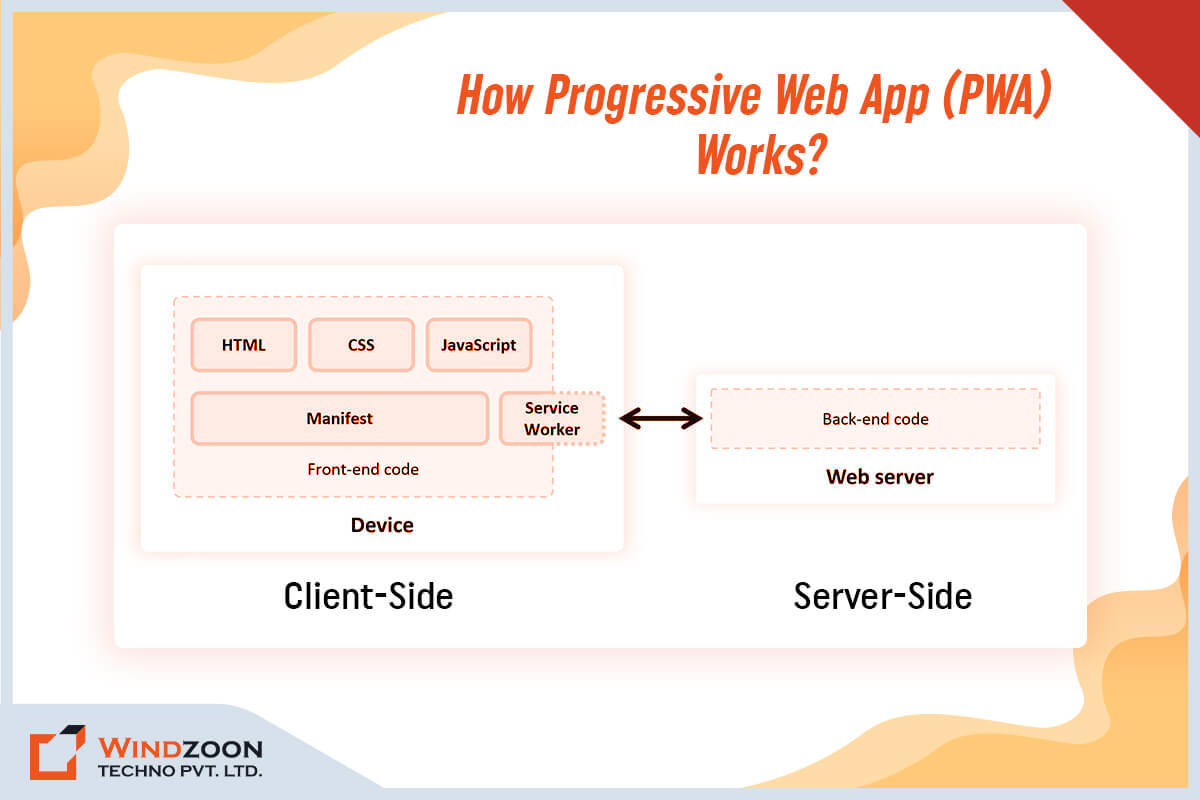
How Progressive Web App (PWA) Works?

how-pwa-works

The architecture of a Progressive Web Application (PWA) is basically like a two-sided coin. On one side, you have the client which is where the user interacts with the app. And on the other side, you have the server which is where the app is hosted and managed.

The client-side of a PWA is built using web technologies that we all know and trust, like HTML, CSS, and JavaScript. This is where the magic happens, and where all the fun stuff takes place as here user interacts with the app.

The significant thing is that these web technologies let the PWA function like an actual native app. That means it can work on any device, from your desktop to your phone or tablet, without needing to be downloaded from an app store.

Now, let’s flip the coin over to the server-side. This is where things get more technical, but don’t worry, we’ll keep it simple. The server side of a PWA uses a combination of traditional web server technologies and modern APIs to deliver an app-like experience.

These APIs include Service Workers which allow the app to work offline by caching its content. It means that even if you’re in the middle of nowhere with no Wi-Fi or data, you can still use the app without any issues. Sounds great, right?

There is more, though. PWAs also make use of Web App Manifests, which describe the app’s metadata. It encompasses elements like the app icon, name, and theme color. This metadata is used to add the PWA to the user’s home screen, making it quickly accessible and identifiable.

Another feature worth noticing is the PWA architecture’s use of a secure HTTPS connection. This guarantees that all data sent between the client and server is encrypted and secure from malicious intrusions. It’s akin to having a bodyguard for your data.

Moreover, the PWA architecture is designed to provide users with a seamless, app-like experience while utilizing the power and flexibility of the web. However, to avail of its full potential it’s recommended to hire mobile app developer from a reputed web development agency.

Now, we will get to know about the fundamental pillars of progressive web apps.

The Three Pillars of Progressive Web Applications

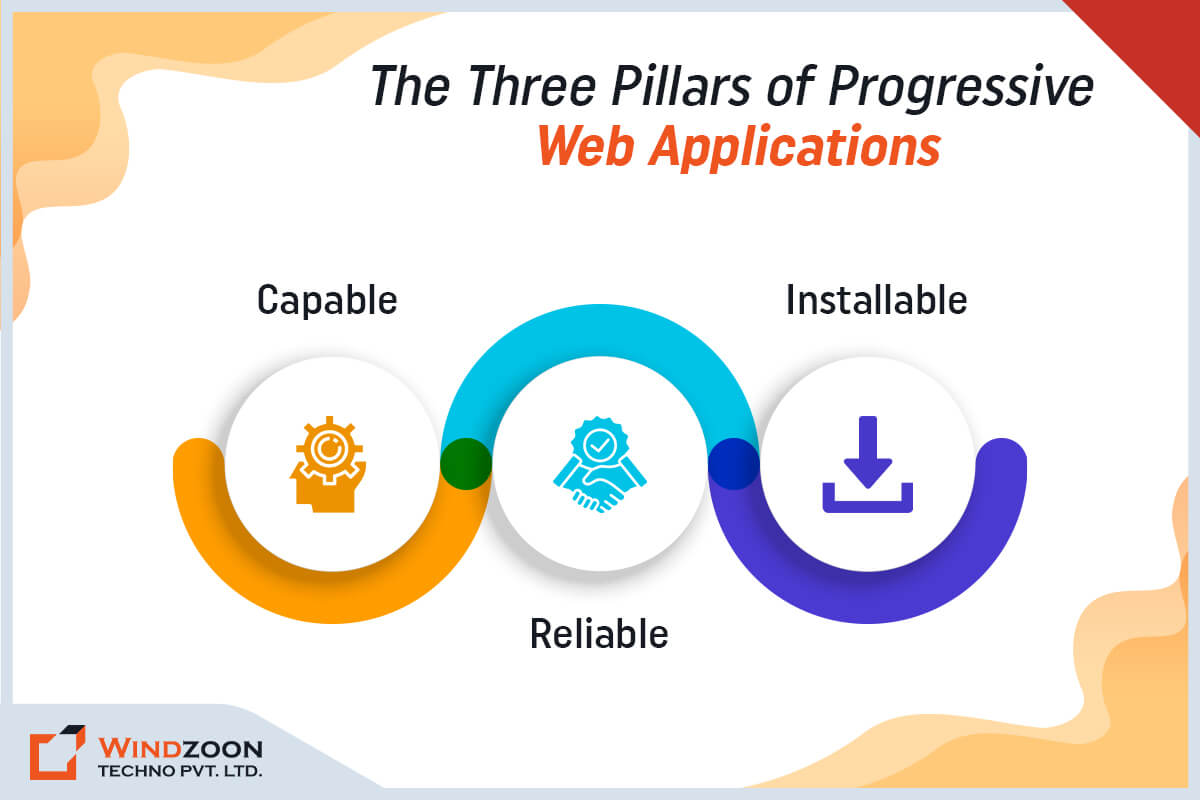
Progressive Web Apps (PWAs) are web-based applications that are capable, reliable, and installable. With the help of these three pillars, they become an experience that resembles a platform-specific application.

3-pillars-of-pwa

1. Capable

The first pillar of PWA applications is capability. It means that PWAs are capable of providing a range of functionalities that can compete with native applications.

They can access device hardware and leverage features like cameras, microphones, geolocation and sensors, just like a native app can.

Besides, PWAs provide the ability to receive push notifications, which is essential for keeping users engaged with the app.

2. Reliable

The second pillar of PWA apps is reliability. Basically, these apps are built to work smoothly no matter what kind of network you’re on, even if it’s weak or unstable. Plus, they can give you a seamless experience even if you don’t have internet, and they load super fast.

The question is, how do they accomplish it?

With the help of service workers, which are scripts that run in the background to cache the app’s content.

And caching frequently used resources also aids in accelerating the performance of the application.

3. Installable

The third and final pillar of PWA applications is all about being “installable”. Basically, this means that PWAs can be installed on a user’s home screen, just like a native app.

However, to achieve this, PWAs use something called a Web App Manifest which defines important things like the app’s icon, name, and even its theme color. All of this helps create an app-like experience that users can easily access and enjoy.

Plus, when you install a PWA, you don’t have to go through the hassle of downloading it from an app store. And that makes the installation process easy and hassle-free.

After this, let’s learn about some of the wonderful features of PWA.

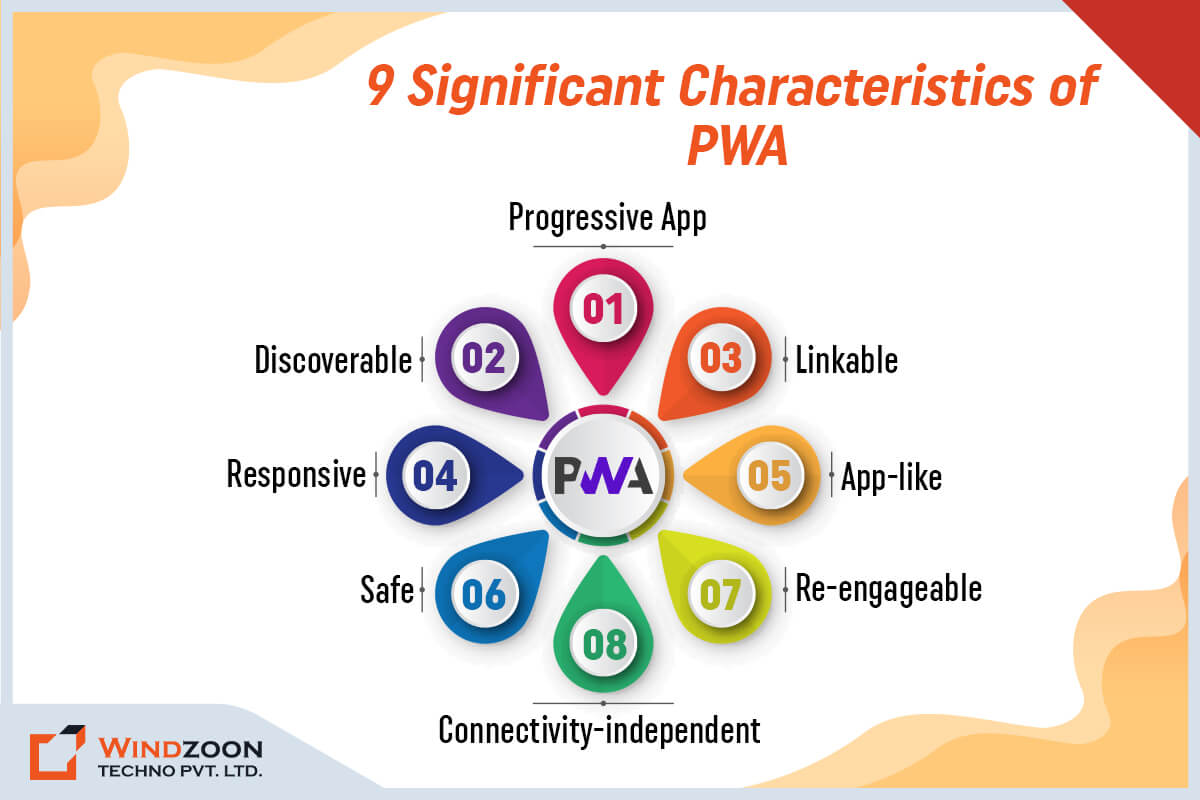
9 Significant Characteristics of PWA

characteristics-of-pwa

1. Progressive App

A progressive web app, by definition, must function on any device and improve progressively, taking benefit of any features available on the user’s device and browser.

2. Discoverable

A progressive web app should be findable in search engines since it is a website. This is a significant benefit over native apps, which are still not as searchable as websites.

3. Linkable

Another trait that has been carried over from websites is that a well-designed website should use the URI to denote the application’s present state. By doing this, the web app will be able to retain or refresh its current state when a user bookmarks or shares the app’s URL.

4. Responsive

A progressive web app’s UI has to adapt to the device’s form factor and screen size.

5. App-like

The application shell model should be used to create progressive web apps, which should have a native-app-like design and require a few page refreshes.

6. Connectivity-independent

It ought to function offline or in places with poor connectivity.

7. Re-engageable

Since users of mobile apps are more likely to re-use them, progressive web apps are made with the same objectives in mind and incorporate push notifications among other features.

8. Safe

A progressive web app must be hosted over HTTPS to prevent man-in-the-middle attacks because it offers a more personalized user experience and can intercept all network requests through service workers.

Next, we will understand the things to keep in mind before designing & developing progressive Web apps.

Things to Consider While Designing Progressive Web Apps

  • It’s crucial to put the user experience front and center while creating PWAs.
  • PWAs should be responsive, meaning they should adjust to multiple screen sizes and orientations.
  • Additionally, they ought to be created with accessibility in mind, with simple navigation, readable fonts, and high contrast.
  • Furthermore, PWAs ought to be created with offline usage in mind, offering users offline content and utilizing caching to boost performance.
  • Finally, PWAs should be made installable, with a clear call to action encouraging users to add the app to their home screen.

Things to Consider While Developing Progressive Web Apps

  • Developing PWAs necessitates an understanding of modern web development technologies as well as best practices.
  • PWAs can be created with a number of different frameworks and tools, such as React, Angular, Vue, and Ionic.
  • To deliver a smooth user experience, developers must make sure the app is quick, reliable, and engaging by leveraging service workers, caching, and push notifications.
  • Furthermore, developers must optimize the app for search engines and make it accessible to users with disabilities.

After this, our next topic of discussion is to know about the key difference between the three primary web app development techniques.

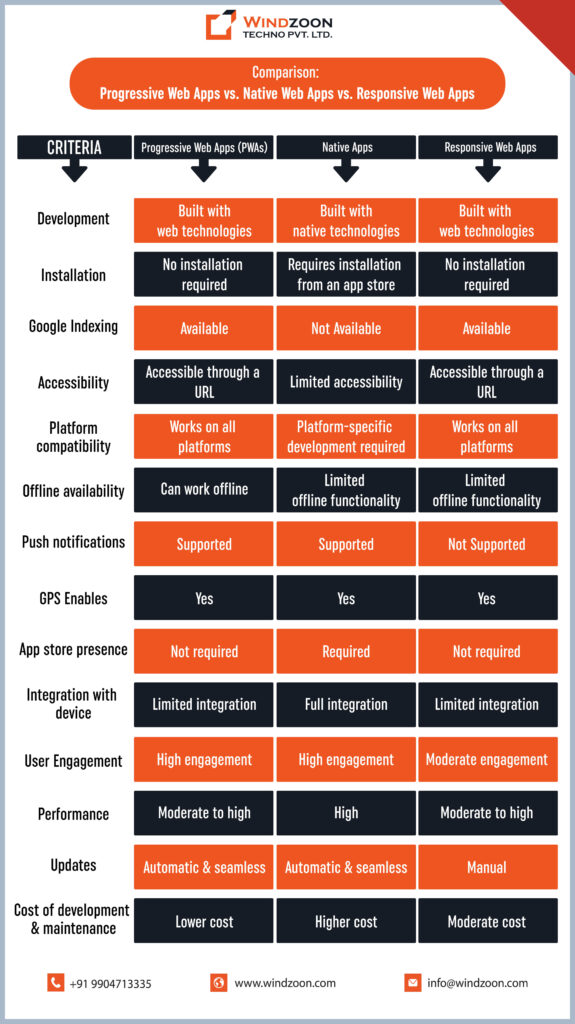
Comparison: Progressive Web Apps vs. Native Web Apps vs. Responsive Web Apps

1. Native Applications

Native Applications have been in existence for a while. They were the main forces behind the development of novel technologies and altered peoples’ perspectives on mobile phone usage. However, there are some drawbacks to a Native App, making Progressive Web Apps a preferable option.

For instance, developers must create native applications for particular operating systems using specific coding languages. To be transmitted to users, these applications must be released on an app distribution platform like the Play Store or the App Store, which might pave the way for monopolization over application distribution.

2. Progressive Web Applications

Progressive Web Applications (PWA) are websites that attempt to emulate the features of native mobile applications. Besides, they aren’t made accessible via platforms used for app release.

3. Responsive Web Applications

The motive behind the development of responsive web applications was to enhance user experience on an array of devices. Its other major purpose was to accommodate the variations in screen sizes among digital devices. However, it lacks features that are typical of native and progressive web applications, such as push notifications, offline support, etc.

Below is a comparison of Progressive Web Apps, Native Apps, and Responsive Web Apps:

comparison-pwa-nativeapps-responsiveapps

[wpdatatable id=16 table_view=regular]

Read Also: Know Which one is better for your business; Flutter or PWA?

And here comes our main topic of discussion and that is:

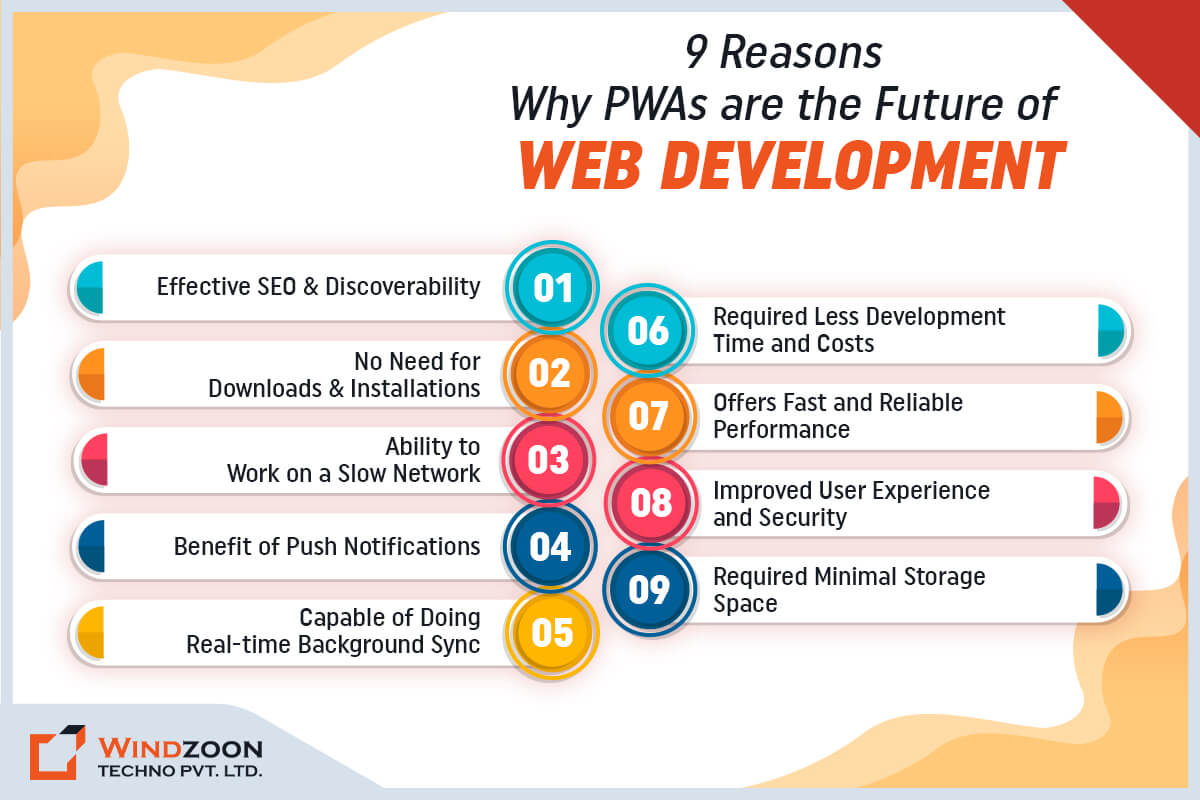
9 Reasons Why PWAs are the Future of Web Development

reasons-why-pwa-is-future-of-web-development

The popularity of Progressive Web Apps (PWAs) as a substitute for native apps has grown in recent years. They offer a lot of advantages that traditional web apps and native apps can’t provide. Here, we will discuss the nine reasons why PWAs are the future of web development.

1. Effective SEO and Discoverability

One of the most significant advantages of PWAs is that they are easily discoverable and search engine optimized. Due to the fact that they have extensive internet functionality, database access, and automatic data.

As a result, search engines like Google, Bing, and others can easily find and index them just like regular web pages. Thus, they can be found through search engine inquiries, increasing the visibility and traffic to your app.

Additionally, they can be shared via URLs, making promoting and sharing your app simpler.

2. No Need for Downloads and Installations

In contrast to native apps, PWAs don’t need to be downloaded or installed.

Instead, they can be accessed via a web browser, saving users the trouble of visiting an app store.

This drastically reduces the risk of customers abandoning an app during the installation process.

3. Ability to Work on a Slow Network

PWAs are made to work well in all kinds of network conditions, even sluggish or unstable ones.

This is made possible by using PWAs’ built-in service workers, which save and cache the content for subsequent display when your clients’ network connections fail.

Additionally, it makes the PWA accessible without having to download it, which is particularly helpful when connectivity is weak.

4. Benefit of Push Notifications

PWAs can notify users via push notifications exactly like native apps.

This implies that users can get updates and alerts even while they aren’t actively using the app. With the help of this PWA functionality, eCommerce businesses have great chances to retain clients.

Because it serves as a reminder to customers of things like forgotten deals and offers and abandoned shopping carts. Brands can interact with their customers more frequently and efficiently by using highly visible push notifications.

5. Capable of Doing Real-time Background Sync

PWA’s service workers can synchronize data in real-time in the background without the user having to interact with the app in any way.

Therefore, the user won’t have to wait for the app to refresh when they open it again because the data will already be up-to-date.

This functionality can be beneficial for apps that require real-time data synchronization, such as chat apps or collaborative software.

6. Required Less Development Time and Costs

Since PWAs only need a single codebase to deliver a consistent experience across all platforms and devices, they are less expensive to design, develop, launch, and maintain.

PWAs provide quick distribution of updates, new features, bug corrections, and other things, which saves money for organizations. In comparison to mobile apps, maintaining progressive web apps is 33% cheaper.

When compared to websites and mobile apps, PWAs allow businesses to deliver the same content across all touchpoints, saving time and money. The PWAs are a financially appealing choice because you don’t have to bother about routine upgrades if they’re functioning properly.

7. Offers Fast and Reliable Performance

Progressive web apps allow for content caching every time a user visits, resulting in a smoother and dramatically better user experience.

Additionally, content caching speeds up page loading. PWAs are fast and constant in their performance, which benefits conversion rates. Compared to native apps, conversion rates from progressive web apps are 52% higher.

Furthermore, a positive user experience aids businesses in customer retention and loyalty.

8. Improved User Experience and Security

When compared to regular web apps, PWAs can provide a better user experience. As they are developed to offer app-like features such as full-screen mode, offline mode, and a home screen icon.

Since PWAs use HTTPS encryption, they are also more secure than regular web apps. It blocks content manipulation, eavesdropping, and other harmful and unlawful activities.

On top of that, PWA takes advantage of web Bluetooth technology, and it comes with some additional security features.

9. Required Minimal Storage Space

PWAs are more compact than mobile apps in terms of size. As a result, PWAs load faster, take less memory to execute and place less strain on the user’s hard disk.

It is due to the manner in which PWAs have developed, which permits data caching in the background while a user interacts with a website.

Also, they do not require downloading or installation on the device. This feature is highly valuable for organizations with a target audience that is sensitive to device storage restrictions.

Next, we will learn about some of the promising examples of progressive web apps around the world.

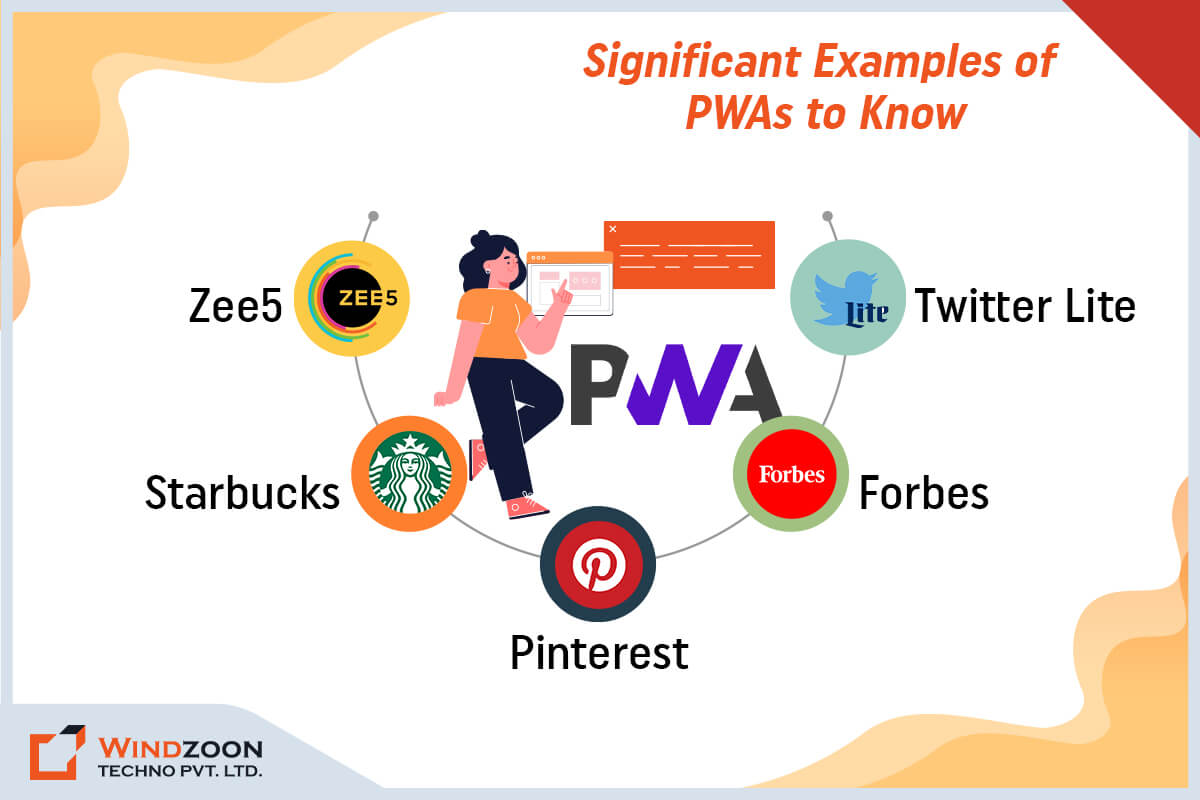
Some Striking PWA Examples to Know

examples-of-pwas

1. Zee5

ZEE5 built a PWA to streamline its platform and broaden its reach. It has increased app performance by three times and decreased buffering time by fifty percent.

2. Starbucks

Starbucks developed a PWA of their ordering platform that offers a comparable user experience to their current native app. Customers may quickly browse the menu, customize orders, add things to their basket, and do other tasks, whether they are doing so online or offline. It has raised the number of daily active users by twofold. And improve orders on desktop at almost the same rate as on mobile.

3. Pinterest

Pinterest revamped its mobile site as a PWA, which increased its core engagements by 60%. Furthermore, they saw a 44% increase in user-generated ad revenue, as well as a 40% increase in time spent on the site.

4. Forbes

Forbes is one of the prominent players in the news and media world. It has converted its website to a PWA. And now it loads in 2.5 seconds on mobile, compared to 6.5 seconds for its previous website. Additionally, there has been a 10% increase in impressions per visit.

5. Twitter Lite

Twitter has also employed PWA for its lite version, which is small, blazingly fast, and still retains the majority of the original app’s features. Twitter Lite reported a 65% increase in pages per session, a 75% rise in Tweets, and a 20% drop in bounce rate. Even on slow networks, Twitter Lite loads in under 3 seconds for repeat visits.

Conclusion

Progressive Web Apps is an innovative solution that combines the best of web and native app technologies. They provide a fast, reliable, and engaging experience for users while enabling developers to create apps that are cost-effective and easy to maintain.

With the rise of mobile usage and the growing demand for mobile-friendly solutions, PWAs are proving to be the future of web development.

Companies such as Starbucks, Pinterest, and Twitter have already leveraged PWAs to improve their user experience and boost their revenue. You can also become like them by joining hands with a skilled web development company to build PWA for your organization.

Windzoon is a prominent mobile app development services provider with exceptional experience and expertise in developing PWAs. To leverage our services, reach out to us and get a quote.

How to Choose a Web Development Company: 11 Useful Tips for 2023

Have you ever wondered what people do first when they learn about a new company or brand? They simply conduct an internet search for that brand or company to learn more about it.

And what is their first choice of internet information source for their search query? The first place to look for trustworthy information is the website of that specific business or brand.

We are leaving an era in which digitalization is at its height. Today, approximately 59% of the world’s population is online. And each day, they use the internet for an average of 6 hours and 54 minutes. Given the reach and effectiveness of the online marketplace, many businesses have moved their operations online. As a result, the World Wide Web now hosts approximately 1.9 billion active websites.

But will having a website on the internet be sufficient to bring in new clients? Definitely not. The mere existence of a website is never sufficient if it fails to draw in visitors. or is unresponsive and slow for visitors to your website because 88% of internet users are less likely to return to a website after a bad experience.

Therefore, when it comes to going digital, an excellent website should be at the top of every company’s priority list. It is not easy to design and develop a good website. However, you can simplify it by outsourcing it to a capable web development company in India & the USA.

Choosing a web development partner involves a few steps and careful evaluation to ensure you select the right team for your needs.

In this blog, we will share some essential tips to choose the right web design & development company for your web development project. These tips will guide you in choosing a web development company and help you identify a good development company that meets your business goals.

So, before we go forward to tips let’s first know about the services offered by web design/development companies.

What Services Does a Web Development / Design Company Offer?

Website Development Company provides a range of web development services and web design services, which are offered by various types of providers, including web development agencies, website design agencies, and design agencies.

These offerings are typical of a professional web development business.

Website Development Services

– Static Website Development

– PHP Website Development

– Custom Website Development

– Front-End Web App Development

– Back-End Web App Development

– Content Management System (CMS) integration

– Development of e commerce websites

– CMS Website Development

– E-Commerce Website Development

– Maintenance & Support

Web developers can also create template based websites for clients seeking quick and affordable solutions. A web developer’s expertise is crucial for implementing these services effectively.

Website Design Services

– Custom Website Design

– Branding & Graphic Design

– UI/UX Design (focused on creating a user friendly and engaging experience for visitors)

– Web App Design

– Mobile App Design

– Wireframe Design

– E-Commerce Website Design

– PSD to HTML5 Conversion

A skilled web designer is essential for delivering these outcomes, ensuring your website is both effective and engaging.

Now, let’s see the characteristics of a good website design/development company.

Signs/Characteristics of a Good Web Design / Development Company

Signs/Characteristics of a Good Web Design / Development Company

When choosing the right web partner, it is crucial to look for a good development company with a proven track record. Any prominent Website Development Company consists of the following characteristics.

A good web development company will have a strong company website and a visible online presence. Be sure to evaluate their overall digital presence and digital presence, including their website, social media profiles, and content, to assess their credibility and expertise.

The best web development companies and experienced web development companies stand out due to their professionalism, client satisfaction, and ability to deliver high-quality results.

1 Work Experience

Diverse projects, industries, and clients demonstrate web development companies’ experience, with industry experience being a key aspect when evaluating a company’s background. Companies with extensive experience in a variety of technical cases are regarded as competent web development firms. Reviewing similar projects they have completed and reaching out to past or current clients can help verify the company’s expertise and reliability.

2 Portfolio

Web development firms post their portfolio on their own websites or on specialized platforms such as Clutch and GoodFirms. If the portfolio contains a variety of samples, it demonstrates the company’s technical expertise and development skills. In addition to reviewing the portfolio, consider reaching out to past clients and current clients for feedback on their experiences. A past client can provide valuable insights into the company’s reliability and quality.

3 Service Selection

Professional IT firms that offer a wide range of web design and development services are regarded as excellent choices. Their comprehensive range of services includes setup, UI/UX design, development, quality assurance, maintenance, & support. Some companies also provide additional services such as SEO optimization, content writing, or digital marketing, which can complement the core website development process.

4 Positive Feedback

Positive customer feedback on the website or business listing website is considered a good sign. It demonstrates the web design company’s credibility and efficiency. Additionally, checking third-party platforms for ratings and client reviews of a website design agency or web design companies can help you make an informed decision.

5 Well-established Procedures

Well-defined development processes are essential for completing work on time and within budget. A clear design process and website development process—covering stages like analysis, research, prototyping, design, coding, and testing—are crucial for delivering quality results. A web development company with well-established processes and methodologies is always thought to be cost-effective and skilled.

6. Simplified Communication

A dedicated web design and development company always shares updates with its clients and expresses business-related concerns. Having a dedicated project manager or experienced project managers is crucial for facilitating smooth collaboration, maintaining consistent communication, and ensuring that all team members are aligned throughout the development process. Therefore, a business that follows a proper communication methodology is thought to be the best at delivering results and fulfilling the goals of its clients.

7 Result-oriented Policy

A result-driven development firm collaborates with the client to formulate a project vision. By aligning the project with your business goals and specific web development needs, such a company ensures the website effectively supports your overall strategy. A web design and development company that focuses on results will help you save time and money on significant changes that occur during the development process.

8 Excellent Work Ethics

Work ethics are the moral standards that govern a person’s behavior. A reputable web development company with a strong work ethic will generate high-quality results. Additionally, the company’s staff will communicate with you and be attentive to your needs.

9 Exceptional Company Website

Investigating the web design and development firm’s overall online presence can reveal more about its quality standards. Therefore, to do that, examine the company’s website, social media profiles, and content.

With this, we have come to the most important topic of our discussion.

11 Essential Tips to Choose the Right Web Design / Development Company for Your Project

Tips to Choose the Right Web Design / Development Company for Your Project

When you set out to choose a web development partner, it’s crucial to ensure they have the right expertise, transparency, and a proven track record. Knowing how to choose a web or web design company that aligns with your business goals can make all the difference in your project’s success. Look for a web development partner who offers clear ownership rights, strong UI/UX design skills, and a thorough vetting process. By carefully considering these factors, you can confidently choose a web design or development company that meets your needs and ensures a successful collaboration.

1. See How Well Do They Understand the Requirements of Your Business?

To begin with, pay attention to how they react to your business needs. Get a list of their clients, then research the previous solutions they have offered. Their solutions should be tailored to the specific industry and target audience of each client.

Do all of their solutions share common traits? Did they use pre-built templates at random, or did they do any research on the target market and target audience for the clients? Or did they just use the same old trendy designs without any ingenious designs that represented the brand?

A seasoned web development company puts itself in your shoes and offers solutions that are tailored to your needs, brand, business goals, and target audience.

2. Look for Particular Cultural Fit

The project’s success or failure depends on the cultural similarities and differences between you and your web development company.

Thus, check to see if their pace, personality, and culture are similar to your own. And ensure that the agency has an agile development culture that allows it to respond quickly to unexpected changes through constant information sharing and interaction mechanisms.

In addition, inquire about the technology partners’ strategies for adapting to changing technologies and trends.

3. Examine Their Website

Analyze the web development company’s website and surmise it as your own. Do you like the layout? Is it appealing? Is it responsive?

Responsive websites are intended to provide the best viewing experience possible for desktop monitors and mobile phone users, ensuring the site works well on mobile devices such as smartphones and tablets.

If you’re looking for a web development company to create a responsive website, make sure they’ve worked with responsive design before. And also ask to see some of their previous work.

4. Review Client Testimonials, Ratings, and Feedback

Almost every website development company has a section on their website where customers can leave reviews or testimonials. Undoubtedly, it will all be positive for all visitors to see.

Hence, to ensure the credibility of the testimonials, spend some time investigating your potential web design & development partners on search engines and other third-party platforms, such as Clutch and GoodFirms.

You can also ask past clients and current clients about the firm and learn about their experiences. Reaching out to a past client can provide valuable insights into the company’s work quality, reliability, and customer service.

5. Take a Look at The Range of Web Design & Development Services They Offer

Web development firms provide a plethora of services. And you might not require all of the services included in a package.

When evaluating potential partners, consider the range of web development services, web design services, and any additional services such as SEO or digital marketing that the company offers. The best way to determine which web design & development service you require is to inquire about the various services available. And determine whether they are a better fit.

If you’re just getting started, it’s best to look for an end-to-end service provider. It can walk you through each stage of website development.

6. Request a Consultation First

Every online business is a unique entity that adheres to particular procedures for a specific target market. Therefore, seeking consultation is essential. During the consultation, discuss your web development needs to ensure the company understands your specific requirements and goals. This will help you determine if you are selecting the right partner who can deliver tailored solutions for your industry. By doing so, you’ll know if you’re selecting the right web development company for your industry.

7. Request That They Send You Their Portfolio

A portfolio demonstrates a web design & development company’s completed projects. There will always be a portfolio section on the website of a reputable web design & development firm. Here, it highlights its prior successes.

Therefore, carefully examine it to know the breadth of expertise of the design & development firm. Look for similar projects to yours, a proven track record of successful outcomes, and relevant industry experience that matches your needs. You can even inquire about the firm’s involvement in the projects you’re interested in.

8. Take Into Account Their Communication Methods

A key component of a web design & development agency is its ability to communicate. Your project may go wrong if there are any communication gaps. Thus, before signing the contract, contact the service provider. Ensure that all parties are on the same page regarding project goals and updates. Evaluate their communication culture by asking the following questions:

– Is their communication and collaboration methods on par with yours?

– Will the design & development team be available via multiple communication channels such as phone, e-mail, Skype, and so on?

– Who will you contact with any questions, comments, or concerns you may have?

– How long will it take for your queries to be answered?

9. Get to Know the Members of The Design & Development Team

A great team can make a significant difference to your project. Thus, try to get a team that is skilled in all facets of web development from programming to design.

When meeting the team, it is important to understand the composition of the web development team, including the web developers—such as front-end, back-end, or full-stack specialists—and the web designer, as each plays a crucial role in delivering a high-quality website.

And you can find such a seasoned team only at a reputable web development company. So, take out some time, and meet the team members who will be working on your project. It will make you assured about their skills &  competence.

10. Inquire About Privacy and Security Policies

In every web design & development business, there are concerns about the security of confidential data. These sensitive data are necessary for many software projects. And, if unprotected, could put the operations of the company in danger.

It is also important to clarify ownership and access rights to the content management system to ensure that you retain control over your website and its content.

As a result, a Non-Disclosure Agreement (NDA) is a requirement of law and ethics for all software development businesses. To protect your sensitive data from prying eyes, most web design and development firms follow this agreement.

11. Obtain a Final Cost Estimate and Complete All Documentation

When it comes to any business decision, the cost is always the deciding factor. Avoid companies that give you estimates that are twice as high or half as low as those from competitors.

It is crucial to inquire about the development costs of the company and to establish a clear budget from the outset. Make sure you understand all the costs involved, including upfront, ongoing, and any potential hidden expenses, to avoid surprises and keep your project on track. Professional website development can start from a few thousand dollars depending on the scope and requirements.

Some organizations might upgrade their offerings by adding new resources and tools. Managing costs and timelines can be time consuming without clear documentation and communication, so ensure everything is clearly outlined before proceeding.

Talk about how they affect the operation of your project. You need a website that prioritizes user-friendliness over all else. Spending money on other flashy features is a waste and adds unnecessary expense.

Questions to Ask Before Hiring a Web Design or Development Company

The following questions will help you comprehend the offerings of top-notch web design & development companies. And assist you in determining whether they are the right fit for growing your online business:

  • What is the experience of the people who will be working on the project?
  • What types of web design, development, and related services do you provide?
  • Can you describe your website development process, including key stages such as analysis, research, prototyping, design, coding, and testing?
  • How do you approach keyword research and integrate it into the website development process?
  • Do you include search engine optimization (SEO) as part of your web design and development services? What strategies do you use for ongoing SEO optimization?
  • What is your method for staying up to date with the latest industry & technology trends?
  • Could you please give some examples of successful case studies and portfolio items? Why were they successful?
  • Do you have any prior experience in our market, or industry, or resolving a problem similar to ours?
  • What is the project management process for a website design/development project?
  • How do you handle ongoing maintenance and support after launching a new website?
  • What is your experience as a web development partner and as a reliable technology partner for businesses?
  • Do you collaborate with a marketing agency for digital marketing needs or can you recommend trusted marketing agencies?
  • How frequently will you evaluate the outcomes, and which metrics will you apply?
  • What are the costs of your services, and should we be prepared for any extra charges?
  • After the site goes live, do you provide ongoing support and maintenance?

In the digital world, your business is represented by its website. Hence, your website must effectively and efficiently reflect your core values. As a result, you should never skimp when designing and developing it.

As a reliable web design company, Windzoon offers high-quality web design & development services at the best market price. We have talented web designers and developers who are proficient in a variety of programming languages and can build custom websites to suit your company’s needs and budget!

You can count on us for everything from mobile app development to website services. To find out more about our services or to request a quote, go to wzadmin.windzoon.in/.

8 Major Reasons for Using ReactJS for your Next Web Development Project

Advancements in technologies introduced ingenious solutions and alternatives that replace the old technology. Before 2015, the concept of web development contained only scripting & rendering the codes. At that time, languages like HTML, CSS, and PHP ruled front-end & back-end web development. However, the invention of JavaScript libraries has replaced this old concept of web development.

The Front-end JavaScript framework provides imperative support in building high-gearing responsive websites & web applications. Nowadays, various front-end JavaScript libraries have sprung up like mushrooms. Choosing the right front-end library for your purpose is difficult. Because each library has its own special feature.

However, we have observed that in recent times, ReactJS has come up as the first preference for app development. Businesses are hiring reactJS development company for their app development projects.

Now you will have this question: Why do companies & developers favor ReactJS for building web applications? Well, continue with the reading, and you will find every answer.

Read More: New Trends of ReactJS that you Need to Follow in your Web Development

What is ReactJS?

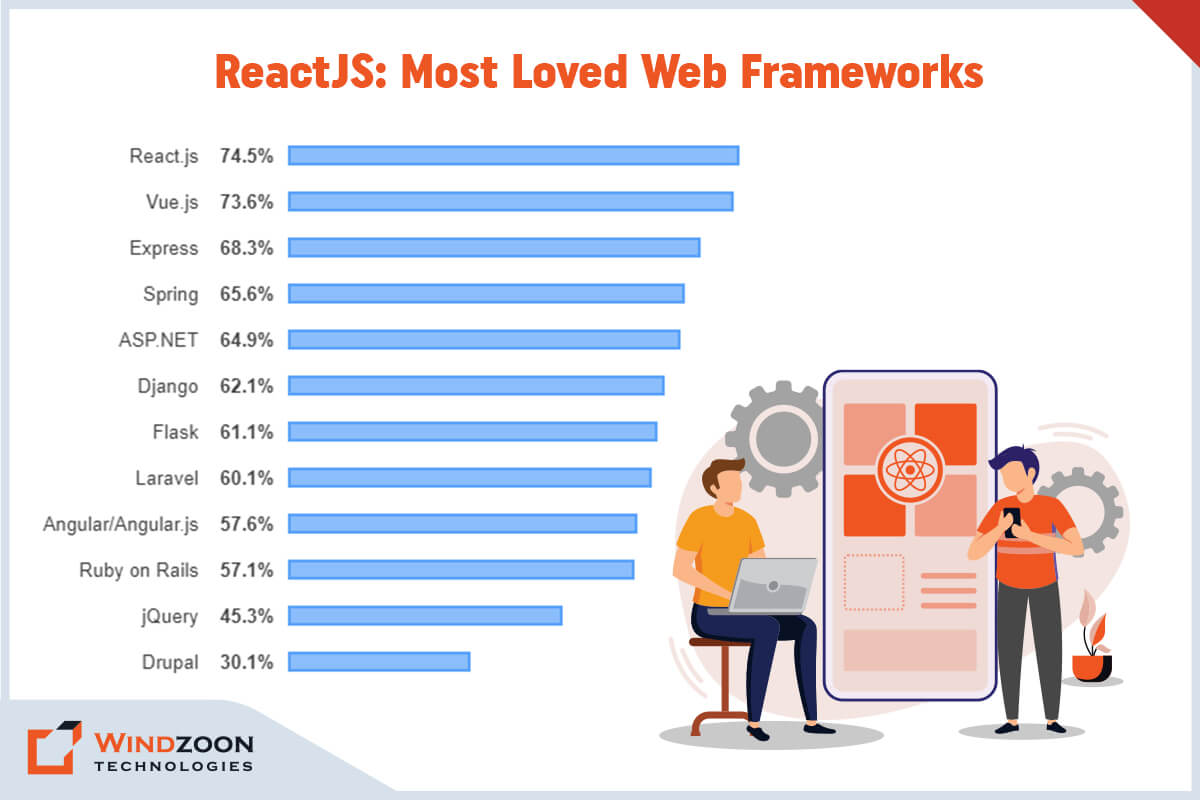
ReactJS is an open-source front-end JavaScript library maintained by Meta & an extensive developer community of Facebook. It is a highly functional, fast, & feature-rich front-end library. ReactJS is mostly used for building large web applications. The functionality of ReactJS made it recognized as the most famous JavaScript framework which is trusted by numerous start-ups & Fortune 500 companies.

ReactJS: Most Loved Web Frameworks

Now let’s go further to know the benefits & reasons to choose ReactJS for your next web app development project. The feature that makes ReactJS one of the most preferred front-end JavaScript libraries.

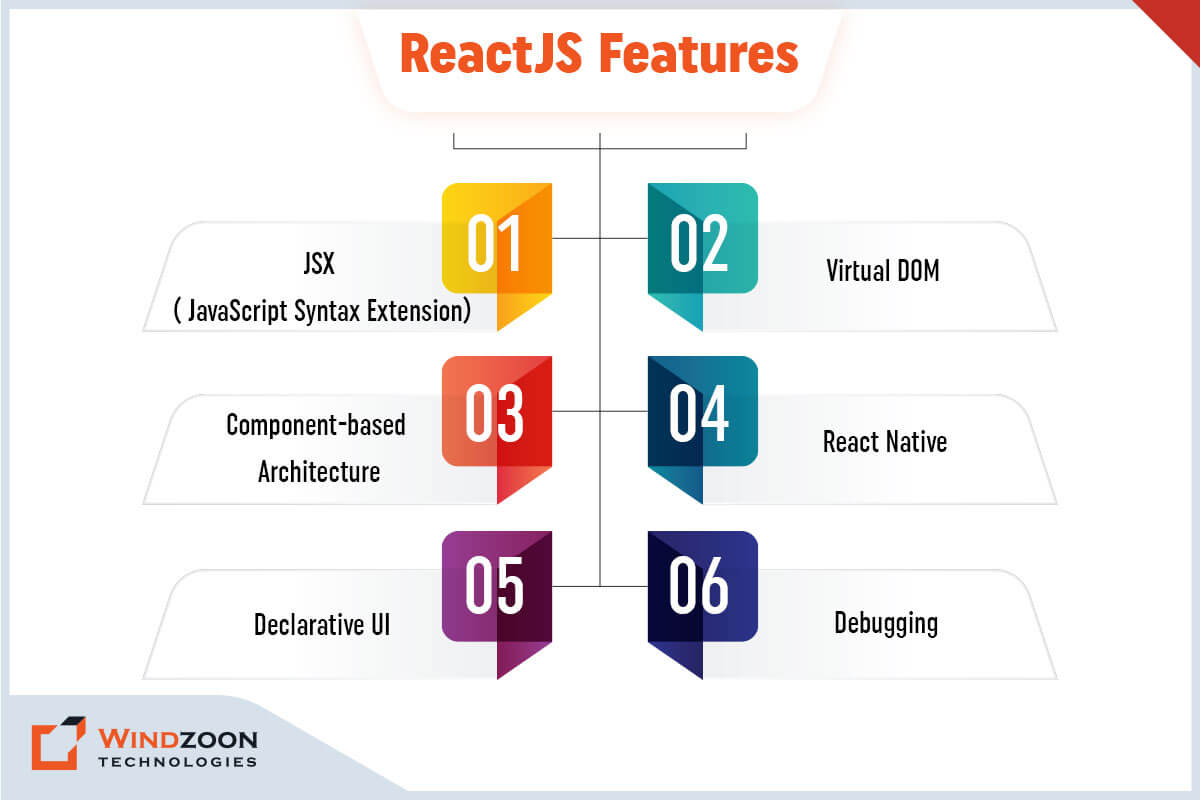
Top ReactJS Features Which Make It Best For Web Development

ReactJS Features
ReactJS Features

1. JSX ( JavaScript Syntax Extension)

The best feature of ReactJS is JSX, a markup syntax similar to HTML. It significantly defines the appearance of the application’s user interface. Developers used this feature to create React components. It makes coding easy and understandable if you have sufficient knowledge of HTML & javascript.

2. Virtual DOM

Document Object Model(DOM) is an essential part of web development as it divides into various modules & executes the code. Virtual DOM represents an actual DOM that works like a one-way data binding.

It re-rendered the entire UI whenever any modification happens during development. After that, it compares the difference between the previous DOM & new DOM and will update the things that have changed. Virtual DOM enhances the application performance without any memory wastage.

3. Component-based Architecture

The ReactJS framework has component-based architecture. And each component contains its own logic & control. Moreover, these components can be reused, which speeds up the development process. Hence, makes it easier for developers to maintain code when working on large-scale projects.

4. React Native

React Native is a custom renderer for the ReactJS framework. It utilizes native components in place of web components. React Native converts the React code to make it compatible with the Android & iOS platforms. And also provides access to their native features. It significantly facilitates mobile application development for both Android & IOS.

5. Declarative UI

ReactJS is the best framework for creating responsive & engaging UIs for both web & mobile applications. It contains a Declarative UI that generates an unadorned view for each state of the application. This simplified view makes React code more readable and easier to fix bugs.

6. Debugging

ReactJS is backed by a massive developer community that makes React applications simple & easy to test. Apart from this, Facebook also provides a small browser extension that simplifies & expedites React debugging.

After learning about the features of ReactJS, let’s move toward the key benefits of react js for front-end development.

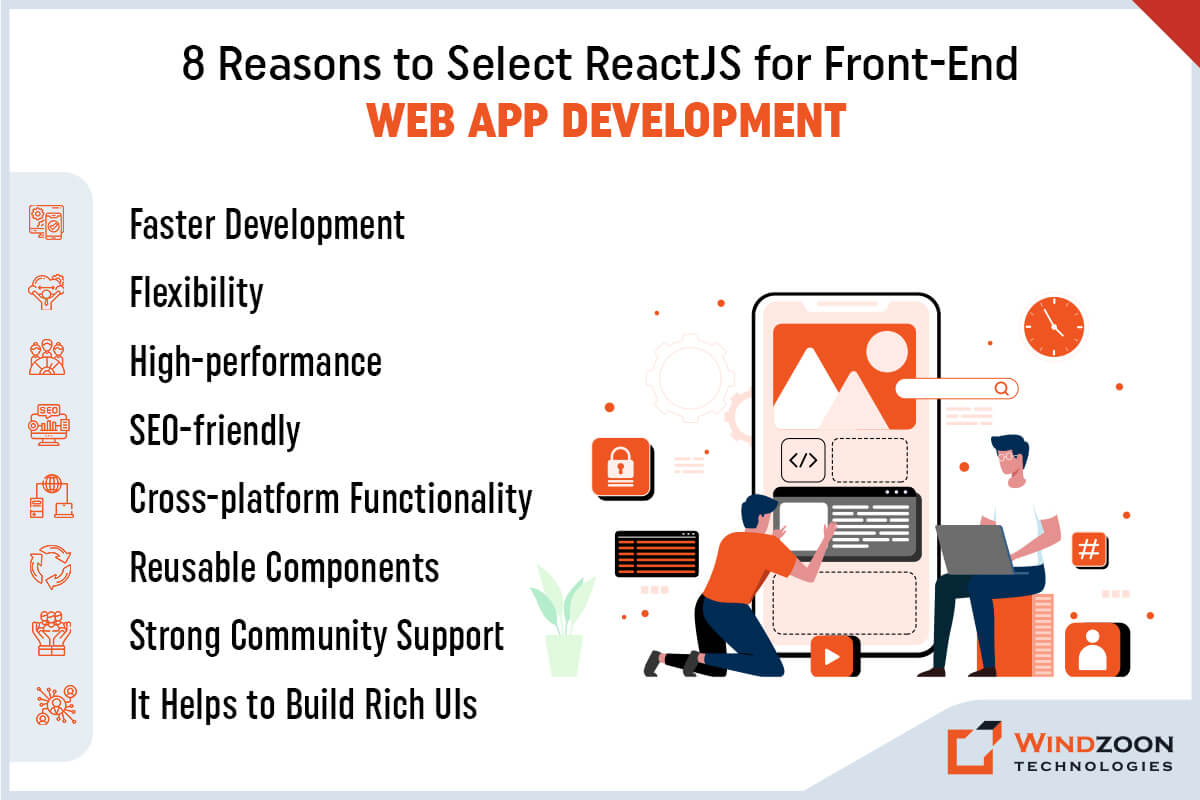
8 Reasons to Select ReactJS for Front-End Web App Development

Reasons to Select ReactJS for Front-End Web App Development

React is an efficient, component-based front-end library that has unmatched scalability & excellent features. Hire ReactJS Developers to optimize the exhilarating benefits of the ReactJS framework.

1. Faster Development

Compared with other popular frameworks like Angular & Vue, React is an easy-to-learn framework. It cuts down the learning time of developers and allows them to complete their projects in record time.

2. Flexibility

React has a modular structure that makes its codes flexible & easy-to-maintain. This flexibility in code saves a considerable amount of time & cost during the app development process.

3. High-performance

ReactJS framework is designed to build high-performance & feature-rich mobile/web applications. It provides a Virtual DOM program & server-side rendering. These features make applications run faster & smoother.

4. SEO-friendly

The super-fast rendering feature of ReactJS brings down page loading time. It enables the application to rank higher on the SERPs.

5. Cross-platform Functionality

ReactJS allows developers to work consistently on cross-platform without rewriting the existing code. It makes the app development work more convenient & faster.

6. Reusable Components

Another important benefit of ReactJS is its ability to reuse components. It saves developers time, as they do not need to rewrite codes for the same features. Besides, changes made in any particular part of the web application do not affect the other parts of it.

7. Strong Community Support

The Front-end library of ReactJS is still maintained by Facebook and its developer community. This massive community & corporate support has made ReactJS a reliable & state-of-the-art framework.

8. It Helps to Build Rich UIs

The User Interface(UI) quality plays a very essential role in the success of any application. ReactJS has advanced features & declarative components. It enables developers to build high-quality user interfaces.

Which Types of Projects to Use ReactJS?

Types of Projects can benefit from ReactJS

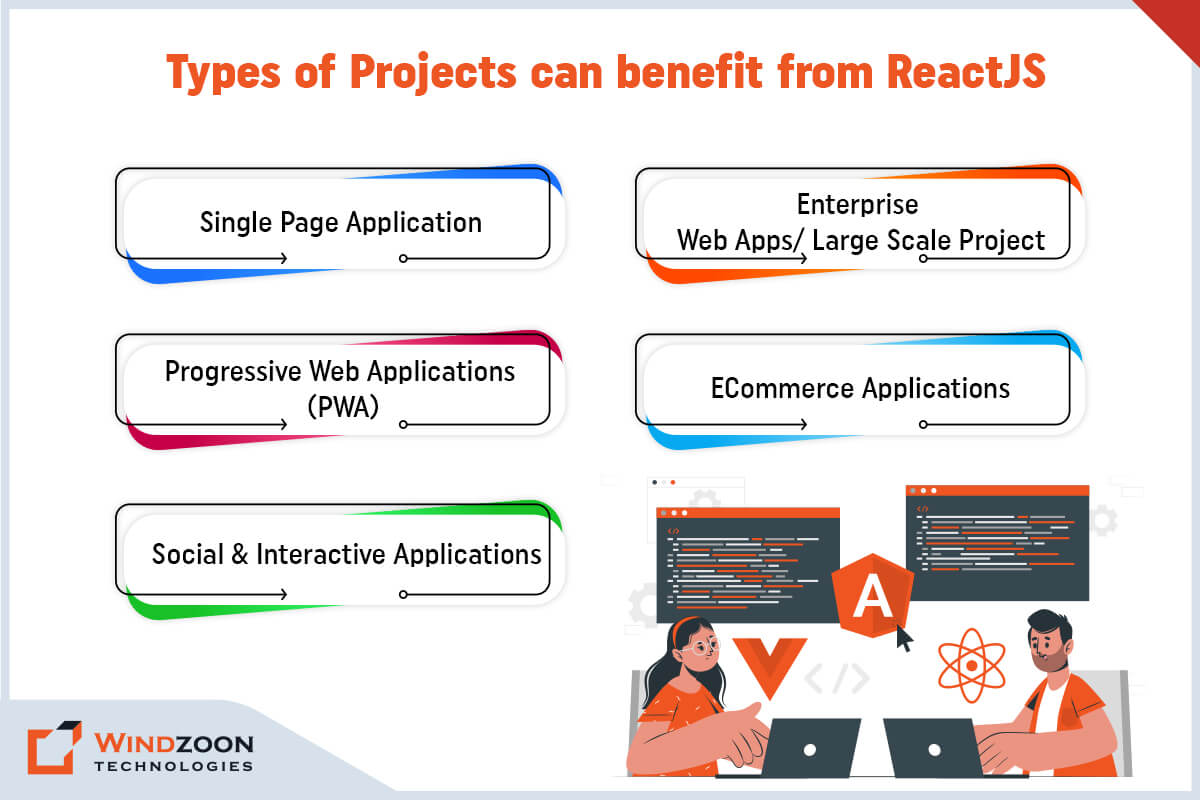
ReactJS has the ability to power a variety of web applications. It can successfully develop any customized web apps ranging from Single Page Applications to ECommerce applications. For your better understanding, we have explained the various uses of ReactJS for web app development. Please take a closer look at it to remove your doubts regarding the capability of ReactJS.

1. Single Page Application

ReactJS allows developers to build dynamic & responsive Single Page Applications(SPAs). These web applications allow users to interact with server data without reloading the page. Besides, SPAs significantly update web page content based on input from the user.

2. Enterprise Web Apps/ Large Scale Project

ReactJS has a component-based architecture that can break development projects into smaller parts by using UI components. Plus, React allows developers to reuse the components that save time & reduces cost. Therefore, ReactJS is the best option for large-scale development projects like Walmart & Airbnb.

3. Progressive Web Applications (PWA)

Progressive Web Application(PWA) is a web app that can be built with HTML, CSS, & JavaScript. It provides users with the feel & functionality of an actual native app. ReactJS has an advanced JavaScript library, components & extensions that support Progressive Web App development. Plus, it can migrate the existing ReactJS web application to Progressive Web Application(PWA).

4. ECommerce Applications

To develop an ECommerce app- APIs, elements, complex filters, and other functionalities are needed. However, React’s ability to build separate components allows developers to create feature-filled ECommerce apps.

5. Social & Interactive Applications

ReactJS is an ideal framework for building Single Page Applications that are also used for social sites. Many popular social media platforms like Facebook & Instagram are built using ReactJS. With its extensive front-end library & unique features, ReactJS helps to build a robust & feature-packed Social & Interactive application per your business needs.

Now, let’s learn about the projects that you shouldn’t develop using ReactJS.

When You Shouldn’t Use ReactJS for Your Project?

However, ReactJS can be utilized for developing varied web applications. Still, there are a few cases when you should not use ReactJS for web development.

1. A Simple Website with Less Dynamic Content

One should avoid using ReactJS when the website is too simple and doesn’t need any dynamic content. In this case, the usage of ReactJS can kill the look & functionality of that particular website.

2. Complex Admin Panels

The use of ReactJS is not advisable in the development of heavy admin panels because it requires more codes in its building. Instead of ReactJS, utilization of a back-end framework is a far better option for building typical admin panels.

3. SEO-optimized Websites with Smooth Crawling Features

ReactJS web development has certain SEO advantages like less page loading time. However, it also has one disadvantage in terms of the poor crawling ability of the React website. This disability can create a significant risk for SEO efforts on React websites.

12 Popular ReactJS Framework Web Application Examples

Companies use ReactJS Framework

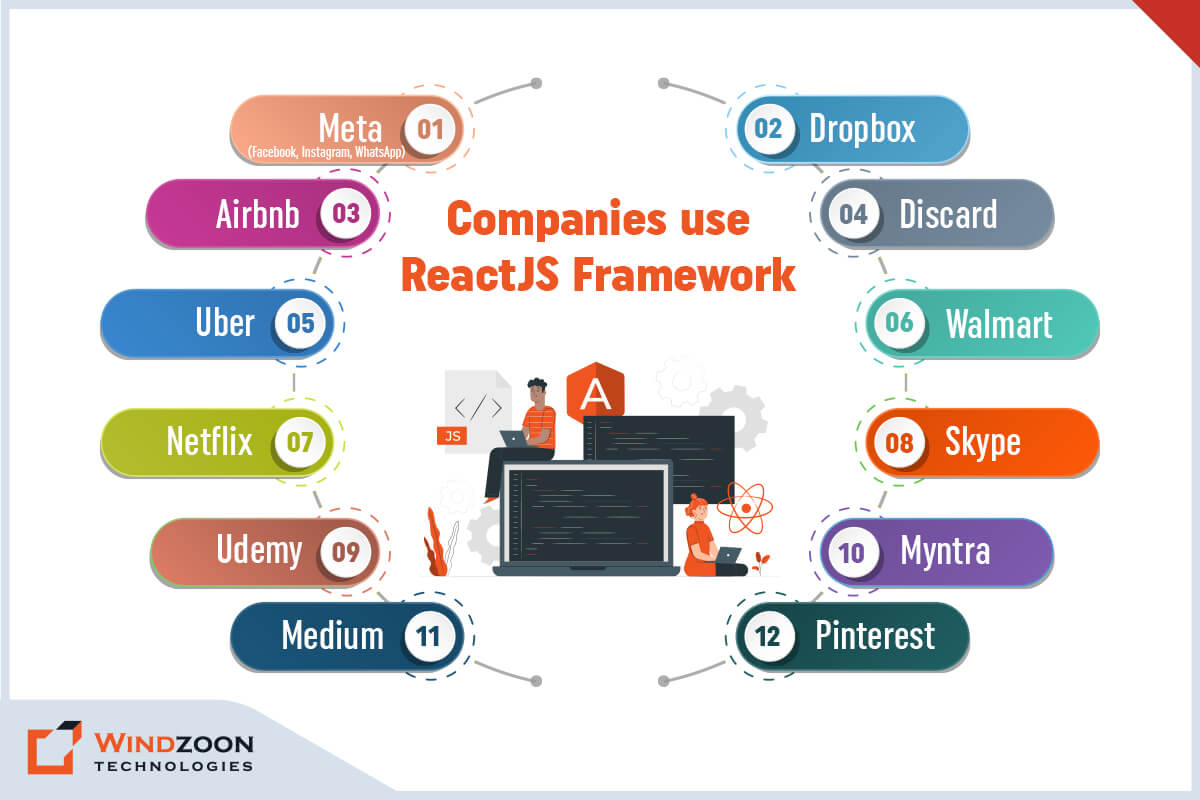
The excellent features & usability of ReactJS have made it one of the most demanding frameworks by many prominent industry leaders. Below, we have listed some famous companies that have used React in their web application.

  • Meta (Facebook, Instagram, WhatsApp)
  • Dropbox
  • Airbnb
  • Discard
  • Uber
  • Walmart
  • Netflix
  • Skype
  • Udemy
  • Myntra
  • Medium
  • Pinterest

Conclusion

We genuinely hope that your purpose in picking this blog post is served. You aren’t left with any doubts regarding the competence of ReactJS for your project. However, to build a high-functional ReactJS application, you will require the help of a competent ReactJS Development Company.

With 10+ years of experience in developing ReactJS web app solutions, Windzoon is competent enough to fit this description. We have talented ReactJS developers who can build any type of complex & custom web solution.

To avail of our services, visit us at wzadmin.windzoon.in/ to get a quote & to learn more about us.