The Future of Artificial Intelligence in Digital Marketing Services

The grand entry of ChatGPT has successfully made AI (artificial intelligence) the talk of the town. Before, it was just a topic for deep discussion among technocrats, scientists and thinkers. But now, it has become a subject of intrigue and concern for even the ordinary people.

The reason is; that the advancement of technology has led to AI saturating every industry and working field. One such industry is digital marketing. The incorporation of artificial intelligence (AI) in digital marketing has transformed the way businesses communicate with their consumers, personalize experiences, and optimize campaigns for optimal efficiency.

As per Statista, the market for artificial intelligence (AI) in marketing was projected around 15.84 billion dollars in 2021. The same source reveals that, by 2028, the value will be increased to above 107.5 billion dollars.

In this blog post, we’ll look at the incredible influence of AI in digital marketing. In addition, learn how collaborating with a digital marketing agency in India or the USA may help you redefine strategy, improve customer interaction, and pave the road for a more effective and data-driven future with AI.


What is Artificial Intelligence?

Artificial Intelligence, commonly known as AI, is akin to a highly intelligent computer brain. This advanced technology enables computers and machines to think, learn, and tackle problems much like humans do. It does so by processing data – both historical and current – to make informed decisions without human intervention.

Remember when you’re playing a video game and the characters you play against seem to think and make decisions on their own? That’s AI in action. Or when you talk to Siri or Alexa, and they understand you and respond, that’s also AI.

AI’s applications are vast and varied. It powers self-driving cars, allows smartphones to recognize faces, and even enables chatbots to assist customers efficiently. In essence, AI is like having a really clever helper that can process lots of information quickly and help us in our daily lives.

Now, let’s learn about the role of artificial intelligence in digital marketing.

Role of AI in Digital Marketing Services

When we talk about the role of Artificial Intelligence (AI) in digital marketing, it is like a highly intelligent partner that assists businesses in efficiently reaching and engaging with a larger online audience.

To know it better, here is an example, when you’re shopping online, AI analyzes your previous purchases and browsing habits. It’s as if the website ‘remembers’ what you like, suggesting new products that align with your interests.

Additionally, AI excels in crafting compelling advertisements designed to grab the attention of the right audience. Its ability to process vast amounts of data enables businesses to understand their customers better. AI can identify the likelihood of a product appealing to different demographic groups, such as a 20-year-old woman or a 50-year-old man. This helps businesses to do more targeted and effective advertising.

Furthermore, AI-powered chatbots on websites offer instant assistance to customers. They answer their queries in no time, thereby enhancing customer service and experience.

Moreover, AI in digital marketing is about leveraging advanced technology to accurately showcase products to the appropriate audience, create more engaging ads, and deliver prompt and efficient customer service.

Examples of AI’s Role in Digital Marketing Services
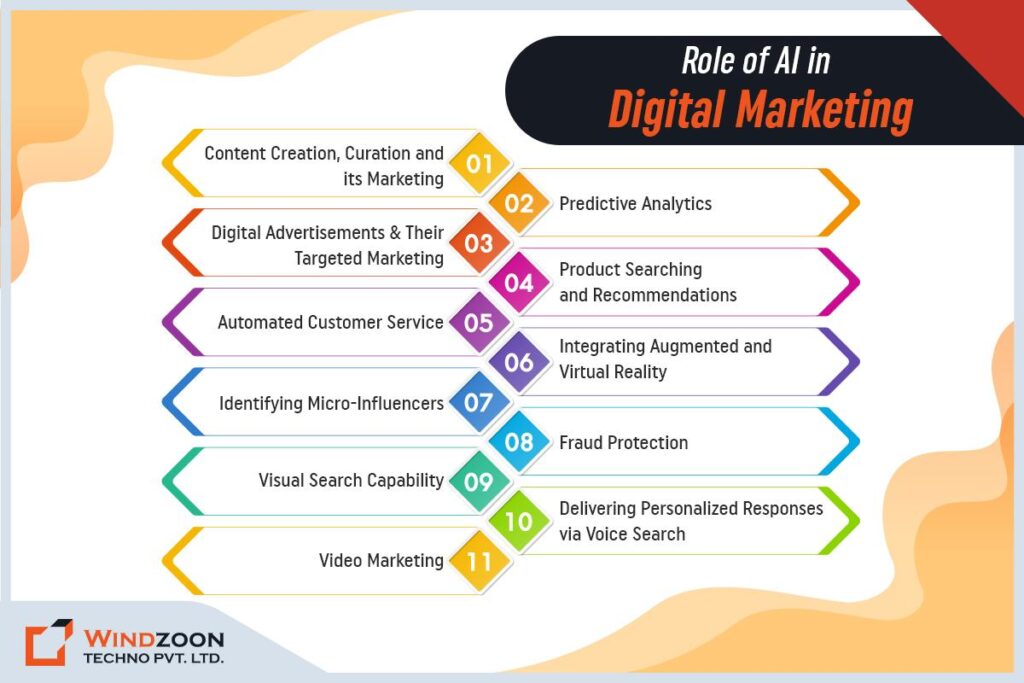
role-of-ai-in-digital-marketing


Following are some routine AI in digital marketing examples:

1. Content Creation, Curation and its Marketing

Artificial Intelligence (AI) is revolutionizing the field of content creation by automating routine tasks and enabling the generation of personalized content on a large scale. Natural Language Generation (NLG) algorithms, such as ChatGPT and BARD, are at the forefront of this change. They can produce various forms of content including blog posts, product descriptions, and social media updates, all while adhering to specific brand guidelines and catering to audience preferences.

In addition to content creation, AI plays a crucial role in content curation. AI-powered tools are adept at navigating the vast sea of online content to pinpoint relevant and trending topics. These tools are not just limited to content discovery; they also aid in determining the most suitable type of content for different platforms and the optimal timing for distribution. This ensures that the content reaches the intended audience effectively and efficiently.

Furthermore, in the realm of AI-driven content marketing, these technological advancements extend to providing data-driven insights and feedback to content creators. By establishing a continuous feedback loop, these tools empower marketers to refine their content creation strategies continuously. They can track and analyze their performance relative to competitors, paving the way for enhanced content quality and more successful marketing outcomes.

2. Predictive Analytics

The use of AI-driven predictive analytics has revolutionized the process of generating and nurturing leads. AI excels in sifting through millions of social media trends and posts, identifying patterns in text, images, and hashtags. Through this analysis of historical data, AI algorithms are capable of pinpointing potential customers with a higher likelihood of conversion. This enables marketers to concentrate their resources on more promising leads.

Additionally, AI is adept at anticipating customer behaviors, such as the likelihood of them discontinuing service, known as churn. This predictive capability allows for preemptive actions to maintain customer loyalty. This adaptability is crucial for marketers to respond to changing market dynamics, ultimately boosting the brand’s performance as new data unfolds.

3. Digital Advertisements & Their Targeted Marketing

Aside from assisting marketers in reaching the correct audience, AI in digital marketing brings up a plethora of chances for businesses to construct new ad campaigns across platforms such as Google, Facebook, and Instagram. These platforms examine user data, including gender, age, interests, demographics, and other personal characteristics, to deliver the optimal experience.

AI ensures, for instance, that people who have been searching for bicycles online get more advertisements for bicycles or riding gear rather than irrelevant items like lawnmowers in their search results.

Targeted Marketing allows AI algorithms to ensure that the user receives the most relevant adverts, therefore boosting the performance of the digital ads provided.

Here, since you are paying for each ad that is shown to a user, you have the choice of who sees your adverts. To provide personalized client experiences, you must first anticipate different consumer categories and include smart designs in digital marketing campaigns.

4. Product Searching and Recommendations

Artificial intelligence improves the accuracy of finding things that customers wish to purchase and presents recommendations for those products. AI-powered product recommendations help consumers locate the products they want to buy.

This is like a friendly store associate who can recall everything you’ve ever liked or purchased. When you look for products online, AI leverages your previous searches and purchases to suggest other items you might be interested in.

On the other side, the right AI tools allow digital marketers to make more accurate and timely forecasts about which things people will purchase. This boosts sales and allows firms to showcase products to potential buyers who have previously decided that they are worthwhile and efficient.

5. Automated Customer Service

Artificial intelligence facilitates automated customer service. It encompasses tasks like sending out messages, providing automated responses through chatbots, delivering results from surveys, and responding to inputs on various online platforms.

Chatbots, powered by AI, are a prominent example of this technology in action. They have revolutionized customer support by offering immediate assistance to users around the clock.

These AI-driven virtual assistants are capable of handling standard inquiries, supplying information about products, and assisting customers throughout their purchasing journey.

Equipped with Natural Language Processing (NLP), chatbots can comprehend and interact with human language, creating a smooth and individualized conversation experience. This level of automation not only conserves time and company resources but also ensures uniformity in customer service across multiple channels.

6. Integrating Augmented and Virtual Reality

Artificial Intelligence (AI) is set to significantly boost the development of Virtual Reality (VR) and Augmented Reality (AR) in the coming years. This emerging marketing approach is outshining traditional methods like billboards and print advertisements.

By blending the virtual world with real-world settings, it offers customers an entirely new and engaging experience. AR, in particular, opens the door to limitless immersive experiences.

Imagine offering interactive product demonstrations or transporting customers directly into your store through virtual showrooms. AR is the key element in transforming standard marketing efforts into extraordinary, memorable journeys.

Hence, prepare to amaze your customers as they interact with your brand in unprecedented ways. Remember, the future of marketing transcends mere product selling; it’s about crafting unforgettable experiences.

7. Identifying Micro-Influencers

This is about finding the right people online to promote products. Micro-influencers are like mini-celebrities on social media; they have fewer followers than big stars but are often more connected to their audience.

AI helps businesses find these micro-influencers. It looks at data like who’s talking about certain topics or products and how people respond to them. This way, businesses can partner with the right micro-influencers who fit with their brand and will appeal to their target customers.

8. Fraud Protection

AI in digital marketing services is like a digital security guard. It helps protect online transactions from fraud. AI systems can learn to spot unusual patterns, like if someone tries to buy a lot of things in a very short time or from a different country than usual.

This can signal a fraudulent transaction. By identifying these patterns, AI can alert the business and help prevent fraud, making online shopping safer for both the business and the customers.

9. Visual Search Capability

Visual search technology, driven by AI algorithms, enables consumers to search using images instead of text or keywords. This advanced search method allows users to find items online by simply using pictures. Google Lens stands as a prime example of this AI-powered Visual Search Capability in the digital marketplace.

This technology is particularly beneficial for those who may not know how to accurately describe what they are looking for, or for those who are not familiar with the specific vocabulary of an item. Consequently, visual search offers a practical solution, bypassing the challenges people encounter when they input incorrect terms in a search bar.

Voice recognition technology, like Alexa playing music or Siri setting alarms, is gaining global popularity. Marketers must recognize the importance of optimizing websites for voice search, as this shift underscores its growing significance.

Artificial Intelligence enables devices to understand and respond to voice commands using natural language. Have you come across Machine Translation Post-Editing? This advanced technology combines native translators’ expertise to create accurate multilingual content that effectively communicates marketing messages, all while minimizing errors. In digital marketing, AI is paving the way for swift conversion of content into multiple languages, catering to diverse customers.

Furthermore, companies can now obtain immediate insights into customer interactions across various communication channels. Backend teams can use this information to automatically route issues to the right support group and employ statistical models to identify the most effective next steps.

11. Video Marketing

Videos have emerged as a potent tool for disseminating knowledge and information. In the past year, there has been a significant surge in video consumption, particularly in live-streaming content.

In response to this trend, businesses are increasingly leveraging artificial intelligence to enhance the effectiveness of their video marketing strategies. AI aids companies in gaining deeper insights into their consumers’ viewing patterns, helping them understand customer behavior, provide tailored content, and ultimately, increase the Return On Investment (ROI) of their video content.

All the digital marketing applications discussed are integral to the Real-Time Optimization approach in ongoing marketing strategies, setting a foundation for automated sales predictions. Future advancements in AI will further enable businesses to operate at optimal profitability, elevate sales, and make adjustments based on concrete data.

Benefits of AI in Digital Marketing Services
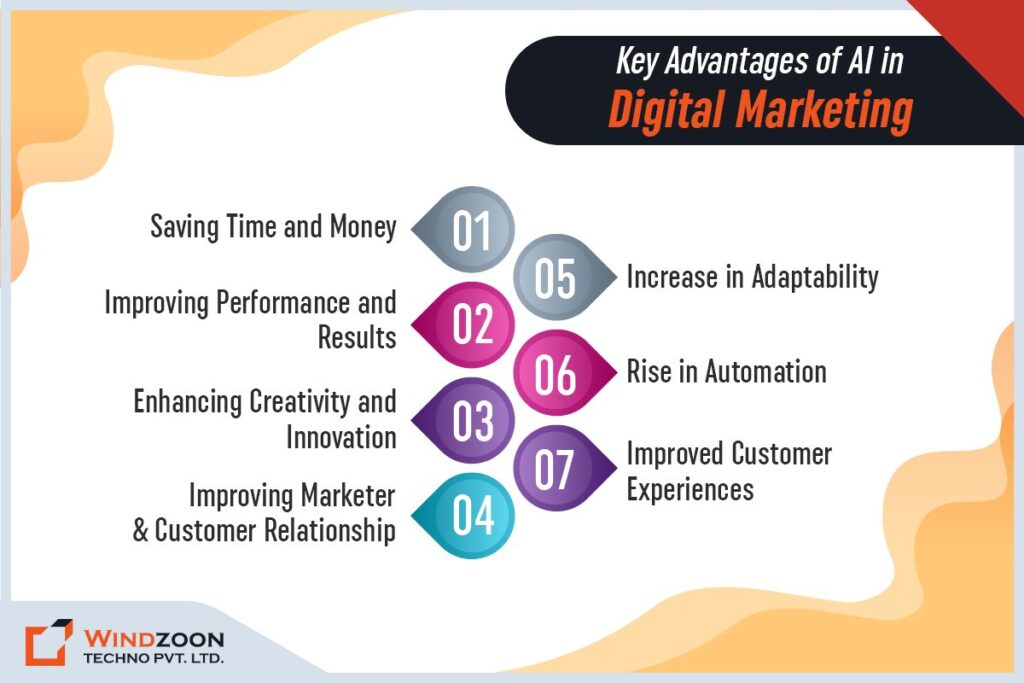
advantages-of-ai-in-digital-marketing

Here are some of the significant advantages of Artificial Intelligence in Digital Marketing.

  1. Saving Time and Money: AI streamlines marketing processes, automating tasks that humans usually perform. This automation saves considerable time and reduces costs, as AI can handle tasks like data analysis and customer service inquiries quickly and efficiently.
  2. Improving Performance and Results: AI’s ability to analyze vast amounts of data helps businesses make more informed decisions. It can predict customer trends and preferences, leading to more effective marketing strategies and better results in terms of sales and customer engagement.
  3. Enhancing Creativity and Innovation: AI provides marketers with new tools and insights, sparking creativity. It can suggest content ideas, design layouts, and even help in creating personalized marketing messages, pushing the boundaries of traditional marketing.
  4. Improving Marketer and Customer Relationship: AI helps in personalizing customer interactions, making them more meaningful. By understanding customer behavior and preferences, AI enables marketers to communicate with customers more effectively, building stronger relationships.
  5. Increase in Adaptability: With AI, marketers can quickly adapt to changes in the market or consumer behavior. AI’s real-time data analysis helps businesses stay agile and responsive to new trends or customer needs.
  6. Rise in Automation: Automation in digital marketing, powered by AI, includes everything from automated email campaigns to chatbots handling customer service inquiries. Due to this efficiency, businesses can concentrate on more strategic responsibilities.
  7. Improved Customer Experiences: AI enhances the customer experience by providing personalized recommendations, quick responses to inquiries, and more engaging content. This tailored approach makes customers feel understood and valued, increasing their loyalty to a brand.

Significant AI Tools for Digital Marketing Services

The following are 19 AI marketing tools you need to try in 2024:

  1. Jasper AI: For copywriting
  2. Surfer SEO: For SEO content writing
  3. Content at Scale: For generating SEO blog posts
  4. Originality AI: For detecting AI-generated content
  5. Writer.com: Content writing tool for teams
  6. FullStory: For analyzing digital experiences
  7. Zapier: For automating various tasks
  8. Hemingway App: For editing and improving content
  9. Chatfuel: For creating chatbots
  10. Grammarly: For content editing and grammar checking
  11. Albert.ai: For digital advertising
  12. Headlime: For designing landing pages
  13. Userbot.ai: For managing conversations
  14. Browse AI: For web page scraping
  15. Algolia: For search and recommendation APIs
  16. PhotoRoom: For removing backgrounds from images
  17. Reply.io’s AI Sales Email Assistant: For managing email replies
  18. Brand24: For media monitoring
  19. Influencity: For influencer marketing

Wants to Leverage AI-Enabled Digital Marketing Services?

The incorporation of AI in digital marketing is poised to alter the industry, increasing the effectiveness and efficiency of marketing efforts while providing improved customer experiences. With fresh and fascinating advancements anticipated in the upcoming years, artificial intelligence in digital marketing has a bright future.

To take advantage of this bright future, you will need the help of a next-gen AI-enabled digital marketing company that helps businesses grow and thrive in the digital world.

We at Windzoon offer innovative AI-enabled digital marketing services to scale up our clients’ businesses. Our team of professional digital marketers love going above and beyond to achieve our clients’ goals.

Hence, don’t wait any longer; contact us now to get a quote and leverage our services.
SEO for Hotels – Improve Your Hotels Online Visibility by 12 Tips

Picture this: you’re a weary traveler, trudging through a new city, looking for a place to rest your head. You whip out your trusty smartphone and type in “hotels near me.” The search results pop up, and you scroll through the options. Which hotel catches your eye? Is it the one with the poorly lit photos and sparse reviews, or is it the one with glowing reviews and stunning visuals?

For hotels and tourism businesses, standing out in the vast sea of online searches is crucial. The size of the worldwide online industry was estimated to be 475 billion dollars in 2022. According to projections, this amount will exceed 521 billion US dollars in 2023 and reach over a trillion US dollars by 2030. And with the pandemic driving more people to domestic travel, it’s more important than ever to have a strong online presence.

So, how can hotels and tourism businesses optimize their online presence for maximum visibility and bookings? As a leading digital marketing agency with years of experience in offering services to the tourism industry, we have prepared some SEO tips for hotel & travel websites. The application of these tips will help you increase your brand visibility and bookings.

So, let’s dive into some SEO tips and tricks that will make your business stand out from the competition.

What is SEO for Hotel & Travel Websites?

We’ll provide a very basic explanation for this question. As an illustration, visualize your hotel or travel website as a magical castle that you want to invite as many guests to explore. From the warm rooms to the stunning vistas, you’ve worked so hard to create a magical experience. But how are people supposed to locate your castle in the big, crowded, internet kingdom?

That’s where SEO enters into play. Search engine optimization, or SEO, is a kind of mystical wand that can raise the ranking of your website in search engine results. By using strategic keywords, optimizing your website structure, and crafting captivating content, you can attract more visitors to your castle and ensure that they have an unforgettable experience. So, cast your SEO spell and watch as the kingdom flocks to your magical castle.

Benefits of SEO for Hotel & Travel Websites

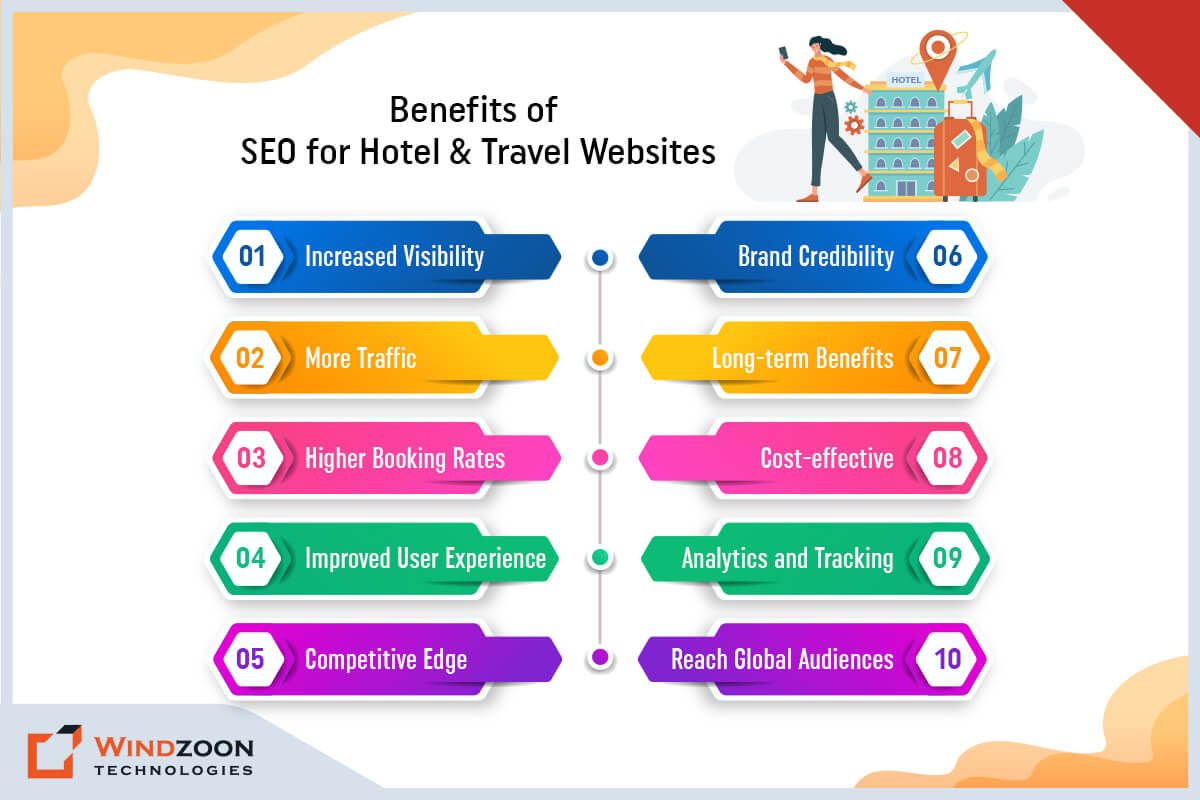
Benefits of SEO for Hotel & Travel Websites

  1. Increased Visibility: SEO helps your website appear higher in search engine results pages (SERPs), which means more people are likely to find and visit your website.
  2. More Traffic: With increased visibility comes more traffic to your website, as people are more likely to click on links that appear higher in search results.
  3. Higher Booking Rates: By optimizing your website for search engines, you can attract more qualified leads who are more likely to book directly on your website.
  4. Improved User Experience: SEO involves optimizing the structure and content of your website, making it more user-friendly and easier to navigate.
  5. Competitive Edge: SEO helps you stand out from the competition by showcasing your unique offerings and value proposition.
  6. Brand Credibility: By appearing higher in search results, you can boost brand awareness and credibility, as people are more likely to trust websites that appear at the top of search results.
  7. Long-term Benefits: SEO is a long-term strategy that can continue to drive traffic and bookings to your website for months or even years to come.
  8. Cost-effective: Compared to other forms of digital marketing, such as paid advertising, SEO can be a more cost-effective way to drive traffic and bookings to your website.
  9. Analytics and Tracking: With SEO, you can track and analyze the performance of your website and adjust your strategy accordingly.
  10. Reach Global Audiences: With SEO, you can target specific keywords and phrases that are relevant to your target audience, including global travelers.

Read More: Hire Digital Marketing Agency For Small Businesses: 8 Useful Tips

12 Effective Hotel SEO Tips to Rank #1 on Google

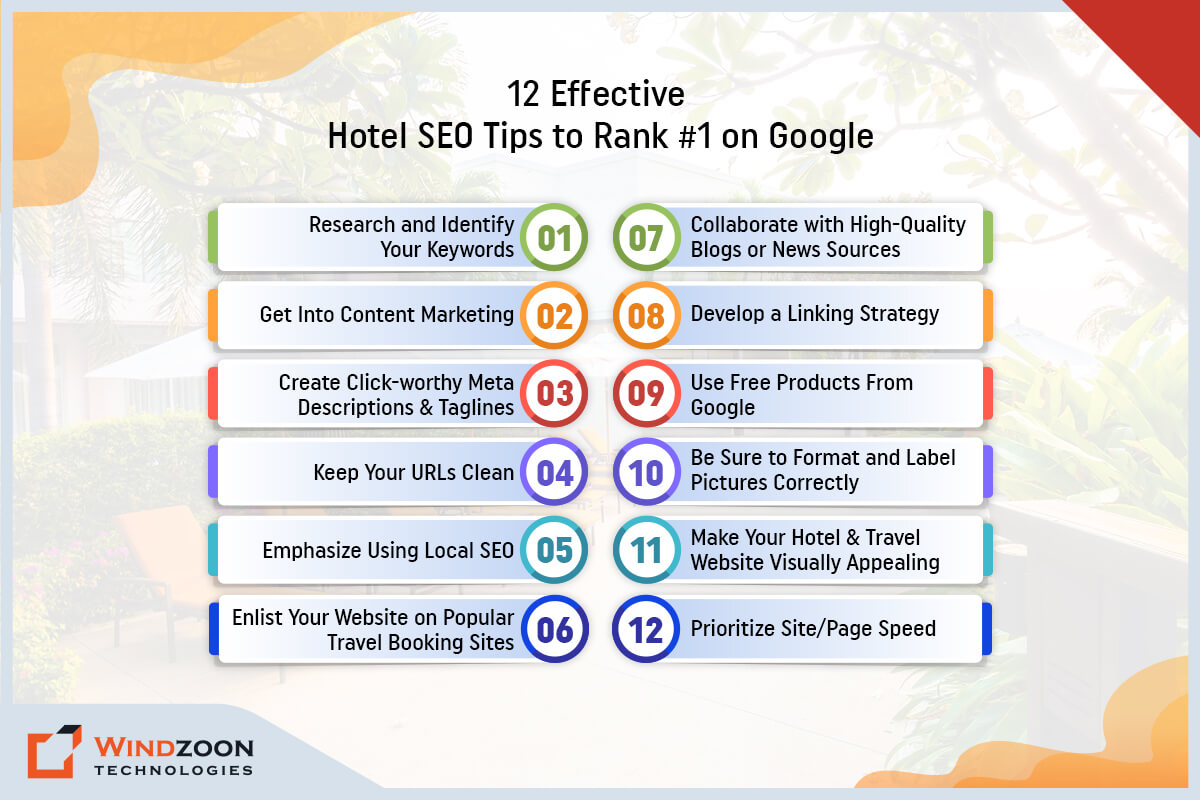
Hotel SEO Tips to Rank #1 on Google

1. Research and Identify Your Keywords

Any SEO strategy should start with a study and keyword identification phase. These are the keywords or sentences that people type into search engines to find your products or services.

Additionally, by focusing on the right keywords, you can draw pertinent traffic to your website and raise the likelihood that users will become paying customers.

To discover the most pertinent and lucrative keywords for your business, you can use a variety of keyword research tools, such as Google Keyword Planner, Ahrefs, or SEMrush. Once you’ve chosen your keywords, incorporate them into the text, meta descriptions, headings, and URLs of your website.

2. Get Into Content Marketing

The next piece of advice is to do content marketing well. It is an effective SEO strategy that entails creating high-quality, informative content. So that, it can attract, engage, and convert your target audience.

However, to do that you need to publish the more recent and pertinent material on your website. It will help your website to gain more authority on SERPs. In addition to increasing your brand reputation and helping you receive backlinks from other websites.

Apart from that, you can demonstrate your expertise and value proposition using a variety of content forms like blog posts, infographics, videos, or guides. However, it’s crucial to produce content that is in line with the interests and requirements of your target audience as well as your company’s objectives.

3. Create Click-worthy Meta Descriptions & Taglines

Meta descriptions and taglines are the short and concise texts that appear below your website’s title in search engine results. They provide a brief summary of your website’s content and value proposition and encourage users to click on your link.

Therefore, it’s crucial to craft compelling and relevant meta descriptions and taglines that entice users to visit your website. You can use action-oriented language, include your target keywords, and highlight your unique selling points to create click-worthy meta descriptions and taglines.

4. Keep Your URLs Clean

Your website’s URLs or web addresses are also critical for SEO. They should be short, descriptive, and easy to read and remember. Avoid using long and complicated URLs that contain random letters or numbers, as they can confuse both users and search engines.

Instead, use hyphens to separate your words and include your target keywords in your URLs. For example, a clean URL for a blog post about the best hotels in Paris could be www.yourwebsite.com/best-hotels-in-paris.

5. Emphasize Using Local SEO

As a hotel or travel website, one of your top priorities should be to rank for local search terms. When people search for hotels or travel destinations, they usually look for options that are nearby. That’s why it’s crucial to optimize your website for local SEO.

Local SEO involves optimizing your website for location-based keywords, such as “hotels in London” or “best restaurants in New York.” You can do this by including your location in your website’s content, titles, and meta descriptions.

Moreover, it’s essential to have a Google My Business listing. It’s free, and it can help you rank higher in local search results. Make sure to provide accurate information about your hotel or travel business, including your address, phone number, and hours of operation.

6. List Your Website on Popular Travel Booking Sites

Getting your hotel or travel website listed on popular travel booking sites can effectively drive traffic and increase bookings. These sites, such as Booking.com or Expedia, are visited by millions of people every day, and they can help you reach a wider audience.

However, keep in mind that these booking sites usually charge a commission for every booking made through their platform. That’s why it’s crucial to find a balance between the commission you pay and the benefits you get from the listing.

7. Collaborate with High-Quality Blogs or News Sources

Collaborating with high-quality blogs or news sources can be an effective way to get backlinks and increase your website’s authority. When you get a backlink from a reputable website, it tells search engines that your website is also trustworthy and relevant.

To find blogs or news sources to collaborate with, you can use tools like BuzzSumo or Ahrefs. These tools allow you to search for websites that are relevant to your niche and have high domain authority.

When reaching out to these websites, make sure to offer them something valuable in return, such as a guest post or a discount for their readers.

8. Develop a Linking Strategy

Internal linking is an essential aspect of on-page SEO. It helps search engines understand the structure of your website and the relevance of each page.

When creating content for your hotel or travel website, make sure to link to other relevant pages on your site. For example, if you’re writing about the top attractions in Paris, you can connect to your page about hotels in Paris or your page about Paris tours.

Moreover, it’s essential to get external links to your website. As mentioned earlier, getting backlinks from reputable websites can help increase your website’s authority and improve your search engine rankings.

You can develop a linking strategy by creating shareable content, such as infographics or guides, and reaching out to relevant websites to ask for backlinks.

9. Use Free Products From Google

Google offers several free products that can help improve your hotel or travel website’s SEO. These products include Google Analytics, Google Search Console, and Google My Business.

Google Analytics allows you to track your website’s traffic, user behavior, and conversions. It can assist you in determining which sites are effective and which ones require improvement.

Google Search Console can assist you in monitoring the success of your website in search results. It allows you to see which keywords your website is ranking for, how many clicks you’re getting, and how many impressions your website is receiving.

Google My Business can help you manage your online presence on Google. It allows you to create a business profile, respond to reviews, and manage your location on Google Maps.

10. Be Sure to Format and Label Pictures Correctly

Images play an essential role in any hotel or travel website. They can capture a visitor’s attention and provide a visual representation of your property, destination, or services. However, search engines cannot “see” images as humans do, so it’s essential to properly format and label them to improve your website’s SEO.

Firstly, make sure that the images you use on your website are high-quality, optimized for the web, and relevant to your content. Secondly, add descriptive and keyword-rich alt tags to your images to help search engines understand what they are about. Alt tags also help visually-impaired visitors understand what the image is about when using a screen reader.

11. Make Your Hotel & Travel Website Visually Appealing

A visually appealing website can significantly improve your visitors’ experience and keep them on your website longer. A visually-pleasing website can also improve your website’s bounce rate, which is an important factor in search engine rankings.

Ensure that your website’s design is attractive, easy to navigate, and user-friendly. Use high-quality images and videos to showcase your hotel or travel destination and use engaging content to tell your story. Additionally, make sure that your website’s layout is consistent, and that the content is organized and easy to read.

12. Prioritize Site/Page Speed

In today’s digital age, website speed is crucial. A slow website can negatively impact user experience, increase bounce rates, and ultimately affect your website’s SEO. As a result, optimizing your website’s performance is critical.

Start by compressing your images and videos, which can significantly reduce your website’s loading time. Additionally, choose a reliable web host, minimize HTTP requests, and leverage browser caching to improve your website’s performance. You can use Google’s PageSpeed Insights tool to evaluate your website’s speed and identify areas of improvement.

Read More: Reasons Why Businesses Need a Digital Marketing Strategies

Conclusion

In conclusion, SEO is critical for any hotel or travel website to gain visibility, attract more visitors, and increase bookings or sales. The above 12 tips can help you optimize your website for search engines and improve your online presence.

By implementing these tips, you can significantly improve your website’s SEO, attract more visitors, and ultimately increase your hotel or travel website’s revenue. However, bear in mind that SEO is a continuous process that requires continuous monitoring and optimization.

Therefore, to get the most out of SEO for your hotel and travel site, you should collaborate with the best SEO service provider company.

Windzoon is a reputable provider of digital marketing services that help companies develop effective digital marketing strategies. Please get in touch with us and request a quote to learn more about our services that are focused on outcomes.

What is a Visual search? & How its Optimization Will Benefit Your Business?

Visual search is a cutting-edge technology that empowers users to search for information using images rather than traditional text queries. With the rapid advancement of artificial intelligence and computer vision, search engines and online platforms are increasingly integrating visual search tools into their services. This shift is transforming how users interact with online content, making it easier and faster to find exactly what they’re looking for—simply by uploading or snapping a photo.

For businesses, optimizing for visual search offers a wealth of benefits. By leveraging visual search technologies, companies can significantly boost their online visibility, ensuring their products and services appear in more search results. This not only drives more targeted traffic to your website but also enhances user engagement, as customers are more likely to interact with visually rich content. Adopting a visual search strategy allows businesses to reach a broader audience, stay ahead of competitors, and tap into the growing number of users who prefer searching with images. In today’s digital landscape, leveraging visual search is essential for any business looking to maximize its online presence and connect with modern consumers.

We’ve all heard the proverb, “A picture is worth a thousand words,” haven’t we? We, humans, are far more dependent on our visual ability. And this is the reason that 90% of all information that the brain receives is visual. In addition, MIT neuroscientists discovered that the brain could recognize images in 13 milliseconds, processing visuals 60,000 times faster than text.

When it comes to search skills and eCommerce, these visual facts are right on the money. Here, Images assist us in searching for the products we want to buy instead of words. And this is known as ‘visual search.’

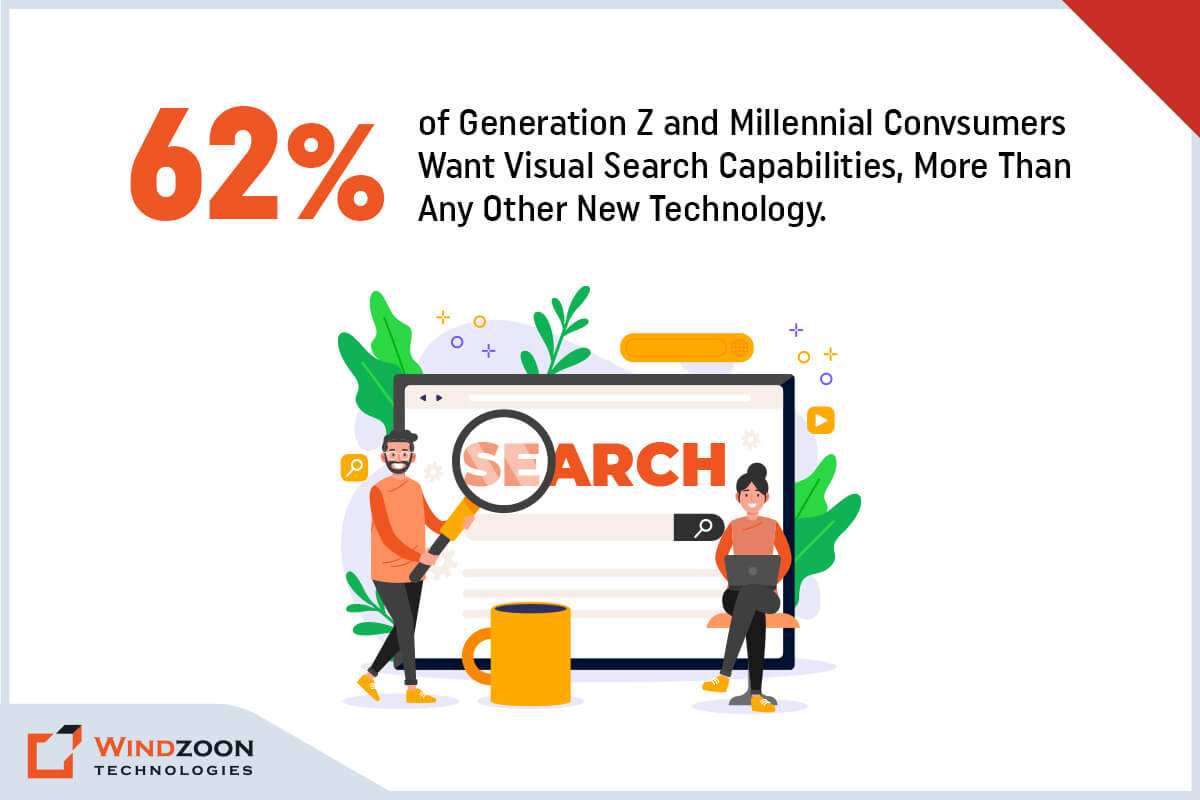
Visual search enables online buyers to find the right products faster and easier than conventional text searches. Research indicates that 62% of millennials and Gen Z members prefer visual search to all other search categories. Visual search engines allow users to upload images to identify objects, find related products, or gather information simply by uploading or snapping a photo.

Visual Search Marketing Statistics

Visual Search Marketing Statistics

As a business, you must evaluate the impact of visual search on your digital marketing strategy, both now and in the future. And to do that, you must ensure that your website is prepared for this kind of search. In this regard, getting assistance from a capable Digital Marketing Company would be advantageous.

With the integration of visual search tools, such as Google Lens and Bing Visual Search, users can leverage advanced visual search engines to find information, products, or inspiration by uploading images or using their mobile devices.

In this article, you will learn everything there is to know about visual search, including:

Visual search makes use of Artificial Intelligence (AI) technology to help users find items utilizing real-world images. Optimizing visual elements such as images and videos can improve the effectiveness of visual search by making content more discoverable and engaging. When someone conducts a visual search, they find the results using a picture instead of typing in a search phrase.

For example, assume you’re on a hike and come across a strange animal you’d like to learn more about. But don’t know how to describe it and get information from a search engine. So, you click the object’s photo and drag it to the search engine. Here’s how visual search works: the visual search engine analyzes the image using AI, machine learning, and computer vision to identify objects and return relevant images and information. The technology will recognize the object and provide relevant images and related information about what you are looking for.

What Is Visual Search Marketing?

Visual search marketing uses search engines’ visual search capabilities to drive traffic to a company’s website. This typically entails providing clear images of all available products that search engines can index. Optimizing images by ensuring they are relevant to the surrounding content, using relevant tags, and including descriptive alt text can significantly improve visual search marketing effectiveness and help your images rank higher in search results.

However, it’s essential to remember that most visual searches are conducted on mobile devices rather than desktop computers. Hence, it would help to make your web app compatible with mobile visual searches. You can do this by hiring the best SEO Service Provider Company in India & USA.

The majority of people confuse picture search and visual search. But these two concepts differ significantly from one another.

Image search is the technique of looking for images on the internet using words. In this case, the user query is a text phrase. In contrast, visual search involves looking for information online through the use of images, where the user query is an image.

How Does Visual Search Work?

When words fall short in expressing what the customer is looking for, visual search helps fill in the blanks. In visual search, the image itself acts as the search query, which the system analyzes to find matches. It recognizes objects in an image and looks for other images that are similar.

Visual search solutions make use of artificial intelligence and machine learning technologies. This is how visual search works: the system uses pictures as “queries” and evaluates forms, colors, and sizes to discover the most relevant search results by comparing the uploaded image to other images in the database. E.g., If you take a picture of the dress, the visual search might help you find & shop for identical or strikingly similar dresses.

The Main Players in The Visual Search Market

The following companies operate some of the most popular visual search engines in the market and are major players in the visual search market:

– Pinterest
– ViSenze
– Turing Analytics
– Cortexica Vision Systems
– Alphabet
– Snap
– Veritone
– Amazon
– Microsoft

Creating High Quality Images for Visual Search

High-quality images are the foundation of any successful visual search optimization strategy. Search engines rely on clear, high resolution images to accurately interpret and index visual content, which in turn helps deliver relevant results to users. To ensure your images stand out in visual search results, always use high quality images that are sharp, well-lit, and free from unnecessary clutter.

Beyond just the image itself, it’s crucial to optimize the supporting information. Use descriptive, keyword-rich image file names and alt text to help search engines understand the content and context of each image. For example, instead of naming a file “IMG1234.jpg,” use a descriptive name like “red-leather-handbag.jpg.” This not only improves your chances of appearing in relevant image searches but also enhances accessibility for users relying on screen readers.

Don’t forget to apply these best practices to your website and social media posts alike. Consistently using high quality images with optimized metadata across all your online platforms increases your visibility in visual search and ensures your content is discoverable by both users and search engines. By focusing on image quality and descriptive details, you’ll be well-positioned to capture more traffic and engagement through visual search.

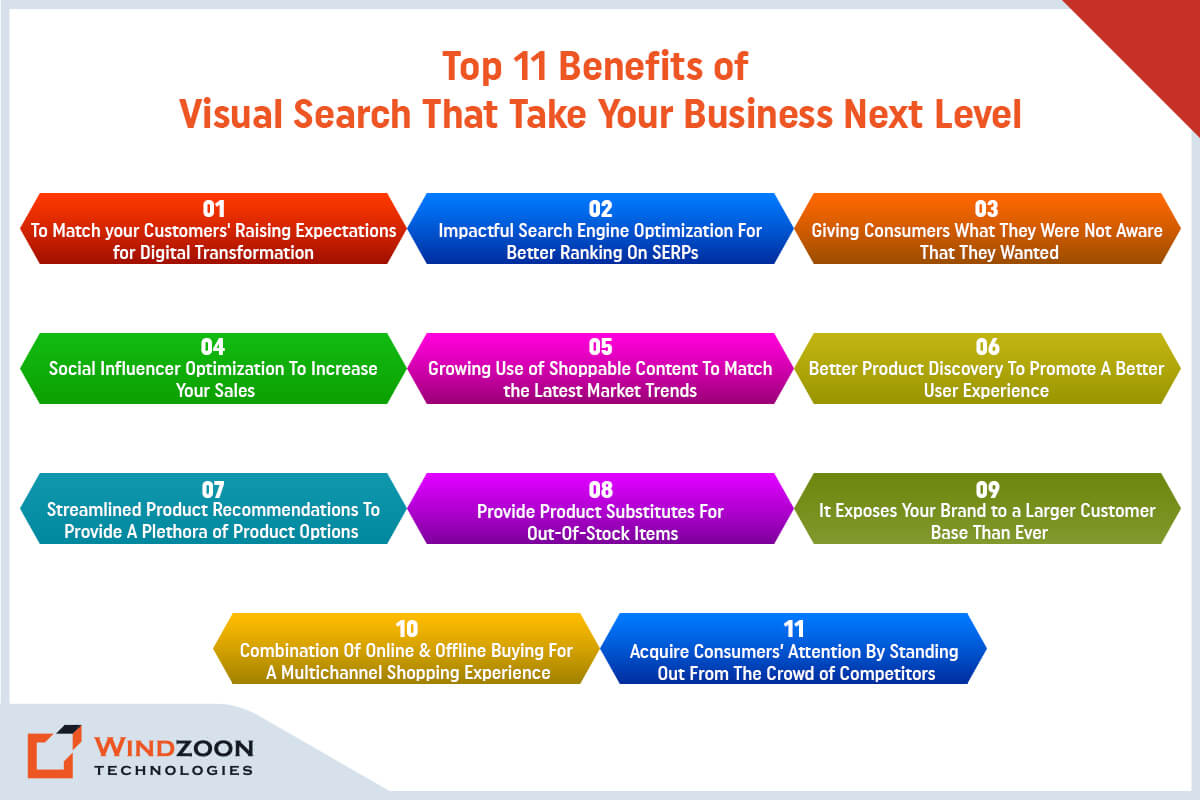
Top 11 Benefits of Visual Search That Take Your Business Next Level

Top 11 Benefits of Visual Search That Take Your Business Next Level

Top 11 Benefits of Visual Search That Take Your Business Next Level

As search evolves beyond its traditional forms and new technologies emerge, it is critical to comprehend and capitalize on them as quickly as feasible. Optimizing images specifically for visual search (visual search optimizing images) is crucial for maximizing the visual search experience, as it helps users find products more efficiently and enhances overall engagement.

With 35% of marketers aiming to optimize for visual search in the future, it is best to stay ahead of the competition early rather than late. The following are the main advantages of optimizing for visual search, including the integration of augmented reality to create immersive and interactive shopping experiences that further enhance the visual search experience in e-commerce.

1. To Match your Customers’ Raising Expectations for Digital Transformation

Think back to the most reliable digital experience you’ve ever had. you were buying on an eCommerce website and discovered a fabulous product at an incredible rate.

That is what visual search is going to do for your brand, whether you practice it or not.

It is astounding how consumer expectations evolve, isn’t it?

In today’s time, consumers expect to be able to discover products using visuals or pictures.

2. Impactful Search Engine Optimization For Better Ranking On SERPs

SEO is meticulous work, often because of all the tagging.

Visual search benefits SEO Services providers to work smarter, on their optimization. The technology allows tagging, an image-to-text, and gives interpretability for search engines. To further improve search engine understanding, it is important to label images with descriptive alt text, optimize image file names, and optimize image titles. Including detailed image metadata also enhances SEO and discoverability.

This is why visual search is much more robust. Utilizing the potential of visual search, your pictures are now SEO-ready & and most, can be found by consumers.

3. Giving Consumers What They Were Not Aware That They Wanted

Customers are adopting visual search because they are watching for inspiration. Which means they need to be told what they must. Doing so appears in the form of absolute interpreting & analyzing what consumers are seeking. AI is used to serve the most similar products.

As marketers, we ought to cater to their evolving desires through artistic sources.

Visual search will have an impact that reaches well exceeding what it was designed to do.

4. Social Influencer Optimization To Increase Your Sales

Now, social influencers tend to post about a particular product they are wearing and tell consumers to buy that particular piece.

A visual search can scan the image of the influencer and tag the products of the outfit by type. Customers can then search every product of the outfit to get the whole look.

To put it, you can invest in influencer marketing to sell your products.

5. Growing Use of Shoppable Content To Match the Latest Market Trends

Businesses are pouring millions into content marketing, without a comprehensive way of getting accurate ROI. The whole content needs to be shoppable. By piercing pictures into the content that takes customers to the product they are looking to buy, your content completely comes to life. A visual search will support your team and see the real impact of the content you create.

Visual search marketing is now just getting more popular, there is no looking back after this. With the young generations trying to embrace all new trends, many businesses are performing distinct aspects of visual search in their marketing strategies.

6. Better Product Discovery To Promote A Better User Experience

It can be difficult for some people to precisely define an object they are seeking for. However, a photo or image may accurately describe every aspect of a product in great detail.

Allowing users to search for products using images can significantly increase product discovery. Rather than scrolling through countless search results, it quickly presented customers with the closest match available for sale.

7. Streamlined Product Recommendations To Provide A Plethora of Product Options

Visual search provides the technology for a product suggestion system. And this technology is based on actual product resemblance rather than other users’ preferences.

Hence, brands utilize it to generate similar product suggestions to provide their customers with a wider range of options.

8. Provide Product Substitutes For Out-Of-Stock Items

Visual search can help to reduce the shopping cart abandon rate by providing an alternative to out-of-stock products.

Visual search enhances product discovery and delivers results where text search fails. It increases conversions, reduces shopping cart abandonment, and provides users with a rich media experience.

9. It Exposes Your Brand to a Larger Customer Base Than Ever

Given that so many different platforms are starting to use visual search. Your product has a better chance than ever of reaching a larger number of users.

However, to do so, you’ll need to list your product both online and on Amazon and Pinterest. This will increase the chances of your product appearing in search results.

10. Combination Of Online & Offline Buying For A Multichannel Shopping Experience

Customers increasingly expect a multichannel shopping experience. And visual search caters to their desire to transition seamlessly between the online and offline worlds.

For example, Google Maps now integrates visual search features to provide location-based information, such as highlighting popular items on restaurant menus or offering historical data about landmarks, which enhances the shopping journey by delivering relevant contextual details.

E.g., Tommy Hilfiger’s visual recognition app. It enabled the brand’s fans to shop for items straight from the 2017 Tommy Hilfiger show in Los Angeles. That resulted in customers spending twice as much time on Tommy Hilfiger’s e-commerce site.

11. Acquire Consumers’ Attention By Standing Out From The Crowd of Competitors

It cannot be easy to stand out on Google with so many e-commerce stores.

However, since visual search is still relatively new, it helps firms differentiate themselves from the competition and ensure that customers see items from their product catalogs.

You must optimize your website and product images to improve the chances that your product will appear in visual searches. Optimizing images and image file names is essential for better search engine rankings. Creating an image sitemap or image sitemaps helps search engines discover and index your website’s images across all web pages, improving visibility in visual search results. And to do so, you should follow the tips provided below. Or you can hire a Local SEO Agency to help you with this task.

– Include SEO keywords in your website’s images
– Design a website with plenty of images
– Always include alt text in your image captions.
– Use the right file formats and sizes for your images
– Optimize image size and dimensions for faster loading
– Compress images to improve website load speed without sacrificing quality
– Use responsive images to enhance user experience on all devices
– Whenever necessary, add captions to your images
– Make use of high-resolution images
– Ensure that images appear on your sitemap and create an image sitemap for better indexing

As more of our favorite apps and sites integrate visual search, it will soon become a routine aspect of life. Visual search provides some intriguing new marketing prospects to which brands should react.

And if you’re a brand trying to boost website traffic & conversion, you shouldn’t just be aware of visual search queries—you need to work hard to seize this important market.

If you need help doing this important task, you may hire a qualified Digital Marketing Agency. At Windzoon, we offer a wide range of Digital Marketing Services. Our skilled and experienced SEO specialists can help you optimize your website for visual search. To for our digital marketing services and to learn more about us, please visit wzadmin.windzoon.in/.

Best Practices for Visual Search Optimization

To maximize your website’s performance in visual search, it’s important to follow a set of proven best practices. Start by using high quality images that are visually appealing and accurately represent your products or services. Next, optimize your image file names and alt text with relevant keywords that reflect what users might search for. For example, use descriptive image titles like “blue-cotton-summer-dress” instead of generic names.

Incorporate structured data, such as schema markup, to provide search engines with additional context about your images. This helps search engines interpret images more effectively and can improve your rankings in search engine results pages. Make sure to use relevant keywords in your image file names, alt text, and descriptive text to further boost your online visibility.

Leverage popular visual search tools like Google Lens and Bing Visual Search to test how your images perform and identify areas for improvement. These tools can help you understand how your content appears in visual search results and guide your optimization efforts. By consistently applying these best practices—using high quality images, optimizing metadata, and implementing structured data—you’ll enhance your website’s visibility, attract more visitors, and stay ahead in the competitive world of visual search.