9 Simple Steps in the Process of Web Design for Success

Some people claim that web designing is an art. However, it’s not entirely correct. What distinguishes design from art is that design is intended to be functional.

And every functional thing requires a process to build.

The process of designing a modern website involves art, technology, and psychology. Apart from that, it also requires technical skill, knowledge of users’ expectations, and a visual sense. If this procedure is successfully followed, it will shorten the time needed to finish the project, increase productivity, and guarantee you don’t miss any important tasks. This approach is often referred to as the modern web design process, which is a structured framework that includes goal setting, understanding target audiences, and aligning design objectives with client needs. Website development and the web development process are comprehensive terms that encompass all stages from planning, design, and coding to testing and launching a website.

As a prominent  web design company in India and USA, we have compiled our decade of web design experience and developed this nine-step procedure for creating engaging site designs. Many users also turn to the best website builders, which offer a drag and drop interface, making it easy to create professional websites without any coding experience.

But before we move to our web designing procedure, let’s get a brief understanding of the importance of web design.

What is the Significance of Web Design?

A well-structured and informative website not only improves traffic but also helps visitors comprehend the business, product, or service by combining text, graphics, and sometimes animations. A well-crafted website’s design and website’s content can significantly enhance engagement and make a strong impression on website visitors, ensuring they instantly recognize the brand and find the information they need. As a result, a better user experience allows the company to reach out to more customers.

Now, we will move towards the most awaited part of this article, and that is:

Understanding Your Target Audience

A successful web design process begins with a deep understanding of your target audience. Before diving into the design process, web designers must identify who will be using the website and what their needs, preferences, and behaviors are. This involves conducting thorough market research, analyzing competitors’ websites, and creating detailed user personas that represent your ideal visitors.

By understanding your target audience, you can tailor the website’s design, content, and functionality to meet their expectations. For example, a website aimed at young professionals may prioritize sleek visuals and mobile-friendly navigation, while a site for seniors might focus on larger text and straightforward layouts. This user-centric approach not only enhances the user experience but also increases the likelihood of achieving your website’s goals, whether that’s generating leads, selling products, or sharing information.

Additionally, considering search engine optimization (SEO) from the outset ensures that your website is easily discoverable by your target audience through search engines. By aligning your web design with the needs and search habits of your users, you set the foundation for a website that is both engaging and effective.

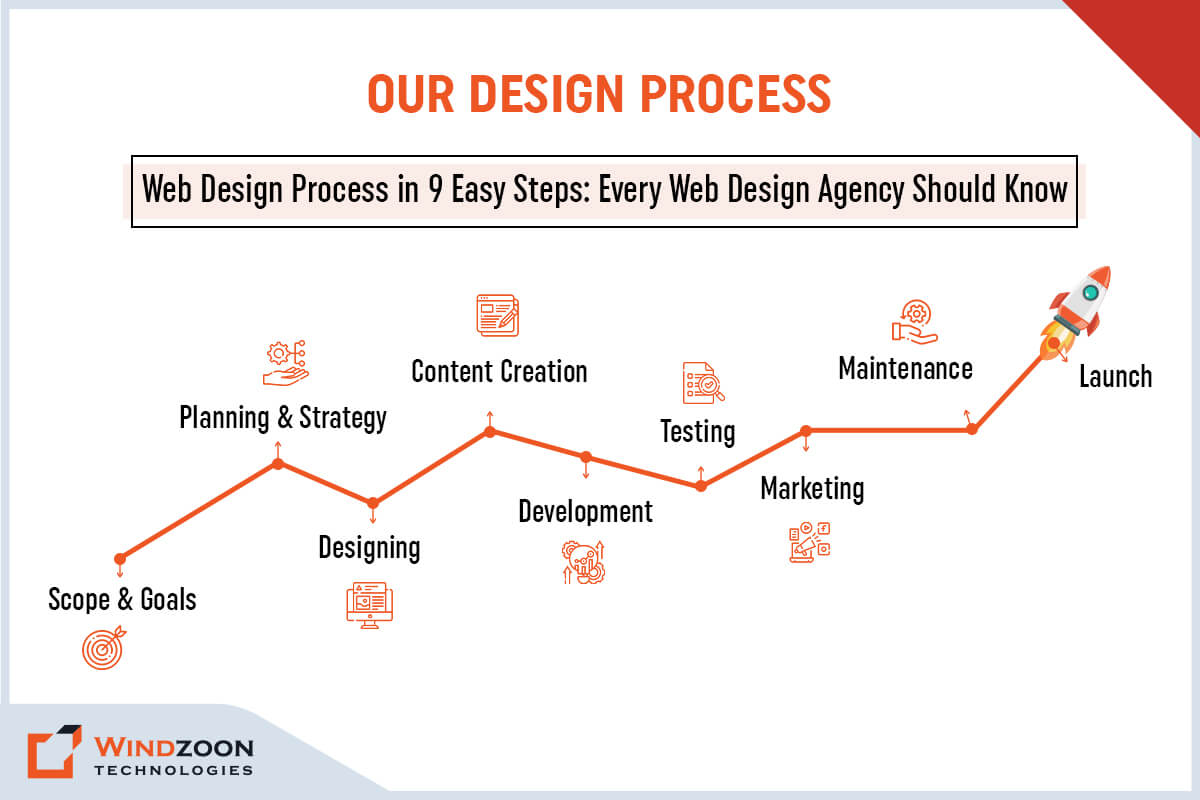
Complete Web Designing Process in 9 Simple Steps
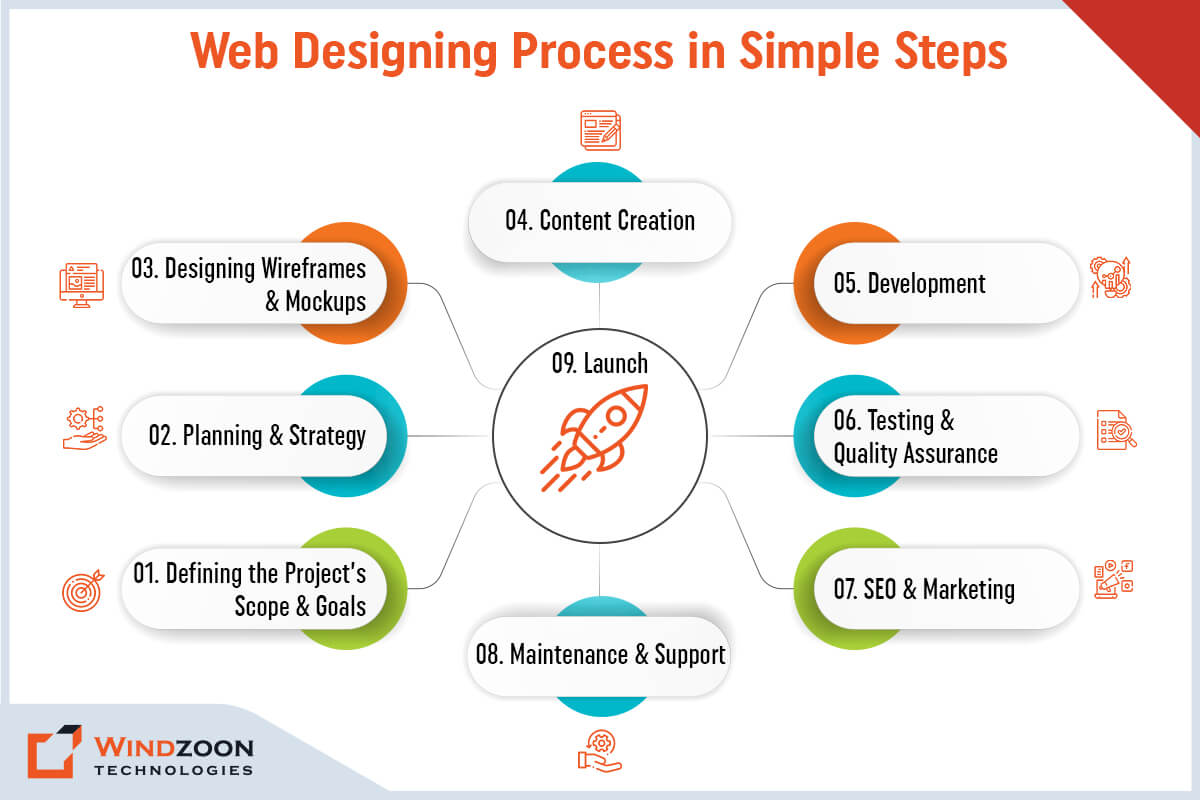
Web Designing Process in Simple Steps

It is important to consider many factors when designing a website’s look and feel. And that is why, to keep you from becoming overwhelmed, we have divided the site design process into ten simple parts. The website design process and development process are structured methodologies that guide you through each stage of building an effective website. When planning your site, focusing on the primary elements—such as sitemaps, wireframes, and content strategy—is essential for successful web design.

1. Defining the Project’s Scope and Goals

This step involves clearly defining the website’s objectives and determining the features and functionality required to achieve those goals. At this stage, it is crucial to identify your website’s target audience and establish your website’s information architecture and site architecture, as these foundational elements will shape your design, content organization, and user experience. Thus, before you begin the process of website design, you should ask yourself the following questions:

  • What is the purpose of your website?
  • Who is the audience you’re aiming for?
  • What primary goals do you want your website to achieve?
  • What products and services are you hoping to provide your clients?
  • What advantages does your current website offer, if any?
  • What changes do you need to redesign the existing website that helps you achieve your business objectives?
  • How well are your rivals doing?

After you’ve answered all these questions, you can easily go on to the next step in the web page design process. This precise information will guide you in the correct way throughout the entire process.

2. Planning and Strategy

It is the second most important step in web design. A web design agency must first do some planning & make strategies to gather useful information related to its target audience & competitors.

Keyword research is essential at this stage. It is important to conduct keyword research to identify relevant keywords that will guide your content and SEO strategy. Additionally, using online resources for gathering design assets, such as images, videos, and fonts, as well as information, can enhance the quality and appeal of your website.

Understanding the goals and objectives of the target audience and competitors before creating a website always help you to stay one step ahead. And will help to create a website that meets the client’s needs and stands out in the market.

Apart from that, you can also utilize Gantt charts or other project development tools to develop realistic project planning for the entire procedure. It will not only assist you in meeting deadlines, but it will also enable you to generate products that will delight your clients. Integrating marketing tools into your planning process will further support website promotion and business growth.

3. Choosing the Right Website Platform

Selecting the right website platform is a pivotal decision in the web design process. With a wide array of website builders and content management systems (CMS) available, it’s important to choose a solution that aligns with your website’s primary aim and the needs of your target audience. Web designers should evaluate platforms based on ease of use, customization capabilities, scalability, and the ability to integrate with essential third-party tools.

Popular website builders like Wix, Squarespace, and WordPress offer user-friendly drag and drop interfaces, making it easier for anyone to create a mobile friendly and visually appealing website without extensive coding knowledge. These platforms also provide a variety of templates and design options, allowing you to customize your site to reflect your brand and engage your audience.

When choosing a website builder, consider the features you need—such as ecommerce functionality, blogging tools, or portfolio galleries—and ensure the platform can support your long-term growth. A well-chosen platform streamlines the web design process, empowers web designers to create a successful website, and ensures your site remains adaptable as your business evolves.

4. Designing Wireframes and Mockups

A site cannot be built without a sitemap, just as a house cannot be built without a blueprint.

The sitemap is the backbone of any well-designed website. It clarifies the relationships between the various pages and content parts and gives web designers a clear picture of the website’s information architecture.

A further step is to develop a wireframe mockup using some design ideas. Wireframes serve as a framework for storing the site’s visual design and content elements, and they can aid in identifying potential difficulties and gaps in the sitemap. Important website elements such as navigation menus, headers, footers, and the inclusion of a dedicated FAQ page should be considered at this stage to improve user experience and provide quick access to essential information.

It helps the website look visually appealing, easy to navigate, and responsive. The design should also be consistent with the client’s brand and target audience.

5. Visual Design Elements

Visual design elements are at the heart of an engaging and effective website. Web designers must thoughtfully combine colors, typography, images, and layouts to create a cohesive and attractive user interface. The right visual aspects not only capture attention but also guide users through the website, making navigation intuitive and enjoyable.

A balanced approach to visual design ensures that the website is both aesthetically pleasing and highly functional. For instance, using a consistent color palette and readable fonts enhances brand recognition and accessibility, while high-quality images and well-structured layouts keep visitors engaged. Visual elements also play a significant role in search engine optimization (SEO), as search engines favor websites that load quickly and are optimized for mobile devices.

To achieve the best results, web designers can utilize design tools like Adobe XD or Sketch to prototype and refine visual elements. Usability testing is essential to gather feedback and ensure that the visual design supports a seamless user experience for all visitors, including those with disabilities. By prioritizing both beauty and usability, you can create a website that stands out in search engines and delights your audience.

6. Content Creation

Once the design and layout are complete, the next stage is to develop high-quality content that is informative, entertaining, and relevant to the target audience. Optimizing your website’s content for both users and search engines is essential for improving rankings and user engagement. When original images are not available, using professional stock photos can enhance the visual appeal of your site and maintain a polished look.

Because if your content is compelling and strong, you can keep clients’ attention and persuade them to make a purchase. When it comes to popular web design trends, content is something that can offer value to your website design.

Aside from increasing engagement, website content improves site visibility for SEO. Therefore, if you want your design process to go quickly and successfully, you should never disregard the content component. Additionally, including a dedicated contact page with essential contact details such as phone number, email, and address is crucial for connecting with your visitors.

7. Development

After the design, layout, and content are finalized, the next step is to develop the website.

As you are aware, hundreds of websites are available online; therefore, for a website to rank well in Google, it must be developed flawlessly. That is why it is crucial to hire expert web developers. The development team plays a key role in translating the visual design into a fully functional website and ensuring all features work as intended. A web developer is responsible for coding the site, maintaining its performance, and handling both front-end and back-end development tasks.

Although coding is always an option for website creation, non-technical people may always use visual page builders, basic themes, and templates to construct personalized sites without wasting time and money. Using a content management system (CMS) like Wix can make it much easier to update and manage your website content. The development process can also include building web apps, which add interactive or complex features beyond traditional websites. Templates can be tailored for specific needs, such as ecommerce sites that require product listings and payment integration, or event websites that benefit from single-page layouts for concise information delivery.

Building your own website using available tools allows for greater customization and control without needing to hire professionals. For businesses, integrating an online store enables direct product sales, order tracking, and payment processing, supporting business growth.

Once you have built a website, make sure to get feedback and update as necessary.

8. Testing and Quality Assurance

Before launching the website, it is important to test it thoroughly to ensure it functions properly and is free of errors. User testing should be conducted to evaluate usability and gather feedback from real users. The web design company should also perform quality assurance checks to ensure the website meets the client’s requirements and industry standards. All the links on the website should be checked to ensure there are no broken links, which can negatively impact user experience and SEO. Additionally, all website functions should be tested to confirm they work as intended. Verifying the website’s accessibility is also essential to ensure it meets accessibility standards and provides an inclusive experience for all users.

Testing for Site Speed and Performance

Ensuring your website loads quickly and performs reliably is a crucial part of the web design process. Site speed and overall website performance directly impact user satisfaction and search engine optimization (SEO). Slow-loading web pages can frustrate visitors and lead to higher bounce rates, while search engines may rank sluggish sites lower in search results.

Web designers should regularly test website speed using tools like Google PageSpeed Insights, which provide actionable recommendations for improvement. Common strategies to boost site speed include optimizing images, minifying CSS and JavaScript files, and leveraging browser caching. These optimizations not only enhance the user experience but also contribute to better rankings in search engines.

Usability testing and collecting user feedback are also important during this phase. By monitoring how real users interact with your site and identifying any performance bottlenecks, you can make targeted improvements that keep your website fast, responsive, and aligned with the needs of your target audience. Consistent testing and optimization ensure your website remains competitive and effective long after launch.

9. SEO and Marketing

SEO and marketing are crucial for the success of any website. A web design agency should optimize the website for search engines and ensure it is easily discoverable by potential customers. Implementing on page seo techniques, such as optimizing meta tags, using internal linking, and providing descriptive alt text, is essential for improving search engine rankings. The company should also use seo tools to audit and improve website performance, and integrate tracking tools to monitor user behavior and traffic sources. Connecting the website to Google Analytics provides detailed performance insights, helping to make informed decisions for ongoing optimization. The company should also create a marketing plan to promote the website and attract more traffic.

10. Maintenance and Support

A website is never truly finished. Because a website requires regular maintenance and updates to ensure it remains relevant and secure. In addition, it’s important to monitor the website’s performance by analyzing metrics such as traffic, user behavior, and engagement to ensure continued success. A web design company should provide ongoing support and maintenance services to keep the website up-to-date and functioning properly.

11. Launch

Launching a website design is the culmination of a comprehensive web design process. After months or even years of planning and development, your website is finally ready to be shared with the world. Launching a new website is an exciting milestone, marking the beginning of your online presence and the importance of ongoing updates and maintenance. While the journey may have been long and arduous, ensuring your website is ready for launch day is important.

This includes everything from ensuring that all content is up-to-date, testing the website for any bugs and glitches, and double-checking that all security protocols are in place. Once you’re confident that your website is fully functional and error-free, you can officially launch it to the public.

After this, we will understand some basic points to keep in mind while designing a website

Things to Consider While Designing A Website

  • One important aspect that a web design company should consider is making the website accessible to all users, including those with disabilities. This includes implementing web accessibility guidelines such as WCAG and ensuring that the website is compatible with assistive technologies such as screen readers.
  • Additionally, a web design company should ensure that the website is built with a responsive or cross-platform design, which will ensure that the website is optimized for viewing on multiple devices and screen sizes.
  • It is also essential to pay attention to key website elements, such as navigation menus, headers, footers, and responsive layouts. Well-designed website elements enhance usability, improve site performance, and contribute to a positive user experience.
  • Another important aspect is the website’s performance; it is crucial to load as fast as possible; this can be achieved by optimizing images, minifying code, and using a Content Delivery Network (CDN). This will not only improve the user experience but also help with search engine rankings.
  • Finally, security is another essential aspect that should not be overlooked. A web design agency should protect the website against common security threats such as SQL injection, cross-site scripting, and cross-site request forgery. This can be done using secure coding practices, implementing SSL, and regular security testing.
  • All in all, a top-notch web design company should always take into account user experience, accessibility, performance, and security to provide a website that meets customer expectations and satisfies their demands.

Conclusion

Web design is a complex process that requires a combination of technical skills and creative thinking. Following these 10 basic steps, a web design company can create a website that meets clients’ needs, stands out in the market, and drives business growth.

Windzoon is a leading web design agency in India and the United States with over ten years of experience. We provide professional web design and development services at competitive rates. Our expert team of web designers and developers is skilled at creating websites that fit the needs and budgets of our clients.

Visit wzadmin.windzoon.in/ to learn more about our web design services or to get a quote.

Conclusion and Final Thoughts

The web design process is a multifaceted journey that requires careful planning, creativity, and technical expertise. From understanding your target audience to selecting the right website platform, focusing on visual design elements, and rigorously testing for site speed and performance, each step plays a vital role in building a successful website.

Effective web design goes beyond aesthetics—it incorporates search engine optimization (SEO), user experience, and the latest web design trends to ensure your business website stands out in a crowded digital landscape. By following a structured design process and leveraging the expertise of skilled web designers, you can create a website that not only meets your goals but also delights your visitors.

Remember, a successful website is never truly finished. Ongoing monitoring, maintenance, and adaptation to new technologies and user expectations are essential to keep your site relevant, secure, and high-performing. Whether you’re launching a new business website, an ecommerce site, or a personal project, investing in a thoughtful web design process will help you achieve lasting online success.
15 E-Commerce Web Design Trends to Design impressive Stores in 2023

We all are living in the digital age, surrounded by a plethora of gadgets and equipment that make our lives more convenient and vibrant. Now, we only need to make a few clicks to send a message, obtain information, or purchase the desired products.

By 2024, eCommerce will account for over 20% of all retail sales and more than $1 trillion in sales. It amply proves that e-commerce businesses are expanding globally. And it has motivated lots of businesspeople to spend money creating eCommerce websites.

However, creating the ideal eCommerce website is not as simple as it appears. You’ll need careful planning and the assistance of an experienced e-commerce web design company. That company’s professionals will assist you in applying the latest trends to your e-commerce site and making it market-ready. When developing websites, trends are crucial to consider because they show us how to build competitive websites. Know about 15 Amazing Web Design Trends for 2023: Which You Should Use.

In this article, we will discuss the top eCommerce website design trends for 2023 to create modern and productive eCommerce websites.

E-Commerce Web Design Trends Look Out

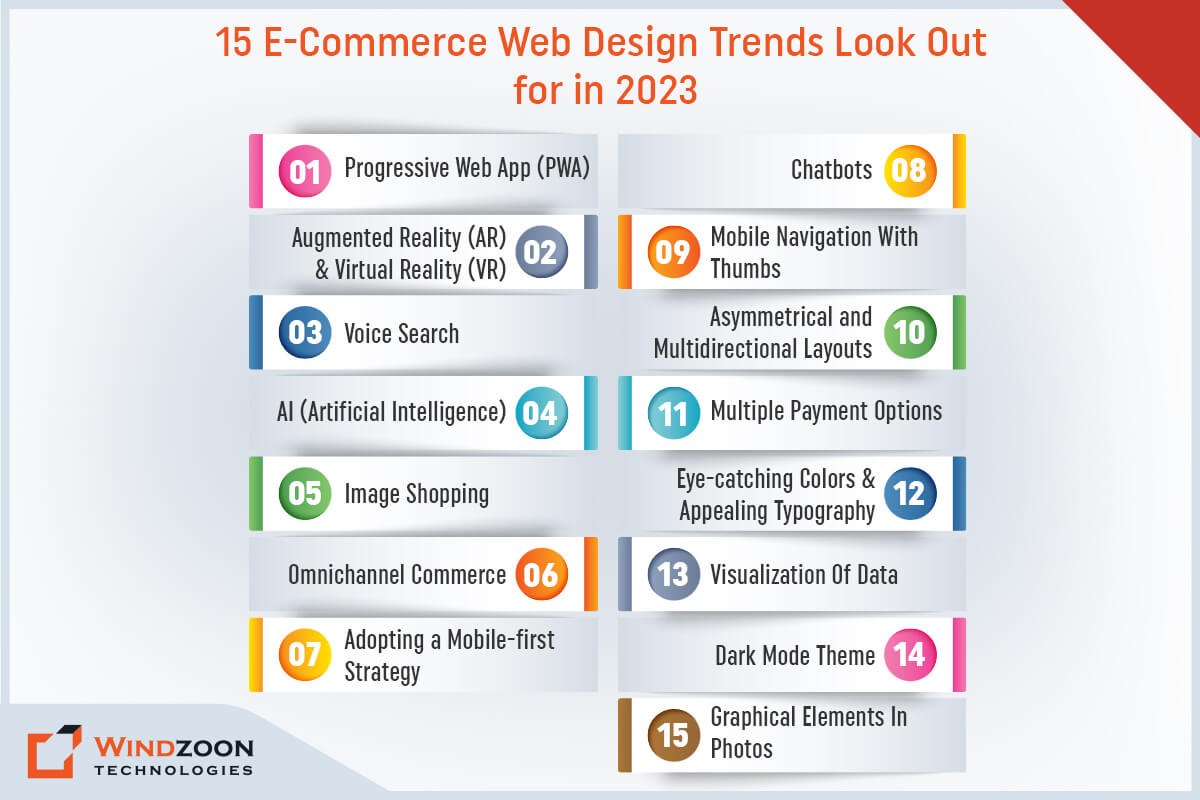
15 E-Commerce Web Design Trends Look Out for in 2023

1. Progressive Web App (PWA)

Progressive Web Apps (PWAs) are a recent development that will soon be crucial in the growth of eCommerce. Online businesses are constantly looking for innovative ways to enhance the customer experience while boosting revenue and profitability.

PWA has several significant advantages, including low development costs, an app-like interface, quick installation, offline operation, and a push notification feature. If implemented properly, these features will make sure that your e-commerce businesses stay one step ahead of their rivals.

2. Augmented Reality And Virtual Reality (AR/VR)

These technologies remove many obstacles that arise during online shopping, making them a huge boon to the eCommerce sector. Augmented reality (AR) is essential when previewing goods or using services before making a purchase.

Having this type of visualization aids users in determining whether a product will satisfy their needs. Businesses that provide eCommerce platforms with Augmented Reality (AR) will be able to broaden their market reach.

Several surveys and reviews attest to the effectiveness of VR experiences. Take Airbnb as an example, which enables you to view a rental before booking. It’s similar to how IKEA can display how a specific sofa would look in your room.

VR can be a reliable tool for websites to deliver useful, captivating content in a way that aids visitors in making a purchasing decision.

People’s lives have changed and become easier in many ways since the introduction of smart speakers and voice assistants like Google Assistant, Alexa, Siri, etc. These technologies improve people’s lives by assisting them in transitioning from “typing” to “speaking.”

Voice tools and devices are made to take specific voice commands, which give users access to a wide range of services. The popularity of voice search is growing, and it will do so even in 2023.

Many eCommerce platforms offer different Voice User Interface options that let users search for products using voice commands. By optimizing your website for voice search, you can successfully grow your business.

4. AI (Artificial Intelligence)

AI is revolutionizing the eCommerce industry by predicting consumer purchasing patterns. Based on past purchases, product searches, and online browsing habits, AI is influencing customers’ eCommerce purchasing decisions. Personalized product recommendations have a significant impact on higher conversion rates.

AI in eCommerce can help online businesses by analyzing trends and customer behavior to determine the best time to launch a product, set a price, and list these items on the best channel (or channels). It will undoubtedly have a positive impact on businesses’ sales and marketing efforts.

5. Image Shopping

There will be an increase in image shopping in e-commerce. To purchase a product from an online store, users will point their camera at the item they wish to purchase. Like CamFinder, there are numerous photo apps available, and this year, many more will appear. This trend will also result in the sale of affiliate products via photoshopping.

For instance, Pinterest recently unveiled its very own photo camera. It identifies and analyzes images to provide a precise product description. It has already partnered with numerous e-commerce sites and top search engines. It gives them pertinent information they can use to categorize and interpret images.

6. Omnichannel Commerce

Omnichannel selling has become critical for online businesses because it allows them to reach every customer touchpoint. Due to their ability to sell through Omni channels, they can serve clients using a variety of platforms and devices, including websites, PWA, social media platforms, and more.

Regardless of where a customer starts their shopping journey, eCommerce businesses can target all different types of customers with omnichannel selling. This trend in eCommerce development has made online shopping more flexible and unrestricted.

For instance, today consumers can purchase goods on any website or platform, including Facebook, eBay, and Amazon. It has established a new standard in the eCommerce sector and will help you expand your company greatly.

7. Adopting Mobile-first Strategy

Mobile technology has become prevalent in our time. According to reports, 79% of smartphone users have made online purchases using their mobile devices. Additionally, search engines will favor websites that are mobile-friendly from a ranking perspective.

Therefore, developing responsive e-commerce websites and mobile apps that can adjust to different screen sizes will become more and more important in 2023. If you want to learn more about the importance of responsive design read our article on how a responsive web design can help your business.

8. Chatbots

Chatbots are one of the most pervasive eCommerce development trends. Chatbots are extremely beneficial to eCommerce businesses because they automate human-to-human interactions. It implies that users can communicate with chatbots on an e-commerce website to quickly and easily obtain a variety of services.

Custom support has frequently proven to be an Achilles’ heel for many online businesses. But with the aid of chatbots powered by artificial intelligence, businesses can offer quick and convenient customer support.

Customers don’t have to wait very long to find solutions because chatbots can respond to their questions and interact with them to solve any problems that may arise. You can hire e-commerce web designers to design a feature-rich website with a smart chatbot.

9. Mobile Navigation With Thumbs

The majority of smartphones that have been released in recent years have bigger screens.

Users primarily use their thumbs to navigate through an app while holding the phone in one hand. Of course, the majority of clickable items and important navigation buttons in the mobile user interface must be easily accessible with the thumb. The comfortable reaching area surrounding the user’s thumb is known as the mobile-thumb zone.

Although larger displays are excellent for precise finger tapping, the larger area that needs to be covered makes single-handed thumb navigation more challenging. Naturally, app developers must prioritize thumb-friendly design more than ever before.

10. Asymmetrical and Multidirectional Layouts

One of the most crucial elements of your e-commerce website is the product gallery. It provides information to visitors that might influence their decision to buy. A typical gallery serves its purpose admirably, but there are other ways to enhance it.

Many companies will be experimenting with grid-based multi-product galleries in 2023. Given that it addresses mobile-first design and interactive shopping experiences, this e-commerce design trend is pertinent.

11. Multiple Payment Options

It should be expected that there will be more methods of online payment as a result of technological advancement.

In addition to conventional methods such as credit and debit cards, the use of digital wallets, cryptocurrency, and even biometrics would significantly increase. The desire for faster, more secure transactions is driving this trend.

Thus, providing a variety of payment options is a great way to increase conversion rates.

12. Eye-catching Colors and Appealing Typography

The worst thing you can do this year is to build an eCommerce app with a lot of white space in between. According to the most recent eCommerce Design Trends, you should experiment with bold, bright colors more to create attractive websites with eye-catching homepages.

Make wise color choices that appeal to customers, send messages, and enhance the shopping experience. Use interesting typography and highlighted letters as well.

13. Visualization Of Data

Information delivery that is both entertaining and informative is difficult. However, you can accomplish that using data visualization. Implementing it won’t be simple, but the payoff will be worthwhile.

You can use infographics and graphs to present your data in an engaging, original way. Data visualization increases the chances that your audience will learn about the information you’re trying to share.

14. Dark Mode Theme

It serves a number of functions when websites are designed in dark mode. One benefit is that it lessens eye fatigue as we spend more and more time in front of screens these days. On the other hand, websites in dark mode have this contemporary appearance that is very attractive. It made the increasing popularity of dark mode not surprising.

15. Graphical Elements In Photos

Images with overlapping graphics grab the audience’s attention more easily. The combination of these two approaches gives the images a distinctive quality.

You can help your business establish a memorable brand by combining the strength of graphics and photos. It will maintain visitors’ interest in what is happening on your website and boost conversion rates!

Conclusion

It is challenging to stay current in the ever-evolving and changing world of eCommerce. However, if you want to keep your brand relevant while offering the best shopping experience for your customers, you must stay up to date on the latest industry trends.

In order for your business to succeed and to be ready for 2023, you must begin implementing these trends into your e-commerce site as soon as possible. If web development languages are not your strong suit, you can hire a website design company and creative agencies to assist you. For that, you can read our blog on how to choose the right web design & development company in 2023.

As a renowned e-commerce web design agency, Windzoon provides premium web design services at the most competitive rates with minimum turn-around time. Our talented web designers can create one-of-a-kind e-commerce web solutions that are customized to your business’s requirements.

For more information about our web design services or to get a quote, visit wzadmin.windzoon.in/.

15 Amazing Web Design Trends for 2023: Which You Should Use

Users form an opinion about your website in about 50 milliseconds (0.05 seconds), which determines whether they stay or leave. According to Google, 46% of consumers decided whether or not to trust a website based on how appealing and aesthetically pleasing it was. This information demonstrates how important website design is to the success of businesses operating online.

The website is the most important component of any online business. And that’s why it is crucial to build a website that allows visitors to easily understand the message and purpose of the brand.

And to create such a design, web design services providers must be familiar with current market trends. Because if they don’t then, their website, which appears modern today, may become obsolete tomorrow.

Here are the trends that every web design firm in India should be aware of in 2023.

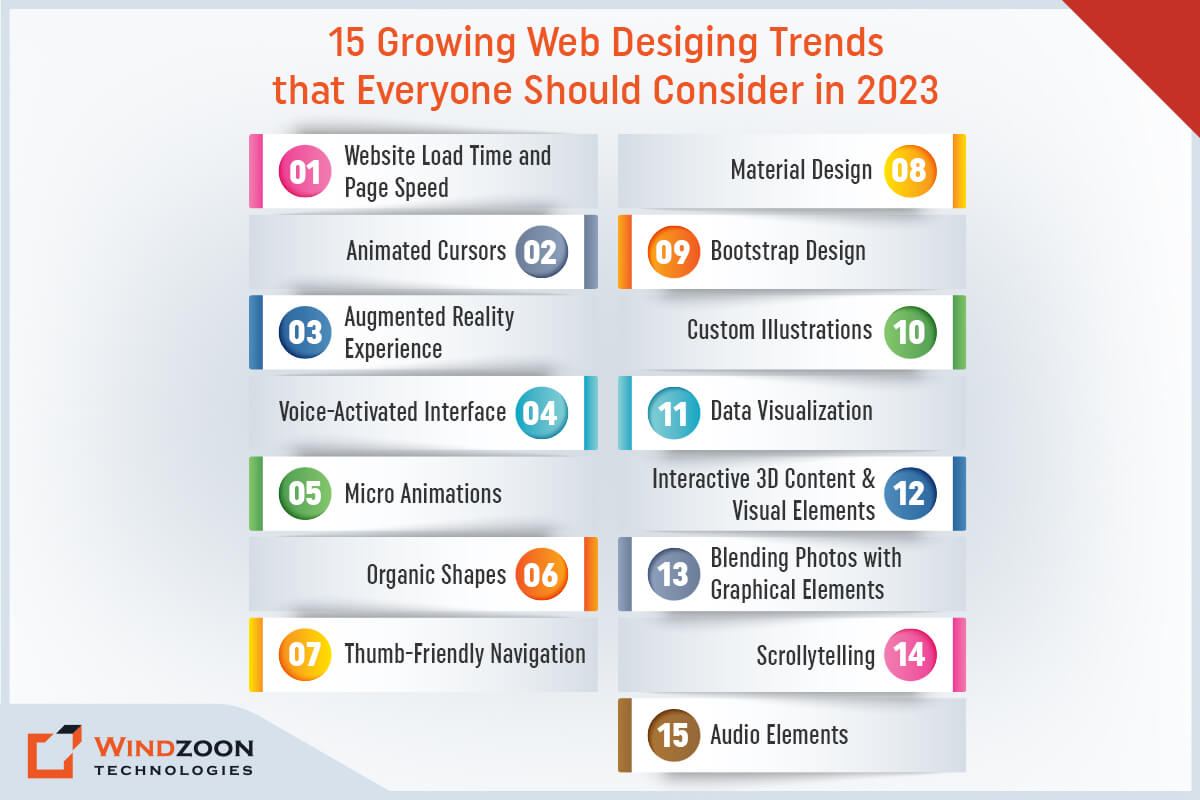
Growing Web Design Trends that Everyone Should Consider

Growing Web Design Trends that Everyone Should Consider

1. Website Load Time and Page Speed

Fast load times are among the most crucial web design requirements. For years, quick loading times have been crucial to UX and SEO. And they still rank highly for websites that want to increase their traffic and conversion rates.

As per studies, more than half of internet users expect a website to load quickly and within two seconds of clicking a link. If your website takes longer than three seconds to load, visitors will probably go to one of your competitors instead.

To avoid this, take assistance from a competent web design agency. The professionals from that agency will help you create a responsive web design with excellent UX and a fast loading speed.

2. Animated Cursors

Another enjoyable way to personalize your website’s user experience is to design how they interact with your web elements – including their cursor!

This 2023 web design trend is surprising users with its subtlety. Visitors can interact with various scrolling behaviors or on-click commands by altering the cursor’s appearance or implementing cursor-triggered animations.

3. Augmented Reality Experience

When it comes to interaction, augmented reality experiences are increasingly popular. All businesses that sell customized products should use this type of website.

Utilizing augmented reality components, the web designer can develop a platform that allows users to customize products as per their needs before making a purchase or requesting a quote.

This experience replaces the initial meeting with the seller which makes your users’ job easier and rise the selling rate.

4. Voice-Activated Interface

Our method of getting information is evolving. Today, we ask a question or make a demand rather than typing a query into Google. As a result, voice chatbots and virtual assistants are becoming more common. And web designers have to adapt to this trend.

Although most websites don’t have a voice-activated interface, this new development isn’t likely to fade away anytime soon. We can anticipate more websites incorporating voice search as a substitute for standard text search.

5. Micro Animations

Micro animations are brief animations, as you might have guessed from the name. However, in this instance, being small does not imply insignificance.

When it comes to assisting users as they navigate your website, micro animations are incredibly helpful. Additionally, they can give your website a playful touch.

6. Organic Shapes

In the year 2020, geometric shapes dominated website design, but in the year 2023, organic shapes will rule. Any shape without straight lines is considered to be organic or fluid. Think about the asymmetrical and winding shapes found in nature, such as hills and the edges of a lake or river.

With no need for sharp angles or lines, fluid shapes are a great way to divide sections of a website. They work well when used on the background web page.

7. Thumb-Friendly Navigation

Designing responsively is no longer sufficient. The goal of web design in 2023 will still be to create websites that are thumb-friendly.

What does “thumb-friendly” actually mean?

We’re referring to how we use our phones. When we hold a phone, our fingers are most likely wrapped around the back of it (or around a phone grip). Letting our thumb do all of the work.

Your site will be easier to use and have a tenfold increase in UX if the navigation bar, menu, and even the contact buttons are placed where your thumb can access them.

8. Material Design

In 2014, Google unveiled the design language known as “Material Design.” Typical web design appears uninteresting in front of it. Using color and shadows to simulate the textures of the physical world is the goal of material design.

The Gmail envelope’s shadows and the calendar’s shadows are two excellent examples of material design. It’s very subtle, but it makes a big difference in giving the icons a three-dimensional appearance. In 2023, we anticipate a significant increase in material design!

9. Bootstrap Design

Bootstrap is more than just a trendy front-end framework. It is a powerful tool for designers and developers to use when creating innovative, and mobile-first websites.

Not only that, but this amazing framework captures the attention of developers by speeding up the development process. Furthermore, websites and applications built with Bootstrap are responsive across multiple devices. And are also light, customizable, and consistent. It is undeniably a trendy tool that designers and developers must be familiar with.

10. Custom Illustrations

Custom graphics have taken the place of stock images. Illustrations aid in bringing your company’s brand to life. Custom illustrations are anticipated to take the lead while generic stock graphics fall by the wayside.

11. Data Visualization

It can be difficult to convey information in an interesting way. But the effort is worthwhile. Because using data visualization makes use of the fact that people are visual beings while still getting your point across.

Data visualization makes images from your data that pique the reader’s interest. And inspire them to discover more about your company. Graphs and infographics are some of the most widely used methods for illustrating data.

12. Blending Photos with Graphical Elements

You may have noticed overlapping graphics on some of the images in your social media feed. A standard image is given a creative and enjoyable touch by this blending technique.

Websites are also embracing this trend. Blending photography and graphics can help to reinforce your company’s branding. And also keeps your website visitors engaged with your content.

13. Interactive 3D Content & Visual Elements

Incorporating 3D elements that users can interact with has become more common thanks to developing web technology and web designers’ desire to stand out from the norm.

Implementing 3D elements isn’t the easiest task. Primarily because they overburden and slow down your website. However, 3D elements are still expected to be popular in 2023.

And they are especially suited to certain types of websites: design firms and architectural firms, for example, make excellent use of 3D elements.

14. Scrollytelling

Scrollytelling is also referred to as ‘narrative visualization.’ It entails presenting several moving visual components before revealing a chronologically-ordered story.

Users control the pace at which the site is navigated while being presented with an engaging and captivating message.

15. Audio Elements

Audio content is being used more frequently now. However, if you decide to use this element, you must pay close attention.

For starters, audio elements can slow down your website, which you never want. Second, take note of the audio track that is played when a user first enters a website. Especially if it begins automatically. If it is excessively loud or fast, the user will startle and find it annoying.

Choose soothing and relaxing audio content if it is appropriate for the type of project you are working on.

Conclusion

According to statistics, 94% of visitors form an opinion about a website based solely on its design. Therefore, everyone in the market gives it their all to create a fantastic website. And designers made this possible by utilizing the most recent web design trends to meet the objectives.

Although, there are countless web design trends, the ones mentioned above are some of the most popular and successful ones that are assisting businesses in evolving their websites. And if you need assistance putting these trends into practice, feel free to contact us.

As a leading web design company, Windzoon provides premium web design & development services at the most competitive rates. Our skilled web designers can design unique websites that are tailored to your company's needs.

Visit us at wzadmin.windzoon.in/ to take advantage of our services or to request a quote.