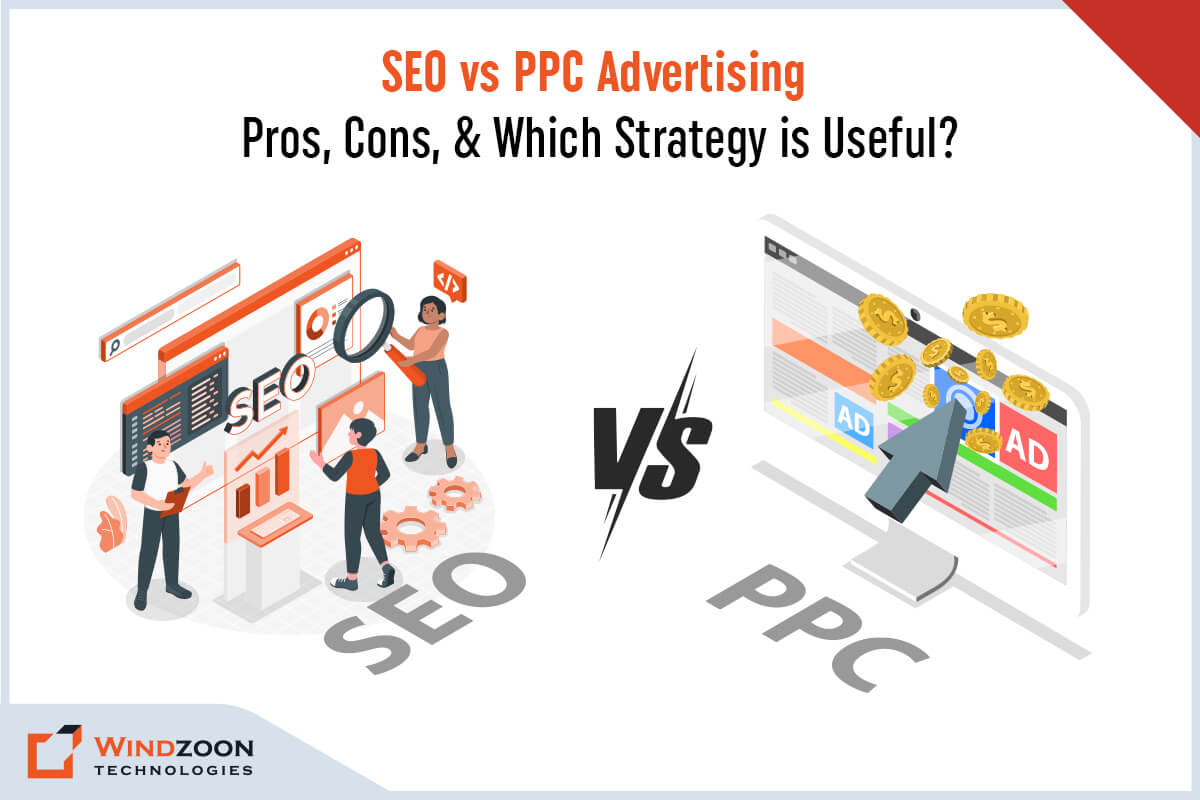
Google processes more than 5.6 billion searches daily, approximately 63,000 per second. How will you get your brand noticed in this sea of traffic? & raise Your website’s ranking above your competitors’.
- What is SEO?
- Types of SEO
- SEO Activities
- Advantages & Disadvantages of SEO
- When to Use SEO?
- What is PPC?
- Types of PPC Advertising
- Activities of PPC Advertising
- Advantages & Disadvantages of PPC
- When to Use PPC Advertising?
- 15 Significant Differences Between SEO and PPC Advertising
- Which Marketing Channel is Preferred for Your Business?
- How Do Both SEO and PPC Work for Your Business?
- Conclusion
Traffic is what keeps a website running & business thriving. Though, only a small number of your potential customers will pay you to use your products or services among the many users who visit your website.
That’s why having a large amount of traffic to your site is necessary for the success of your business. SEO is a cost-effective strategy for generating relevant traffic, helping you attract visitors who are more likely to become customers. And if you’re having difficulty driving traffic to your website, then you are not the only one. In this fiercely competitive industry, many business owners face similar challenges in attracting clients.
The reason is it’s challenging to strike a balance between various digital marketing strategies, their upkeep, and outcomes. However, there are two marketing strategies that are used to solve this problem: search engine optimization (SEO) or pay-per-click (PPC) campaigns. An SEO agency can help businesses optimize their organic search presence and integrate SEO with other marketing channels for better results. Or you can take help from the Best Digital Marketing Agency in the USA
What technique is best for you, though?
In response to the question above, this article discusses what you can expect from each marketing strategy. We’ve included some pros and cons of both SEO and PPC strategies. In addition, a detailed explanation to guide you in choosing which strategy is best for you.
Now, let’s learn more about SEO & PPC and how they are different from each other.
What is SEO?
Businesses require higher rankings on search engine result pages for their websites to remain visible to customers. Getting your website or content to the top of search engine results pages (SERPs) is critical. These top positions are known as organic listings, which are natural search results that appear based on relevance and effective SEO efforts. And businesses can reach this milestone only with the help of a Local SEO Service Provider Company
SEO (Search Engine Optimization) Services use natural methods to improve a website’s search engine rankings, and must continually adapt to evolving search engine algorithms to maintain or enhance visibility. It employs search engine rules and regulations to increase the number of website visitors.
As a result, it assists business organizations in expanding and increasing their consumer reach by growing their online network. A well executed seo strategy combines content optimization, earning quality backlinks, and adaptability to changing ranking factors for sustained success.
After learning about what SEO is, let’s go further to know its different types & activities.
Types of SEO
The six types of areas that fall under SEO are as follows:
- Keyword research entails determining what people are looking for.
- On-page SEO entails creating and optimizing SEO content that searchers want, including writing effective meta descriptions to improve search engine results snippets and page visibility.
- Off-page SEO entails gaining trust and authority from other websites.
- Technical SEO entails ensuring that search engines can find, crawl, and index your content.
- Competitive analysis entails gathering detailed information & doing an analysis of what our competitors are doing to promote their business.
- Content creation & curation entails creating unique & engaging content, doing its optimization, & marketing.
Now, let’s see which activities come under SEO
SEO Activities
Despite having six different areas, SEO mainly focuses on On-page & Off-page activities. These activities help to improve your business ranking on various search engines like Yahoo, Google, Bing, and other search engines. Following is the list of On-page SEO activities & Off-page SEO activities.
On-page Activities
1. Keywords research
2. Keyword planning
3. Creating Meta title & Meta description
4. Creating user-friendly content (ensure your content aligns with search intent to improve relevance and rankings)
5. Image optimization
6. Forming URL structures
7. Internal linking
8. Optimize Body Content
9. Enhancing page performance
Off-page Activities
1. Competitor Analysis
2. Commenting/Blog Commenting
3. Influencer Outreach
4. Guest Author/Posting
5. Link Building
6. Content Marketing
7. Newsletters
8. Forum and Ques Ans
9. Google Local Business Listing
After learning about SEO activities, let’s move further to know its Pros & Cons.
Advantages & Disadvantages of SEO
Advantages of SEO
1. Cost-Effective Approach
SEO is neither easy nor cheap. It is, however, less expensive than other digital marketing strategies.
2. Long-term effects of brand awareness
The effects of organic SEO are long-term. They may take some time to appear, but you can be certain that they will grow over time as the results begin to pour in.
3. It increases your brand credibility
In practice, most people trust websites that appear near the top of a Search engine results page(SERPs). Hence, SEO focuses on increasing your SEO rankings on SERPs to establish your brand credibility. A high ranking in organic search results can help you gain trust & reputation while increasing CTR.
4. Increase ROI
Seeing as SEO is free, the ROI is significantly higher when compared to other paid digital marketing strategies.
5. Higher CPC
Since organic SEO doesn’t charge for each click, it offers a lower cost per click.
Disadvantages of SEO
1. SEO is time-consuming
SEO is much slower than paid digital marketing mediums. It may take months after optimizing your site to see results, whereas paid mediums will generate leads immediately.
2. SEO is a continuous process
SEO is a continuous process. Your website will never be completely “optimized,” but it will continue to improve as you continue to work on it. The good news is that it will continue to improve your rankings in the future, and you will hopefully reap the benefits of your SEO investment.
3. SEO never compromises the quality of content
It demands unique and trustworthy content. If you want people to read, share, and link to your website. And for that, you must be perceived as an authority on the subject.
4. Intense competition
Numerous business owners like you desire better rankings. Plan better SEO techniques to rank higher than your competitors, and be prepared to confront the competition.
Now, we know the pros & cons of SEO, so let’s know when you should use SEO techniques.
When to Use SEO?
==> If you have long-term business objectives,
==> If you want to build the authority of your brand
==> If you have enough patience to wait for the unforeseen ROI with minimal investment,
==> If you want to create a high-quality CTR that is both affordable and long-lasting,
==> If you want your website to appear to the most relevant search users, focusing on relevant keywords that match user intent,
==> If you want to create content that reaches your audience at various stages of the sales funnel, it’s important to identify and optimize for target keywords,
==> After learning about SEO in detail, we can move on to PPC.
What is PPC?
Pay-per-click (PPC) is a type of search engine marketing (SEM) in which an advertiser pays a publisher (like Google Ads or Facebook) for each time a user clicks on the ad. These PPC ads appear in paid search results above organic listings on search engine results pages (SERPs).
This concept enables firms to pay only when customers interact with their advertisements, meaning advertisers pay each time their ad is clicked. It helps businesses to attract customers who are eager to take advantage of your offer.
Besides, PPC advertisements always coexist with organic search results. And the cost of PPC advertisement is typically determined by your industry and the search volume of the keyword you’re targeting.
You can use PPC Marketing Services to stay competitive in a crowded industry. It helps you reach your target audience even if your site lacks the domain authority for organic rankings.
Now that we know what SEO is let’s go further to know its different types & activities.
Types of PPC Advertising
Like SEO, there are also six areas that come under PPC advertising.
==> Search Ads
==> Shopping Ads
==> Display Ads
==> Video Ads
==> Social Media Ads
Social media ads can quickly boost brand visibility and promote time-sensitive offers, making them ideal for short-term campaigns and immediate results.
==> Mobile App Install Ads
After this, let’s see which activities come under PPC.
Activities of PPC Advertising
PPC advertising activities help businesses to remain competitive in a crowded market and gain quick access to their target audience. Here is the list of activities that come under PPC advertising.
==> Do a detailed study about the nature of business & its marketing requirements.
==> Keywords research to reach the maximum audience, focusing on selecting the right search keywords for effective targeting.
==> Landing page optimization.
==> Campaign creation (creating ad groups, making ads, adding extensions), with attention to strategic ad placement to maximize visibility.
==> Copywriting for advertisement.
==> Negative keyword research.
==> Campaign optimization & maintenance.
Now, let’s move further to learn the Pros & Cons of PPC.
Advantages & Disadvantages of PPC Advertising
Advantage of PPC
1. Increase your brand visibility
Search engines(Google) place paid ads above organic results, giving them more eyes.
2. Easy to target the right audience
With PPC, you can easily target customers by using the right keywords, brands, language, demographics, location, device, and more. By focusing on specific keywords, you enable precise audience segmentation in PPC campaigns, ensuring your ads reach the most relevant users.
3. It gives you complete control over your marketing strategy
Here, you’ll get to choose which keywords to include, as well as the CTA, pricing, and landing page.
4. It raises the visibility and recalls the value
Visual ads’ utilization helps businesses increase recall and CTR.
5. It generates quick and consistent results
When the PPC campaign is launched, you can expect to see almost immediate results in the form of clicks, traffic, and conversions.
Disadvantages of PPC
1. Continuous investment is required
Paid ads stop when you stop investing in them, as you might expect. And with that, the traffic, clicks, and conversions all come to a halt.
2. Many people feel skeptical about paid advertisements
Paid advertisements do not guarantee to give 100% results. Many people still feel uncertain about its results & effectiveness.
3. ROI may not be very encouraging
In PPC, you will have to spend more money to make more money. However, even after spending a significant amount of money, you might not get the return on investment you’re expected to get.
As we know about the pros & cons of PPC, so let’s get ahead to learn when you should use it.
When to Use PPC Advertising?
==> If your product is unique or one-of-a-kind
==> If you are willing to take the risk of making a significant investment
==> If you require immediate results for a specific time period (for example, by launching paid search campaigns or a PPC ad to quickly drive targeted traffic)
==> If you wish to run a short-term seasonal offer sale
==> If you intend to divert more leads to your business
==> If you want to target specific demographics and locations (using paid search ads for precise audience targeting)
Finally, we have reached the most significant part of our article:
15 Significant Differences Between SEO and PPC Advertising
[wpdatatable id=2 table_view=regular]
Learn more about the difference between SEO & SMO and how they affect your business.
Now, we know the difference between SEO and PPC, so let’s find out which marketing strategy benefits you the most. Integrating SEO with PPC can provide a holistic digital marketing approach, improving overall performance and decision-making.
Which Marketing Channel is Preferred for Your Business?
It is often asked which SEO strategy is better for your business growth: PPC or SEO. The best choice between SEO or PPC will depend on your goals, growth plans, and other marketing strategies. It is crucial to select the right strategy by understanding how SEO and PPC align with your business objectives and available resources.
Paid search is the best option if you want to get targeted traffic, clicks, and conversions immediately. If you want to achieve long-term goals like brand credibility, exposure, and scaling your business within a reasonable budget, then organic SEO should also be on your priority lists. Experts agree that you shouldn’t run these strategies in parallel. Instead, find a way to combine them to benefit your company.
How Do Both SEO and PPC Work for Your Business?
We would love to see both SEO and PPC in the same world. Both have their pros and cons, but they work best when used in conjunction. When SEO and PPC work together, you’ll often achieve results that surpass the sum of their parts.
There are many benefits to running SEO and PPC simultaneously:
- PPC data can be used to feed keywords and conversions into organic search (SEO), and ongoing SEO efforts can be informed by insights gained from PPC campaigns.
- Targeting clicks in paid & organic for high-performing keywords can increase traffic to your site, as PPC ads can complement organic search performance for maximum reach.
- Keywords that are high in cost, high volume, or low-converting (but still important) can be moved from PPC into organic search.
- You can feed your landing pages and organic listing with A/B testing of ad copy and landing page content.
- Remarketing lets you stay in front of visitors after an initial touch via search engines and tailor messaging to their engagement with your website.
- Before you commit to long-term SEO strategies, test your keyword strategy in PPC.
- All customer journey stages should be for targeted users, from comparison to purchase to research.
- Having strong organic and paid visibility can increase your confidence & brand awareness. Additionally, strong organic visibility reduces reliance on paid ads, making your marketing more cost-effective over time.
Read More: Important Reasons Why Business Need a Digital Marketing Strategy
Conclusion
The decision between SEO and PPC ultimately comes down to your business situation. Therefore, take your time and evaluate both SEO and PPC to determine which one is best for you. And to get even better results for your company, you can even combine the strategies.
If you lack time or resources to optimize your SEO and PPC strategies, you can seek help from a professional digital marketing company. At Windzoon, we have experienced & skilled SEO and PPC experts that can proficiently handle your company’s digital marketing activities.
Besides, we also provide SEO, SMO, & PPC Marketing Services. If you want to avail of our digital marketing services & want to know more about us, then visit wzadmin.windzoon.in/ and get a quote.